- Details
- Category: Maxim
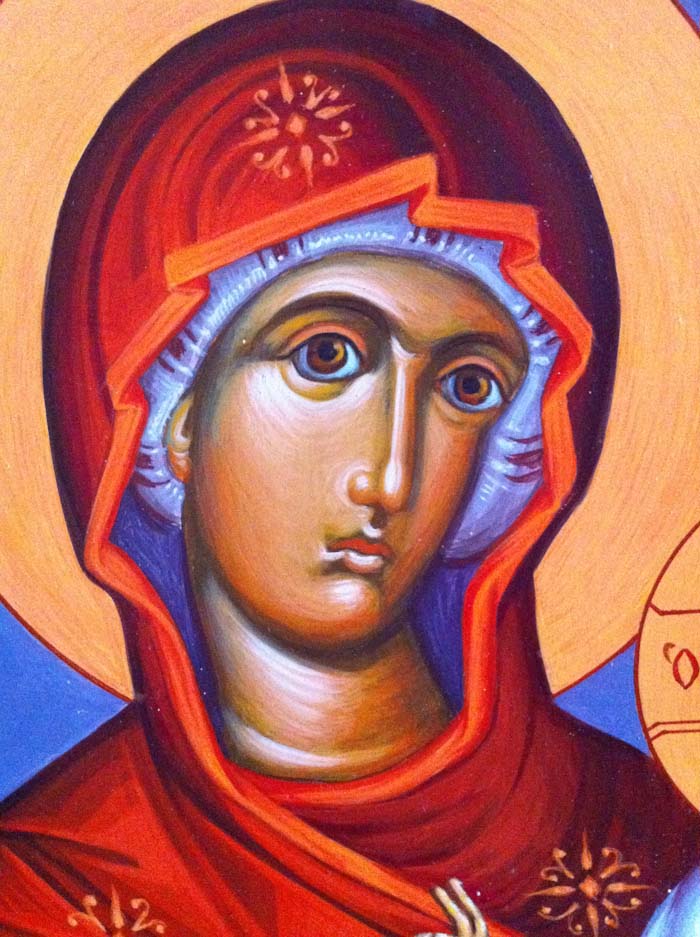
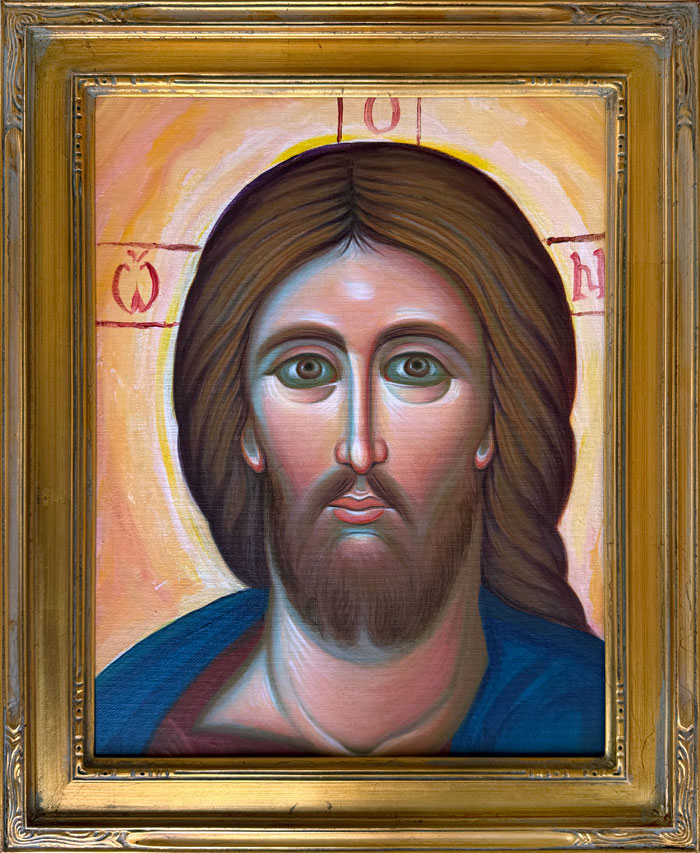
"Christ the Savior", acrylic on canvas panel, 11x14 inches, Radmila Vasiljević and Bishop Maxim, 2026
This icon depicts Christ Pantocrator, the eternal Lord whose calm and penetrating gaze meets the viewer in a spirit of compassion and peace. Painted in a restrained palette of warm earth tones, soft blues, and luminous flesh colors, the image draws upon the Byzantine tradition while expressing a gentle contemporary sensitivity. The subtle modeling of the face and the quiet radiance of the halo emphasize Christ’s dual identity as both fully human and fully divine. Through its simplicity and intimacy, the icon invites prayerful encounter with the One who is “the same yesterday, today, and forever.” (Heb. 13:8)
This icon depicts Christ Pantocrator, the eternal Lord whose calm and penetrating gaze meets the viewer in a spirit of compassion and peace. Painted in a restrained palette of warm earth tones, soft blues, and luminous flesh colors, the image draws upon the Byzantine tradition while expressing a gentle contemporary sensitivity. The subtle modeling of the face and the quiet radiance of the halo emphasize Christ’s dual identity as both fully human and fully divine. Through its simplicity and intimacy, the icon invites prayerful encounter with the One who is “the same yesterday, today, and forever.” (Heb. 13:8)
- Details
- Category: Maxim
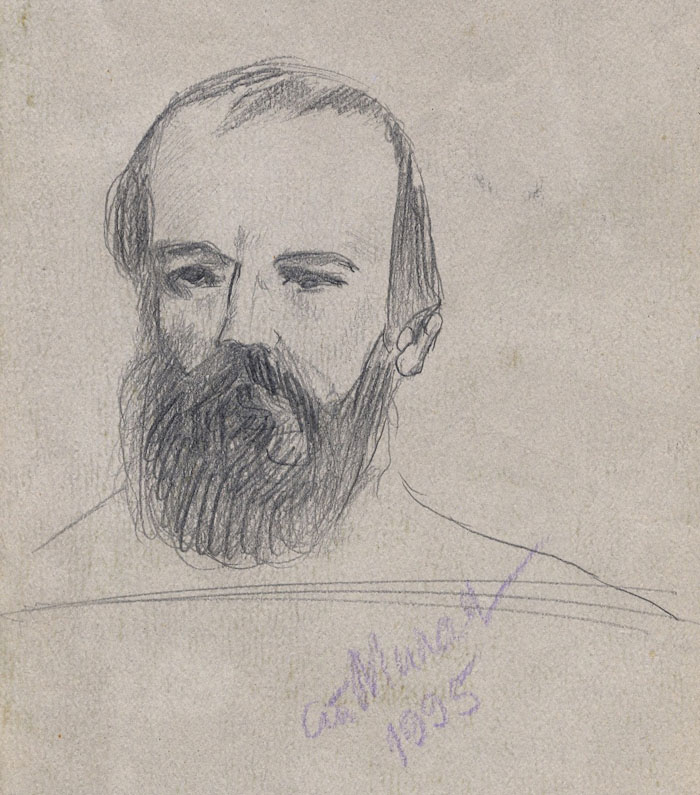
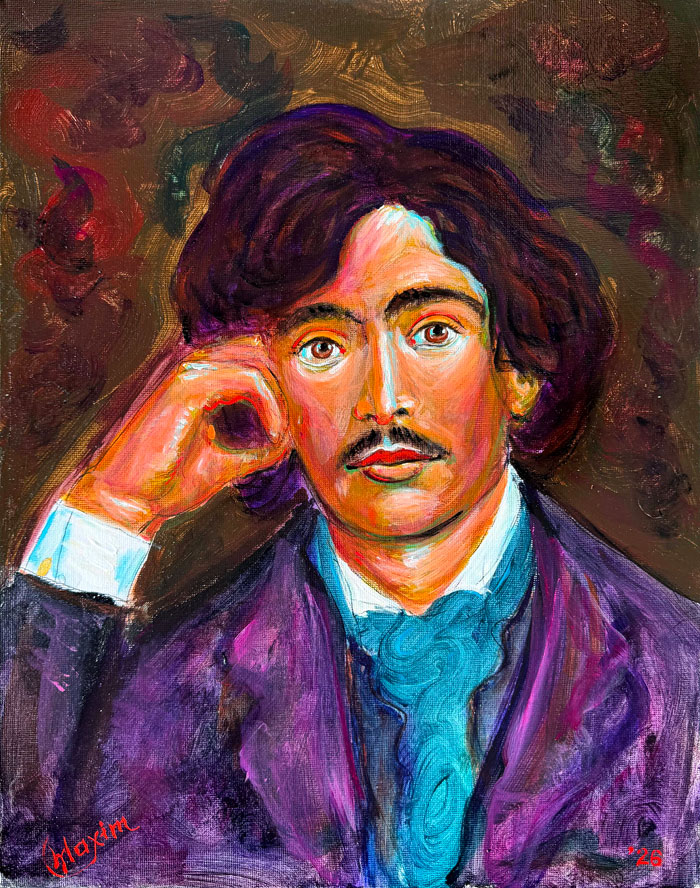
"Khalil Gibran", acrylic on canvas, 11x14 inches, Bishop Maxim, 2026
Depicted in a moment of contemplation, Khalil Gibran emerges from a luminous field of warm and cool tones that reflect the spiritual and poetic dimensions of his work. Expressive brushwork and subtle shifts of color seek to capture not only the likeness of the writer, but also the inward vision that inspired The Prophet and his other writings. The portrait presents Gibran as a figure poised between memory, imagination, and revelation.
Depicted in a moment of contemplation, Khalil Gibran emerges from a luminous field of warm and cool tones that reflect the spiritual and poetic dimensions of his work. Expressive brushwork and subtle shifts of color seek to capture not only the likeness of the writer, but also the inward vision that inspired The Prophet and his other writings. The portrait presents Gibran as a figure poised between memory, imagination, and revelation.
- Details
- Category: Maxim
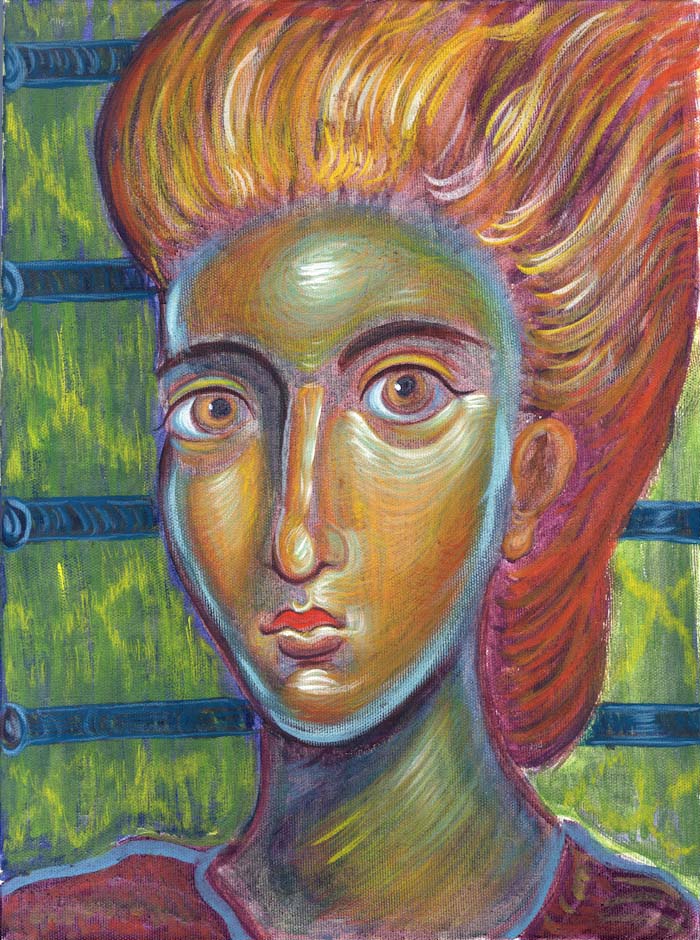
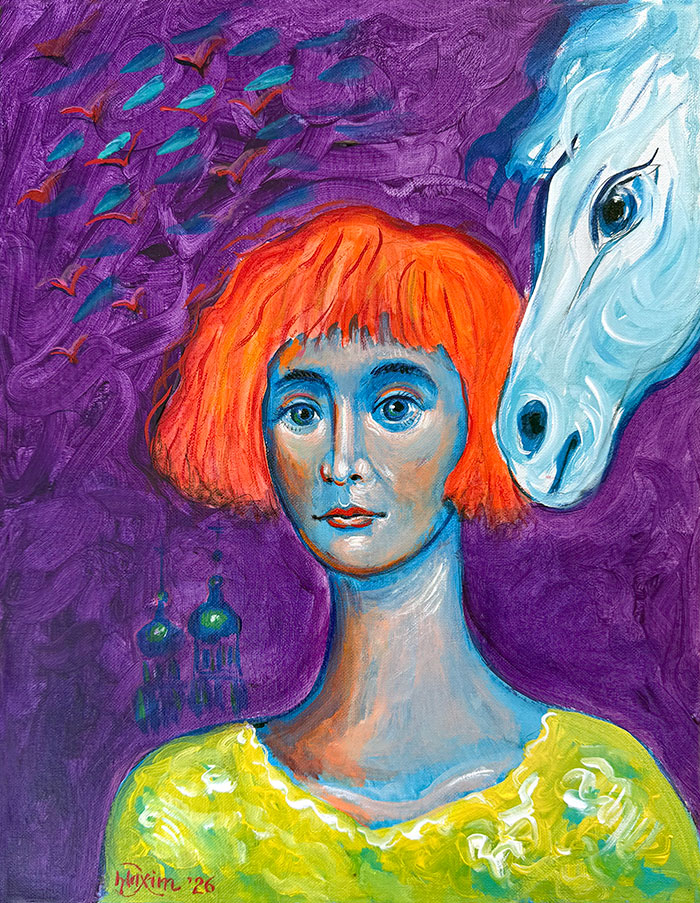
"Tsvetaeva: Not Exile, Not Home", acrylic on canvas, 14x18 inches, Bishop Maxim, 2026
Not a portrait, exactly. More an attempt to get close to whatever it was that made her poems possible — that inner country she carried around and couldn't put down. She appears in blue, against violet. The white horse is there beside her, as horses tend to be in the Russian imagination: freedom, fate, something between the two. Her hair is orange — almost aggressively so. It seemed right. Birds cross the sky above her, the way thoughts cross when you're somewhere you didn't choose to be. Faint church domes in the distance. Not Russia as a place, but Russia as something you remember against your will. She looks out. Not at you, not away from you — somewhere in between. That seems right too. The tragedies are not the subject. They never were, with her. What lasted was the force underneath them.
Not a portrait, exactly. More an attempt to get close to whatever it was that made her poems possible — that inner country she carried around and couldn't put down. She appears in blue, against violet. The white horse is there beside her, as horses tend to be in the Russian imagination: freedom, fate, something between the two. Her hair is orange — almost aggressively so. It seemed right. Birds cross the sky above her, the way thoughts cross when you're somewhere you didn't choose to be. Faint church domes in the distance. Not Russia as a place, but Russia as something you remember against your will. She looks out. Not at you, not away from you — somewhere in between. That seems right too. The tragedies are not the subject. They never were, with her. What lasted was the force underneath them.
- Details
- Category: Maxim
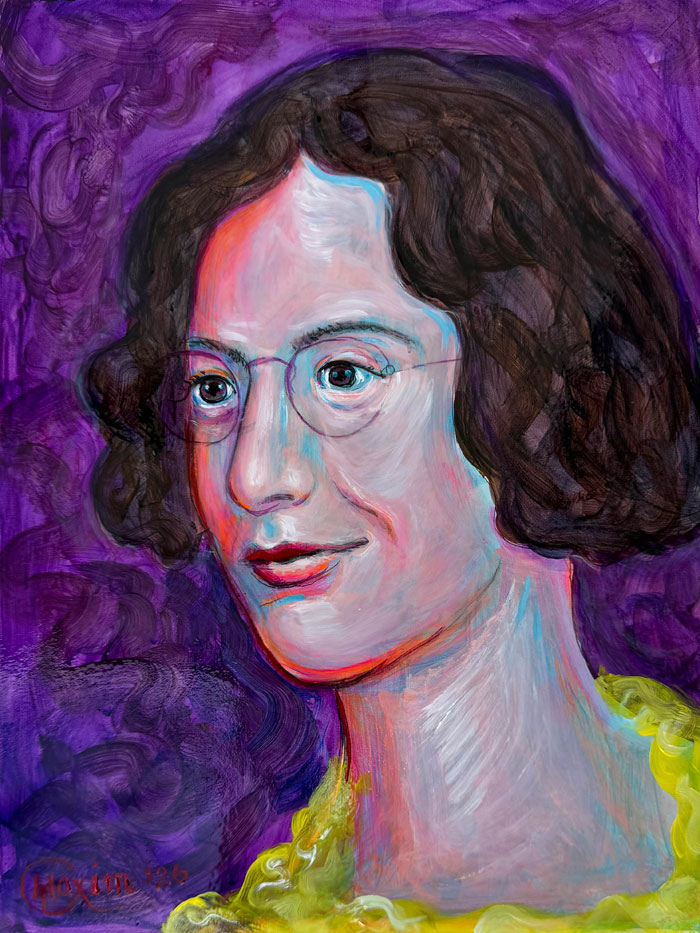
"Simone Weil", acrylic on canvas, Bishop Maxim, 2026
A contemplative portrait of Simone Weil, rendered through luminous flesh tones and a deep violet ground. Her gaze holds together clarity and fragility—lucidity and vulnerability—revealing the intensity of a thinker whose life was marked by radical attention, compassion, and spiritual longing. More than likeness, the painting seeks to evoke Weil’s inner presence: exposed, searching, and illuminated by truth.
A contemplative portrait of Simone Weil, rendered through luminous flesh tones and a deep violet ground. Her gaze holds together clarity and fragility—lucidity and vulnerability—revealing the intensity of a thinker whose life was marked by radical attention, compassion, and spiritual longing. More than likeness, the painting seeks to evoke Weil’s inner presence: exposed, searching, and illuminated by truth.
- Details
- Category: Maxim
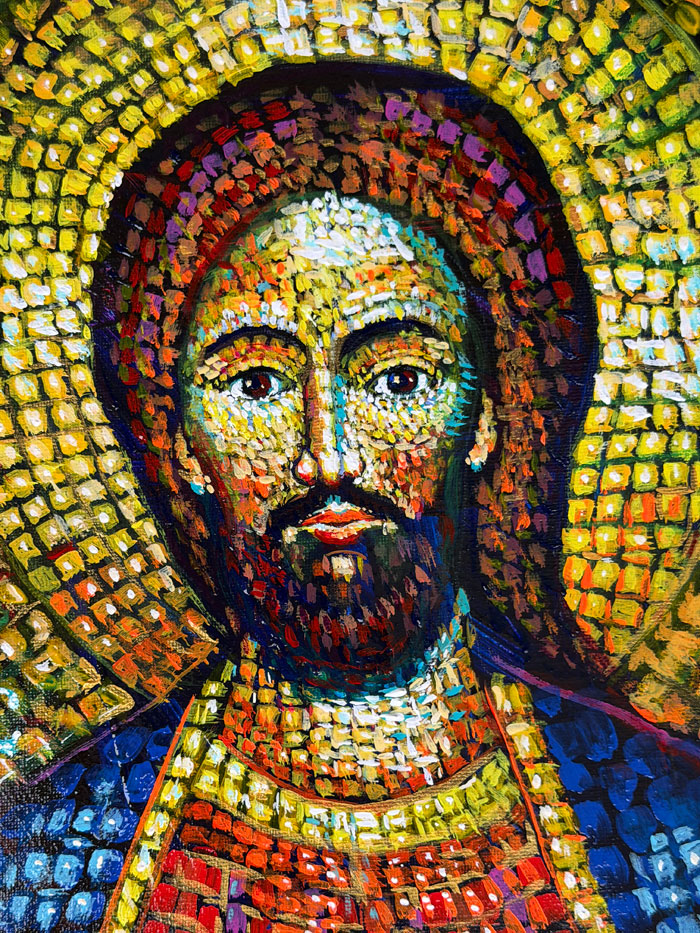
"Christ Pantocrator: The Gathering of Light", detail, acrylic on canvas, 12 x 16 in, Bishop Maxim, 2026
- Details
- Category: Maxim
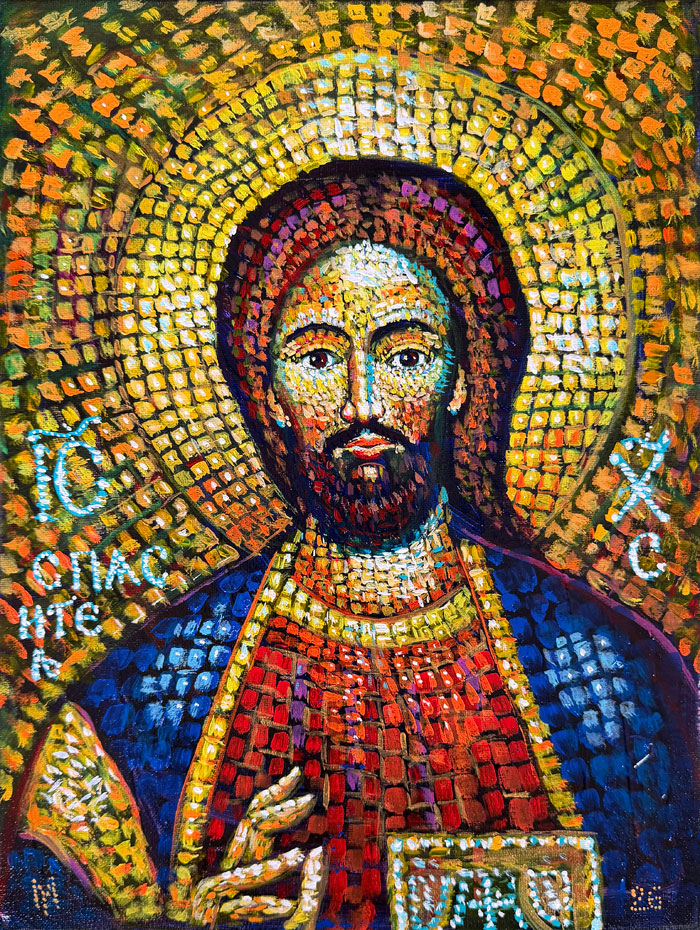
"Christ Pantocrator: The Gathering of Light", acrylic on canvas, 12 x 16 in, Bishop Maxim, 2026
A contemporary rendering of the Pantocrator, this painting reimagines the Byzantine icon through thousands of vibrant, tessera-like brushstrokes — acrylic on canvas standing in for gold and glass. The face of Christ emerges from a radiant golden halo with quiet, frontal authority: dark eyes level and still, beard rendered in deep indigo and umber, the asymmetry of the features preserving the solemn humanity of the iconographic tradition. Around him, the background pulses with a mosaic of amber, ochre, olive, and orange — warm light made tactile and insistent.
Below the halo, the vestments shift dramatically into deep cobalt and crimson, their richly decorated omophorion built from stacked strokes of red, gold, and violet. The raised right hand offers a gesture of blessing, while the left holds a gilded Gospel book. Flanking the figure, the traditional Christological inscriptions — ІС ХС and СПАСИТЕЉ (Savior) — are rendered in light blue, anchoring the image in its Orthodox lineage.
What makes the work alive is its refusal to be still. Every surface vibrates. Yet across all that fragmentation, the gaze holds — steady, undemanding, total. The painting does not represent Christ so much as gather toward him: multiplicity finding its center, color finding its icon.
A contemporary rendering of the Pantocrator, this painting reimagines the Byzantine icon through thousands of vibrant, tessera-like brushstrokes — acrylic on canvas standing in for gold and glass. The face of Christ emerges from a radiant golden halo with quiet, frontal authority: dark eyes level and still, beard rendered in deep indigo and umber, the asymmetry of the features preserving the solemn humanity of the iconographic tradition. Around him, the background pulses with a mosaic of amber, ochre, olive, and orange — warm light made tactile and insistent.
Below the halo, the vestments shift dramatically into deep cobalt and crimson, their richly decorated omophorion built from stacked strokes of red, gold, and violet. The raised right hand offers a gesture of blessing, while the left holds a gilded Gospel book. Flanking the figure, the traditional Christological inscriptions — ІС ХС and СПАСИТЕЉ (Savior) — are rendered in light blue, anchoring the image in its Orthodox lineage.
What makes the work alive is its refusal to be still. Every surface vibrates. Yet across all that fragmentation, the gaze holds — steady, undemanding, total. The painting does not represent Christ so much as gather toward him: multiplicity finding its center, color finding its icon.
- Details
- Category: Maxim
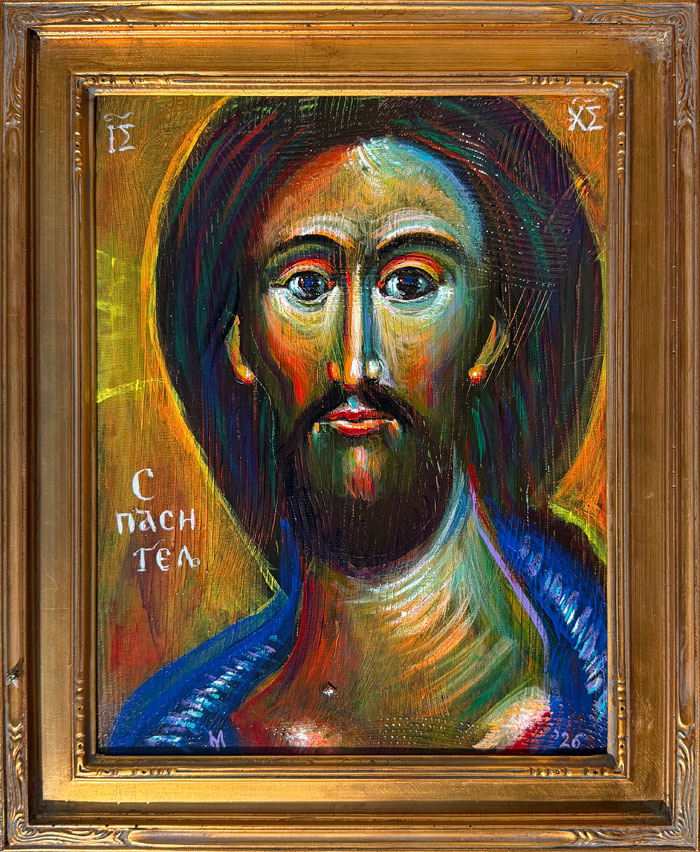
"Christ the Savior: after Andrei Rublev", acrylic on on canvas panel, 11 x 14 in, Bishop Maxim, 2026
Inspired by the quiet spiritual depth of Andrei Rublev, this contemporary icon of Christ Pantocrator combines Byzantine stillness with expressive modern color. The frontal gaze, golden halo, and cyrillic inscription recall the ancient icon tradition, while the vibrant brushwork suggests an inner, transfiguring light. Christ appears not distant, but present - gentle, watchful, and alive before the viewer.
Inspired by the quiet spiritual depth of Andrei Rublev, this contemporary icon of Christ Pantocrator combines Byzantine stillness with expressive modern color. The frontal gaze, golden halo, and cyrillic inscription recall the ancient icon tradition, while the vibrant brushwork suggests an inner, transfiguring light. Christ appears not distant, but present - gentle, watchful, and alive before the viewer.
- Details
- Category: Maxim
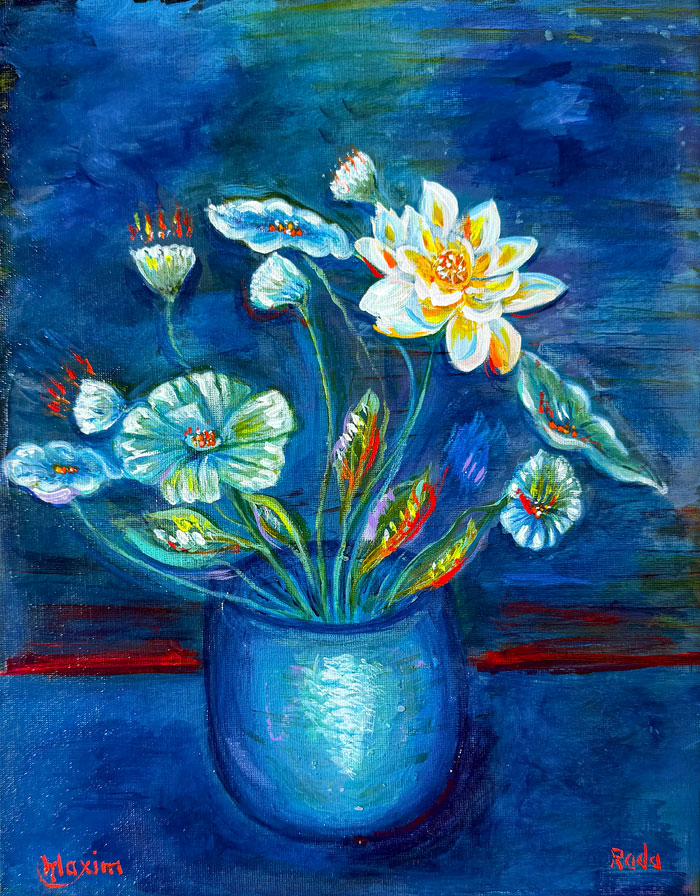
"Vigil of Light in Blue Silence", acrylic on canvas panel, 11 x 14 in, Bishop Maxim and Radmila Vasiljevic, 2026
Against a deep blue field, a humble vessel holds luminous blossoms that rise like quiet flames. The central white flower glows with warmth, while delicate buds echo a sense of gentle movement and watchfulness. A subtle red horizon line adds tension, as if marking the threshold between stillness and awakening. The painting becomes a meditation on inner light, fragile yet enduring.
Against a deep blue field, a humble vessel holds luminous blossoms that rise like quiet flames. The central white flower glows with warmth, while delicate buds echo a sense of gentle movement and watchfulness. A subtle red horizon line adds tension, as if marking the threshold between stillness and awakening. The painting becomes a meditation on inner light, fragile yet enduring.
- Details
- Category: Maxim
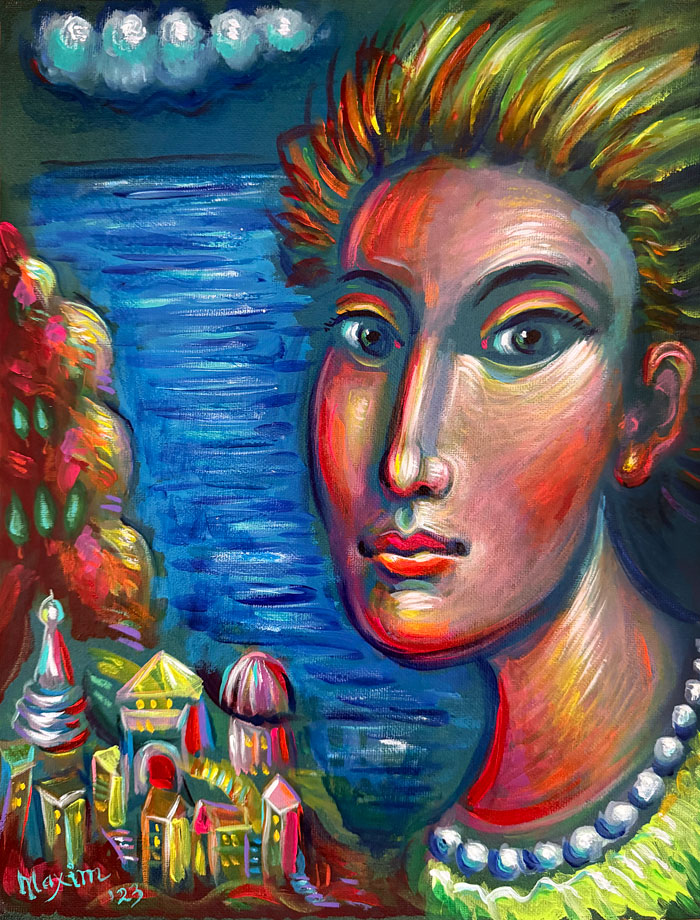
"Clarice Lispector: The Inner Sea", acrylic on canvas panel, 12 x 16 inches, Bishop Maxim, 2023-2026
A raw, glowing portrait of Clarice Lispector that feels like it’s halfway between her face and the inside of her head. Her eyes are huge and restless, pulling you in the way her writing does. The colors on her face keep shifting, breaking apart and sliding back together—like identity refusing to sit still. Behind her, the sea isn’t really a sea. It’s this vast, quiet field of consciousness, calm but endless. Down below, the little cluster of buildings feels half-remembered, like a fragile dream of home, exile, and everything she carried from one continent to another. It’s not just a portrait. It’s a meditation that hums with the same mystery she always wrote about: the visible world trembling right on the edge of the unseen.
A raw, glowing portrait of Clarice Lispector that feels like it’s halfway between her face and the inside of her head. Her eyes are huge and restless, pulling you in the way her writing does. The colors on her face keep shifting, breaking apart and sliding back together—like identity refusing to sit still. Behind her, the sea isn’t really a sea. It’s this vast, quiet field of consciousness, calm but endless. Down below, the little cluster of buildings feels half-remembered, like a fragile dream of home, exile, and everything she carried from one continent to another. It’s not just a portrait. It’s a meditation that hums with the same mystery she always wrote about: the visible world trembling right on the edge of the unseen.
- Details
- Category: Maxim
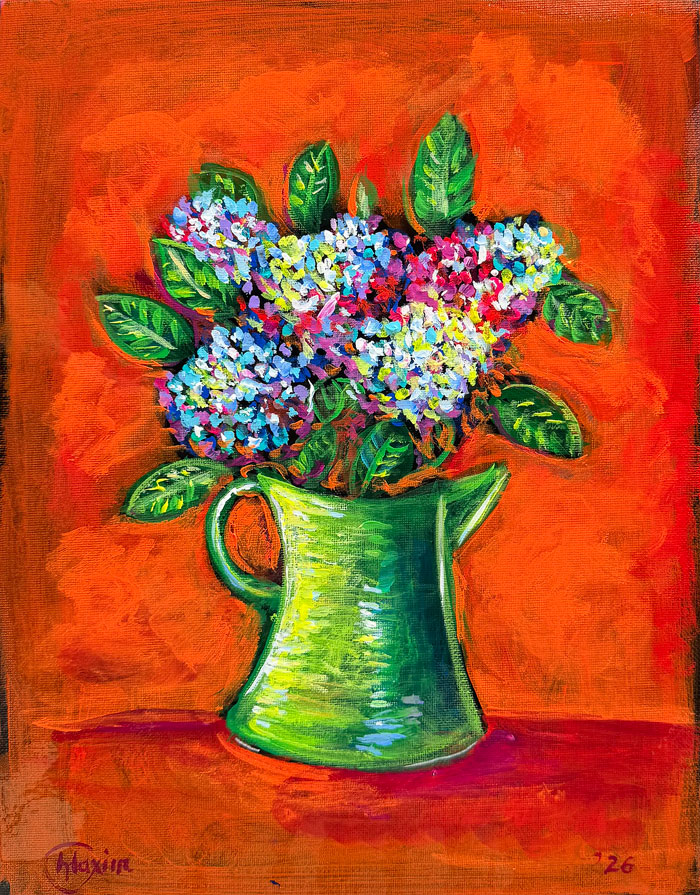
"Vessel of Summer Breath", acrylic on canvas panel, 11 x 14 inches, Bishop Maxim, 2026
A luminous green vase holds a vibrant cluster of hortensia, their blossoms flickering in blues, pinks, and whites. Set against a radiant orange ground, the composition pulses with warmth and contrast, where cool petals and living light meet in a quiet celebration of color and presence.
- Stamatis Skliris
A luminous green vase holds a vibrant cluster of hortensia, their blossoms flickering in blues, pinks, and whites. Set against a radiant orange ground, the composition pulses with warmth and contrast, where cool petals and living light meet in a quiet celebration of color and presence.
- Stamatis Skliris
- Details
- Category: Maxim
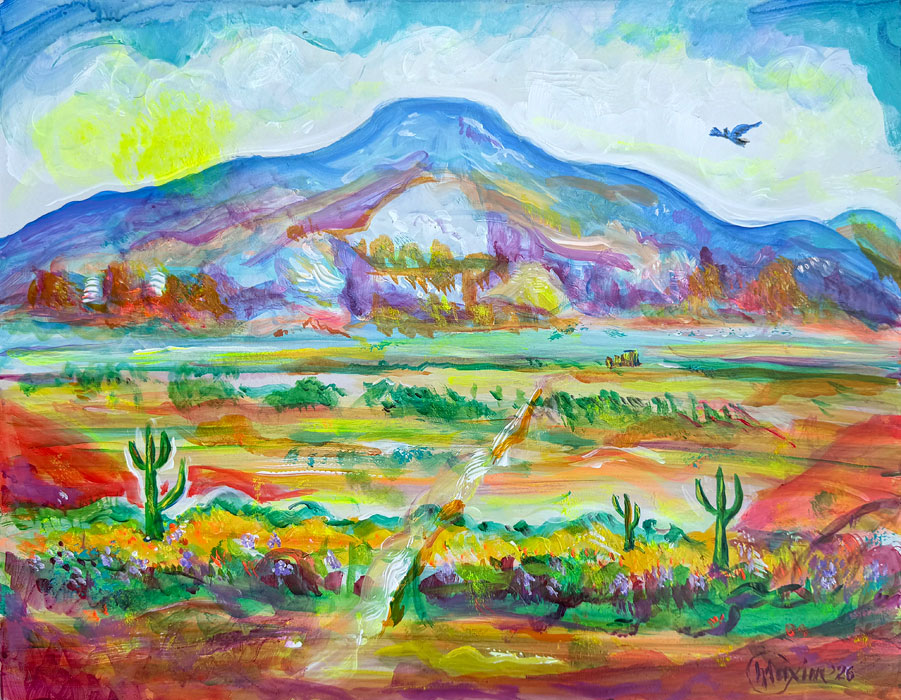
"Desert of Promise", acrylic on board, 14x18 inches, Bishop Maxim, 2026
In this luminous rendering of the Arizona desert, the artist departs from strict naturalism to reveal a landscape poised between promise and fulfillment. The familiar elements, such as cacti, distant plains, and a solitary mountain, are softened by a veil of translucent color, where earth tones dissolve into gentle blues, violets, and golds. The desert is both observed and contemplated. Light becomes the governing presence. It does not fall upon the land but seems to arise from within it, suggesting a creation quietly transfigured. The horizon opens rather than closes, inviting the viewer into a space where time is suspended between what is and what is promised. The composition carries a theological undertone: the desert, often seen as barren, is here revealed as fertile in meaning, bearing within itself the seeds of renewal. Through delicate brushwork and a restrained yet radiant palette, the artist proposes a vision of nature that is not abandoned, but gently and irrevocably held within divine providence.
In this luminous rendering of the Arizona desert, the artist departs from strict naturalism to reveal a landscape poised between promise and fulfillment. The familiar elements, such as cacti, distant plains, and a solitary mountain, are softened by a veil of translucent color, where earth tones dissolve into gentle blues, violets, and golds. The desert is both observed and contemplated. Light becomes the governing presence. It does not fall upon the land but seems to arise from within it, suggesting a creation quietly transfigured. The horizon opens rather than closes, inviting the viewer into a space where time is suspended between what is and what is promised. The composition carries a theological undertone: the desert, often seen as barren, is here revealed as fertile in meaning, bearing within itself the seeds of renewal. Through delicate brushwork and a restrained yet radiant palette, the artist proposes a vision of nature that is not abandoned, but gently and irrevocably held within divine providence.
- Details
- Category: Maxim
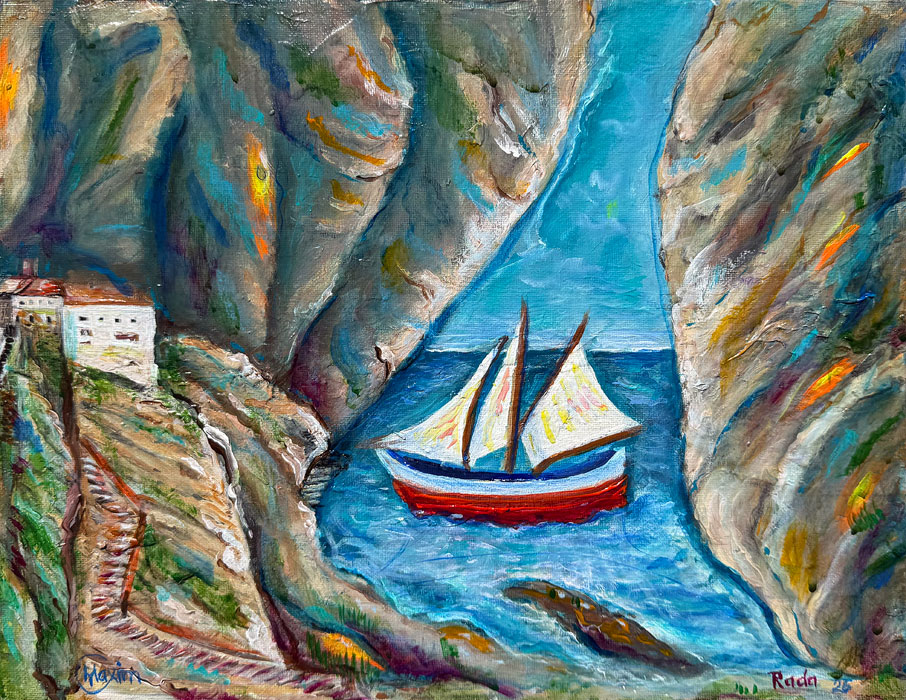
"Passage Between the Living Cliffs", acrylic on canvas board, Bishop Maxim and Radmila Vasiljevic, 2026
A vividly colored coastal passage frames a small sailboat as it moves through narrow waters between towering rock formations. Expressive brushstrokes and luminous accents animate the cliffs, while a modest dwelling and winding path anchor the human presence. The composition evokes a quiet journey—both physical and inward—guided through tension toward openness and light.
A vividly colored coastal passage frames a small sailboat as it moves through narrow waters between towering rock formations. Expressive brushstrokes and luminous accents animate the cliffs, while a modest dwelling and winding path anchor the human presence. The composition evokes a quiet journey—both physical and inward—guided through tension toward openness and light.
- Details
- Category: Maxim
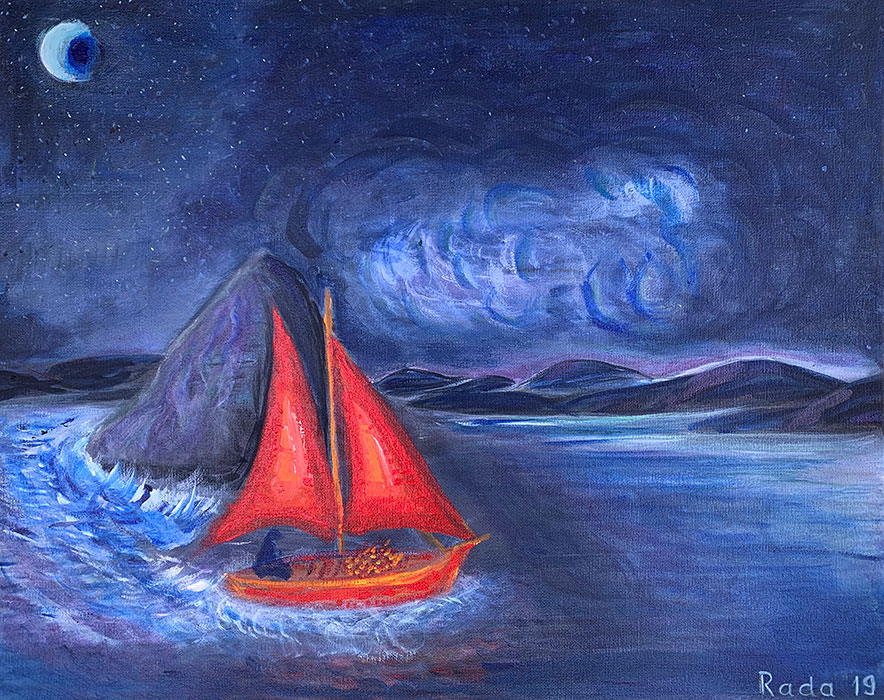
"Sailing Through the Night of Breath", acrylic on canvas, Radmila Vasiljevic, 2019
A small wooden boat with radiant red sails cuts through dark, moonlit waters, its wake shimmering in tones of blue and silver. Behind it rises a shadowed island, while above, a vast, swirling cloud seems to exhale wind into the sails, as if the night itself were guiding the journey. The glowing warmth of the vessel contrasts with the cool expanse of sea and sky, evoking solitude, movement, and a quiet trust in unseen forces. Painted in 2019, the work carries a dreamlike stillness—both intimate and cosmic.
A small wooden boat with radiant red sails cuts through dark, moonlit waters, its wake shimmering in tones of blue and silver. Behind it rises a shadowed island, while above, a vast, swirling cloud seems to exhale wind into the sails, as if the night itself were guiding the journey. The glowing warmth of the vessel contrasts with the cool expanse of sea and sky, evoking solitude, movement, and a quiet trust in unseen forces. Painted in 2019, the work carries a dreamlike stillness—both intimate and cosmic.
- Details
- Category: Maxim
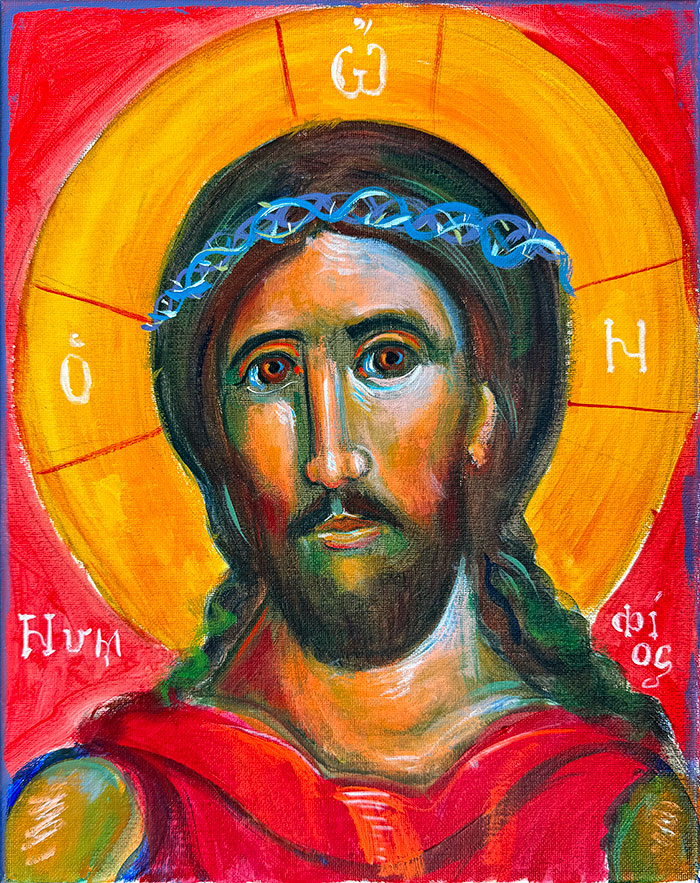
"Behold the Bridegroom of Humility", acrylic on canvas, Bishop Maxim, 2026
Here is a Christ who does not impose, but joyfully descends, appearing in an unexpected manner, eagerly yet patiently waiting to clothe us in the glorious garment of His purity. He enters into humanity’s darkness, not with power and authority here, but in utmost humility, softly singing a hymn of Light. Radiant, resolute eyes offer a steadfast hope in the midst of mourning as He prepares the heavenly wedding feast. Behold, the Bridegroom. - Gabriella Matthews
Here is a Christ who does not impose, but joyfully descends, appearing in an unexpected manner, eagerly yet patiently waiting to clothe us in the glorious garment of His purity. He enters into humanity’s darkness, not with power and authority here, but in utmost humility, softly singing a hymn of Light. Radiant, resolute eyes offer a steadfast hope in the midst of mourning as He prepares the heavenly wedding feast. Behold, the Bridegroom. - Gabriella Matthews
- Details
- Category: Maxim
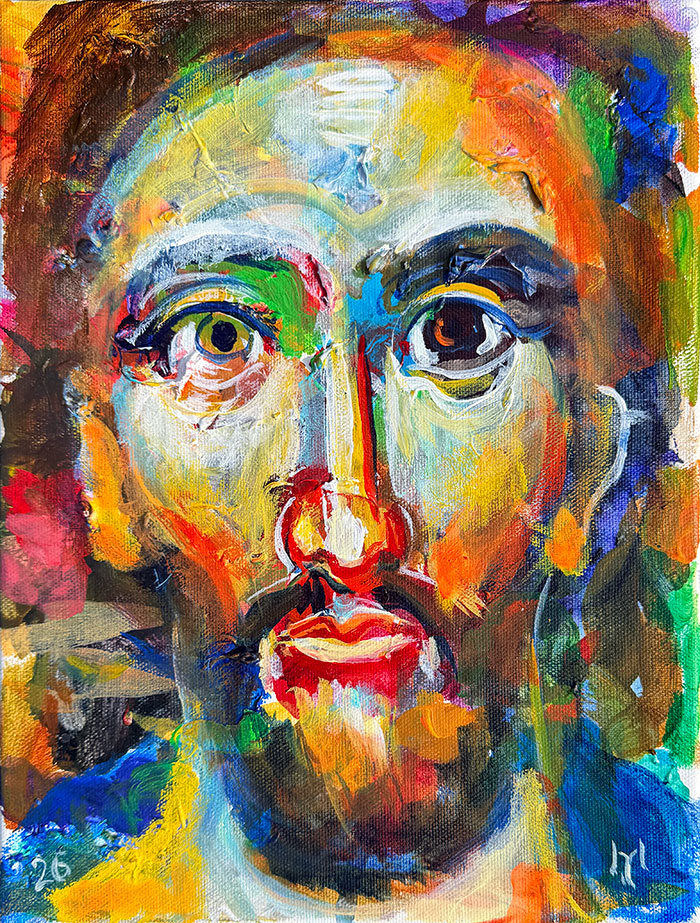
"A Face from the Wounded Ground", acrylic on canvas, Bishop Maxim, 2026
From a surface already used and layered with earlier gestures, a face slowly emerges without plan or correction. The marks, scratches, and ruptures of the ground read as human wounds—those gathered through grief, fatigue, and lived experience across many paths of life.
Nothing is smoothed away. Light passes through the fractures. The eyes remain open and attentive, neither commanding nor retreating.
It is a face that could be Christ—appearing not from perfection, but from what is worn, spent, and quietly waiting to be seen.
From a surface already used and layered with earlier gestures, a face slowly emerges without plan or correction. The marks, scratches, and ruptures of the ground read as human wounds—those gathered through grief, fatigue, and lived experience across many paths of life.
Nothing is smoothed away. Light passes through the fractures. The eyes remain open and attentive, neither commanding nor retreating.
It is a face that could be Christ—appearing not from perfection, but from what is worn, spent, and quietly waiting to be seen.
- Details
- Category: Maxim
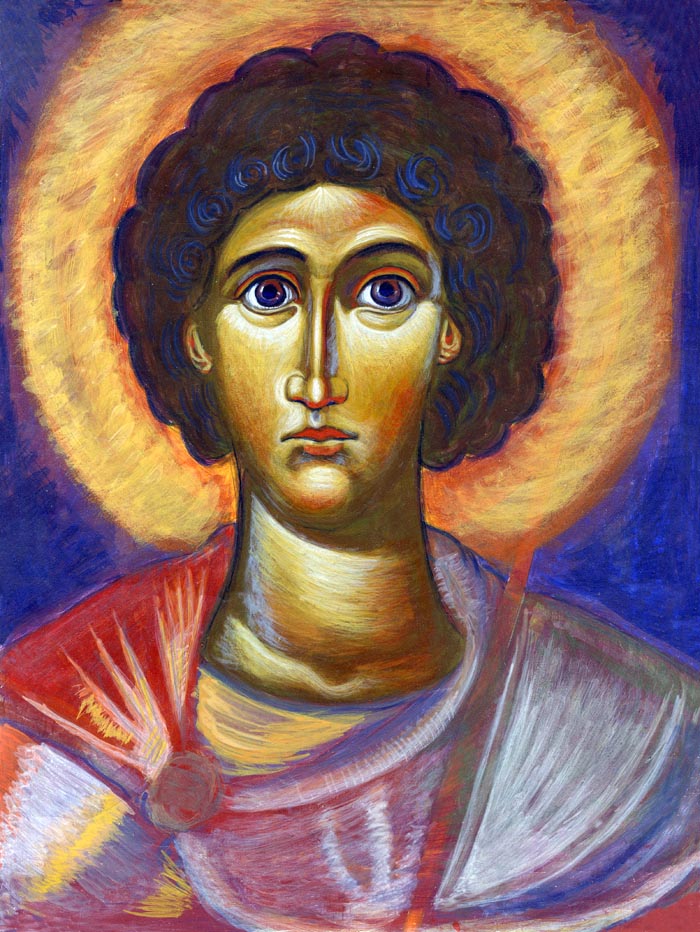
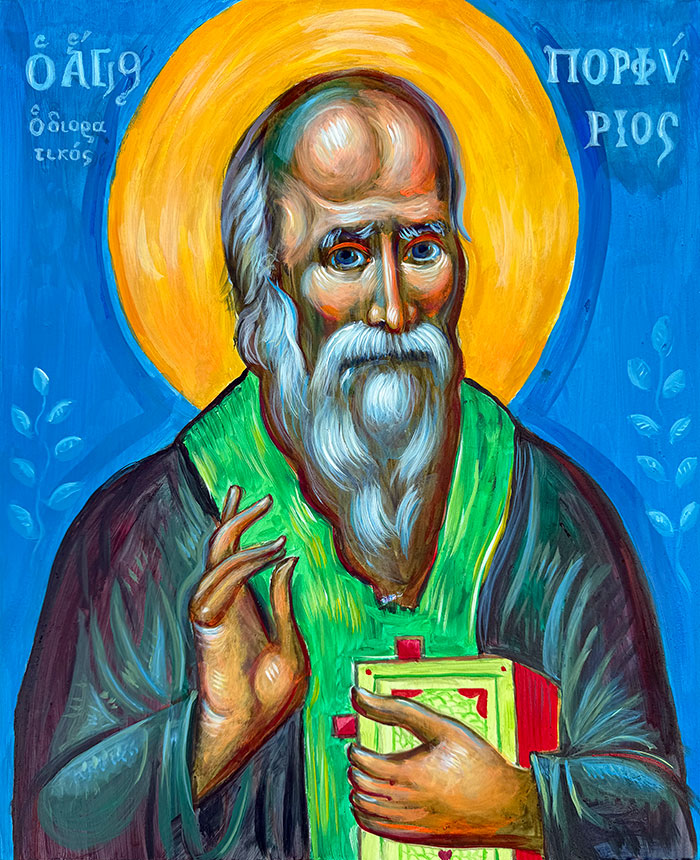
"St Porphyrios the New", acrylic on canvas, Fr. Marko Bojovic, 2026
This painting is a fruit of the iconography classes that Father Marko attended in Jackson at the diocesan workshop. It depicts Saint Porphyrios the New, whose calm and joyful gaze greets us—embracing us, welcoming us, and gently inviting us to repentance.
This painting is a fruit of the iconography classes that Father Marko attended in Jackson at the diocesan workshop. It depicts Saint Porphyrios the New, whose calm and joyful gaze greets us—embracing us, welcoming us, and gently inviting us to repentance.
- Details
- Category: Maxim
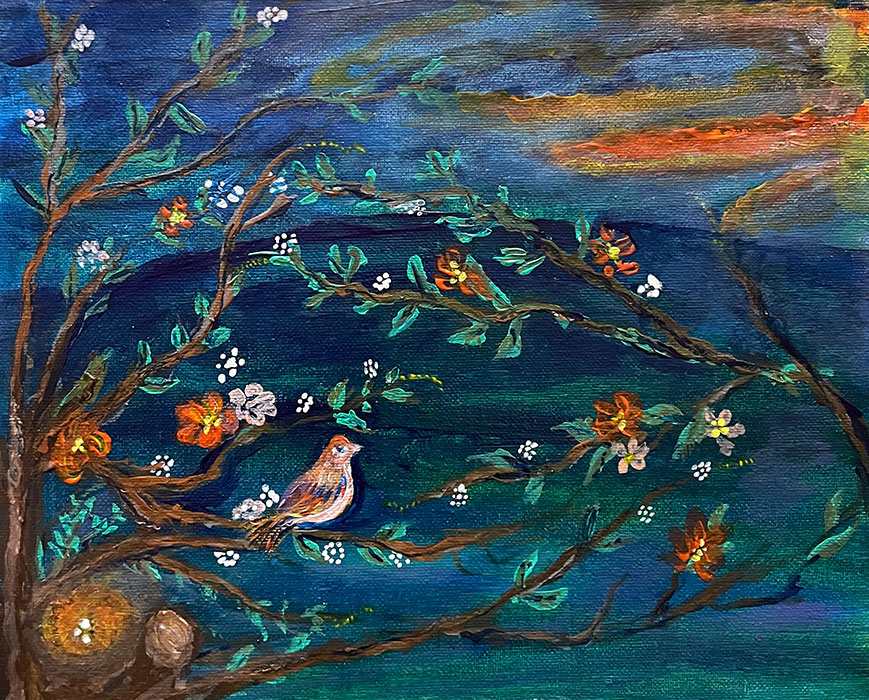
"Chirping at Dawn", acrylic on canvas board, Radmila Vasiljevic, 2026
Chirping at Dawn has a quiet courage. It isn’t the song that ends the day, but the one that begins it. The light feels like a promise - cool blues easing into green, with a touch of warmth as morning arrives. The bird is not looking back; it is simply there, present, trusting. The nest reads as a beginning, the branches as something waking up. There’s an old, steady faith in it: that day will come again, and that even a small sound belongs in it.
Chirping at Dawn has a quiet courage. It isn’t the song that ends the day, but the one that begins it. The light feels like a promise - cool blues easing into green, with a touch of warmth as morning arrives. The bird is not looking back; it is simply there, present, trusting. The nest reads as a beginning, the branches as something waking up. There’s an old, steady faith in it: that day will come again, and that even a small sound belongs in it.
- Details
- Category: Maxim
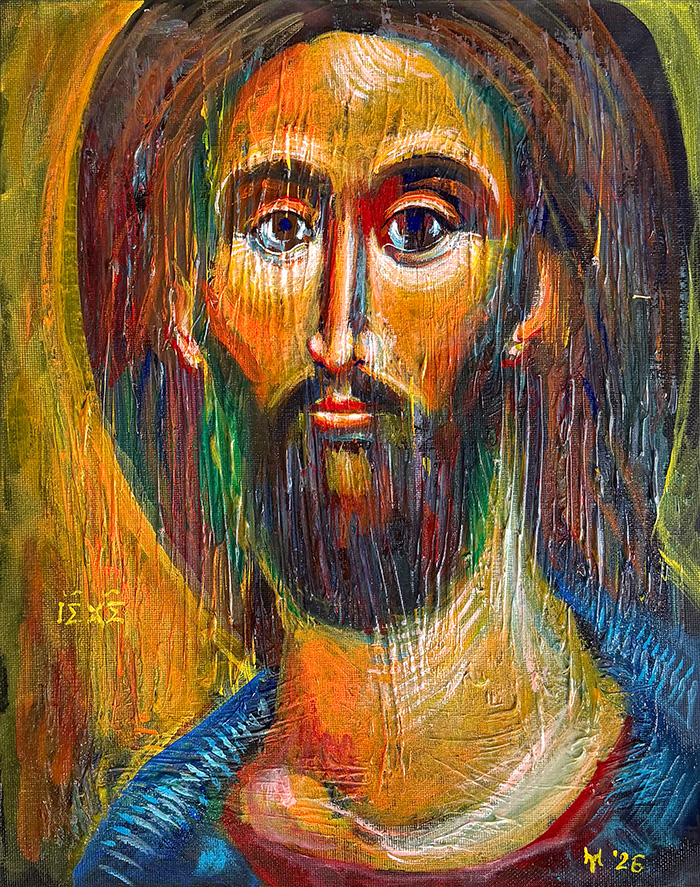
"Christ the Savior (Spas)", acrylic on canvas board, Bishop Maxim, 2026
A luminous, textured portrait evoking Andrei Rublev’s serenity, where bold strokes infuse timeless divinity with modern warmth and depth.
A luminous, textured portrait evoking Andrei Rublev’s serenity, where bold strokes infuse timeless divinity with modern warmth and depth.
- Details
- Category: Maxim
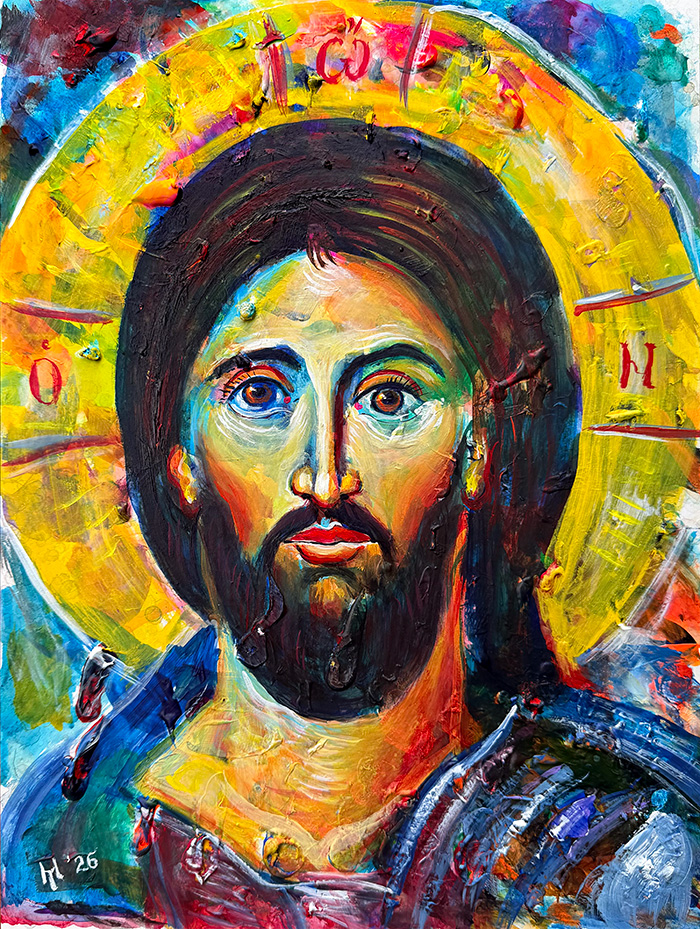
"Behold, I Am With You", acrylic on gesso board, Bishop Maxim, 2026
This is my first painting of 2026. Upon a surface that had already lived many lives—layers of color, crossings of chance and intention—Christ emerges in a Byzantine voice. He is not placed there by force; He arrives. He appears suddenly, almost quietly, as one recognizes a familiar face in a crowded street. This Christ greets the year before us. He stands within an age bruised by human suffering, scarred by cruelty, and unhealed memory. The wounds of the world are not concealed beneath fresh pigment; they remain, bearing witness. Yet from within that wounded ground, His presence rises— as an invitation and not as accusation. Here, Christ does not dominate history; He interrupts despair. He comes as hope that does not shout, as comfort that does not erase pain, as a promise that refuses to be extinguished. In the old Byzantine manner—timeless, frontal, unwavering—He looks at us and waits. This is a greeting for 2026: not naïve, not triumphant, but faithful. A reminder that even now, especially now, hope can still appear—unexpectedly, gently, and for everyone.
This is my first painting of 2026. Upon a surface that had already lived many lives—layers of color, crossings of chance and intention—Christ emerges in a Byzantine voice. He is not placed there by force; He arrives. He appears suddenly, almost quietly, as one recognizes a familiar face in a crowded street. This Christ greets the year before us. He stands within an age bruised by human suffering, scarred by cruelty, and unhealed memory. The wounds of the world are not concealed beneath fresh pigment; they remain, bearing witness. Yet from within that wounded ground, His presence rises— as an invitation and not as accusation. Here, Christ does not dominate history; He interrupts despair. He comes as hope that does not shout, as comfort that does not erase pain, as a promise that refuses to be extinguished. In the old Byzantine manner—timeless, frontal, unwavering—He looks at us and waits. This is a greeting for 2026: not naïve, not triumphant, but faithful. A reminder that even now, especially now, hope can still appear—unexpectedly, gently, and for everyone.
- Details
- Category: Maxim
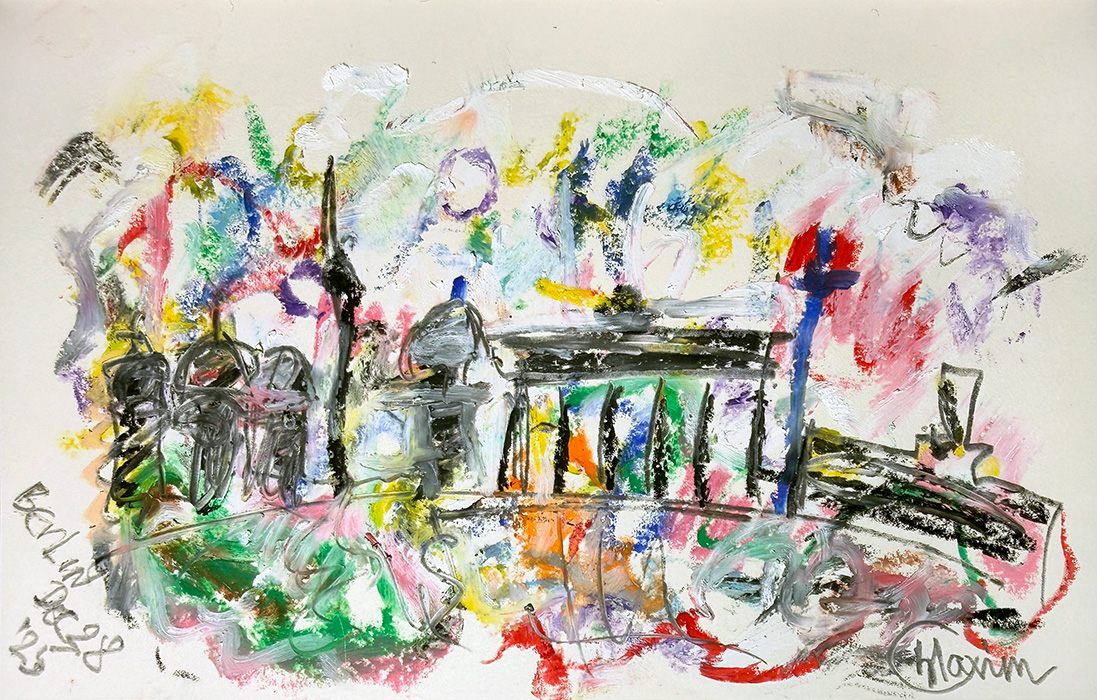
"Berlin—Echoes in Becoming", pastel on paper, Bishop Maxim, 2025
An abstract rendering of Berlin in which architectural memory and emotional atmosphere merge through dynamic line and luminous color, suggesting the city’s enduring tension between structure and transformation.
An abstract rendering of Berlin in which architectural memory and emotional atmosphere merge through dynamic line and luminous color, suggesting the city’s enduring tension between structure and transformation.
- Details
- Category: Maxim
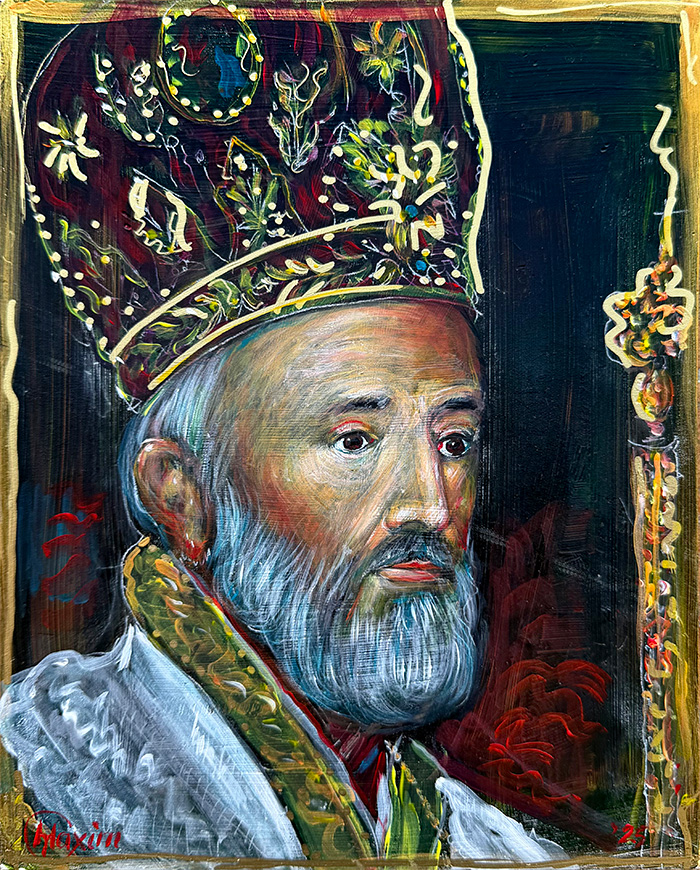
"The Weight of Communion", acrylic on gesso board, Bishop Maxim, 2025
This portrait presents John Zizioulas, Metropolitan of Pergamon, not as a monument of authority but as a man carrying time, thought, and ecclesial responsibility upon his brow. The gaze is slightly averted, inward and attentive, as if listening to a question not yet spoken. The crown—rendered less as regalia than as a living field of signs—hovers between what has been received and what is still awaited. The dark ground holds him in silence, allowing the face to emerge as a place of encounter rather than display. It is a portrait of presence, restraint, and luminous gravity.
This portrait presents John Zizioulas, Metropolitan of Pergamon, not as a monument of authority but as a man carrying time, thought, and ecclesial responsibility upon his brow. The gaze is slightly averted, inward and attentive, as if listening to a question not yet spoken. The crown—rendered less as regalia than as a living field of signs—hovers between what has been received and what is still awaited. The dark ground holds him in silence, allowing the face to emerge as a place of encounter rather than display. It is a portrait of presence, restraint, and luminous gravity.
- Details
- Category: Maxim
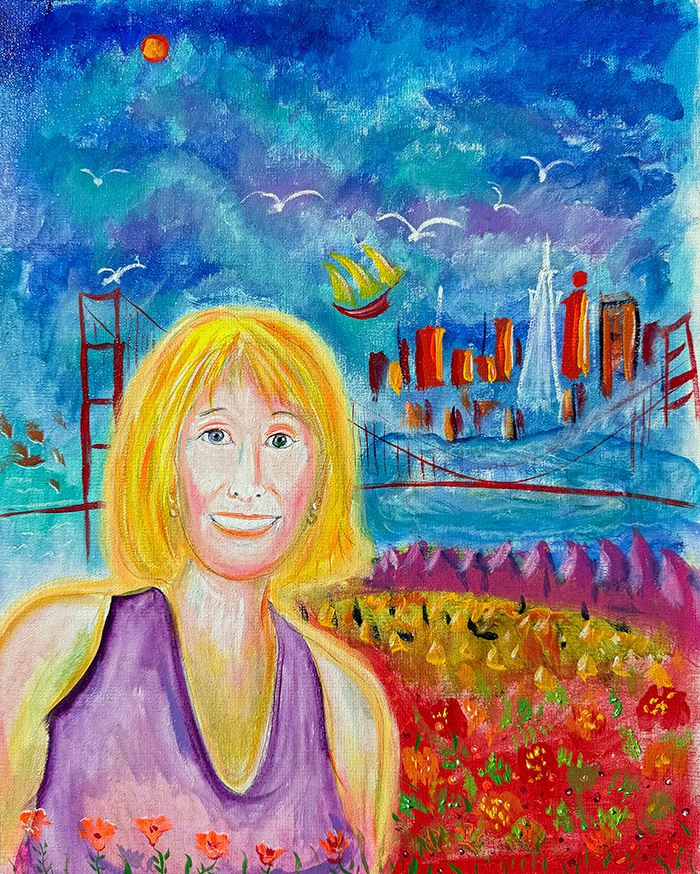
"Harboring Light: A Bay Area Portrait", acrylic on canvas board, Bishop Maxim, 2025
This portrait places a luminous female figure within the symbolic landscape of the San Francisco Bay. The Golden Gate Bridge and the glowing skyline unfold behind her as signs of passage, connection, and continuity, while birds and a small sail recall the Bay’s timeless movement between arrival and departure. Rendered in expressive, radiant color, the figure appears as a calm witness to the region’s spirit—rooted in the flowering foreground, open to the wide sky. The work favors emotional presence over strict likeness, evoking belonging, warmth, and the quiet light that defines the Bay Area.
This portrait places a luminous female figure within the symbolic landscape of the San Francisco Bay. The Golden Gate Bridge and the glowing skyline unfold behind her as signs of passage, connection, and continuity, while birds and a small sail recall the Bay’s timeless movement between arrival and departure. Rendered in expressive, radiant color, the figure appears as a calm witness to the region’s spirit—rooted in the flowering foreground, open to the wide sky. The work favors emotional presence over strict likeness, evoking belonging, warmth, and the quiet light that defines the Bay Area.
- Details
- Category: Maxim
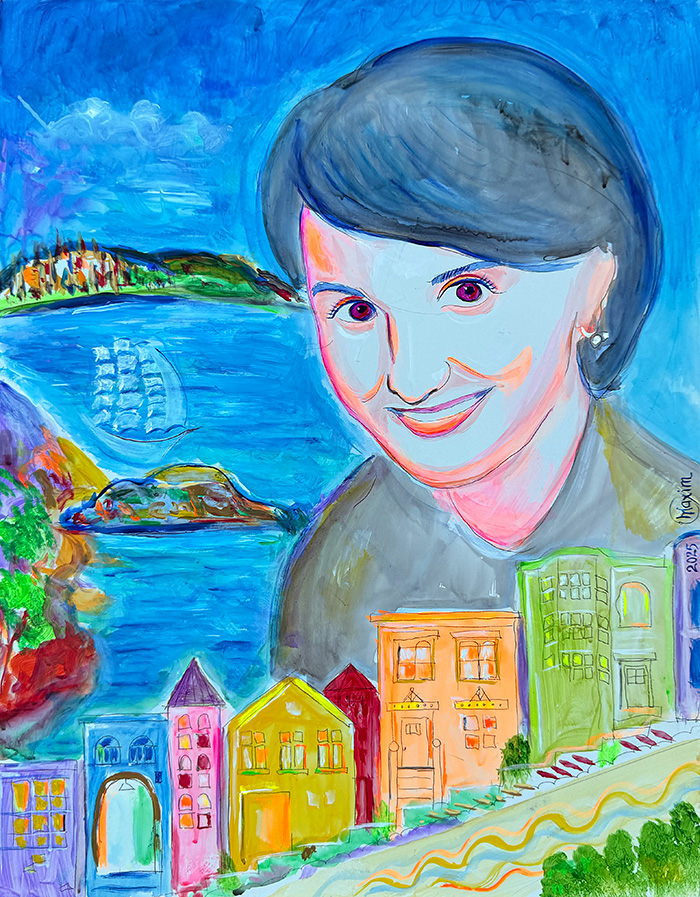
"Bay Light on Her Face", acrylic on gesso board, Bishop Maxim, 2025
In this whimsical portrait, the gentle smile of a woman rises above the rolling neighborhoods and sparkling waters of San Francisco. Behind her, the bay opens like a luminous embrace—its islands, cliffs, and shifting blues echoing both the city’s restless energy and its quiet corners of refuge. Below, the houses—painted in joyful, childlike colors—climb the familiar hills with a playful rhythm, as if greeting her presence. The portrait’s soft lines and bright palette mingle tenderness with urban vibrancy, portraying a soul at home in the Bay’s ever-changing light, rooted in the warmth of place and the poetry of the city’s landscapes.
In this whimsical portrait, the gentle smile of a woman rises above the rolling neighborhoods and sparkling waters of San Francisco. Behind her, the bay opens like a luminous embrace—its islands, cliffs, and shifting blues echoing both the city’s restless energy and its quiet corners of refuge. Below, the houses—painted in joyful, childlike colors—climb the familiar hills with a playful rhythm, as if greeting her presence. The portrait’s soft lines and bright palette mingle tenderness with urban vibrancy, portraying a soul at home in the Bay’s ever-changing light, rooted in the warmth of place and the poetry of the city’s landscapes.
- Details
- Category: Maxim
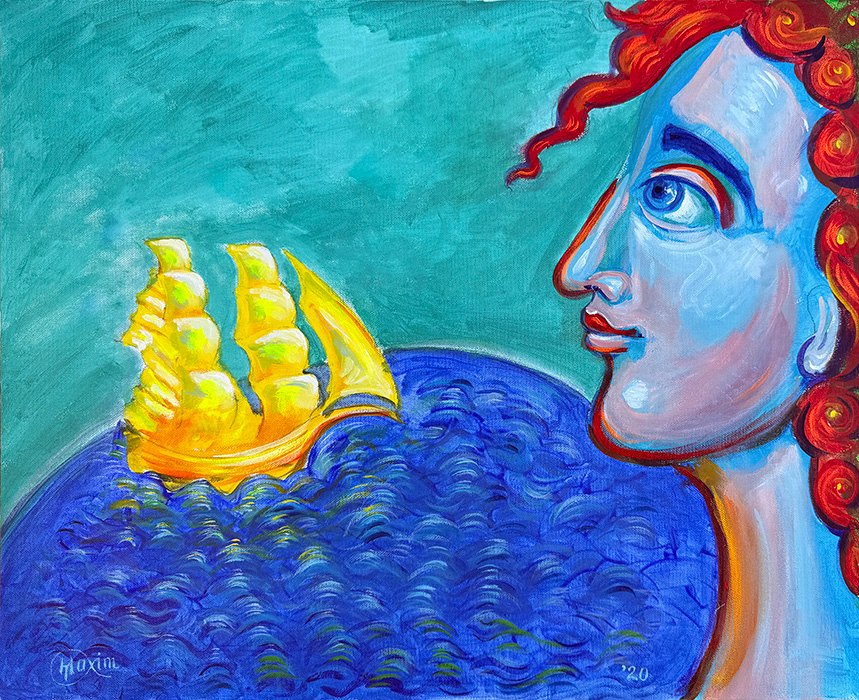
"Voyager of the Inner Sea", acrylic on canvas, Bishop Maxim, 2020
Created in the quiet, disorienting months of the COVID period, this lyrical painting captures a moment of inward searching and hopeful imagination. A tranquil blue face turns toward a radiant golden ship gliding over deep cobalt waters—an emblem of journeys dreamed rather than taken, and of horizons longed for while the world stood still. With stylized lines, bold contrasts, and a gentle mythic tone, the work becomes a meditation on solitude, yearning, and the resilient human impulse to look beyond confinement toward the promise of open seas.
Created in the quiet, disorienting months of the COVID period, this lyrical painting captures a moment of inward searching and hopeful imagination. A tranquil blue face turns toward a radiant golden ship gliding over deep cobalt waters—an emblem of journeys dreamed rather than taken, and of horizons longed for while the world stood still. With stylized lines, bold contrasts, and a gentle mythic tone, the work becomes a meditation on solitude, yearning, and the resilient human impulse to look beyond confinement toward the promise of open seas.
- Details
- Category: Maxim
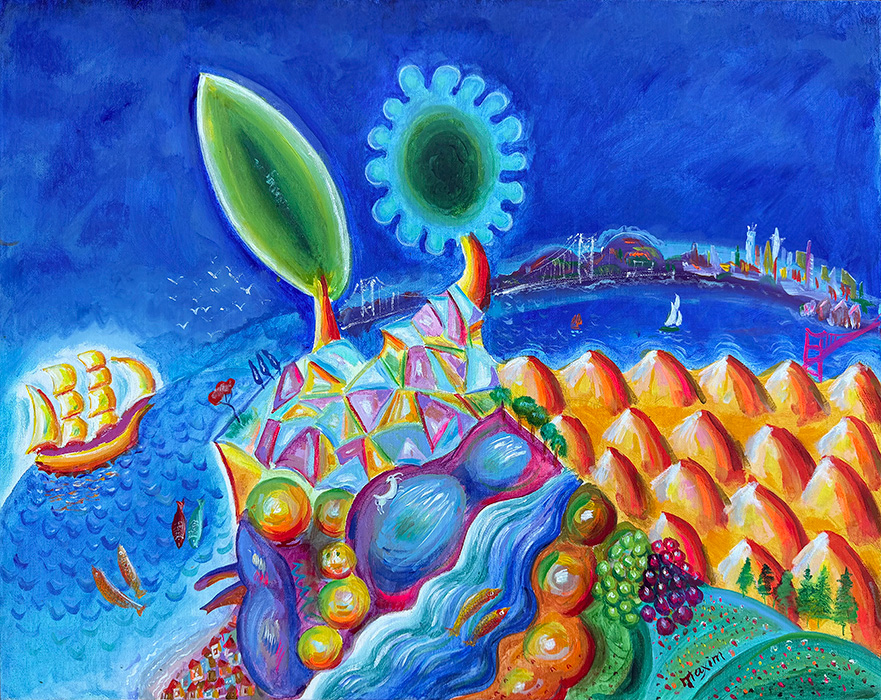
"Bay Area Vision", acrylic on canvas, Bishop Maxim, 2025
Two great trees rise at the heart of this composition—one leafy and luminous, the other like a radiant sunburst—anchoring the entire scene in a dialogue between earth and heaven. Around them unfolds a vision of the San Francisco Bay rendered through post-Byzantine chromatic symbolism. Inspired by Stamatis Skliris, the artist fuses modern form with Byzantine sensibility. The rolling golden hills, crystalline patterns, and glowing waters become living symbols of creation’s abundance and harmony. The Bay and cityscape shimmer in the background, less as topography and more as revelation—an icon of communion between nature, humanity, and divine energy. Through its vibrant palette and contemplative rhythm, Bay Area Vision transforms the familiar landscape into a sacred hymn of transfiguration, where even the trees seem to pray.
Two great trees rise at the heart of this composition—one leafy and luminous, the other like a radiant sunburst—anchoring the entire scene in a dialogue between earth and heaven. Around them unfolds a vision of the San Francisco Bay rendered through post-Byzantine chromatic symbolism. Inspired by Stamatis Skliris, the artist fuses modern form with Byzantine sensibility. The rolling golden hills, crystalline patterns, and glowing waters become living symbols of creation’s abundance and harmony. The Bay and cityscape shimmer in the background, less as topography and more as revelation—an icon of communion between nature, humanity, and divine energy. Through its vibrant palette and contemplative rhythm, Bay Area Vision transforms the familiar landscape into a sacred hymn of transfiguration, where even the trees seem to pray.
- Details
- Category: Maxim
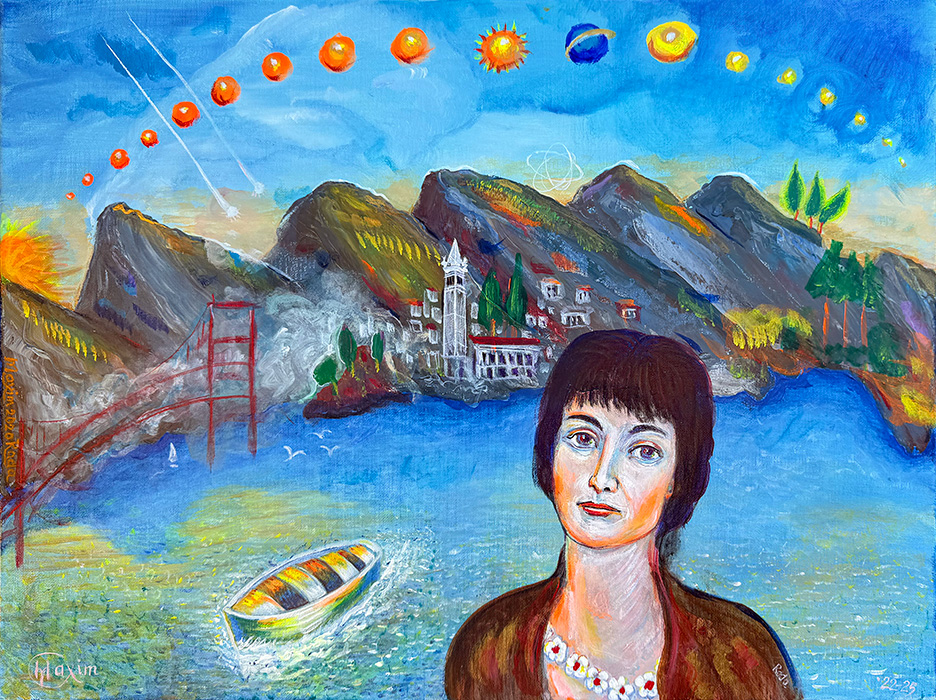
"Wonder in the New World", acrylic on canvas, Bishop Maxim and Radmila Vasiljevic, 2020-2025
This portrait of Serbian nuclear physicist places her between the world she left and the universe she studies. The Golden Gate Bridge and a Balkan-style village meet under a sky alive with celestial bodies, atomic forms, and radiant light, reflecting her life at Berkeley’s Nuclear Engineering Department. A lone boat on shimmering water hints at her journey across continents. The mountains and heavens together evoke the quiet awe that shapes both her scientific work and her sense of the world’s mystery.
This portrait of Serbian nuclear physicist places her between the world she left and the universe she studies. The Golden Gate Bridge and a Balkan-style village meet under a sky alive with celestial bodies, atomic forms, and radiant light, reflecting her life at Berkeley’s Nuclear Engineering Department. A lone boat on shimmering water hints at her journey across continents. The mountains and heavens together evoke the quiet awe that shapes both her scientific work and her sense of the world’s mystery.
- Details
- Category: Maxim
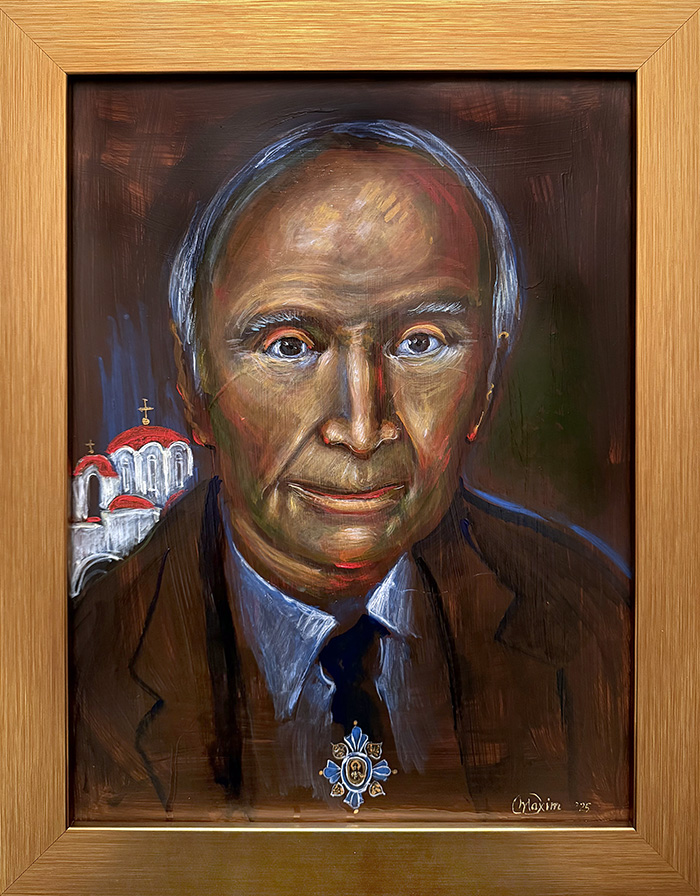
"Mika Golubović—Portrait", acrylic on gesso board, Bishop Maxim, 2025
This portrait honors Mika Golubović, a beloved Bay Area philanthropist of Serbian heritage and longtime president of the First Serbian Benevolent Society—the oldest Serbian organization in the United States. His decades of service and generosity toward the community are reflected in the painting’s warm, dignified presence.
Earthy reds, ochres, and soft golds shape his face with gentle, impressionistic strokes, suggesting a life marked by wisdom and quiet strength. Cool highlights in his hair and eyes add clarity and depth. Behind him, the red-domed Serbian church evokes heritage and faith, while the medal at his chest glimmers with a note of well-earned honor. The composition radiates warmth, gratitude, and the enduring legacy of a man who gave so much.
This portrait honors Mika Golubović, a beloved Bay Area philanthropist of Serbian heritage and longtime president of the First Serbian Benevolent Society—the oldest Serbian organization in the United States. His decades of service and generosity toward the community are reflected in the painting’s warm, dignified presence.
Earthy reds, ochres, and soft golds shape his face with gentle, impressionistic strokes, suggesting a life marked by wisdom and quiet strength. Cool highlights in his hair and eyes add clarity and depth. Behind him, the red-domed Serbian church evokes heritage and faith, while the medal at his chest glimmers with a note of well-earned honor. The composition radiates warmth, gratitude, and the enduring legacy of a man who gave so much.
- Details
- Category: Maxim
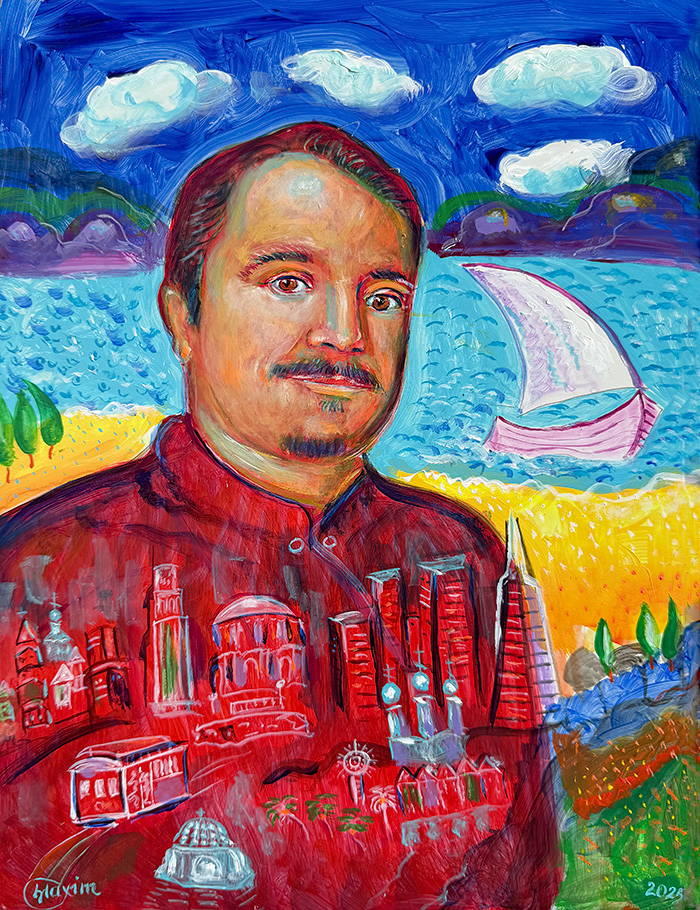
"City and Priest in One Heartbeat", acrylic on gesso board, Bishop Maxim, 2025
This painting weaves the face of a San Francisco priest with the layered architecture of the city he shepherds — domes, spires, bridges, and towers appearing as if embroidered onto his robe. Behind him, the Pacific sky opens in deep blues and bright clouds, and a lone sail draws a quiet arc of peace. The portrait celebrates a ministry shaped by the rhythms of the Bay: steadfast, welcoming, and touched by the poetry of the place.
This painting weaves the face of a San Francisco priest with the layered architecture of the city he shepherds — domes, spires, bridges, and towers appearing as if embroidered onto his robe. Behind him, the Pacific sky opens in deep blues and bright clouds, and a lone sail draws a quiet arc of peace. The portrait celebrates a ministry shaped by the rhythms of the Bay: steadfast, welcoming, and touched by the poetry of the place.
- Details
- Category: Maxim
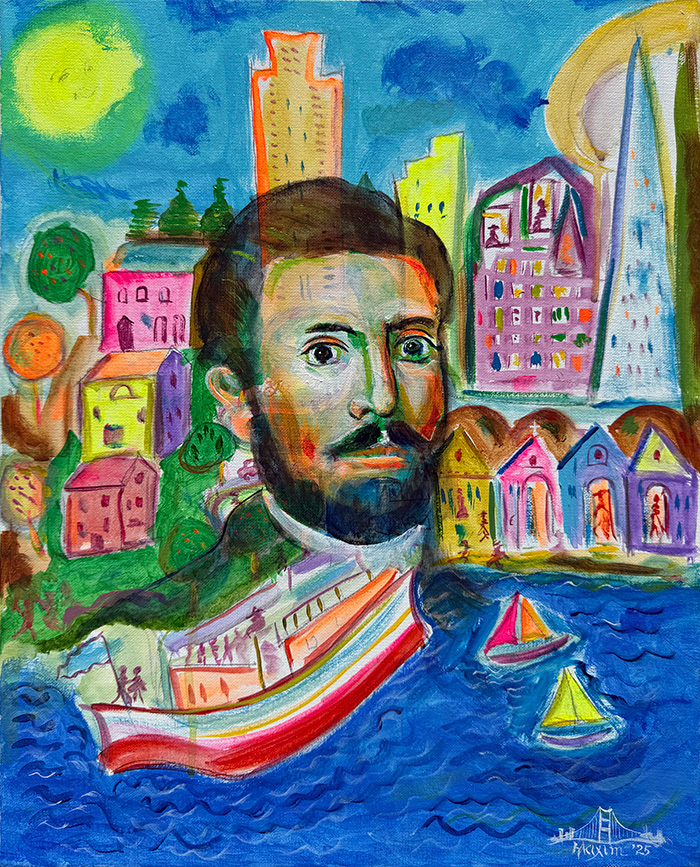
"Sebastian Dabovich: A Son of San Francisco", acrylic on canvas, Bishop Maxim, 2025
A youthful Sebastian Dabovich rises from the colorful life of his native San Francisco, the city’s hills, homes, and sails unfolding around him like a living biography. The portrait weaves him into the city’s rhythm, suggesting how deeply his early surroundings shaped the future missionary he would become.
A youthful Sebastian Dabovich rises from the colorful life of his native San Francisco, the city’s hills, homes, and sails unfolding around him like a living biography. The portrait weaves him into the city’s rhythm, suggesting how deeply his early surroundings shaped the future missionary he would become.
- Details
- Category: Maxim
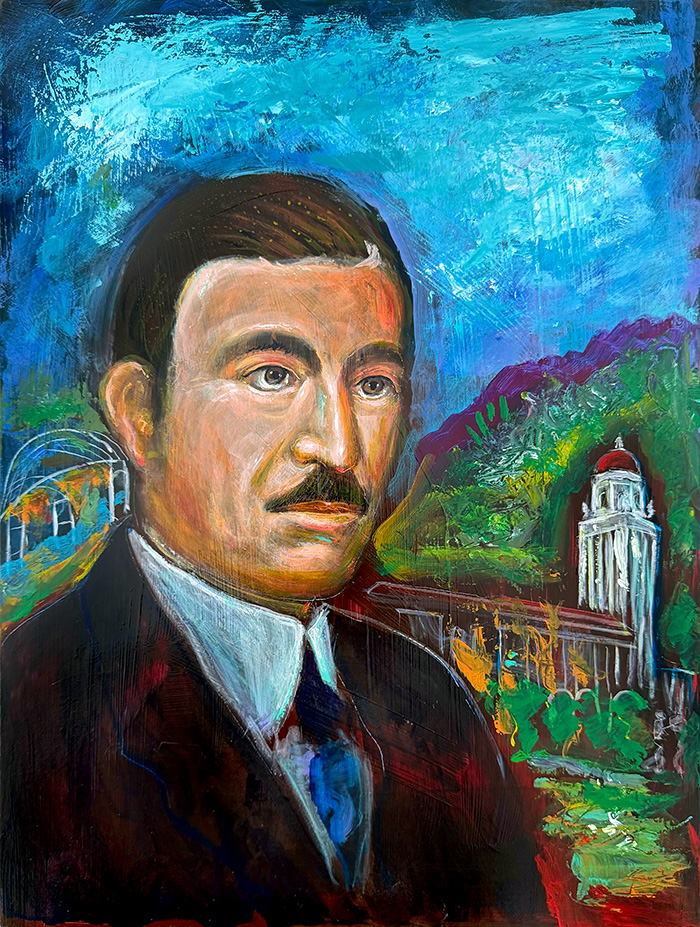
"Todor Polich: Builder Between Hills and Horizons", acrylic on gesso board, Bishop Maxim, 2025
This portrait renders Todor Polich in the vigor of his younger years, his steady gaze reflecting the resolve that shaped bridges, communities, and institutions. Behind him rise the soft, enduring hills of Herzegovina—the land that formed him—while to the right stands the iconic tower of Stanford, honoring his generosity toward the Hoover Institution. To the left, one of his bridges arcs like a testament in steel and spirit. The painting weaves these worlds together, capturing a benefactor whose life joined landscapes, peoples, and futures with quiet strength.
This portrait renders Todor Polich in the vigor of his younger years, his steady gaze reflecting the resolve that shaped bridges, communities, and institutions. Behind him rise the soft, enduring hills of Herzegovina—the land that formed him—while to the right stands the iconic tower of Stanford, honoring his generosity toward the Hoover Institution. To the left, one of his bridges arcs like a testament in steel and spirit. The painting weaves these worlds together, capturing a benefactor whose life joined landscapes, peoples, and futures with quiet strength.
- Details
- Category: Maxim
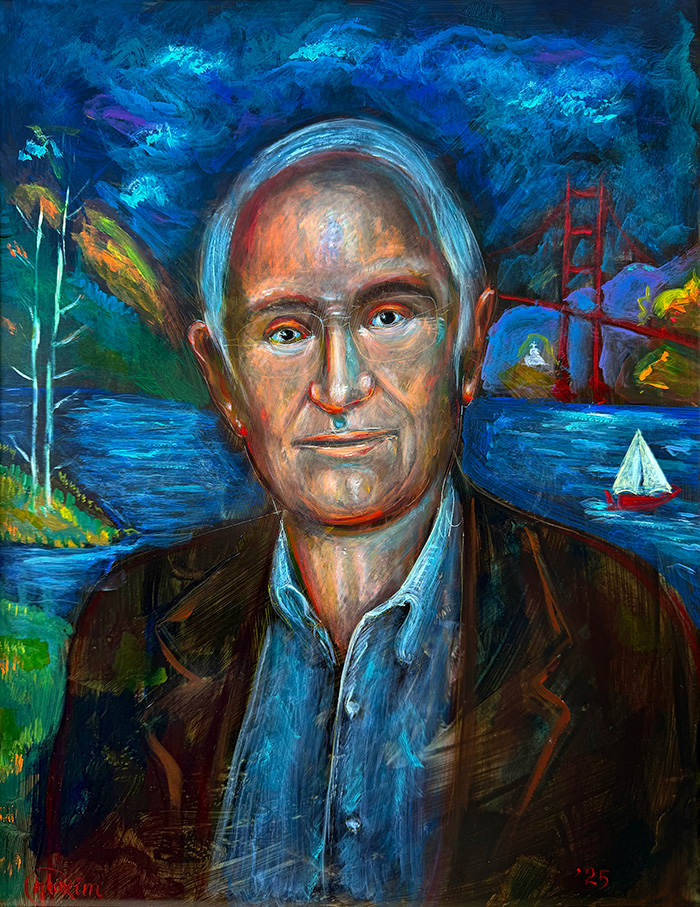
"Between Lakes and Bay", acrylic on gesso board, Bishop Maxim, 2025
Bishop Maxim’s portrait of Ron Radakovich, a Serbian-American philanthropist, unites the landscapes of his life—from the birch-lined lakes of Minnesota to the luminous horizons of the San Francisco Bay. Behind the calm, reflective figure, the cool northern tones blend with the fiery glow of the Golden Gate Bridge, symbolizing a life bridging cultures and generations. The expressive color palette—echoing post-Byzantine chromatic symbolism—imbues the work with quiet spirituality. Though unfinished, the painting stands as a meditation on belonging, memory, and the landscapes that shape the soul.
Bishop Maxim’s portrait of Ron Radakovich, a Serbian-American philanthropist, unites the landscapes of his life—from the birch-lined lakes of Minnesota to the luminous horizons of the San Francisco Bay. Behind the calm, reflective figure, the cool northern tones blend with the fiery glow of the Golden Gate Bridge, symbolizing a life bridging cultures and generations. The expressive color palette—echoing post-Byzantine chromatic symbolism—imbues the work with quiet spirituality. Though unfinished, the painting stands as a meditation on belonging, memory, and the landscapes that shape the soul.
- Details
- Category: Maxim
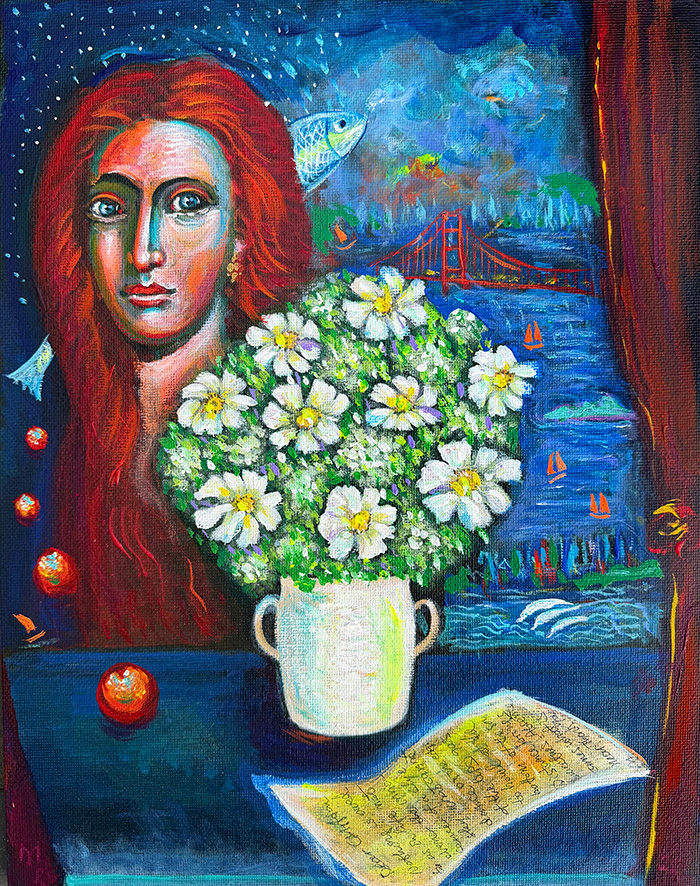
"Letter Beneath the Night Tide", acrylic on canvas board, Bishop Maxim, 2025
A red-haired figure gazes out from a San Francisco night where the Golden Gate glows like an ember and sailboats drift over dream-colored waters. A vase of bright daisies anchors the scene, while floating oranges and a swift silver fish lend a touch of the surreal. On the table, a softly lit letter suggests a message carried by tide and memory. The painting becomes a meditation on longing, presence, and the quiet poetry of a city by the sea.
A red-haired figure gazes out from a San Francisco night where the Golden Gate glows like an ember and sailboats drift over dream-colored waters. A vase of bright daisies anchors the scene, while floating oranges and a swift silver fish lend a touch of the surreal. On the table, a softly lit letter suggests a message carried by tide and memory. The painting becomes a meditation on longing, presence, and the quiet poetry of a city by the sea.
- Details
- Category: Maxim
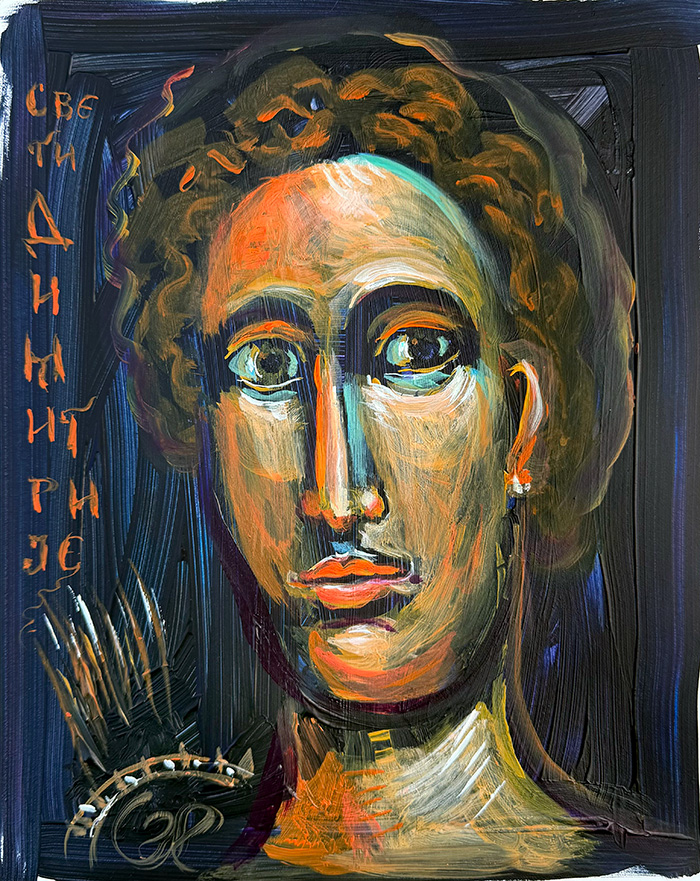
"Saint Demetrius, Face of Courage", acrylic on gesso board, Bishop Maxim, 2025
Saint Demetrius shines with the bold intimacy of expressionism and the quiet reverence of Byzantine memory. His elongated, luminous face—modeled in warm earth tones touched with ember-orange and cool greens—gives him both tenderness and resolve. The wide, reflective eyes carry the saint’s youthful courage, while the dark indigo background becomes a sanctuary around him. The inscription “Свети Димитрије” stands like a vertical prayer, and the faint suggestion of a spear at the lower left recalls his martyrdom without overpowering the composition. The brushwork moves with musical energy, suggesting a halo more by radiance than by outline. Altogether, it feels like a timeless encounter—an ancient saint emerging through a modern painter’s breath.
Saint Demetrius shines with the bold intimacy of expressionism and the quiet reverence of Byzantine memory. His elongated, luminous face—modeled in warm earth tones touched with ember-orange and cool greens—gives him both tenderness and resolve. The wide, reflective eyes carry the saint’s youthful courage, while the dark indigo background becomes a sanctuary around him. The inscription “Свети Димитрије” stands like a vertical prayer, and the faint suggestion of a spear at the lower left recalls his martyrdom without overpowering the composition. The brushwork moves with musical energy, suggesting a halo more by radiance than by outline. Altogether, it feels like a timeless encounter—an ancient saint emerging through a modern painter’s breath.
- Details
- Category: Maxim
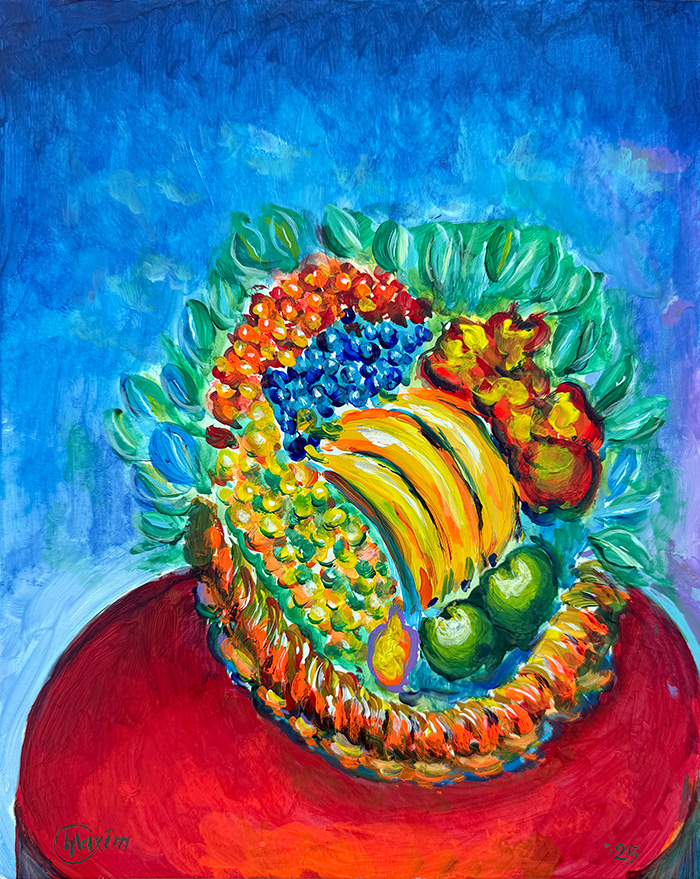
"Thanksgiving Abundance", acrylic on gesso board, Bishop Maxim, 2025
A radiant cornucopia bursts with color and life, its fruits glowing like miniature suns against a sky of deep, blessed blue. The basket curves forward in a warm embrace, offering its harvest with joy—a vibrant hymn of gratitude painted in the spirit of the season.
A radiant cornucopia bursts with color and life, its fruits glowing like miniature suns against a sky of deep, blessed blue. The basket curves forward in a warm embrace, offering its harvest with joy—a vibrant hymn of gratitude painted in the spirit of the season.
- Details
- Category: Maxim
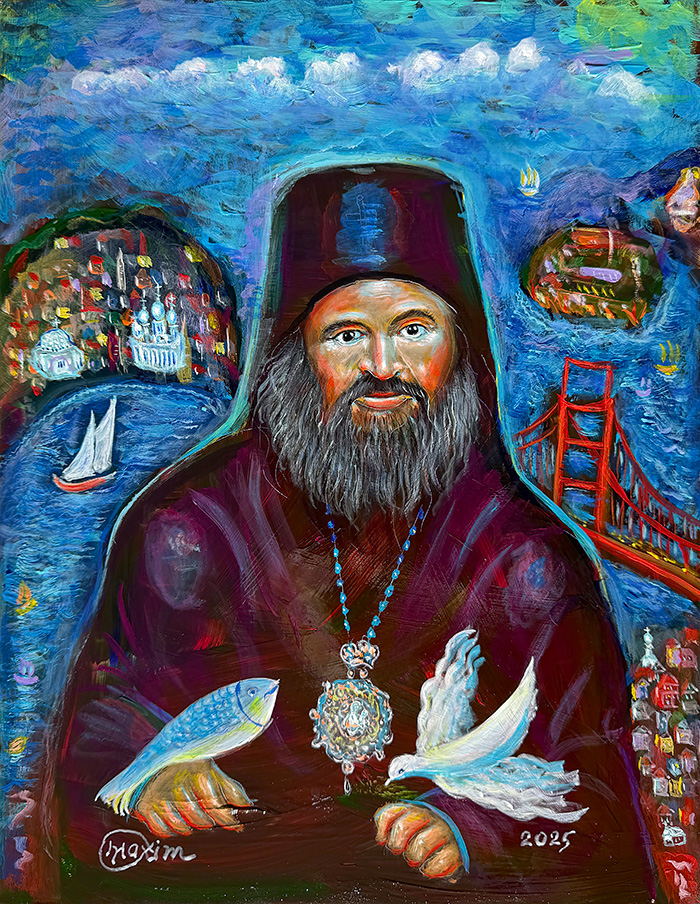
"St. John of San Francisco in the Bay of Grace", acrylic on gesso board, Bishop Maxim, 2025
In St. John of San Francisco in the Bay of Grace, Bishop Maxim unites the spiritual and the local, depicting the saint as a radiant guardian of the Bay Area. Clad in deep violet robes that echo both Byzantine sanctity and Pacific twilight, he stands between the waters and the city, his gaze gentle yet penetrating. A fish and a dove rest upon his hands— symbols of baptism and peace—while behind him shimmer the city lights and the vermilion span of the Golden Gate Bridge, a threshold between heaven and earth. The saturated blues and luminous tones create a visionary calm where time and place dissolve. The saint’s halo blends with the sky, as if sanctity itself breathes through the Bay’s rhythm— the sea, the clouds, the human heart.
In St. John of San Francisco in the Bay of Grace, Bishop Maxim unites the spiritual and the local, depicting the saint as a radiant guardian of the Bay Area. Clad in deep violet robes that echo both Byzantine sanctity and Pacific twilight, he stands between the waters and the city, his gaze gentle yet penetrating. A fish and a dove rest upon his hands— symbols of baptism and peace—while behind him shimmer the city lights and the vermilion span of the Golden Gate Bridge, a threshold between heaven and earth. The saturated blues and luminous tones create a visionary calm where time and place dissolve. The saint’s halo blends with the sky, as if sanctity itself breathes through the Bay’s rhythm— the sea, the clouds, the human heart.
- Details
- Category: Maxim
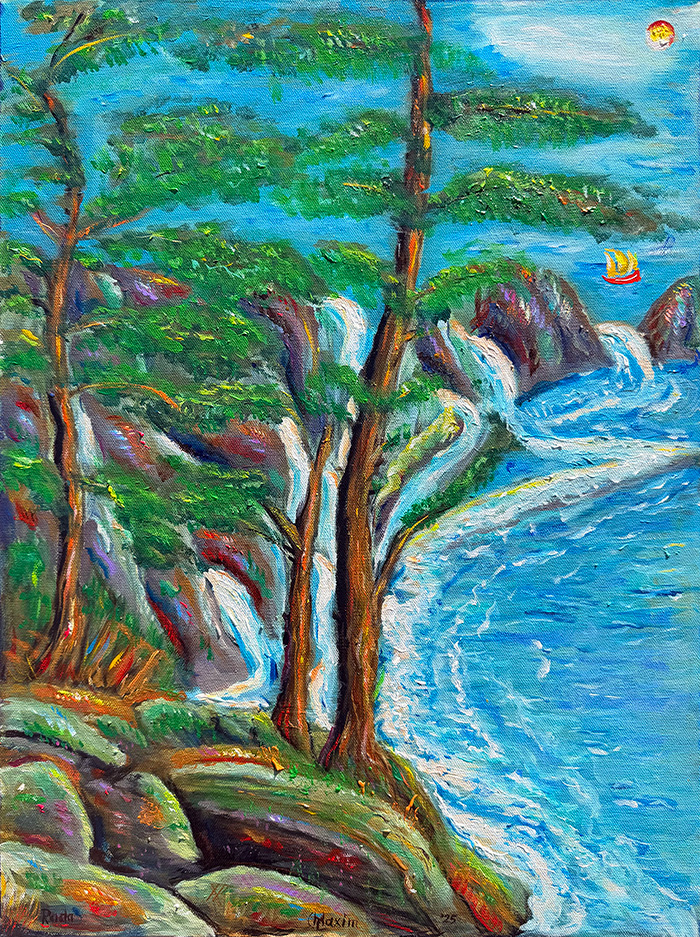
"Twilight Surge Near Monterey", acrylic on canvas, Rada Vasiljevic and Bishop Maxim, 2025
Set along the storied coastline near Monterey, this impressionist seascape captures the Pacific at the threshold of evening, when colors loosen and the landscape breathes in deeper hues. The cliffs rise in expressive strokes of emerald, violet, and rose, their textured surfaces echoing the rugged beauty of the Monterey headlands. Below, the water shimmers in layers of turquoise and pearly white, suggesting the rhythmic surge of waves that define this part of the California coast. The painting’s lively, windswept brushwork evokes both the immensity of the Pacific and the quiet inwardness one feels standing before it—a tender homage to the timeless dialogue between sea, light, and shore near Monterey.
Set along the storied coastline near Monterey, this impressionist seascape captures the Pacific at the threshold of evening, when colors loosen and the landscape breathes in deeper hues. The cliffs rise in expressive strokes of emerald, violet, and rose, their textured surfaces echoing the rugged beauty of the Monterey headlands. Below, the water shimmers in layers of turquoise and pearly white, suggesting the rhythmic surge of waves that define this part of the California coast. The painting’s lively, windswept brushwork evokes both the immensity of the Pacific and the quiet inwardness one feels standing before it—a tender homage to the timeless dialogue between sea, light, and shore near Monterey.
- Details
- Category: Maxim
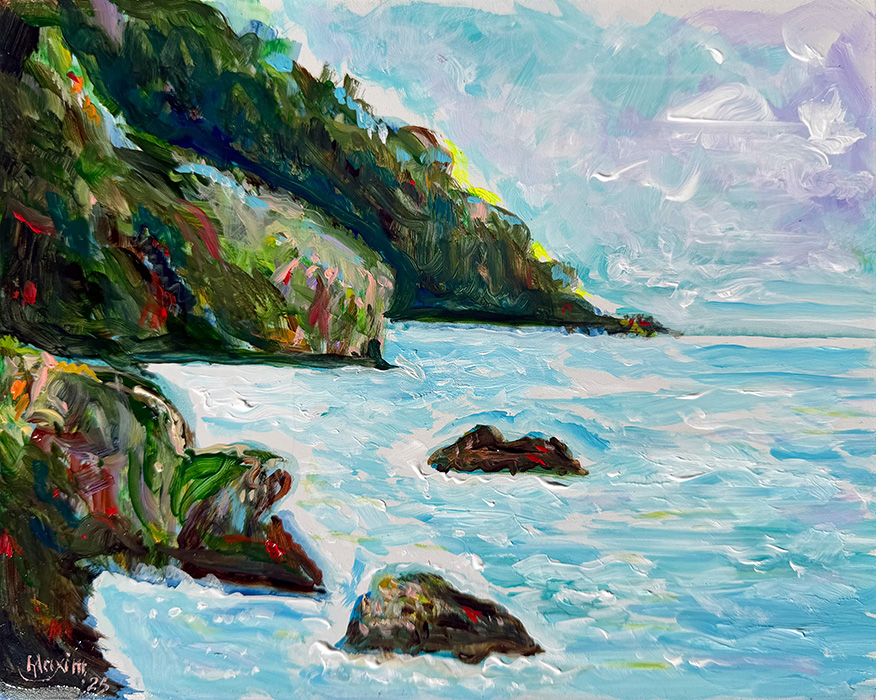
"Aqua Light Along the Pacific Cliffs", acrylic on gesso board, Bishop Maxim, 2025
In this impressionist rendering of the Pacific Coast, broad, fluid strokes of turquoise and lavender mingle with dense, earthen greens to evoke a shoreline caught in a moment of shimmering stillness. The cliffs rise with rhythmic, almost musical layering, while the sea spreads out in luminous sweeps of light, suggesting the perpetual motion of water meeting rock. Subtle warm accents—pink, gold, coral—breathe life into the foliage and stones, turning the landscape into a hymn of color and memory. Painted with expressive, tactile energy, the work captures the sensation of standing before the Pacific as it opens into the sky, offering both a sense of nearness and a longing toward the horizon beyond.
In this impressionist rendering of the Pacific Coast, broad, fluid strokes of turquoise and lavender mingle with dense, earthen greens to evoke a shoreline caught in a moment of shimmering stillness. The cliffs rise with rhythmic, almost musical layering, while the sea spreads out in luminous sweeps of light, suggesting the perpetual motion of water meeting rock. Subtle warm accents—pink, gold, coral—breathe life into the foliage and stones, turning the landscape into a hymn of color and memory. Painted with expressive, tactile energy, the work captures the sensation of standing before the Pacific as it opens into the sky, offering both a sense of nearness and a longing toward the horizon beyond.
- Details
- Category: Maxim
"Longing Beyond the Bay 2", acrylic on canvas, Bishop Maxim, 2025
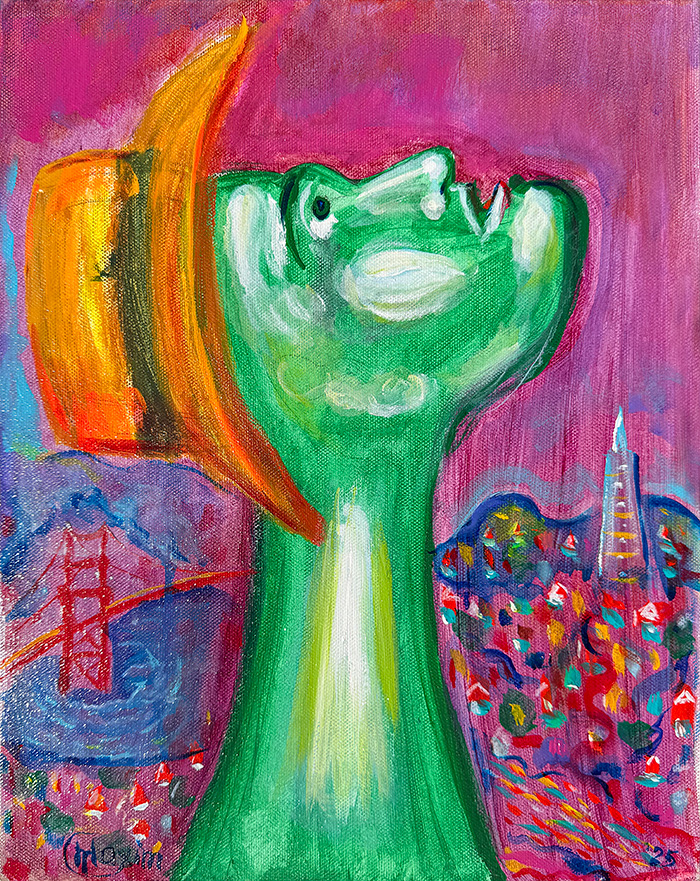
In this luminous, dream-colored vision, a solitary figure rises like a pillar of sea-green light from the heart of San Francisco, his face lifted toward a horizon that lies above the world’s noise. Around him, the Golden Gate Bridge, the flickering city lights, and the sharp silhouette of the Transamerica Pyramid shimmer like half-remembered constellations—earthly, vibrant, but secondary to the quiet pull of something higher. The brushstrokes swirl with movement and memory, as though the whole city exhales through this one searching soul. It is a portrait of belonging and exile at once—a person immersed in the life of the Bay yet yearning for the beyond that whispers through its skies.
In this luminous, dream-colored vision, a solitary figure rises like a pillar of sea-green light from the heart of San Francisco, his face lifted toward a horizon that lies above the world’s noise. Around him, the Golden Gate Bridge, the flickering city lights, and the sharp silhouette of the Transamerica Pyramid shimmer like half-remembered constellations—earthly, vibrant, but secondary to the quiet pull of something higher. The brushstrokes swirl with movement and memory, as though the whole city exhales through this one searching soul. It is a portrait of belonging and exile at once—a person immersed in the life of the Bay yet yearning for the beyond that whispers through its skies.
- Details
- Category: Maxim
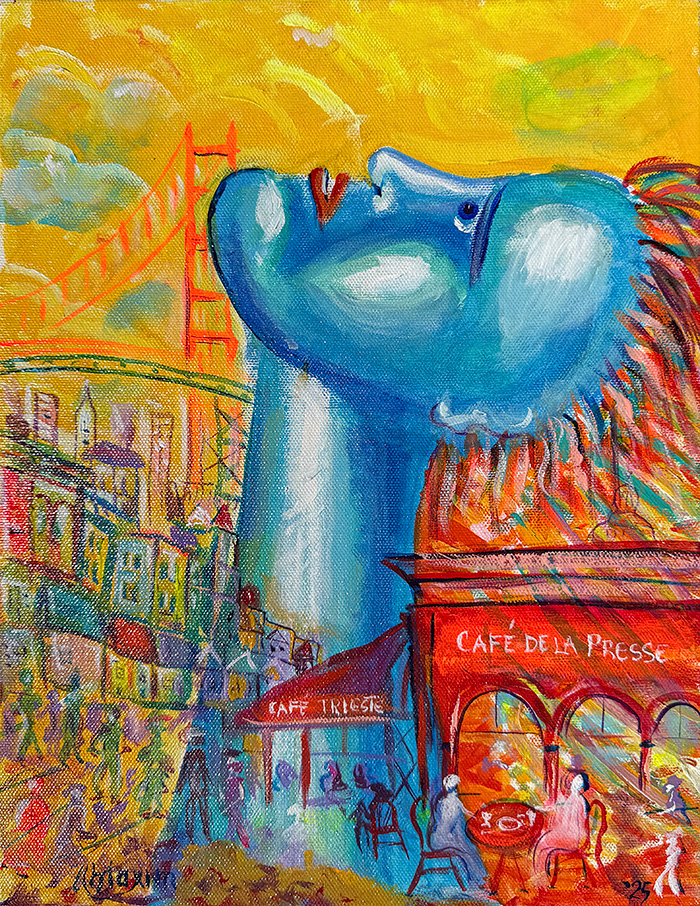
"Longing Beyond the Bay 1", acrylic on canvas, Bishop Maxim, 2025
In this contemplative cityscape, a solitary blue figure lifts his face toward the sky, exhaling a quiet yearning that rises above San Francisco’s lively hills, cafés, and iconic bridges. The golden atmosphere shimmers with a sense of something just out of reach—an unseen horizon that calls the soul beyond the daily bustle below. While the city hums with color and motion, the figure remains still, absorbed in an inner search. The painting weaves together urban life and spiritual longing, suggesting that amid the noise of the world, the heart continues to listen for a distant, luminous beyond.
In this contemplative cityscape, a solitary blue figure lifts his face toward the sky, exhaling a quiet yearning that rises above San Francisco’s lively hills, cafés, and iconic bridges. The golden atmosphere shimmers with a sense of something just out of reach—an unseen horizon that calls the soul beyond the daily bustle below. While the city hums with color and motion, the figure remains still, absorbed in an inner search. The painting weaves together urban life and spiritual longing, suggesting that amid the noise of the world, the heart continues to listen for a distant, luminous beyond.
- Details
- Category: Maxim
"Beloved Among the Bay Winds", acrylic on gesso board, Bishop Maxim, 2025
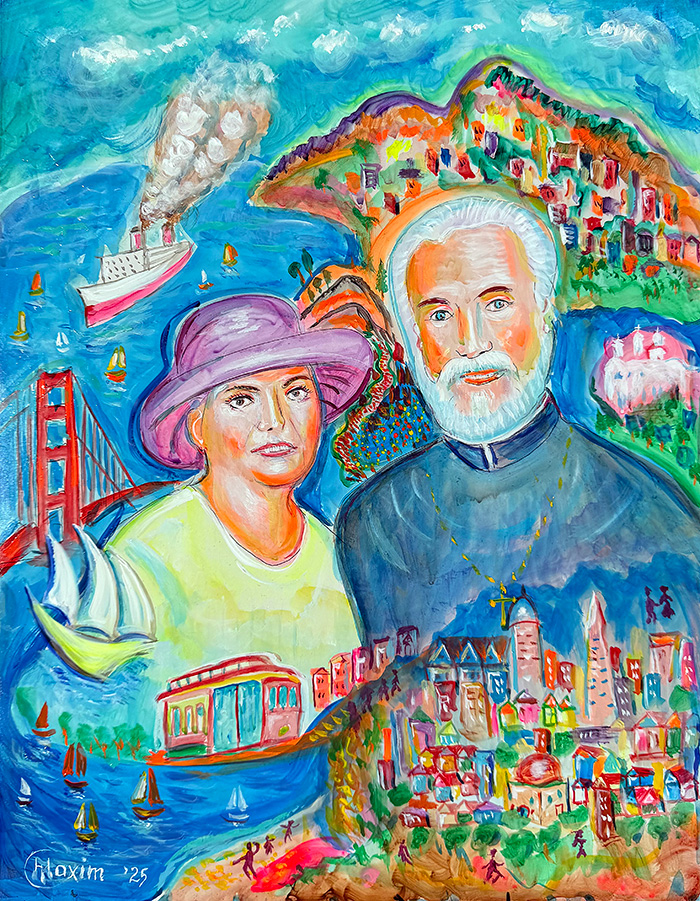
Set against a dreamlike tapestry of San Francisco’s hills, waters, and iconic landmarks, this portrait presents a couple whose gentle presence anchors the city’s vibrant whirl. The artist interlaces the Golden Gate Bridge, sailboats on the shimmering bay, Coit Tower, colorful neighborhoods, and a steaming ferry into a lyrical mosaic that feels both personal and civic. The figures—serene, wise, and warmly rendered—stand at the meeting point of memory and place, their lives quietly illuminated by the landscape that surrounds them. Through expressive color and fluid line, the painting becomes a celebration of companionship, vocation, and the enduring spirit of the Bay.
Set against a dreamlike tapestry of San Francisco’s hills, waters, and iconic landmarks, this portrait presents a couple whose gentle presence anchors the city’s vibrant whirl. The artist interlaces the Golden Gate Bridge, sailboats on the shimmering bay, Coit Tower, colorful neighborhoods, and a steaming ferry into a lyrical mosaic that feels both personal and civic. The figures—serene, wise, and warmly rendered—stand at the meeting point of memory and place, their lives quietly illuminated by the landscape that surrounds them. Through expressive color and fluid line, the painting becomes a celebration of companionship, vocation, and the enduring spirit of the Bay.
- Details
- Category: Maxim
"Where Nature Breathes Into the City", acrylic on canvas, Rada Vasiljevic and Bishop Maxim, 2025
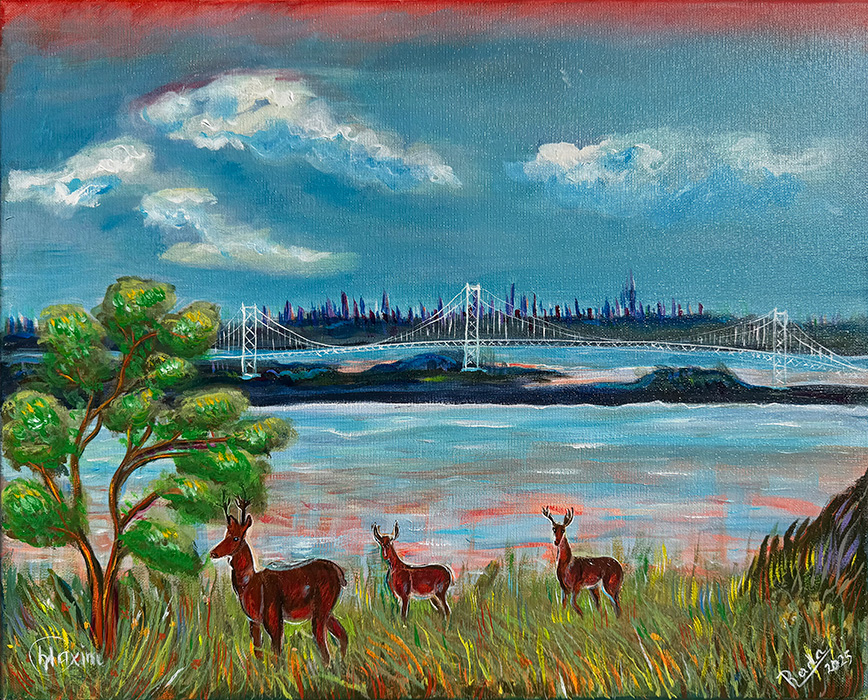
This collaborative landscape blends the tenderness of hand-painted nature with the quiet geometry of San Francisco’s skyline, creating a scene where wildlife, rolling hills, and luminous waters share the same horizon as the city’s iconic silhouettes. The painting moves with a living rhythm—trees in blossom, colors flowing like shifting light—while the distant city rises gently, less as an intrusion and more as a companion to the natural world. Together, the artists shape a vision of harmony, where human presence and untamed beauty coexist in a single, radiant breath.
This collaborative landscape blends the tenderness of hand-painted nature with the quiet geometry of San Francisco’s skyline, creating a scene where wildlife, rolling hills, and luminous waters share the same horizon as the city’s iconic silhouettes. The painting moves with a living rhythm—trees in blossom, colors flowing like shifting light—while the distant city rises gently, less as an intrusion and more as a companion to the natural world. Together, the artists shape a vision of harmony, where human presence and untamed beauty coexist in a single, radiant breath.
- Details
- Category: Maxim
"Jack London: A City Forged in Fire and Fog", acrylic on gesso board, Bishop Maxim, 2025
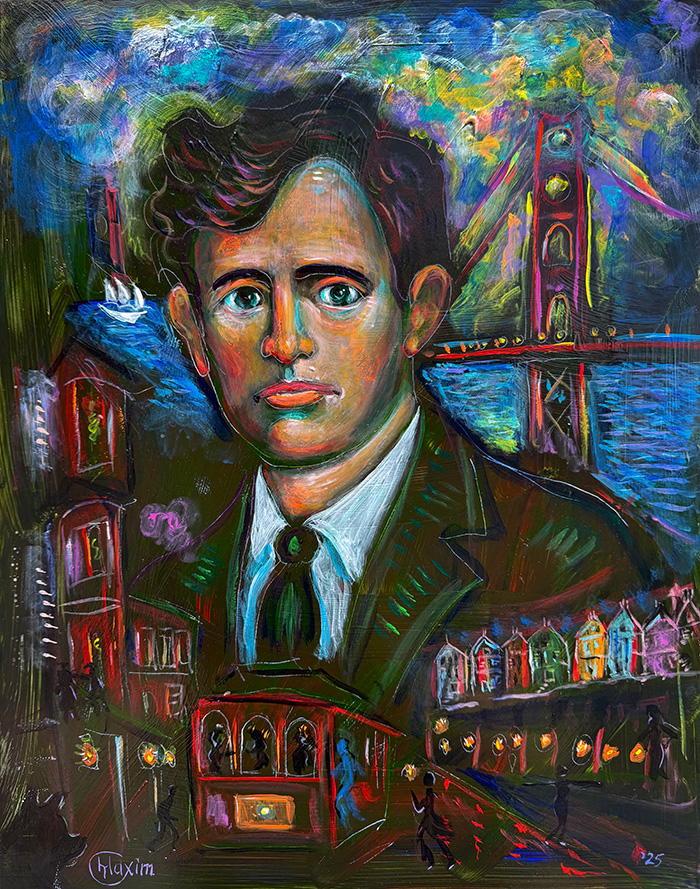
In this vivid, expressionistic portrait, Jack London emerges as witness and architect of San Francisco’s restless spirit. His luminous, searching eyes—set against a whirl of cloud, sea, and bridge—suggest a mind perpetually on the edge of discovery. Around him, the city unfolds like a living canvas: Victorian houses glowing at dusk, a cable car climbing its eternal ascent, and the Golden Gate rising through mist like a gateway to adventure. The palette is electric and windswept, capturing the stormy brilliance of a writer whose life and work were inseparable from the wild heartbeat of the Bay.
In this vivid, expressionistic portrait, Jack London emerges as witness and architect of San Francisco’s restless spirit. His luminous, searching eyes—set against a whirl of cloud, sea, and bridge—suggest a mind perpetually on the edge of discovery. Around him, the city unfolds like a living canvas: Victorian houses glowing at dusk, a cable car climbing its eternal ascent, and the Golden Gate rising through mist like a gateway to adventure. The palette is electric and windswept, capturing the stormy brilliance of a writer whose life and work were inseparable from the wild heartbeat of the Bay.
- Details
- Category: Maxim
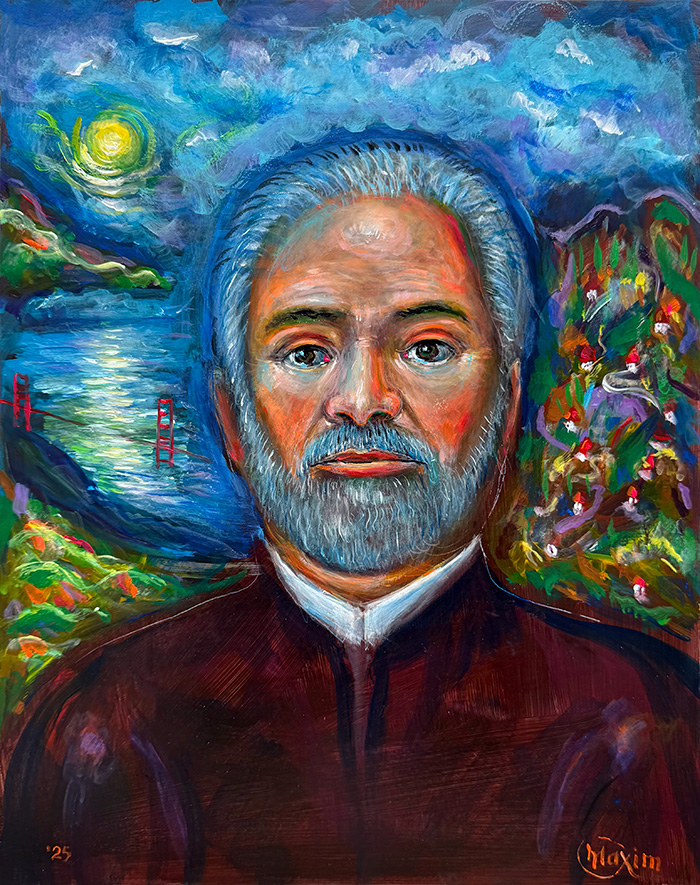
"Elder of the Bay: Portrait Beneath the Luminous Sky", acrylic on gesso board, Bishop Maxim, 2025
In this luminous portrait, the elder figure stands serenely before a transfigured San Francisco—moonlit waters, rising hills, and the quiet red arches of the Golden Gate forming a symbolic landscape of memory and spirit. His silver hair and steady gaze radiate calm dignity, while the swirling sky and blooming hillsides envelop him in an atmosphere that feels both earthly and otherworldly. On his right side, the gentle contours and muted tones evoke the rugged beauty of his old country, Bosnia—a landscape of ancestral mountains and quiet resilience—silently accompanying him across the ocean. Blending expressive realism with visionary color, the painting unites the inner depth of the man with the restless beauty of the Bay and the remembered homeland of his youth, creating a portrait that is at once contemplative, poetic, and quietly transcendent.
In this luminous portrait, the elder figure stands serenely before a transfigured San Francisco—moonlit waters, rising hills, and the quiet red arches of the Golden Gate forming a symbolic landscape of memory and spirit. His silver hair and steady gaze radiate calm dignity, while the swirling sky and blooming hillsides envelop him in an atmosphere that feels both earthly and otherworldly. On his right side, the gentle contours and muted tones evoke the rugged beauty of his old country, Bosnia—a landscape of ancestral mountains and quiet resilience—silently accompanying him across the ocean. Blending expressive realism with visionary color, the painting unites the inner depth of the man with the restless beauty of the Bay and the remembered homeland of his youth, creating a portrait that is at once contemplative, poetic, and quietly transcendent.
- Details
- Category: Maxim
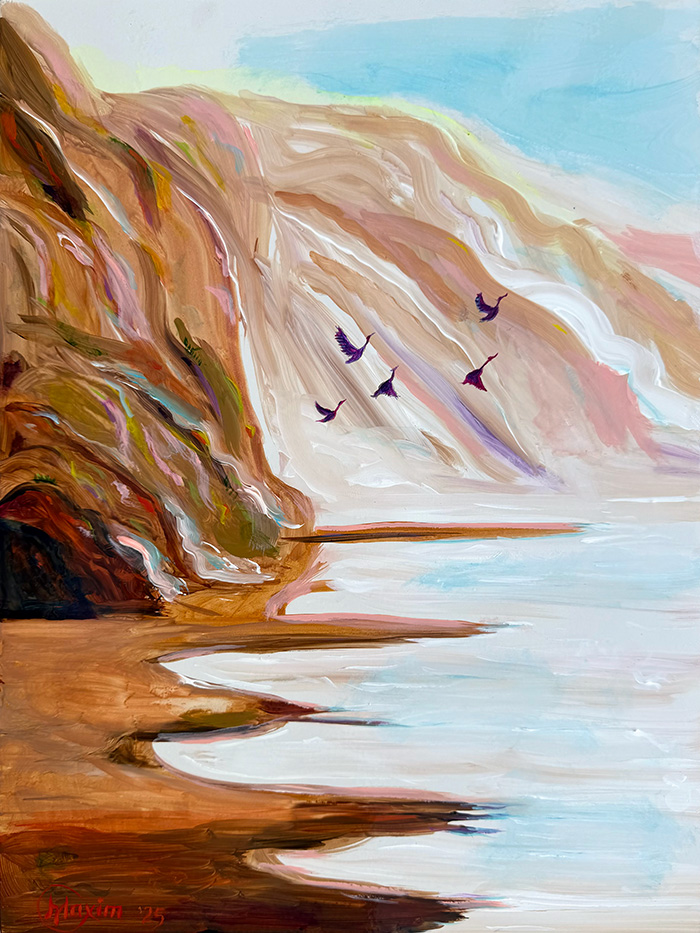
"Pacific Ascent", acrylic on gesso board, Bishop Maxim, 2025
Along the Pacific cliffs near San Francisco, earth and sea lean toward one another in warm, breathing colors. The bluffs rise like ancient hymns, softened by mist, while a small flock of violet birds sweeps across the open sky. Their flight gathers the scene into a single gentle motion—where the coast becomes a memory, a longing, and a promise carried lightly over the bay.
Along the Pacific cliffs near San Francisco, earth and sea lean toward one another in warm, breathing colors. The bluffs rise like ancient hymns, softened by mist, while a small flock of violet birds sweeps across the open sky. Their flight gathers the scene into a single gentle motion—where the coast becomes a memory, a longing, and a promise carried lightly over the bay.
- Details
- Category: Maxim
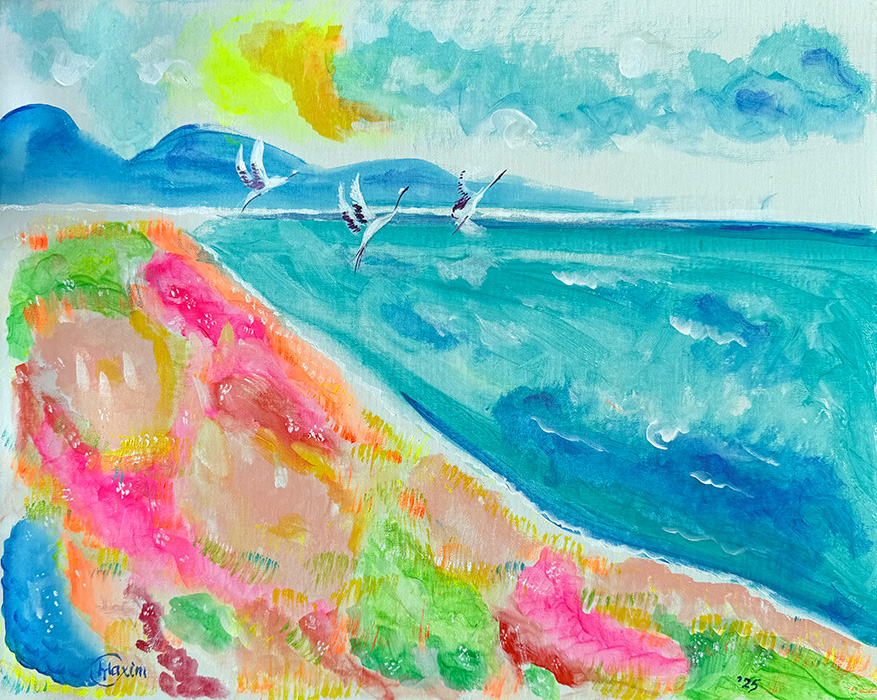
"Three Wings over the Northern Coast", acrylic on canvas board, Bishop Maxim, 2025
Bathed in bright Pacific sunlight, this coastal landscape captures the Bay Area’s northern shores in vibrant, living color. The sea glows in shifting turquoise, the hills rise in quiet blue, and three white birds lift across the sky like notes of a soaring melody. Nature appears here as background with radiant presence—alive, spirited, and full of movement.
Bathed in bright Pacific sunlight, this coastal landscape captures the Bay Area’s northern shores in vibrant, living color. The sea glows in shifting turquoise, the hills rise in quiet blue, and three white birds lift across the sky like notes of a soaring melody. Nature appears here as background with radiant presence—alive, spirited, and full of movement.
- Details
- Category: Maxim
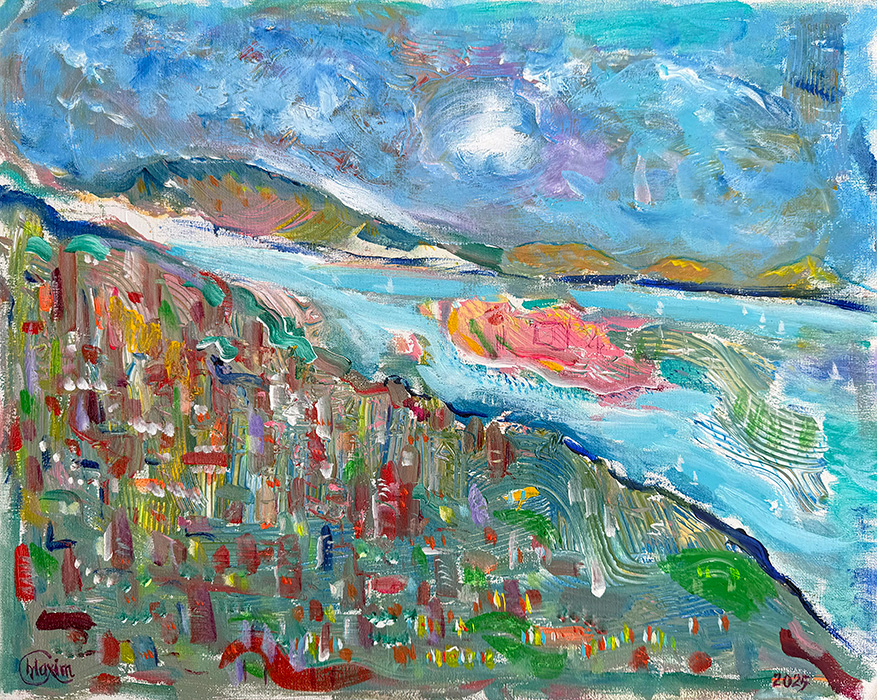
"San Francisco Bay, Morning Reverie", acrylic on canvas, Bishop Maxim, 2025
In this vivid, dreamlike rendering of San Francisco, the city rises as a mosaic of color—reds, greens, and violets suggesting its winding hills and lively neighborhoods. The coastline arcs toward luminous turquoise waters, alive with shifting currents and scattered white sails. At the center, a warm rose-gold island glows like an ember on the Bay. A swirling sky of blues and violets crowns the scene, giving the landscape a sense of breath and quiet transcendence. The work evokes not the literal city, but the spirit of San Francisco—restless, radiant, and ever renewed.
In this vivid, dreamlike rendering of San Francisco, the city rises as a mosaic of color—reds, greens, and violets suggesting its winding hills and lively neighborhoods. The coastline arcs toward luminous turquoise waters, alive with shifting currents and scattered white sails. At the center, a warm rose-gold island glows like an ember on the Bay. A swirling sky of blues and violets crowns the scene, giving the landscape a sense of breath and quiet transcendence. The work evokes not the literal city, but the spirit of San Francisco—restless, radiant, and ever renewed.
- Details
- Category: Maxim
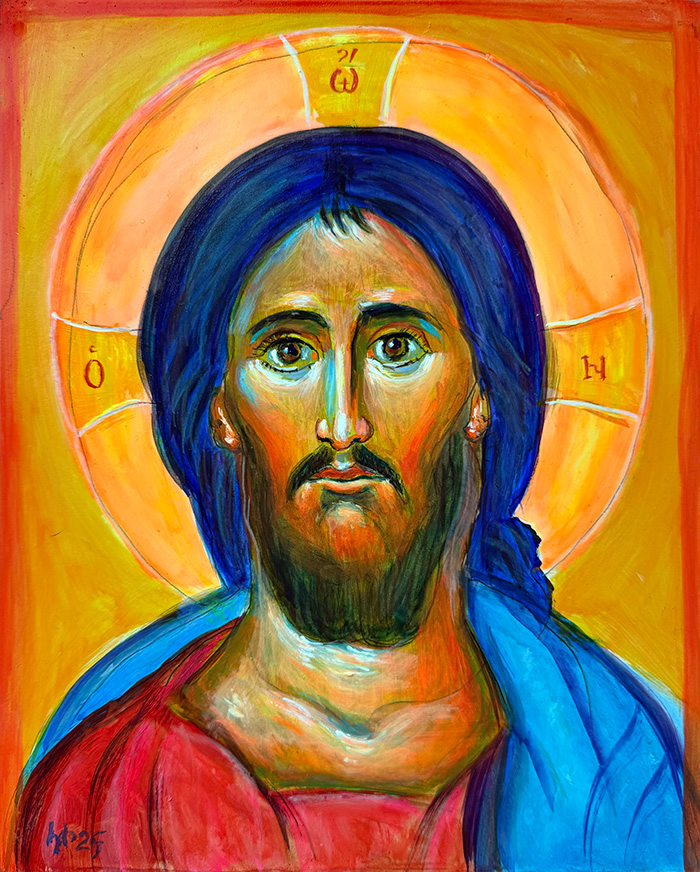
"Christ of the Eternal Now", acrylic on gesso board, Bishop Maxim, 2025
This work reinterprets the direct, soulful gaze of the ancient Fayum mummy portraits to depict Christ. The figure is rendered with depth and intense realism, achieved through thick, deliberate impasto. The warm, vital flesh tones are built up with smoldering oranges and reds, suggesting an inner, divine fire that contrasts sharply with the deep, cool blues framing the figure. It is a fusion of classical intensity and a lyrical contemporary hand, presenting a Christ who is both profoundly human and quietly divine, everlasting.
This work reinterprets the direct, soulful gaze of the ancient Fayum mummy portraits to depict Christ. The figure is rendered with depth and intense realism, achieved through thick, deliberate impasto. The warm, vital flesh tones are built up with smoldering oranges and reds, suggesting an inner, divine fire that contrasts sharply with the deep, cool blues framing the figure. It is a fusion of classical intensity and a lyrical contemporary hand, presenting a Christ who is both profoundly human and quietly divine, everlasting.
- Details
- Category: Maxim
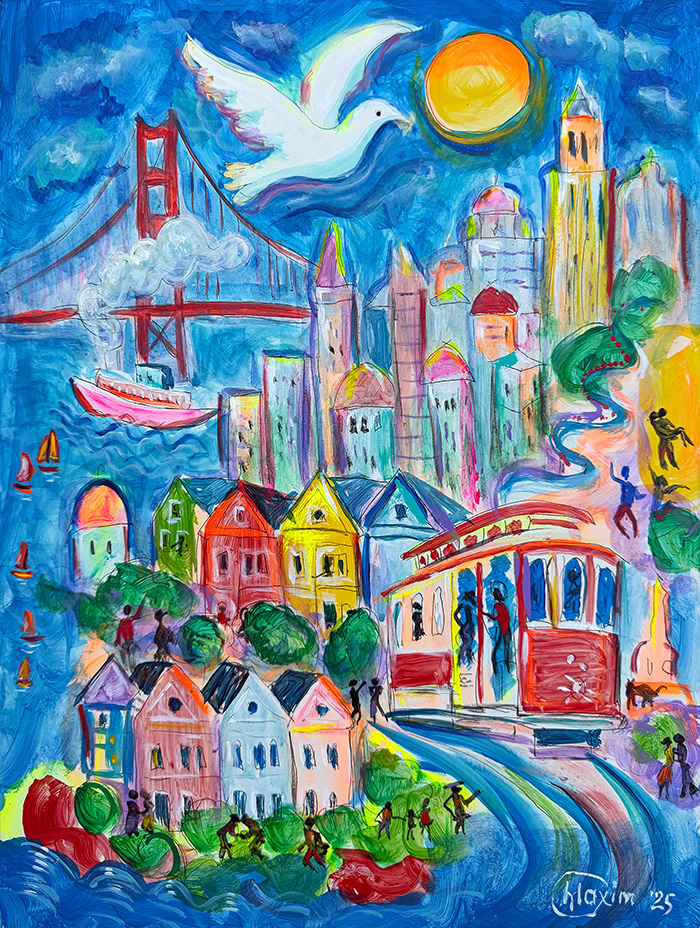
"City of Light and Wings: San Francisco", acrylic on gesso board, Bishop Maxim, 2025
In City of Light and Wings: San Francisco, Bishop Maxim transforms the Bay Area into a lyrical mosaic of color and movement. The familiar landmarks—the Golden Gate Bridge, the rolling cable car, the painted houses—are reimagined through a post-Byzantine chromatic vision that converges sacred and civic harmonies. A radiant dove soars above the skyline, symbolizing both the city’s spirit of freedom and its yearning for peace. Among these forms, silhouettes of people in motion animate the scene: walking along the waterfront, ascending the hills, greeting one another in passing. Their gestures echo the pulse of the city’s daily life. The swirling streets, sunlit domes, and sailing boats pulse with life, merging ocean, sky, and humanity into a single rhythm of joy. Through its vivid hues and fluid lines, the painting celebrates San Francisco not as a fixed place but as a luminous communion of nature, art, and the human heart.
In City of Light and Wings: San Francisco, Bishop Maxim transforms the Bay Area into a lyrical mosaic of color and movement. The familiar landmarks—the Golden Gate Bridge, the rolling cable car, the painted houses—are reimagined through a post-Byzantine chromatic vision that converges sacred and civic harmonies. A radiant dove soars above the skyline, symbolizing both the city’s spirit of freedom and its yearning for peace. Among these forms, silhouettes of people in motion animate the scene: walking along the waterfront, ascending the hills, greeting one another in passing. Their gestures echo the pulse of the city’s daily life. The swirling streets, sunlit domes, and sailing boats pulse with life, merging ocean, sky, and humanity into a single rhythm of joy. Through its vivid hues and fluid lines, the painting celebrates San Francisco not as a fixed place but as a luminous communion of nature, art, and the human heart.
- Details
- Category: Maxim
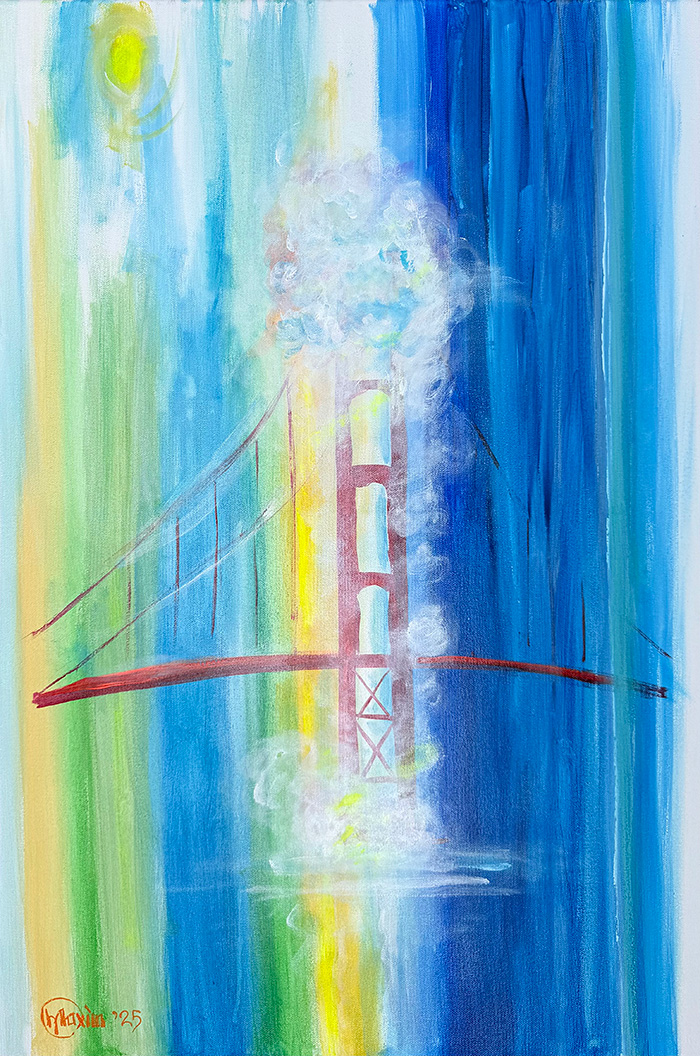
"Golden Gate in Morning Light", acrylic on canvas, Bishop Maxim, 2025
The painting deconstructs the Golden Gate's steel structure, reframing it as a study in atmosphere and light. The vertical composition uses cool blues and greens, sharply counterpointed by a vibrant golden swirl of sun. This juxtaposition elevates the San Francisco fog from mere weather to a central, unifying formal element, capturing the quiet miracle of dawn over the Bay. The application of color in veiled layers suggests the mist is actively dissolving the bridge's edges, lending the piece an ephemeral quality. This intentional handling creates a sense of transient mystery, where the architecture is completely transfigured into a poetic axis.
The painting deconstructs the Golden Gate's steel structure, reframing it as a study in atmosphere and light. The vertical composition uses cool blues and greens, sharply counterpointed by a vibrant golden swirl of sun. This juxtaposition elevates the San Francisco fog from mere weather to a central, unifying formal element, capturing the quiet miracle of dawn over the Bay. The application of color in veiled layers suggests the mist is actively dissolving the bridge's edges, lending the piece an ephemeral quality. This intentional handling creates a sense of transient mystery, where the architecture is completely transfigured into a poetic axis.
- Details
- Category: Maxim
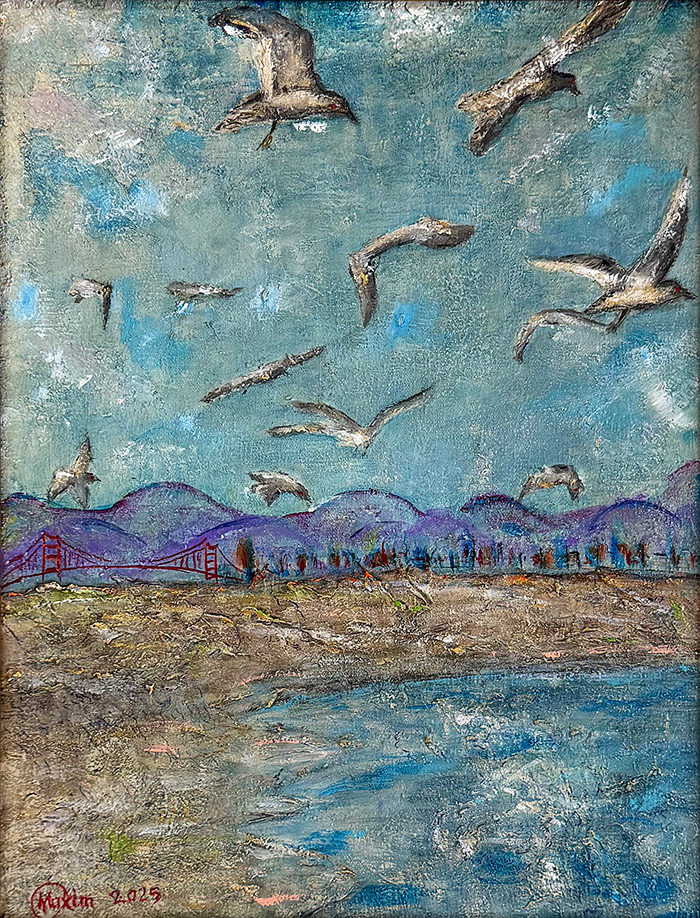
"Seagulls over the Bay", mixed media on canvas, multi-layered impasto technique, Bishop Maxim, 2025
In Seagulls over the Bay, Bishop Maxim captures the lyrical breath of San Francisco’s shoreline beneath a sky alive with motion and light. The seagulls—spirits of freedom—sweep above the shimmering water, their wings echoing the rhythm of Jonathan Livingston Seagull’s quest for transcendence. Through a richly layered technique, translucent tones of violet, turquoise, and gold unfold like musical chords, creating depth that feels both earthly and ethereal. The distant city glows softly across the horizon, bridging the seen and the unseen, matter and meaning. As the birds vanish into the radiant expanse, the painting seems to whisper its secret: find out what you already know.
In Seagulls over the Bay, Bishop Maxim captures the lyrical breath of San Francisco’s shoreline beneath a sky alive with motion and light. The seagulls—spirits of freedom—sweep above the shimmering water, their wings echoing the rhythm of Jonathan Livingston Seagull’s quest for transcendence. Through a richly layered technique, translucent tones of violet, turquoise, and gold unfold like musical chords, creating depth that feels both earthly and ethereal. The distant city glows softly across the horizon, bridging the seen and the unseen, matter and meaning. As the birds vanish into the radiant expanse, the painting seems to whisper its secret: find out what you already know.
- Details
- Category: Maxim
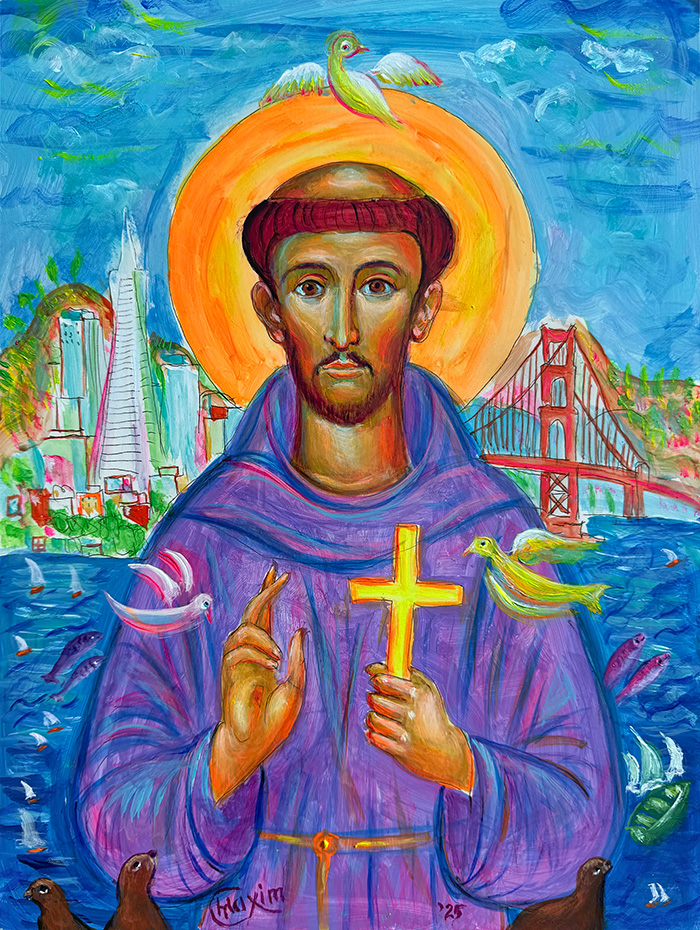
"Francis of Assisi in San Francisco", acrylic on gesso board, Bishop Maxim, 2025
Bathed in the pearly light of the Pacific, Saint Francis stands as both patron and witness to the city that bears his name. Around him, the living world awakens—birds wheel through the coastal haze, sea lions surface like benedictions from the Bay, and the golden dog at his feet listens to the city’s pulse. Set against the skyline veiled in fog, Francis is no longer a solitary ascetic but a companion to creation itself. His robe gathers the earth tones of sand and wharf, his gesture of blessing opens toward the bridges and waters that breathe with the same rhythm as the animals around him. The painting becomes a hymn of kinship—a vision in which the saint’s prayer extends beyond human bounds, binding San Francisco’s wild and urban life into a luminous ecology of grace.
Bathed in the pearly light of the Pacific, Saint Francis stands as both patron and witness to the city that bears his name. Around him, the living world awakens—birds wheel through the coastal haze, sea lions surface like benedictions from the Bay, and the golden dog at his feet listens to the city’s pulse. Set against the skyline veiled in fog, Francis is no longer a solitary ascetic but a companion to creation itself. His robe gathers the earth tones of sand and wharf, his gesture of blessing opens toward the bridges and waters that breathe with the same rhythm as the animals around him. The painting becomes a hymn of kinship—a vision in which the saint’s prayer extends beyond human bounds, binding San Francisco’s wild and urban life into a luminous ecology of grace.
- Details
- Category: Maxim
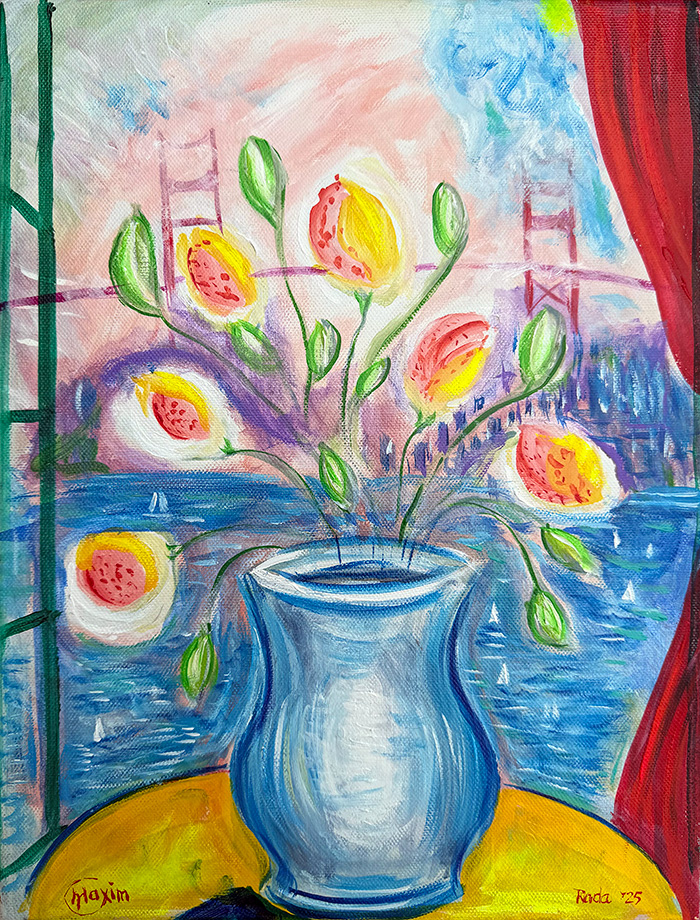
"Bay View from the Window", acrylic on canvas, 2025, Bishop Maxim and Radmila Vasiljevic
From the quiet interior of a city apartment, the Bay unfolds through a window — one wing ajar, a curtain gently swaying as if breathing with the wind outside. A single vase stands near the sill, its form echoing the contours of the distant hills. The city’s rhythm hums beyond: muted sailboats, bridges dissolving in fog, and the glimmer of light upon the water. This painting invites a contemplative pause — a dialogue between interior stillness and the living pulse of San Francisco, between the intimacy of home and the vast openness of the Bay.
From the quiet interior of a city apartment, the Bay unfolds through a window — one wing ajar, a curtain gently swaying as if breathing with the wind outside. A single vase stands near the sill, its form echoing the contours of the distant hills. The city’s rhythm hums beyond: muted sailboats, bridges dissolving in fog, and the glimmer of light upon the water. This painting invites a contemplative pause — a dialogue between interior stillness and the living pulse of San Francisco, between the intimacy of home and the vast openness of the Bay.
- Details
- Category: Maxim
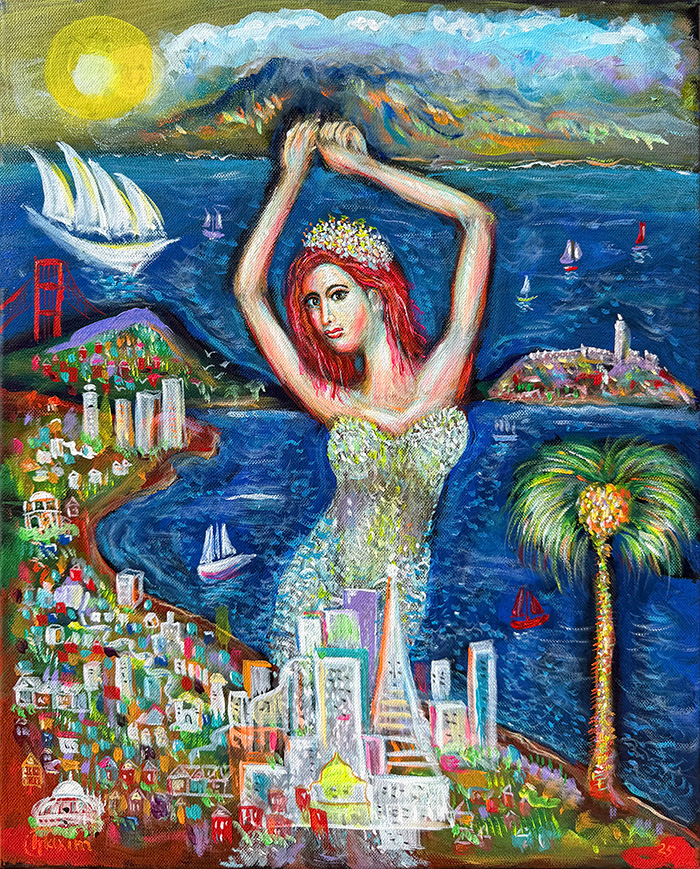
"The Mermaid of San Francisco Bay", acrylic on canvas, Bishop Maxim, 2025
The Mermaid of San Francisco Bay stands between myth and metropolis — a gentle sentinel of the Pacific, gazing with innocent wonder upon the city shimmering beyond her reach. Her tender, resolute posture suggests a being suspended between sea and sky: one hand anchored to the earth’s edge, the other tracing the horizon where water meets skyline. The Golden Gate Bridge glows like a crimson thread through the mist, while sailboats drift across the turquoise calm. Silver fog swirls through her hair as if the breath of the Bay had taken form, whispering stories of longing and return. Bathed in sea-green, fog-gray, and sunset-gold, the scene reveals a fragile harmony between nature and city — between timeless myth and the living pulse of modern life. Her innocent gaze becomes a mirror of San Francisco itself: open to the infinite, yearning, and forever becoming.
The Mermaid of San Francisco Bay stands between myth and metropolis — a gentle sentinel of the Pacific, gazing with innocent wonder upon the city shimmering beyond her reach. Her tender, resolute posture suggests a being suspended between sea and sky: one hand anchored to the earth’s edge, the other tracing the horizon where water meets skyline. The Golden Gate Bridge glows like a crimson thread through the mist, while sailboats drift across the turquoise calm. Silver fog swirls through her hair as if the breath of the Bay had taken form, whispering stories of longing and return. Bathed in sea-green, fog-gray, and sunset-gold, the scene reveals a fragile harmony between nature and city — between timeless myth and the living pulse of modern life. Her innocent gaze becomes a mirror of San Francisco itself: open to the infinite, yearning, and forever becoming.
- Details
- Category: Maxim
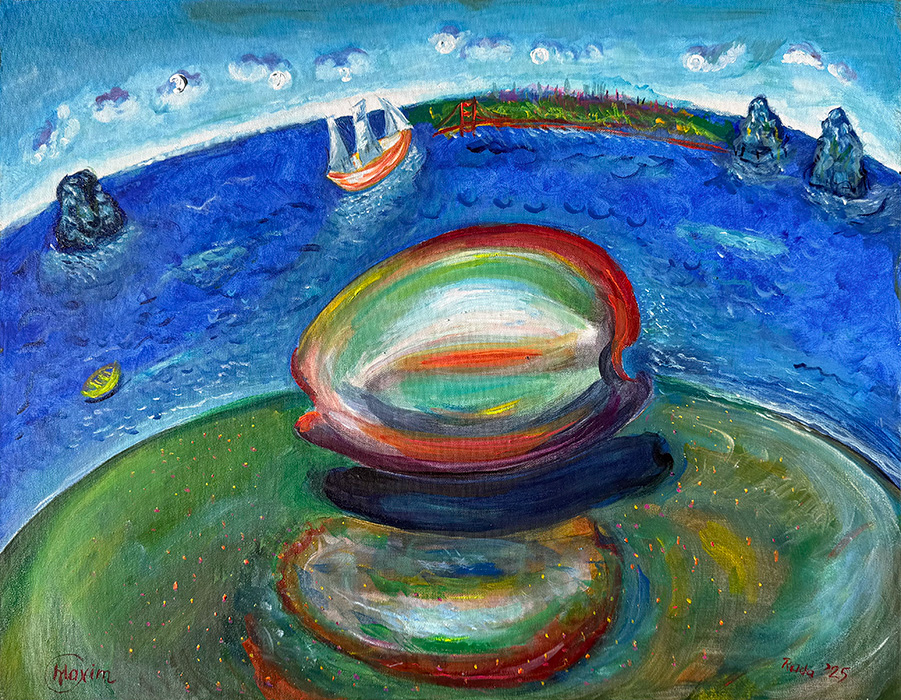
"Pearl of the Bay", acrylic on canvas, Bishop Maxim, 2025
The Pacific’s vast breath captured in a single shell, echoing the song of San Francisco’s waters.
The Pacific’s vast breath captured in a single shell, echoing the song of San Francisco’s waters.
- Details
- Category: Maxim
"Janis Rising Over the Bay", acrylic on canvas panel, Bishop Maxim, 2025
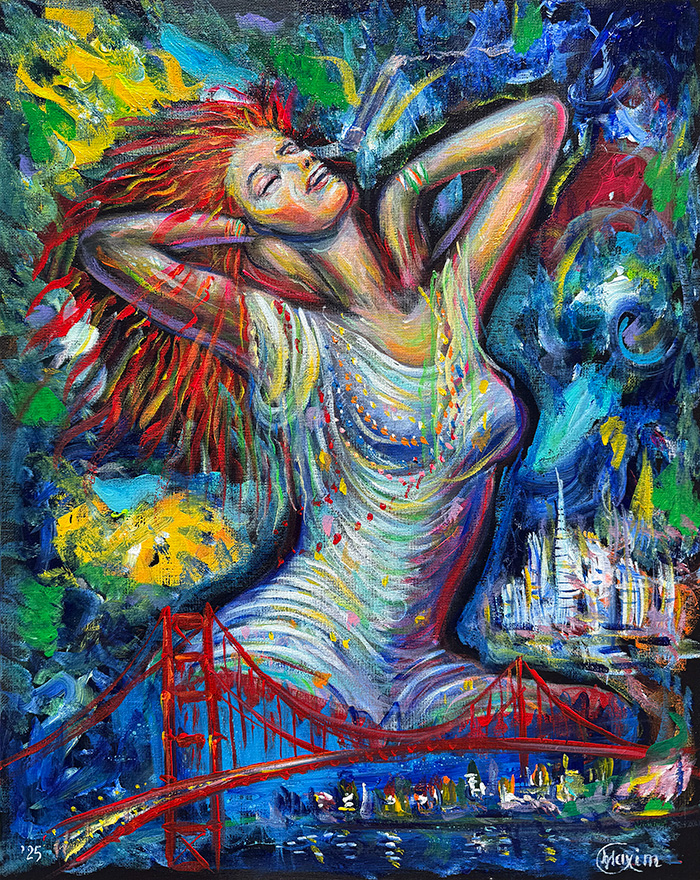
In this luminous vision, Janis Joplin — muse of freedom and raw emotion—rises like a spirit above the Golden Gate Bridge, her song dissolving into the very sky. The bridge, painted in bold crimson, anchors her ecstatic presence to the city that shaped her fire: San Francisco. The skyline glimmers like musical notes; waves of blue, green, and violet swirl in rhythm with her untamed voice. Maxim fuses portrait and landscape into a single hymn—a celebration of the city’s soul, its bridges between sound and light, rebellion and beauty.
In this luminous vision, Janis Joplin — muse of freedom and raw emotion—rises like a spirit above the Golden Gate Bridge, her song dissolving into the very sky. The bridge, painted in bold crimson, anchors her ecstatic presence to the city that shaped her fire: San Francisco. The skyline glimmers like musical notes; waves of blue, green, and violet swirl in rhythm with her untamed voice. Maxim fuses portrait and landscape into a single hymn—a celebration of the city’s soul, its bridges between sound and light, rebellion and beauty.
- Details
- Category: Maxim
"Pacifica", acrylic on canvas, 2020, Bishop Maxim and Rada Vasiljević
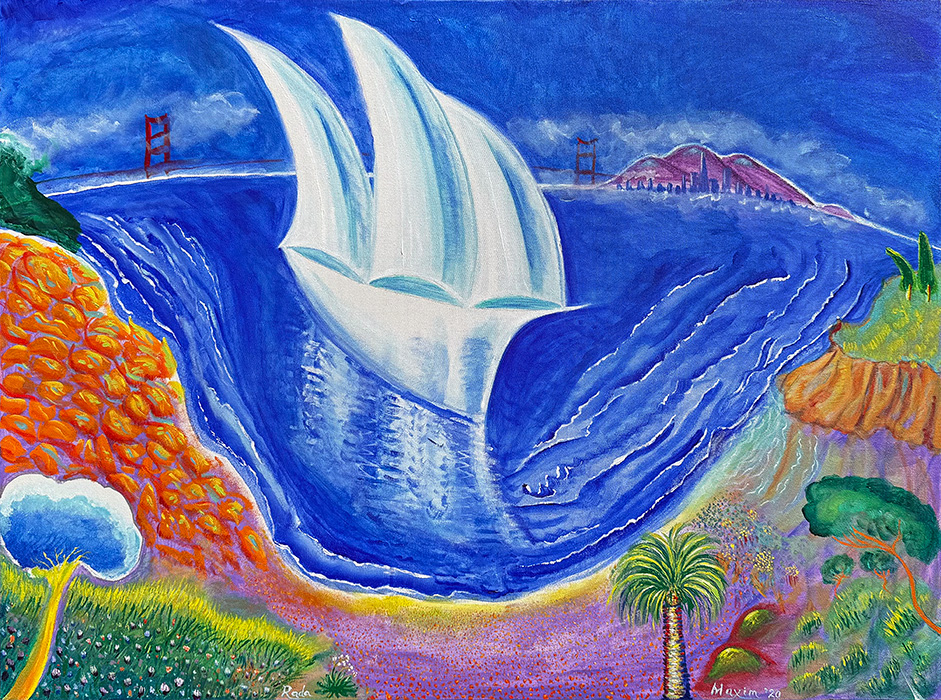
In Pacifica, sea and sky melt into one luminous horizon, where a single white-sailed vessel drifts across the indigo expanse. The waves shimmer with gold and emerald, as though the ocean itself breathes light. Along the shore, radiant hues of violet and coral evoke both arrival and farewell—a moment suspended between peace and movement. With its vivid palette and lyrical brushwork, the painting transforms the Pacific coast into a vision of serenity and spiritual passage, where nature becomes an icon of eternity.
In Pacifica, sea and sky melt into one luminous horizon, where a single white-sailed vessel drifts across the indigo expanse. The waves shimmer with gold and emerald, as though the ocean itself breathes light. Along the shore, radiant hues of violet and coral evoke both arrival and farewell—a moment suspended between peace and movement. With its vivid palette and lyrical brushwork, the painting transforms the Pacific coast into a vision of serenity and spiritual passage, where nature becomes an icon of eternity.
- Details
- Category: Maxim
"Alma of San Francisco", acrylic on canvas, Bishop Maxim, 2025
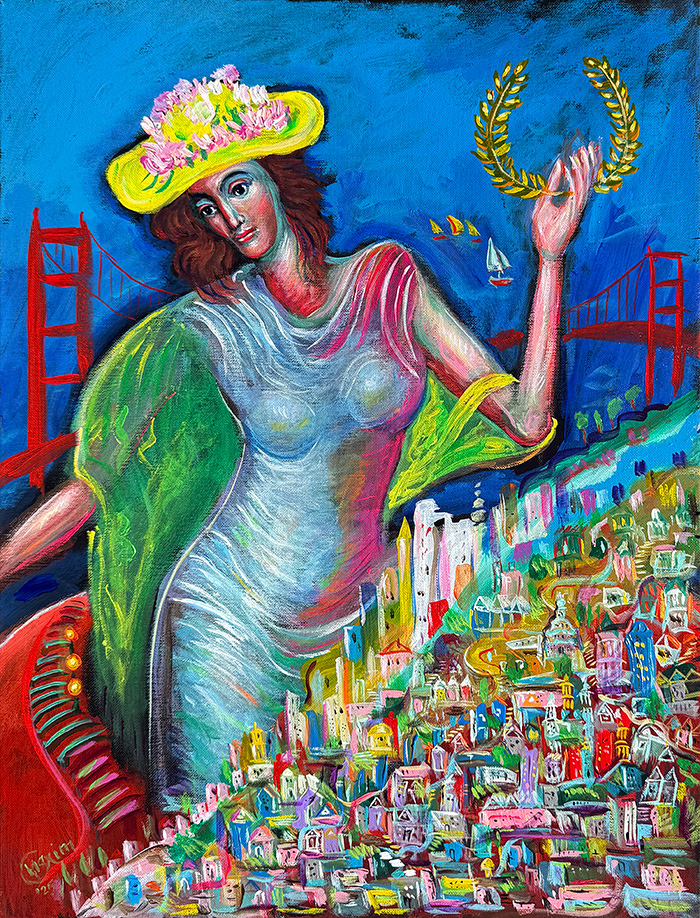
In this radiant vision of Alma de Bretteville Spreckels—the "Great Grand Dame of San Francisco"—the city itself seems to rise at her feet like a jeweled offering. Draped in flowing silver and green, crowned with blossoms and a sunlit hat, Alma extends a golden laurel toward the sky, as if blessing the city she helped shape. Behind her, the twin towers of the Golden Gate Bridge gleam in vermilion, anchoring the mythic to the real. Blending Byzantine luminosity with Californian exuberance, the painting transforms Alma into an allegory of grace, resilience, and civic beauty—a patroness presiding eternally over her beloved San Francisco.
In this radiant vision of Alma de Bretteville Spreckels—the "Great Grand Dame of San Francisco"—the city itself seems to rise at her feet like a jeweled offering. Draped in flowing silver and green, crowned with blossoms and a sunlit hat, Alma extends a golden laurel toward the sky, as if blessing the city she helped shape. Behind her, the twin towers of the Golden Gate Bridge gleam in vermilion, anchoring the mythic to the real. Blending Byzantine luminosity with Californian exuberance, the painting transforms Alma into an allegory of grace, resilience, and civic beauty—a patroness presiding eternally over her beloved San Francisco.
- Details
- Category: Maxim
"Red Sail over Sausalito Bay", acrylic on canvas panel, Bishop Maxim and Rada Vasiljević, 2025
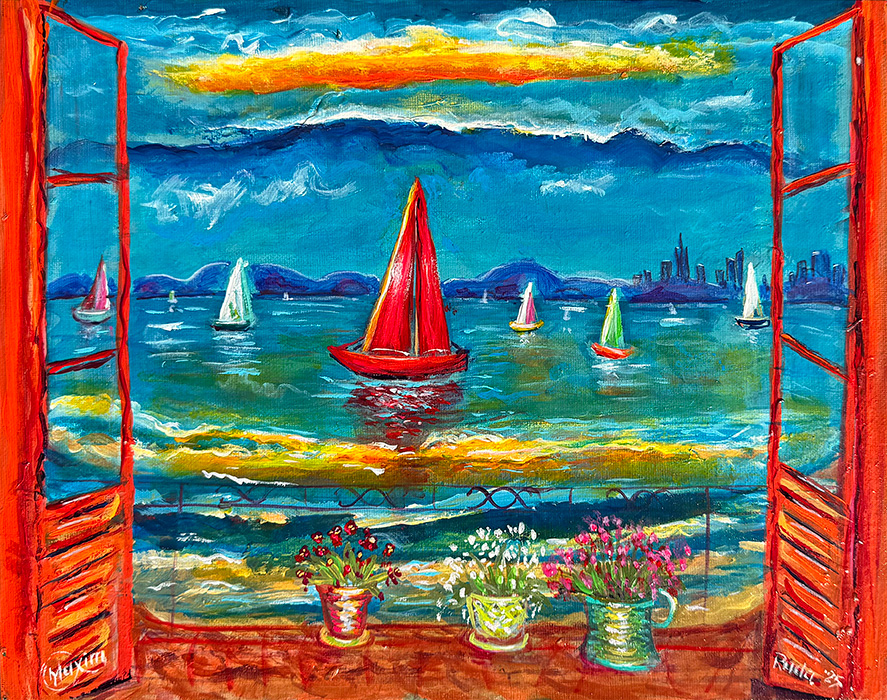
Through open crimson shutters, a vivid red sailboat drifts across the turquoise waters of Sausalito Bay toward the distant San Francisco skyline. Golden waves and flower pots in bloom frame the view, merging homely warmth with the call of the open sea—a moment where stillness and adventure meet beneath the California sun.
Through open crimson shutters, a vivid red sailboat drifts across the turquoise waters of Sausalito Bay toward the distant San Francisco skyline. Golden waves and flower pots in bloom frame the view, merging homely warmth with the call of the open sea—a moment where stillness and adventure meet beneath the California sun.
- Details
- Category: Maxim
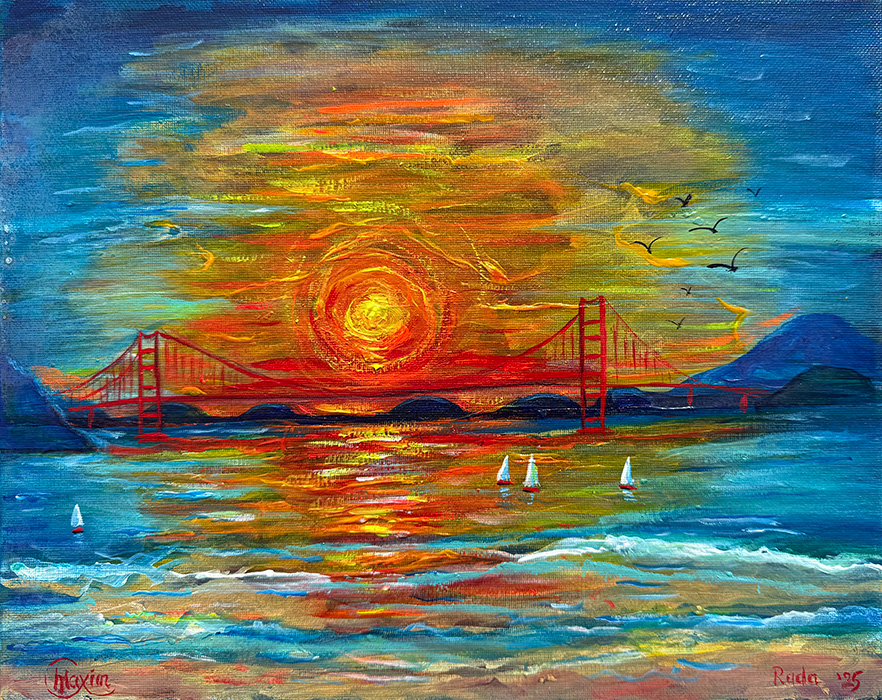
"Fire over the Golden Gate", acrylic on canvas, 2025, Bishop Maxim & Radmila Vasiljevic
In Fire over the Golden Gate, the artists capture the Bay’s sunset as a living flame — a radiant vortex of light pouring over the bridge and sea. The iconic Golden Gate Bridge emerges in molten red against a glowing sky, while sailboats drift serenely through shimmering reflections. The interplay of bold, swirling brushstrokes and delicate transparencies evokes both movement and stillness — the eternal rhythm of sea, sky, and spirit meeting at day’s end.
In Fire over the Golden Gate, the artists capture the Bay’s sunset as a living flame — a radiant vortex of light pouring over the bridge and sea. The iconic Golden Gate Bridge emerges in molten red against a glowing sky, while sailboats drift serenely through shimmering reflections. The interplay of bold, swirling brushstrokes and delicate transparencies evokes both movement and stillness — the eternal rhythm of sea, sky, and spirit meeting at day’s end.
- Details
- Category: Maxim
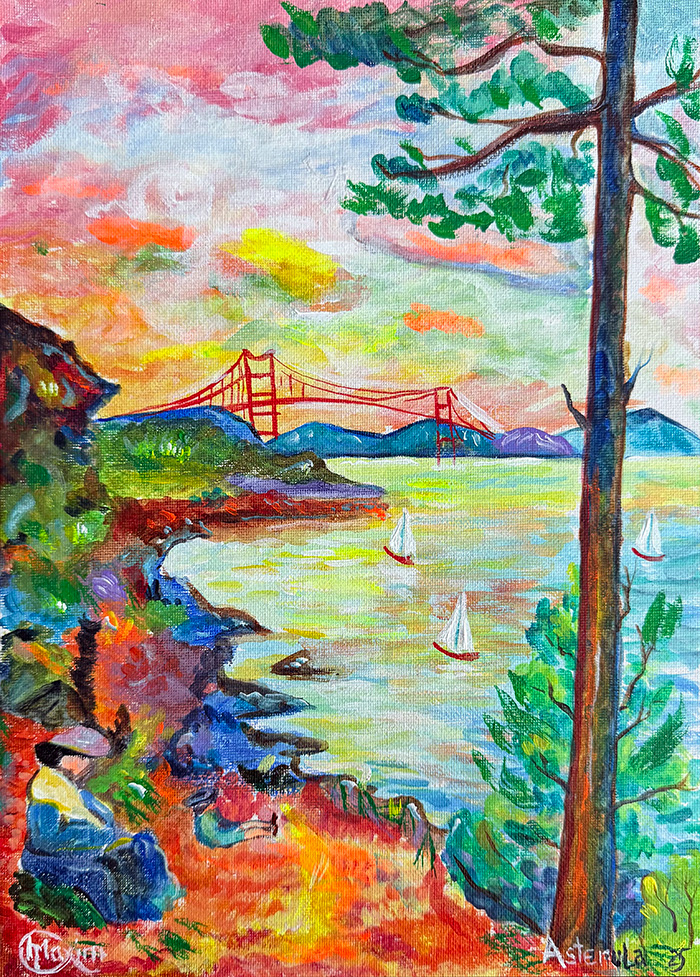
"Evening Light over the Golden Gate", acrylic on canvas, 2025, Bishop Maxim & Asteroula Thermou
The painters capture the Bay’s twilight in a vibrant symphony of color. The Golden Gate Bridge glows in crimson beneath a radiant sky, while sailboats drift through golden waters. A solitary figure and a steadfast pine evoke quiet reflection — a moment where light, land, and spirit meet in harmony.
The painters capture the Bay’s twilight in a vibrant symphony of color. The Golden Gate Bridge glows in crimson beneath a radiant sky, while sailboats drift through golden waters. A solitary figure and a steadfast pine evoke quiet reflection — a moment where light, land, and spirit meet in harmony.
- Details
- Category: Maxim
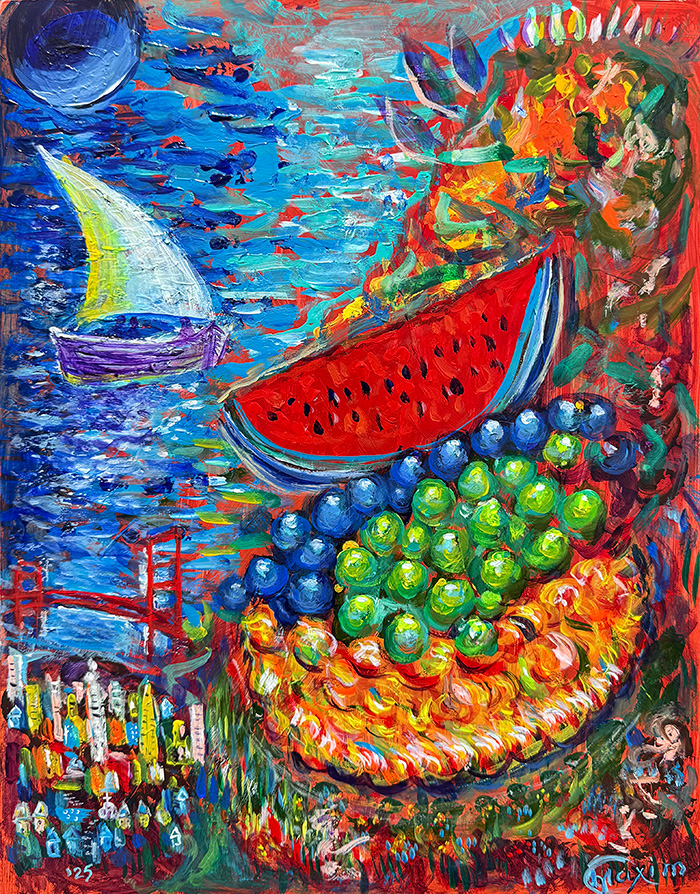
"Moonlit Harvest, Napa Valley", acrylic on gesso board, 2025
A poetic fusion of Napa Valley’s vineyards and the San Francisco Bay, this painting glows with moonlit stillness. In the foreground, grapes and a watermelon evoke abundance, while a ship drifts beneath the night sky toward the city’s distant lights. With its impressionistic color and Byzantine harmony, the work captures the mystery of harvest — where earth’s fruit and heaven’s light meet in quiet celebration.
A poetic fusion of Napa Valley’s vineyards and the San Francisco Bay, this painting glows with moonlit stillness. In the foreground, grapes and a watermelon evoke abundance, while a ship drifts beneath the night sky toward the city’s distant lights. With its impressionistic color and Byzantine harmony, the work captures the mystery of harvest — where earth’s fruit and heaven’s light meet in quiet celebration.
- Details
- Category: Maxim
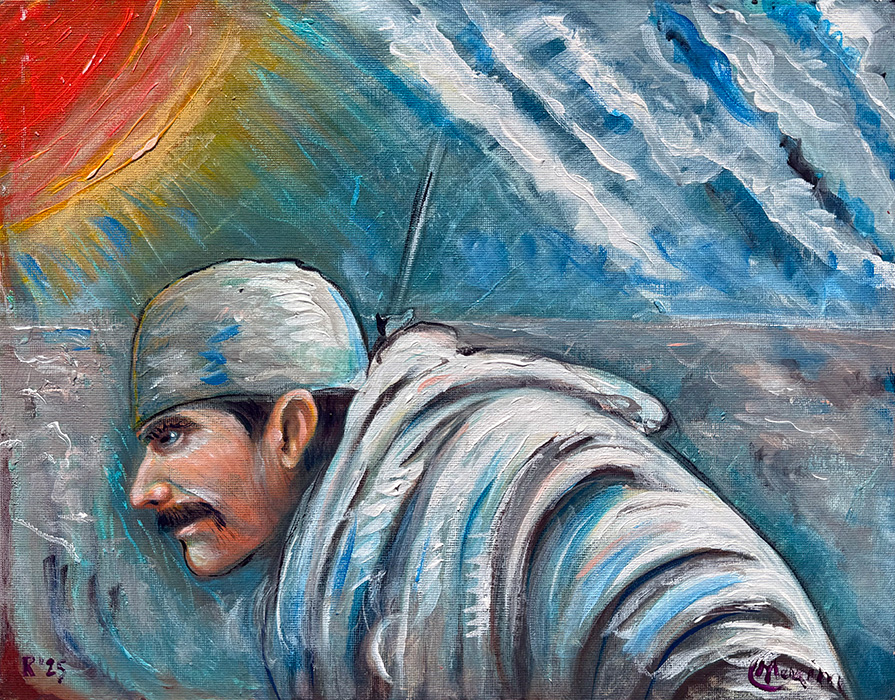
"Serbian Soldier, ‘Hawkeye’ (Oko sokolovo) World War I", acrylic on canvas panel, 2025, by Bishop Maxim and Radmila Vasiljevic
Renowned for his exceptional marksmanship and fearless precision, this Serbian soldier—nicknamed “Hawkeye” (Oko sokolovo)—became a symbol of vigilance and courage during World War I. His sharp vision and unwavering composure under fire embodied the spirit of a nation defending its freedom amidst immense adversity.
Renowned for his exceptional marksmanship and fearless precision, this Serbian soldier—nicknamed “Hawkeye” (Oko sokolovo)—became a symbol of vigilance and courage during World War I. His sharp vision and unwavering composure under fire embodied the spirit of a nation defending its freedom amidst immense adversity.
- Details
- Category: Maxim
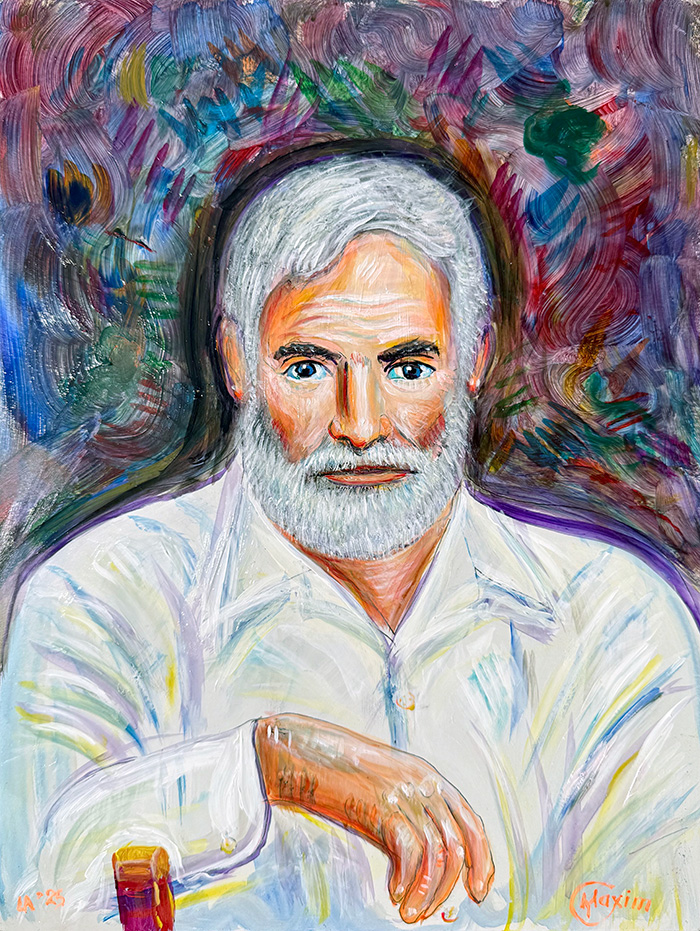
"Portrait of Ernest Hemingway", acrylic on gesso board, Bishop Maxim, San Marino, 2025
In an incredible way, one that none of us expected, Bishop Maximos entered into the soul of Hemingway and understood The Old Man and the Sea to the highest degree possible. He painted a lofty intellectual with a deep and thoughtful gaze, which at the same time belongs to a fisherman in his boat, exuding the scent of salt and the fishiness of the sea. The viewer of the painting almost senses the smell of the fish and discerns in that gaze joy, blessing, something sacred, but also the fear of the sea—the fear of the inevitable: that the great fish he has caught might be eaten away before he reaches his harbor. Hemingway carries this very fear in his eyes, and thus this portrait by Maximos is among the most inspired. It makes us participants with all those students of Hemingway who immerse themselves in his work and draw from it truths as genuine as the four Gospels. —Stamatis Skliris
In an incredible way, one that none of us expected, Bishop Maximos entered into the soul of Hemingway and understood The Old Man and the Sea to the highest degree possible. He painted a lofty intellectual with a deep and thoughtful gaze, which at the same time belongs to a fisherman in his boat, exuding the scent of salt and the fishiness of the sea. The viewer of the painting almost senses the smell of the fish and discerns in that gaze joy, blessing, something sacred, but also the fear of the sea—the fear of the inevitable: that the great fish he has caught might be eaten away before he reaches his harbor. Hemingway carries this very fear in his eyes, and thus this portrait by Maximos is among the most inspired. It makes us participants with all those students of Hemingway who immerse themselves in his work and draw from it truths as genuine as the four Gospels. —Stamatis Skliris
- Details
- Category: Maxim
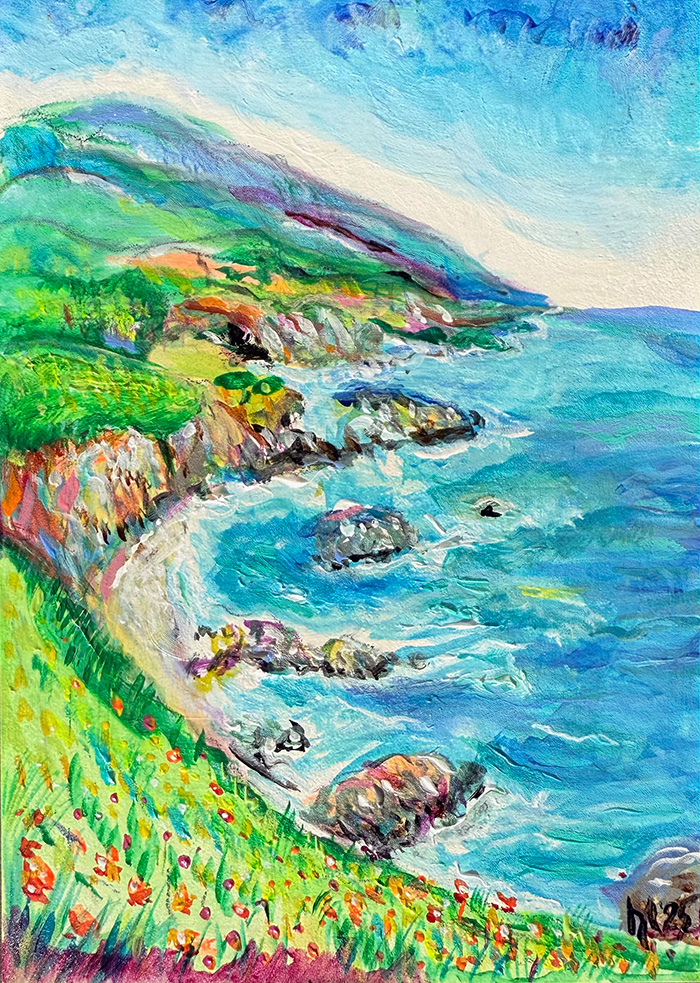
"Pacific Edge, San Francisco Coast", acrylic on gesso board, 7x9 inch, Bishop Maxim, 2025
This painting captures the rugged Pacific shoreline just north of San Francisco with a vivid, impressionistic palette. Rolling green hills plunge toward turquoise waters, their edges alive with orange and crimson wildflowers reminiscent of California poppies. The brushwork, loose yet deliberate, echoes the plein-air tradition while embracing a modern Fauvist intensity. Waves curl around scattered rocks, and the sky stretches in layered blues, evoking the meeting of land, sea, and air as a timeless, living icon of the California coast.
This painting captures the rugged Pacific shoreline just north of San Francisco with a vivid, impressionistic palette. Rolling green hills plunge toward turquoise waters, their edges alive with orange and crimson wildflowers reminiscent of California poppies. The brushwork, loose yet deliberate, echoes the plein-air tradition while embracing a modern Fauvist intensity. Waves curl around scattered rocks, and the sky stretches in layered blues, evoking the meeting of land, sea, and air as a timeless, living icon of the California coast.
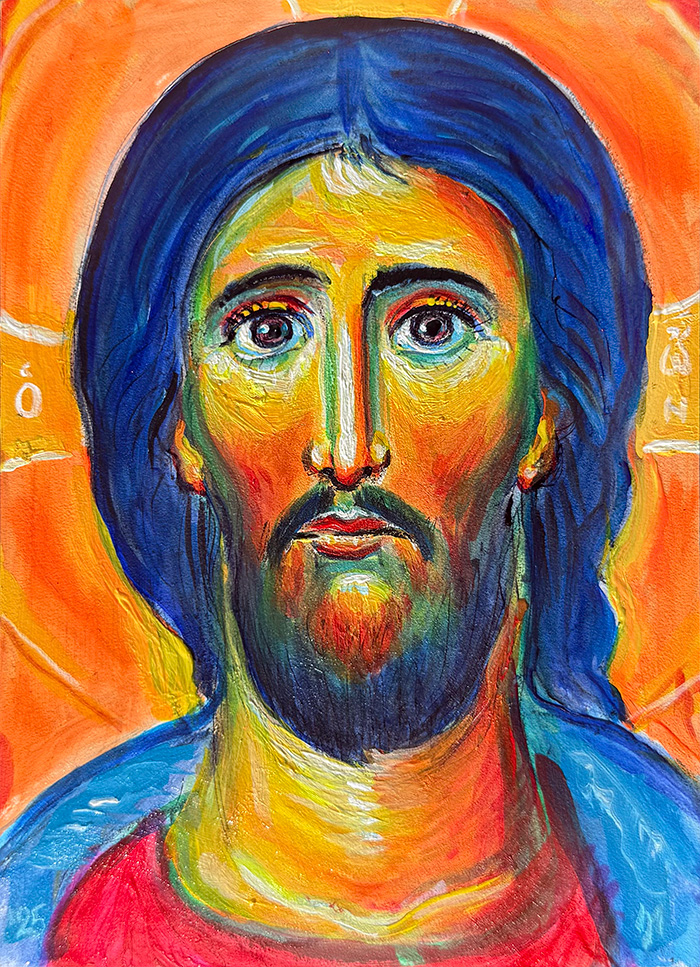
- Details
- Category: Maxim
"Christ the Same Throughout the Ages", acrylic on gesso board, 7x9 inch, Bishop Maxim, 2025
Drawing inspiration from the ancient Mandylion and the haunting realism of the Fayum portraits, this contemporary icon also resonates with the vibrant, post-Byzantine vision of Father Stamatis Skliris. Like Skliris, the artist uses bold acrylics, luminous contrasts, and fluid brushwork to translate sacred tradition into modern color and movement. The elongated face, frontal gaze, and vivid eyes echo the timeless immediacy of Fayum encaustics, while the saturated oranges, deep blues, and radiant yellows evoke the uncreated light of the Transfiguration. Tradition and innovation converge here, inviting viewers into a living encounter with Christ.
Drawing inspiration from the ancient Mandylion and the haunting realism of the Fayum portraits, this contemporary icon also resonates with the vibrant, post-Byzantine vision of Father Stamatis Skliris. Like Skliris, the artist uses bold acrylics, luminous contrasts, and fluid brushwork to translate sacred tradition into modern color and movement. The elongated face, frontal gaze, and vivid eyes echo the timeless immediacy of Fayum encaustics, while the saturated oranges, deep blues, and radiant yellows evoke the uncreated light of the Transfiguration. Tradition and innovation converge here, inviting viewers into a living encounter with Christ.
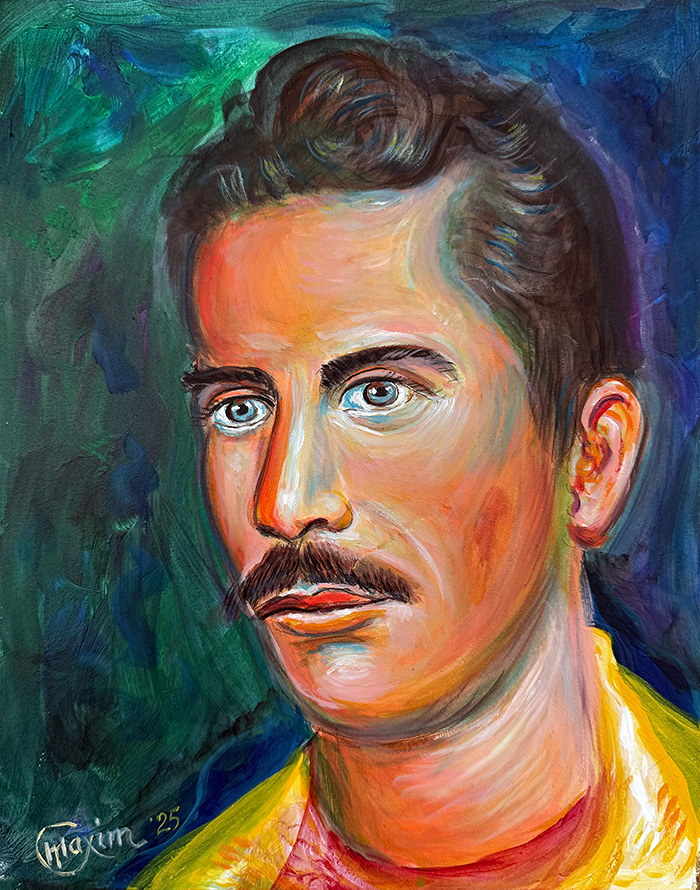
- Details
- Category: Maxim
"John Steinbeck", acrylic on canvas, Bishop Maxim, 2025
Steinbeck’s steady gaze and finely modeled features emerge from a tide of blue-green and earthen hues, evoking the California valleys he immortalized in prose. Expressive brushwork and radiant color capture the likeness and the moral gravity of one of the 20th century’s great storytellers, reflecting his empathy for ordinary lives and landscapes.
Steinbeck’s steady gaze and finely modeled features emerge from a tide of blue-green and earthen hues, evoking the California valleys he immortalized in prose. Expressive brushwork and radiant color capture the likeness and the moral gravity of one of the 20th century’s great storytellers, reflecting his empathy for ordinary lives and landscapes.
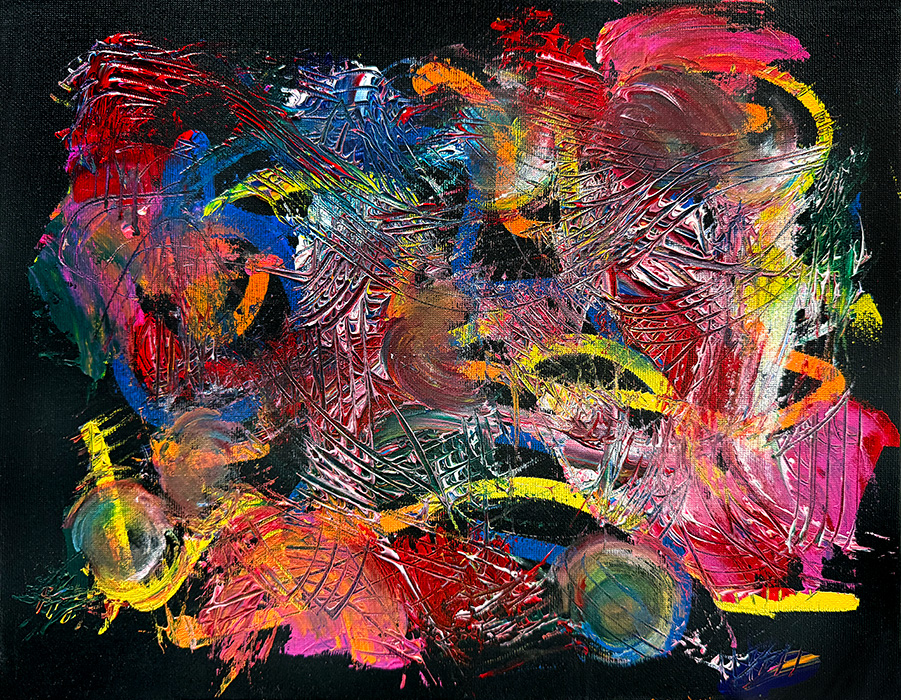
- Details
- Category: Maxim
"Currents of the Bay: Hills in Motion, Fog and Neon, Weavings of the Mission, Lombard’s Dream", acrylic on canvas, 2025, Bishop Maxim with Basil, Milorad, and Vladan
Currents of the Bay swirl into Hills in Motion, where Fog and Neon blur the edges of night and day. In the Weavings of the Mission, colors and cultures converge like secret threads, and Lombard’s Dream winds upward in a dance of ascent and descent. This canvas invites you not to see San Francisco, but to feel it — as a living tide of light, movement, and memory.
Currents of the Bay swirl into Hills in Motion, where Fog and Neon blur the edges of night and day. In the Weavings of the Mission, colors and cultures converge like secret threads, and Lombard’s Dream winds upward in a dance of ascent and descent. This canvas invites you not to see San Francisco, but to feel it — as a living tide of light, movement, and memory.
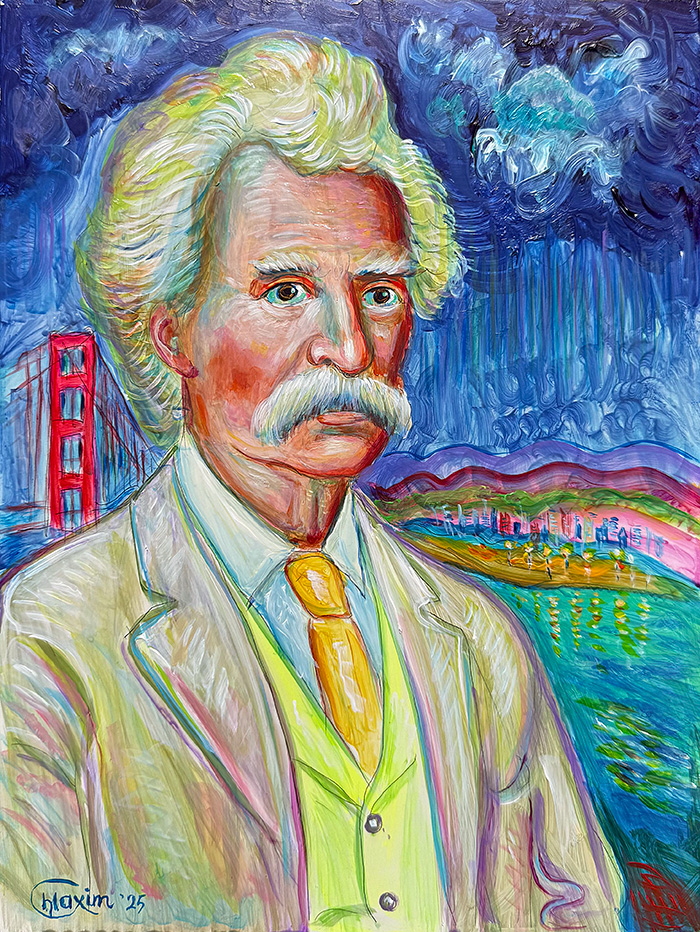
- Details
- Category: Maxim
"Mark Twain Over the Golden Gate", acrylic on gesso board, Bishop Maxim, 2025
In this vivid portrait, Mark Twain stands before a dreamlike San Francisco Bay, the Golden Gate Bridge rising behind him. His lemon-green hair and electric suit echo the city’s fog and light, while the swirling sky and water hint at both humor and melancholy. Twain’s steady gaze toward the horizon reflects his role as a restless observer—bridging eras, places, and the enduring wit of American letters.
In this vivid portrait, Mark Twain stands before a dreamlike San Francisco Bay, the Golden Gate Bridge rising behind him. His lemon-green hair and electric suit echo the city’s fog and light, while the swirling sky and water hint at both humor and melancholy. Twain’s steady gaze toward the horizon reflects his role as a restless observer—bridging eras, places, and the enduring wit of American letters.
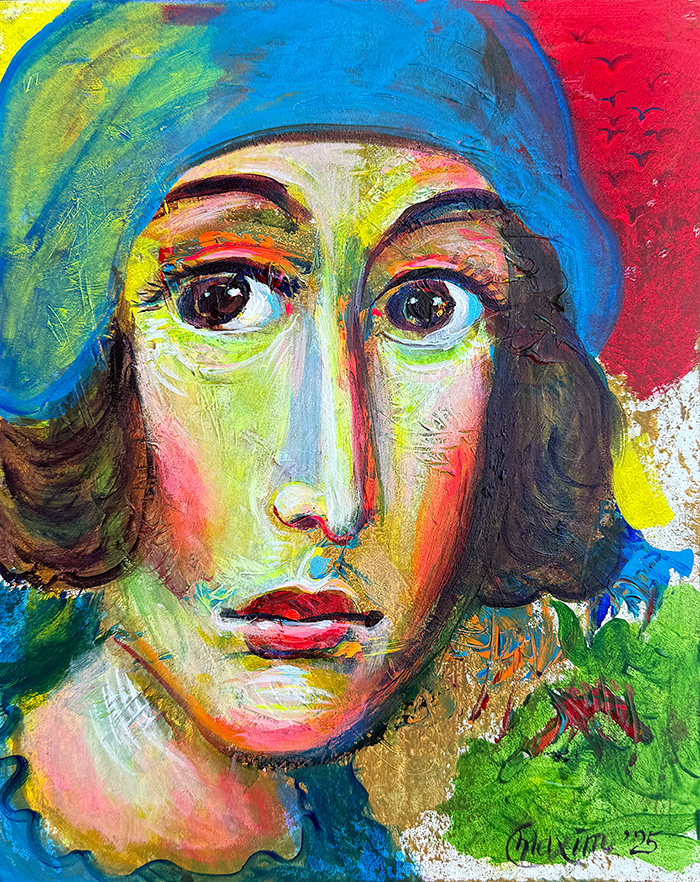
- Details
- Category: Maxim
"Portrait of Isadora Duncan", acrylic on gesso board, San Marino, Bishop Maxim, 2025
This portrait of the American dancer Isadora Duncan brims with vivid color and restless energy. The intense palette magnifies the searching quality of her eyes, which seem to hold both fragility and defiance—an inner dialogue of vulnerability and strength that mirrors the dramatic arc of her life.
This portrait of the American dancer Isadora Duncan brims with vivid color and restless energy. The intense palette magnifies the searching quality of her eyes, which seem to hold both fragility and defiance—an inner dialogue of vulnerability and strength that mirrors the dramatic arc of her life.
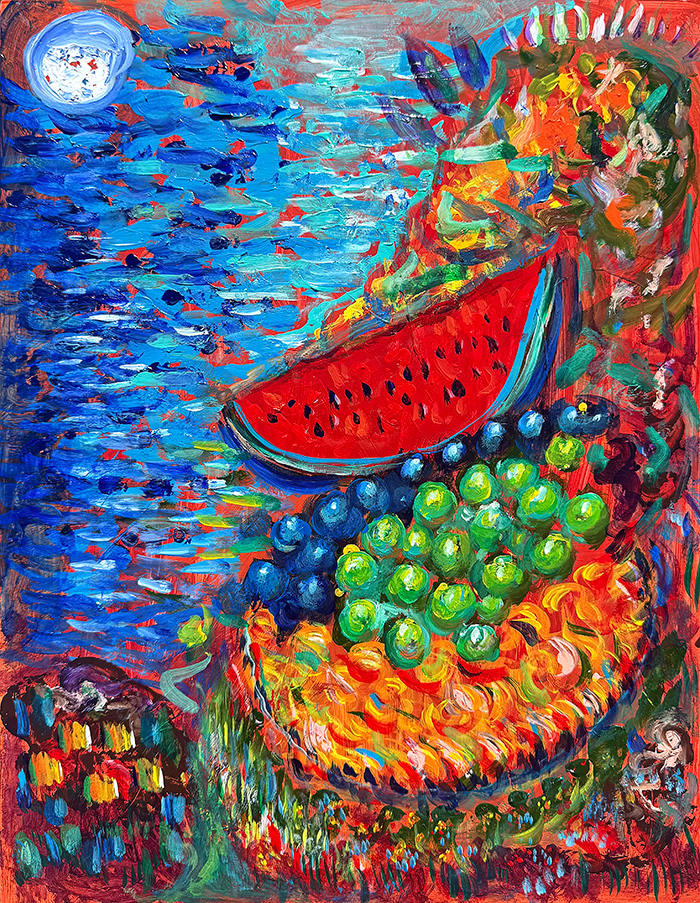
- Details
- Category: Maxim
"Moonlit Harvest", acrylic on gesso board, Bishop Maxim, 2025
In this vibrant canvas, the abundance of summer fruit becomes a cosmic celebration. A bold slice of watermelon dominates the scene, flanked by luminous grapes and fiery clusters that seem to shimmer with their own inner light. The background dissolves into a sea of swirling blues and reds, where a radiant full moon illuminates the night, its glow scattering across the water like silver fish in motion. The composition blurs the boundary between land and sky, feast and cosmos—suggesting that the fruits of the earth mirror the mysteries of the heavens. The brushstrokes, impassioned and free, weave together joy, rhythm, and movement, as if nature itself were caught dancing under the moon’s lasting gaze. The vibrant color palette and expressive freedom bear the clear influence of Stamatis Skliris, whose synthesis of Byzantine tradition and modern expression resonates throughout this work.
In this vibrant canvas, the abundance of summer fruit becomes a cosmic celebration. A bold slice of watermelon dominates the scene, flanked by luminous grapes and fiery clusters that seem to shimmer with their own inner light. The background dissolves into a sea of swirling blues and reds, where a radiant full moon illuminates the night, its glow scattering across the water like silver fish in motion. The composition blurs the boundary between land and sky, feast and cosmos—suggesting that the fruits of the earth mirror the mysteries of the heavens. The brushstrokes, impassioned and free, weave together joy, rhythm, and movement, as if nature itself were caught dancing under the moon’s lasting gaze. The vibrant color palette and expressive freedom bear the clear influence of Stamatis Skliris, whose synthesis of Byzantine tradition and modern expression resonates throughout this work.
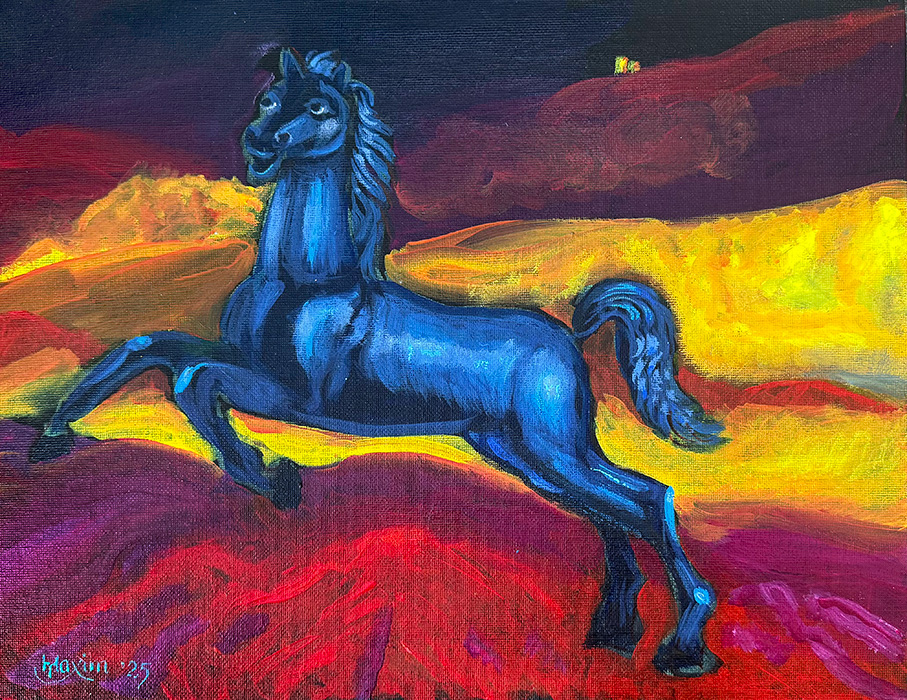
- Details
- Category: Maxim
"Horse in the Dunes", acrylic on canvas, Bishop Maxim, 2025
Set against a landscape of burning dunes, this midnight-blue horse emerges as both creature and vision. Its body, luminous with shades of cobalt and indigo, contrasts with the fiery waves of crimson and gold that ripple through the desert. A glowing band of gold-yellow light in the background suggests radiance and mystery, as if the desert itself were aflame with hidden energy. The composition evokes the desert as a place of trial and revelation, where the horse becomes a symbol of freedom, vitality, and transcendence. The faint dwelling on the horizon anchors the scene in human memory, yet the painting leans toward the mythic, where nature and spirit merge in a field of living color.
Set against a landscape of burning dunes, this midnight-blue horse emerges as both creature and vision. Its body, luminous with shades of cobalt and indigo, contrasts with the fiery waves of crimson and gold that ripple through the desert. A glowing band of gold-yellow light in the background suggests radiance and mystery, as if the desert itself were aflame with hidden energy. The composition evokes the desert as a place of trial and revelation, where the horse becomes a symbol of freedom, vitality, and transcendence. The faint dwelling on the horizon anchors the scene in human memory, yet the painting leans toward the mythic, where nature and spirit merge in a field of living color.
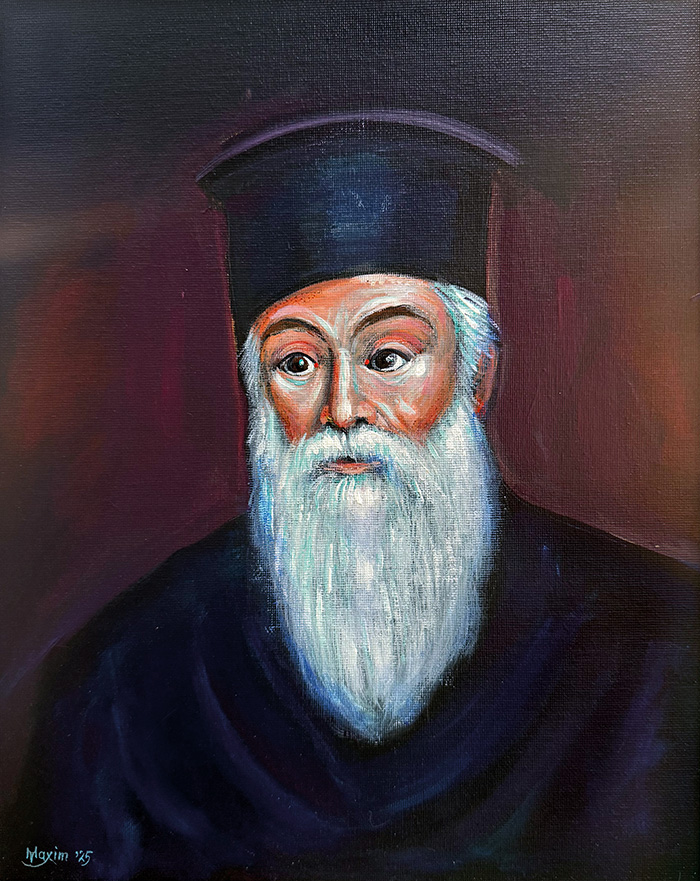
- Details
- Category: Maxim
"Father Thomas Chrysikos: Light from Agrafa", acrylic on canvas, Bishop Maxim, 2025
Portrait of Father Thomas Chrysikos, priest of the historic Church of St. Irini in Athens and native of Karpenisi in the Agrafa mountains. Painted as a tribute by his former deacon, the work highlights his expressive presence, devotion to tradition, and love for liturgical order, with luminous contrasts that evoke both inner light and spiritual vigilance.
Portrait of Father Thomas Chrysikos, priest of the historic Church of St. Irini in Athens and native of Karpenisi in the Agrafa mountains. Painted as a tribute by his former deacon, the work highlights his expressive presence, devotion to tradition, and love for liturgical order, with luminous contrasts that evoke both inner light and spiritual vigilance.
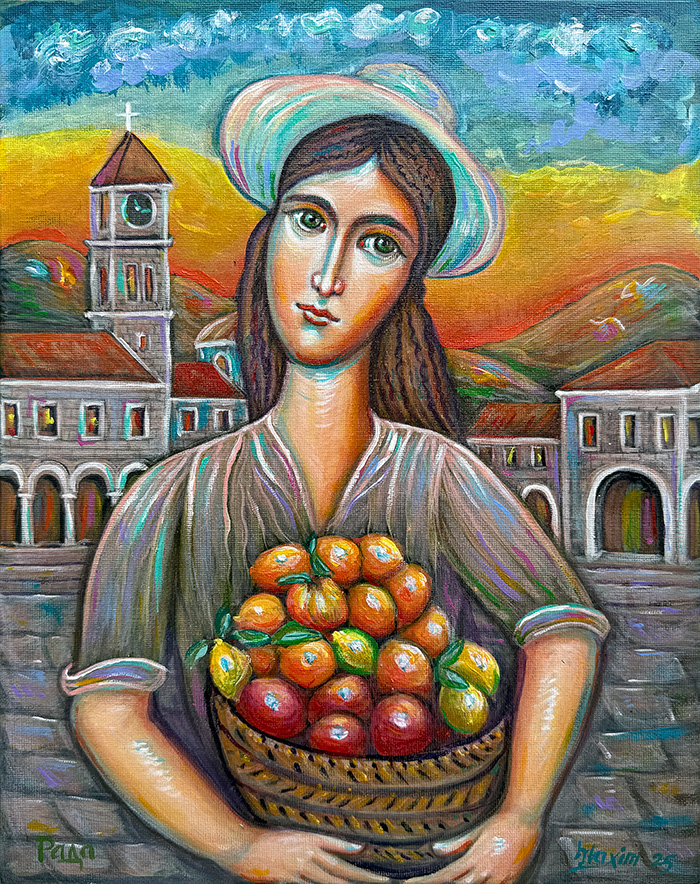
- Details
- Category: Maxim
"Trebinje Woman at the Market – Morning", acrylic on canvas, Bishop Maxim & Radmila Vasiljevic, 2025
This work brings a warm scene of a morning market in Trebinje, bathed in the first rays of the sun. A woman, dignified and serene, carries in her arms fresh fruits in baskets, while the scents and colors of the marketplace enliven the scene. Soft golden tones of morning light flow over her face and hat, highlighting the gentleness of her expression and the depth of her gaze. The background, in harmonious shades of ochre, green, and crimson, conveys the vibrant yet unobtrusive energy of local everyday life. At once an intimate portrait and a colorful chronicle of a morning, the painting carries within it the rhythm and soul of the city.
This work brings a warm scene of a morning market in Trebinje, bathed in the first rays of the sun. A woman, dignified and serene, carries in her arms fresh fruits in baskets, while the scents and colors of the marketplace enliven the scene. Soft golden tones of morning light flow over her face and hat, highlighting the gentleness of her expression and the depth of her gaze. The background, in harmonious shades of ochre, green, and crimson, conveys the vibrant yet unobtrusive energy of local everyday life. At once an intimate portrait and a colorful chronicle of a morning, the painting carries within it the rhythm and soul of the city.
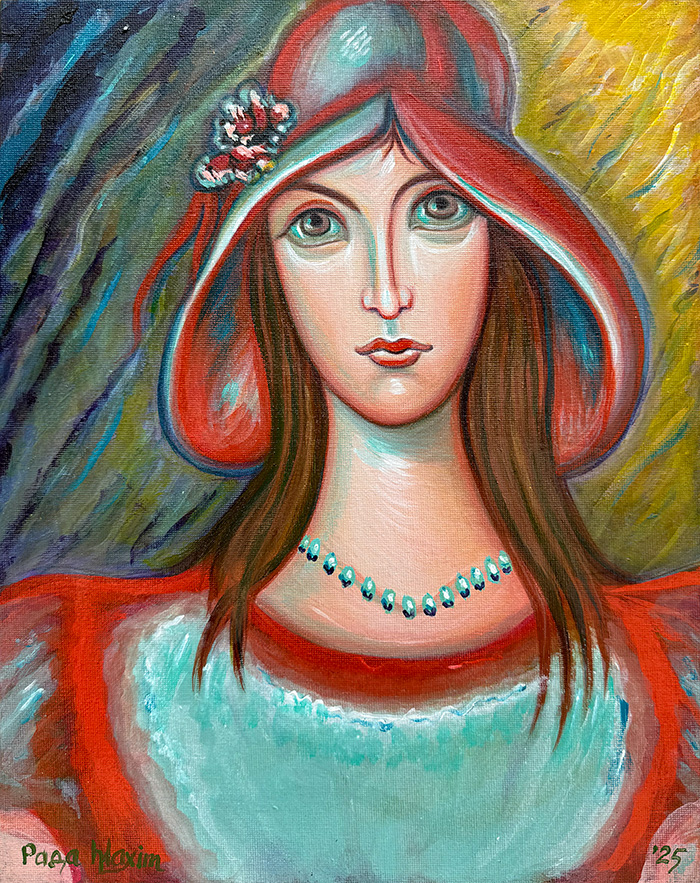
- Details
- Category: Maxim
"Herzegovinian Woman in America", acrylic on canvas, Bishop Maxim & Radmila Vasiljevic, 2025
The painting portrays a young woman from Herzegovina who, in a foreign land, carries within herself the silence of her homeland. The warm, earthy tones of her face and clothing stand in contrast to the cooler, urban background that suggests the American setting. Her gaze, directed somewhere beyond the frame, reveals both longing and quiet strength—a bridge between the stone hills and the distant ocean. In her figure, colors and light unite two worlds within a single destiny.
The painting portrays a young woman from Herzegovina who, in a foreign land, carries within herself the silence of her homeland. The warm, earthy tones of her face and clothing stand in contrast to the cooler, urban background that suggests the American setting. Her gaze, directed somewhere beyond the frame, reveals both longing and quiet strength—a bridge between the stone hills and the distant ocean. In her figure, colors and light unite two worlds within a single destiny.
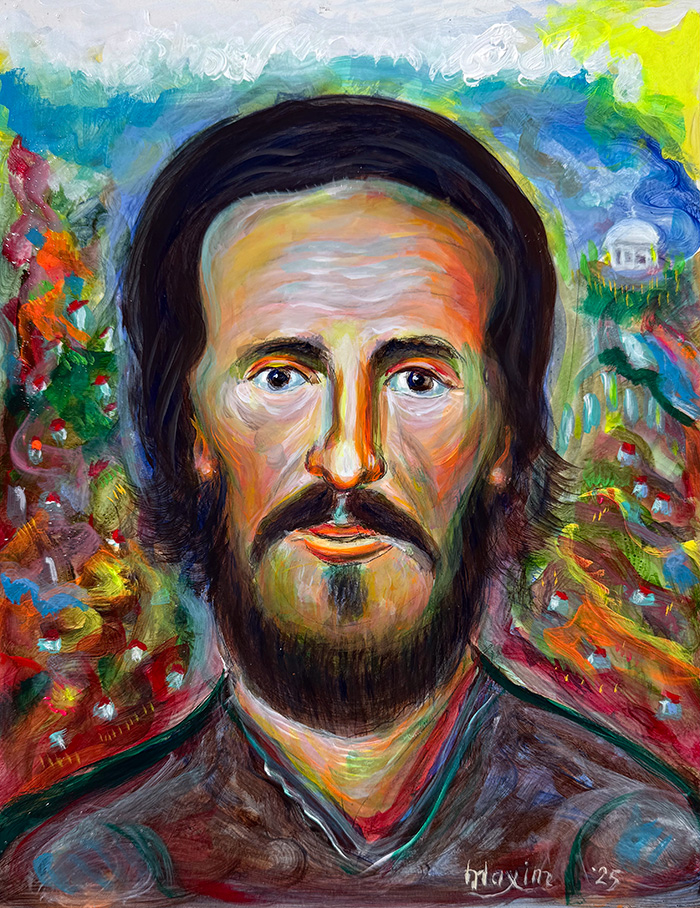
- Details
- Category: Maxim
"The Quiet Strength of Atanasije", acrylic on canvas, Bishop Maxim, 2025
A luminous portrait of Hieromonk Atanasije Jevtić, painted on the eve of his episcopal ministry. His steady, penetrating gaze emerges from warm ochres, reds, and greens, framed by dark hair and beard. Behind him, vibrant, abstract landscapes and a distant church dome evoke both the rootedness of his homeland and his orientation toward the divine. The work blends vitality and stillness, offering not only a likeness but a glimpse into his spiritual depth.
A luminous portrait of Hieromonk Atanasije Jevtić, painted on the eve of his episcopal ministry. His steady, penetrating gaze emerges from warm ochres, reds, and greens, framed by dark hair and beard. Behind him, vibrant, abstract landscapes and a distant church dome evoke both the rootedness of his homeland and his orientation toward the divine. The work blends vitality and stillness, offering not only a likeness but a glimpse into his spiritual depth.
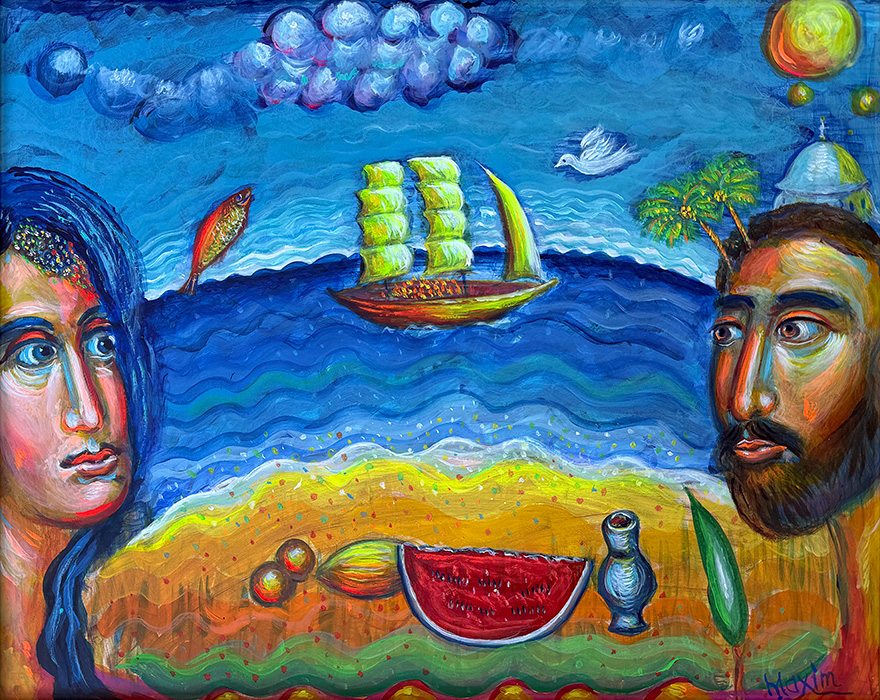
- Details
- Category: Maxim
"Dialogue Across the Sea", acrylic on canvas, framed in gilded wood, Bishop Maxim, 2020
In this vivid seascape, two faces—male and female—confront each other across a golden shore. Between them, symbols of fruit, vessel, and leaf evoke abundance and hospitality. Beyond, a sailing ship traverses luminous waves, as a fish leaps, a dove glides, and a domed building rises under a radiant sun. Blending Byzantine-inspired form with modern color, the work weaves themes of journey, encounter, and the meeting of earthly and spiritual horizons.
In this vivid seascape, two faces—male and female—confront each other across a golden shore. Between them, symbols of fruit, vessel, and leaf evoke abundance and hospitality. Beyond, a sailing ship traverses luminous waves, as a fish leaps, a dove glides, and a domed building rises under a radiant sun. Blending Byzantine-inspired form with modern color, the work weaves themes of journey, encounter, and the meeting of earthly and spiritual horizons.
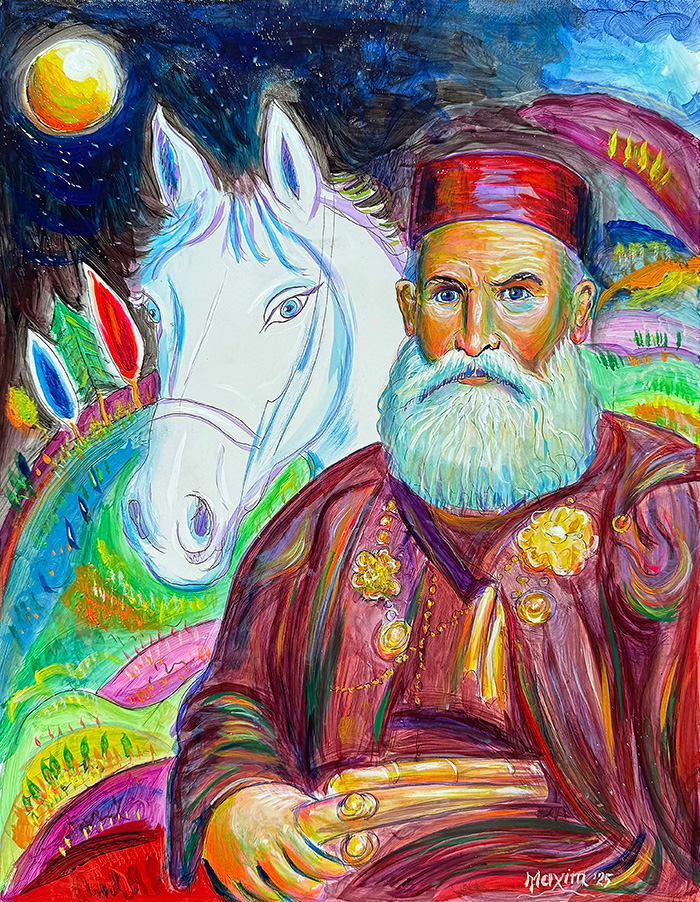
- Details
- Category: Maxim
"Portrait of Bogdan Zimonjić", acrylic on gesso board, Bishop Maxim, 2025
This evocative portrait captures Archpriest Bogdan Zimonjić (1813–1909), the legendary Serbian cleric and rebel leader who championed his people against Ottoman and Austro-Hungarian rule. His piercing gaze, beneath a crimson cap, confronts history with reflection, resolve, and unyielding spirit. Behind him, a luminous white horse emerges from the mists of legend, symbolizing his dual role as spiritual and martial shepherd. A crescent moon hangs in a dark sky, while colorful banners wave, conjuring ceremonial, folkloric, and eschatological themes. The folds of his robe, like mountain ranges, ground him deeply in the soul of Herzegovina. Painted in a post-Byzantine idiom infused with modern expressionism, the artwork harmonizes historical memory and imaginative vision. It celebrates Zimonjić not just as a figure of resistance, but as a potent symbol of a nation’s enduring spiritual freedom.
This evocative portrait captures Archpriest Bogdan Zimonjić (1813–1909), the legendary Serbian cleric and rebel leader who championed his people against Ottoman and Austro-Hungarian rule. His piercing gaze, beneath a crimson cap, confronts history with reflection, resolve, and unyielding spirit. Behind him, a luminous white horse emerges from the mists of legend, symbolizing his dual role as spiritual and martial shepherd. A crescent moon hangs in a dark sky, while colorful banners wave, conjuring ceremonial, folkloric, and eschatological themes. The folds of his robe, like mountain ranges, ground him deeply in the soul of Herzegovina. Painted in a post-Byzantine idiom infused with modern expressionism, the artwork harmonizes historical memory and imaginative vision. It celebrates Zimonjić not just as a figure of resistance, but as a potent symbol of a nation’s enduring spiritual freedom.
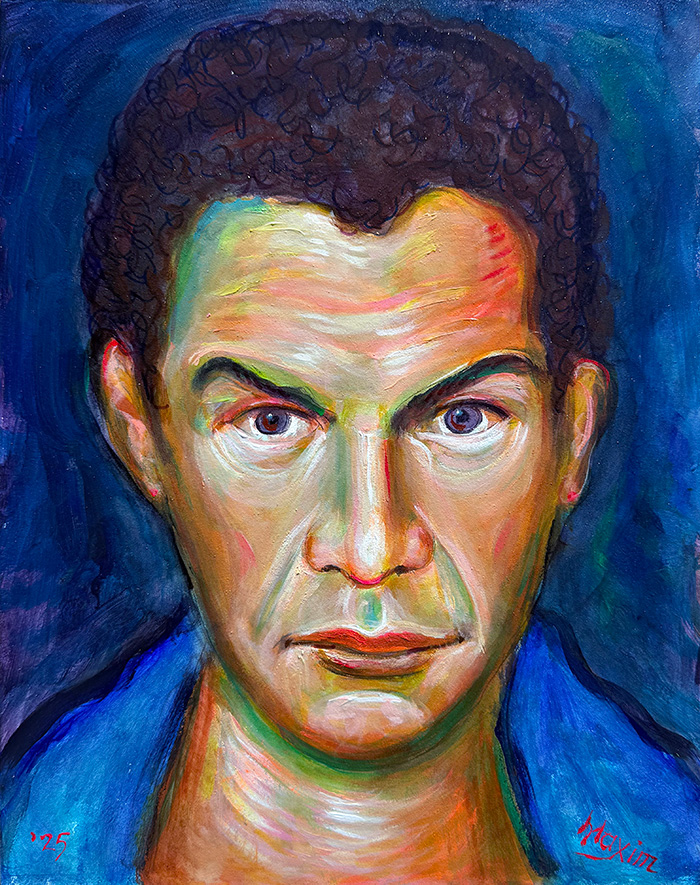
- Details
- Category: Maxim
"Glogovac’s Epic Fusion of Hercegovina’s Spirit and Belgrade’s Soul 2", acrylic on canvas, Bishop Maxim, 2025
The portrait quietly bears witness to the essential truth that tragedy does not have the final word. For Glogovac, the fullness of time has come. He has known and embraced all, wept over every human sorrow. He has risen above it all, and—bathed, blessed, steadfast, shaped by a singular experience, fulfilled—he enters with dignity into the joy of his Lord.
The portrait quietly bears witness to the essential truth that tragedy does not have the final word. For Glogovac, the fullness of time has come. He has known and embraced all, wept over every human sorrow. He has risen above it all, and—bathed, blessed, steadfast, shaped by a singular experience, fulfilled—he enters with dignity into the joy of his Lord.
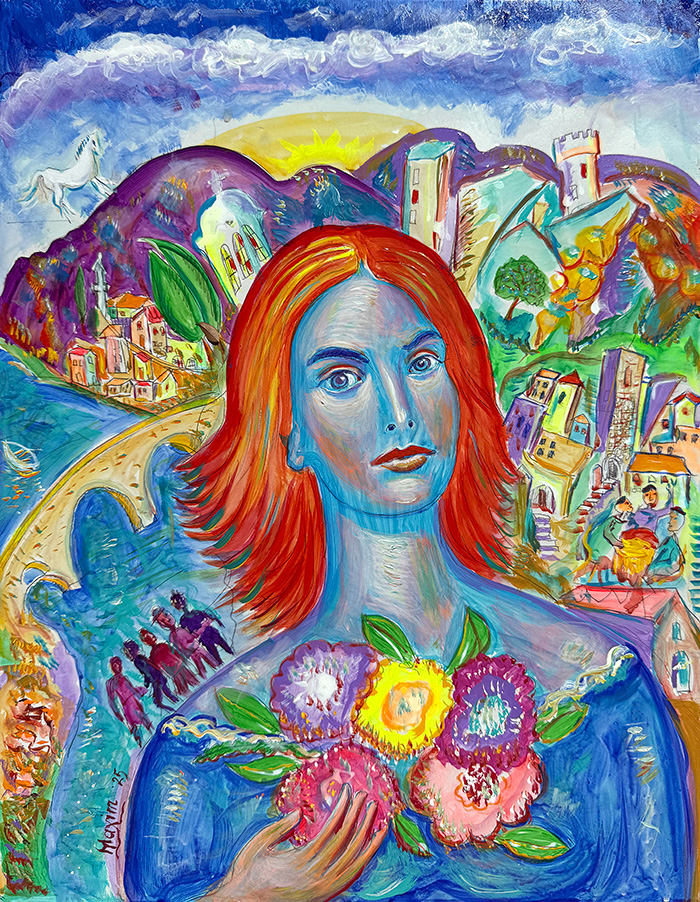
- Details
- Category: Maxim
"Trebinje Girl in a Turning Town", acrylic on gesso board, Bishop Maxim, 2025
In this cubist vision of Trebinje, buildings lean and shift, streets twist, and hills rest quietly in the distance. The town is alive with movement—people pass by, cafés buzz—yet at the center walks a young woman with flowers in hand. She does not dominate the scene, but the town seems to gently revolve around her. Her presence reminds us that cities find their meaning in the people who inhabit them. The painting suggests a subtle reversal: the town serves the person, not the person the town. In this quiet, graceful figure, we are invited to reflect on the dignity of the person—that the soul of a place is found in the uniqueness of each passerby.
In this cubist vision of Trebinje, buildings lean and shift, streets twist, and hills rest quietly in the distance. The town is alive with movement—people pass by, cafés buzz—yet at the center walks a young woman with flowers in hand. She does not dominate the scene, but the town seems to gently revolve around her. Her presence reminds us that cities find their meaning in the people who inhabit them. The painting suggests a subtle reversal: the town serves the person, not the person the town. In this quiet, graceful figure, we are invited to reflect on the dignity of the person—that the soul of a place is found in the uniqueness of each passerby.
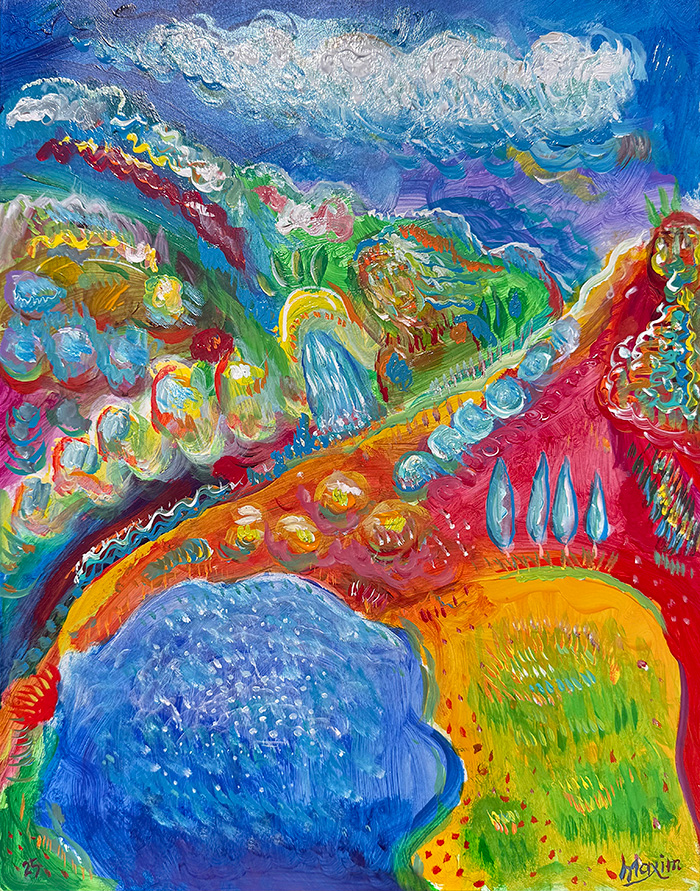
- Details
- Category: Maxim
"Boračko jezero: Heart of the North", acrylic on canvas panel, Bishop Maxim, 2025
This vivid landscape reimagines Boracko Jezero, cradled in the northern mountains of Herzegovina. The lake glows in deep blue, surrounded by flowing hills, fiery reds, golden fields, and vibrant greens. The land moves with energy— clouds swirl, trees lean, and paths curve as if stirred by breath. Though no figure is shown, traces of human presence linger— suggested in rhythm and form. Nature is not static here, but alive and responsive, holding memory and meaning. A tribute to Herzegovina’s natural soul, this work captures the dynamic harmony of earth, water, and sky in motion.
This vivid landscape reimagines Boracko Jezero, cradled in the northern mountains of Herzegovina. The lake glows in deep blue, surrounded by flowing hills, fiery reds, golden fields, and vibrant greens. The land moves with energy— clouds swirl, trees lean, and paths curve as if stirred by breath. Though no figure is shown, traces of human presence linger— suggested in rhythm and form. Nature is not static here, but alive and responsive, holding memory and meaning. A tribute to Herzegovina’s natural soul, this work captures the dynamic harmony of earth, water, and sky in motion.
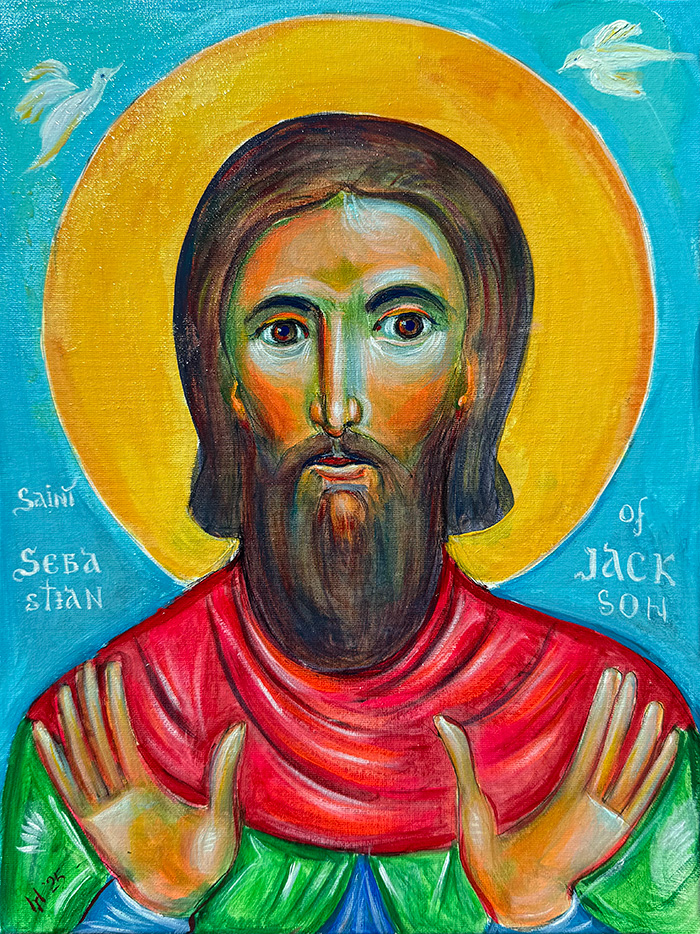
- Details
- Category: Maxim
"Saint Sebastian of Jackson: The One Who Listens and Intercedes", acrylic on canvas, Bishop Maxim, 2025
Saint Sebastian of Jackson gazes out with a quiet attentiveness, his wide eyes radiant with compassion and silent prayer. His uplifted hands, open and gently poised, suggest both a readiness to listen and an intercession on our behalf—an icon of communion. Rendered in a modern Byzantine style, the saint’s visage is luminous with layered hues—earthy reds, verdant greens, and the serene blue of the heavens behind him—each color dancing in harmony. The golden halo glows with warmth, while white doves flit like whispers of grace. A vision where ancient tradition and contemporary spirit embrace, inviting us to stillness, to being seen, and to being heard.
Saint Sebastian of Jackson gazes out with a quiet attentiveness, his wide eyes radiant with compassion and silent prayer. His uplifted hands, open and gently poised, suggest both a readiness to listen and an intercession on our behalf—an icon of communion. Rendered in a modern Byzantine style, the saint’s visage is luminous with layered hues—earthy reds, verdant greens, and the serene blue of the heavens behind him—each color dancing in harmony. The golden halo glows with warmth, while white doves flit like whispers of grace. A vision where ancient tradition and contemporary spirit embrace, inviting us to stillness, to being seen, and to being heard.
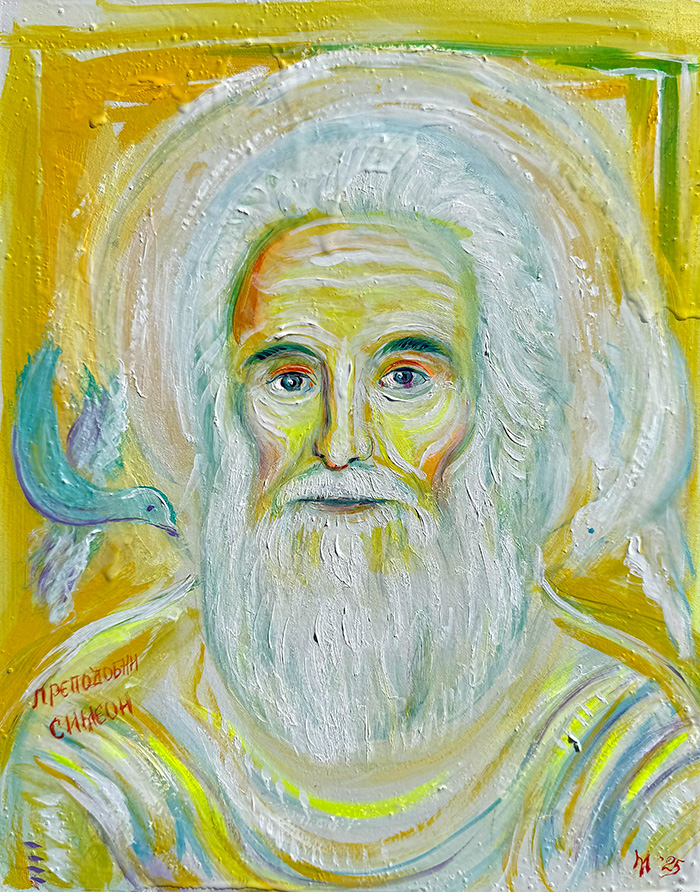
- Details
- Category: Maxim
"Elder Simeon of Herzegovina: Light Beyond the Barbed Wire", acrylic on gesso board, Bishop Maxim, 2025
Elder Simeon—monk, confessor, and beloved man of the people—stands here not in somber tones, but in vibrant color, as if transfigured by the very light he bore through suffering. A survivor of the Dachau concentration camp, he returned to Herzegovina not broken, but sanctified. His face, lined by time, tells of silent endurance. And yet the colors—bold blues, golds, reds—speak of resurrection, not ruin. His gaze is direct, tender, human. Not a traditional icon, but a radiant hymn to resilience. In Elder Simeon, suffering has no final word—only light does.
Elder Simeon—monk, confessor, and beloved man of the people—stands here not in somber tones, but in vibrant color, as if transfigured by the very light he bore through suffering. A survivor of the Dachau concentration camp, he returned to Herzegovina not broken, but sanctified. His face, lined by time, tells of silent endurance. And yet the colors—bold blues, golds, reds—speak of resurrection, not ruin. His gaze is direct, tender, human. Not a traditional icon, but a radiant hymn to resilience. In Elder Simeon, suffering has no final word—only light does.
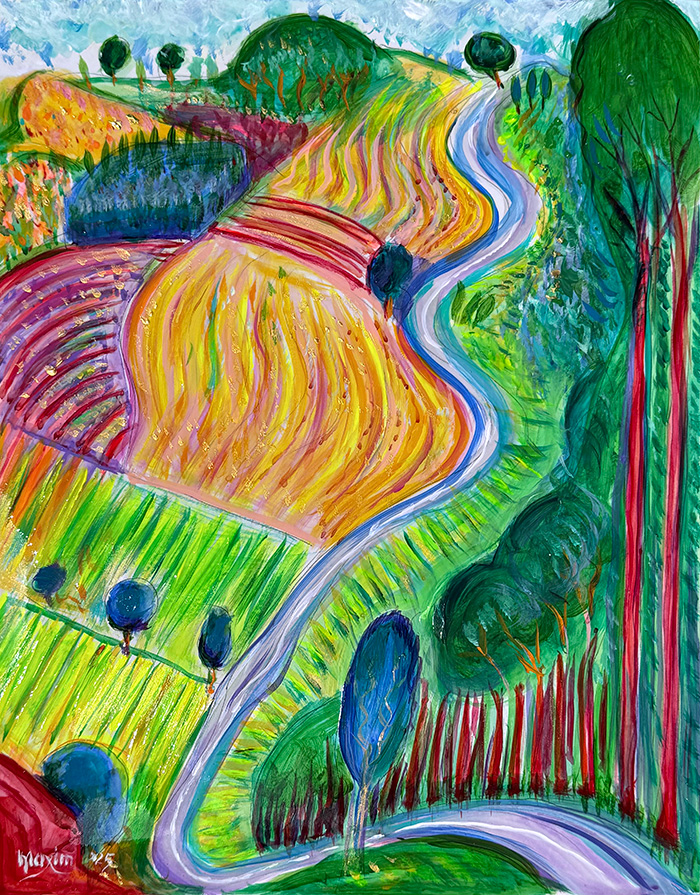
- Details
- Category: Maxim
"Popovo Polje: A Harvest of Color and Grace" acrylic on gesso board, Bishop Maxim, 2025
This vivid portrayal of Popovo Polje in East Herzegovina captures the ripeness of harvest season with a palette echoing the spirit of David Hockney. Undulating fields burst with golden yellows, deep reds, and vibrant greens—each stroke celebrating the earth’s abundance and the priest’s quiet guardianship of the land.
A winding road leads the eye through hills rich with color and life, where trees stand like sentinels and the fields hum with the fullness of late summer. Ripe fruits, fertile soil, and radiant light all converge in this joyful, reverent hymn to nature’s bounty.
This vivid portrayal of Popovo Polje in East Herzegovina captures the ripeness of harvest season with a palette echoing the spirit of David Hockney. Undulating fields burst with golden yellows, deep reds, and vibrant greens—each stroke celebrating the earth’s abundance and the priest’s quiet guardianship of the land.
A winding road leads the eye through hills rich with color and life, where trees stand like sentinels and the fields hum with the fullness of late summer. Ripe fruits, fertile soil, and radiant light all converge in this joyful, reverent hymn to nature’s bounty.
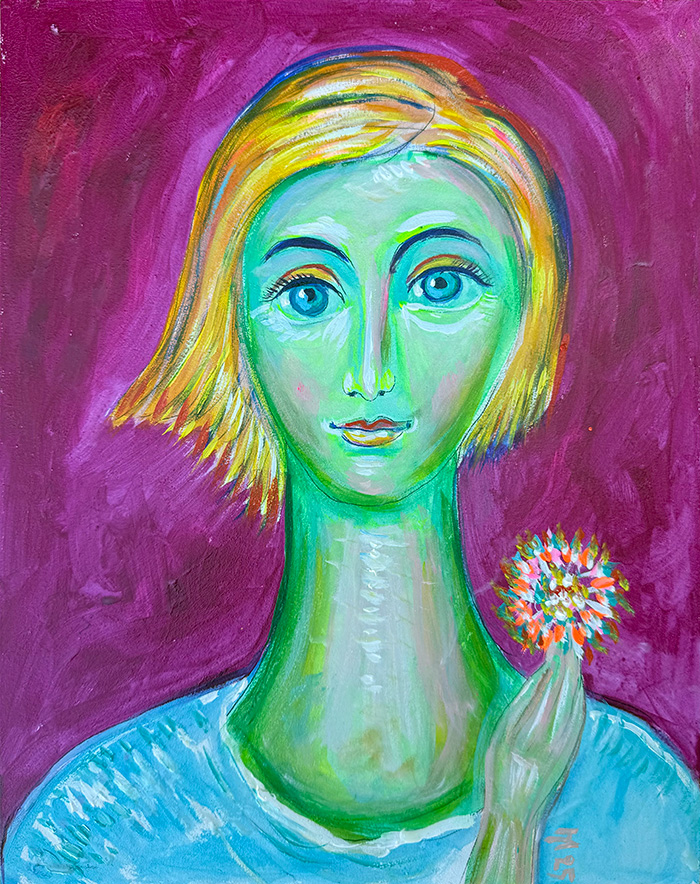
- Details
- Category: Maxim
"Emily’s Return", acrylic on canvas, Bishop Maxim, 2025
In this vivid, almost otherworldly portrait, the artist channels the character of Emily Webb from Our Town, just as she gazes back upon the living world. Her skin shimmers with a green, luminous tone—symbolic of the threshold between life and afterlife—while her eyes are wide, not with fear, but with the wonder of recognition. The flower she holds, exploding with color, echoes both the fragility and intensity of fleeting moments. Her elongated neck and gentle posture lend her a timeless, saint-like presence, as if she is both child and spirit, memory and longing. The purple background bathes her in the hue of twilight—when day meets night, and life meets eternity.
In this vivid, almost otherworldly portrait, the artist channels the character of Emily Webb from Our Town, just as she gazes back upon the living world. Her skin shimmers with a green, luminous tone—symbolic of the threshold between life and afterlife—while her eyes are wide, not with fear, but with the wonder of recognition. The flower she holds, exploding with color, echoes both the fragility and intensity of fleeting moments. Her elongated neck and gentle posture lend her a timeless, saint-like presence, as if she is both child and spirit, memory and longing. The purple background bathes her in the hue of twilight—when day meets night, and life meets eternity.
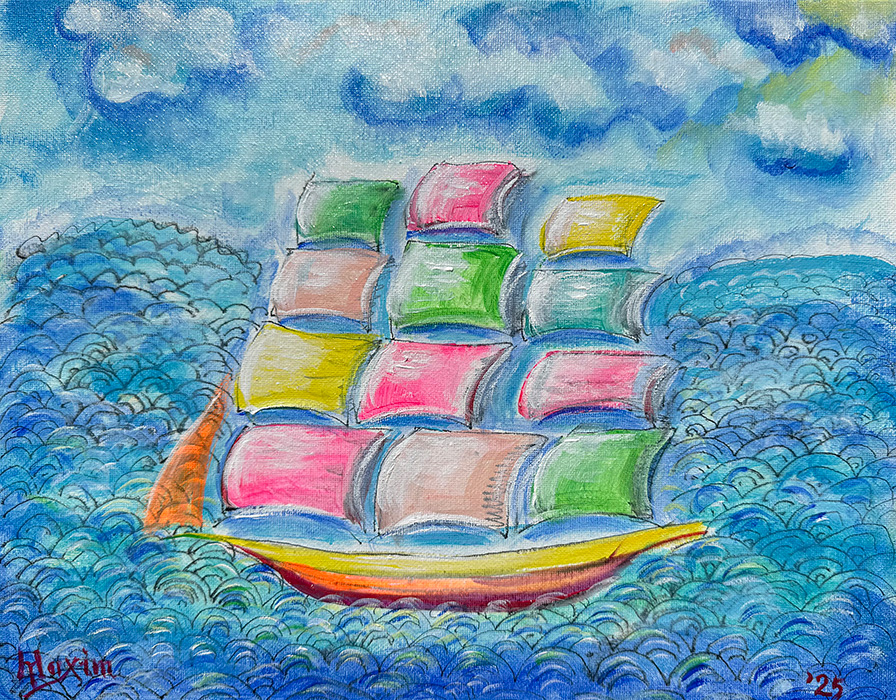
- Details
- Category: Maxim
"The Ship of Many Dreams", acrylic on canvas, Bishop Maxim, 2025
The ship, with its cascade of vividly colored square sails—pink, green, yellow, peach—appears like a floating patchwork quilt stitched by the wind itself. The water is a sea of stylized waves, almost scales of a mythical sea creature, rippling in a symphony of blues and aquamarines. The sky above is playful, as if echoing the ship’s joy with puffs of clouds dabbed on like whispers of poetry. The hull glows in warm tones of gold, red, and orange, suggesting both dawn and the timeless treasure it carries. This ship seems to glide not just over water, but through emotion, memory, and hope.
The ship, with its cascade of vividly colored square sails—pink, green, yellow, peach—appears like a floating patchwork quilt stitched by the wind itself. The water is a sea of stylized waves, almost scales of a mythical sea creature, rippling in a symphony of blues and aquamarines. The sky above is playful, as if echoing the ship’s joy with puffs of clouds dabbed on like whispers of poetry. The hull glows in warm tones of gold, red, and orange, suggesting both dawn and the timeless treasure it carries. This ship seems to glide not just over water, but through emotion, memory, and hope.
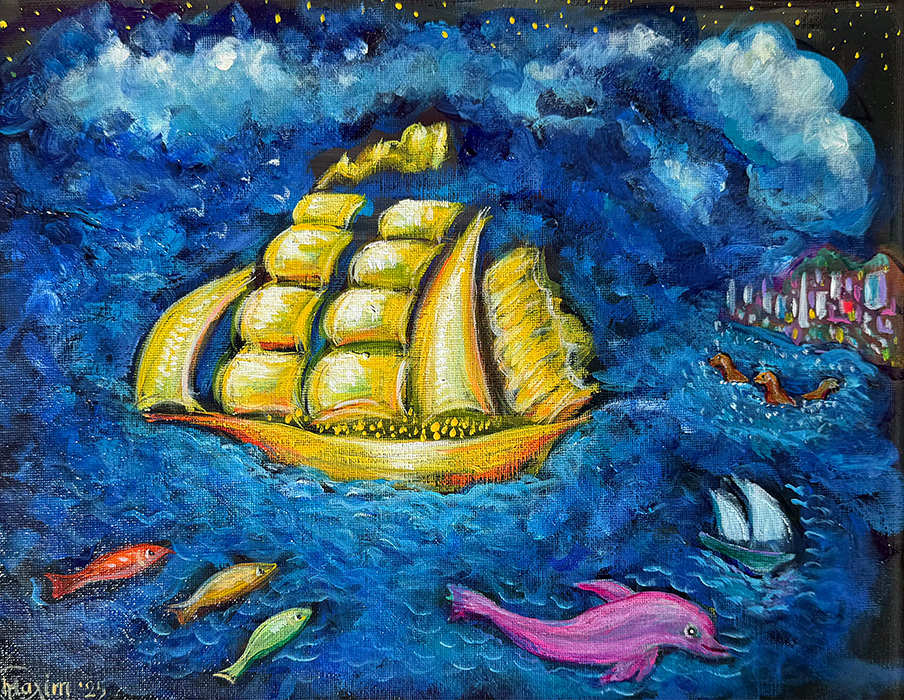
- Details
- Category: Maxim
"Sails of the Midnight Sea", acrylic on canvas panel, Bishop Maxim, 2025
In the quiet splendor of a starlit night, a golden ship sails joyfully across a sea of sapphire dreams. Its billowing sails catch the breath of heaven, as though bearing treasures not merely of gold, but of wonder and hope. Beneath the surface, dolphins and colorful fish glide serenely, while a small boat drifts gently in their company—silent companions in the deep. A distant island glows faintly on the horizon, kissed by a single crimson light, and above it all, the night sky unfurls its veil of clouds and stars, watching over this enchanted voyage.
In the quiet splendor of a starlit night, a golden ship sails joyfully across a sea of sapphire dreams. Its billowing sails catch the breath of heaven, as though bearing treasures not merely of gold, but of wonder and hope. Beneath the surface, dolphins and colorful fish glide serenely, while a small boat drifts gently in their company—silent companions in the deep. A distant island glows faintly on the horizon, kissed by a single crimson light, and above it all, the night sky unfurls its veil of clouds and stars, watching over this enchanted voyage.
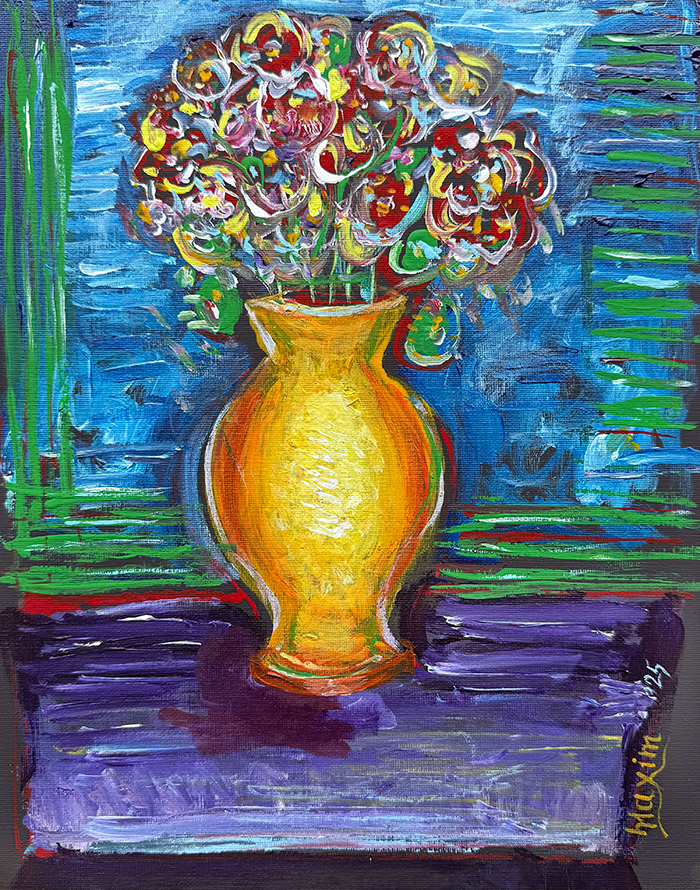
- Details
- Category: Maxim
"The Golden Vase", acrylic on canvas panel, Bishop Maxim, 2025
A luminous golden vase stands boldly at the center of a symphony of colors, cradling a whirlwind of vivid, swirling blossoms. The flowers, abstract yet unmistakably alive, burst forth in reds, pinks, and greens, as if dancing in celebration. Behind them, a backdrop of electric blues and greens evokes both serenity and spontaneity, while the table—a foundation of purples and indigos—grounds the composition with quiet strength.
The brushwork is vigorous, almost musical, hinting at motion and memory. This piece feels like a conversation between Van Gogh’s emotional turbulence and the Byzantine sense of luminance, yet it is entirely personal—an offering of joy from the soul of the artist.
A luminous golden vase stands boldly at the center of a symphony of colors, cradling a whirlwind of vivid, swirling blossoms. The flowers, abstract yet unmistakably alive, burst forth in reds, pinks, and greens, as if dancing in celebration. Behind them, a backdrop of electric blues and greens evokes both serenity and spontaneity, while the table—a foundation of purples and indigos—grounds the composition with quiet strength.
The brushwork is vigorous, almost musical, hinting at motion and memory. This piece feels like a conversation between Van Gogh’s emotional turbulence and the Byzantine sense of luminance, yet it is entirely personal—an offering of joy from the soul of the artist.
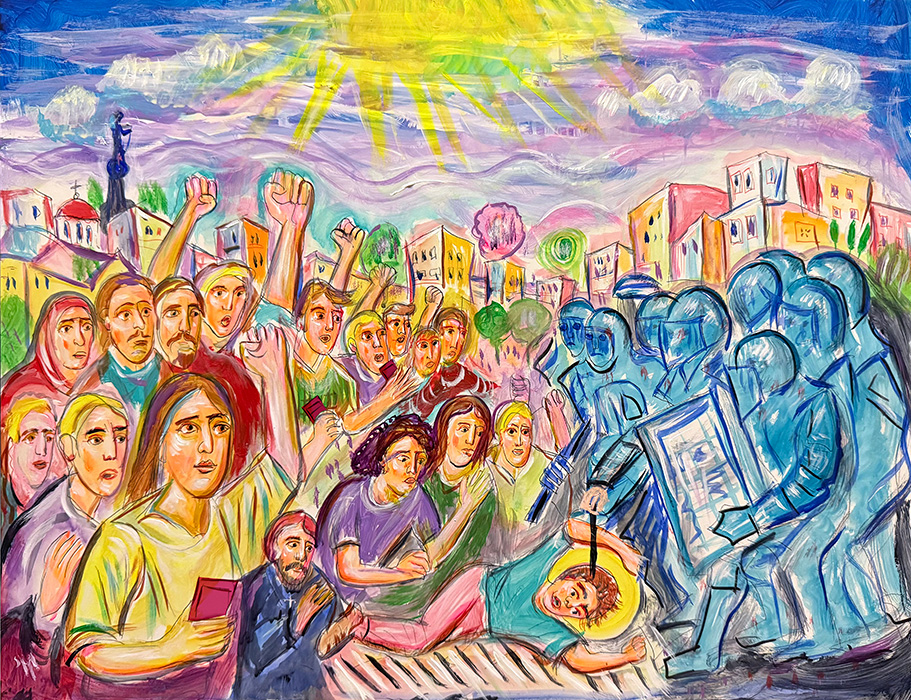
- Details
- Category: Maxim
"Let the Stones Cry Out", acrylic on canvas, Bishop Maxim, 2025
In this expressive, modern icon of protest, a crowd rises beneath a radiant sky, hands lifted, eyes aflame with truth. On the right, faceless riot police advance, overpowering a fallen youth—haloed, innocent, and crushed. He lies as a martyr of justice, while the city watches, and heaven weeps golden light. Between the fists of resistance and the shields of repression, a sacred tension pulses: mercy meets truth, righteousness kisses peace.
In this expressive, modern icon of protest, a crowd rises beneath a radiant sky, hands lifted, eyes aflame with truth. On the right, faceless riot police advance, overpowering a fallen youth—haloed, innocent, and crushed. He lies as a martyr of justice, while the city watches, and heaven weeps golden light. Between the fists of resistance and the shields of repression, a sacred tension pulses: mercy meets truth, righteousness kisses peace.
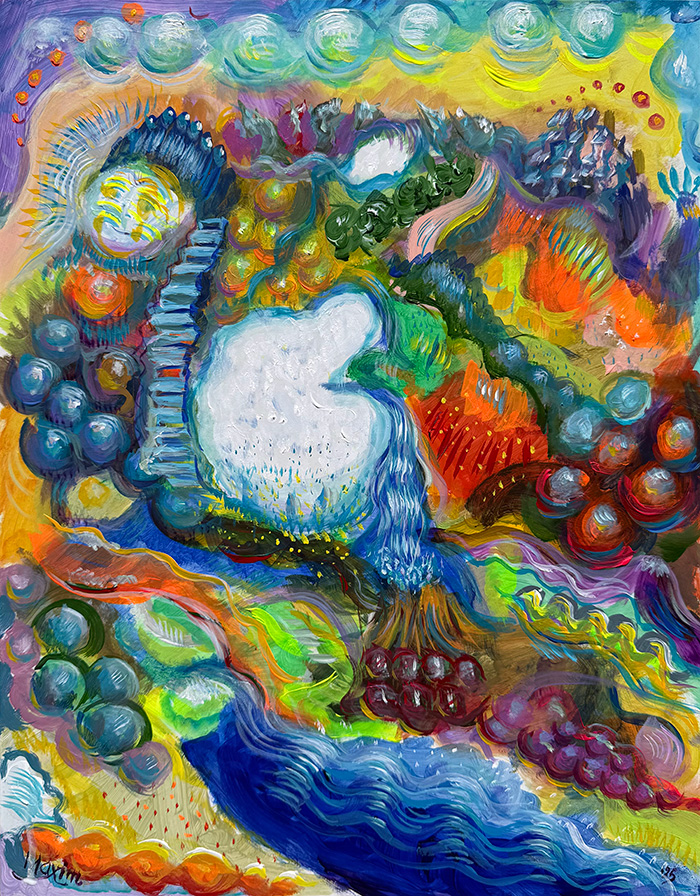
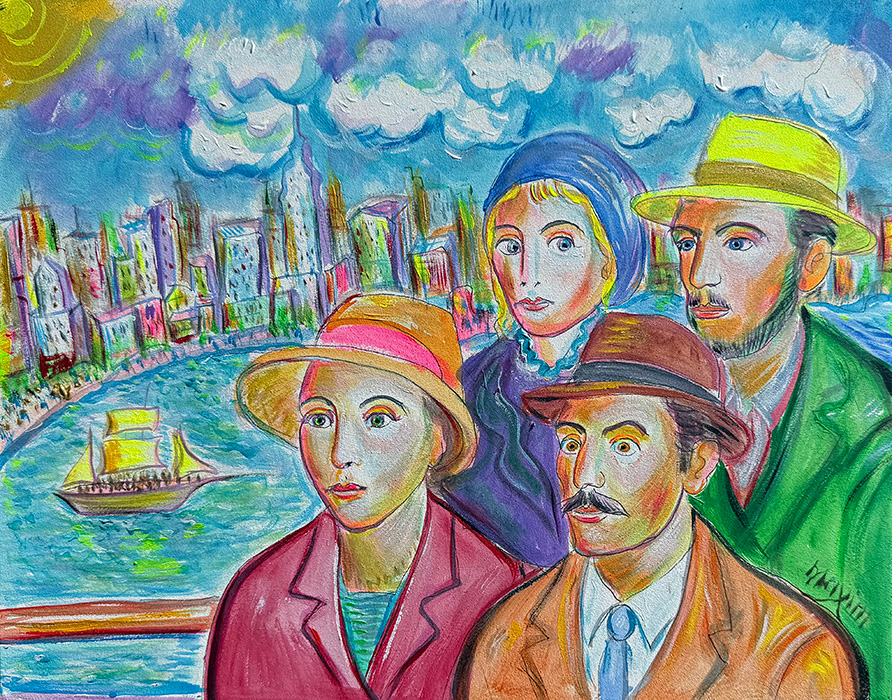
- Details
- Category: Maxim
"Awaiting the Newcomers", acrylin on gesso board, Bishop Maxim, 2025
Set against a shimmering old harbor, "Awaiting the Newcomers" captures a tender moment of the immigrant experience. The painting, blending impressionist softness with modernist clarity, portrays new Americans eagerly awaiting loved ones from the Old World. A distant boat, with its aged rigging, evokes late 19th or early 20th-century transatlantic journeys—long, uncertain, and filled with hope. Figures in the foreground, in period fashion and bold colors, express resilience, longing, and quiet joy. Their eyes scan the horizon for the ship and the fulfillment of a dream: reunion, new beginnings, and the promise of a new land. The work beautifully evokes the bittersweet melody of belonging, where memory and anticipation converge on the shores of destiny.
Set against a shimmering old harbor, "Awaiting the Newcomers" captures a tender moment of the immigrant experience. The painting, blending impressionist softness with modernist clarity, portrays new Americans eagerly awaiting loved ones from the Old World. A distant boat, with its aged rigging, evokes late 19th or early 20th-century transatlantic journeys—long, uncertain, and filled with hope. Figures in the foreground, in period fashion and bold colors, express resilience, longing, and quiet joy. Their eyes scan the horizon for the ship and the fulfillment of a dream: reunion, new beginnings, and the promise of a new land. The work beautifully evokes the bittersweet melody of belonging, where memory and anticipation converge on the shores of destiny.
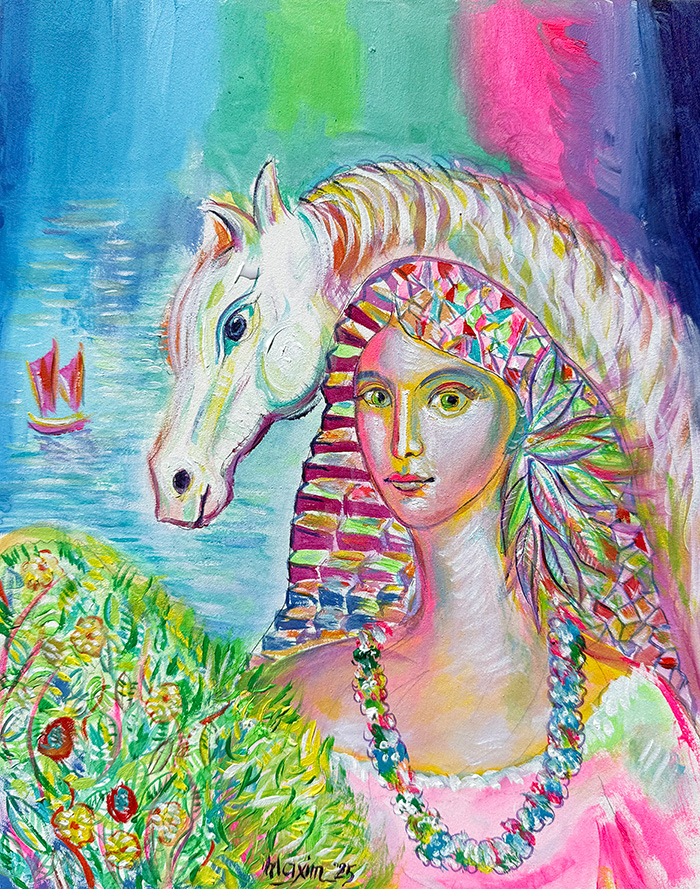
- Details
- Category: Maxim
"The Girl Swifter than a Horse", acrylic on gesso board, Bishop Maxim, 2025
This portrait depicts a mythical maiden, not born of man and woman, but fashioned by nature and the spirits of folk legend. She was drawn from the abyss of snow, brought to life by the wind, nursed by the morning dew, clothed in forest leaves, and adorned by the blossoms of the meadow. Her appearance transcends the human: whiter than snow, rosier than a rose, brighter than the sun of Elijah’s sky. Her gaze is swift and piercing, her body caught in motion, as if forever escaping the bounds of time and nature. In this work, the painter weaves folklore and dreamlike radiance into a figure of symbolic feminine power—elusive, untamed, swifter even than the fastest horse.
This portrait depicts a mythical maiden, not born of man and woman, but fashioned by nature and the spirits of folk legend. She was drawn from the abyss of snow, brought to life by the wind, nursed by the morning dew, clothed in forest leaves, and adorned by the blossoms of the meadow. Her appearance transcends the human: whiter than snow, rosier than a rose, brighter than the sun of Elijah’s sky. Her gaze is swift and piercing, her body caught in motion, as if forever escaping the bounds of time and nature. In this work, the painter weaves folklore and dreamlike radiance into a figure of symbolic feminine power—elusive, untamed, swifter even than the fastest horse.
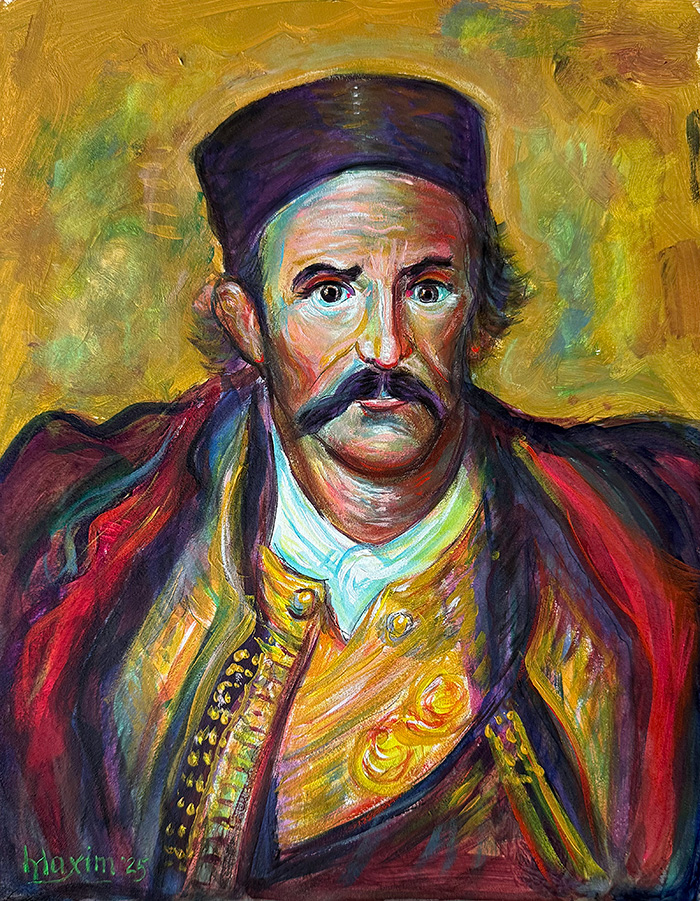
- Details
- Category: Maxim
"Defender in the Light of Dawn", acrylic on gesso board, Bishop Maxim, 2025
This painting portrays a Herzegovinian warrior from the 19th century, captured in the solemn moment of advancing toward battle. His gaze reveals both concern and resolve, reflecting the inner struggle of a man bound by love for his homeland and beloved. His face, softly illumined in the Byzantine tradition, radiates an inner light, contrasting with the richly detailed traditional garments that speak of honor, devotion, and sacrifice. Executed in a style reminiscent of late 19th to early 20th-century Serbian painters, possibly evoking the spirit of Petar Lubarda, the background shimmers with a palette of yellow oxide, Naples yellow, and Turner yellow, blended with muted greens and earthy browns, suggesting both the vitality and gravity of the land he defends.
This painting portrays a Herzegovinian warrior from the 19th century, captured in the solemn moment of advancing toward battle. His gaze reveals both concern and resolve, reflecting the inner struggle of a man bound by love for his homeland and beloved. His face, softly illumined in the Byzantine tradition, radiates an inner light, contrasting with the richly detailed traditional garments that speak of honor, devotion, and sacrifice. Executed in a style reminiscent of late 19th to early 20th-century Serbian painters, possibly evoking the spirit of Petar Lubarda, the background shimmers with a palette of yellow oxide, Naples yellow, and Turner yellow, blended with muted greens and earthy browns, suggesting both the vitality and gravity of the land he defends.
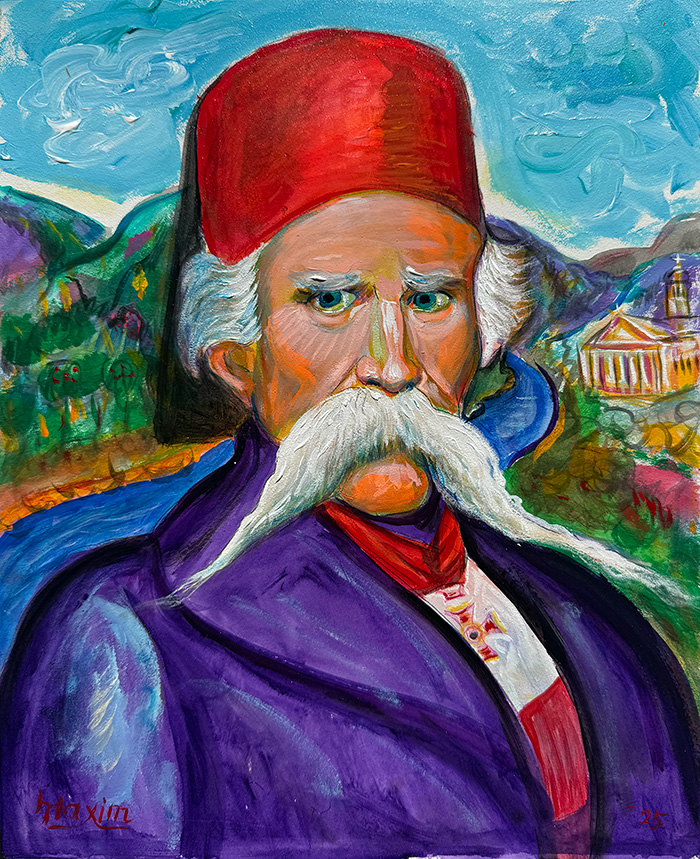
- Details
- Category: Maxim
"Vuk: From Rock and Root to Word and World", acrylic on gesso board, Bishop Maxim, 2025
This portrait of Vuk Stefanović-Karadžić, the father of modern Serbian language, presents him with a penetrating gaze turned not toward us, but toward an unseen future. His wild hair and distinct moustache evoke both the raw force of his character and the folk roots he preserved. Behind him, the landscape blends the rugged hills of Herzegovina with hints of Western academic life, reflecting the two worlds he bridged. Vuk stands as a solitary figure, not bound by his time, but envisioning what is to come. His presence speaks not only of reform, but of the enduring power of language to shape identity.
This portrait of Vuk Stefanović-Karadžić, the father of modern Serbian language, presents him with a penetrating gaze turned not toward us, but toward an unseen future. His wild hair and distinct moustache evoke both the raw force of his character and the folk roots he preserved. Behind him, the landscape blends the rugged hills of Herzegovina with hints of Western academic life, reflecting the two worlds he bridged. Vuk stands as a solitary figure, not bound by his time, but envisioning what is to come. His presence speaks not only of reform, but of the enduring power of language to shape identity.
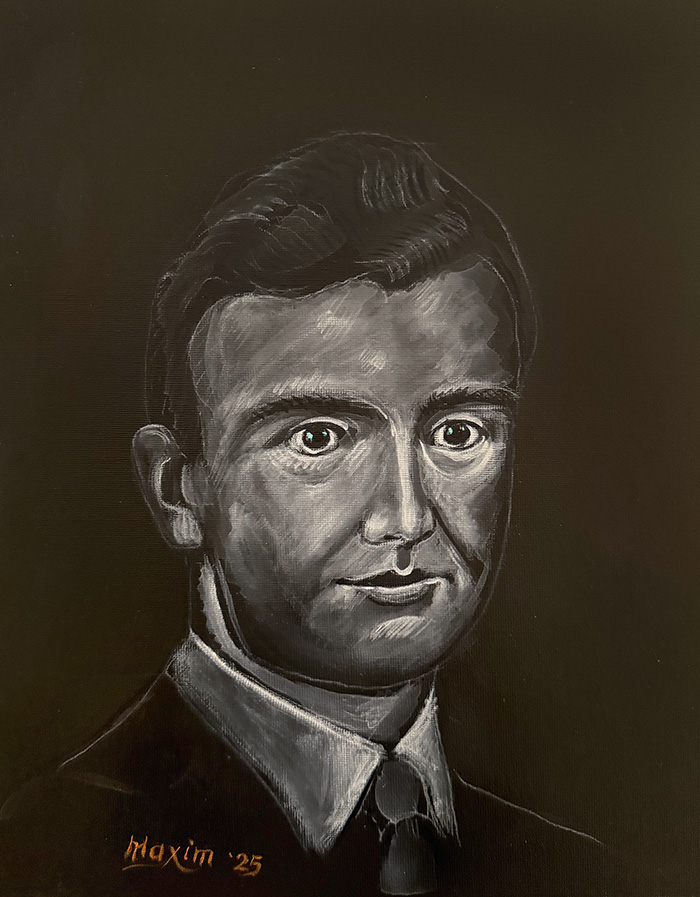
- Details
- Category: Maxim
"Gaze of Becoming: Between Athens and Harvard", acrylic on canvas panel, Bishop Maxim, 2025
This drawing portrays John Zizioulas in his Harvard years—thoughtful, serene, and marked by a quiet intensity. His gaze reveals a young theologian in formation, balancing deep tradition with emerging insight. The lines are gentle yet purposeful, capturing a mind on the cusp of shaping a vision that would one day transform Orthodox and Christian thought.
This drawing portrays John Zizioulas in his Harvard years—thoughtful, serene, and marked by a quiet intensity. His gaze reveals a young theologian in formation, balancing deep tradition with emerging insight. The lines are gentle yet purposeful, capturing a mind on the cusp of shaping a vision that would one day transform Orthodox and Christian thought.
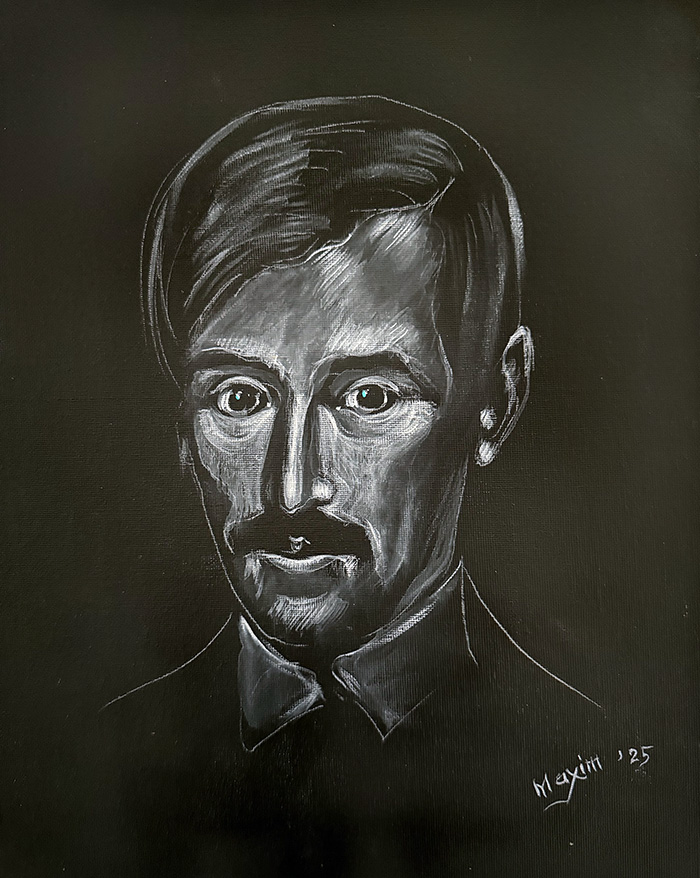
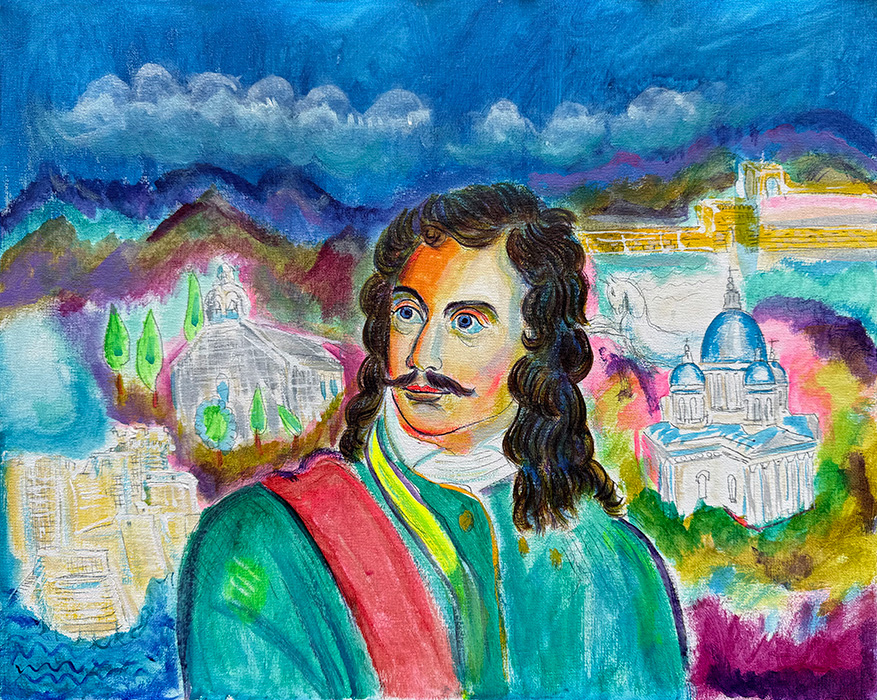
- Details
- Category: Maxim
"Grof Sava Vladislavić: Visions Across Empires", acrylic on canvas panel, Bishop Maxim, 2025
This expressive portrait presents Grof Sava Vladislavić—diplomat, nobleman, and cultural bridge-builder—surrounded by the landmarks of his life. His gaze reaches beyond the frame, as if toward the worlds he helped shape. Around him swirl Orthodox churches, imperial palaces, and coastal cities, while a white horse emerges from the clouds—a symbol of journey and destiny. Blending portrait and dreamscape, the painting evokes not just a man, but a vision that crossed borders and centuries.
This expressive portrait presents Grof Sava Vladislavić—diplomat, nobleman, and cultural bridge-builder—surrounded by the landmarks of his life. His gaze reaches beyond the frame, as if toward the worlds he helped shape. Around him swirl Orthodox churches, imperial palaces, and coastal cities, while a white horse emerges from the clouds—a symbol of journey and destiny. Blending portrait and dreamscape, the painting evokes not just a man, but a vision that crossed borders and centuries.
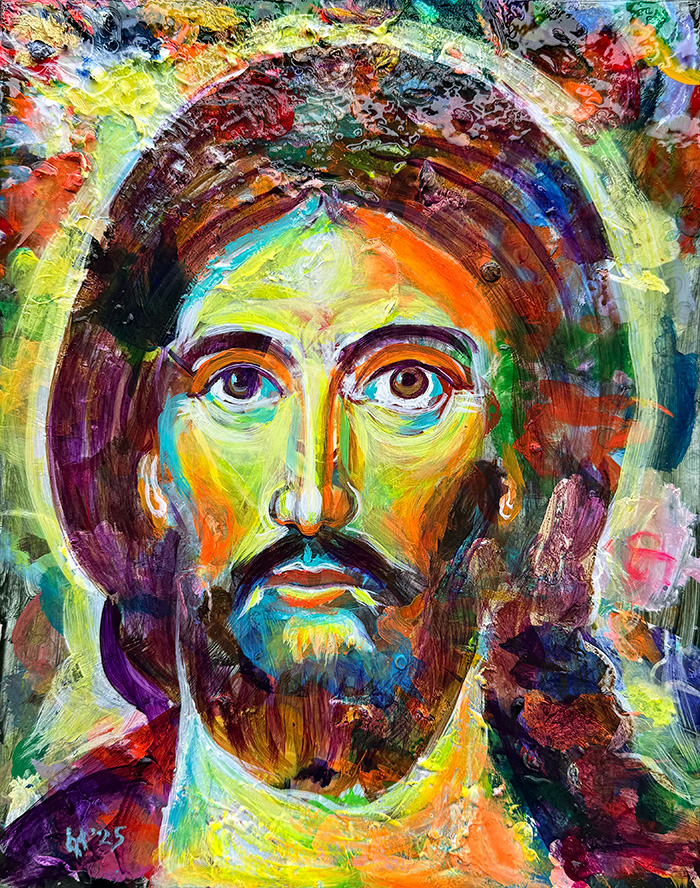
- Details
- Category: Maxim
"Christ of Herzegovina", acrylic on gesso board, Bishop Maxim, 2025
We often speak of light—Christ as light, the Saints who beheld it—but let us now see this as a portrait. What draws us is the gaze: a glance that meets ours and reads our heart, as we, in turn, read it like a dear friend. There’s a harmony—love, respect, understanding—that forms a quiet dialogue between viewer and image.
The more we gaze, the more it speaks: “Stamati, my Stamati.” A living axis forms between two eyes—ours and the portrait’s. It invites: “Come, speak to me. Pray.” Though the listening itself cannot be painted, the gaze is rendered with deep clarity.
There is no hesitation in the lines—especially in the hair and the light upon the cheeks and lids. The strokes, glowing with red and orange, reveal a confident hand—perhaps even a student of portraiture who has learned well the secret of bringing presence to the surface.
—Stamatis Skliris
We often speak of light—Christ as light, the Saints who beheld it—but let us now see this as a portrait. What draws us is the gaze: a glance that meets ours and reads our heart, as we, in turn, read it like a dear friend. There’s a harmony—love, respect, understanding—that forms a quiet dialogue between viewer and image.
The more we gaze, the more it speaks: “Stamati, my Stamati.” A living axis forms between two eyes—ours and the portrait’s. It invites: “Come, speak to me. Pray.” Though the listening itself cannot be painted, the gaze is rendered with deep clarity.
There is no hesitation in the lines—especially in the hair and the light upon the cheeks and lids. The strokes, glowing with red and orange, reveal a confident hand—perhaps even a student of portraiture who has learned well the secret of bringing presence to the surface.
—Stamatis Skliris
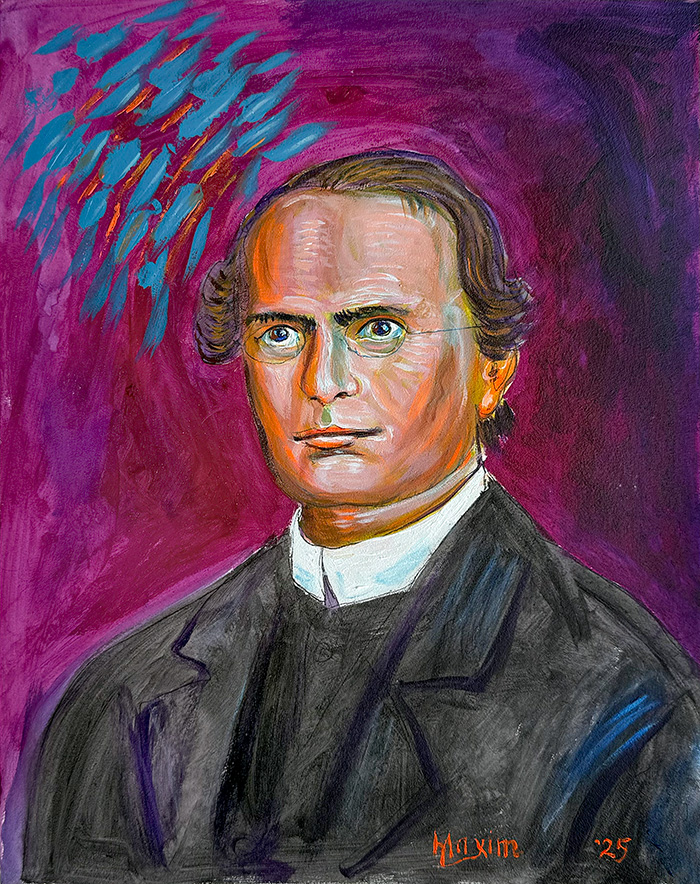
- Details
- Category: Maxim
"Gregor Mendel: Patience and Revelation", acrylic on gesso board, Bishop Maxim, 2025
This portrait captures Gregor Mendel—Augustinian monk and father of modern genetics—as a figure of attentiveness. His gaze is focused, his posture composed, embodying the quiet patience of scientific observation and the contemplative depth of monastic life. Mendel is depicted not amid dramatic discovery, but in the sacred act of listening—listening to nature, reason, and the whisper of revelation that binds faith and inquiry. The painting bridges the cloister and the laboratory, the sacred and the empirical. Here, science is not severed from belief but illuminated by it. Behind him, violet and deep red hues evoke the ambiance of his religious vocation and the mystery of the unknown he sought to understand. Light gently touches his face, suggesting that truth—like grace often comes quietly to those who wait and watch with reverence.
This portrait captures Gregor Mendel—Augustinian monk and father of modern genetics—as a figure of attentiveness. His gaze is focused, his posture composed, embodying the quiet patience of scientific observation and the contemplative depth of monastic life. Mendel is depicted not amid dramatic discovery, but in the sacred act of listening—listening to nature, reason, and the whisper of revelation that binds faith and inquiry. The painting bridges the cloister and the laboratory, the sacred and the empirical. Here, science is not severed from belief but illuminated by it. Behind him, violet and deep red hues evoke the ambiance of his religious vocation and the mystery of the unknown he sought to understand. Light gently touches his face, suggesting that truth—like grace often comes quietly to those who wait and watch with reverence.
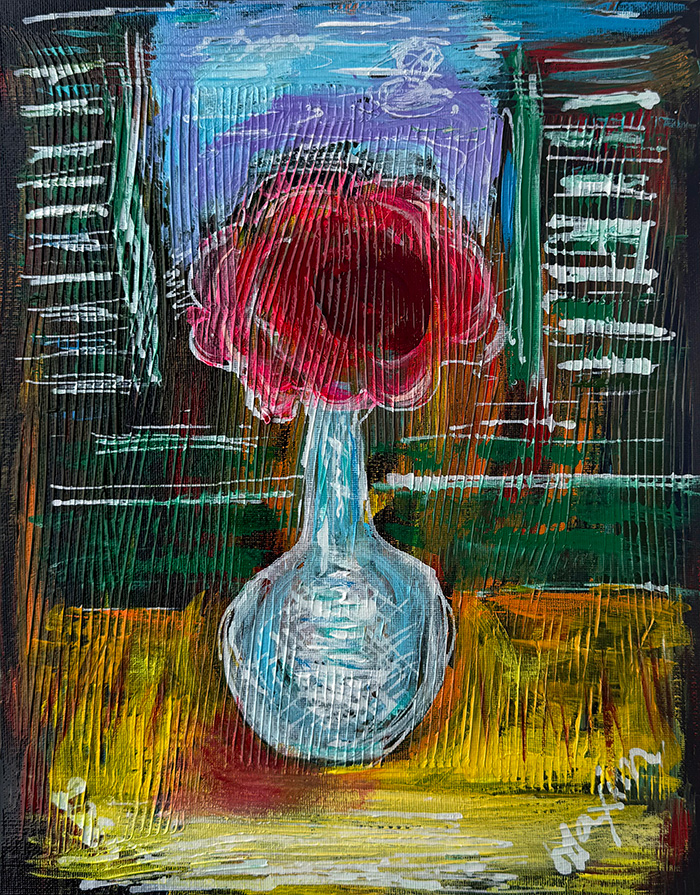
- Details
- Category: Maxim
"Red Bloom by the Window", acrylic on canvas panel, Bishop Maxim, 2025
A single red flower blooms boldly from a translucent vase, centered against a backdrop of luminous colors and rhythmic vertical strokes. This painting is a study in contrasts—light and shadow, stillness and vibration. Behind the flower, two stylized green window shutters frame a view of sky rendered in cool blues and purples, suggesting an interior and expansive space. Executed subtly reminiscent of David Hockney’s visual language—with its vivid palette, flattened perspective, and decorative clarity—the composition invites the viewer into a playful yet contemplative space. The brushwork is textured and insistent, as if each line were a whisper or a hymn, drawing the gaze into a layered meditation.
A single red flower blooms boldly from a translucent vase, centered against a backdrop of luminous colors and rhythmic vertical strokes. This painting is a study in contrasts—light and shadow, stillness and vibration. Behind the flower, two stylized green window shutters frame a view of sky rendered in cool blues and purples, suggesting an interior and expansive space. Executed subtly reminiscent of David Hockney’s visual language—with its vivid palette, flattened perspective, and decorative clarity—the composition invites the viewer into a playful yet contemplative space. The brushwork is textured and insistent, as if each line were a whisper or a hymn, drawing the gaze into a layered meditation.
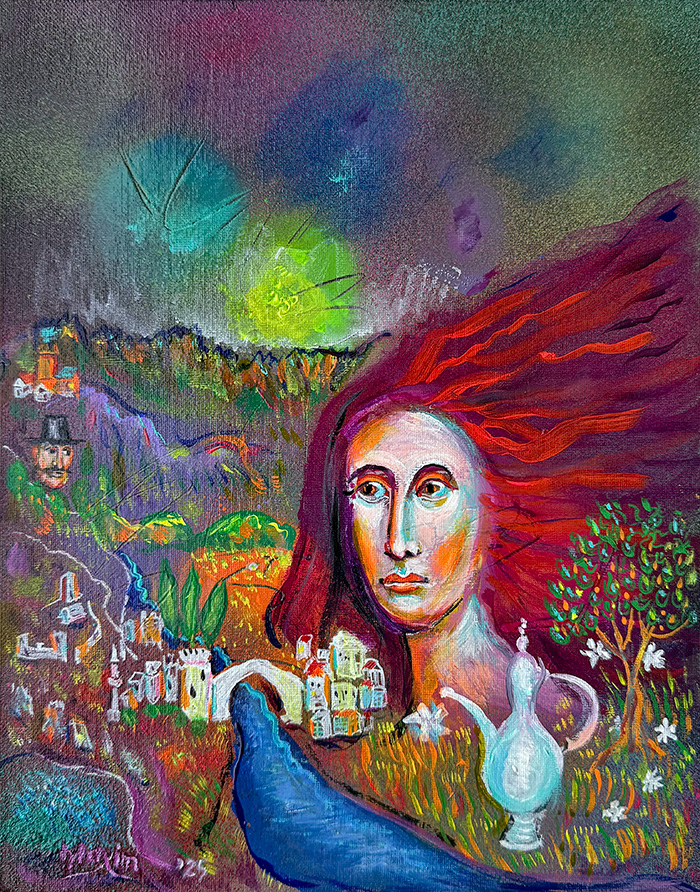
- Details
- Category: Maxim
"She Who Watches Over Mostar", acrylic on canvas panel, Bishop Maxim, 2025
In this vibrant and dreamlike composition, the city of Mostar unfolds in full splendor—its iconic bridge arches gracefully over the emerald river, framed by old stone houses, blooming trees, and the distant outline of Velesh Mountain. Hovering above it all, a monumental female figure gazes tenderly upon the town, her presence both protective and contemplative—an ethereal personification of memory, spirit, or silent witness. At her side, an ibrik—vessel of water—glimmers like an offering, evoking themes of hospitality, life, and the quenching of deeper thirsts. Bathed in sun and bursting with color, the painting invites us to see Mostar not only as a place but as a story, a song, a soul.
In this vibrant and dreamlike composition, the city of Mostar unfolds in full splendor—its iconic bridge arches gracefully over the emerald river, framed by old stone houses, blooming trees, and the distant outline of Velesh Mountain. Hovering above it all, a monumental female figure gazes tenderly upon the town, her presence both protective and contemplative—an ethereal personification of memory, spirit, or silent witness. At her side, an ibrik—vessel of water—glimmers like an offering, evoking themes of hospitality, life, and the quenching of deeper thirsts. Bathed in sun and bursting with color, the painting invites us to see Mostar not only as a place but as a story, a song, a soul.
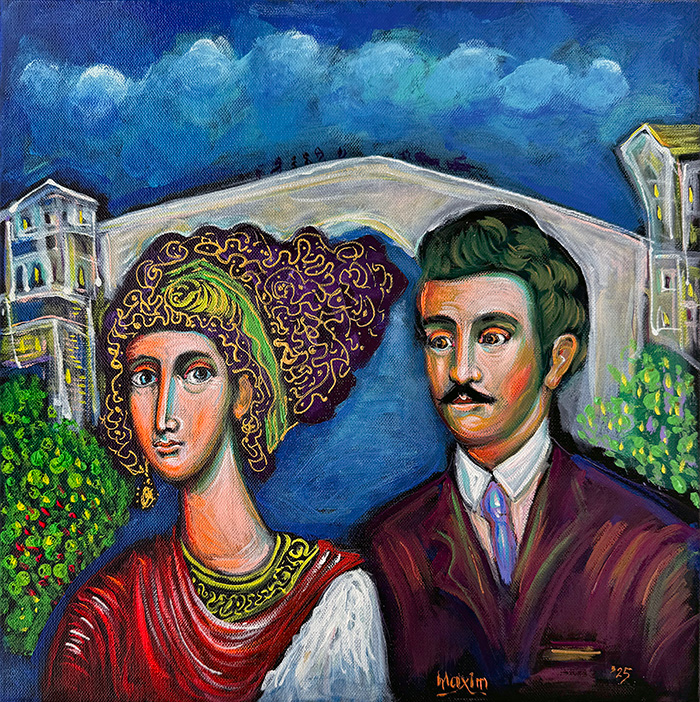
- Details
- Category: Maxim
"Osman and Zorka: Love Beyond the Divide", acrylic on canvas, Bishop Maxim, 2025
This painting portrays the Muslim poet Osman Djikić (d. 1912) alongside his Serbian wife Zorka, set against the iconic backdrop of the Mostar Bridge—a symbol of connection and division. The couple stands as a quiet testament to interfaith harmony and emotional resilience in early 20th-century Herzegovina, when such a union was viewed with suspicion. Zorka is depicted in traditional attire, her hair styled in the manner of an “embroidery”, delicately adorned with gold thread, reflecting both cultural richness and feminine grace. Osman and Zorka exchange glances filled with mutual affection, their closeness radiating a gentle defiance of the societal norms that sought to separate them.
This painting portrays the Muslim poet Osman Djikić (d. 1912) alongside his Serbian wife Zorka, set against the iconic backdrop of the Mostar Bridge—a symbol of connection and division. The couple stands as a quiet testament to interfaith harmony and emotional resilience in early 20th-century Herzegovina, when such a union was viewed with suspicion. Zorka is depicted in traditional attire, her hair styled in the manner of an “embroidery”, delicately adorned with gold thread, reflecting both cultural richness and feminine grace. Osman and Zorka exchange glances filled with mutual affection, their closeness radiating a gentle defiance of the societal norms that sought to separate them.
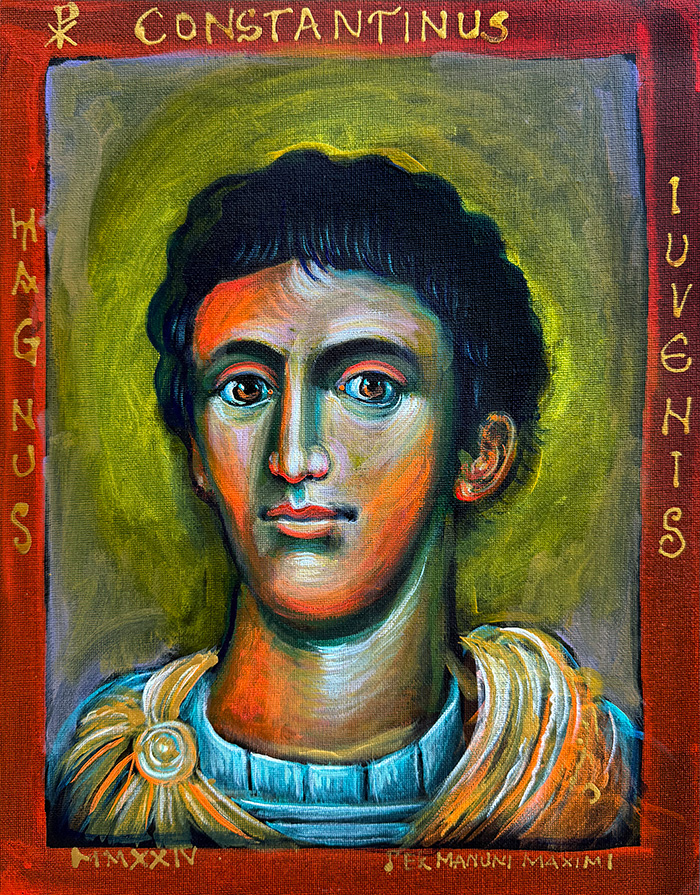
- Details
- Category: Maxim
"Constantinus Magnus Iuvenis", acrylic on canvas panel, Bishop Maxim, 2024
In this evocative portrait, the young Constantine the Great stands as a Roman soldier—his posture upright, his neck firm, his armor sculpted with imperial clarity. The contours of his face bear the strength of a warrior and the foresight of a ruler. Yet it is in the eyes, softly illumined, that we glimpse something more: not only the promise of power and future triumphs, but the shimmering hint of a destiny that reaches beyond empire—toward eternity. Here, youth meets providence, and history becomes haloed with mystery.
In this evocative portrait, the young Constantine the Great stands as a Roman soldier—his posture upright, his neck firm, his armor sculpted with imperial clarity. The contours of his face bear the strength of a warrior and the foresight of a ruler. Yet it is in the eyes, softly illumined, that we glimpse something more: not only the promise of power and future triumphs, but the shimmering hint of a destiny that reaches beyond empire—toward eternity. Here, youth meets providence, and history becomes haloed with mystery.
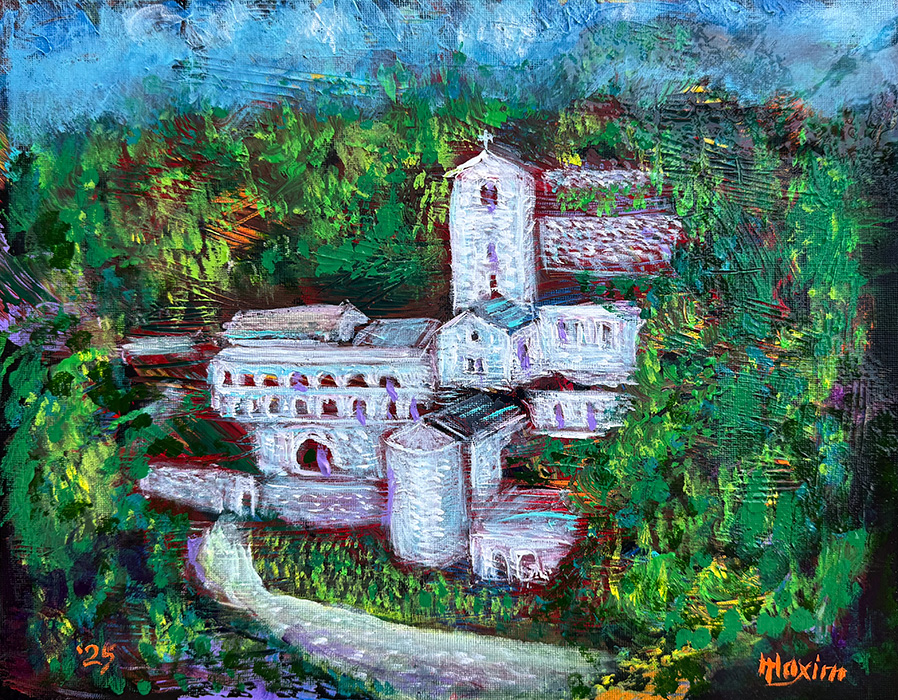
- Details
- Category: Maxim
"Sacred Glow: St. Peter of Cetinje Monastery", acrylic on canvas panel, Bishop Maxim, 2025
Bathed in a gentle, almost sacred light, the historic Monastery of St. Peter of Cetinje emerges in this impressionist rendering as a vision of stillness and grace. The whitewashed walls glow with quiet majesty, standing serene amidst the surrounding forest, where soft greens whisper through the trees. Acrylic meets canvas like memory meets prayer—capturing a place and a presence. Here, time breathes gently, and the spirit of Montenegro rests beneath the sun.
Bathed in a gentle, almost sacred light, the historic Monastery of St. Peter of Cetinje emerges in this impressionist rendering as a vision of stillness and grace. The whitewashed walls glow with quiet majesty, standing serene amidst the surrounding forest, where soft greens whisper through the trees. Acrylic meets canvas like memory meets prayer—capturing a place and a presence. Here, time breathes gently, and the spirit of Montenegro rests beneath the sun.
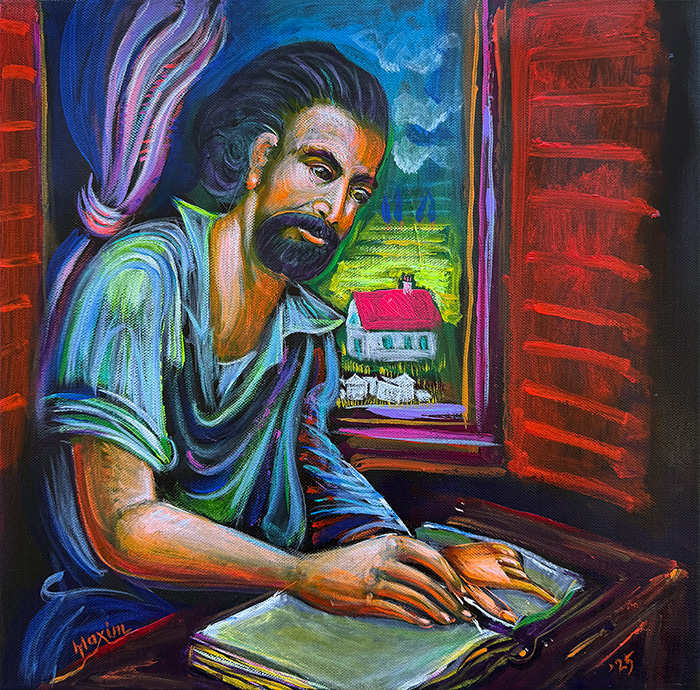
- Details
- Category: Maxim
"Mak Dizdar: The Scribe of Silence and Stone", acrylic on canvas, Bishop Maxim, 2025
Mak Dizdar, the poetic soul of Herzegovina, is portrayed here in a moment of silent genesis. Seated in the hush of his room, his presence echoes the ancient voices of the Stećci, Herzegovina’s timeless stones. His shirt and the curtain beside him share a muted radiance, leading the gaze to a window where a lone house and sacred stone stand—witnesses to the life and loss his verses awaken. The page before him shimmers with history, longing, and quiet hope in this subdued interior. More than a manuscript, it is Mak’s way of giving breath to the forgotten and voice to the buried.
Mak Dizdar, the poetic soul of Herzegovina, is portrayed here in a moment of silent genesis. Seated in the hush of his room, his presence echoes the ancient voices of the Stećci, Herzegovina’s timeless stones. His shirt and the curtain beside him share a muted radiance, leading the gaze to a window where a lone house and sacred stone stand—witnesses to the life and loss his verses awaken. The page before him shimmers with history, longing, and quiet hope in this subdued interior. More than a manuscript, it is Mak’s way of giving breath to the forgotten and voice to the buried.
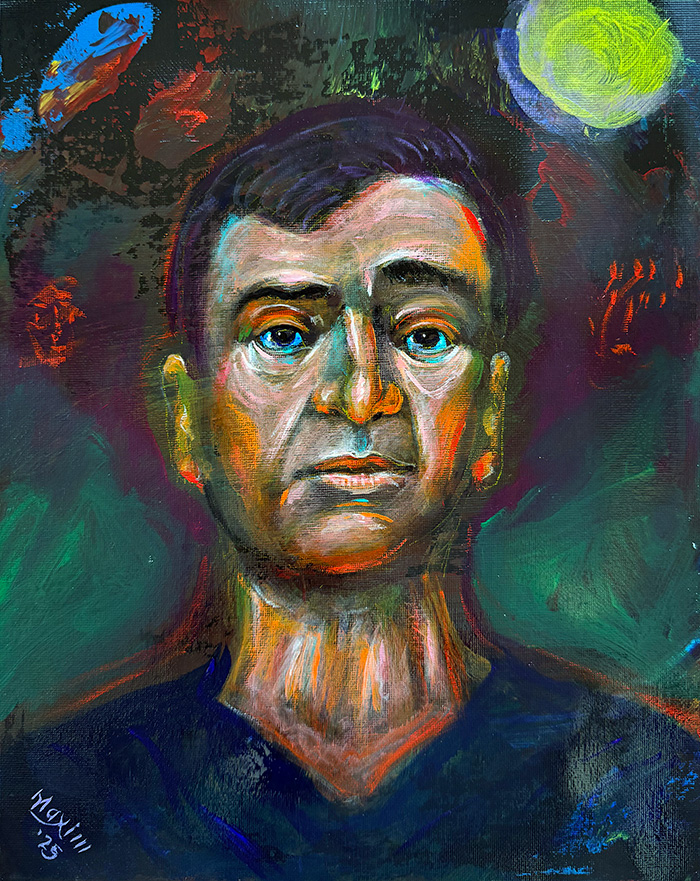
- Details
- Category: Maxim
"Threshold and Grace: Dr. Peško", acrylic on canvas panel, Bishop Maxim, 2025
Dr. Peško stands at the edge where body meets mystery—surgeon, witness, and bearer of the in-between. From the shadowed depths of the operating room, he rises not in escape but in return, marked by the quiet devotion of one who has seen suffering and answered with skill and sacrifice. His face, etched with endurance, reflects not despair but a vocation lived fully. Overhead, a burst of yellow light breaks the gloom—a grace beyond anatomy, a silent benediction. This portraiture is a testament. In his hands, the human becomes luminous.
Dr. Peško stands at the edge where body meets mystery—surgeon, witness, and bearer of the in-between. From the shadowed depths of the operating room, he rises not in escape but in return, marked by the quiet devotion of one who has seen suffering and answered with skill and sacrifice. His face, etched with endurance, reflects not despair but a vocation lived fully. Overhead, a burst of yellow light breaks the gloom—a grace beyond anatomy, a silent benediction. This portraiture is a testament. In his hands, the human becomes luminous.
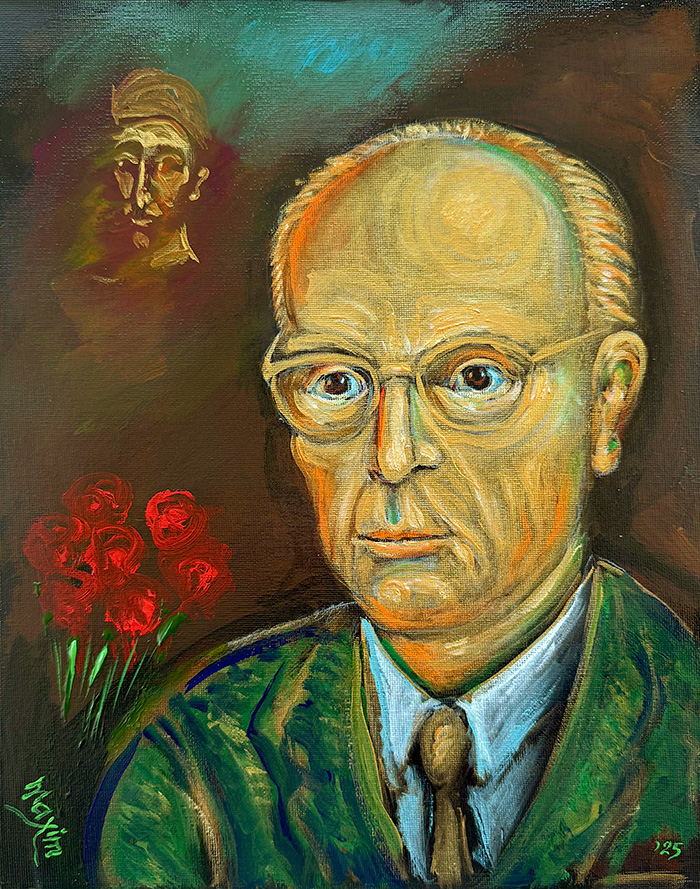
- Details
- Category: Maxim
"Selimović in Gold", acrylic on canvas board, Bishop Maxim, 2025
In this evocative portrait, Meša Selimović, the great Yugoslav writer, is captured in a moment of profound contemplation—his gaze cast aside, as if searching the silence for answers long buried. On his right, emerging like memory from shadow, is the faint, spectral shape of a dervish—the haunted hero of "Dervish and Death"—a figure born of Selimović’s grief, forged in the fire of fraternal loss. Beneath them, flowers bloom—yet each petal bears the echo of a human face, as if sorrow has taken root and blossomed into witness. Gold dominates the palette, tracing the lines of Selimović’s face not with glory, but with the solemn weight of wisdom hard-won.
In this evocative portrait, Meša Selimović, the great Yugoslav writer, is captured in a moment of profound contemplation—his gaze cast aside, as if searching the silence for answers long buried. On his right, emerging like memory from shadow, is the faint, spectral shape of a dervish—the haunted hero of "Dervish and Death"—a figure born of Selimović’s grief, forged in the fire of fraternal loss. Beneath them, flowers bloom—yet each petal bears the echo of a human face, as if sorrow has taken root and blossomed into witness. Gold dominates the palette, tracing the lines of Selimović’s face not with glory, but with the solemn weight of wisdom hard-won.
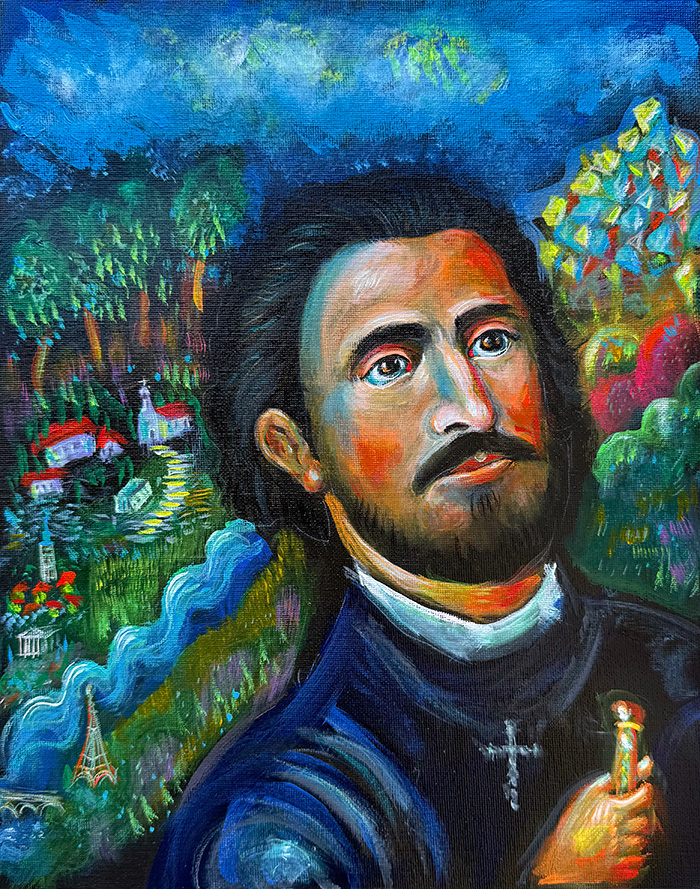
- Details
- Category: Maxim
"The Sword Bearer of Wisdom: The Young Archimandrite", acrylic on canvas panel, Maxim Bishop, 2025
This painting depicts the young Archimandrite Nikifor Dučić—monk, historian, soldier, and scholar—emerging from the rugged land of Herzegovina, sword in hand, striding through history. From monastic school to the battlefield, from the Cetinje Seminary to the Sorbonne, from parliament to the National Library, his life was a journey of faith and nationhood. The sword symbolizes struggle; the unseen book, wisdom. Together they reflect his mission: to unite, to enlighten, and to defend.
This painting depicts the young Archimandrite Nikifor Dučić—monk, historian, soldier, and scholar—emerging from the rugged land of Herzegovina, sword in hand, striding through history. From monastic school to the battlefield, from the Cetinje Seminary to the Sorbonne, from parliament to the National Library, his life was a journey of faith and nationhood. The sword symbolizes struggle; the unseen book, wisdom. Together they reflect his mission: to unite, to enlighten, and to defend.
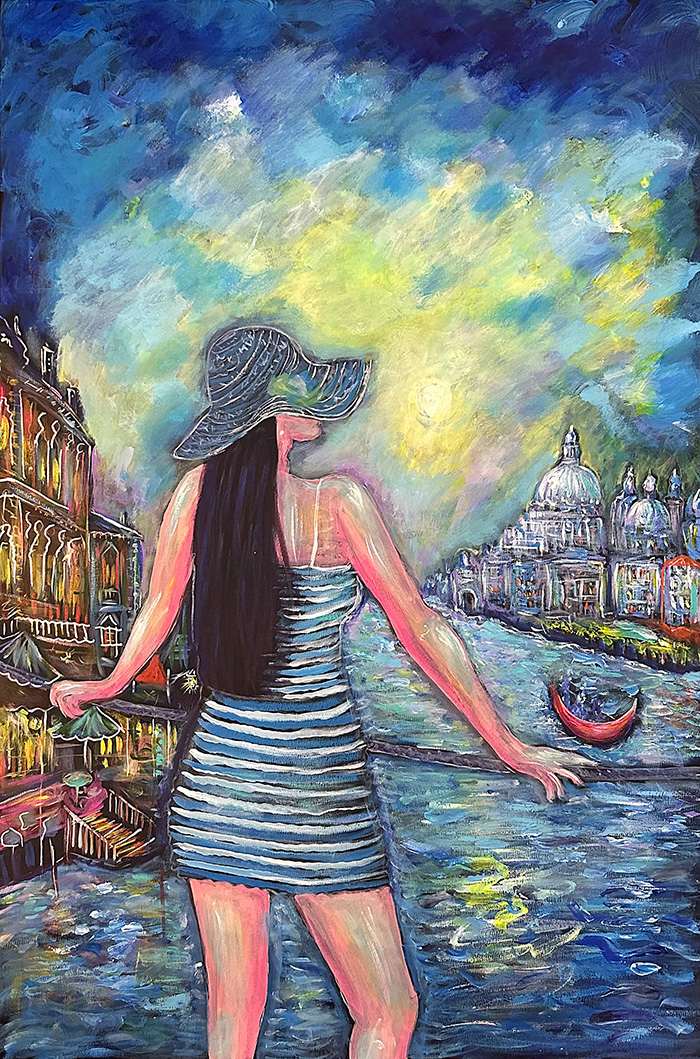
- Details
- Category: Maxim
"Life Rushes into a City Museum", No2, acrylic on canvas, Bishop Maxim, 2024
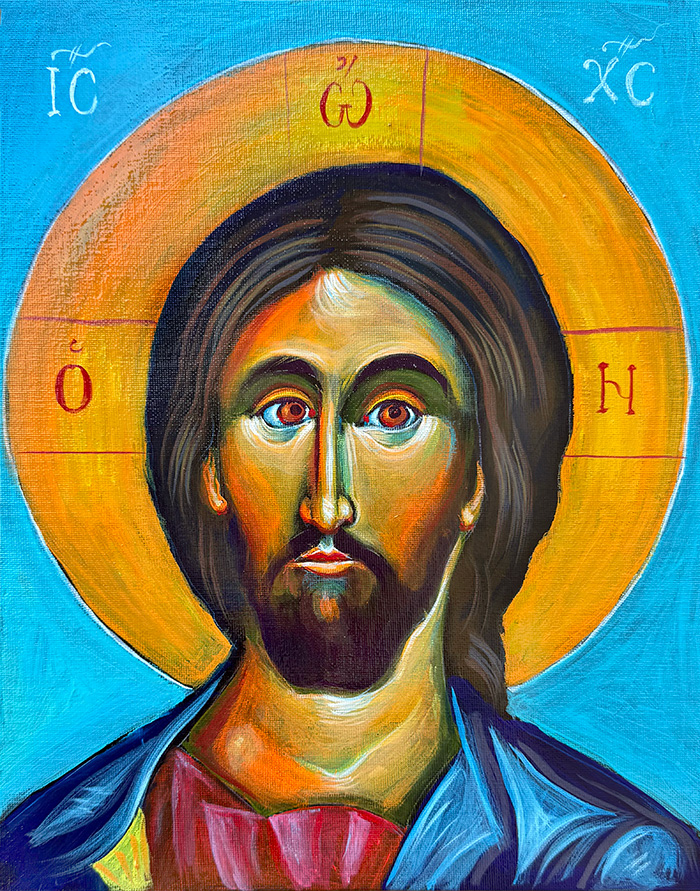
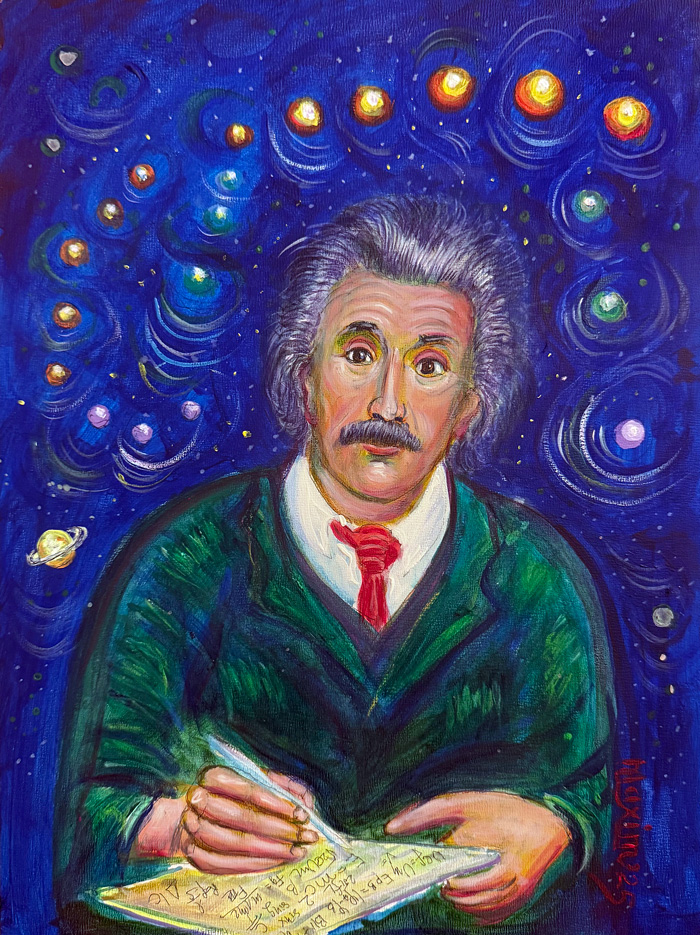

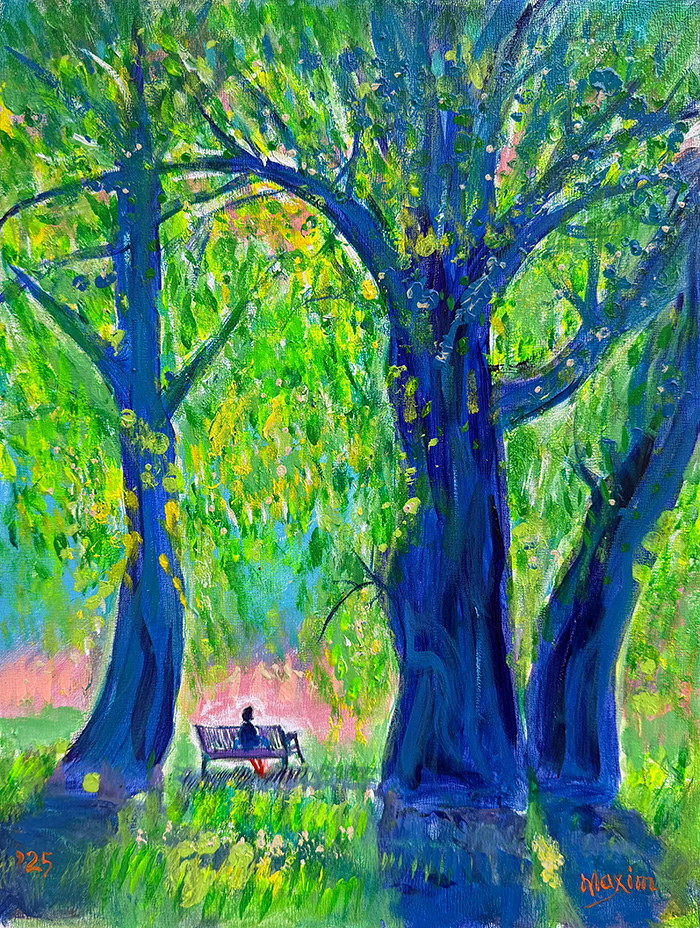
- Details
- Category: Maxim
"Beneath the Indigo Canopy", acrylic on gesso board, Bishop Maxim, 2025
This evocative painting captures a serene summer moment in a sun-dappled park. Towering trees, their trunks rising boldly in indigo blue, frame the scene with a sense of strength and mystery. Swirling above and scattered below, a symphony of multicolored leaves hints at the fullness of summertime. In the distance, almost dreamlike, a solitary bench holds a quiet figure, seated in contemplation. The atmosphere is one of peaceful stillness—refreshing, spacious, and imbued with gentle introspection, inviting the viewer to pause, breathe, and behold.
This work is a reinterpretation of an image the author once saw online—he couldn’t resist the urge to recreate it in his own hand.
This evocative painting captures a serene summer moment in a sun-dappled park. Towering trees, their trunks rising boldly in indigo blue, frame the scene with a sense of strength and mystery. Swirling above and scattered below, a symphony of multicolored leaves hints at the fullness of summertime. In the distance, almost dreamlike, a solitary bench holds a quiet figure, seated in contemplation. The atmosphere is one of peaceful stillness—refreshing, spacious, and imbued with gentle introspection, inviting the viewer to pause, breathe, and behold.
This work is a reinterpretation of an image the author once saw online—he couldn’t resist the urge to recreate it in his own hand.
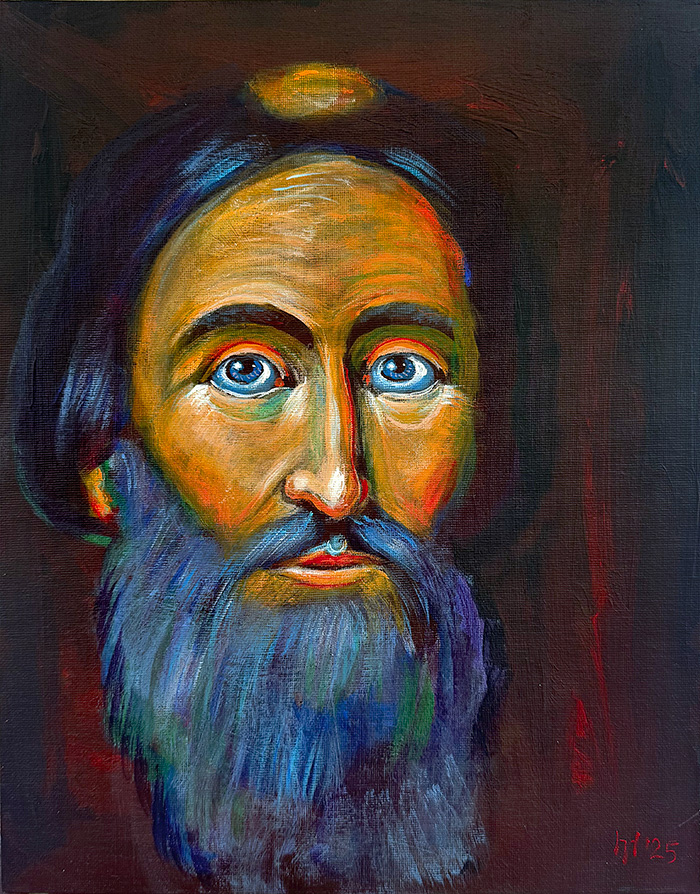
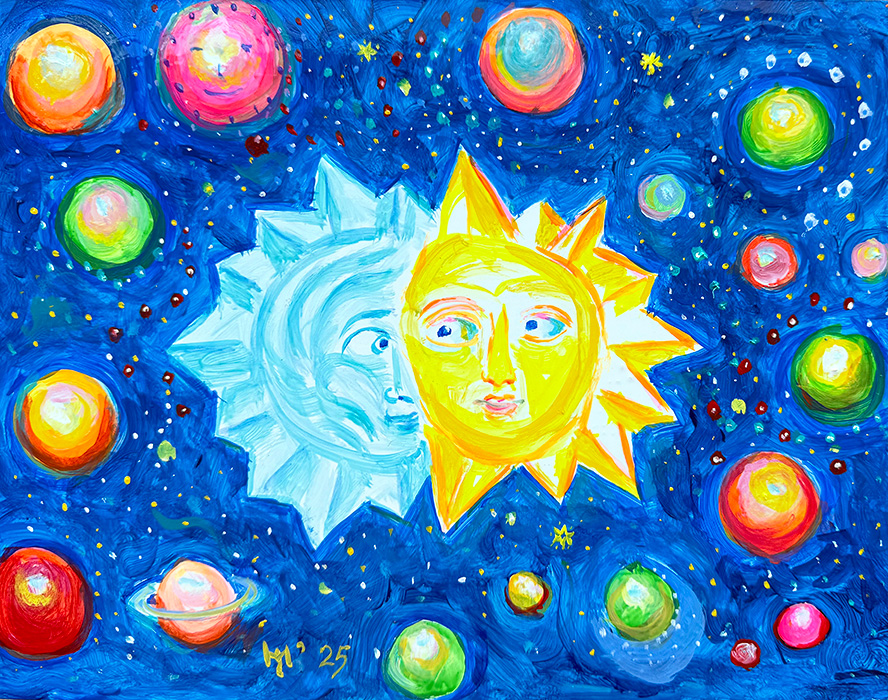
- Details
- Category: Maxim
"Praise Him, Sun and Moon... All You Shining Stars", acrylic on gesso board, Bishop Maxim, 2025
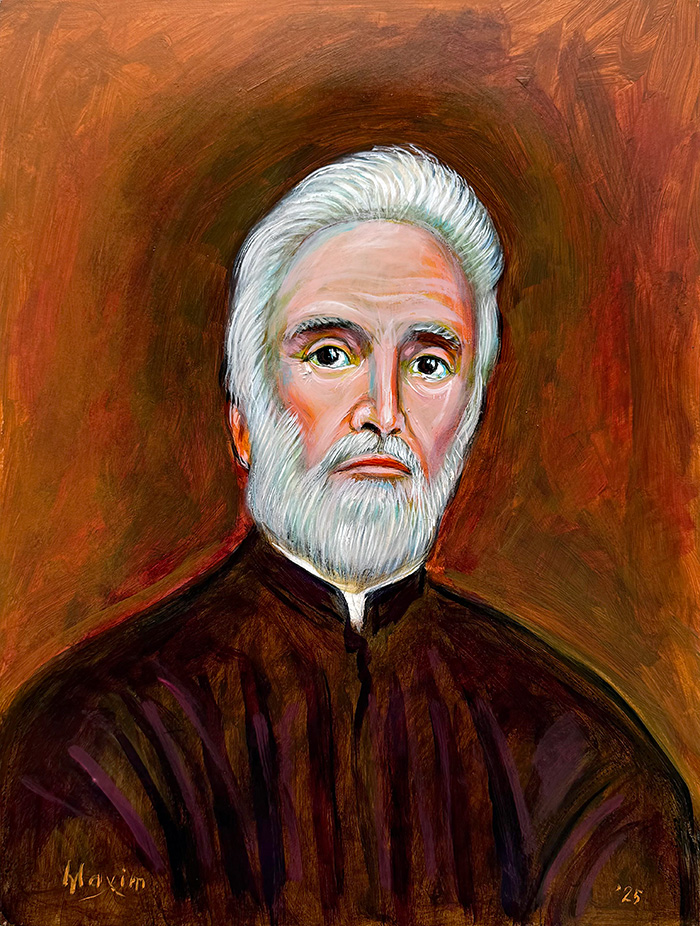
- Details
- Category: Maxim
"Metropolitan John (Zizioulas)", acrylic on gesso board, Bishop Maxim, 2025
INTERPRETATION OF THE PORTRAIT OF THE METROPOLITAN OF PERGAMON JOHN (ZIZIOULAS) by the hand of Bishop MAXIMOS (VASILJEVIC)
An invisible axis connects the gaze of the depicted Metropolitan with the spectator. This gaze looks at us seriously and thoughtfully, and together with the soft wrinkles of the forehead and the ambiguous lips, it is as if they immobilize time and look not exactly at us, but as if they are penetrating our being and exploring something deep and hidden. The painter succeeded with great simplicity in expressing something ontological: the question of the depicted about life and its meaning. The raised eyebrows of the portrait also contribute to this. After all, this very profound look is like wondering: do you really exist, spectator? Is this relationship real? In other words, they allow for hope to transpire in a relationship of the eyes that brings us into a real relationship. It is what we say in theological language: a true eschatological loving relationship of persons.
Here Bishop Maxim surpassed himself and reached the ideal of the orthodox iconographer. And we are left with the right to ask ourselves: could Maxim get there if his long patient and obedient apprenticeship in Metropolitan of Pergamon hadn’t preceded?
In Athens on the 24th of November 2021.
Fr. Stamatis Skliris
INTERPRETATION OF THE PORTRAIT OF THE METROPOLITAN OF PERGAMON JOHN (ZIZIOULAS) by the hand of Bishop MAXIMOS (VASILJEVIC)
An invisible axis connects the gaze of the depicted Metropolitan with the spectator. This gaze looks at us seriously and thoughtfully, and together with the soft wrinkles of the forehead and the ambiguous lips, it is as if they immobilize time and look not exactly at us, but as if they are penetrating our being and exploring something deep and hidden. The painter succeeded with great simplicity in expressing something ontological: the question of the depicted about life and its meaning. The raised eyebrows of the portrait also contribute to this. After all, this very profound look is like wondering: do you really exist, spectator? Is this relationship real? In other words, they allow for hope to transpire in a relationship of the eyes that brings us into a real relationship. It is what we say in theological language: a true eschatological loving relationship of persons.
Here Bishop Maxim surpassed himself and reached the ideal of the orthodox iconographer. And we are left with the right to ask ourselves: could Maxim get there if his long patient and obedient apprenticeship in Metropolitan of Pergamon hadn’t preceded?
In Athens on the 24th of November 2021.
Fr. Stamatis Skliris
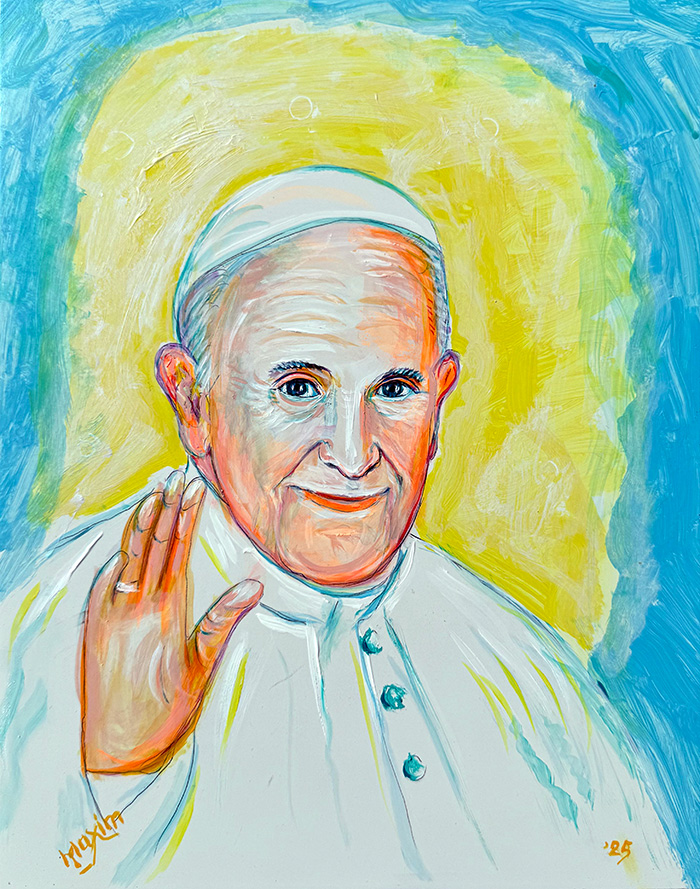
- Details
- Category: Maxim
"The Farewell That Shines Beyond", acrylic on gesso board, Bishop Maxim, 2025
In this acrylic composition on gesso board, the Pope stands in radiant white robes, his face aglow with light, turned toward us in a final, tender wave. Painted just before his passing, the work now bears the aura of a prophetic goodbye—yet it is no farewell of sorrow. His expression shines with peace, promise, and an everlasting joy. The luminous palette, dominated by whites and golds, reflects not only his earthly dignity but the eternal light into which he has entered. A portrait of legacy—smiling, waving, enduring.
In this acrylic composition on gesso board, the Pope stands in radiant white robes, his face aglow with light, turned toward us in a final, tender wave. Painted just before his passing, the work now bears the aura of a prophetic goodbye—yet it is no farewell of sorrow. His expression shines with peace, promise, and an everlasting joy. The luminous palette, dominated by whites and golds, reflects not only his earthly dignity but the eternal light into which he has entered. A portrait of legacy—smiling, waving, enduring.
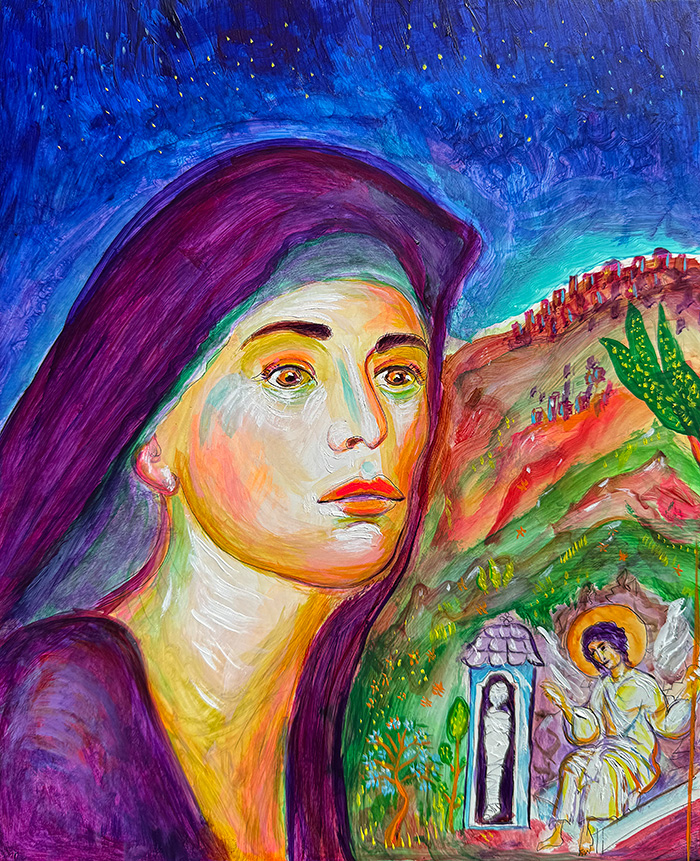
- Details
- Category: Maxim
"The Fragrance of the Unseen", acrylic on gesso board, Bishop Maxim, 2025
She comes alone, the Myrrh-bearing Woman, shrouded in silence and shadow, to the tomb that held the Lifegiver. Her face, etched with both grief and urgency, leans toward the unknown—desperation in her steps, yet some flicker of hope already breaking through the morning’s stillness. The painting captures the very threshold of revelation: a moment suspended between loss and life, death and resurrection. Though she bears myrrh for a corpse, she unknowingly carries hope for the world. The canvas holds the indeterminacy of the moment—where despair and light meet, where she becomes, without knowing it yet, the first apostle of the Resurrection. This is the agony and beauty of Before the Dawn: the vibrant silence of a soul arriving at the tomb, not yet knowing that the stone has been rolled away.
She comes alone, the Myrrh-bearing Woman, shrouded in silence and shadow, to the tomb that held the Lifegiver. Her face, etched with both grief and urgency, leans toward the unknown—desperation in her steps, yet some flicker of hope already breaking through the morning’s stillness. The painting captures the very threshold of revelation: a moment suspended between loss and life, death and resurrection. Though she bears myrrh for a corpse, she unknowingly carries hope for the world. The canvas holds the indeterminacy of the moment—where despair and light meet, where she becomes, without knowing it yet, the first apostle of the Resurrection. This is the agony and beauty of Before the Dawn: the vibrant silence of a soul arriving at the tomb, not yet knowing that the stone has been rolled away.
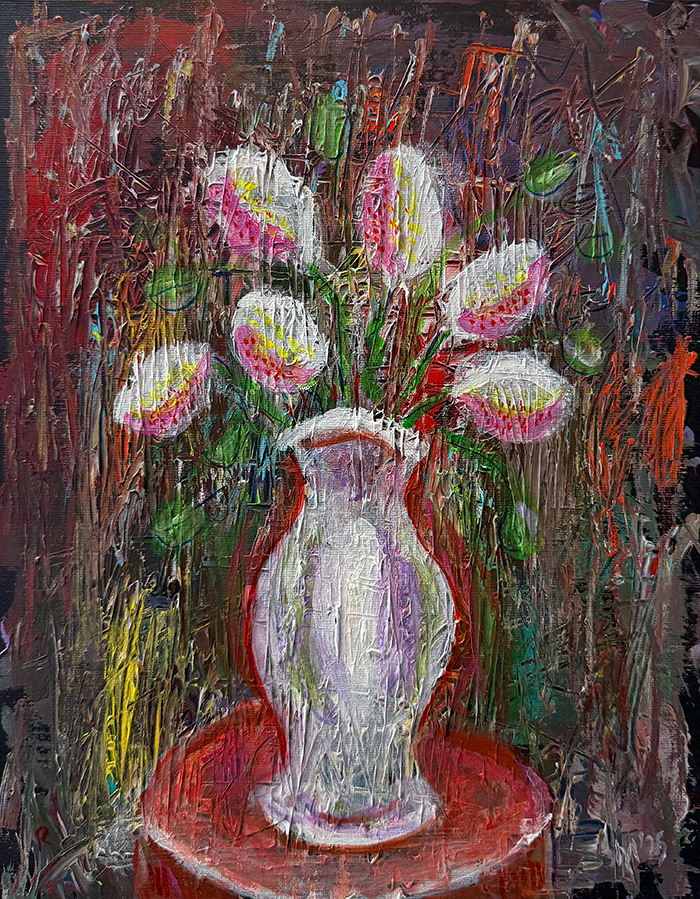
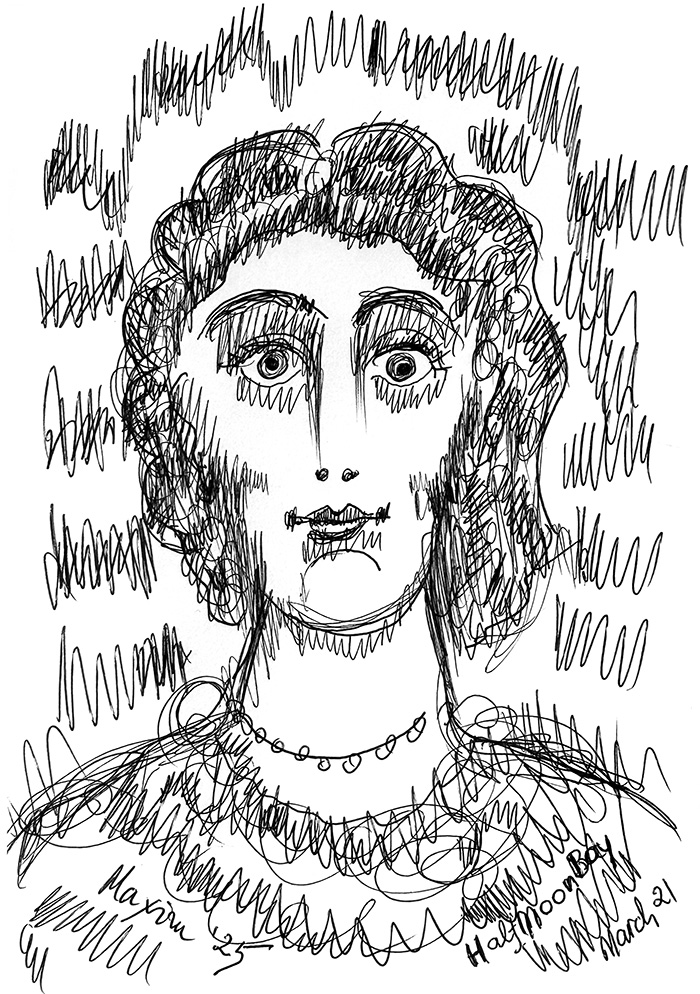
- Details
- Category: Maxim
"A Pause in Time", drawing, Bishop Maxim, 2025
A moment of calm introspection, “A Pause in Time” captures a soft, reflective gaze that draws the viewer inward. With delicate lines and subtle contrasts, the portrait evokes presence and mystery—an invitation to pause and quietly observe.
A moment of calm introspection, “A Pause in Time” captures a soft, reflective gaze that draws the viewer inward. With delicate lines and subtle contrasts, the portrait evokes presence and mystery—an invitation to pause and quietly observe.
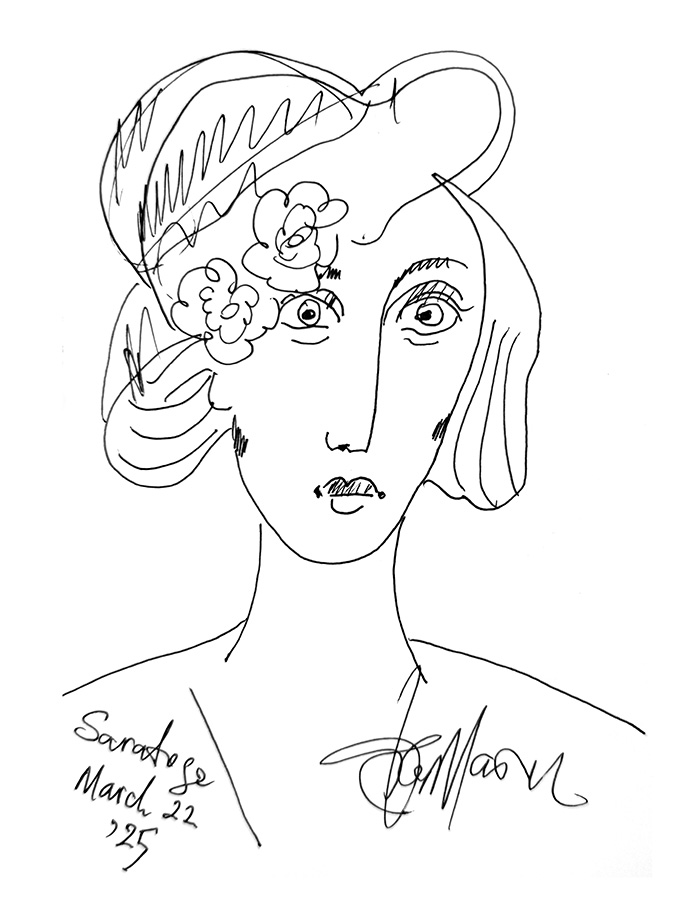
- Details
- Category: Maxim
"Karolina's Stillness with a Question", drawing, Bishop Maxim, 2025
This expressive portrait of Karolina captures a moment suspended between stillness and inquiry. Her wide-open eyes and direct gaze suggest not only presence, but a gentle curiosity—a quiet urge to understand, to connect, to know. The artist conveys this inner tension through subtle linework and restraint, allowing emotion to surface without excess. There is a contemplative calm to the piece, yet beneath it stirs a questioning spirit. With minimal detail and elegant simplicity, the drawing becomes a mirror for our own wonderings—offering a glimpse into Karolina’s interior world while preserving its mystery.
This expressive portrait of Karolina captures a moment suspended between stillness and inquiry. Her wide-open eyes and direct gaze suggest not only presence, but a gentle curiosity—a quiet urge to understand, to connect, to know. The artist conveys this inner tension through subtle linework and restraint, allowing emotion to surface without excess. There is a contemplative calm to the piece, yet beneath it stirs a questioning spirit. With minimal detail and elegant simplicity, the drawing becomes a mirror for our own wonderings—offering a glimpse into Karolina’s interior world while preserving its mystery.
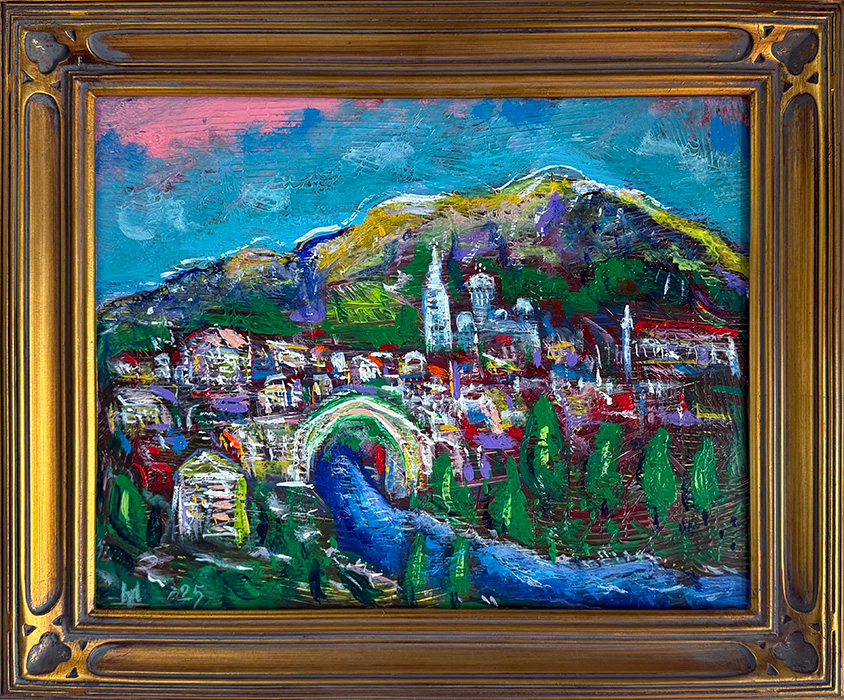
- Details
- Category: Maxim
"Mostar in Light and Texture", acrylic on canvas panel, Bishop Maxim, 2025
This vivid impressionist-relief painting of Mostar captures the city’s poetic spirit through layered textures and luminous color. The iconic Old Bridge (Stari Most) arches gracefully across the canvas, not merely as architecture, but as a symbol of memory, resilience, and the unbroken thread of heritage. The textured technique creates a tactile landscape—the stones of the bridge, the shimmering Neretva River, and the clustered buildings of the old town emerge in almost sculptural form, inviting the viewer to not only see, but feel the city. With light dancing across the surface, the painting evokes a living Mostar—at once rooted in history and pulsing with the rhythms of day and dusk. This work is a celebration of Mostar’s beauty, fragility, and enduring soul.
This vivid impressionist-relief painting of Mostar captures the city’s poetic spirit through layered textures and luminous color. The iconic Old Bridge (Stari Most) arches gracefully across the canvas, not merely as architecture, but as a symbol of memory, resilience, and the unbroken thread of heritage. The textured technique creates a tactile landscape—the stones of the bridge, the shimmering Neretva River, and the clustered buildings of the old town emerge in almost sculptural form, inviting the viewer to not only see, but feel the city. With light dancing across the surface, the painting evokes a living Mostar—at once rooted in history and pulsing with the rhythms of day and dusk. This work is a celebration of Mostar’s beauty, fragility, and enduring soul.
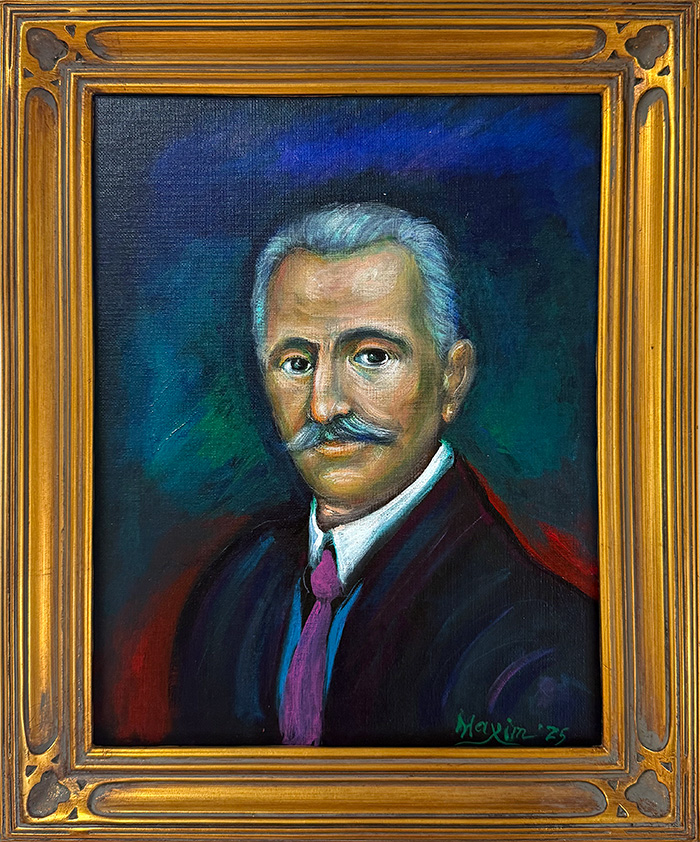
- Details
- Category: Maxim
"Aleksa Šantić: A Soul of Homeland and Sevdah", acrylic on canvas panel, Bishop Maxim, 2025
This portrait of Aleksa Šantić, Mostar’s cherished poet, catches the quiet melancholy and steady strength that ran through his life and words. His eyes, thoughtful under creased brows, hint at a soul torn between yearning and home—a man who felt his people’s highs and lows deep in his bones. The brushstrokes, soft and textured, mirror the gentle flow of his poems, and the muted colors call up the dusty stone and fading light of Herzegovina. Šantić doesn’t loom large here; he’s human—warm, proud, with a glow that’s all his own. You can almost hear his voice in the stillness, murmuring lines of love, grief, and a nation stirring awake. This isn’t just a likeness—it’s a nod to a man who put a voice to a land and its heart.
This portrait of Aleksa Šantić, Mostar’s cherished poet, catches the quiet melancholy and steady strength that ran through his life and words. His eyes, thoughtful under creased brows, hint at a soul torn between yearning and home—a man who felt his people’s highs and lows deep in his bones. The brushstrokes, soft and textured, mirror the gentle flow of his poems, and the muted colors call up the dusty stone and fading light of Herzegovina. Šantić doesn’t loom large here; he’s human—warm, proud, with a glow that’s all his own. You can almost hear his voice in the stillness, murmuring lines of love, grief, and a nation stirring awake. This isn’t just a likeness—it’s a nod to a man who put a voice to a land and its heart.
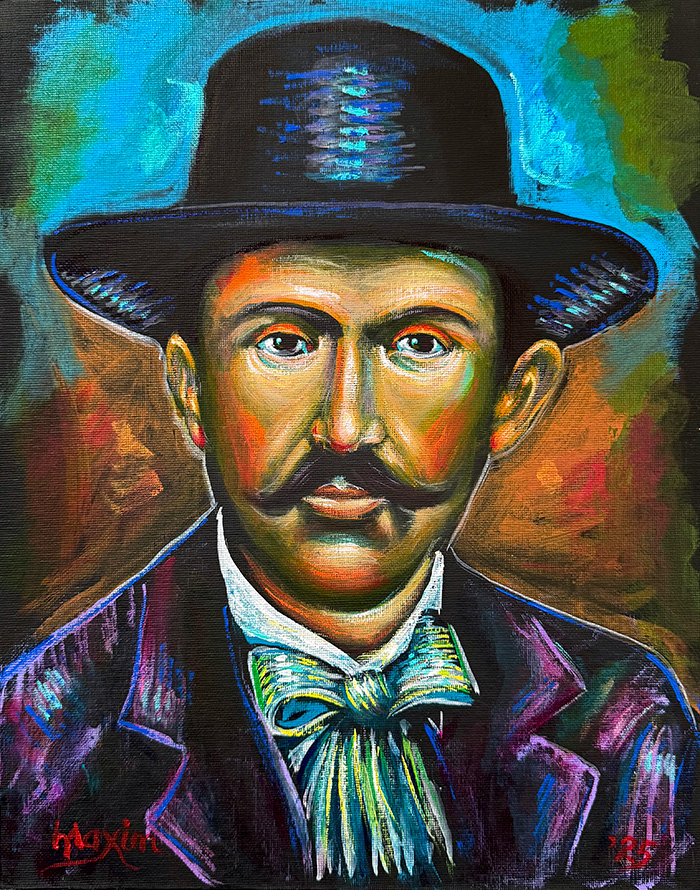
- Details
- Category: Maxim
"A Hat Full of Stories: Svetozar Ćorović", acrylic on canvas panel, Bishop Maxim, 2025
In this striking portrait, Svetozar Ćorović, the renowned Herzegovinian writer, is rendered with quiet intensity and depth. Wearing his distinctive hat—a symbol both of era and identity—he gazes slightly aside, as if listening to the murmurs of memory or weighing a thought before it becomes word. The earthy tones surrounding him evoke the rugged landscape of Herzegovina, while the subtle interplay of light and shadow on his face speaks to an inner life shaped by the joys and burdens of history, language, and homeland. The brushstrokes are confident yet tender, allowing the viewer to sense both the public figure and the private man.
In this striking portrait, Svetozar Ćorović, the renowned Herzegovinian writer, is rendered with quiet intensity and depth. Wearing his distinctive hat—a symbol both of era and identity—he gazes slightly aside, as if listening to the murmurs of memory or weighing a thought before it becomes word. The earthy tones surrounding him evoke the rugged landscape of Herzegovina, while the subtle interplay of light and shadow on his face speaks to an inner life shaped by the joys and burdens of history, language, and homeland. The brushstrokes are confident yet tender, allowing the viewer to sense both the public figure and the private man.
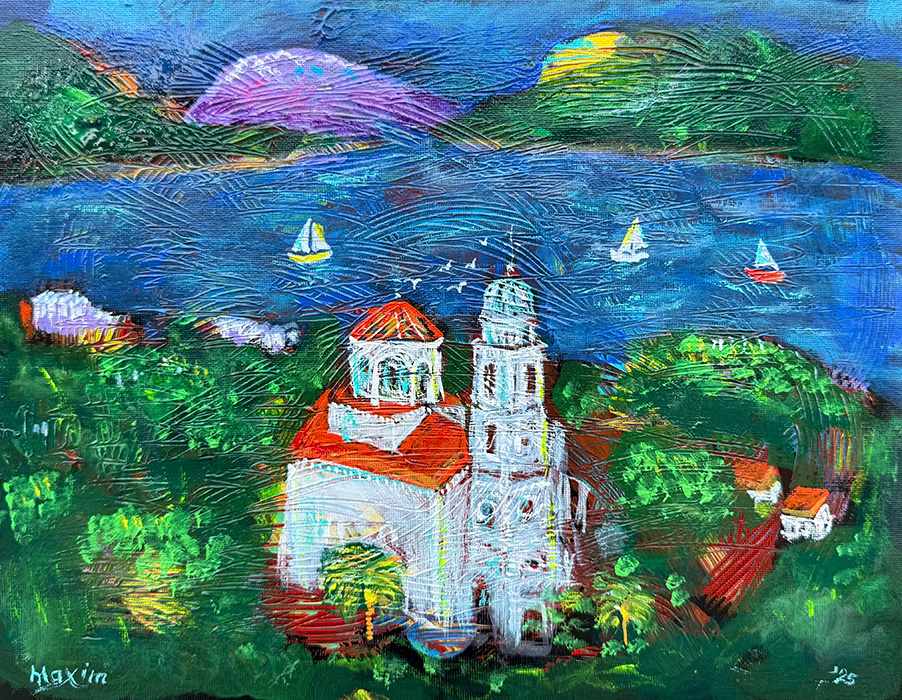
- Details
- Category: Maxim
"Sanctuary on the Heights: Savina Monastery", acrylic on canvas panel, Bishop Maxim, 2025
This impressionist painting captures the tranquil landscape of Savina Monastery in Montenegro, set not on the coast but elevated on the hills. The scene features a central white church that radiates the spiritual purity of the region. Surrounding nature is depicted in a loosely detailed style, complementing the serene sea dotted with ships. In the distance, mountains stretch across the horizon, enhancing the serene ambiance of this revered site.
This impressionist painting captures the tranquil landscape of Savina Monastery in Montenegro, set not on the coast but elevated on the hills. The scene features a central white church that radiates the spiritual purity of the region. Surrounding nature is depicted in a loosely detailed style, complementing the serene sea dotted with ships. In the distance, mountains stretch across the horizon, enhancing the serene ambiance of this revered site.
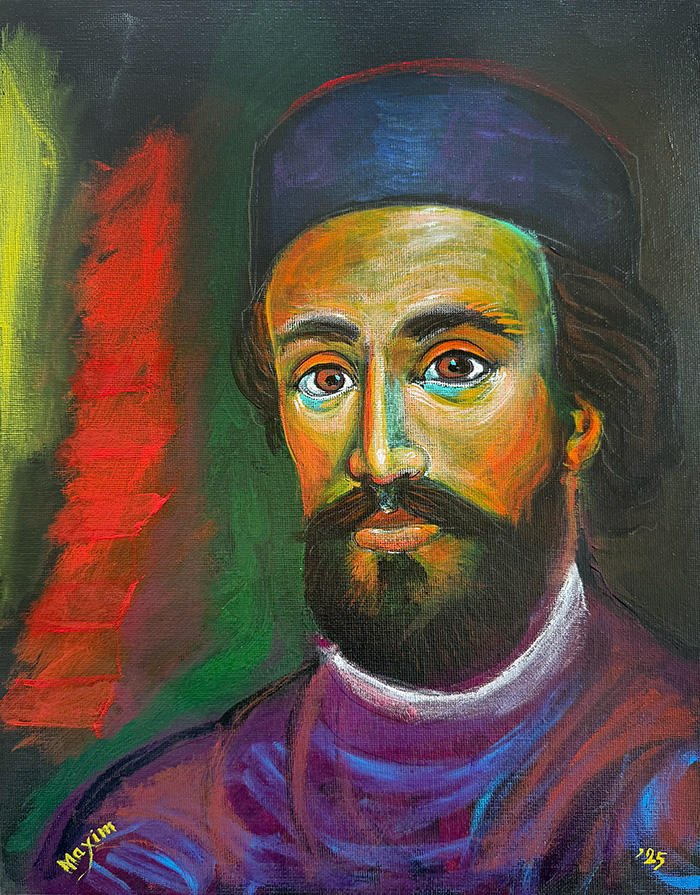
- Details
- Category: Maxim
"Seer Beyond the Visible", acrylic on canvas panel, Bishop Maxim, 2025
This portrait of Vladika Njegoš, the poet-prince of Montenegro, reveals a man of strength and contemplation. His gaze pierces beyond the visible, as if beholding the mystery of God through the human face. Surrounded by red, green, and yellow, he stands both as a national figure, and as one who sees—and is seen—by the transcendent.
This portrait of Vladika Njegoš, the poet-prince of Montenegro, reveals a man of strength and contemplation. His gaze pierces beyond the visible, as if beholding the mystery of God through the human face. Surrounded by red, green, and yellow, he stands both as a national figure, and as one who sees—and is seen—by the transcendent.
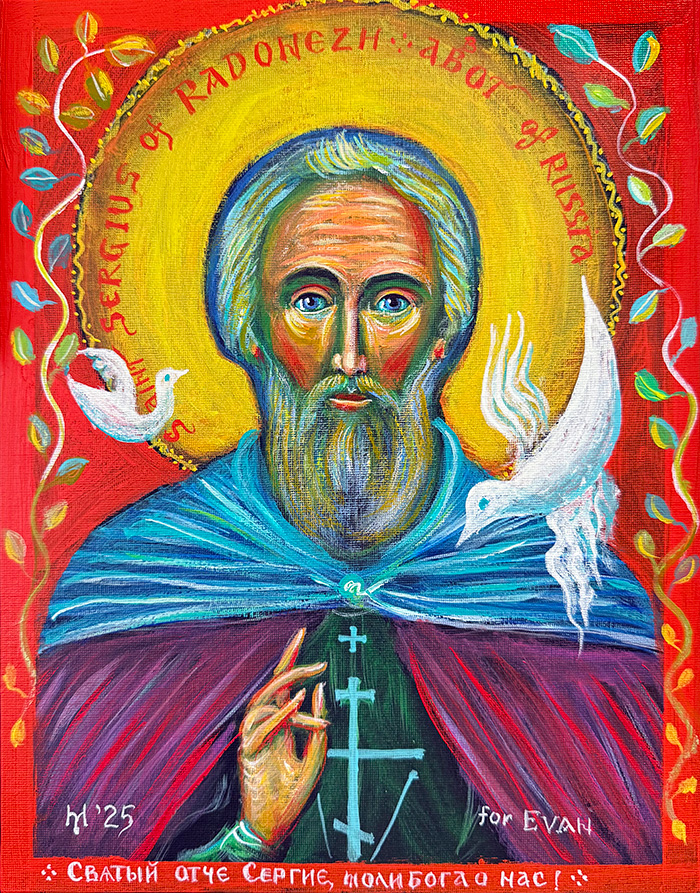
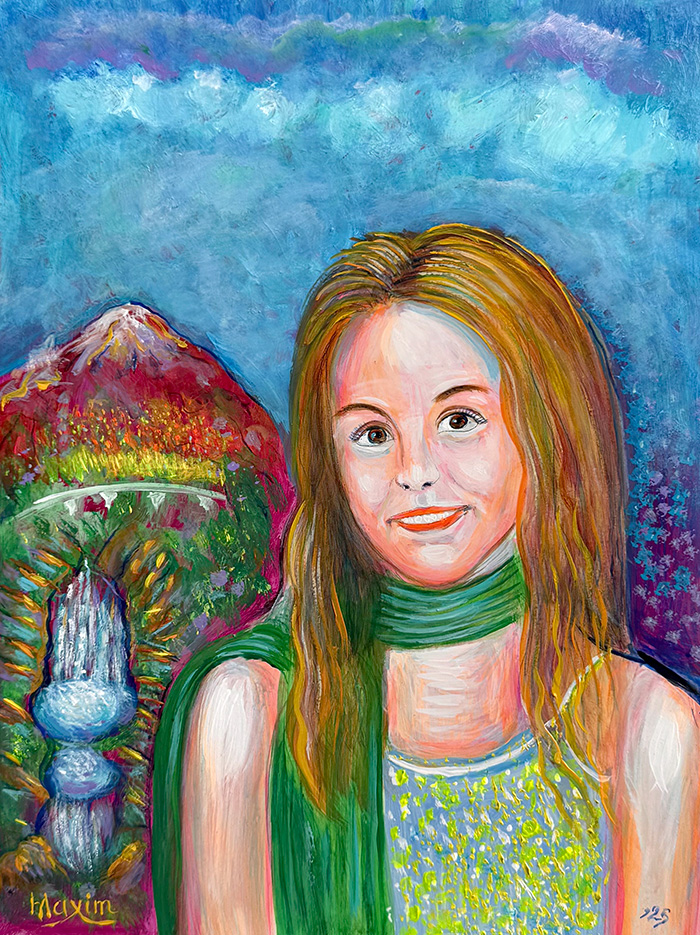
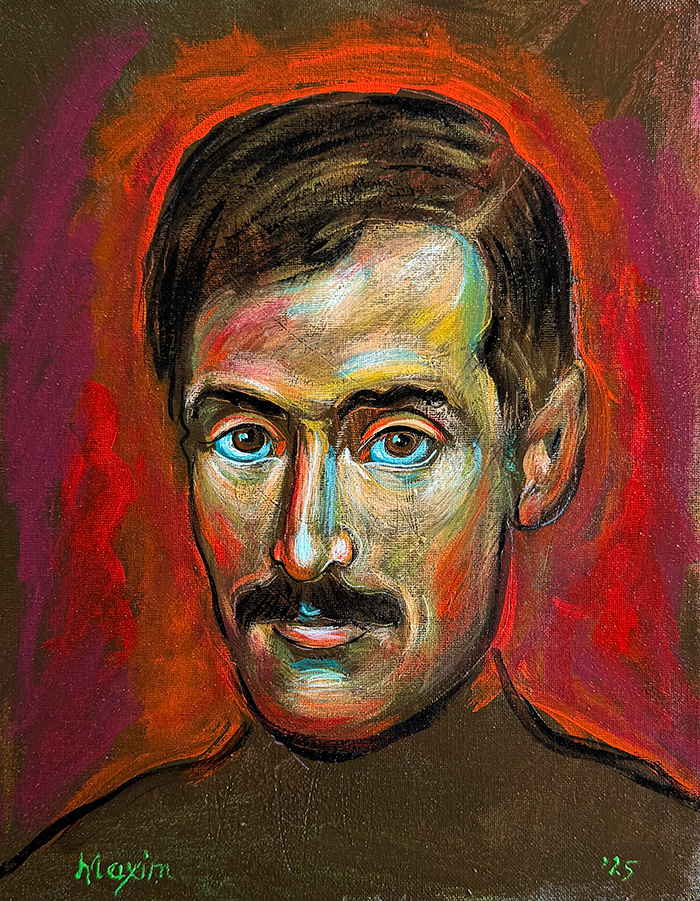
- Details
- Category: Maxim
"Jovan Dučić – A Gaze Through Time", acrylic on canvas panel, Bishop Maxim, 2025
In this evocative portrait, Byzantine iconographic elements blend with impressionist and expressionist influences to depict a youthful Jovan Dučić. His penetrating gaze meets the viewer with contemplative intensity. The vibrant background hues, echoing across his face, create a dynamic warmth, balanced by cool blue accents that provide serenity and structure. The result transcends representation, capturing the intellectual, introspective, and poetic essence of Dučić in his early years.
In this evocative portrait, Byzantine iconographic elements blend with impressionist and expressionist influences to depict a youthful Jovan Dučić. His penetrating gaze meets the viewer with contemplative intensity. The vibrant background hues, echoing across his face, create a dynamic warmth, balanced by cool blue accents that provide serenity and structure. The result transcends representation, capturing the intellectual, introspective, and poetic essence of Dučić in his early years.
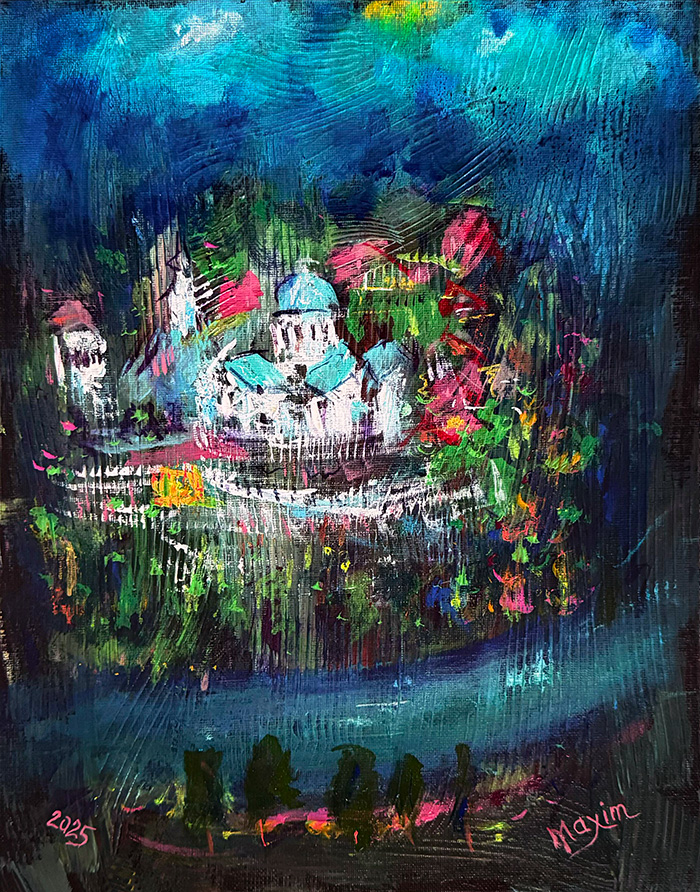
- Details
- Category: Maxim
"Tvrdos: A Timeless Light", acrylic on canvas panel, Bishop Maxim, 2025
An impressionistic portrayal of Monastery Tvrdoš, painted with free, expressive brushstrokes, emerging as a luminous structure in its natural setting—radiating an ancient presence that still shines today, inviting the viewer to imagine its rich stories. A combination of energy and drama contrasted with calming blue hues.
An impressionistic portrayal of Monastery Tvrdoš, painted with free, expressive brushstrokes, emerging as a luminous structure in its natural setting—radiating an ancient presence that still shines today, inviting the viewer to imagine its rich stories. A combination of energy and drama contrasted with calming blue hues.
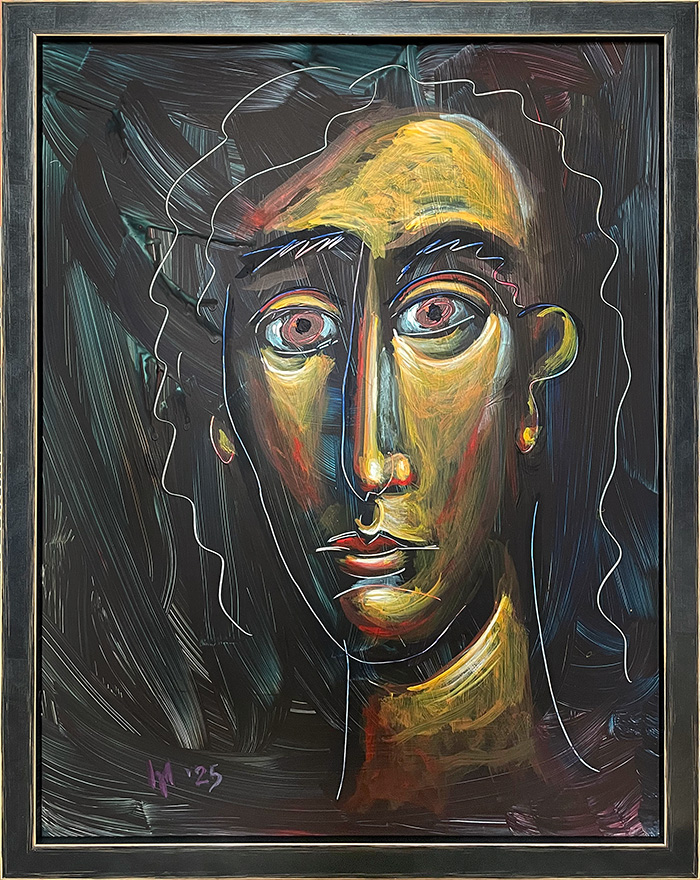
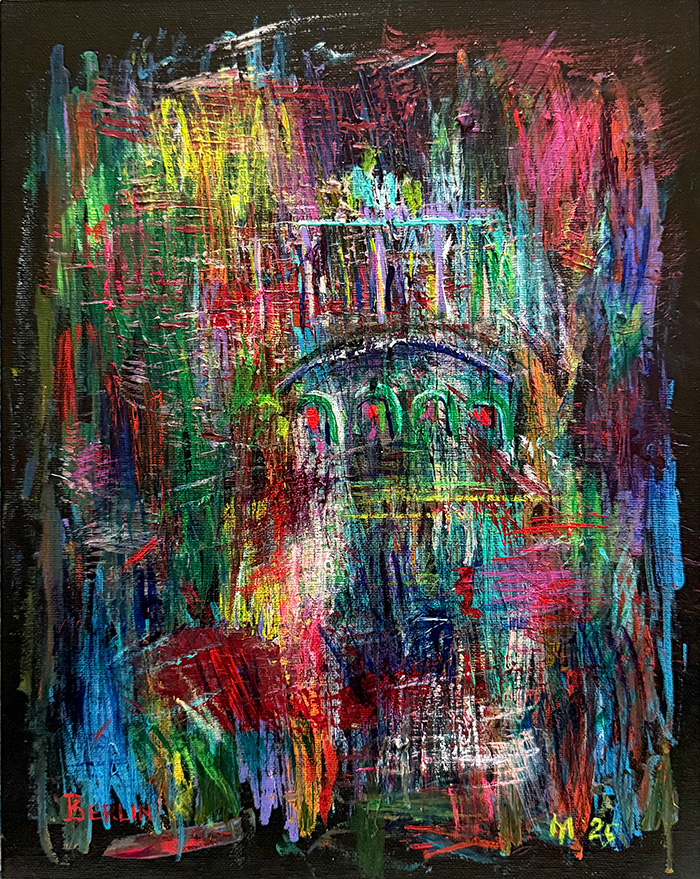
- Details
- Category: Maxim
"Bridge in Trebinje, Nightscape", acrylic on canvas, Bishop Maxim, Berlin, 2025
This abstract composition captures the iconic bridge of Trebinje, veiled in the mystery of night. Vivid strokes of red, green, and indigo dissolve into one another, evoking reflections of city lights upon dark waters. The structure itself emerges from the swirling atmosphere as both memory and vision—at once recognizable and dreamlike. The luminous palette transforms the Herzegovinian night into a symphony of color, suggesting the quiet pulse of the town and the timeless endurance of its stone arches beneath the stars.
This abstract composition captures the iconic bridge of Trebinje, veiled in the mystery of night. Vivid strokes of red, green, and indigo dissolve into one another, evoking reflections of city lights upon dark waters. The structure itself emerges from the swirling atmosphere as both memory and vision—at once recognizable and dreamlike. The luminous palette transforms the Herzegovinian night into a symphony of color, suggesting the quiet pulse of the town and the timeless endurance of its stone arches beneath the stars.
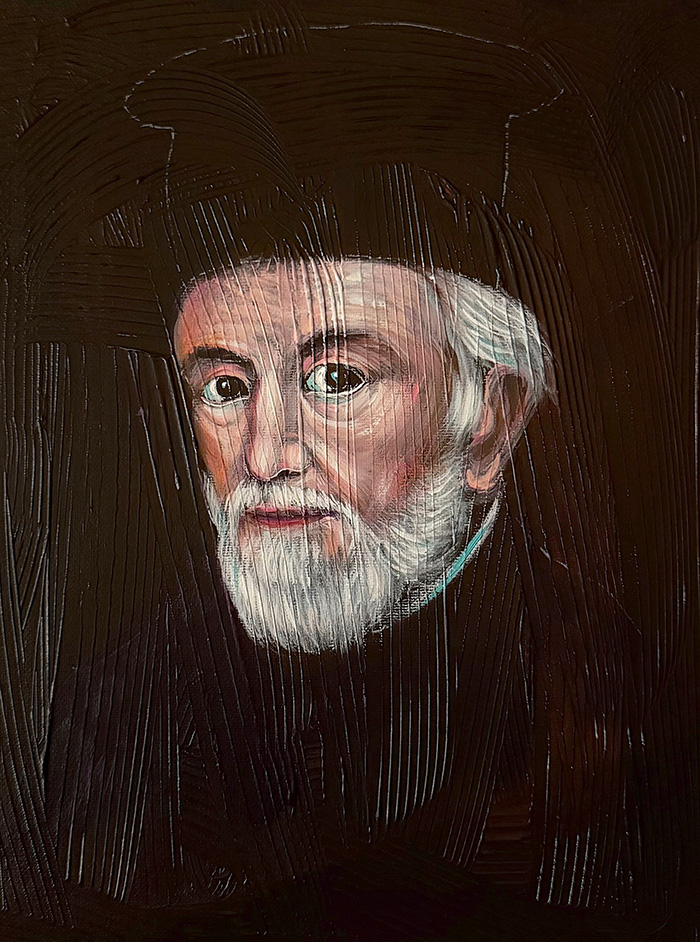
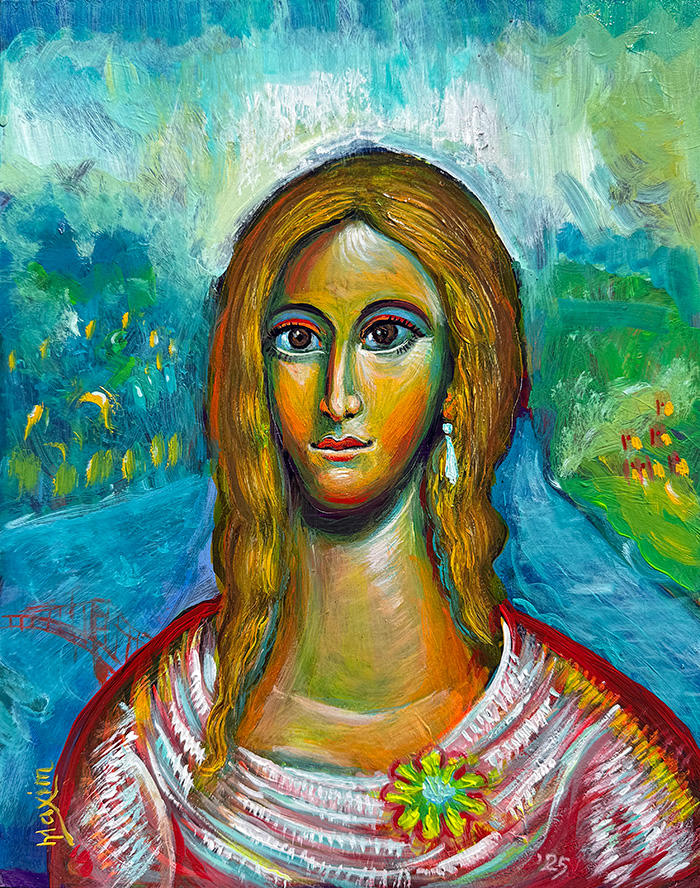
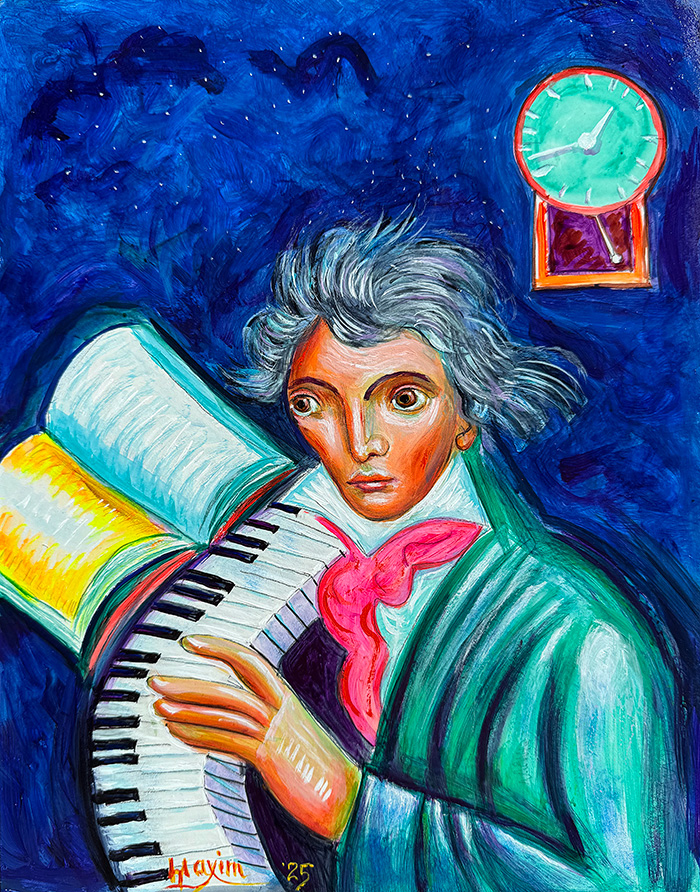
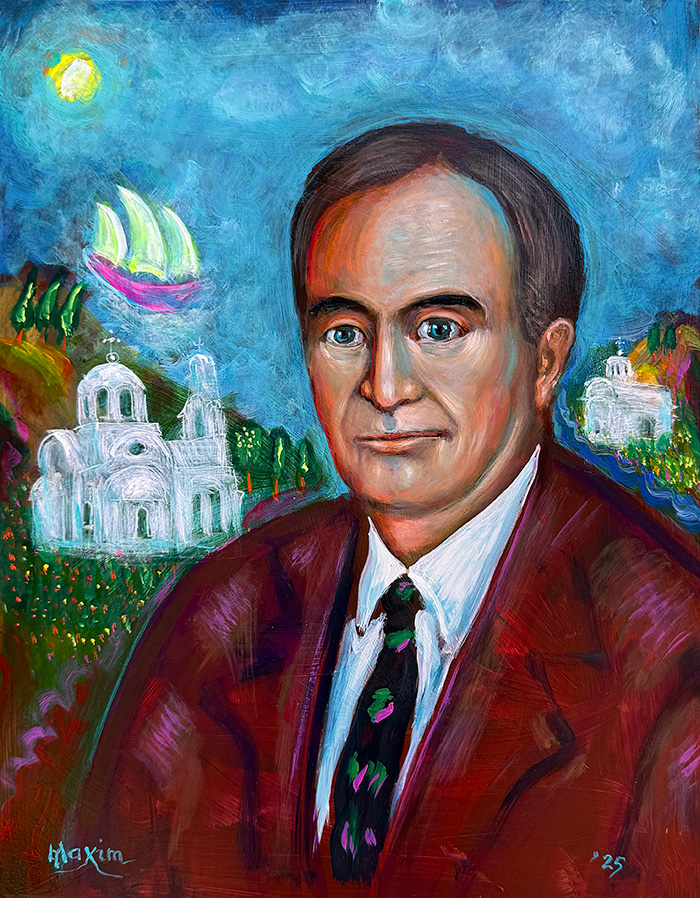
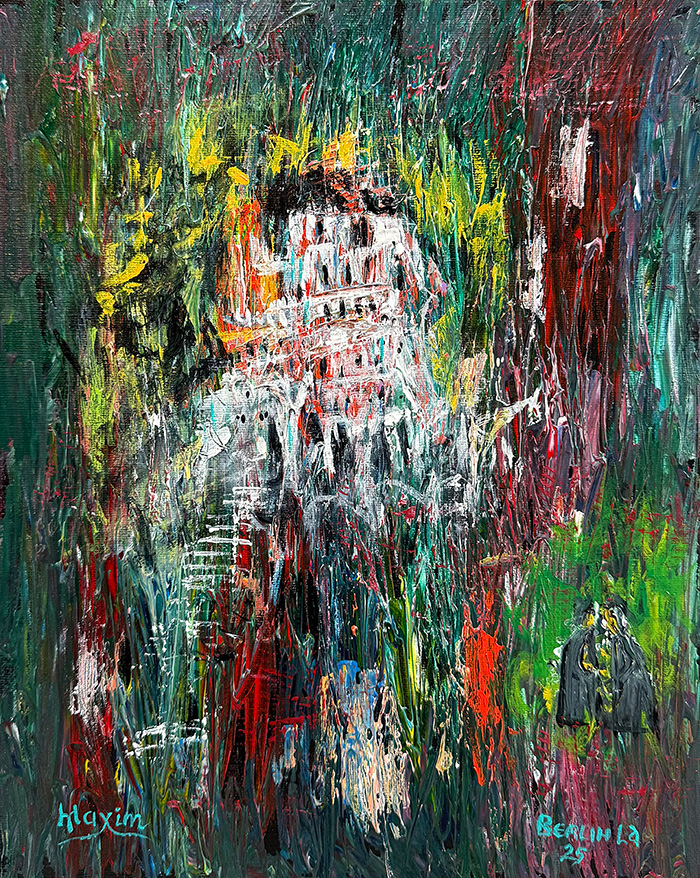
- Details
- Category: Maxim
"Ostrog: The Ascent of Silence", acrylic on canvas panel, Bishop Maxim, 2025
A cascade of colors flows vertically across the canvas, each layer a whisper of emotion, time, and unseen depths. Inspired by Gerhard Richter’s abstraction, the painting weaves a symphony of bold and subdued hues, creating a dynamic interplay of movement and stillness. At its heart, Ostrog Monastery is a luminous sanctuary carved into Montenegro’s cliffs—suspended between earth and sky, a beacon of faith and miracles. Remote and nearly inaccessible, it calls the pilgrim to ascend in body and spirit. Beneath this sacred retreat, two monks are discerned in the dialogue, their flowing black robes mirroring the unseen currents of thought. Their exchange transcends words, wrestling with mystery in the silence of the mountains. This painting invites contemplation—an ascent into silence where color dissolves into meaning, and the unseen becomes visible.
A cascade of colors flows vertically across the canvas, each layer a whisper of emotion, time, and unseen depths. Inspired by Gerhard Richter’s abstraction, the painting weaves a symphony of bold and subdued hues, creating a dynamic interplay of movement and stillness. At its heart, Ostrog Monastery is a luminous sanctuary carved into Montenegro’s cliffs—suspended between earth and sky, a beacon of faith and miracles. Remote and nearly inaccessible, it calls the pilgrim to ascend in body and spirit. Beneath this sacred retreat, two monks are discerned in the dialogue, their flowing black robes mirroring the unseen currents of thought. Their exchange transcends words, wrestling with mystery in the silence of the mountains. This painting invites contemplation—an ascent into silence where color dissolves into meaning, and the unseen becomes visible.
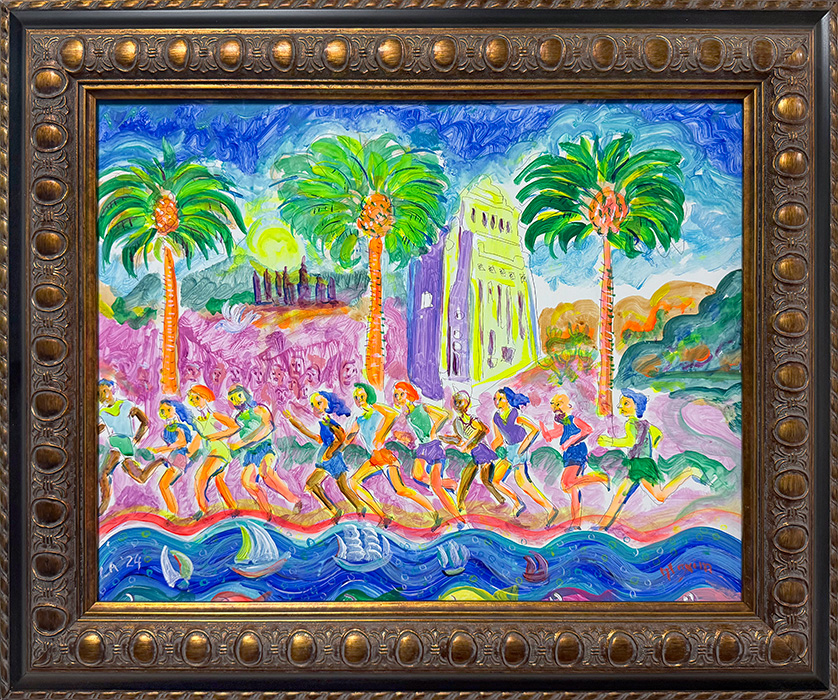
- Details
- Category: Maxim
"Running Through the Heart of LA", acrylic on gesso board, Bishop Maxim, 2024
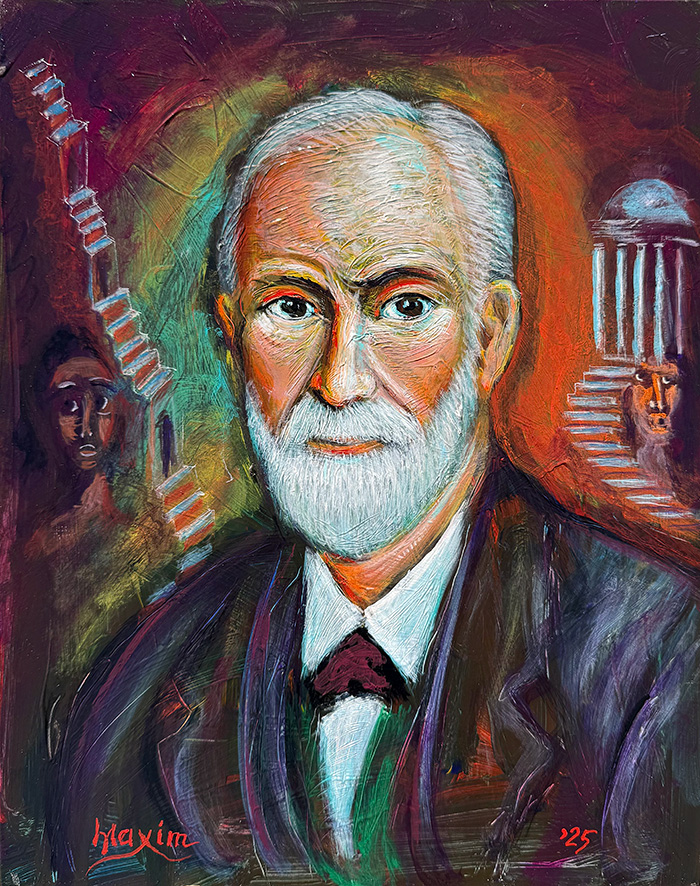
- Details
- Category: Maxim
"Freud", acrylic on gesso board, Bishop Maxim, 2025
"Freud's Gaze Beneath" - In "The Gaze Beneath," Sigmund Freud confronts the viewer with an intense, penetrating gaze that seeks to uncover hidden truths. Surrounding him, shadowy staircases descend into the depths of the subconscious, where faint, ghostly figures emerge, symbolizing repressed memories and secret fears. This painting is a portrait of Freud and reflects the viewer’s psychological depths, capturing the tension between the conscious mind and the dark, unseen layers beneath.
"Freud's Gaze Beneath" - In "The Gaze Beneath," Sigmund Freud confronts the viewer with an intense, penetrating gaze that seeks to uncover hidden truths. Surrounding him, shadowy staircases descend into the depths of the subconscious, where faint, ghostly figures emerge, symbolizing repressed memories and secret fears. This painting is a portrait of Freud and reflects the viewer’s psychological depths, capturing the tension between the conscious mind and the dark, unseen layers beneath.
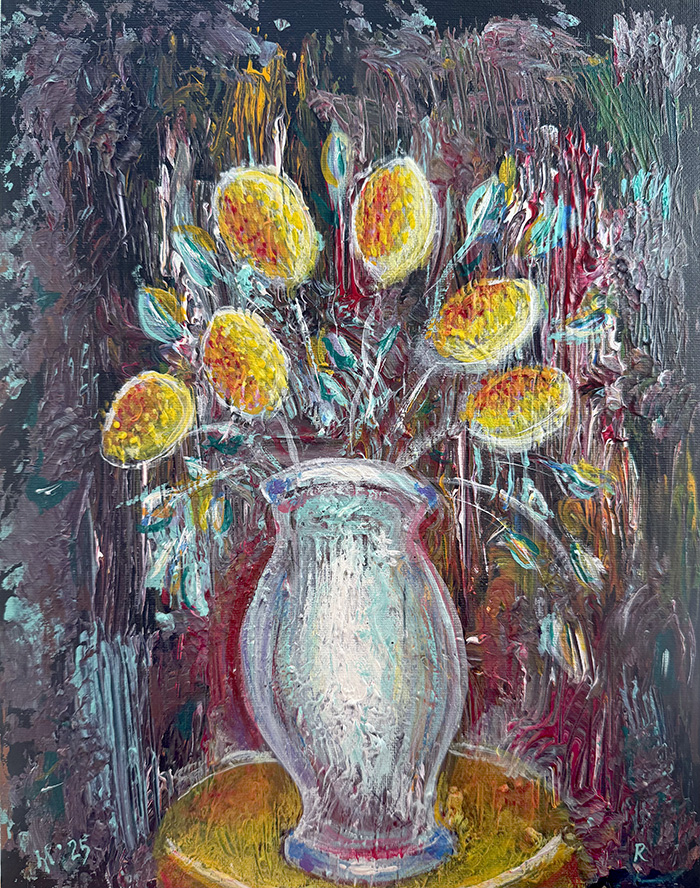
- Details
- Category: Maxim
"Marigold" (Tagetes), acrylic on canvas panel, Bishop Maxim, 2025
The flower Marigold (Tagetes) is known for its bright orange and yellow flowers and is commonly used in gardens, religious ceremonies, and traditional medicine.
The flower Marigold (Tagetes) is masterfully rendered in every aspect: 1) The lighting of the vase evokes the chiaroscuro technique of ancient sculpture. 2) Each blossom plays with warm and cool colors. 3) The vertical lines in the background add a modern perception of space.
— Stamatis Skliris
Το λουλούδι «κατιφές» (πληθυντικός οι κατιφεδεσείναι )αριστουργηματικά απόδοσμένο από κάθε πλευρά: 1. Ο φωτισμός του βάζου παραπέμπει σε αρχαία γλυπτική φωτοσκίασης, 2. Το κάθε ανθούς παίζει με θερμά κ ψυχρά χρώματα κι 3. Οι κατακόρυφες γραμμές του φόντου προσδίδουν μοντέρνα αντίληψη του χώρου.
The flower Marigold (Tagetes) is known for its bright orange and yellow flowers and is commonly used in gardens, religious ceremonies, and traditional medicine.
The flower Marigold (Tagetes) is masterfully rendered in every aspect: 1) The lighting of the vase evokes the chiaroscuro technique of ancient sculpture. 2) Each blossom plays with warm and cool colors. 3) The vertical lines in the background add a modern perception of space.
— Stamatis Skliris
Το λουλούδι «κατιφές» (πληθυντικός οι κατιφεδεσείναι )αριστουργηματικά απόδοσμένο από κάθε πλευρά: 1. Ο φωτισμός του βάζου παραπέμπει σε αρχαία γλυπτική φωτοσκίασης, 2. Το κάθε ανθούς παίζει με θερμά κ ψυχρά χρώματα κι 3. Οι κατακόρυφες γραμμές του φόντου προσδίδουν μοντέρνα αντίληψη του χώρου.
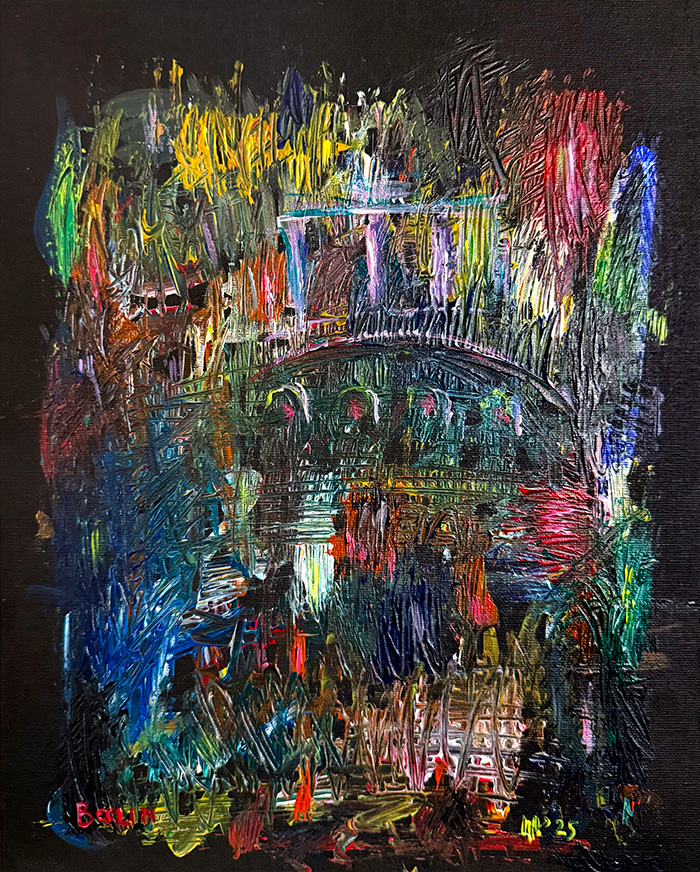
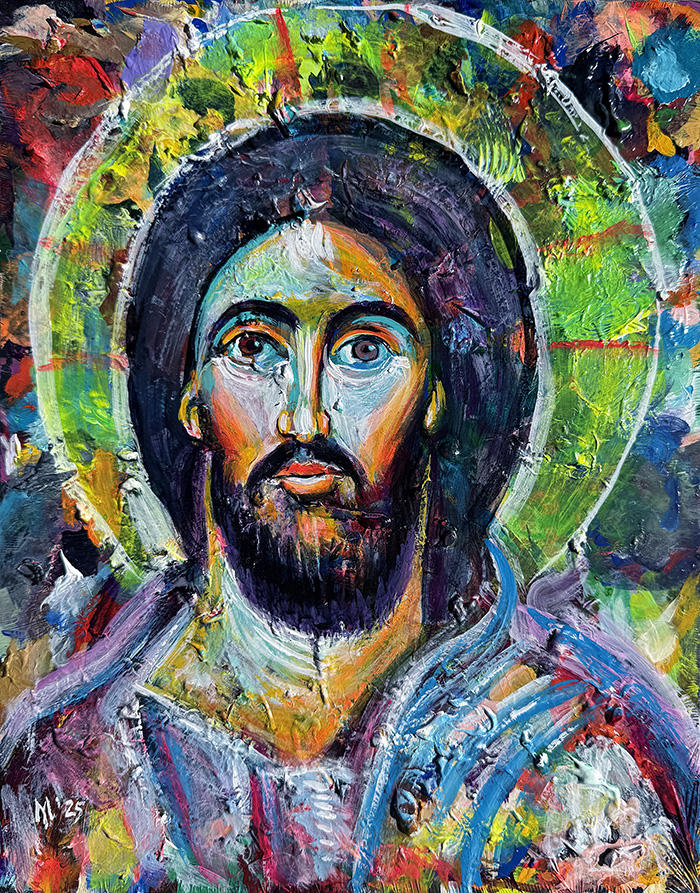
- Details
- Category: Maxim
"Christ of Gaza: Love and Truth Amidst Fragmentation", acrylic on canvas panel, Bishop Maxim, 2025
Jagged multicolored brush strokes express this image of Christ, reminiscent of the famous icon of St Catherine’s monastery, with one compassionate eye and one of stark reality. Together, Love and Truth are expressed through the multiple overtones of a culture at war with itself and a population of Christians diminishing in the Holy Land as Christ is gradually outcast and eliminated from the place of his birth. Being all things for all people and suffering all manner of things, the colors of the painting reflect both a hopeful synergy while the brush strokes embody the chaotic pain of ruptures and fragmentation that are present. In this way the artist manages to make the medium of the paint itself congruent with the character of the eyes of Christ, bearing the pain of Man, while remaining the Only Lover of Humankind Whose Truth is not an excuse for violence and revenge, but an eternal invitation to discover the Love that renders it salvific.
Jagged multicolored brush strokes express this image of Christ, reminiscent of the famous icon of St Catherine’s monastery, with one compassionate eye and one of stark reality. Together, Love and Truth are expressed through the multiple overtones of a culture at war with itself and a population of Christians diminishing in the Holy Land as Christ is gradually outcast and eliminated from the place of his birth. Being all things for all people and suffering all manner of things, the colors of the painting reflect both a hopeful synergy while the brush strokes embody the chaotic pain of ruptures and fragmentation that are present. In this way the artist manages to make the medium of the paint itself congruent with the character of the eyes of Christ, bearing the pain of Man, while remaining the Only Lover of Humankind Whose Truth is not an excuse for violence and revenge, but an eternal invitation to discover the Love that renders it salvific.
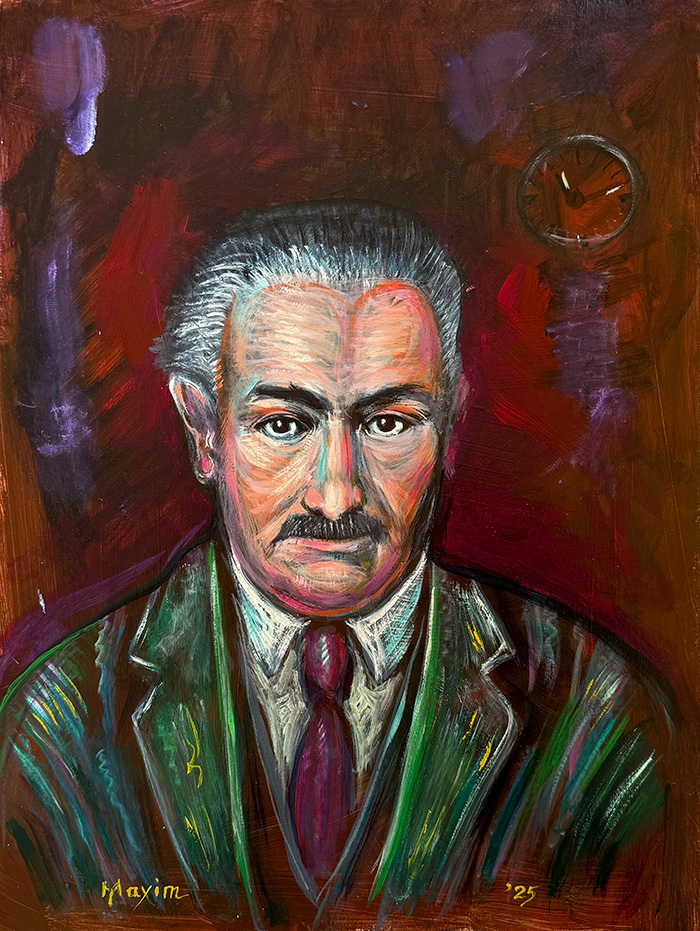
- Details
- Category: Maxim
"The Gaze of Time", acrylic on gesso board, Bishop Maxim, 2025
This painting depicts German philosopher Martin Heidegger, a central figure of existentialism, set against a deep red-dark background that subtly conveys the relentless ticking and passage of time. His penetrating gaze meets the viewer, embodying the existential uncertainty of human existence. The composition reflects Heidegger’s philosophy, emphasizing that the present is inextricably tied to the future—our “being” defined by its relationship to “futurity.” Elements of his seminal work, Zeit und Sein (Time and Being), are woven into the portrait, inviting the viewer to confront the temporality and openness of existence.
This painting depicts German philosopher Martin Heidegger, a central figure of existentialism, set against a deep red-dark background that subtly conveys the relentless ticking and passage of time. His penetrating gaze meets the viewer, embodying the existential uncertainty of human existence. The composition reflects Heidegger’s philosophy, emphasizing that the present is inextricably tied to the future—our “being” defined by its relationship to “futurity.” Elements of his seminal work, Zeit und Sein (Time and Being), are woven into the portrait, inviting the viewer to confront the temporality and openness of existence.
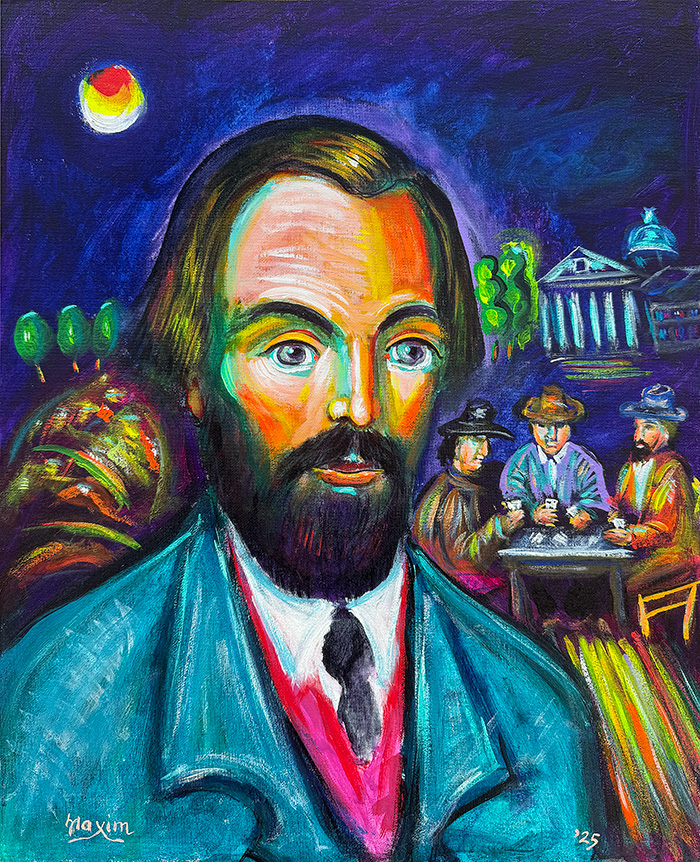
- Details
- Category: Maxim
"The Gambler’s Dilemma", acrylic on canvas panel, Bishop Maxim, 2025
This painting portrays Fyodor Dostoyevsky dominating the composition, his figure and expression capturing a deeply introspective moment during his stay in Wiesbaden, Germany. The renowned author stands as the central focus, his face reflecting a blend of hesitation and inner conflict as he contemplates whether to enter the gambling game. To the right, much smaller in scale, card players are depicted in the midst of their game, their activity contrasting with Dostoyevsky’s solitary reflection. The background subtly incorporates features of Wiesbaden, serving as a homage to Dostoyevsky’s ties to Germany and the experiences that shaped his literary genius.
This painting portrays Fyodor Dostoyevsky dominating the composition, his figure and expression capturing a deeply introspective moment during his stay in Wiesbaden, Germany. The renowned author stands as the central focus, his face reflecting a blend of hesitation and inner conflict as he contemplates whether to enter the gambling game. To the right, much smaller in scale, card players are depicted in the midst of their game, their activity contrasting with Dostoyevsky’s solitary reflection. The background subtly incorporates features of Wiesbaden, serving as a homage to Dostoyevsky’s ties to Germany and the experiences that shaped his literary genius.
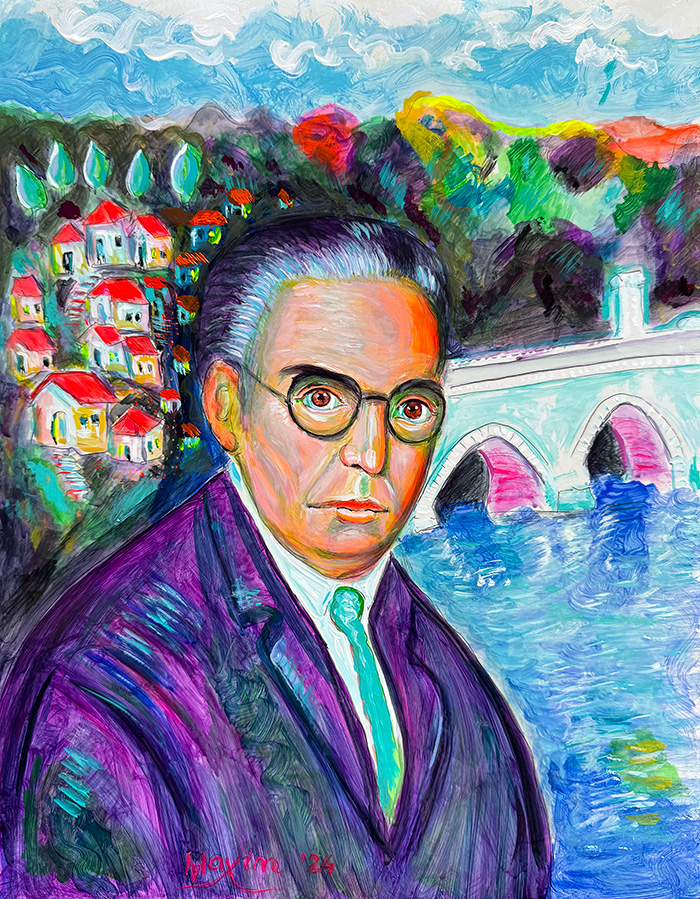
- Details
- Category: Maxim
"Ivo Andrić and the Bridge on the Drina 2", acrylic on gesso board, Bishop Maxim, 2024
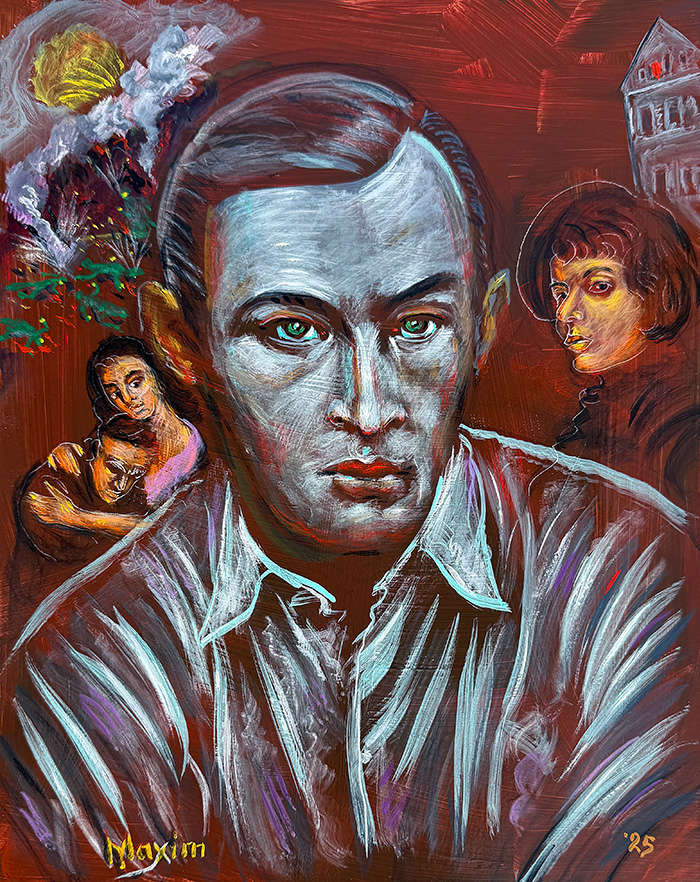
- Details
- Category: Maxim
"Remarque’s Elegy: Light Amidst the Shadows of War", acrylic on gesso board, Bishop Maxim, 2025
This acrylic painting pays homage to Erich Maria Remarque, the renowned German writer, capturing his profound reflections on war and humanity. Using a limited palette, the artwork balances light and shadow to reflect the duality of devastation and the enduring human spirit. Remarque’s figure, painted in black and white highlights, dominates the foreground, symbolizing his impartiality as an observer of human conflict. His contemplative expression blends introspection with distress. The background contrasts with stark scenes of war, interspersed with moments of compassion—a soldier aiding a comrade, a fleeting embrace. With its evocative imagery and nuanced tones, the painting transcends portraiture, reflecting on the complexities of war and the humanity Remarque explored in his work.
This acrylic painting pays homage to Erich Maria Remarque, the renowned German writer, capturing his profound reflections on war and humanity. Using a limited palette, the artwork balances light and shadow to reflect the duality of devastation and the enduring human spirit. Remarque’s figure, painted in black and white highlights, dominates the foreground, symbolizing his impartiality as an observer of human conflict. His contemplative expression blends introspection with distress. The background contrasts with stark scenes of war, interspersed with moments of compassion—a soldier aiding a comrade, a fleeting embrace. With its evocative imagery and nuanced tones, the painting transcends portraiture, reflecting on the complexities of war and the humanity Remarque explored in his work.
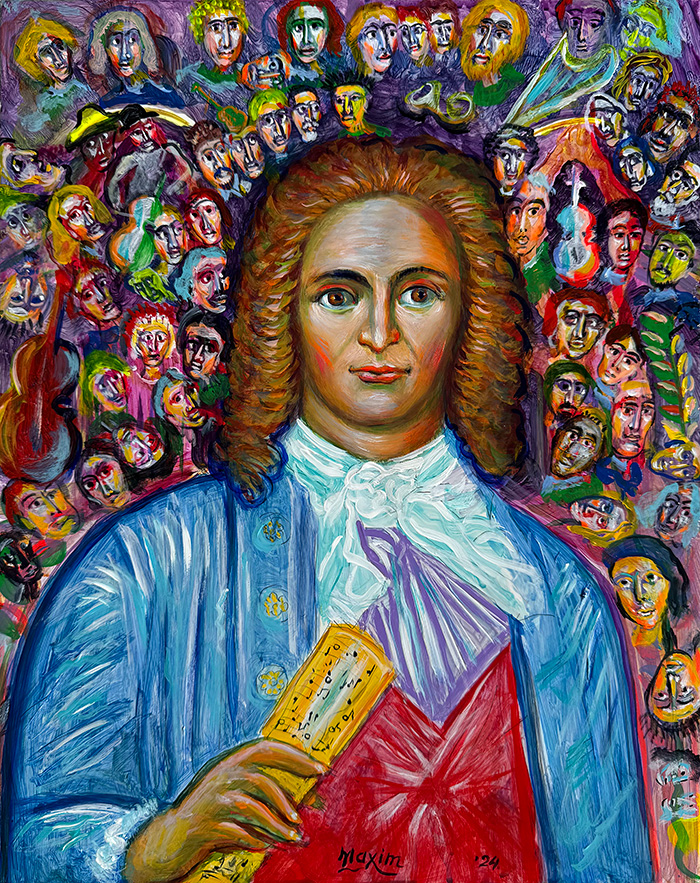
- Details
- Category: Maxim
"The Maestro’s Revelation: A Prelude to Awe", acrylic on gesso board, Bishop Maxim, 2025
This vibrant painting captures a youthful Johann Sebastian Bach, poised on the threshold of a grand performance. Painted in vivid, dynamic colors, Bach’s gaze is inspired and mysterious, suggesting the revelation of a heavenly piece of music. The composition pulsates with energy as the background teems with over 50 finely rendered faces of spectators, each expressing awe, excitement, and intrigue in anticipation of the transcendent performance to come. Musical instruments subtly emerge amidst the scene, blending seamlessly into an atmosphere charged with expectation and reverence.
This vibrant painting captures a youthful Johann Sebastian Bach, poised on the threshold of a grand performance. Painted in vivid, dynamic colors, Bach’s gaze is inspired and mysterious, suggesting the revelation of a heavenly piece of music. The composition pulsates with energy as the background teems with over 50 finely rendered faces of spectators, each expressing awe, excitement, and intrigue in anticipation of the transcendent performance to come. Musical instruments subtly emerge amidst the scene, blending seamlessly into an atmosphere charged with expectation and reverence.
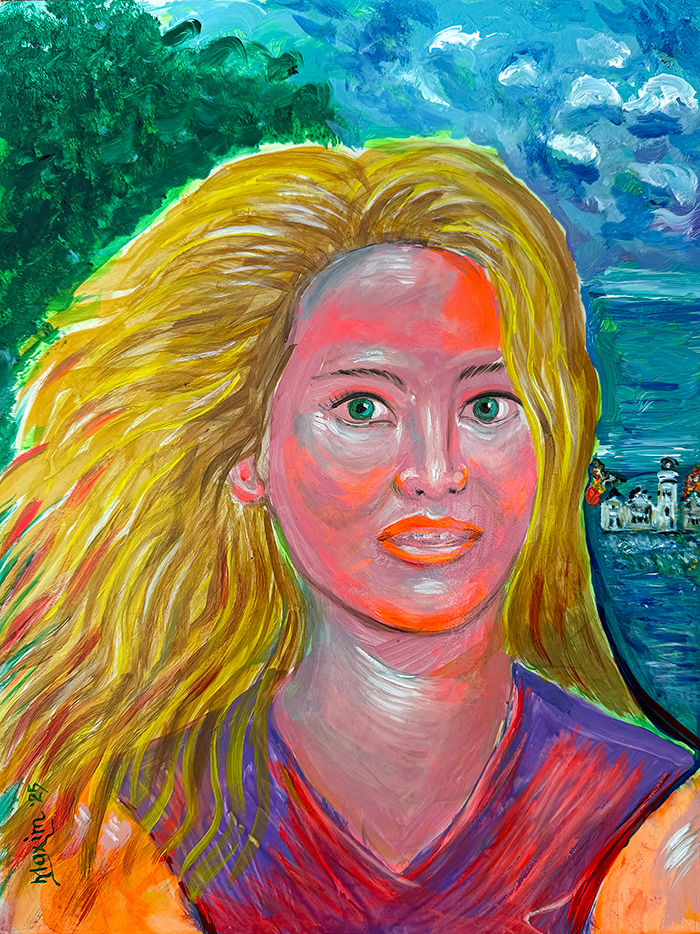
- Details
- Category: Maxim
"Lady of Schloss Mespelbrunn Water Castle", acrylic on gesso board, Bishop Maxim, 2025
This painting combines portrait and landscape. A lady with flowing, typically Germanic long hair gazes joyfully outward, her serene presence occupying most of the canvas. To her right, vibrant green trees symbolize life, while to her left, the vast sky evokes freedom. Below, the tranquil lake reflects the elegant water castle, Schloss Mespelbrunn, blending seamlessly into the scene. Rendered in acrylic on gesso board, the painting portrays the lady as an embodiment of Germany’s natural beauty and spirit, harmonizing humanity with the surrounding landscape.
This painting combines portrait and landscape. A lady with flowing, typically Germanic long hair gazes joyfully outward, her serene presence occupying most of the canvas. To her right, vibrant green trees symbolize life, while to her left, the vast sky evokes freedom. Below, the tranquil lake reflects the elegant water castle, Schloss Mespelbrunn, blending seamlessly into the scene. Rendered in acrylic on gesso board, the painting portrays the lady as an embodiment of Germany’s natural beauty and spirit, harmonizing humanity with the surrounding landscape.
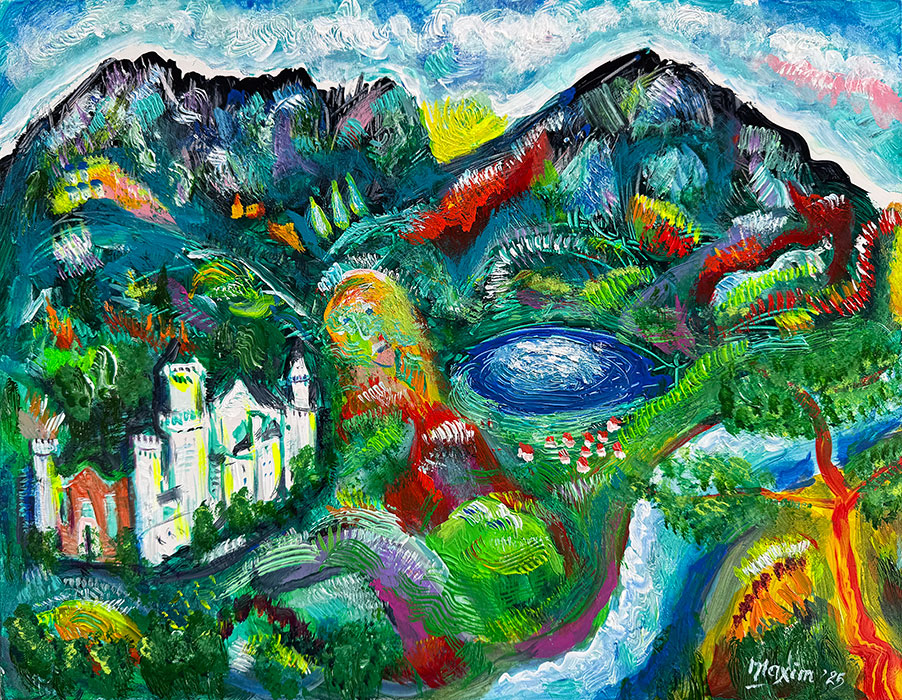
- Details
- Category: Maxim
"Germany’s Symphony of Trials in the Garden of Eternity", acrylic on gesso board, Bishop Maxim, 2025
A dense garden paradise surrounding a castle. No signs of human life. But a large hovering figure with five fingers looking down on the castle. I'm not sure it is a beneficent figure. No castles of monological self-protection are immune to the forces that try human beings and ultimately serve God’s plan to test us and reveal the futility of our self-protection in order to prepare us for eternal life, depending on our responses. Lord, save me from the castles I build so that I seek only the protection of your Holy Cross! — Stephen Muse
A dense garden paradise surrounding a castle. No signs of human life. But a large hovering figure with five fingers looking down on the castle. I'm not sure it is a beneficent figure. No castles of monological self-protection are immune to the forces that try human beings and ultimately serve God’s plan to test us and reveal the futility of our self-protection in order to prepare us for eternal life, depending on our responses. Lord, save me from the castles I build so that I seek only the protection of your Holy Cross! — Stephen Muse
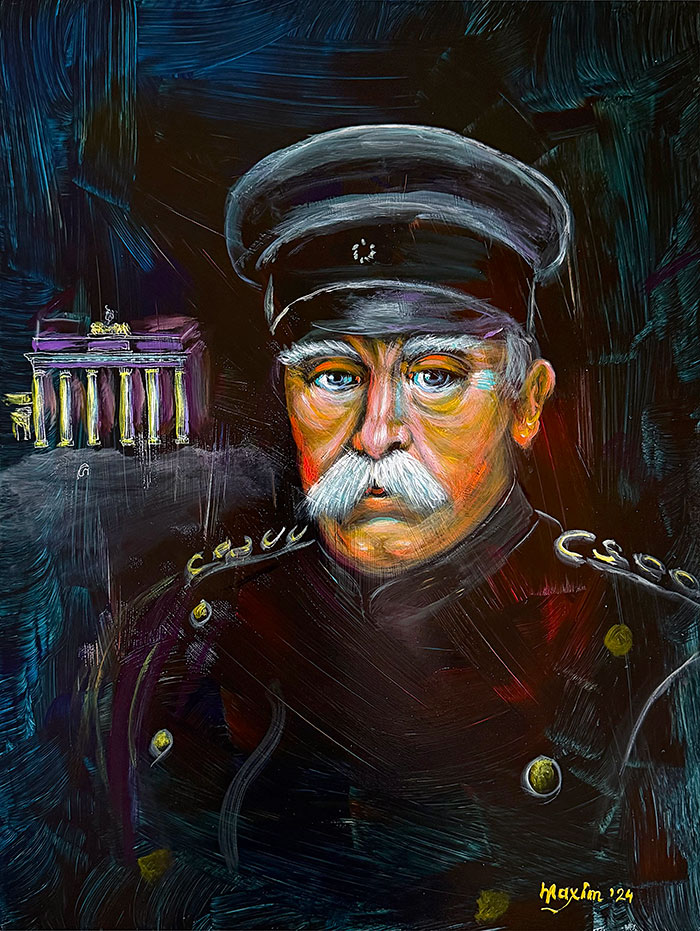
- Details
- Category: Maxim
"Bismarck: The Moment of Resolve", acrylic on gesso board, Bishop Maxim, 2024
This striking portrait of Otto von Bismarck, the unifier of Germany, captures him as an older man with a resolute and introspective expression. The darker-toned background underscores the weight of his decisions and the gravitas of his role in history. Behind him, to the right, the Brandenburg Gate emerges subtly, symbolizing both the unity of Germany and the monumental legacy of Bismarck’s statesmanship. The interplay of light and shadow accentuates the moment of deep contemplation, as if Bismarck is rethinking and recommitting to his vision for a unified Germany. Painted on a gesso board, the work is both timeless and evocative, inviting the viewer to engage with the complexity of the man and his mission.
This striking portrait of Otto von Bismarck, the unifier of Germany, captures him as an older man with a resolute and introspective expression. The darker-toned background underscores the weight of his decisions and the gravitas of his role in history. Behind him, to the right, the Brandenburg Gate emerges subtly, symbolizing both the unity of Germany and the monumental legacy of Bismarck’s statesmanship. The interplay of light and shadow accentuates the moment of deep contemplation, as if Bismarck is rethinking and recommitting to his vision for a unified Germany. Painted on a gesso board, the work is both timeless and evocative, inviting the viewer to engage with the complexity of the man and his mission.
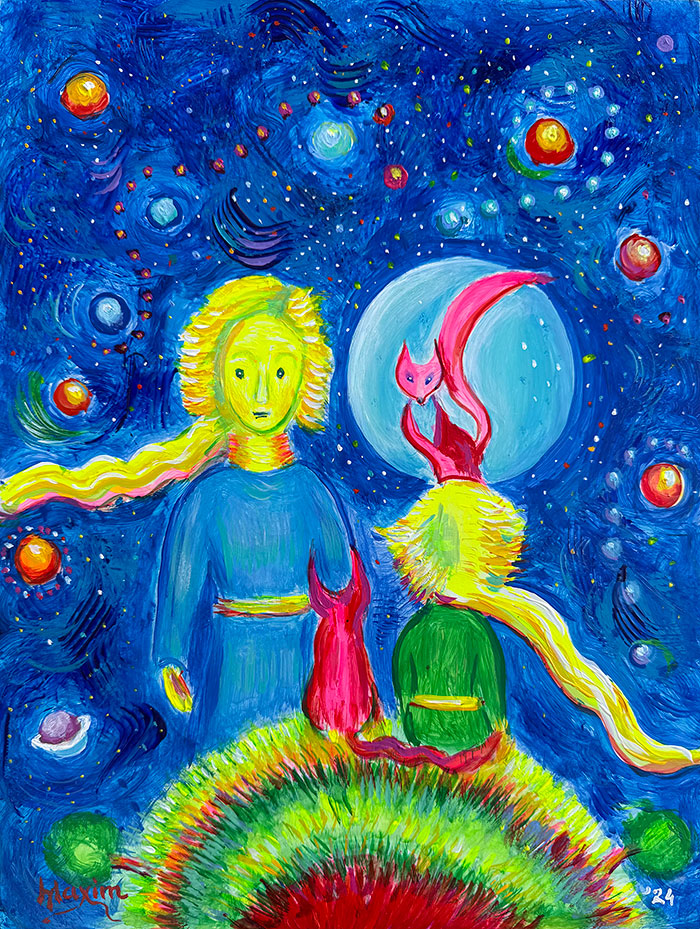
- Details
- Category: Maxim
"Interstellar Reflections: The Little Prince and the Fox", acrylic on gesso board, Bishop Maxim, 2024
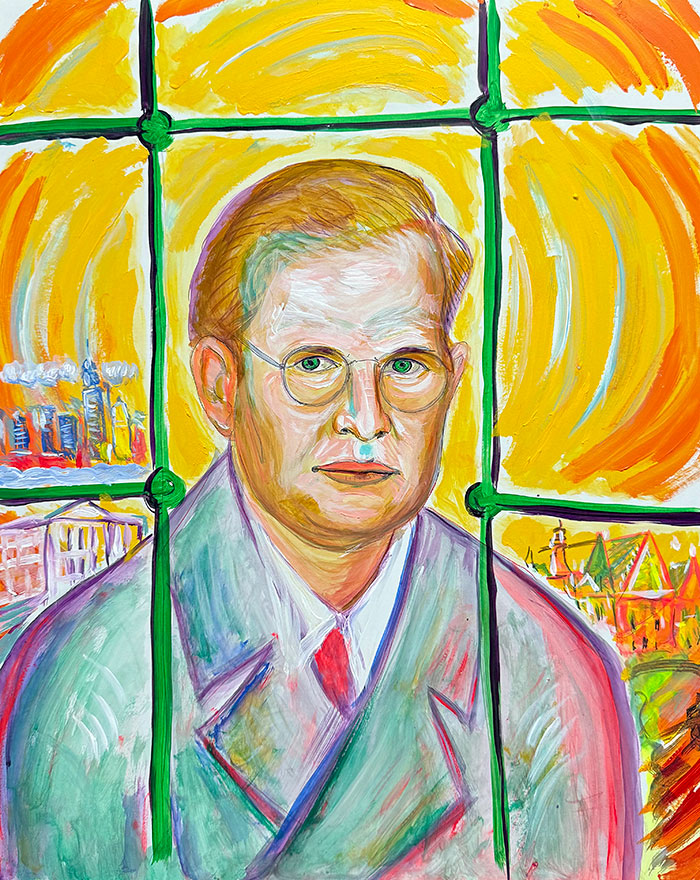
- Details
- Category: Maxim
"Bonhoeffer: Unchained Faith", acrylic on gesso board, Bishop Maxim, 2024
This portrait of Dietrich Bonhoeffer captures the theologian's unwavering spirit in the face of persecution. Though imprisoned for his resistance to the Nazi regime, Bonhoeffer's depiction here transcends the physical confines of his cell. Bright pastel hues and the suggestion of broken bars speak to an inner freedom found in faith, while his resolute gaze conveys a profound sense of optimism and spiritual assurance. Woven into the composition are subtle symbols representing key places in Bonhoeffer's life: Wrocław, Tübingen, and New York. These elements serve as a visual reminder of his journey and the global impact of his work. The painting is a testament to Bonhoeffer's enduring legacy, his commitment to justice, and the power of faith to triumph even in the darkest times.
This portrait of Dietrich Bonhoeffer captures the theologian's unwavering spirit in the face of persecution. Though imprisoned for his resistance to the Nazi regime, Bonhoeffer's depiction here transcends the physical confines of his cell. Bright pastel hues and the suggestion of broken bars speak to an inner freedom found in faith, while his resolute gaze conveys a profound sense of optimism and spiritual assurance. Woven into the composition are subtle symbols representing key places in Bonhoeffer's life: Wrocław, Tübingen, and New York. These elements serve as a visual reminder of his journey and the global impact of his work. The painting is a testament to Bonhoeffer's enduring legacy, his commitment to justice, and the power of faith to triumph even in the darkest times.
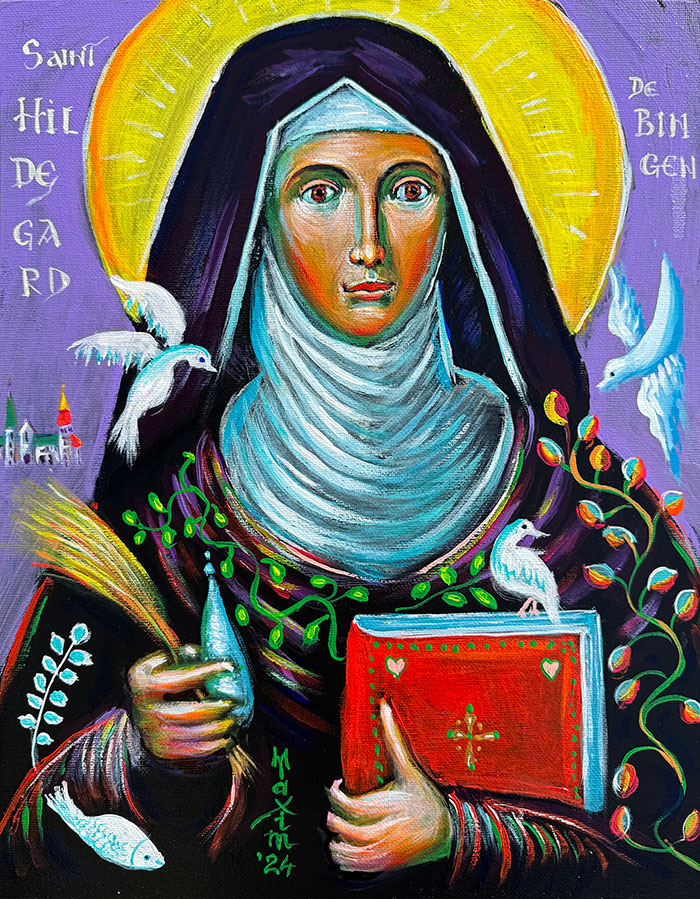
- Details
- Category: Maxim
"Hildegard: Guardian of Creation", acrylic on canvas panel, Bishop Maxim, 2024
This painting depicts Saint Hildegard of Bingen, a luminous figure of the medieval Church in Germany, celebrated for her divine visions, intellectual brilliance, and deep love for creation. Surrounded by a vibrant array of plants, birds, and other natural elements, Saint Hildegard is portrayed as a protector of the natural environment. The painting captures her harmonious relationship with nature, reflecting her teachings that connected the Gospel’s truths with a profound appreciation for the natural world. Every detail—flora, fauna, and her serene presence—symbolizes her legacy of nurturing the soul and creation through wisdom.
This painting depicts Saint Hildegard of Bingen, a luminous figure of the medieval Church in Germany, celebrated for her divine visions, intellectual brilliance, and deep love for creation. Surrounded by a vibrant array of plants, birds, and other natural elements, Saint Hildegard is portrayed as a protector of the natural environment. The painting captures her harmonious relationship with nature, reflecting her teachings that connected the Gospel’s truths with a profound appreciation for the natural world. Every detail—flora, fauna, and her serene presence—symbolizes her legacy of nurturing the soul and creation through wisdom.
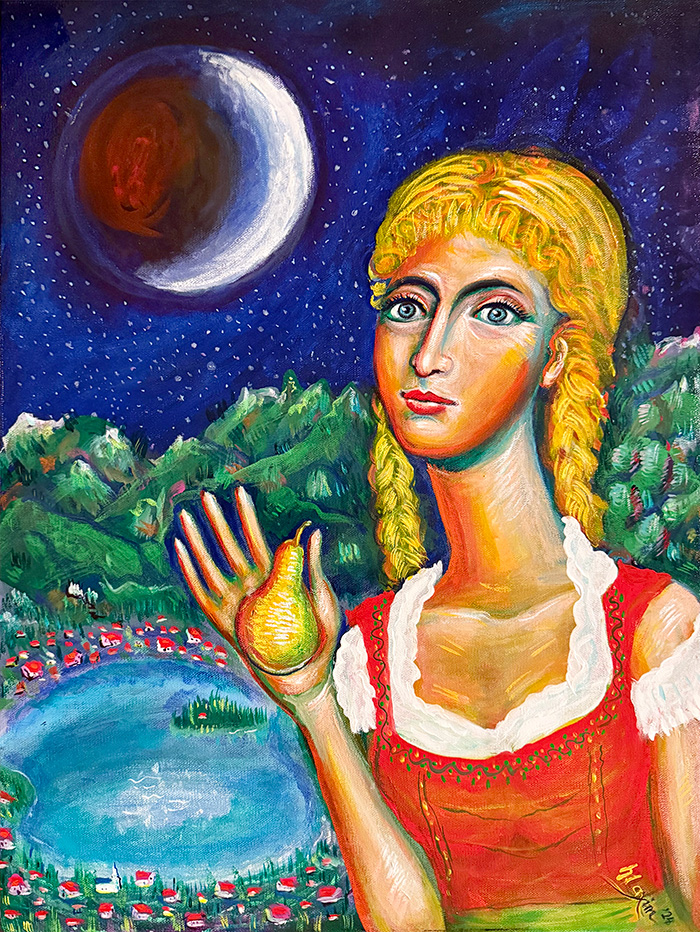
- Details
- Category: Maxim
"Moonlit Greetings by Schliersee", acrylic on canvas, Bishop Maxim, 2024
The painting captures the serene and mystical ambiance of Schliersee Lake at night, where nature’s tranquility meets human warmth. The half-moon, the stars, and the traditional attire of the German lady pay homage to the region’s rich cultural and natural beauty. Her sincere yet welcoming gaze bridges the viewer with the scene, symbolizing a harmonious blend of nature, tradition, and humanity.
The painting captures the serene and mystical ambiance of Schliersee Lake at night, where nature’s tranquility meets human warmth. The half-moon, the stars, and the traditional attire of the German lady pay homage to the region’s rich cultural and natural beauty. Her sincere yet welcoming gaze bridges the viewer with the scene, symbolizing a harmonious blend of nature, tradition, and humanity.
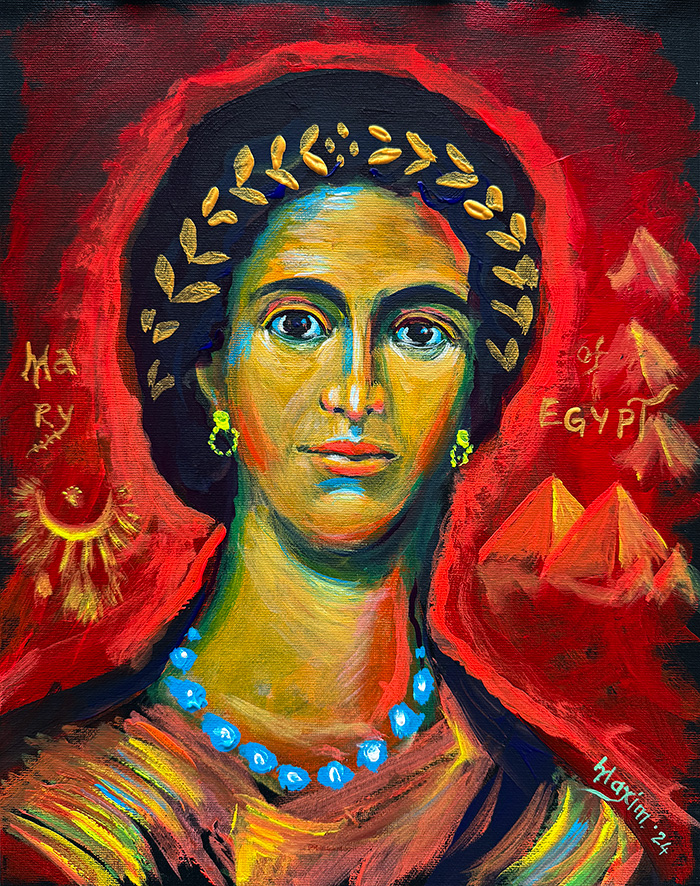
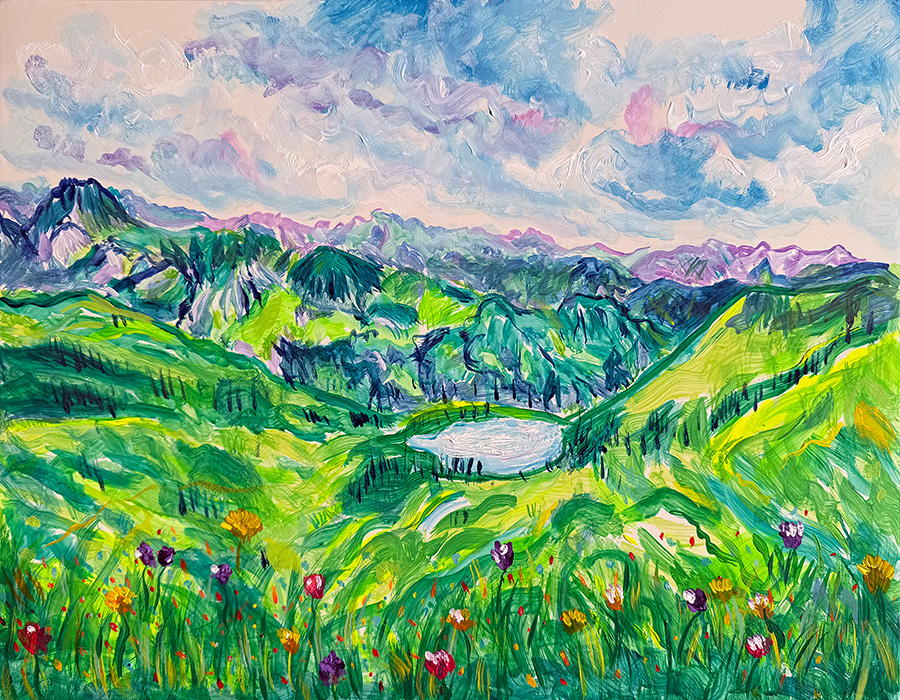
- Details
- Category: Maxim
"Blooming Algovia", acrylic on gesso board, Bishop Maxim, 2024
The serene mountainous landscape of the Algovia (Allgäu) region in Bavarian Swabia, where lush greenery dominates the scene. The distant mountains are rendered in harmonious shades of green, blue, and purple, creating a tranquil depth. In contrast, the foreground bursts with vibrant flowers, introducing warm hues that play delightfully against the cooler tones of the mountains. The interplay of warm and cool colors weaves a balanced and captivating composition, reflecting the region's natural beauty.
The serene mountainous landscape of the Algovia (Allgäu) region in Bavarian Swabia, where lush greenery dominates the scene. The distant mountains are rendered in harmonious shades of green, blue, and purple, creating a tranquil depth. In contrast, the foreground bursts with vibrant flowers, introducing warm hues that play delightfully against the cooler tones of the mountains. The interplay of warm and cool colors weaves a balanced and captivating composition, reflecting the region's natural beauty.
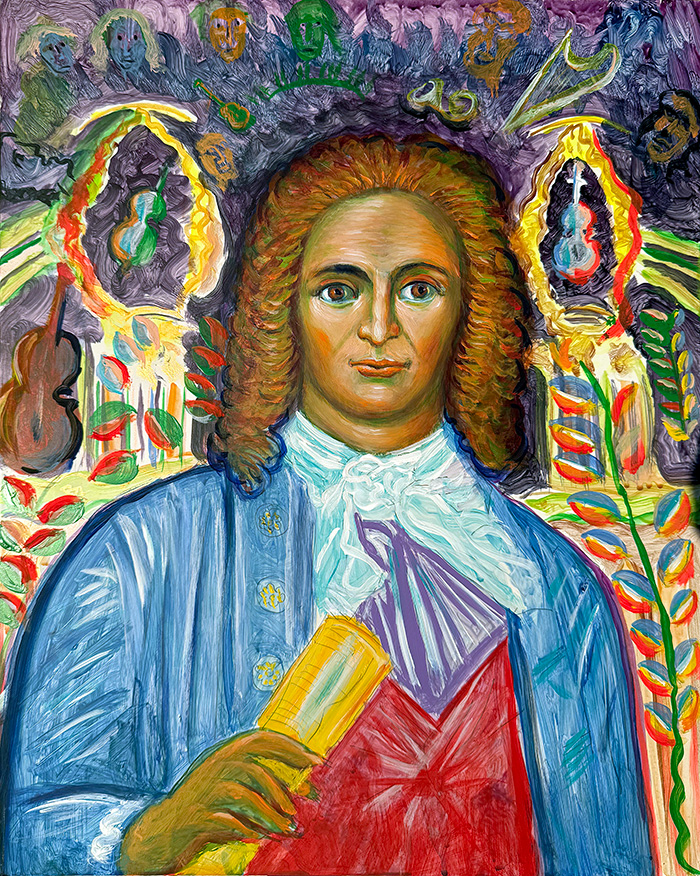
- Details
- Category: Maxim
"Johann Sebastian Bach: A Prelude to Genius", acrylic on gesso board, Bishop Maxim, 2024
This painting portrays Johann Sebastian Bach as a youthful and inspired musician, surrounded by various instruments that hint at his prodigious talent and musical legacy. The flourishing natural setting around him reflects his compositions' poetic and harmonious character, seamlessly blending the world of music and nature.
Though currently unfinished, the painting captures the spirit of a young Bach in a contemplative yet vibrant moment. It is set to be completed soon for an upcoming exhibition in Germany.
This painting portrays Johann Sebastian Bach as a youthful and inspired musician, surrounded by various instruments that hint at his prodigious talent and musical legacy. The flourishing natural setting around him reflects his compositions' poetic and harmonious character, seamlessly blending the world of music and nature.
Though currently unfinished, the painting captures the spirit of a young Bach in a contemplative yet vibrant moment. It is set to be completed soon for an upcoming exhibition in Germany.
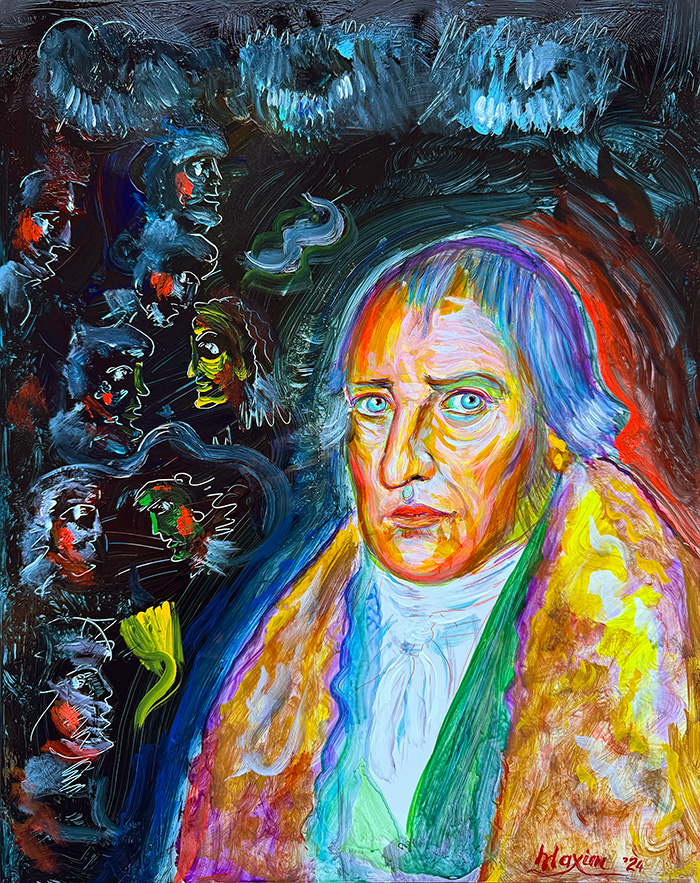
- Details
- Category: Maxim
"Portrait of Hegel", acrylic on gesso board, Bishop Maxim, 2024
A profound portrait that will one day rank among the greatest portraits of Bishop Maximus. From the perspective of facial composition, it presents three-quarters of the subject with a robust structure that makes the oblique gaze of the eyes captivating, pinning us to our place in astonishment. Here is a personality defined by its inner grandeur, one that honors us merely by looking at us. Though it does not speak as a painting, it hints at its greatness and predisposes us to study the works of this giant. This portrait could rightfully be described as an ICON, for an icon is a type of painting that reveals the eternal majesty, the God-given eternity, of the one depicted. Thus, it becomes evident that Vasiljevic possesses the gift to present the "giants of faith" as more human while simultaneously portraying the great as divinely majestic!
—Stamatis Skliris
A profound portrait that will one day rank among the greatest portraits of Bishop Maximus. From the perspective of facial composition, it presents three-quarters of the subject with a robust structure that makes the oblique gaze of the eyes captivating, pinning us to our place in astonishment. Here is a personality defined by its inner grandeur, one that honors us merely by looking at us. Though it does not speak as a painting, it hints at its greatness and predisposes us to study the works of this giant. This portrait could rightfully be described as an ICON, for an icon is a type of painting that reveals the eternal majesty, the God-given eternity, of the one depicted. Thus, it becomes evident that Vasiljevic possesses the gift to present the "giants of faith" as more human while simultaneously portraying the great as divinely majestic!
—Stamatis Skliris
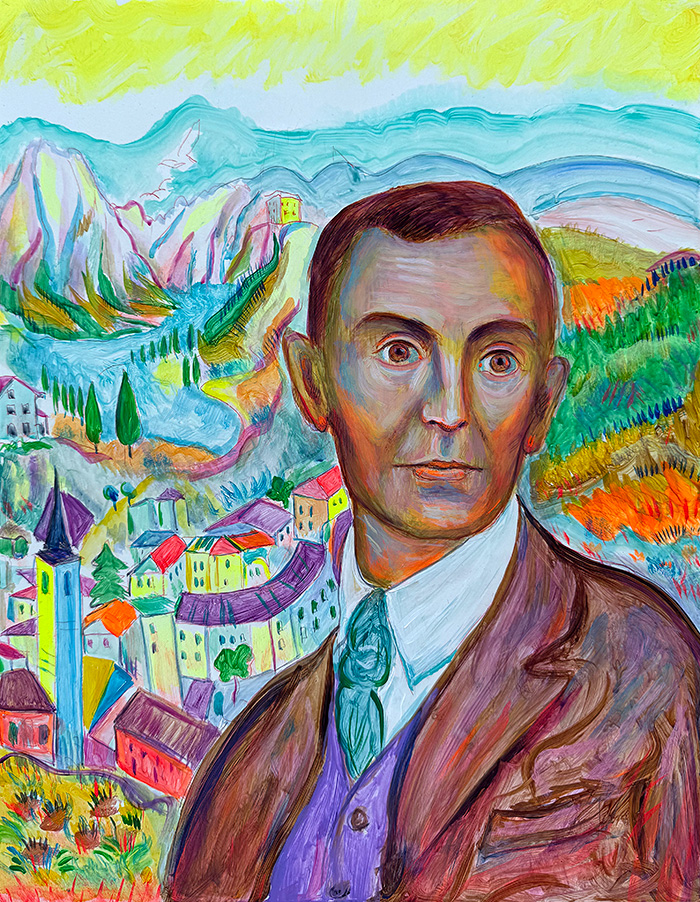
- Details
- Category: Maxim
"Hermann Hesse: A Reflective Portrait", acrylic on gesso board, Bishop Maxim, 2024
This painting portrays German writer Hermann Hesse in a contemplative moment, gazing thoughtfully to the left. Behind him, Germany's landscapes unfold, reflecting the inspirations for his life, literature, and art. The pastel-toned acrylics create a soft, textured effect, capturing Hesse’s introspective nature and profound connection to the world. Viewers are invited to share in his quiet reflection, drawn into the harmony of his inner world and creative spirit.
This painting portrays German writer Hermann Hesse in a contemplative moment, gazing thoughtfully to the left. Behind him, Germany's landscapes unfold, reflecting the inspirations for his life, literature, and art. The pastel-toned acrylics create a soft, textured effect, capturing Hesse’s introspective nature and profound connection to the world. Viewers are invited to share in his quiet reflection, drawn into the harmony of his inner world and creative spirit.
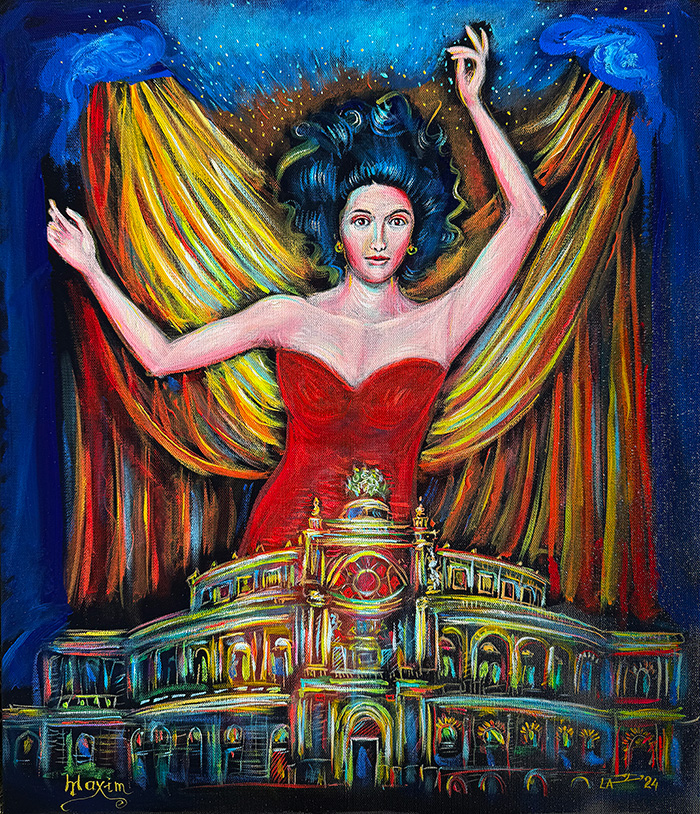
- Details
- Category: Maxim
"Aria of the Cosmos: Anna Netrebko’s Transcendence from the Semperoper", acrylic on canvas, Bishop Maxim, 2024
Anna Netrebko rises majestically from the Semperoper in Dresden, her figure illuminated by celestial light as she transcends the grandeur of the opera house into the infinite cosmos. Her flowing gown, like starlight woven into form, symbolizes the power of her voice to dissolve the boundaries between earth and the heavens. The Semperoper, anchored below, becomes the foundation of her ascent, embodying how art elevates humanity beyond time and space. In this moment, Netrebko is not just a diva but a cosmic force, uniting the beauty of human artistry with the vastness of the universe.
Anna Netrebko rises majestically from the Semperoper in Dresden, her figure illuminated by celestial light as she transcends the grandeur of the opera house into the infinite cosmos. Her flowing gown, like starlight woven into form, symbolizes the power of her voice to dissolve the boundaries between earth and the heavens. The Semperoper, anchored below, becomes the foundation of her ascent, embodying how art elevates humanity beyond time and space. In this moment, Netrebko is not just a diva but a cosmic force, uniting the beauty of human artistry with the vastness of the universe.
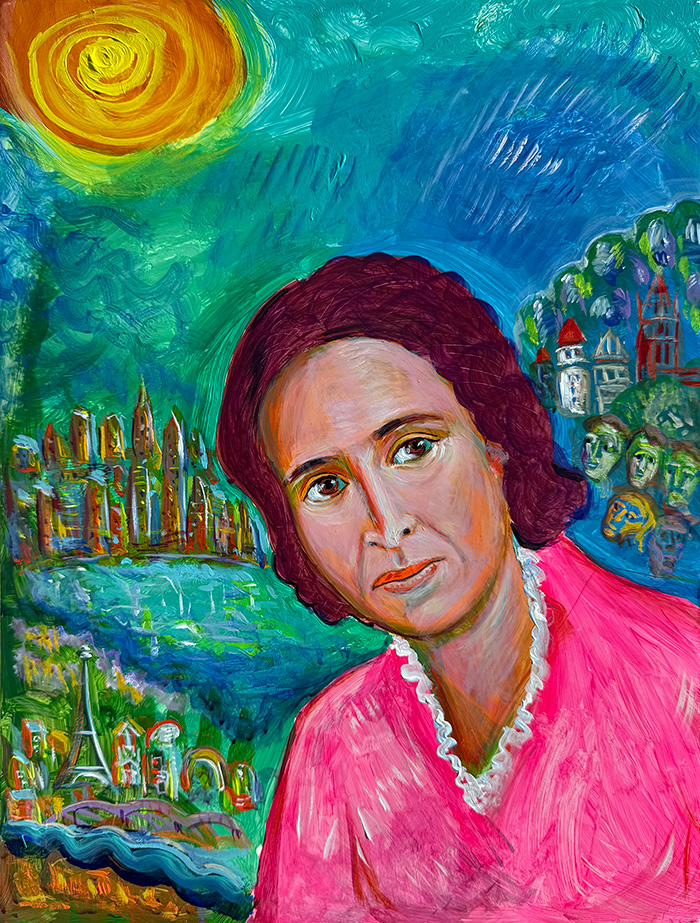
- Details
- Category: Maxim
"Hannah Arendt: Vision Beyond Boundaries", acrylic on Gesso Board, Bishop Maxim, 2024
This vibrant painting captures the philosophical depth and dynamic spirit of Hannah Arendt, one of the 20th century’s most influential thinkers. Dressed in bold pink, symbolizing her luminous intellect and personhood, Arendt is surrounded by landmarks of her life: Königsberg, her birthplace; Paris, a city of exile and growth; and New York, where her critiques of totalitarianism took shape. Her gaze, turned toward an unseen horizon, reflects her pursuit of alternate visions of order and freedom. Celebrating Arendt as a philosopher and visionary, the piece invites reflection on her legacy and her challenge to rethink the structures shaping humanity.
This vibrant painting captures the philosophical depth and dynamic spirit of Hannah Arendt, one of the 20th century’s most influential thinkers. Dressed in bold pink, symbolizing her luminous intellect and personhood, Arendt is surrounded by landmarks of her life: Königsberg, her birthplace; Paris, a city of exile and growth; and New York, where her critiques of totalitarianism took shape. Her gaze, turned toward an unseen horizon, reflects her pursuit of alternate visions of order and freedom. Celebrating Arendt as a philosopher and visionary, the piece invites reflection on her legacy and her challenge to rethink the structures shaping humanity.
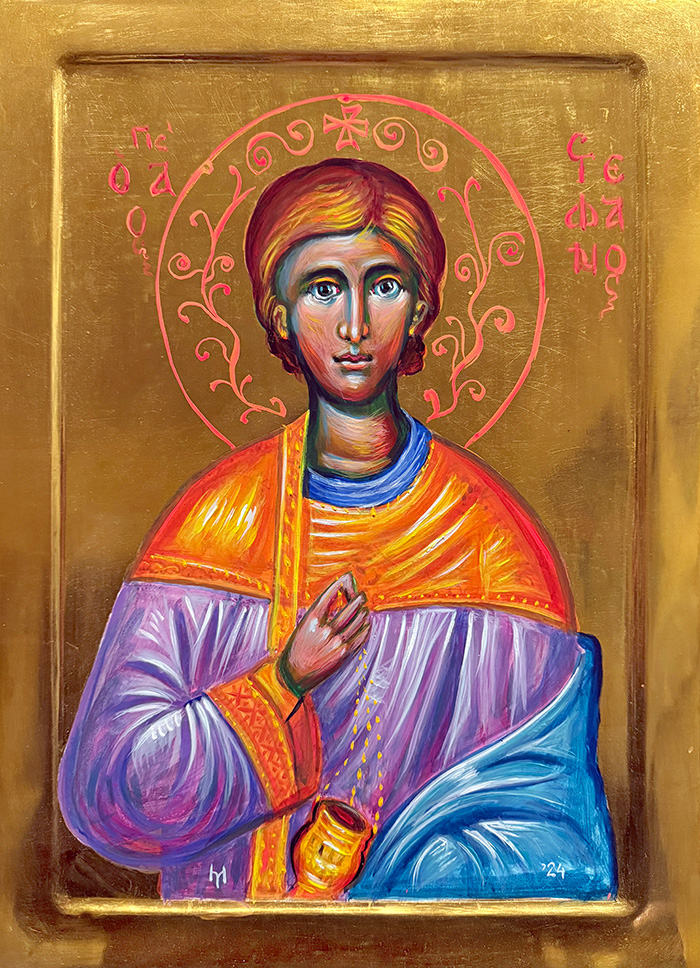
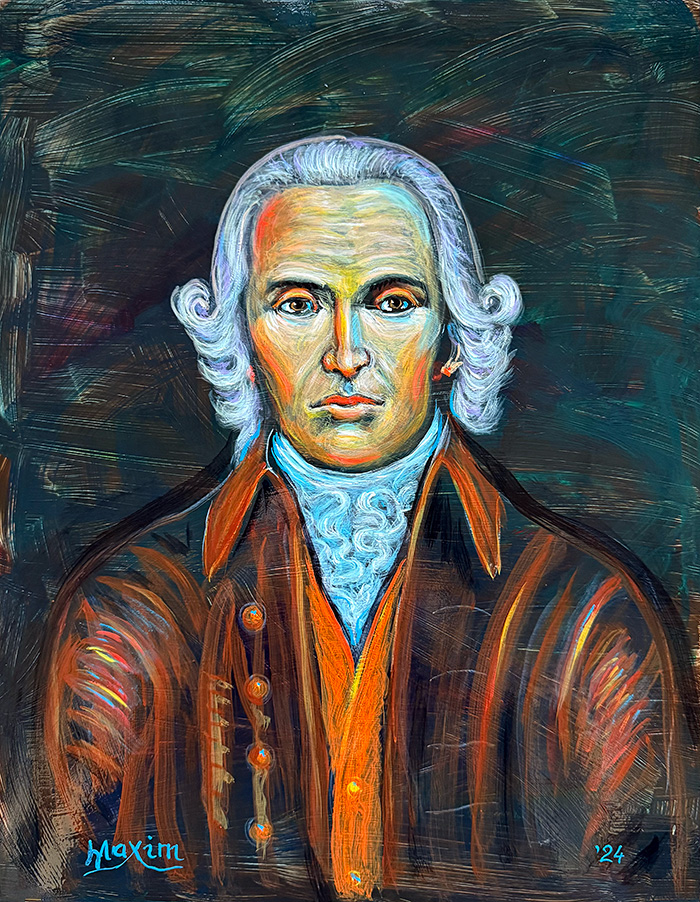
- Details
- Category: Maxim
"Immanuel Kant", acrylic on gesso board, Bishop Maxim, 2024
A robust portrait with a solid architecture of face and hair, embodying meticulous contemplation and austere philosophy, with an expression of perfection that permits no void or innocent joy from any error. The tonal notes of the garment resemble the dead leaves of autumn—“les feuilles mortes se ramassent à la pelle”—as if echoing some Mozart score, where beneath an outburst of joy lies the most noble sorrow.
—Stamatis Skliris
A robust portrait with a solid architecture of face and hair, embodying meticulous contemplation and austere philosophy, with an expression of perfection that permits no void or innocent joy from any error. The tonal notes of the garment resemble the dead leaves of autumn—“les feuilles mortes se ramassent à la pelle”—as if echoing some Mozart score, where beneath an outburst of joy lies the most noble sorrow.
—Stamatis Skliris
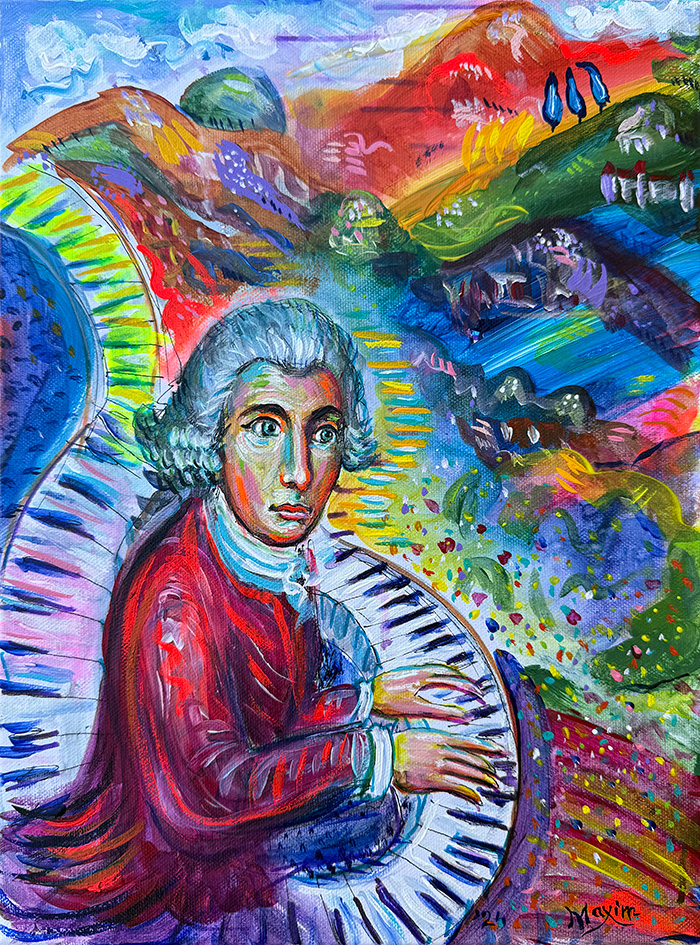
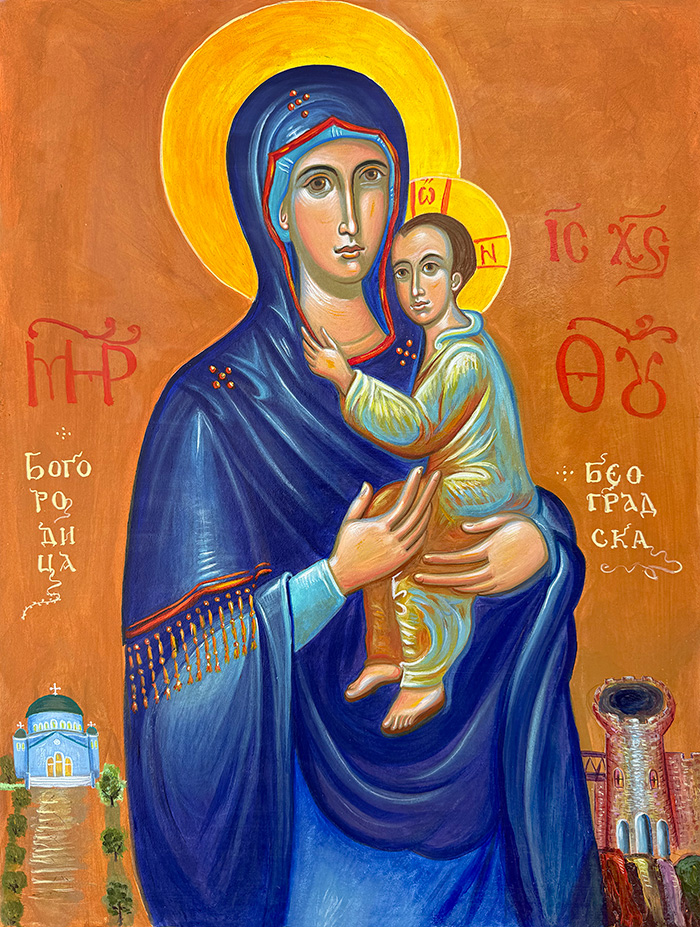
- Details
- Category: Maxim
"The Panagia of Belgrade—Bogorodica Beogradska," egg tempera on cardboard, by Radmila and Maxim Vasiljevic, 2020
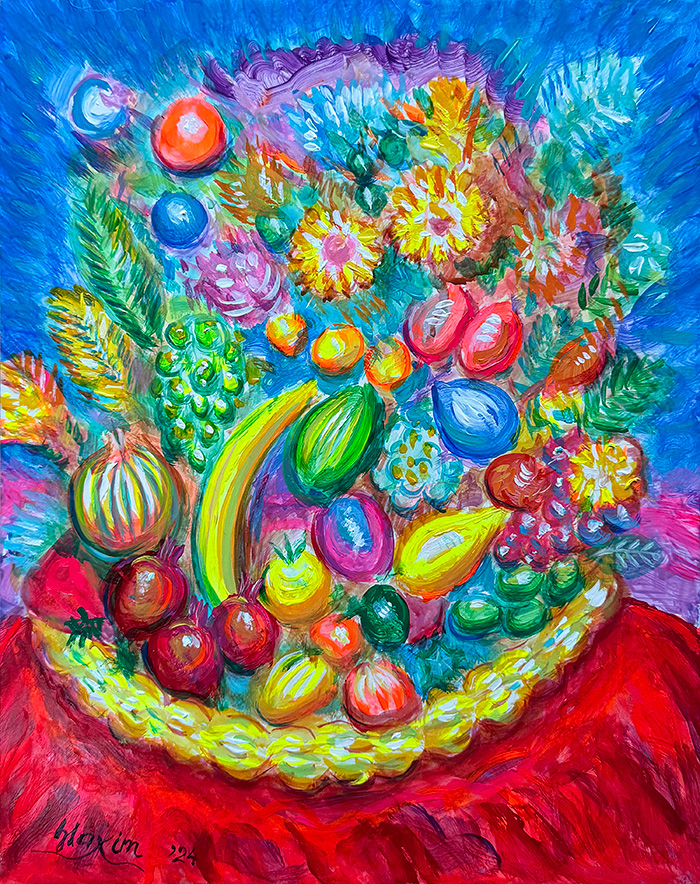
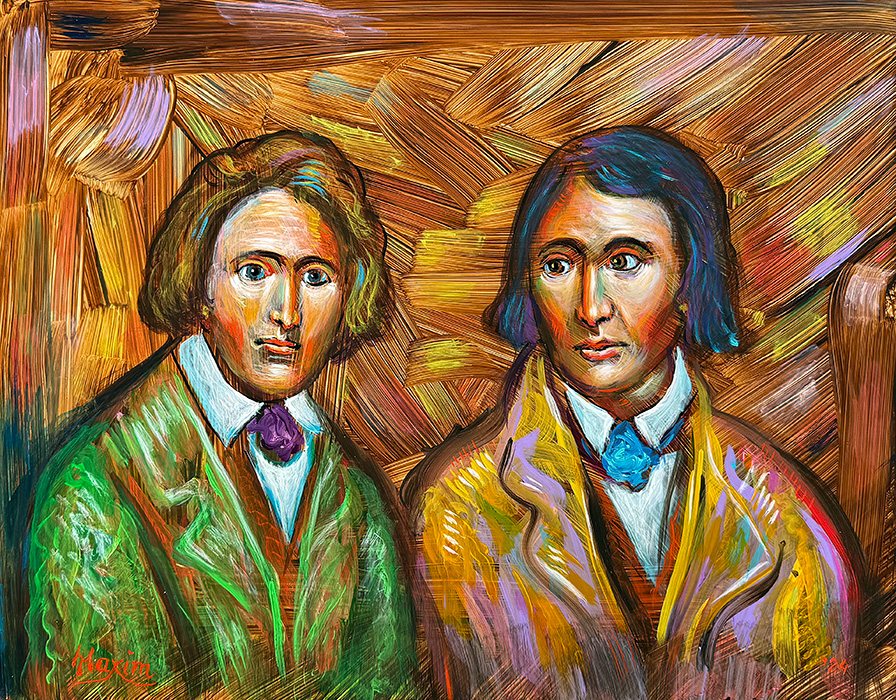
- Details
- Category: Maxim
"The Brothers Grimm", acrylic on gesso board, Bishop Maxim, 2024
This acrylic on canvas portrays the Brothers Grimm as youthful figures, their coats rendered in joyous, vibrant colors that symbolize the liveliness and magic of the tales they brought to life. The background is intentionally indefinitive, with dynamic brushstrokes of dominating brown light, evoking a sense of intrigue and depth. This abstract yet deliberate backdrop reflects the complex, timeless nature of the stories they conveyed, inviting the viewer to step into the world of wonder and mystery captured in their works.
This acrylic on canvas portrays the Brothers Grimm as youthful figures, their coats rendered in joyous, vibrant colors that symbolize the liveliness and magic of the tales they brought to life. The background is intentionally indefinitive, with dynamic brushstrokes of dominating brown light, evoking a sense of intrigue and depth. This abstract yet deliberate backdrop reflects the complex, timeless nature of the stories they conveyed, inviting the viewer to step into the world of wonder and mystery captured in their works.
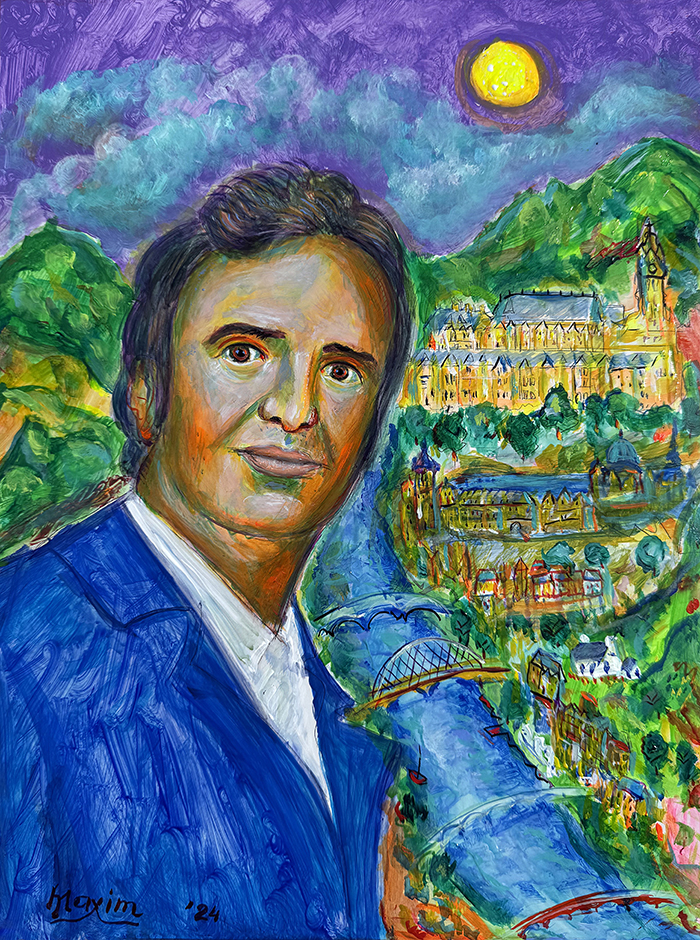
- Details
- Category: Maxim
"Crossing Boundaries: The Journey of Professor Zizioulas from Greece to Scotland", acrylic on gesso board, Bishop Maxim, 2024
The painter portrays the crossing of geographical and intellectual boundaries as John Zizioulas moved from Greece to Scotland, bridging the theological traditions of East and West. This hints at his role in creating connections between different academic and spiritual landscapes.
The painter portrays the crossing of geographical and intellectual boundaries as John Zizioulas moved from Greece to Scotland, bridging the theological traditions of East and West. This hints at his role in creating connections between different academic and spiritual landscapes.
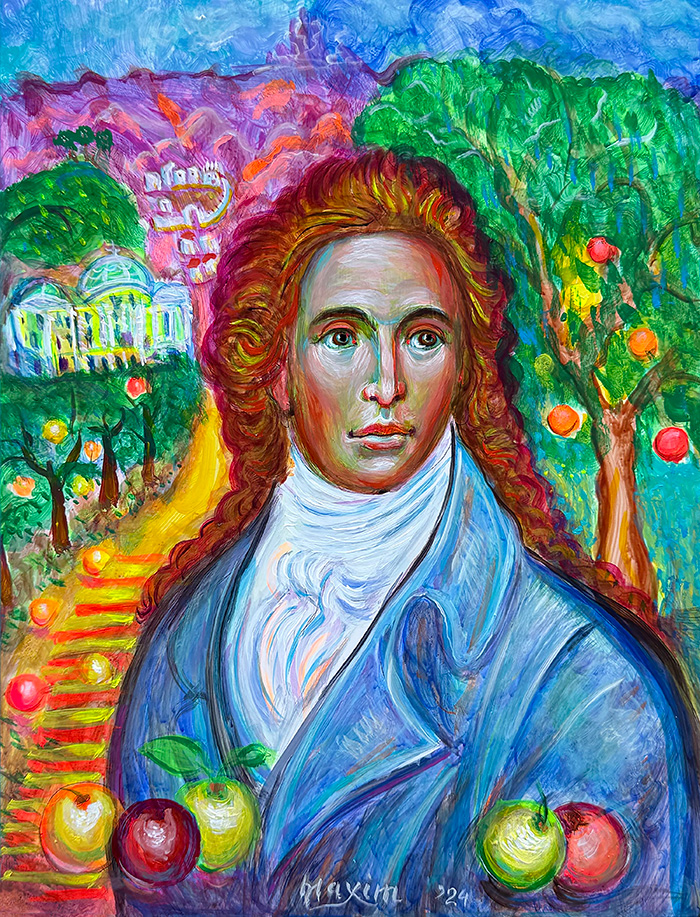
- Details
- Category: Maxim
"The Scent of Inspiration: Schiller’s Muse", acrylic on gesso board, Bishop Maxim, 2024
In this painting of Friedrich Schiller, he stands in a vibrant, natural setting, surrounded by scattered apples—some fresh, some slightly rotting, invoking his unique creative ritual. Sunlight filters through trees, casting warm tones over the scene, highlighting Schiller’s pensive expression. The apples are carefully positioned, creating an atmosphere of quiet inspiration, as if their subtle scent fuels his imagination. This charming detail captures Schiller’s eccentricity, symbolizing the quirky yet powerful habits that can drive artistic genius.
In this painting of Friedrich Schiller, he stands in a vibrant, natural setting, surrounded by scattered apples—some fresh, some slightly rotting, invoking his unique creative ritual. Sunlight filters through trees, casting warm tones over the scene, highlighting Schiller’s pensive expression. The apples are carefully positioned, creating an atmosphere of quiet inspiration, as if their subtle scent fuels his imagination. This charming detail captures Schiller’s eccentricity, symbolizing the quirky yet powerful habits that can drive artistic genius.
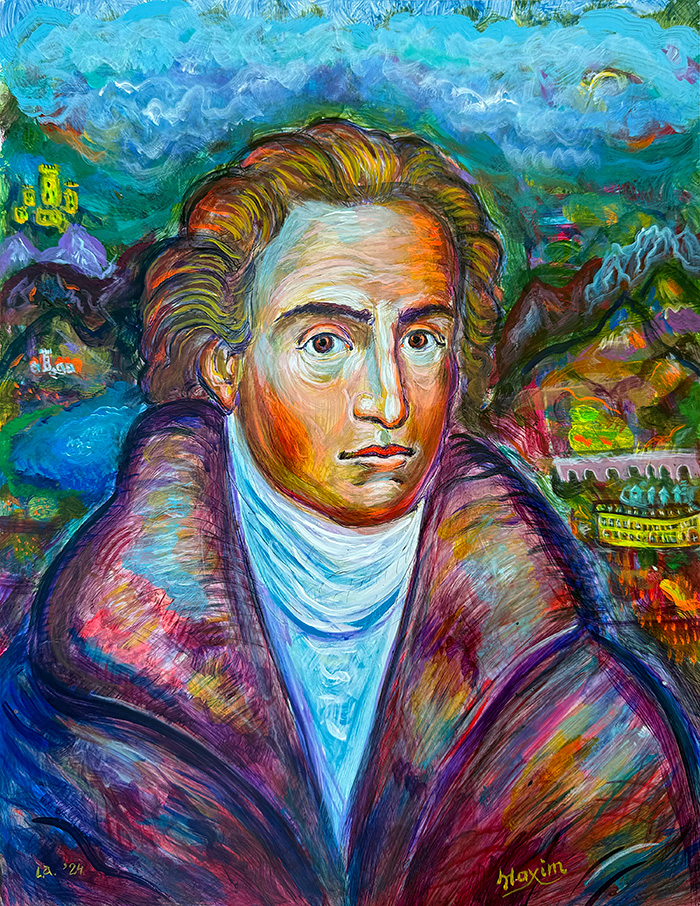
- Details
- Category: Maxim
"Sorrows and Joys of Young Goethe", acrylic on gesso board, Bishop Maxim, 2024
The sorrows and joys of the young Goethe are expressed not only through the ambiguous expression on his face but especially through the marvelous composition of somber colors in his attire and joyful colors in the landscape. The culmination of JOY bursts, explodes, in the divine blue sky that crowns the painting.
—Stamatis Skliris
The sorrows and joys of the young Goethe are expressed not only through the ambiguous expression on his face but especially through the marvelous composition of somber colors in his attire and joyful colors in the landscape. The culmination of JOY bursts, explodes, in the divine blue sky that crowns the painting.
—Stamatis Skliris
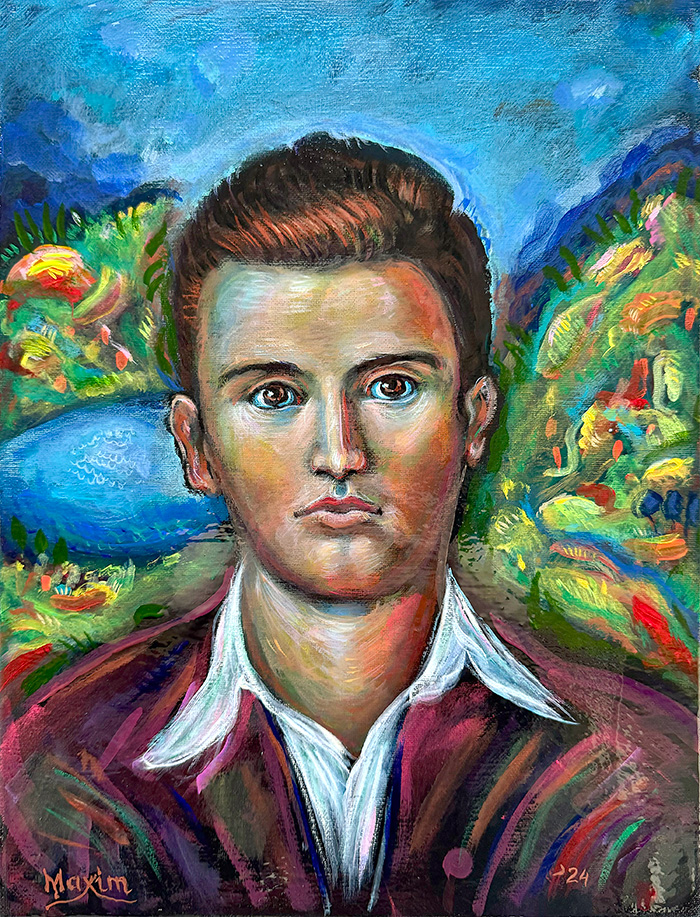
- Details
- Category: Maxim
"The Seeds of Wisdom: Youthful Beginnings of a Great Life", acrylic on canvas, Bishop Maxim, 2024
The artistic virtues of the portrait of the young John Zizioulas (from the village of Katafygio Velventou in the Municipality of Servia, in the region of Kozani) are evident in its ability to convincingly depict a young man, full of life, with both emotion and seriousness. The background, with its slopes, is a delightful play of light and colors, and the mastery of the painting lies in its ability to evoke a real, existing landscape without portraying anything specific. It is literally ΖΩ-ΓΡΑΦΙΚΗ, the art that captures a living person. The painting successfully depicts a living person, fulfilling its purpose. This is known as the gift and experience of painting.
— Stamatis Skliris
The artistic virtues of the portrait of the young John Zizioulas (from the village of Katafygio Velventou in the Municipality of Servia, in the region of Kozani) are evident in its ability to convincingly depict a young man, full of life, with both emotion and seriousness. The background, with its slopes, is a delightful play of light and colors, and the mastery of the painting lies in its ability to evoke a real, existing landscape without portraying anything specific. It is literally ΖΩ-ΓΡΑΦΙΚΗ, the art that captures a living person. The painting successfully depicts a living person, fulfilling its purpose. This is known as the gift and experience of painting.
— Stamatis Skliris
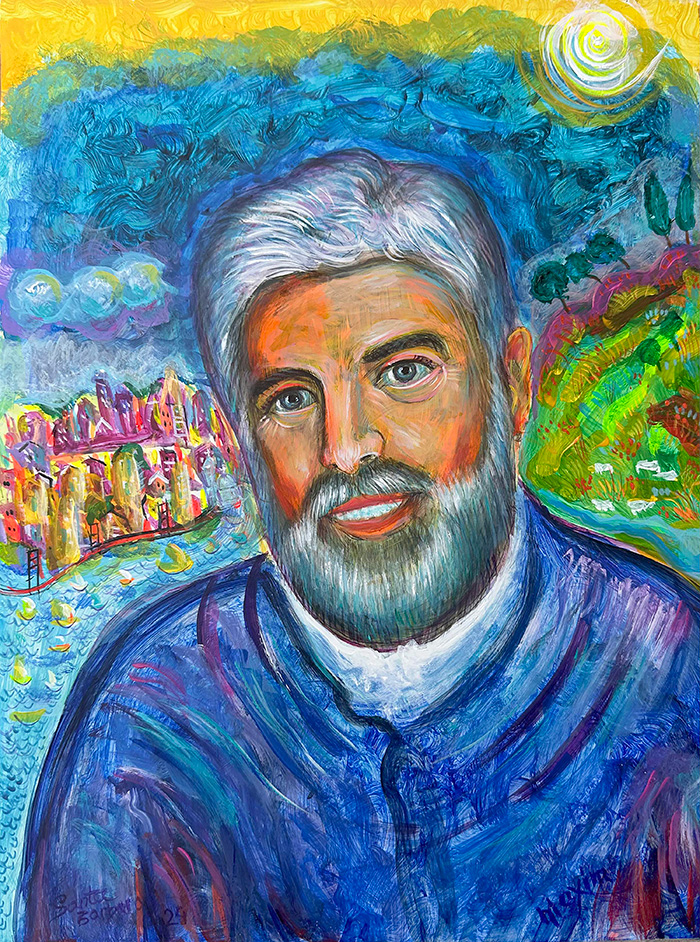
- Details
- Category: Maxim
“A Study in Style and Color”, acrylic on canvas, Bishop Maxim, 2024
"This portrait is refreshingly spontaneous, featuring a naturally relaxed and smiling subject. The composition is geometrically splendid, with a brilliant interplay between the background and the silhouette. Complementary color accents beautifully tie the elements together, particularly the gilded yellow at the sky's top edge. The evolution in style is especially noteworthy in the details of the hair, beard, and shirt. Truly, this is one of painter’s finest works".
— Stamatis Skliris
"This portrait is refreshingly spontaneous, featuring a naturally relaxed and smiling subject. The composition is geometrically splendid, with a brilliant interplay between the background and the silhouette. Complementary color accents beautifully tie the elements together, particularly the gilded yellow at the sky's top edge. The evolution in style is especially noteworthy in the details of the hair, beard, and shirt. Truly, this is one of painter’s finest works".
— Stamatis Skliris
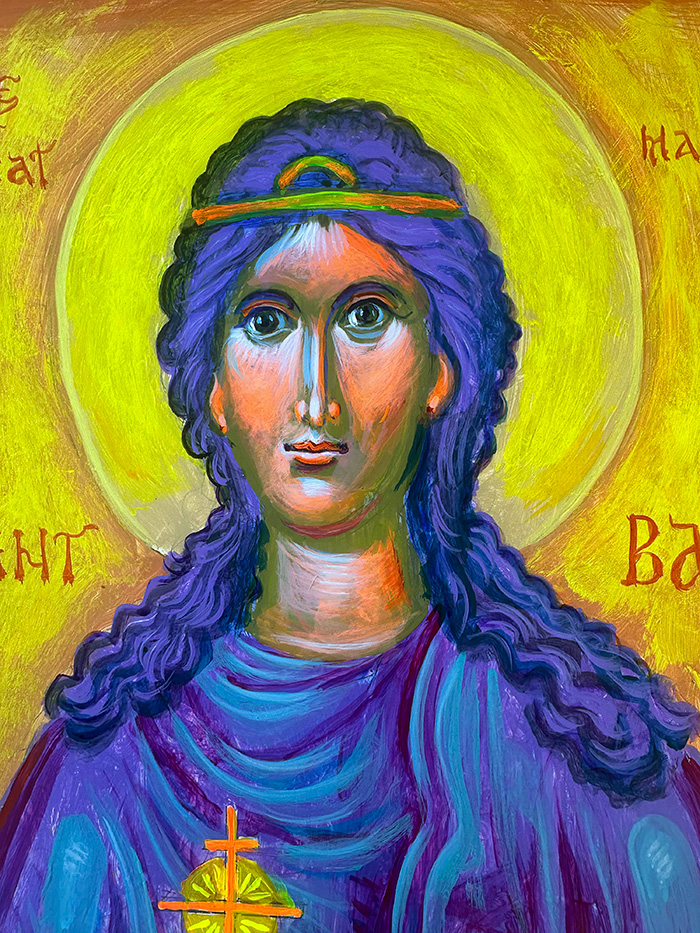
- Details
- Category: Maxim
"St Barbara the Great Martyr", detail, acrylic on woden panel board, 2024, by the hand of Fr. Stamatis Skliris and Bishop Maxim Vasiljevic
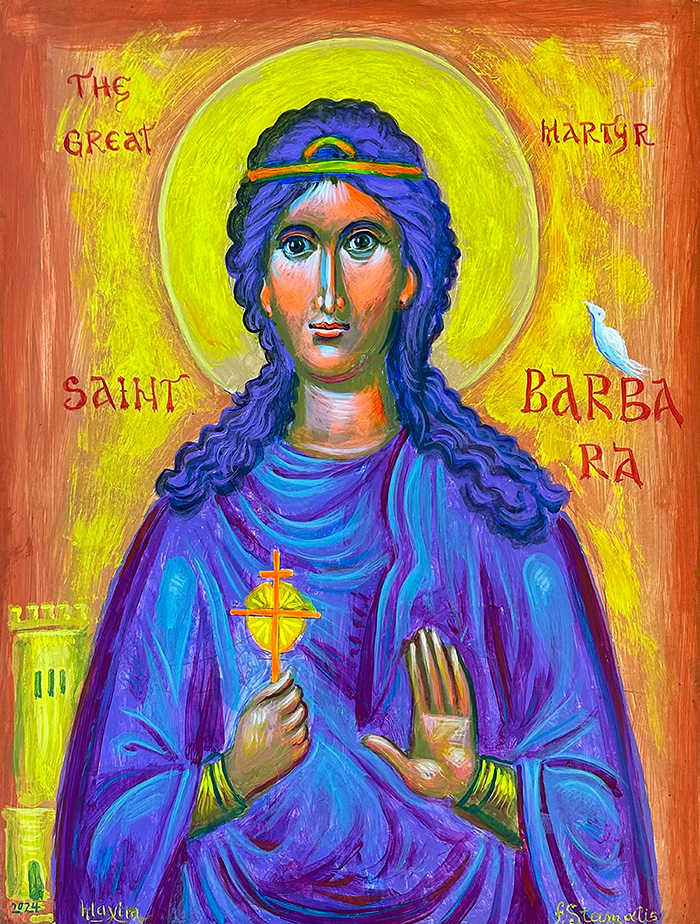
- Details
- Category: Maxim
"St Barbara the Great Martyr", acrylic on woden panel board, 2024, by the hand of Fr. Stamatis Skliris and Bishop Maxim Vasiljevic
THEOLOGICAL MEANING OF THE ICON BACKGROUND: The background represents a golden-yellow cloud of light, which covered Christ and the two Prophets, causing their garments to shine like light on Mount Tabor during the Transfiguration.
TECHNIQUE OF WOOD PANEL ICON: Four layers of wooden panel board (plywood) are pressed together with wood glue and intense heat, resulting in a stable panel for yachts and luxury boats. This wood neither warps nor rots.
THEOLOGICAL MEANING OF THE ICON BACKGROUND: The background represents a golden-yellow cloud of light, which covered Christ and the two Prophets, causing their garments to shine like light on Mount Tabor during the Transfiguration.
TECHNIQUE OF WOOD PANEL ICON: Four layers of wooden panel board (plywood) are pressed together with wood glue and intense heat, resulting in a stable panel for yachts and luxury boats. This wood neither warps nor rots.
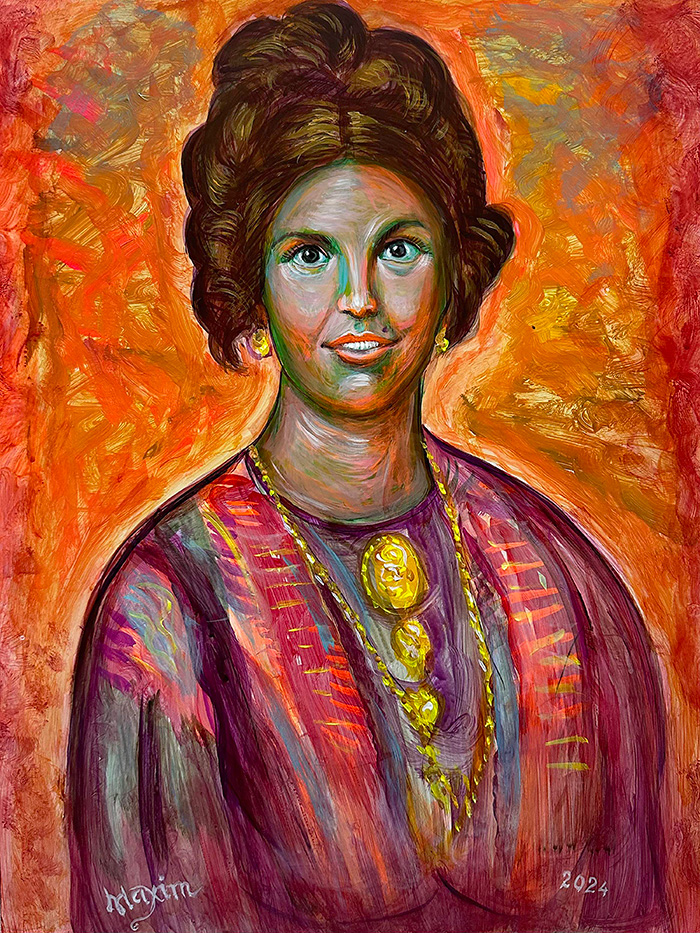
- Details
- Category: Maxim
"Barbara’s Youth in Paradise: A Portrait of Eternal Joy", acrylic on canvas, Bishop Maxim, 2024
"The expression, the age, and the face of Barbara that I painted over the last couple of days has come to embody, for me, her youthfulness in Paradise. It’s as if she is there, youthful, joyful, and liberated from the burdens of history and the trials of illness. What remains now is simply love, a loving smile, and the joy she radiates in Christ."
— Bishop Maxim
"The portrait of this lady is a spontaneous expression of a naturally joyful temperament. Both her expressive face and the warm background, along with the rich fabrics of her dress, are painted with great artistic mastery. She is the very embodiment of joy, full of life. An amazing combination of complementary warm and cool colors. I thank the painter because his artistic creation give me a real sentiment of full joy and optimism that is very necessary in our tragic world."
— Fr. Stamatis Skliris
"The expression, the age, and the face of Barbara that I painted over the last couple of days has come to embody, for me, her youthfulness in Paradise. It’s as if she is there, youthful, joyful, and liberated from the burdens of history and the trials of illness. What remains now is simply love, a loving smile, and the joy she radiates in Christ."
— Bishop Maxim
"The portrait of this lady is a spontaneous expression of a naturally joyful temperament. Both her expressive face and the warm background, along with the rich fabrics of her dress, are painted with great artistic mastery. She is the very embodiment of joy, full of life. An amazing combination of complementary warm and cool colors. I thank the painter because his artistic creation give me a real sentiment of full joy and optimism that is very necessary in our tragic world."
— Fr. Stamatis Skliris
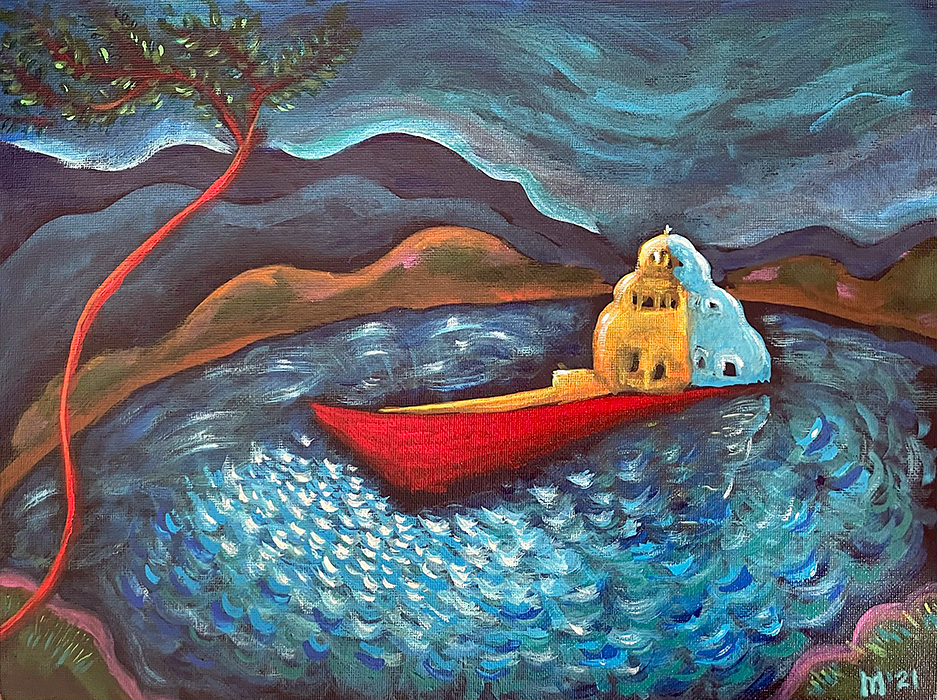
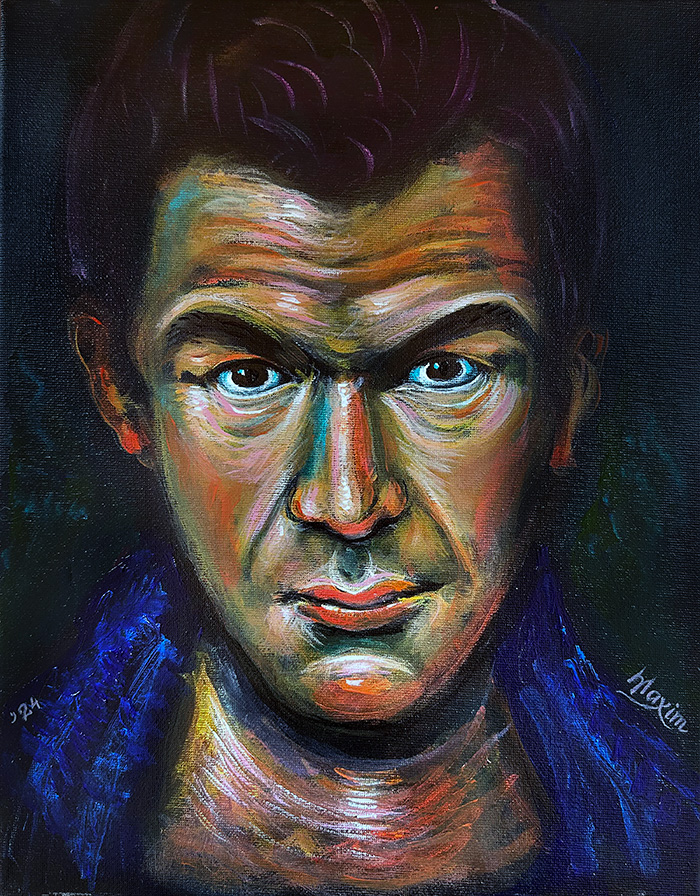
- Details
- Category: Maxim
"Glogovac’s Epic Fusion of Hercegovina’s Spirit and Belgrade’s Soul", acrylic on canvas, Bishop Maxim, 2024
"He so identified with the tragedy of the characters and the times he so masterfully interpreted that he himself became a tragic figure. So deeply did he immerse himself in the mystery of his (anti)heroes that in each of them, he discovered an icon of God and thus became iconic himself—a participant in the Crucifixion and Resurrection of Christ, for whom and to whom he lived, almost imperceptibly. These two layers of his character are beautifully and faithfully attested to by the two images of painter Maxim Bishop."
—Marko Bojović
"He so identified with the tragedy of the characters and the times he so masterfully interpreted that he himself became a tragic figure. So deeply did he immerse himself in the mystery of his (anti)heroes that in each of them, he discovered an icon of God and thus became iconic himself—a participant in the Crucifixion and Resurrection of Christ, for whom and to whom he lived, almost imperceptibly. These two layers of his character are beautifully and faithfully attested to by the two images of painter Maxim Bishop."
—Marko Bojović
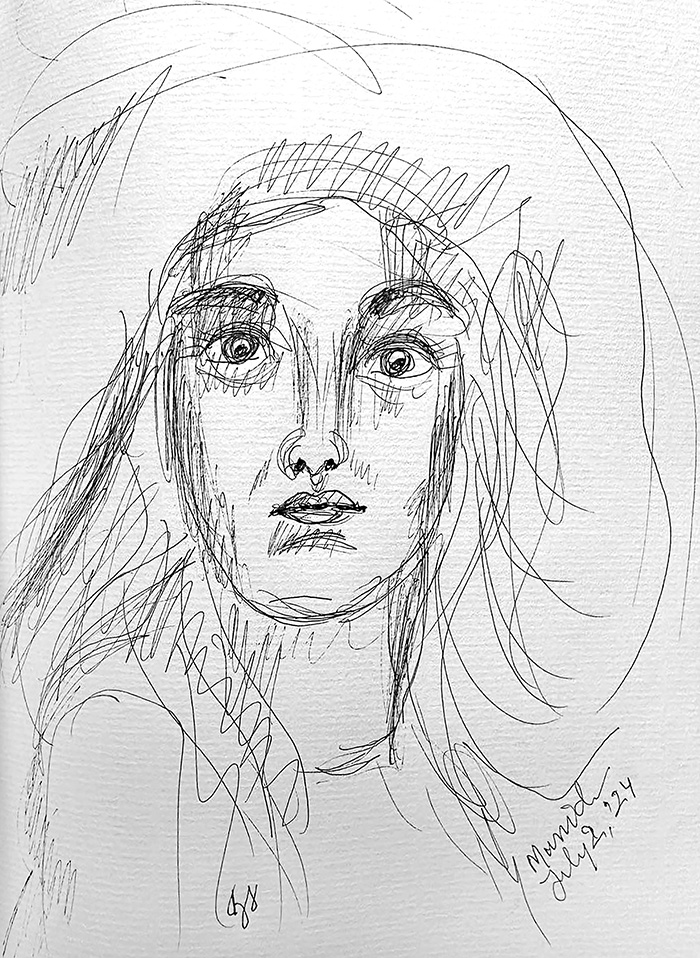
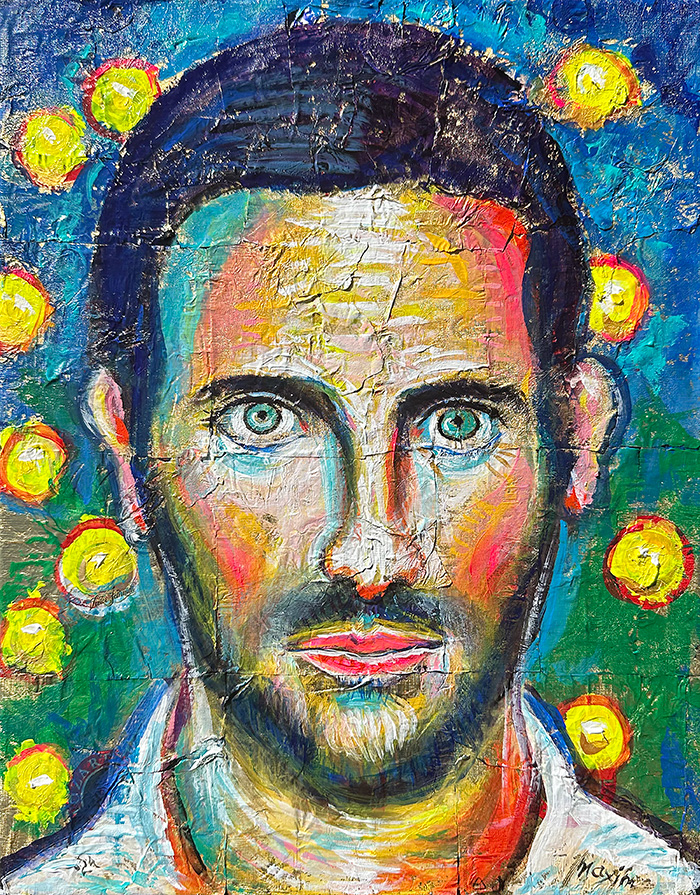
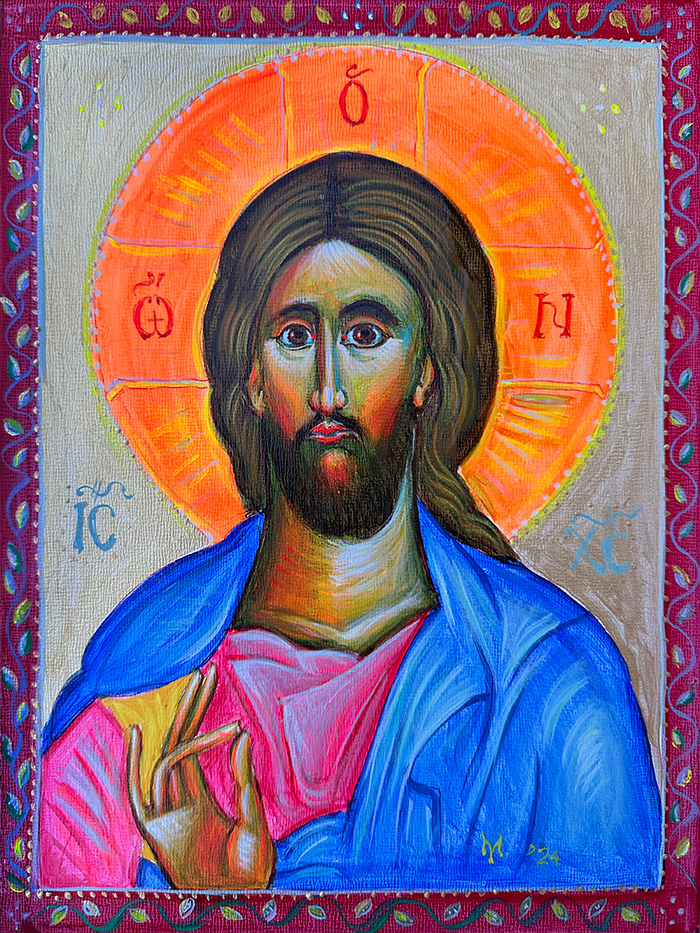
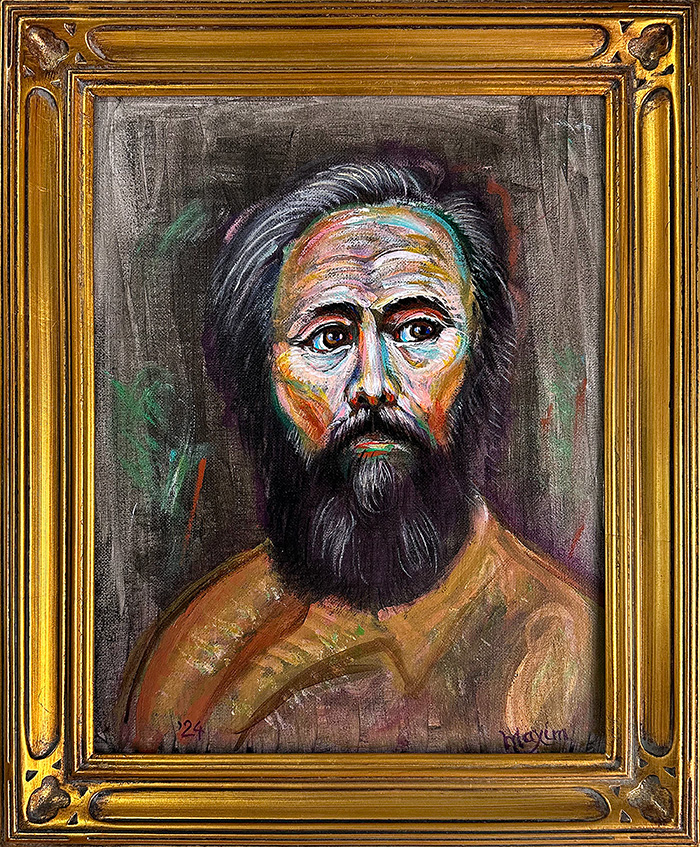
- Details
- Category: Maxim
"Seizing Inspiration: The Noble Gaze of Solzhenitsyn", acrylic on wooden panel, Bishop Maxim, 2024
This painter does not belong to the greatest painters of the ages, but he is a painter who occasionally produces works of rare artistic wisdom. What did he immortalize in this painting? Solzhenitsyn’s body is turned to the left and appears almost golden, thus rendering his poor flesh as something precious. His face is turned slightly to the side, and his gaze reaches backward, trying to capture a fleeting inspiration before it escapes him. He knows well that inspiration only passes in front of us once. Seize the moment! He has also succeeded in capturing the ineffable nobility that anoints the venerable face of the writer, who hailed from the great family of noble writers through the ages.
— Stamatis Skliris
This painter does not belong to the greatest painters of the ages, but he is a painter who occasionally produces works of rare artistic wisdom. What did he immortalize in this painting? Solzhenitsyn’s body is turned to the left and appears almost golden, thus rendering his poor flesh as something precious. His face is turned slightly to the side, and his gaze reaches backward, trying to capture a fleeting inspiration before it escapes him. He knows well that inspiration only passes in front of us once. Seize the moment! He has also succeeded in capturing the ineffable nobility that anoints the venerable face of the writer, who hailed from the great family of noble writers through the ages.
— Stamatis Skliris
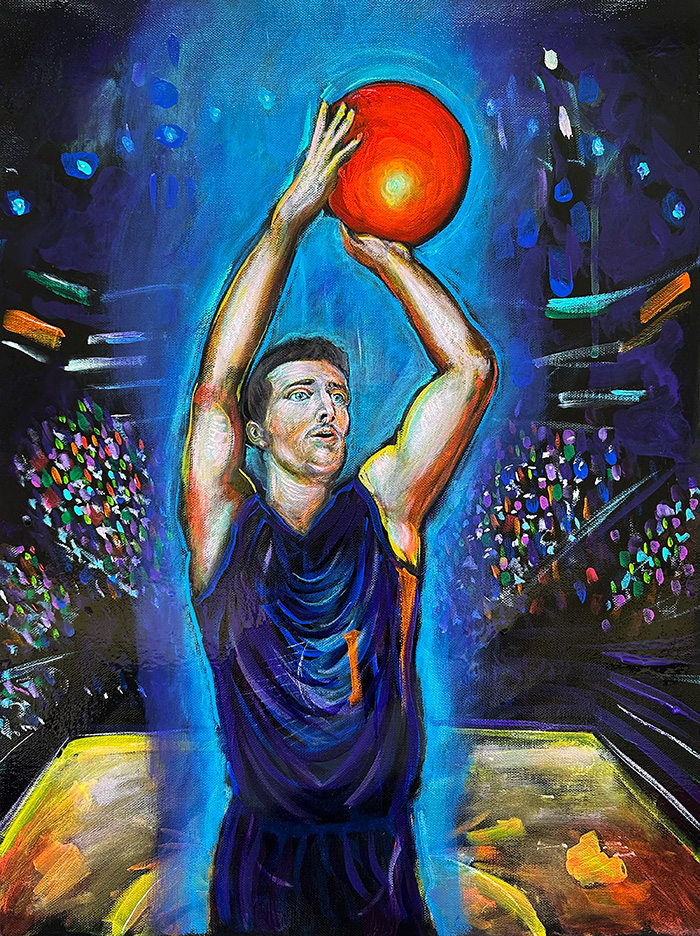
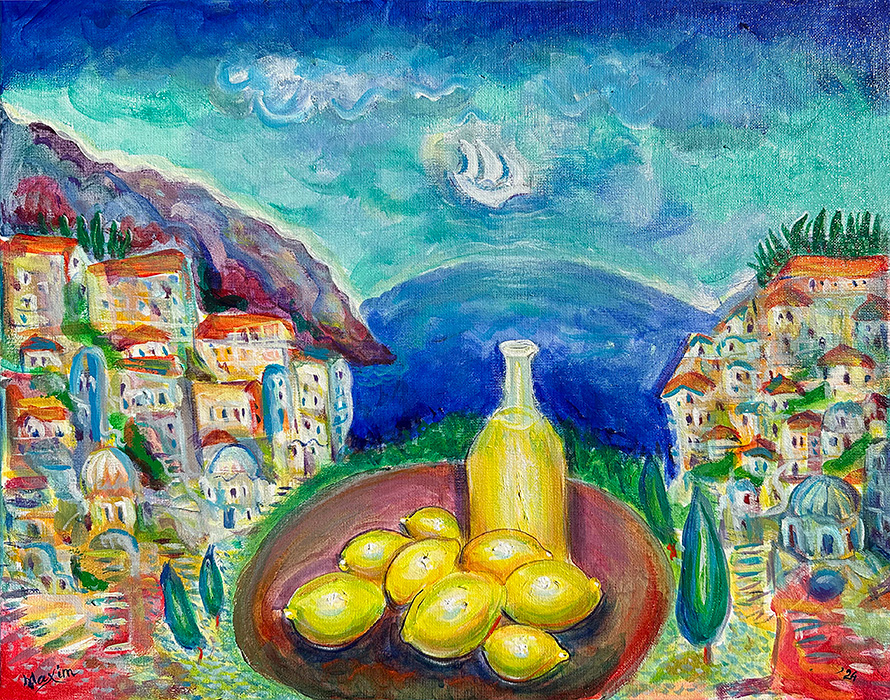
- Details
- Category: Maxim
"A Lively Landscape of Lemons", acrylic on canvas, Bishop Maxim, 2024
A coastal village scene with lemons and a limoncello bottle ready to be served. This landscape invites contemplation of the present as a glimpse of the eternal, a scene not of stillness and death but of such blessing that it evokes sentiments like “Rejoice” and “Be courageous, I have overcome the world.” A landmark landscape. An example of Orthodox landscape painting! The lemons appear animated, bowing their heads as if to say, "Soon, we will be sliced and turned into refreshing lemonade."
— Stamatis Skliris
A coastal village scene with lemons and a limoncello bottle ready to be served. This landscape invites contemplation of the present as a glimpse of the eternal, a scene not of stillness and death but of such blessing that it evokes sentiments like “Rejoice” and “Be courageous, I have overcome the world.” A landmark landscape. An example of Orthodox landscape painting! The lemons appear animated, bowing their heads as if to say, "Soon, we will be sliced and turned into refreshing lemonade."
— Stamatis Skliris
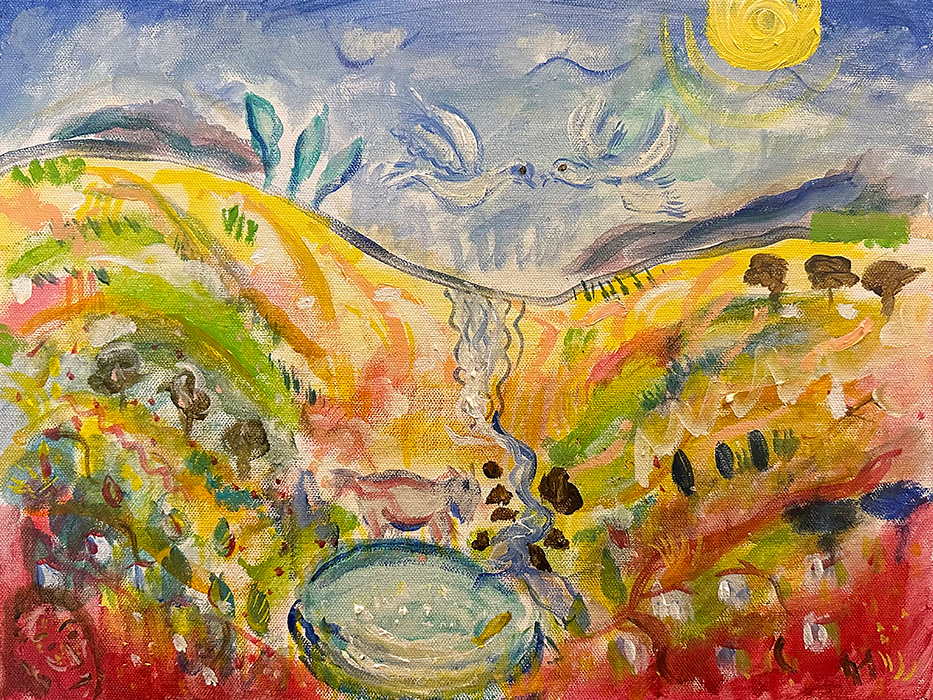
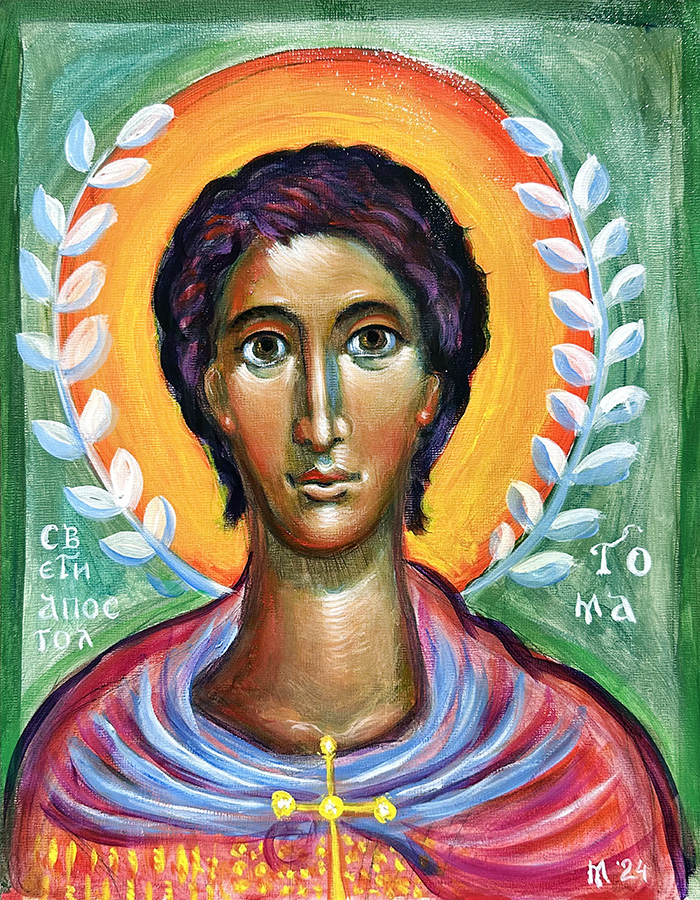
- Details
- Category: Maxim
“St. Thomas: Awe of Resurrection, Crowned in Martyrdom”, acrylic on canvas, Bishop Maxim, 2024
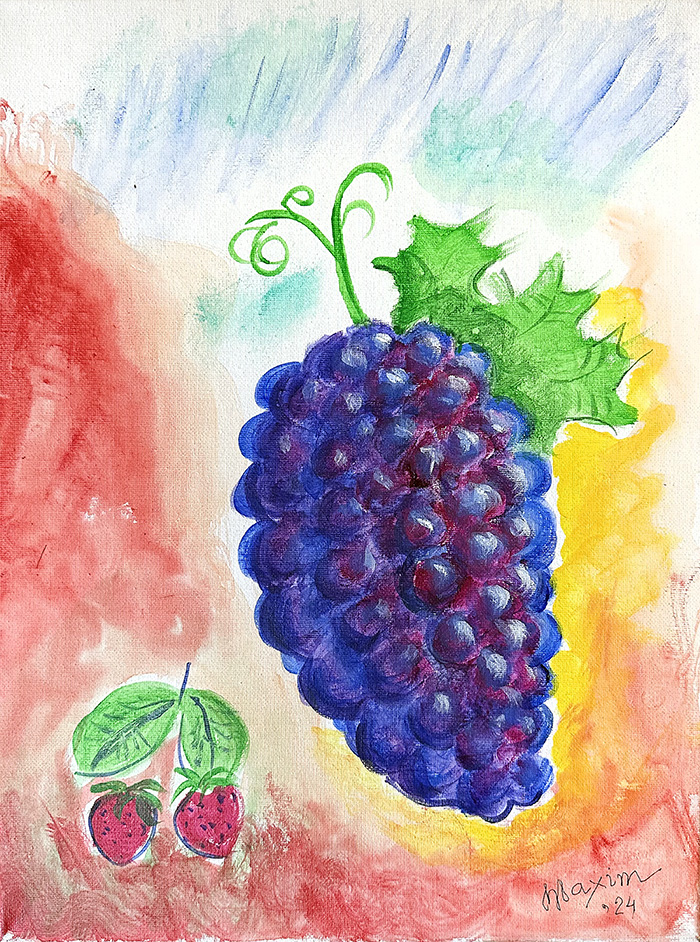
- Details
- Category: Maxim
“Clusters of Time: The Grape’s Journey from Vine to Wine”, acrylic on canvas, Bishop Maxim, 2024
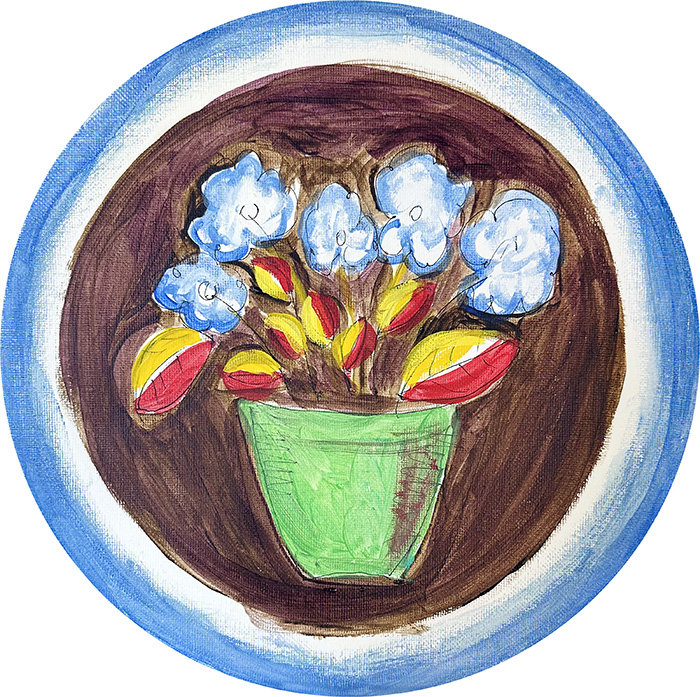
- Details
- Category: Maxim
“Emerald Bloom: Flowers in a Sapphire Embrace”, acrylic on canvas, Bishop Maxim, 2024
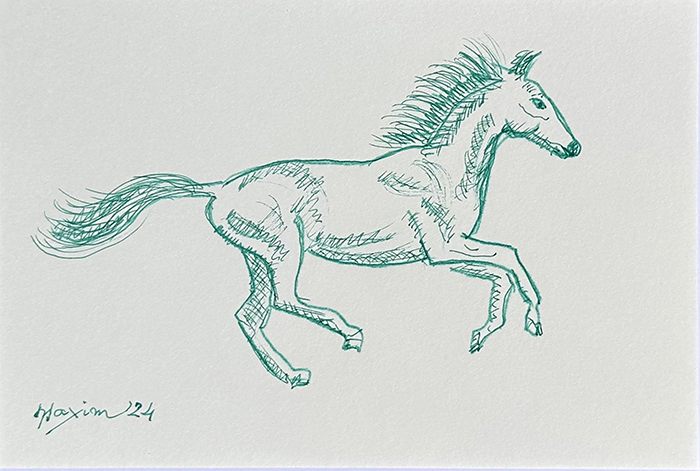
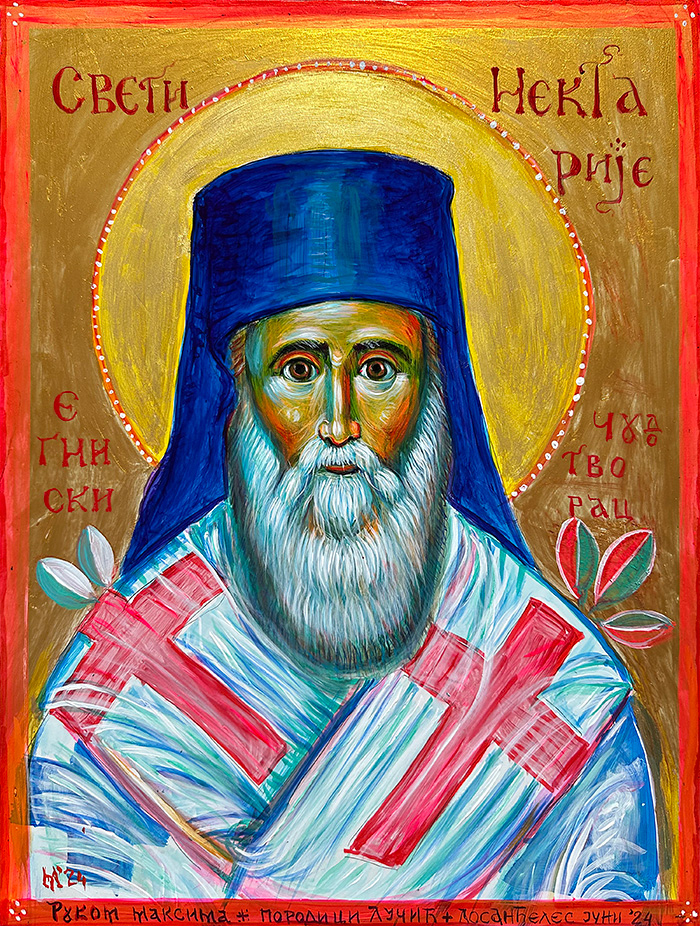
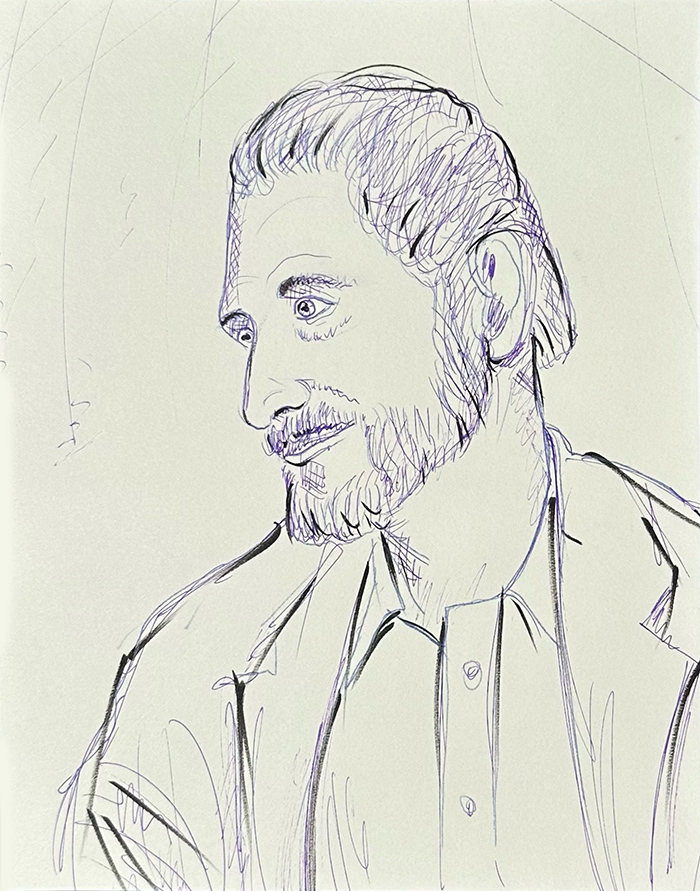
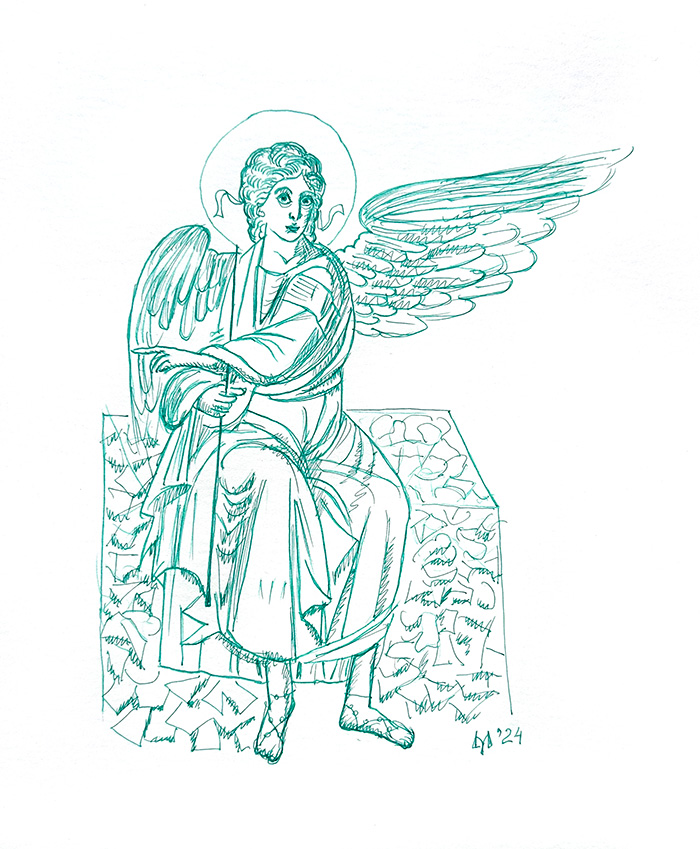
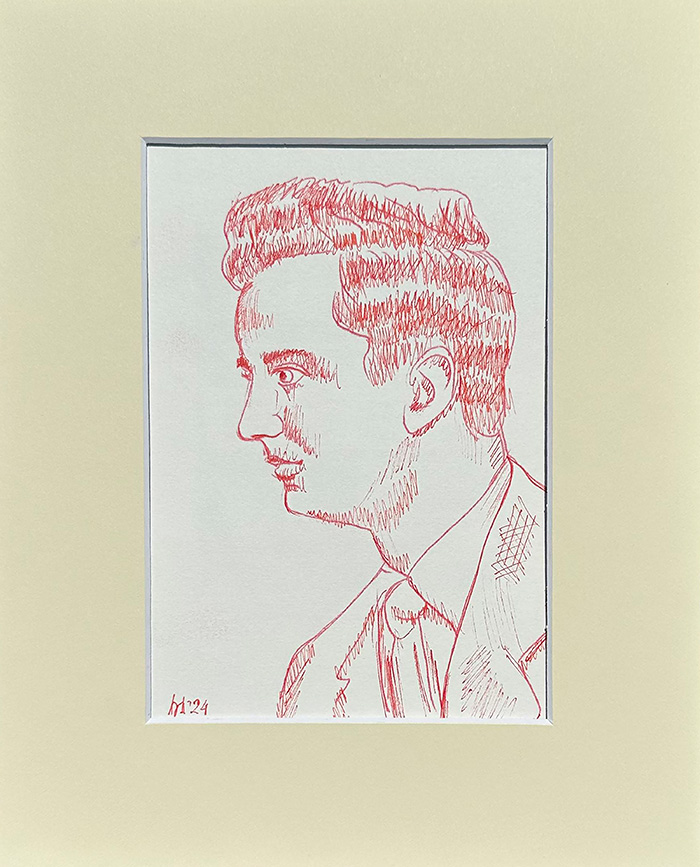
- Details
- Category: Maxim
"Portrait of a Young John Zizioulas in Profile", drawing, Bishop Maxim, 2024
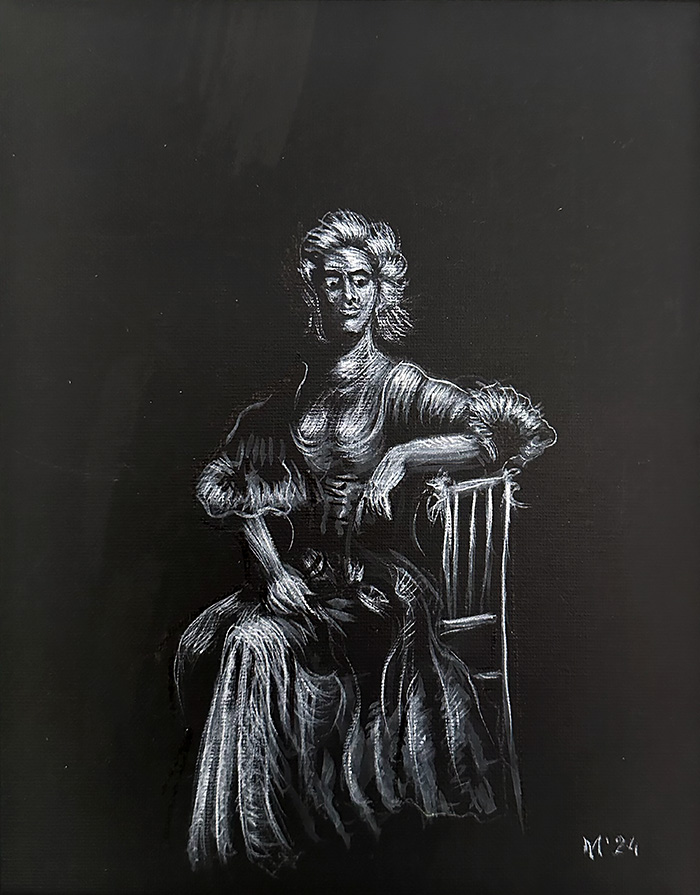
- Details
- Category: Maxim
"Margarita Terekhova", acrylic on canvas, Bishop Maxim, 2024
Margarita Terekhova, the distinguished Soviet Russian actress, is remembered for her profound performances in Andrei Tarkovsky's films. In this portrait, she sits on a chair, exuding a serene and contemplative presence that reflects the depth she brought to her roles. Terekhova's expressive figure and poised demeanor capture her artistry, conveying intense emotion and introspection. Her work with Tarkovsky allowed her to explore nuanced characters, solidifying her legacy in Russian cinema.
The artist employed "chiaroscuro" in this portrait of Terekhova. Originating from the Italian words "chiaro" (light) and "scuro" (dark), this technique uses strong contrasts between light and dark to create volume and three-dimensionality. The dark background and white brush strokes highlight Terekhova’s features, adding dramatic effect and depth to her presence.
Margarita Terekhova, the distinguished Soviet Russian actress, is remembered for her profound performances in Andrei Tarkovsky's films. In this portrait, she sits on a chair, exuding a serene and contemplative presence that reflects the depth she brought to her roles. Terekhova's expressive figure and poised demeanor capture her artistry, conveying intense emotion and introspection. Her work with Tarkovsky allowed her to explore nuanced characters, solidifying her legacy in Russian cinema.
The artist employed "chiaroscuro" in this portrait of Terekhova. Originating from the Italian words "chiaro" (light) and "scuro" (dark), this technique uses strong contrasts between light and dark to create volume and three-dimensionality. The dark background and white brush strokes highlight Terekhova’s features, adding dramatic effect and depth to her presence.
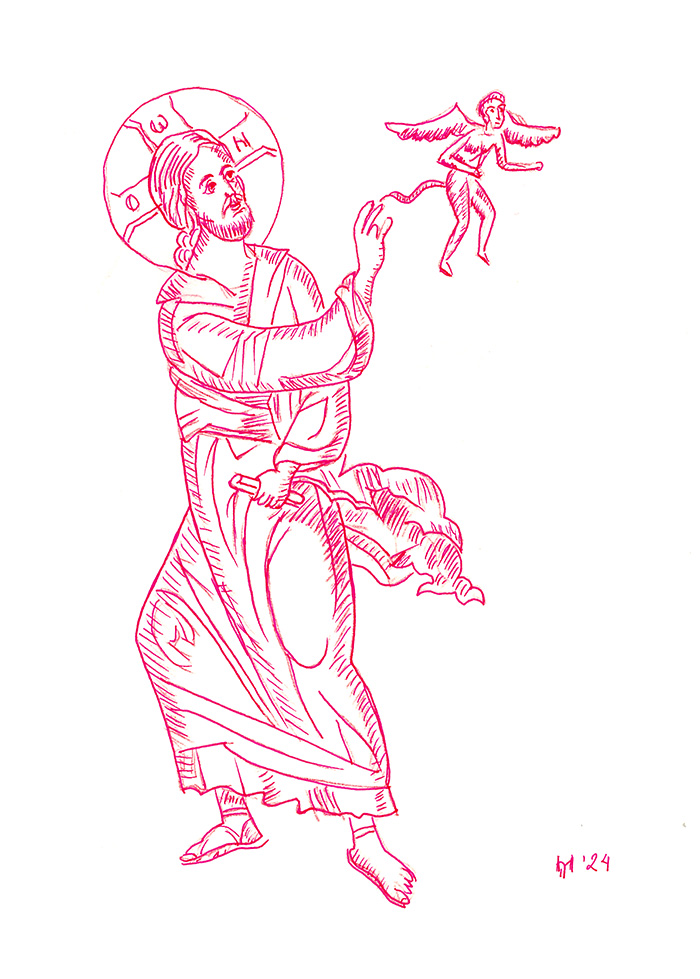
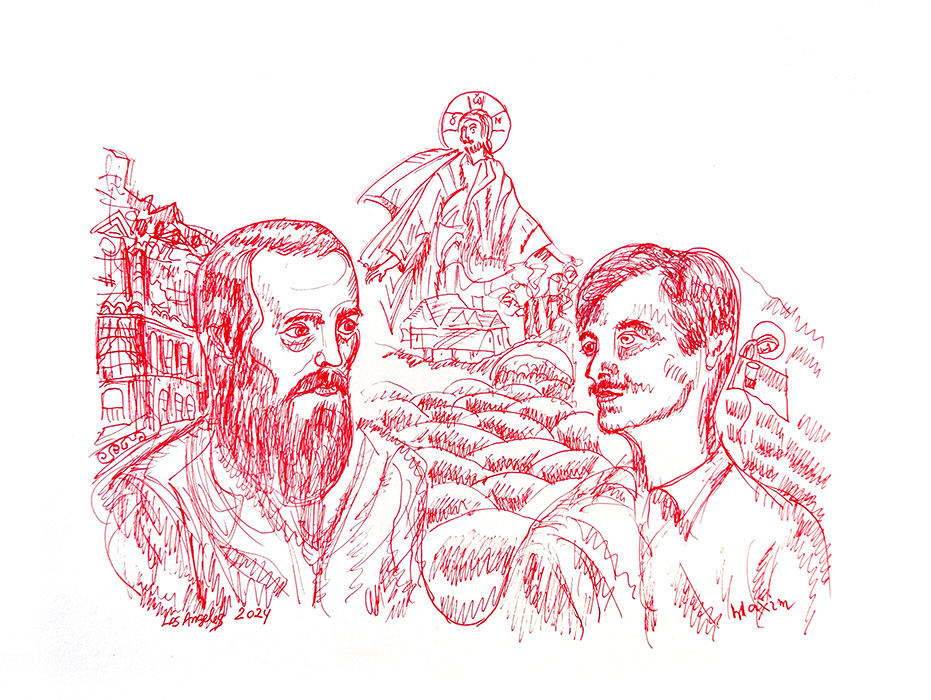
- Details
- Category: Maxim
"Echoes of Genius: Dostoevsky and Tarkovsky’s Confluence of Visions", drawing, Bishop Maxim, 2024
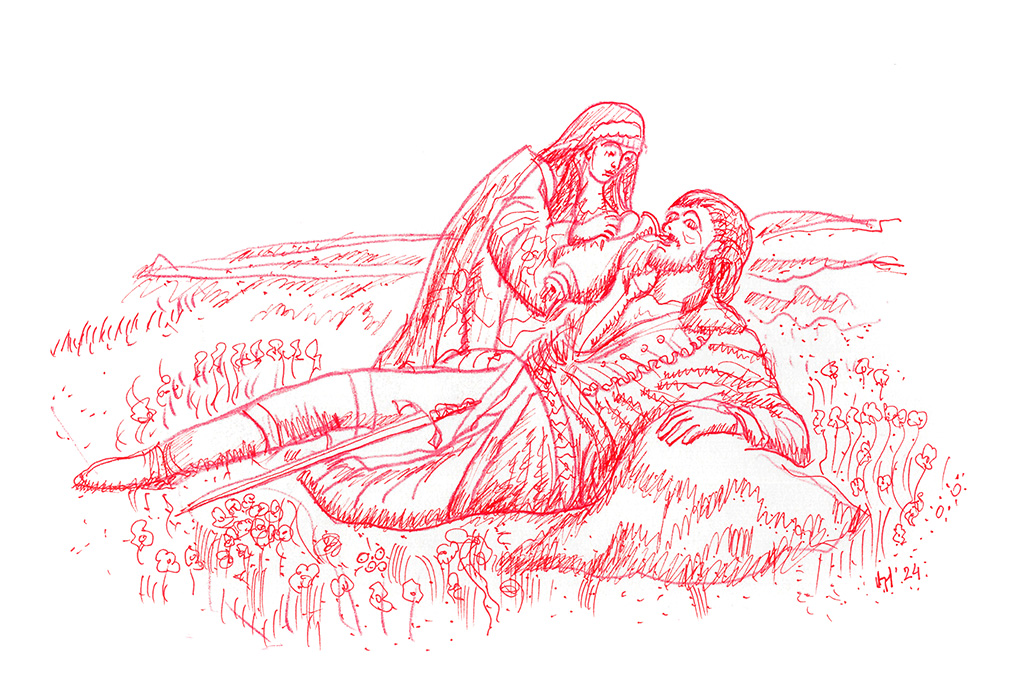
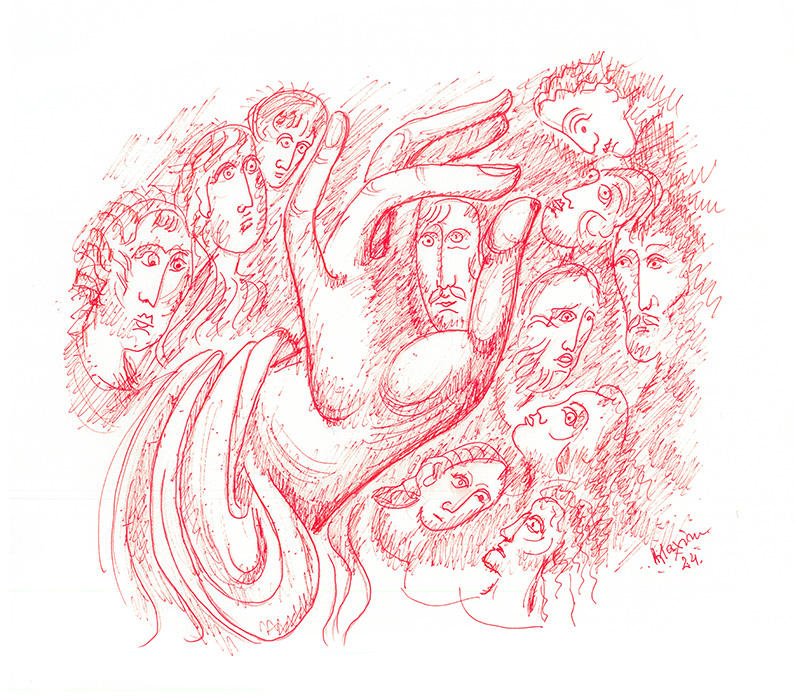
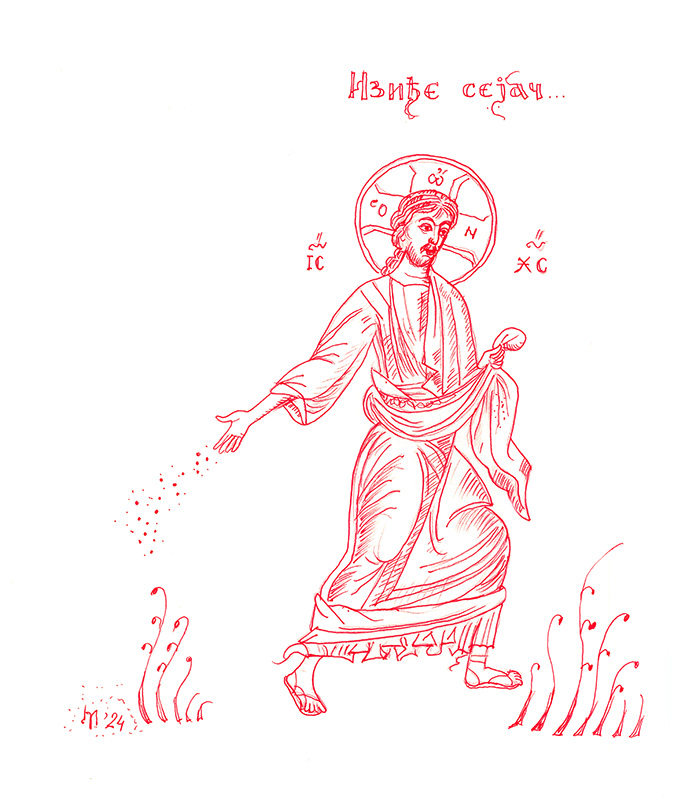
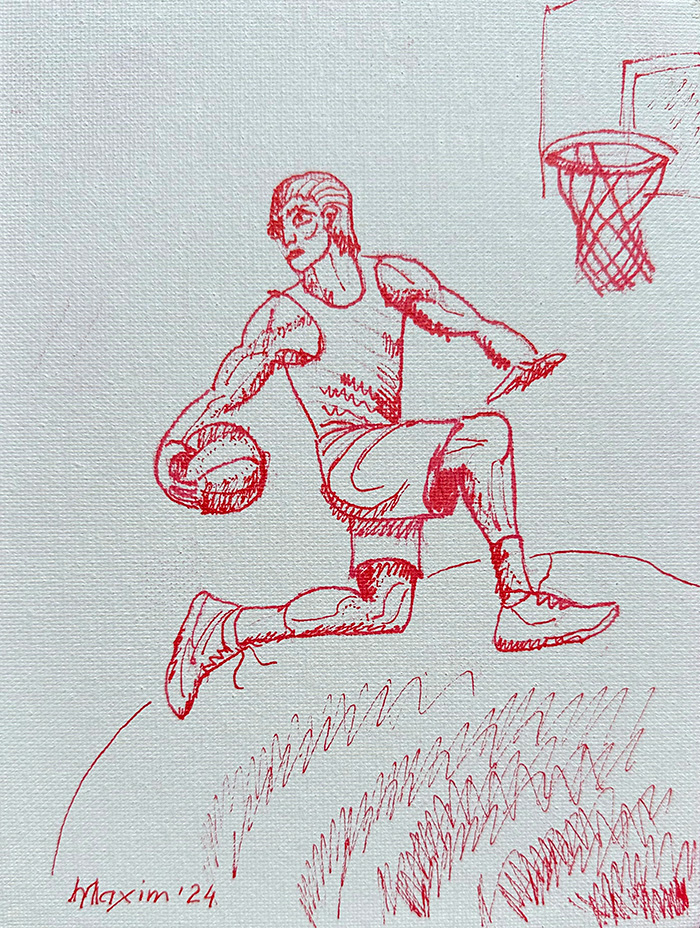
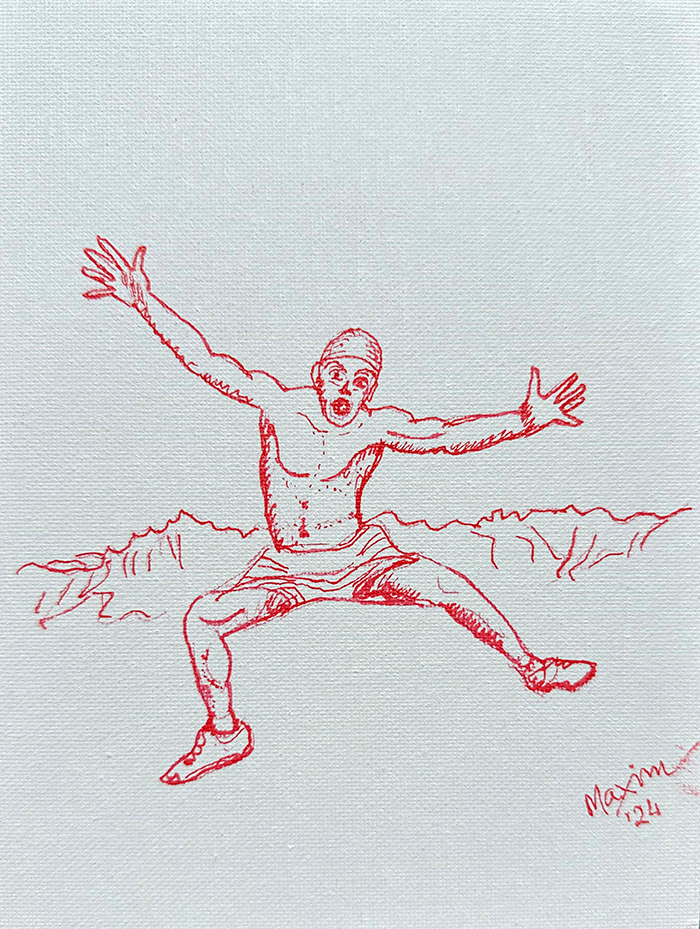
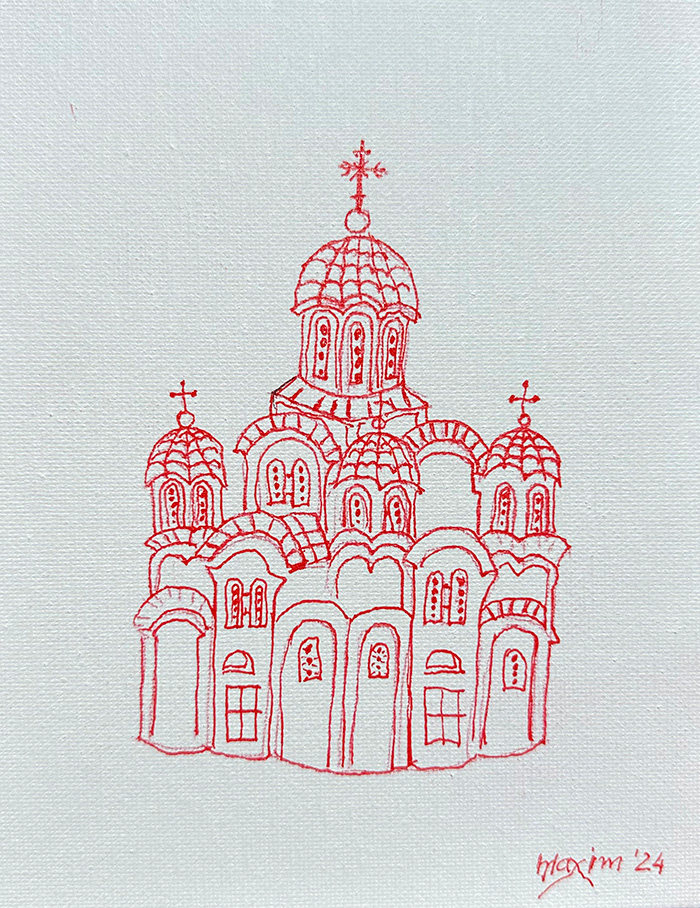
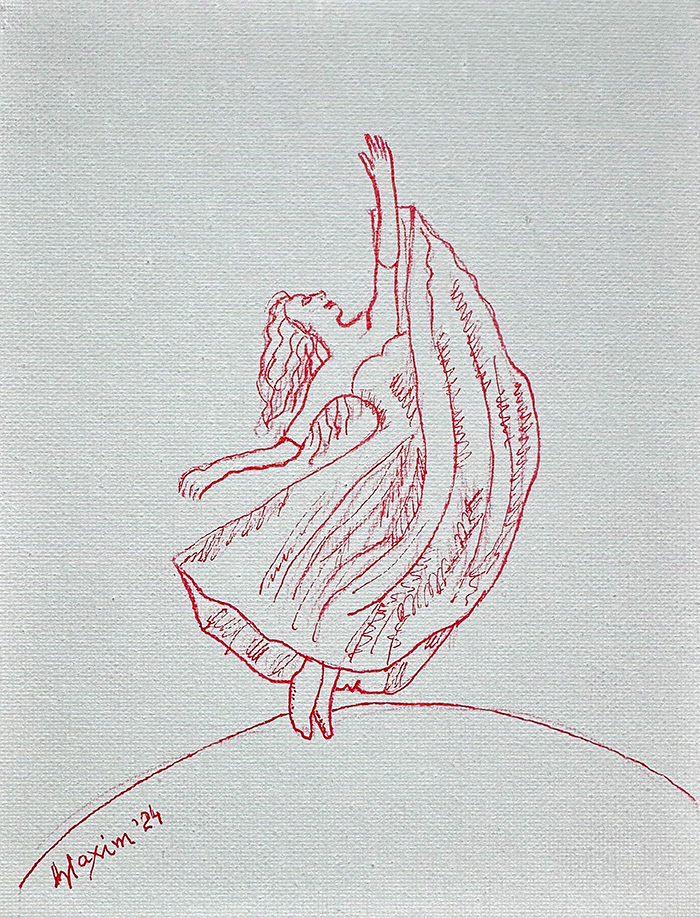
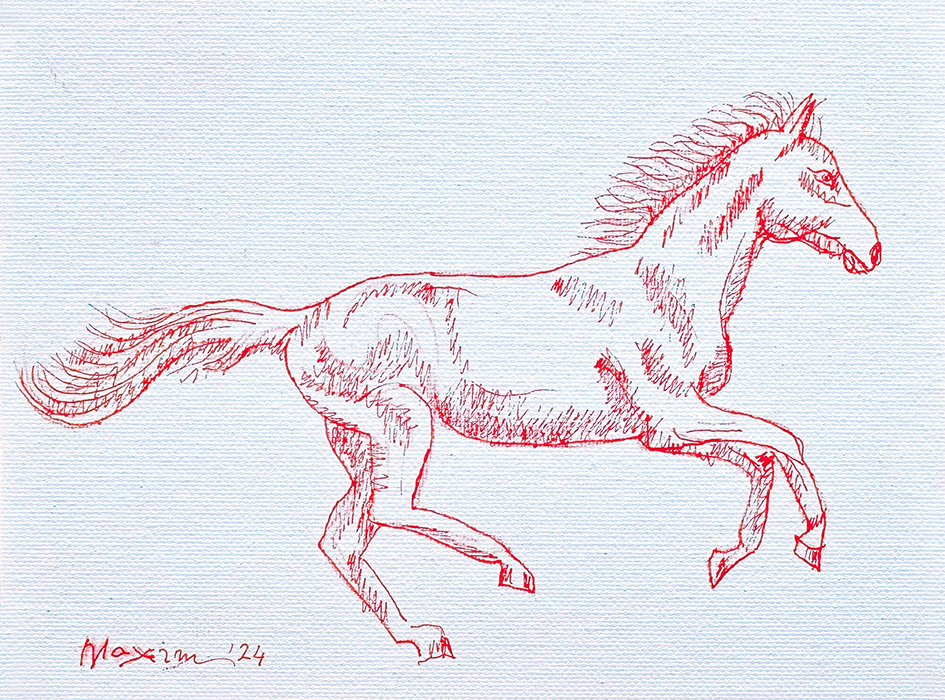
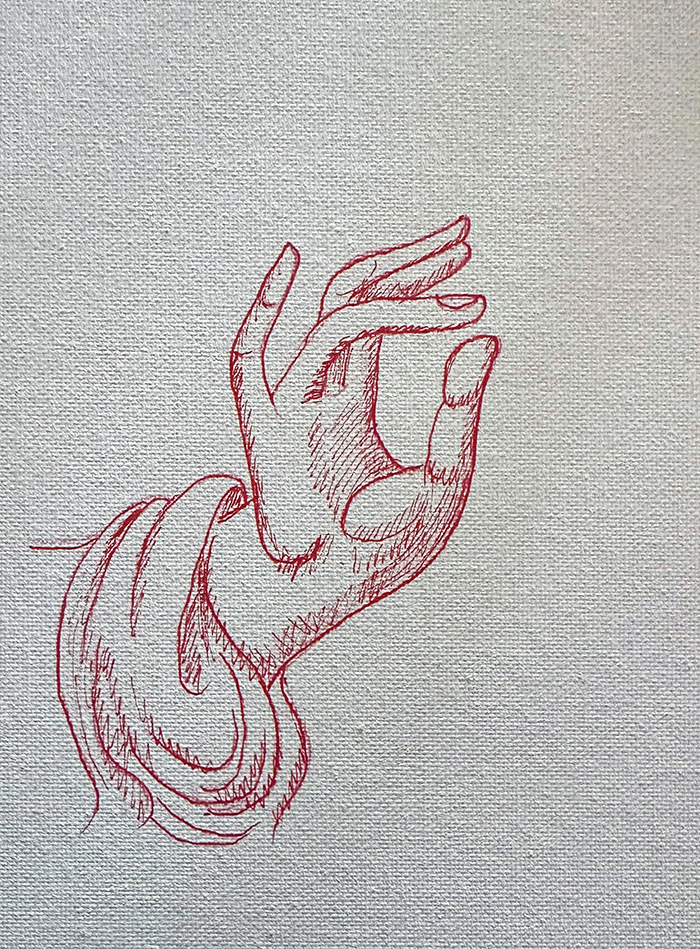
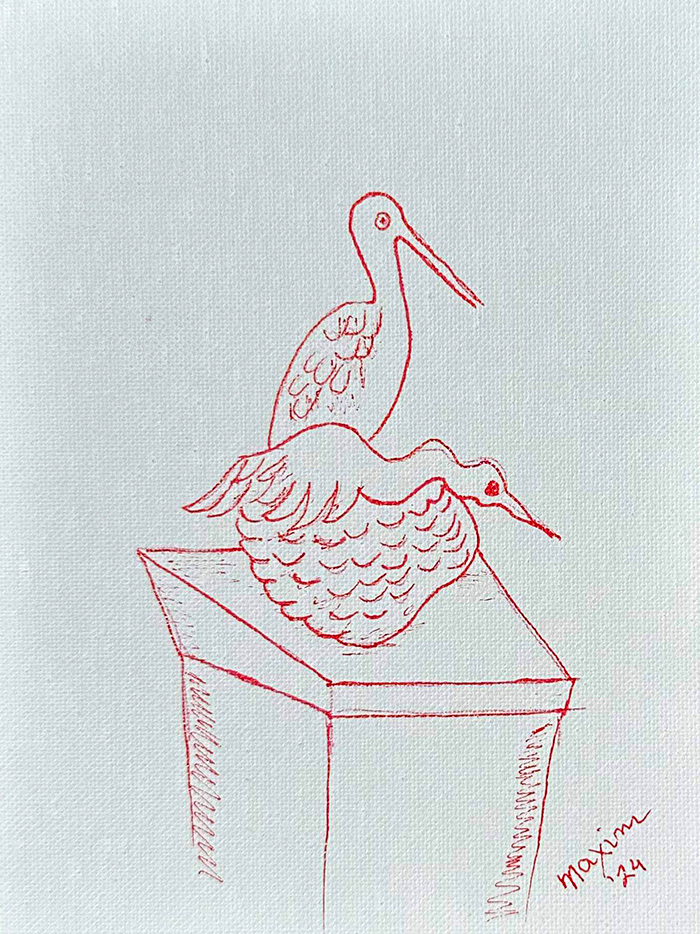
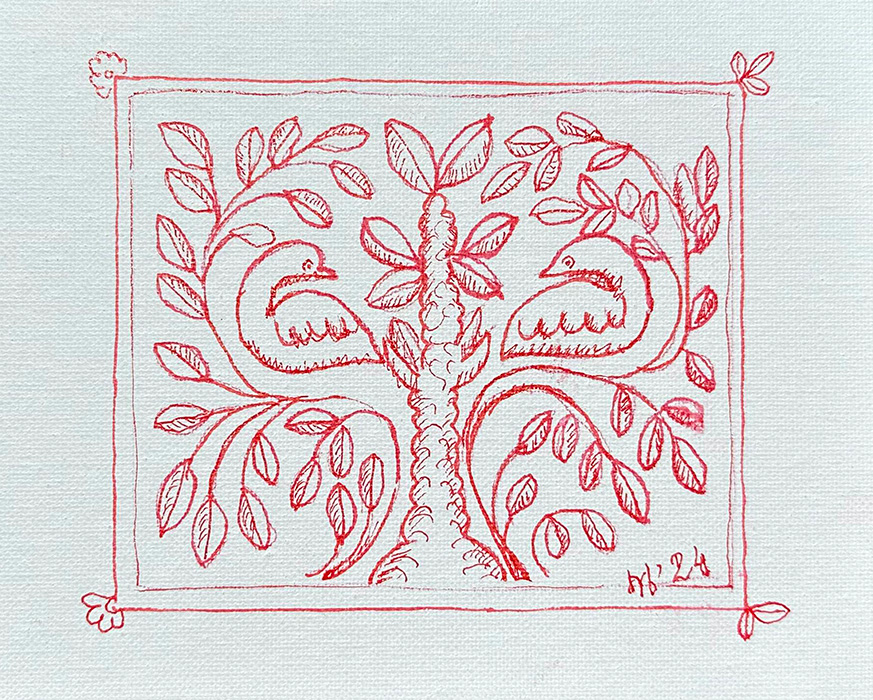
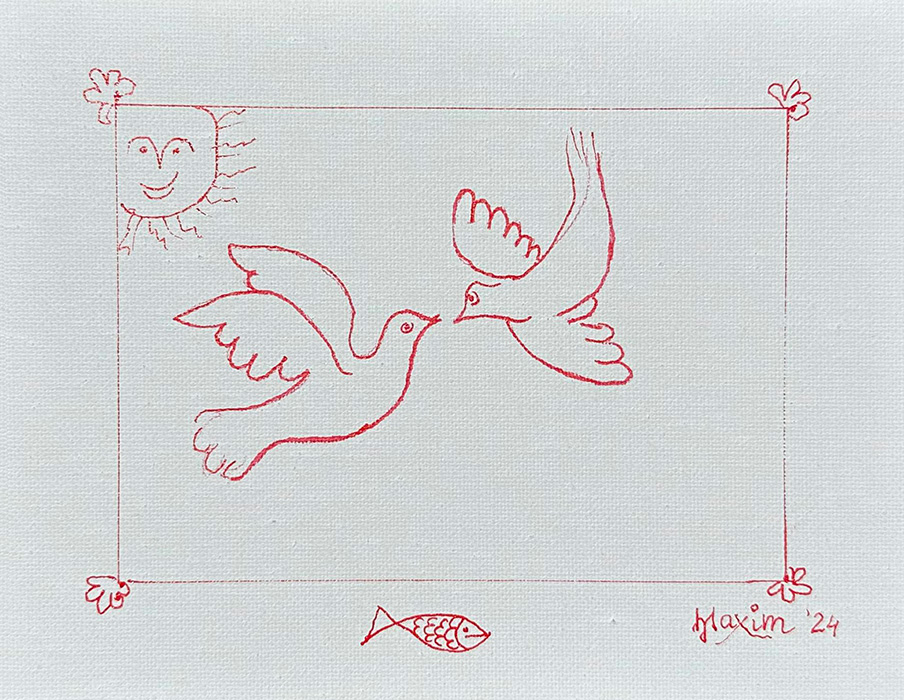
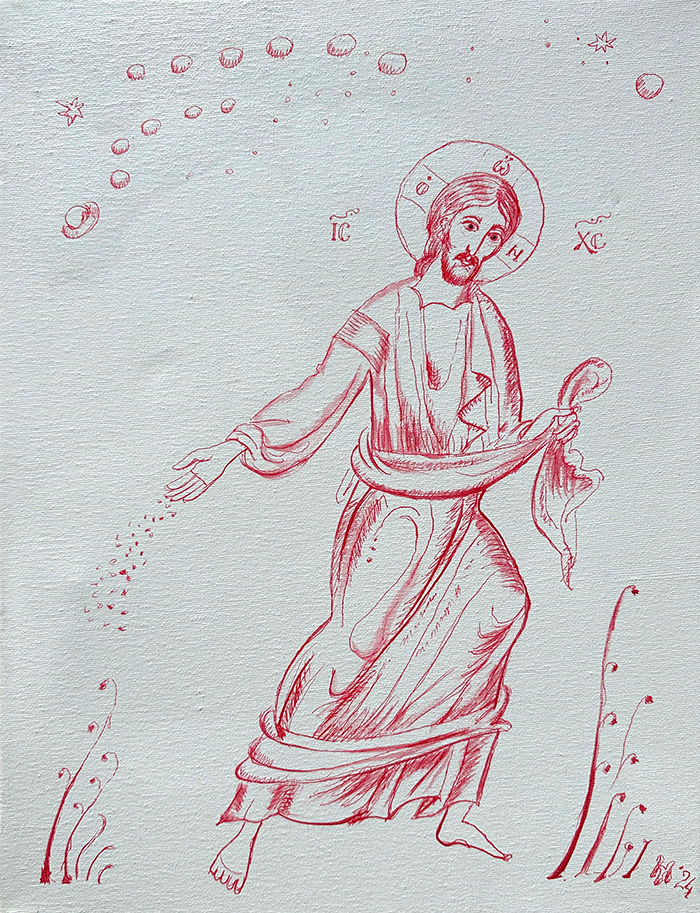
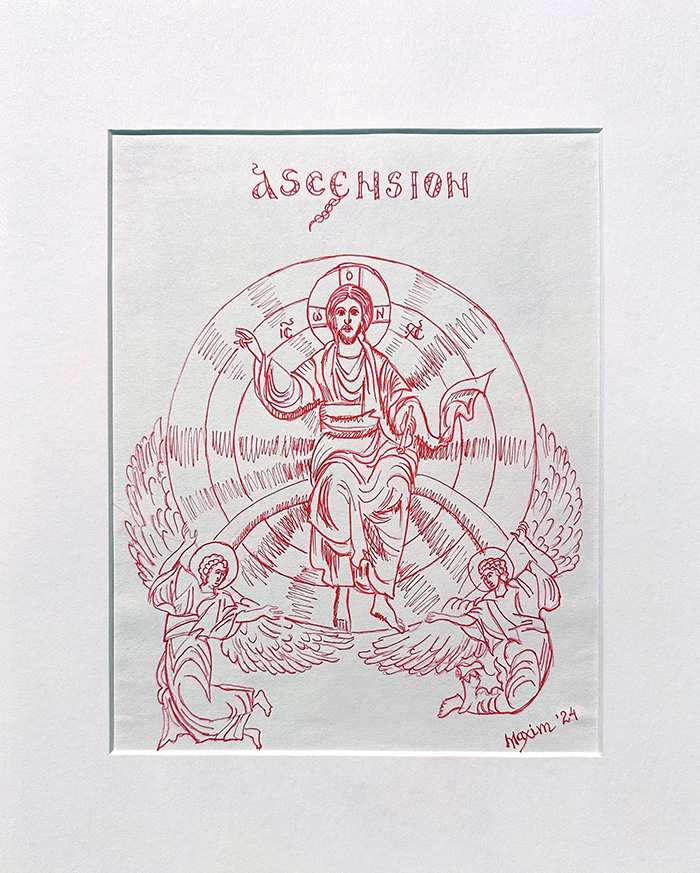
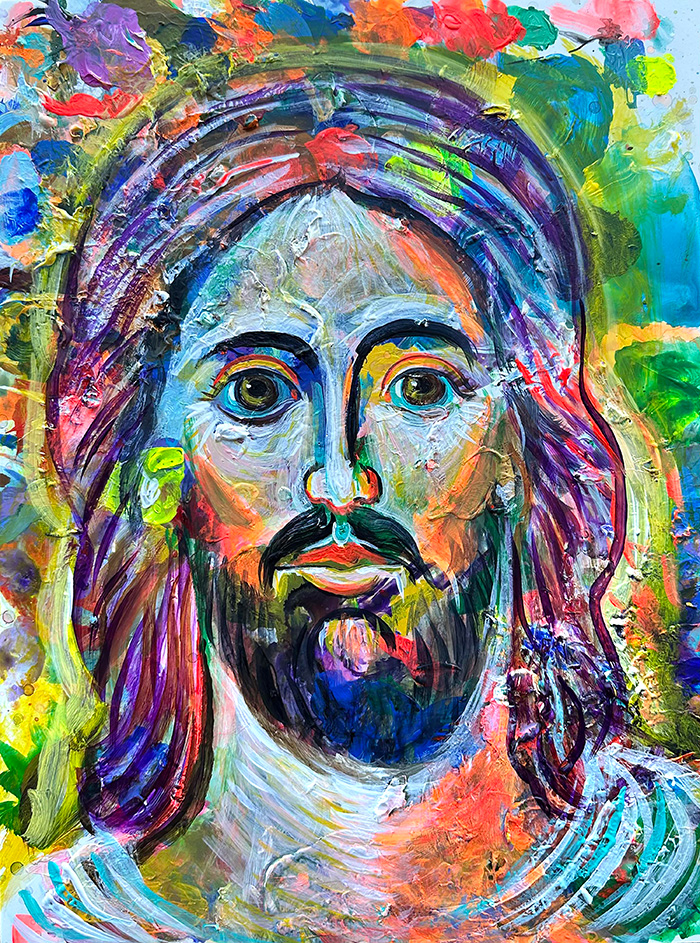
- Details
- Category: Maxim
"The White Christ Light," acrylic on gesso board, Bishop Maxim, 2024
Only those things we would like to see, such as that it emits light, Christ is the light, that the Saints saw the light, etc. However, let us see it as a portrait. It succeeds in the eyes with that instantaneous glance that looks at us and reads our heart, and we also read it as we would a friend. Because there is a harmony of love, mutual understanding, appreciation, respect, and mutual interest. We see it looking at us, and as we have said before, if it does not say something to you for a long time, ten minutes, a quarter of an hour, if you keep looking at two eyes of a portrait, you cannot understand much about the expression. Now we keep looking, and the more we look, the more we understand that it is saying to me, “Stamati, my Stamati, my Stamati.” It looks as if it has not looked at anything else. An axis is created between the two glances: a line that leaves from me and goes to it and another that leaves from it and comes to me. I am not indifferent to it. Maybe you fell, maybe I am cornering you, maybe you do not feel free? Come, tell me, or in other words, pray, talk to me, and as I look at you, so I will listen to you. However, the listening, how much it is willing to listen to us, is not visible artistically. The glance is what is captured more easily and leaves very simply. Maximus’s lines in the hair, for example, have no hesitation. When you see white, and it has no hesitation, it either has absolute truth or, let us say, absolute certainty. However, here, it has no hesitation at all. How will they turn from the top of the parting downwards, and how will they straighten as they fall down as if, let us say, Maximus studied for a year or two in portraiture and learned some secrets to capture from teachers. He also managed to place lighting on the cheeks, eyelids, and the upper lids, red, which has a glowing orange.
Only those things we would like to see, such as that it emits light, Christ is the light, that the Saints saw the light, etc. However, let us see it as a portrait. It succeeds in the eyes with that instantaneous glance that looks at us and reads our heart, and we also read it as we would a friend. Because there is a harmony of love, mutual understanding, appreciation, respect, and mutual interest. We see it looking at us, and as we have said before, if it does not say something to you for a long time, ten minutes, a quarter of an hour, if you keep looking at two eyes of a portrait, you cannot understand much about the expression. Now we keep looking, and the more we look, the more we understand that it is saying to me, “Stamati, my Stamati, my Stamati.” It looks as if it has not looked at anything else. An axis is created between the two glances: a line that leaves from me and goes to it and another that leaves from it and comes to me. I am not indifferent to it. Maybe you fell, maybe I am cornering you, maybe you do not feel free? Come, tell me, or in other words, pray, talk to me, and as I look at you, so I will listen to you. However, the listening, how much it is willing to listen to us, is not visible artistically. The glance is what is captured more easily and leaves very simply. Maximus’s lines in the hair, for example, have no hesitation. When you see white, and it has no hesitation, it either has absolute truth or, let us say, absolute certainty. However, here, it has no hesitation at all. How will they turn from the top of the parting downwards, and how will they straighten as they fall down as if, let us say, Maximus studied for a year or two in portraiture and learned some secrets to capture from teachers. He also managed to place lighting on the cheeks, eyelids, and the upper lids, red, which has a glowing orange.
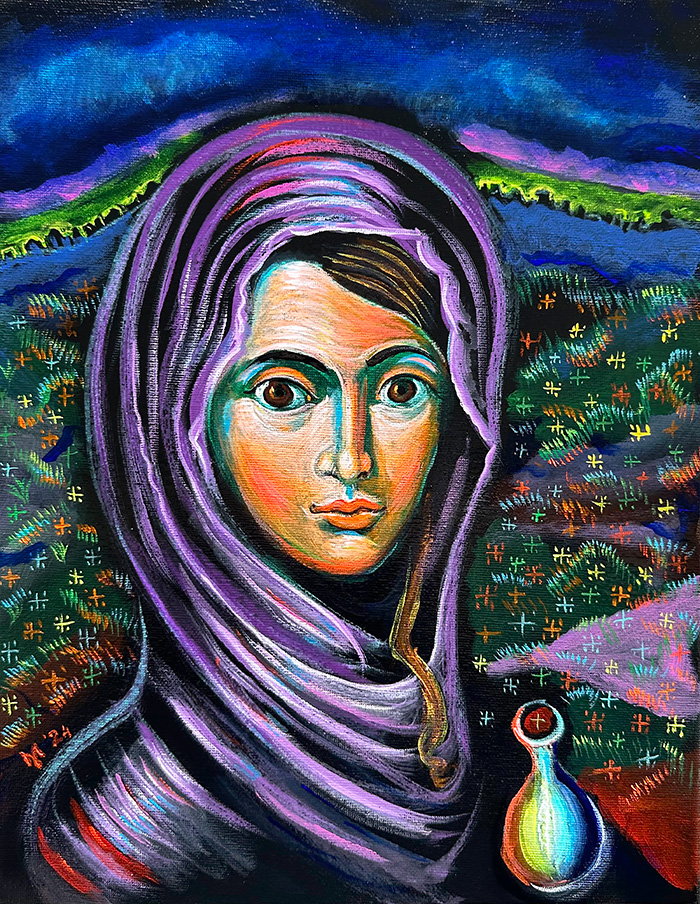
- Details
- Category: Maxim
"Saint Magdalene", acrylic on canvas, Bishop Maxim, 2024
The uncertainty of the previous image here turns into certainty, leading to that ecstatic look when He said to her, "MARY!" And she responded eagerly, "RABBONI, TEACHER!"
Both images are interesting. We pinpointed the subtle difference. One is as she goes to the tomb. The second is the joy as she turns and sees Jesus.
- Fr. Stamatis Skliris
The uncertainty of the previous image here turns into certainty, leading to that ecstatic look when He said to her, "MARY!" And she responded eagerly, "RABBONI, TEACHER!"
Both images are interesting. We pinpointed the subtle difference. One is as she goes to the tomb. The second is the joy as she turns and sees Jesus.
- Fr. Stamatis Skliris
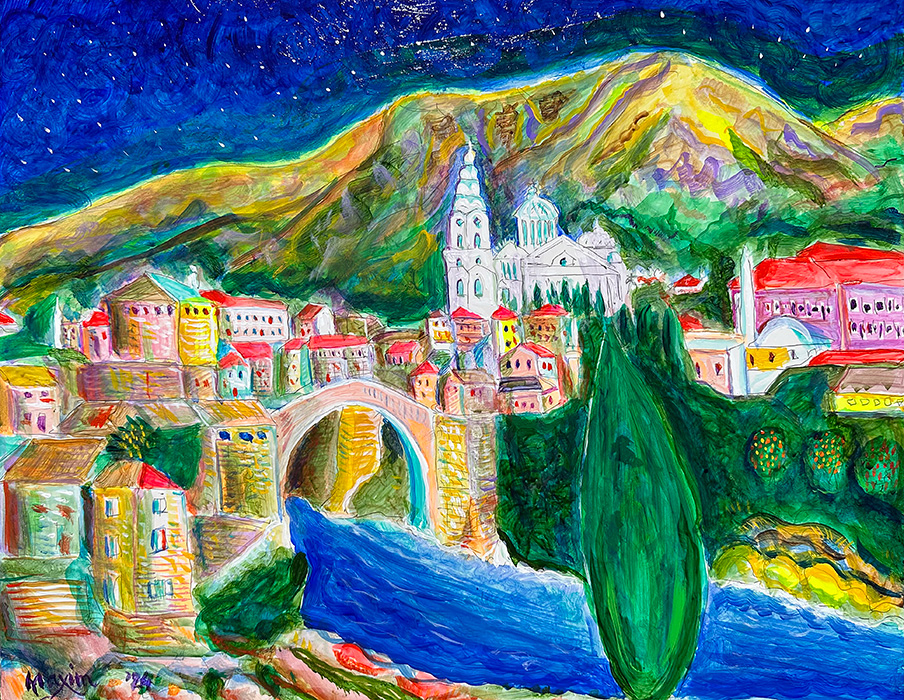
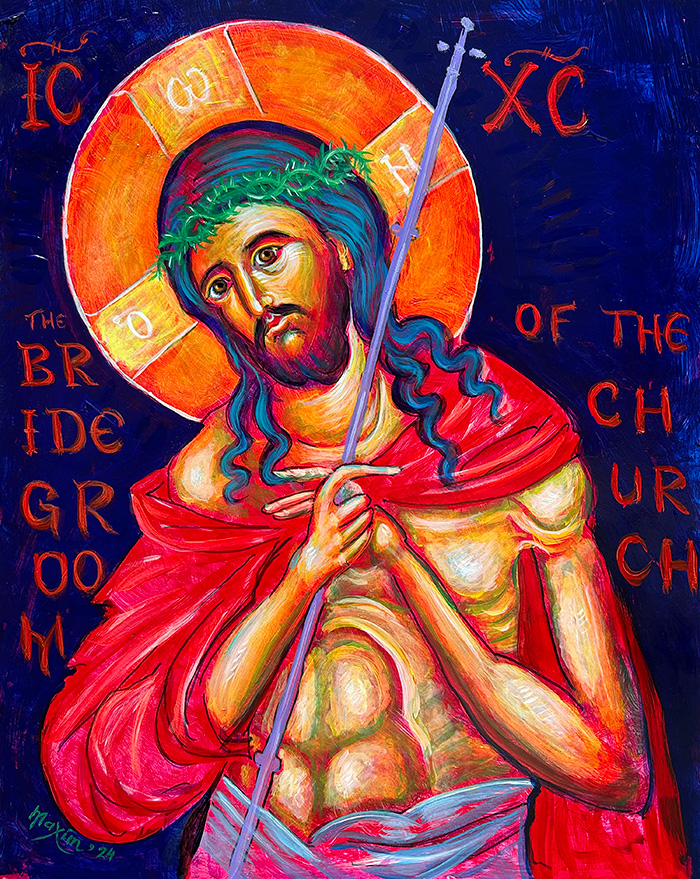
- Details
- Category: Maxim
"The Wounded Bridegroom", acrylic on gesso board, Bishop Maxim, 2024
In the mystery of Holy Week, His Passion becomes the bridal chamber, adorned not with glory as we imagine it, but with our weakness, our blows, and our silence before truth. Alone among many, He conquers as one defeated, giving life where death reigns. The Cross thus unveils the secret glory of the Church: that love endures, bears all, and transforms all.
Crowned with thorns, yet radiant in a quiet majesty, the Bridegroom stands—His wounded love untouched by the triumphs of this world. His gaze, heavy with sorrow yet filled with knowing, does not judge but invites; for He who is condemned receives all without condemning. The reed placed in His hand becomes a hidden sceptre, revealing a Kingdom not of power, but of humility.
And from this stillness, like a flame within the night, there bursts forth an inexhaustible light: the Resurrection, not as a reward, but as a gift. The Bridegroom remains, waiting in patience and tenderness, calling each soul into that final recognition: that everything, whether sorrow, judgment, or even death itself, is gathered and transfigured into a single, boundless triumph of love.
In the mystery of Holy Week, His Passion becomes the bridal chamber, adorned not with glory as we imagine it, but with our weakness, our blows, and our silence before truth. Alone among many, He conquers as one defeated, giving life where death reigns. The Cross thus unveils the secret glory of the Church: that love endures, bears all, and transforms all.
Crowned with thorns, yet radiant in a quiet majesty, the Bridegroom stands—His wounded love untouched by the triumphs of this world. His gaze, heavy with sorrow yet filled with knowing, does not judge but invites; for He who is condemned receives all without condemning. The reed placed in His hand becomes a hidden sceptre, revealing a Kingdom not of power, but of humility.
And from this stillness, like a flame within the night, there bursts forth an inexhaustible light: the Resurrection, not as a reward, but as a gift. The Bridegroom remains, waiting in patience and tenderness, calling each soul into that final recognition: that everything, whether sorrow, judgment, or even death itself, is gathered and transfigured into a single, boundless triumph of love.
!["Twelve Disciples before Their Illumination" [or: "For those who love us and those who hate us"], acrylic on canvas, Bishop Maxim, 2024](/images/01/em/0410.jpg "\"Twelve Disciples before Their Illumination\" [or: \"For those who love us and those who hate us\"], acrylic on canvas, Bishop Maxim, 2024")
- Details
- Category: Maxim
"Twelve Disciples before Their Illumination" [or: "For those who love us and those who hate us"], acrylic on canvas, Bishop Maxim, 2024
The Last Supper - A group of disciples embraces the Teacher who offers them life. How did the iconographer achieve an ethos of Harmony and identification of the group for two reasons: the fear of impending martyrdom and the faith in the supernatural transcendence of nothingness? They are all one body, the BODY OF CHRIST. An incorruptible body. And they all experience together, as united in spirit and body through divine communion, the unique moment that split history in two. Artistic secret of the painting: the gazes of the disciples that identify with each other and the stage design of the united bodies, where not even a pin could fall!!!
— Stamatis Skliris
A harmonious gathering of expectant faces and vibrant colors surround Christ depicted against the immense backdrop of a star-pitted night, suggesting the all-encompassing cosmic nature of the event. John the beloved leans upon the Lord’s shoulder. All eyes and faces are turned toward him... except for one who turns in the opposite direction. This is the Eucharistic banquet of an unredeemed humanity. The blood red of the cup and the Holy Altar are of one piece with the red of the Savior’s divine quintessence which will be poured out through his human flesh and blood. The overall harmony of the painting, with its diversity of vibrant colors and faces, gives form to the reality that “Christ is in our midst!” Surrounded by untransformed humanity, “those who love us and those who hate us,” he prepares to pour out his life in order to transform ours. Apart from any commentary, this is a vibrantly beautiful painting of harmony, color, and form. Very appealing.
— Stephen Muse
The Last Supper - A group of disciples embraces the Teacher who offers them life. How did the iconographer achieve an ethos of Harmony and identification of the group for two reasons: the fear of impending martyrdom and the faith in the supernatural transcendence of nothingness? They are all one body, the BODY OF CHRIST. An incorruptible body. And they all experience together, as united in spirit and body through divine communion, the unique moment that split history in two. Artistic secret of the painting: the gazes of the disciples that identify with each other and the stage design of the united bodies, where not even a pin could fall!!!
— Stamatis Skliris
A harmonious gathering of expectant faces and vibrant colors surround Christ depicted against the immense backdrop of a star-pitted night, suggesting the all-encompassing cosmic nature of the event. John the beloved leans upon the Lord’s shoulder. All eyes and faces are turned toward him... except for one who turns in the opposite direction. This is the Eucharistic banquet of an unredeemed humanity. The blood red of the cup and the Holy Altar are of one piece with the red of the Savior’s divine quintessence which will be poured out through his human flesh and blood. The overall harmony of the painting, with its diversity of vibrant colors and faces, gives form to the reality that “Christ is in our midst!” Surrounded by untransformed humanity, “those who love us and those who hate us,” he prepares to pour out his life in order to transform ours. Apart from any commentary, this is a vibrantly beautiful painting of harmony, color, and form. Very appealing.
— Stephen Muse
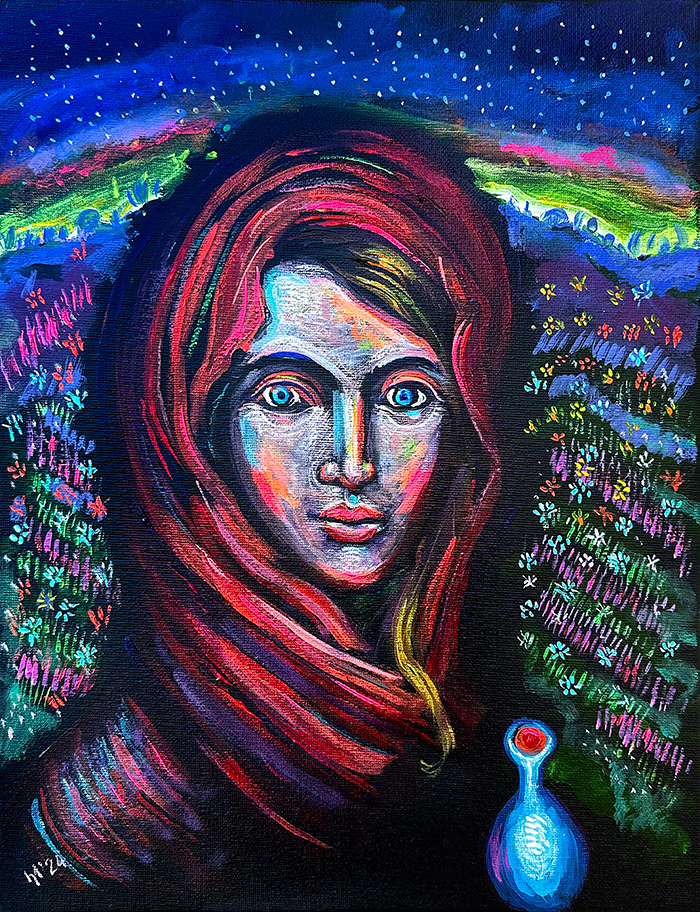
- Details
- Category: Maxim
"The Myrrhbearer’s Gaze", acrylic on canvas, Bishop Maxim, 2024
The painter captures the Myrrhbearer’s gaze as she witnesses the Resurrection. Her expression, a blend of surprise, awe, and curiosity, is rendered with exquisite detail. This moment, set on Holy Saturday, encapsulates a profound narrative: her preparation to anoint Him meets the miraculous sight of the Risen Christ. The artwork not only portrays this biblical event but also invites the viewer into the depth of this transformative experience, where the spring’s renewal mirrors her renewed faith.
It appears as if the dawn sweetly breaks, and the Myrrh-bearer goes with fear and inquiry about who will roll away the stone, for it was exceedingly large. She firmly holds the myrrh container, and we recognize her. It has become a mature portrait for artist Maxim, where the eyes, in a wondrous way, and a few brush strokes express everything we discussed. While the dawn sympathetically illuminates the landscape and inanimate nature, conversely, the animate nature—1. eyes wide open, 2. face fearful, and 3. garment wrapped around her body—has all the elements that express the mystery and enigmatic aspect of Baltus’ work. Similarly, here, the Saint is a mystery and enigma until the dazzling angels announce that, indeed, the Lord has risen! The small flowers surrounding her in the background emphasize the contrast. While her face is marked by the turmoil of death, nature, in stark contrast, smiles indifferently, seemingly oblivious to death’s presence and unaffected by it.
— Stamatis Skliris
Φαίνεται σαν να γλυκоχαράζει η αυγούλα κ πάει με φόβο κ διερώτηση ποιος θα κυλίσει το λίθο “ην γαρ ΜΕΓΑΣ σφόδρα”. ΚΡΑΤΑΕΙ το μυροδοχείο κ την αναγνωρίζουμε. Είναι πι για σένα ένα ώριμο πορτραίτο όπου τα μάτια με θαυμαστό τρόπο κ λίγες πινελιές εκφράζουν όλα όσα είπαμε πιο πάνω. Ενώ η αυγή φωτίζει συμπαθητικά το τοπίο, την άψυχη φύση, αντιθέτως η έμψυχη φύση: 1. Ως μάτια διεσταλμένα, 2. Το πρόσωπο φοβισμένο και 3. Το ένδυμα τυλιγμένο γύρω στο σώμα της ΕΧΕΙ ΟΛΑ ΤΑ ΣΤΟΙΧΕΙΑ ΠΟΥ ΕΚΦΡΑΖΟΥΝ ΤΟ ΜΥΣΤΗΡΙΩΔΕΣ Κ Τ ΑΙΝΙΓΜΑΤΙΚΟ ΣΤΟ ΕΡΓΟ ΤΟΥ BALTUS. Έτσι κι εδώ η ΑΓΙΑ είναι ΑΙΝΙΓΜΑ Κ ΜΥΣΤΗΡΙΟ μέχρι να της πουν οι απαστράπτοντα σ ΑΓΓΕΛΟΙ ότι ΑΝΕΣΤΗ Ο ΚΥΡΙΟΣ ΟΝΤΩΣ!!! Τα λουλουδάκια που περιβάλλουν πίσω της στο φόντο την Αγία τονίζουν τη διαφορά: 1. Ενώ το πρόσωπο ταράζεται μπροστά στο πεπρωμένο του θανάτου, 2. Ολως αντιθέτως η φύση χαμόγελα αδιάφορη σαν να μη βλέπει το θάνατο κ μένει αδιάφορη.
— Stamatis Skliris
The painter captures the Myrrhbearer’s gaze as she witnesses the Resurrection. Her expression, a blend of surprise, awe, and curiosity, is rendered with exquisite detail. This moment, set on Holy Saturday, encapsulates a profound narrative: her preparation to anoint Him meets the miraculous sight of the Risen Christ. The artwork not only portrays this biblical event but also invites the viewer into the depth of this transformative experience, where the spring’s renewal mirrors her renewed faith.
It appears as if the dawn sweetly breaks, and the Myrrh-bearer goes with fear and inquiry about who will roll away the stone, for it was exceedingly large. She firmly holds the myrrh container, and we recognize her. It has become a mature portrait for artist Maxim, where the eyes, in a wondrous way, and a few brush strokes express everything we discussed. While the dawn sympathetically illuminates the landscape and inanimate nature, conversely, the animate nature—1. eyes wide open, 2. face fearful, and 3. garment wrapped around her body—has all the elements that express the mystery and enigmatic aspect of Baltus’ work. Similarly, here, the Saint is a mystery and enigma until the dazzling angels announce that, indeed, the Lord has risen! The small flowers surrounding her in the background emphasize the contrast. While her face is marked by the turmoil of death, nature, in stark contrast, smiles indifferently, seemingly oblivious to death’s presence and unaffected by it.
— Stamatis Skliris
Φαίνεται σαν να γλυκоχαράζει η αυγούλα κ πάει με φόβο κ διερώτηση ποιος θα κυλίσει το λίθο “ην γαρ ΜΕΓΑΣ σφόδρα”. ΚΡΑΤΑΕΙ το μυροδοχείο κ την αναγνωρίζουμε. Είναι πι για σένα ένα ώριμο πορτραίτο όπου τα μάτια με θαυμαστό τρόπο κ λίγες πινελιές εκφράζουν όλα όσα είπαμε πιο πάνω. Ενώ η αυγή φωτίζει συμπαθητικά το τοπίο, την άψυχη φύση, αντιθέτως η έμψυχη φύση: 1. Ως μάτια διεσταλμένα, 2. Το πρόσωπο φοβισμένο και 3. Το ένδυμα τυλιγμένο γύρω στο σώμα της ΕΧΕΙ ΟΛΑ ΤΑ ΣΤΟΙΧΕΙΑ ΠΟΥ ΕΚΦΡΑΖΟΥΝ ΤΟ ΜΥΣΤΗΡΙΩΔΕΣ Κ Τ ΑΙΝΙΓΜΑΤΙΚΟ ΣΤΟ ΕΡΓΟ ΤΟΥ BALTUS. Έτσι κι εδώ η ΑΓΙΑ είναι ΑΙΝΙΓΜΑ Κ ΜΥΣΤΗΡΙΟ μέχρι να της πουν οι απαστράπτοντα σ ΑΓΓΕΛΟΙ ότι ΑΝΕΣΤΗ Ο ΚΥΡΙΟΣ ΟΝΤΩΣ!!! Τα λουλουδάκια που περιβάλλουν πίσω της στο φόντο την Αγία τονίζουν τη διαφορά: 1. Ενώ το πρόσωπο ταράζεται μπροστά στο πεπρωμένο του θανάτου, 2. Ολως αντιθέτως η φύση χαμόγελα αδιάφορη σαν να μη βλέπει το θάνατο κ μένει αδιάφορη.
— Stamatis Skliris
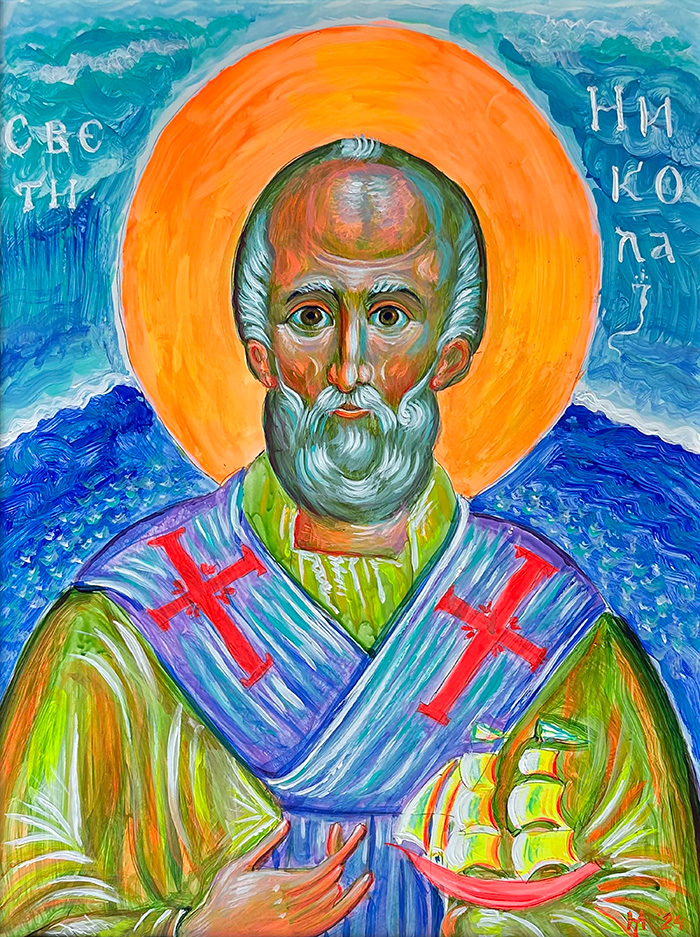
- Details
- Category: Maxim
"Guardian of the Seas: Saint Nicholas", acrylic on gesso board, Bishop Maxim, 2024
This painting depicts Saint Nicholas emerging from the sea, serving as a beacon of comfort in tumultuous times. Cradling a boat in his left hand and bestowing a blessing with his right, he embodies divine safeguarding. His face and vibrant clothing are rendered in a fusion of Byzantine and contemporary art styles, adding a timeless yet modern dimension to his figure. The vibrant blue backdrop and sky highlight the grace and tranquility he introduces amidst the chaos stirred by the restless waters.
This painting depicts Saint Nicholas emerging from the sea, serving as a beacon of comfort in tumultuous times. Cradling a boat in his left hand and bestowing a blessing with his right, he embodies divine safeguarding. His face and vibrant clothing are rendered in a fusion of Byzantine and contemporary art styles, adding a timeless yet modern dimension to his figure. The vibrant blue backdrop and sky highlight the grace and tranquility he introduces amidst the chaos stirred by the restless waters.
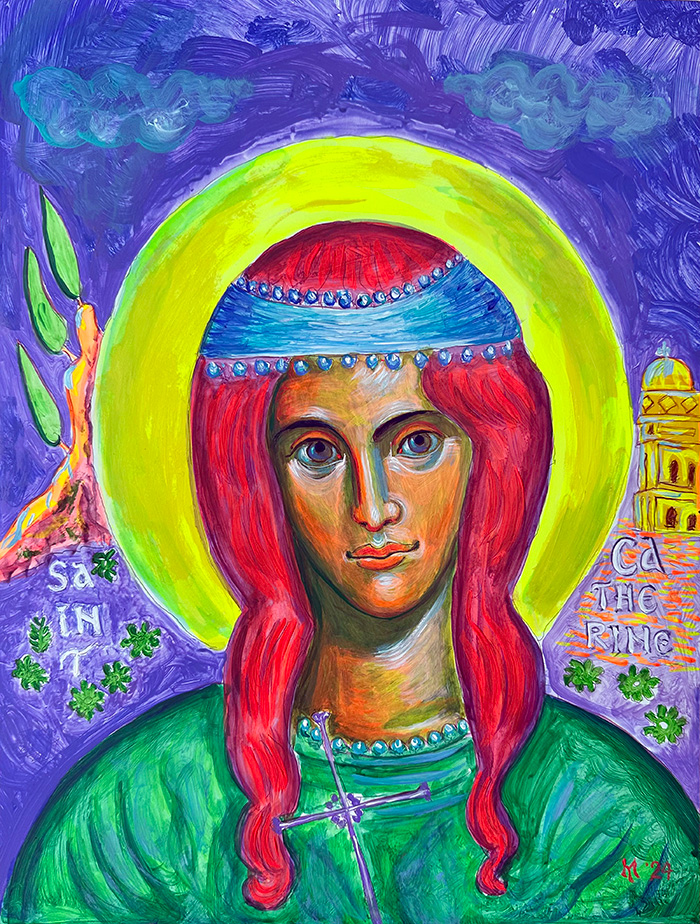
- Details
- Category: Maxim
"St Catherine of Sinai", acrylic on gesso board, Bishop Maxim, 2024
This rendition of the icon of Saint Catherine is arguably the finest. Her gaze is captivating, seemingly leaning towards us as if to listen; the depiction of her holy garments and the scenic background featuring little trees to the left and a church to the right are exquisitely crafted. The sky, rendered with stunning beauty, symbolizes Paradise—a place we aspire to reach and meet her. Additionally, the elegant backgrounds behind saints like this one, with three small trees on the left and a yellow church on the right—or perhaps Mount Sinai—and libraries and universities on the right, demonstrate a mature artistic language that Vasiljevic mastered slowly but surely. The work is presented as strong and untamed; it has its own identity, and we must take care not to lose sight of it.
— Stamatis Skliris
This rendition of the icon of Saint Catherine is arguably the finest. Her gaze is captivating, seemingly leaning towards us as if to listen; the depiction of her holy garments and the scenic background featuring little trees to the left and a church to the right are exquisitely crafted. The sky, rendered with stunning beauty, symbolizes Paradise—a place we aspire to reach and meet her. Additionally, the elegant backgrounds behind saints like this one, with three small trees on the left and a yellow church on the right—or perhaps Mount Sinai—and libraries and universities on the right, demonstrate a mature artistic language that Vasiljevic mastered slowly but surely. The work is presented as strong and untamed; it has its own identity, and we must take care not to lose sight of it.
— Stamatis Skliris
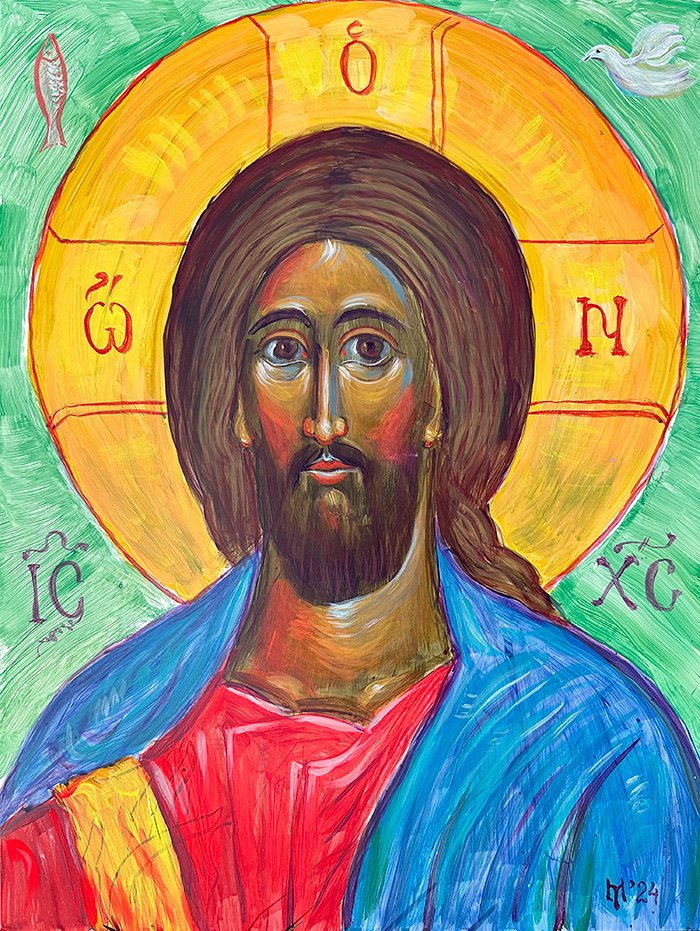
- Details
- Category: Maxim
"Jesus Christ", acrylic on gesso board, Montana, Bishop Maxim, 2024
This portable icon of Jesus Christ the Savior, showcased in Kalispell, Montana, on Saturday, April 20, 2024, captures the essence of traditional Byzantine iconography with a refreshingly communal twist. Executed in a style that reverberates with the simplicity and depth characteristic of Byzantine art, the painting emerges as a collaborative masterpiece. Each brushstroke, contributed by various attendees during the public event, culminates in a unified image that not only honors but revitalizes the age-old techniques of Byzantine painters. This approach not only deepens the aesthetic and spiritual resonance of the piece but also transforms it into a living tableau of community engagement and artistic homage.
The iconography workshop led by Bishop Maxim provided a learning experience for Orthodox Catechumens and inquirers in Kalispell. It was held in the relaxed and friendly atmosphere of a coffee shop, where participants could engage hands-on with the styles and techniques of iconography.
This portable icon of Jesus Christ the Savior, showcased in Kalispell, Montana, on Saturday, April 20, 2024, captures the essence of traditional Byzantine iconography with a refreshingly communal twist. Executed in a style that reverberates with the simplicity and depth characteristic of Byzantine art, the painting emerges as a collaborative masterpiece. Each brushstroke, contributed by various attendees during the public event, culminates in a unified image that not only honors but revitalizes the age-old techniques of Byzantine painters. This approach not only deepens the aesthetic and spiritual resonance of the piece but also transforms it into a living tableau of community engagement and artistic homage.
The iconography workshop led by Bishop Maxim provided a learning experience for Orthodox Catechumens and inquirers in Kalispell. It was held in the relaxed and friendly atmosphere of a coffee shop, where participants could engage hands-on with the styles and techniques of iconography.
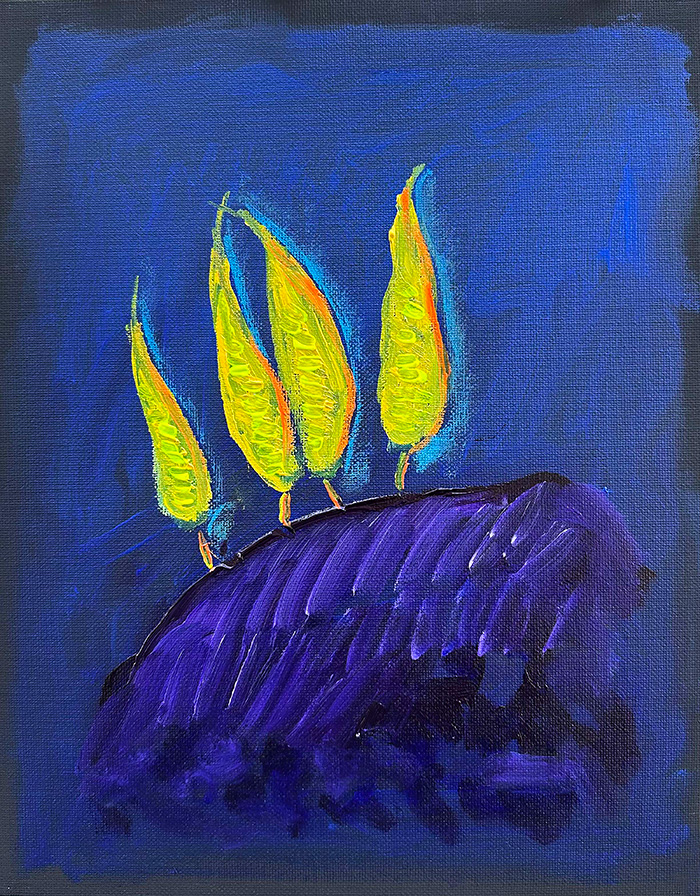
- Details
- Category: Maxim
"Mystic Guardians of the Night", acrylic on canvas panel, Bishop Maxim, 2024
This evocative painting portrays a dramatic nocturnal scene on a mountain cliff, where four tree-like figures akin to cypresses emerge bathed in an ethereal glow. Painted in vivid yellows and ochres against a deep blue night sky, these trees stand in stark contrast, imbuing them with a narrative presence as if they were characters in a mystical tale. The unseen light source that casts their forms in such vivid relief adds a layer of mystery, compelling the viewer to ponder the hidden stories these illuminated sentinels might hold. The artist masterfully employs color and contrast to craft a visual narrative that is both enigmatic and deeply engaging.
This evocative painting portrays a dramatic nocturnal scene on a mountain cliff, where four tree-like figures akin to cypresses emerge bathed in an ethereal glow. Painted in vivid yellows and ochres against a deep blue night sky, these trees stand in stark contrast, imbuing them with a narrative presence as if they were characters in a mystical tale. The unseen light source that casts their forms in such vivid relief adds a layer of mystery, compelling the viewer to ponder the hidden stories these illuminated sentinels might hold. The artist masterfully employs color and contrast to craft a visual narrative that is both enigmatic and deeply engaging.
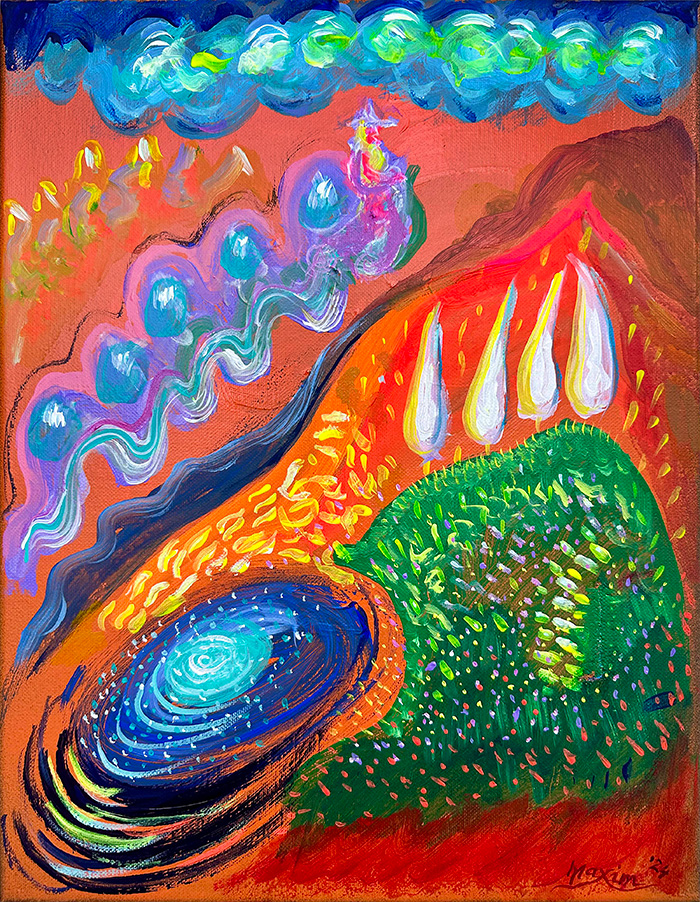
- Details
- Category: Maxim
"Diagonal Dynamics: Contrast and Motion in the Surreal Landscape", acrylic on canvas, Bishop Maxim, 2024
All variations of the painting with the four cypresses by the artist are remarkable. Here, within the burning earth, a transparent snake, a small pond of greenery, and (a very SMART move) the trees are stark white, creating a surreal contrast. An ORANGE COMPOSITION OF COLORS gives us a song of joy. The transparency of the snake and the sky of clouds is impressive. The complementary encounters of warm and cool tones are also beautiful. The diagonal axis that runs through the composition is clever. This is a painting that is free, copying no one, moving in an open space where the diagonal enhances the movement and turns it into action.
- Fr. Stamatis
All variations of the painting with the four cypresses by the artist are remarkable. Here, within the burning earth, a transparent snake, a small pond of greenery, and (a very SMART move) the trees are stark white, creating a surreal contrast. An ORANGE COMPOSITION OF COLORS gives us a song of joy. The transparency of the snake and the sky of clouds is impressive. The complementary encounters of warm and cool tones are also beautiful. The diagonal axis that runs through the composition is clever. This is a painting that is free, copying no one, moving in an open space where the diagonal enhances the movement and turns it into action.
- Fr. Stamatis
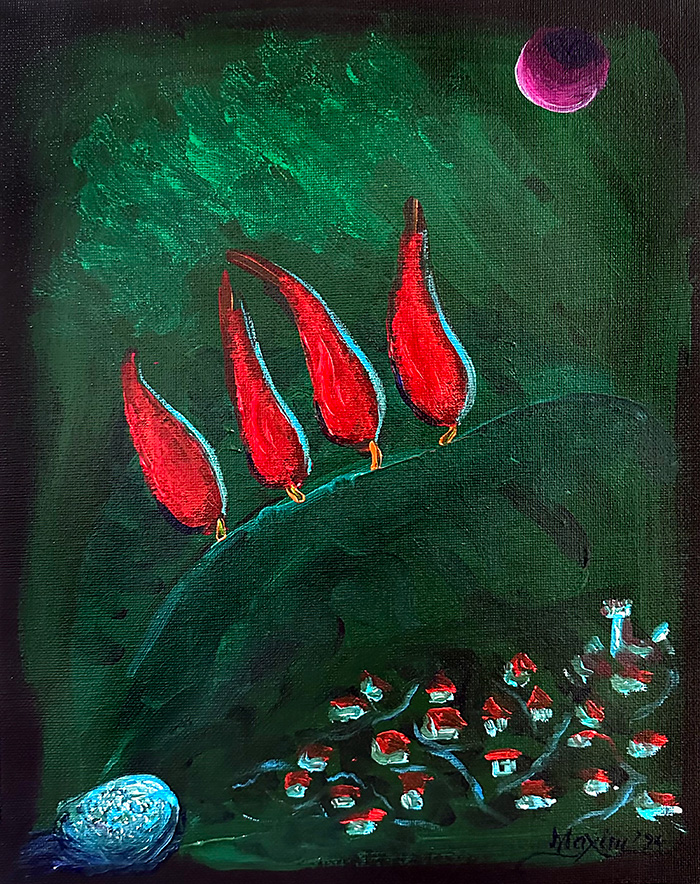
- Details
- Category: Maxim
"Crimson Arboreal Moonlight", acrylic on canvas panel, Bishop Maxim, 2024.
Beautiful is the transparent red of the four trees and the Moon that illuminates them. As well as the miniatures of the houses below and the iridescence of the lake’s waters. “Oh, God, if only You deemed me worthy to live such a magical night!!! Lord, You have crafted around us the entire vast world, which is a true JEWEL, a true adornment! You have graced us with a painter capable of creating his own jewel, which completes and arouses within us divine love!”
— Stamatis Skliris
Beautiful is the transparent red of the four trees and the Moon that illuminates them. As well as the miniatures of the houses below and the iridescence of the lake’s waters. “Oh, God, if only You deemed me worthy to live such a magical night!!! Lord, You have crafted around us the entire vast world, which is a true JEWEL, a true adornment! You have graced us with a painter capable of creating his own jewel, which completes and arouses within us divine love!”
— Stamatis Skliris
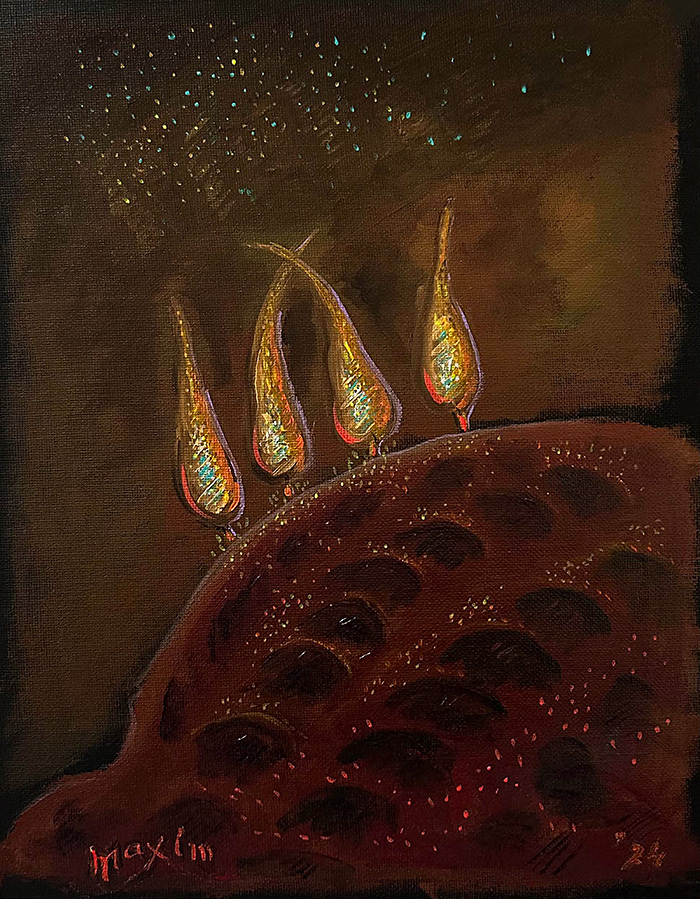
- Details
- Category: Maxim
"Celestial Whispers", acrylic on canvas panel, Bishop Maxim, 2024
This painting exquisitely captures a serene yet enigmatic landscape, blending earthy tones of sienna and umber with a star-studded sky that evokes wonder. The dynamic arrangement of four trees adds depth and invites viewers into the scene’s mystique. The use of acrylic on canvas enhances the vivid colors, making “Celestial Whispers” a compelling fusion of natural elements with a surreal touch. This work invites contemplation, offering a visual feast that beckons the observer into its depths.
This painting exquisitely captures a serene yet enigmatic landscape, blending earthy tones of sienna and umber with a star-studded sky that evokes wonder. The dynamic arrangement of four trees adds depth and invites viewers into the scene’s mystique. The use of acrylic on canvas enhances the vivid colors, making “Celestial Whispers” a compelling fusion of natural elements with a surreal touch. This work invites contemplation, offering a visual feast that beckons the observer into its depths.
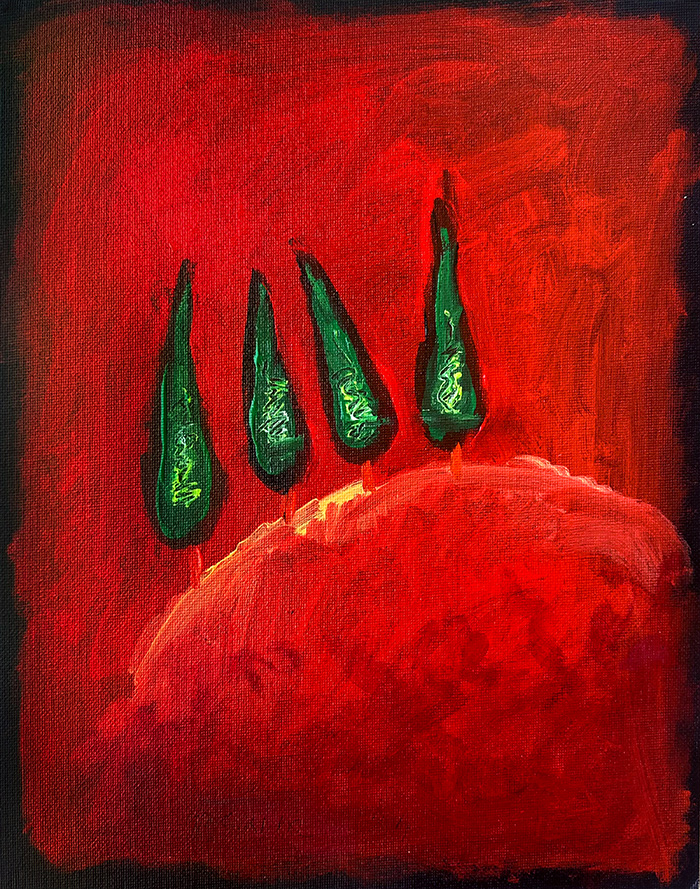
- Details
- Category: Maxim
“Emerald Silence at Dusk”, acrylic on canvas panel, Bishop Maxim, 2024
This painting presents a warm reddish background transitioning into lush greenish trees, evoking the peaceful and contemplative stillness of twilight.
In a paradoxical and inexplicable way, this second painting (titled “Emerald Silence at Dusk”) is more... ART than the first, titled “Solitary Blues at Sunset.” Of course, many will prefer the first trees. However, the second trees have something inexplicable about them. The first we see as trees that have sprung up on rocks and soil while the second grow on the ridge of a spherical planet, it is not something simple. The painter introduces us to cosmic problems. And our existence is dizzying in this dimension. The first paints landscapes. The second, however, depicts non-existent events. MAXIM, your composition has a rare originality. It is as if the author of Genesis is whispering to us: “In the beginning, God made the four cypresses on the ridge of the earth. And the earth was blood-soaked. And the trees stood above graves. And humans had ‘invented war’.”
Κατά έναν παράδοξο τροπο και ανεξήγητο αυτός ο δεύτερος πίνακας ειναι πιο.... ΤΕΧΝΗ από τον πρώτο. Φυσικά σε πάρα πολλούς θα αρέσουν τα πρώτα. Όμως τα δεύτερα έχουν κάτι σαν ανεξήγητο.τα πρώτα τα βλέπουμε σαν δένδρα που φύτρωσαν πάνω σε βράχια και χώμα ενώ τα δεύτερα φυτρώνουν πάνω στη ράχη ενός σφαιρικού πλανήτη, δεν είναι κάτι απλό. Ο ζωγράφος μας εισάγει σε προβλήματα συμπαντικά. Και η υπάρξή μας ιλιγγιά σε αυτή τη διάσταση. Ο πρώτος ζωγραφίζει τοπία. Ο δεύτερος όμως παριστά ανύπαρκτα συμβάντα. ΜΑΞΙΜΕ, η συνθεσή Σου αυτή έχει σπάνια πρωτογένεια. Είναι σαν ο συγγραφέας της Γενέσεως να μας ψιθυρίζει: «Εν αρχη εποίησεν ο Θεός τα τέσσερα κυπαρίσσια επί της ράχης της γης. Η δε γη ην αιματοποτισμενη. Και τα δένδρα ίσταντο άνωθεν τάφων. Οι δε άνθρωποι δε «είχαν εφεύρει τον πόλεμον».
— Fr. Stamatis Skliris
This painting presents a warm reddish background transitioning into lush greenish trees, evoking the peaceful and contemplative stillness of twilight.
In a paradoxical and inexplicable way, this second painting (titled “Emerald Silence at Dusk”) is more... ART than the first, titled “Solitary Blues at Sunset.” Of course, many will prefer the first trees. However, the second trees have something inexplicable about them. The first we see as trees that have sprung up on rocks and soil while the second grow on the ridge of a spherical planet, it is not something simple. The painter introduces us to cosmic problems. And our existence is dizzying in this dimension. The first paints landscapes. The second, however, depicts non-existent events. MAXIM, your composition has a rare originality. It is as if the author of Genesis is whispering to us: “In the beginning, God made the four cypresses on the ridge of the earth. And the earth was blood-soaked. And the trees stood above graves. And humans had ‘invented war’.”
Κατά έναν παράδοξο τροπο και ανεξήγητο αυτός ο δεύτερος πίνακας ειναι πιο.... ΤΕΧΝΗ από τον πρώτο. Φυσικά σε πάρα πολλούς θα αρέσουν τα πρώτα. Όμως τα δεύτερα έχουν κάτι σαν ανεξήγητο.τα πρώτα τα βλέπουμε σαν δένδρα που φύτρωσαν πάνω σε βράχια και χώμα ενώ τα δεύτερα φυτρώνουν πάνω στη ράχη ενός σφαιρικού πλανήτη, δεν είναι κάτι απλό. Ο ζωγράφος μας εισάγει σε προβλήματα συμπαντικά. Και η υπάρξή μας ιλιγγιά σε αυτή τη διάσταση. Ο πρώτος ζωγραφίζει τοπία. Ο δεύτερος όμως παριστά ανύπαρκτα συμβάντα. ΜΑΞΙΜΕ, η συνθεσή Σου αυτή έχει σπάνια πρωτογένεια. Είναι σαν ο συγγραφέας της Γενέσεως να μας ψιθυρίζει: «Εν αρχη εποίησεν ο Θεός τα τέσσερα κυπαρίσσια επί της ράχης της γης. Η δε γη ην αιματοποτισμενη. Και τα δένδρα ίσταντο άνωθεν τάφων. Οι δε άνθρωποι δε «είχαν εφεύρει τον πόλεμον».
— Fr. Stamatis Skliris
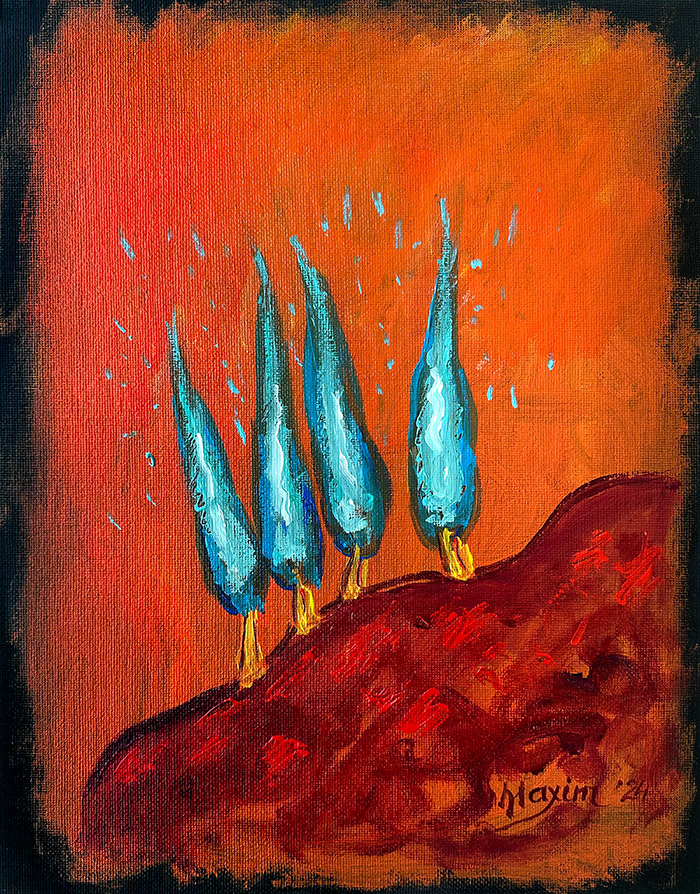
- Details
- Category: Maxim
"Solitary Blues at Sunset", acrylic on canvas panel, Bishop Maxim, 2024
It features a vibrant orange backdrop that fades into bluish trees, encapsulating the tranquil yet melancholic atmosphere of a lone sunset.
It features a vibrant orange backdrop that fades into bluish trees, encapsulating the tranquil yet melancholic atmosphere of a lone sunset.
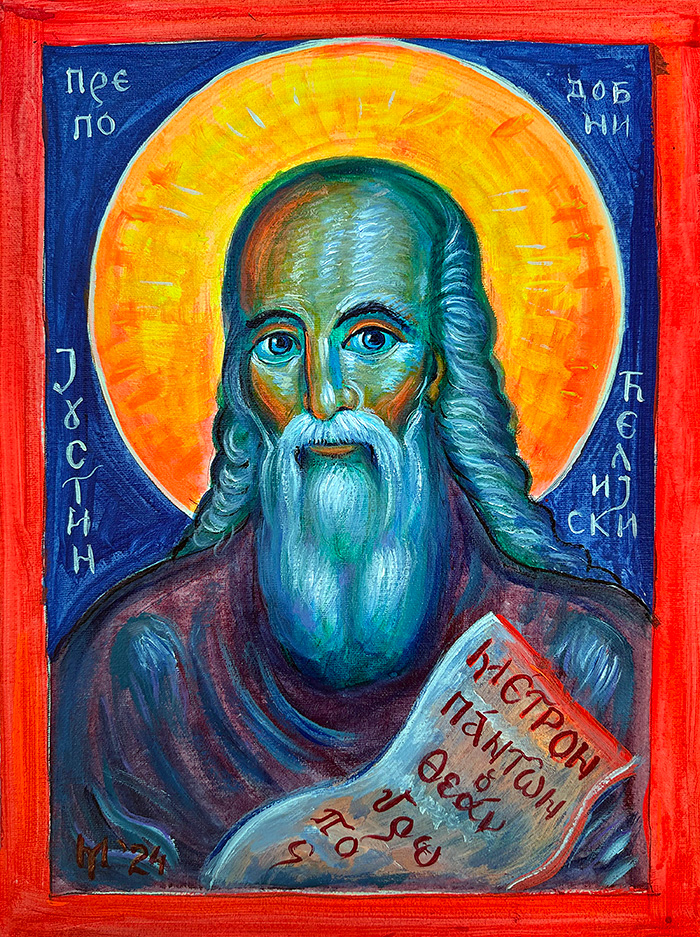
- Details
- Category: Maxim
"St Justin the New of Chelie", acrylic on canvas, Bishop Maxim, 2024
This modern Orthodox icon painting features St. Justin the New of Chelie, rendered in vibrant acrylic on canvas. The saint is depicted with a gaze that conveys approval, connecting directly with the viewer through his expressive eyes. In his hands, he holds an inscription that reads, "The measure of everything—the God man," highlighting his theological significance. The use of vivid colors in the composition not only enhances the visual impact but also infuses the artwork with a sense of optimism, reflecting the saint's enlightening presence and spiritual guidance. This icon beautifully combines traditional religious art with contemporary artistic elements, making it a captivating piece that both venerates and inspires.
This modern Orthodox icon painting features St. Justin the New of Chelie, rendered in vibrant acrylic on canvas. The saint is depicted with a gaze that conveys approval, connecting directly with the viewer through his expressive eyes. In his hands, he holds an inscription that reads, "The measure of everything—the God man," highlighting his theological significance. The use of vivid colors in the composition not only enhances the visual impact but also infuses the artwork with a sense of optimism, reflecting the saint's enlightening presence and spiritual guidance. This icon beautifully combines traditional religious art with contemporary artistic elements, making it a captivating piece that both venerates and inspires.
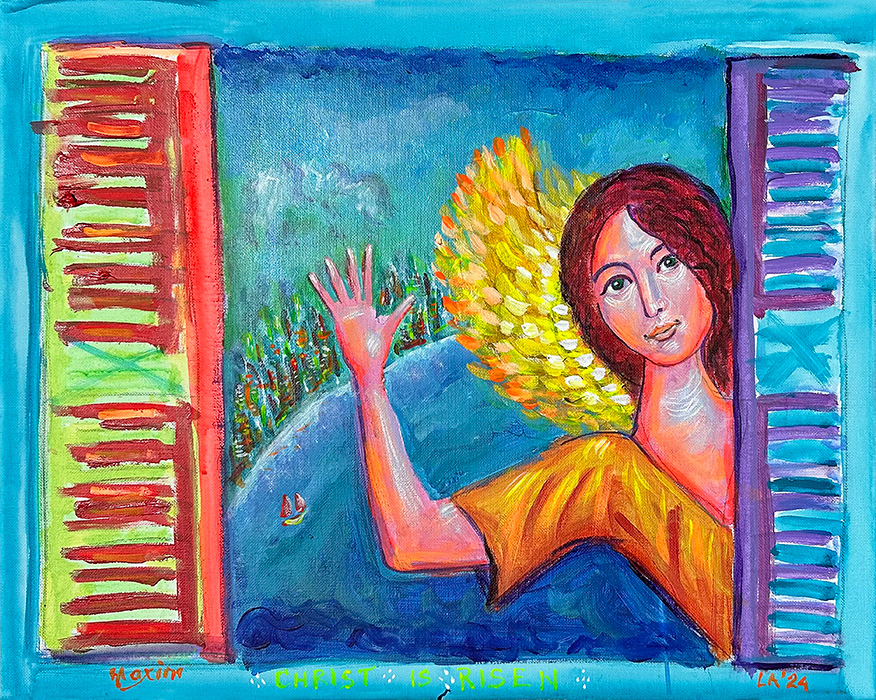
- Details
- Category: Maxim
"Angel Waving Me Through the Window of the World", acrylic on canvas, Bishop Maxim, 2024
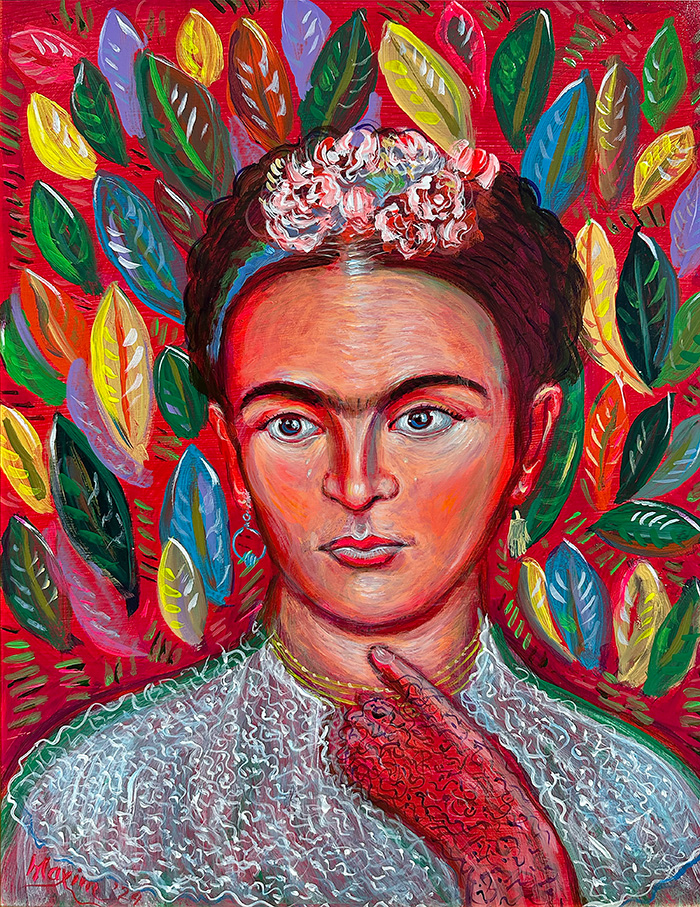
- Details
- Category: Maxim
"Frida Kahlo: Un Lienzo de Vida y Legado", acrylic on gesso board, Bishop Maxim, 2024
In this envisioned portrait, Frida Kahlo emerges as a symbol of resilience, her spirit intertwined with a vibrant canvas of nature reflecting her tumultuous life. Surrounded by a burst of colorful flowers and lush foliage, each element symbolizes her rich fabric of experiences, with the garden mirroring the depths of her soul. Her penetrating gaze draws viewers into her realm of pain, passion, and creativity, revealing a journey marked by both suffering and artistic triumph. The bold colors, especially the striking reds, serve as a secular halo, celebrating her as a pivotal figure in art. Her attire, alive with expressive hues, underscores her bold spirit and artistic prowess. Both a portrait and a color narrative, this is a tribute to Frida Kahlo's enduring legacy as an art icon.
In this envisioned portrait, Frida Kahlo emerges as a symbol of resilience, her spirit intertwined with a vibrant canvas of nature reflecting her tumultuous life. Surrounded by a burst of colorful flowers and lush foliage, each element symbolizes her rich fabric of experiences, with the garden mirroring the depths of her soul. Her penetrating gaze draws viewers into her realm of pain, passion, and creativity, revealing a journey marked by both suffering and artistic triumph. The bold colors, especially the striking reds, serve as a secular halo, celebrating her as a pivotal figure in art. Her attire, alive with expressive hues, underscores her bold spirit and artistic prowess. Both a portrait and a color narrative, this is a tribute to Frida Kahlo's enduring legacy as an art icon.
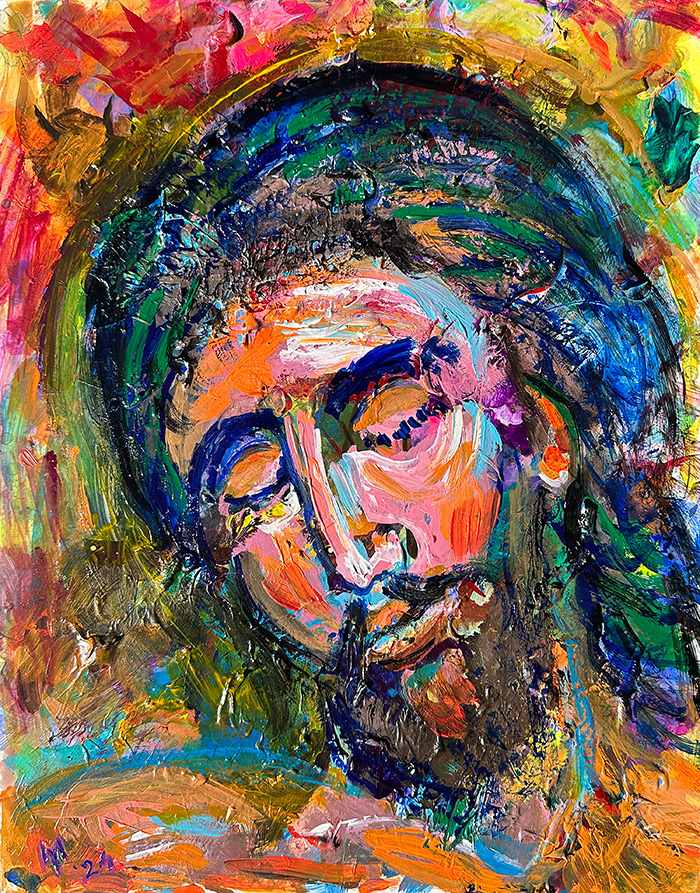
- Details
- Category: Maxim
"The Crucified King: Glory in Suffering’s Embrace", acrylic on gesso board, Bishop Maxim, 2024
This portrayal focuses on Christ at His most vulnerable: crucified, lifeless on the Epitaphion, yet declared the “King of Glory.” Through intense colors and expressive detail, the artist captures the paradox of Christ’s sacrifice, transforming the cross from a symbol of defeat into one of ultimate victory. Here, the artist’s free use of vivid hues redefines glory—not through power, but through the humility and sacrificial love of Christ’s lowest moment. This image invites reflection on the true glory found in the depth of self-giving love.
This portrayal focuses on Christ at His most vulnerable: crucified, lifeless on the Epitaphion, yet declared the “King of Glory.” Through intense colors and expressive detail, the artist captures the paradox of Christ’s sacrifice, transforming the cross from a symbol of defeat into one of ultimate victory. Here, the artist’s free use of vivid hues redefines glory—not through power, but through the humility and sacrificial love of Christ’s lowest moment. This image invites reflection on the true glory found in the depth of self-giving love.
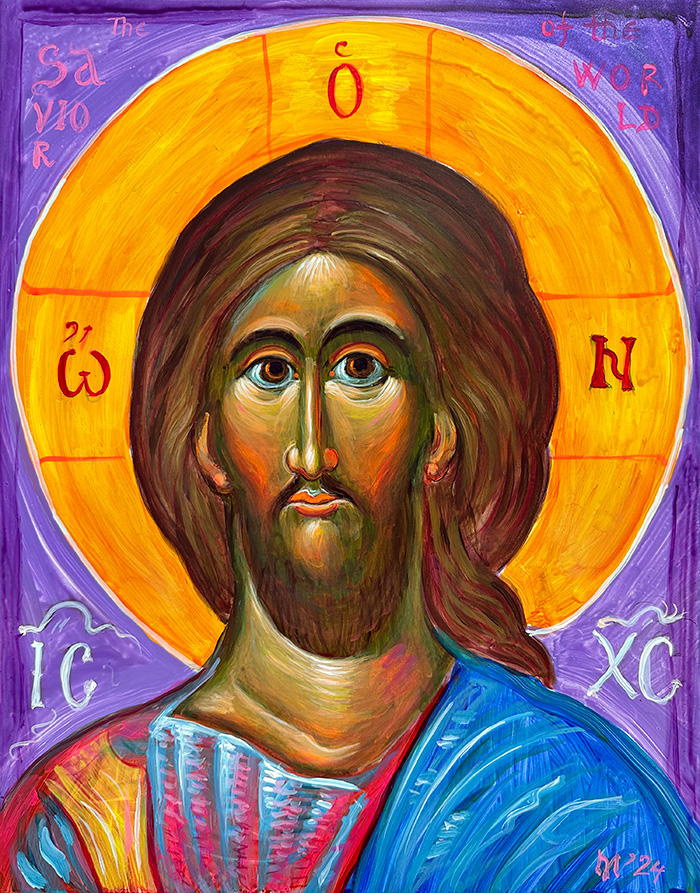
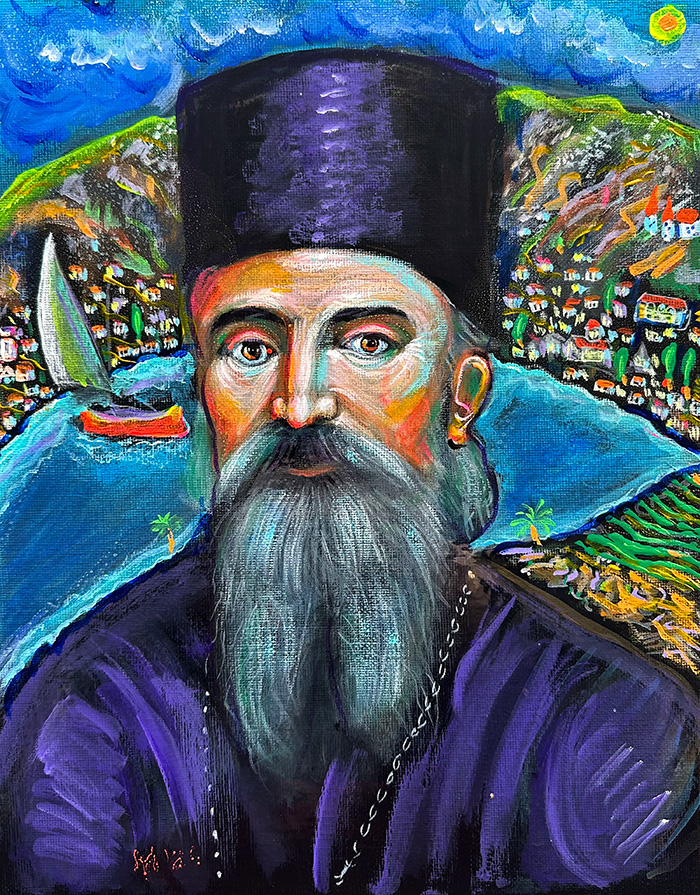
- Details
- Category: Maxim
"Caring Bishop Nikodim", acrylic on canvas panel, Bishop Maxim, 2024
The painting captures the pensive character of Nikodim Milaš, the bishop of Dalmatia, immersed in thought and faced with the unknown future and the destiny of his flock. His face is rendered with precision, conveying the weight of his reflections. The coastline nature serves as an amphitheater gracefully embracing the central figure, enhanced by the subtle inclusion of a small boat to the left and a smattering of houses. The composition seamlessly melds introspection with the external environment, symbolizing the bishop’s deep bond with his surroundings.
— Fr Stamatis Skliris
The painting captures the pensive character of Nikodim Milaš, the bishop of Dalmatia, immersed in thought and faced with the unknown future and the destiny of his flock. His face is rendered with precision, conveying the weight of his reflections. The coastline nature serves as an amphitheater gracefully embracing the central figure, enhanced by the subtle inclusion of a small boat to the left and a smattering of houses. The composition seamlessly melds introspection with the external environment, symbolizing the bishop’s deep bond with his surroundings.
— Fr Stamatis Skliris
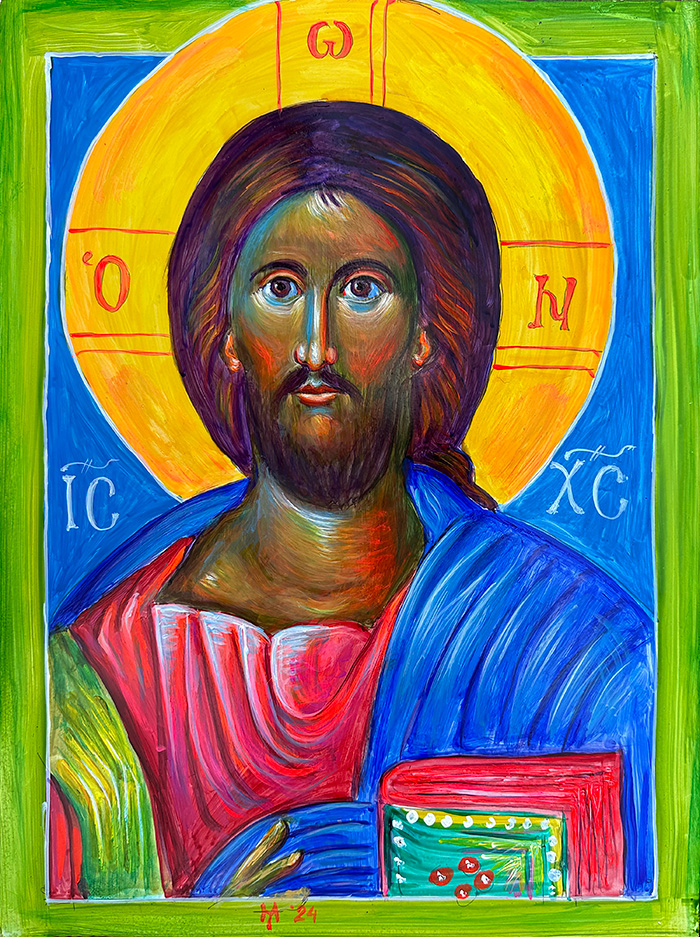
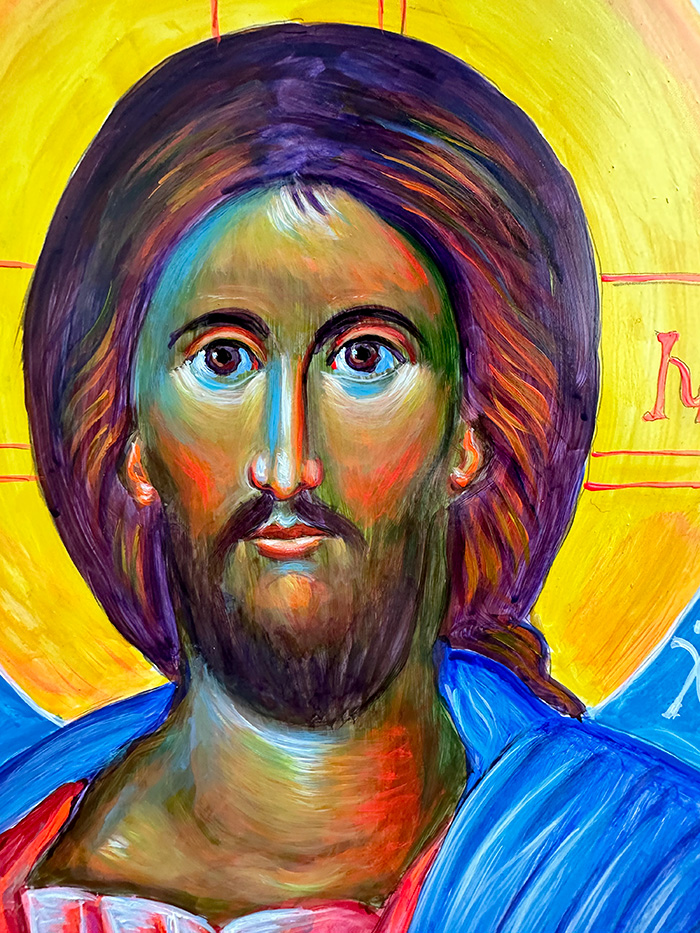
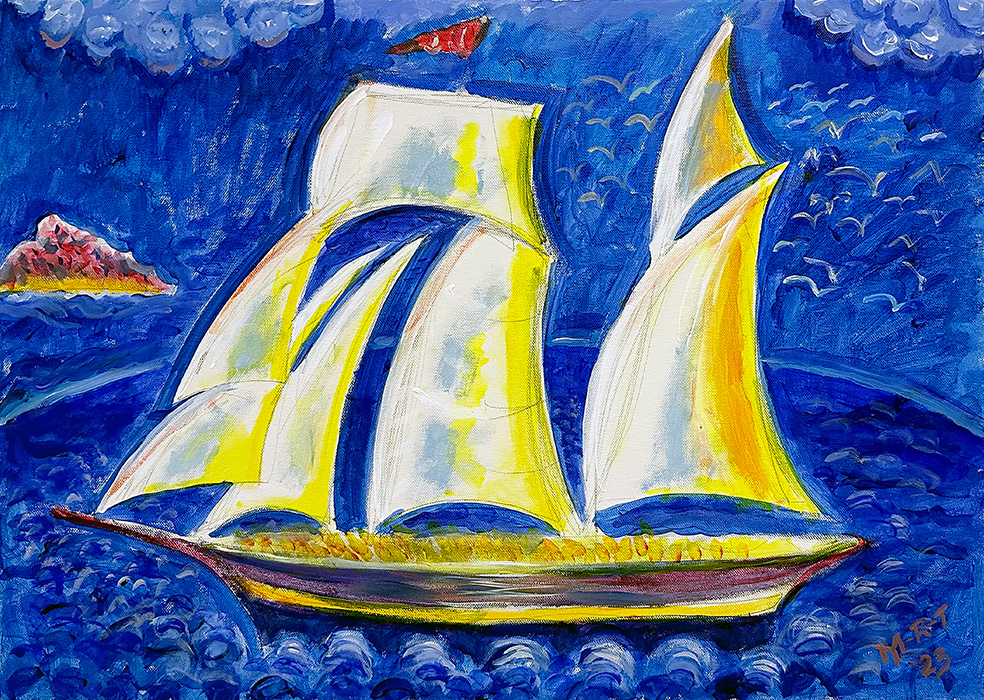
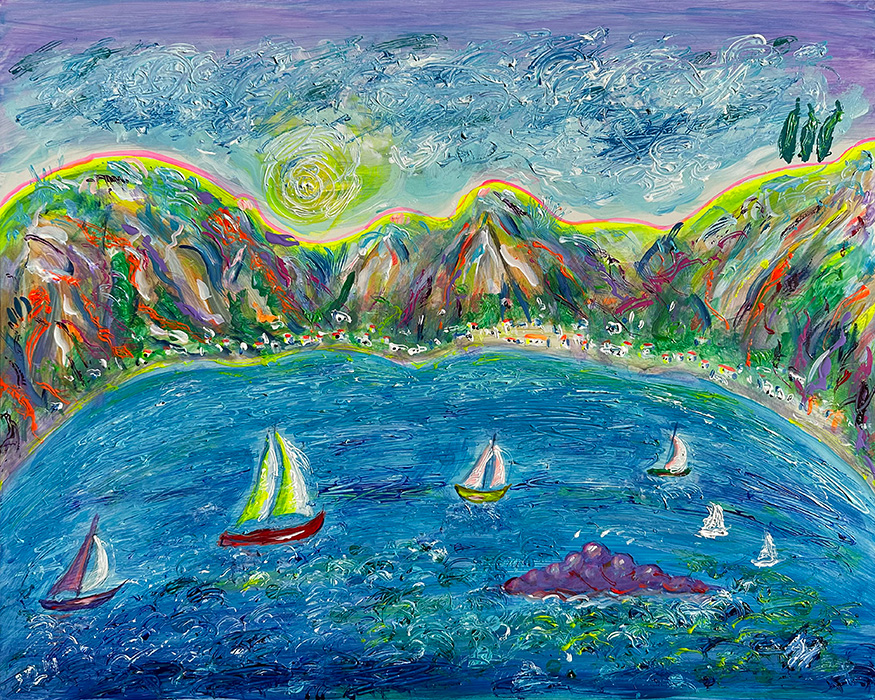
- Details
- Category: Maxim
“An Impressionist Vista: Bocca di Cattaro,” acrylic on canvas, Bishop Maxim, 2024
This impressionist masterpiece captures the ethereal beauty of Kotor Bay in Montenegro, depicted in the magical twilight just before sunset. The vibrant sea, mirroring the still strong light of day, breathes life into the scene, complemented by boats gently sailing, creating a serene narrative across the water. Quaint coastal houses blend the tranquil sea with the dramatic ascent of majestic mountains, highlighting Montenegro’s natural splendor. Above, the sky transitions from day to evening with a dazzling palette of yellow, pink, and deepening blues, showcasing the impressionist’s talent in blending the boundaries between earth and heaven. This painting celebrates nature’s fleeting beauty, presenting Bocca di Cattaro Bay as an immersive experience of peace and vitality.
This impressionist masterpiece captures the ethereal beauty of Kotor Bay in Montenegro, depicted in the magical twilight just before sunset. The vibrant sea, mirroring the still strong light of day, breathes life into the scene, complemented by boats gently sailing, creating a serene narrative across the water. Quaint coastal houses blend the tranquil sea with the dramatic ascent of majestic mountains, highlighting Montenegro’s natural splendor. Above, the sky transitions from day to evening with a dazzling palette of yellow, pink, and deepening blues, showcasing the impressionist’s talent in blending the boundaries between earth and heaven. This painting celebrates nature’s fleeting beauty, presenting Bocca di Cattaro Bay as an immersive experience of peace and vitality.
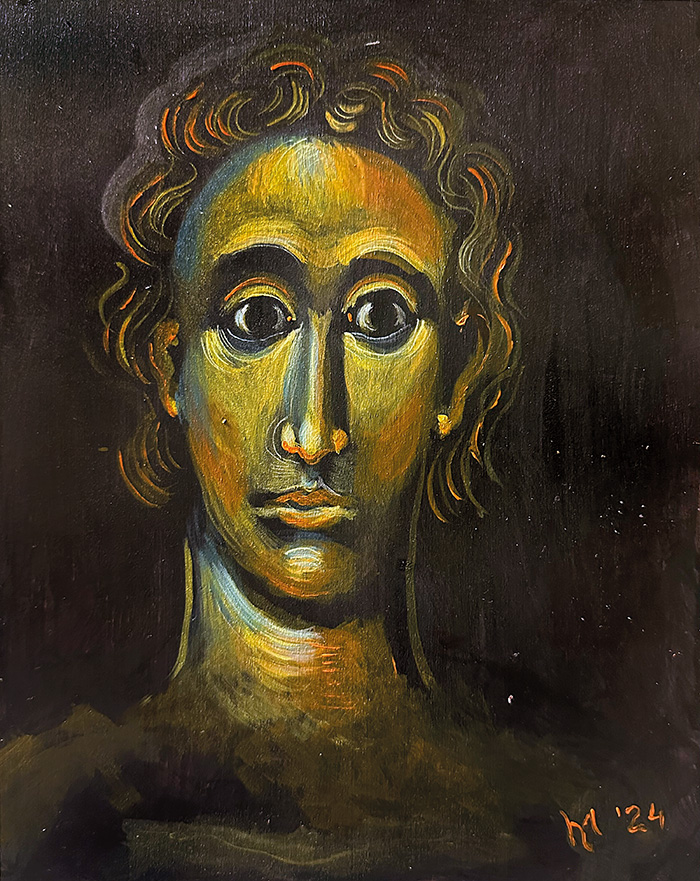
- Details
- Category: Maxim
"Dawn of Genesis", acrylic on gesso board, Bishop Maxim, 2024
The artwork titled “The Dawn of Genesis” employs a distinctive iconographic technique, where the creative process begins with a dark canvas. Shadows are meticulously layered onto this canvas, followed by gradual applications of light, crafting the subject from the depths of darkness. This method symbolically mirrors the biblical account of creation, suggesting that the figure—presumably first created human being—is sculpted from the void, brought into existence by divine light. The title itself evokes the moment of creation, where man emerges from nonexistence, embodying the first dawn of creation. The narrative captured within the painting subtly conveys man’s initial encounter with the divine; his creation by God is marked by an inaugural vision, possibly of God Himself. This profound moment is reflected in man’s expression, particularly in his eyes, which are rendered to convey a sense of awe or surprise at this revelation. Thus, the painting not only depicts the physical emergence of man from nothingness but also captures the spiritual awakening of the first human as he beholds something—or someone—beyond himself for the very first time.
The artwork titled “The Dawn of Genesis” employs a distinctive iconographic technique, where the creative process begins with a dark canvas. Shadows are meticulously layered onto this canvas, followed by gradual applications of light, crafting the subject from the depths of darkness. This method symbolically mirrors the biblical account of creation, suggesting that the figure—presumably first created human being—is sculpted from the void, brought into existence by divine light. The title itself evokes the moment of creation, where man emerges from nonexistence, embodying the first dawn of creation. The narrative captured within the painting subtly conveys man’s initial encounter with the divine; his creation by God is marked by an inaugural vision, possibly of God Himself. This profound moment is reflected in man’s expression, particularly in his eyes, which are rendered to convey a sense of awe or surprise at this revelation. Thus, the painting not only depicts the physical emergence of man from nothingness but also captures the spiritual awakening of the first human as he beholds something—or someone—beyond himself for the very first time.
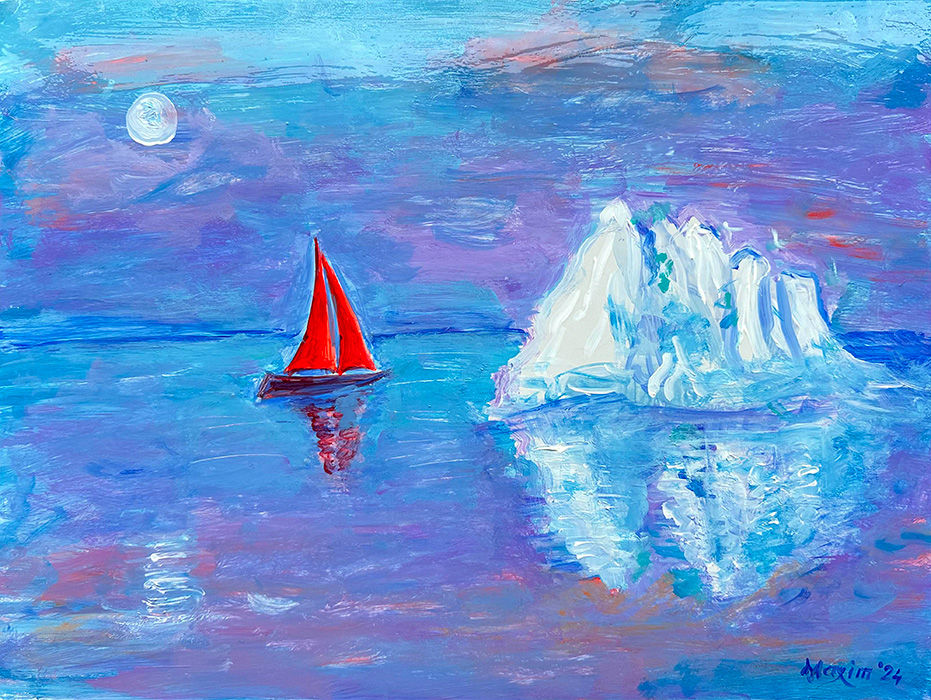
- Details
- Category: Maxim
"Voyage of Warmth," acrylic on gesso board, Bishop Maxim, 2024
Created on February 17, 2024, this acrylic painting on the gesso board captures a serene yet profound moment at sea. The viewer’s gaze is drawn to a solitary boat, its sails unfurled, painted a vibrant red that contrasts starkly against the cool, muted tones of a frozen island. This island, an embodiment of isolation and rigidity, stands as a heart of stone amidst the vastness of the ocean. Above, the sky offers just a glimpse of the sun, a subtle nod to hope and renewal. The red sails of the boat symbolize the warmth of life and passion, navigating through the cold, unyielding challenges. This scene is not merely a depiction of a physical journey but a metaphorical voyage toward transformation and awakening. This “Voyage of Warmth” eloquently speaks to the power of resilience, love, and the eternal quest for inner change, bearing the promise of renewal to the frozen recesses of the soul.
"This recent painting by Bishop Maxim uniquely blends elements of both the New England (American) Coast and the British Coast, aligning itself with the great literary traditions of both America and Britain."
- Valerie Glover
"A captivating image of serene and spacious stillness, gliding through silent waters, past glaciers, surrounded by warmth peeking through sky and sea to form an enveloping womb. The tiny bright red sails evoke the pilgrim heart seeking the Spirit’s flame to pass through even in the coldest and loneliest of deserted places. Hesychia! This painting had the effect of evoking inside me stillness and strange, gentle attention focused by the bright red sailing vessel. It created an inner landscape inviting the silence and attention within."
- Stephen Muse
Created on February 17, 2024, this acrylic painting on the gesso board captures a serene yet profound moment at sea. The viewer’s gaze is drawn to a solitary boat, its sails unfurled, painted a vibrant red that contrasts starkly against the cool, muted tones of a frozen island. This island, an embodiment of isolation and rigidity, stands as a heart of stone amidst the vastness of the ocean. Above, the sky offers just a glimpse of the sun, a subtle nod to hope and renewal. The red sails of the boat symbolize the warmth of life and passion, navigating through the cold, unyielding challenges. This scene is not merely a depiction of a physical journey but a metaphorical voyage toward transformation and awakening. This “Voyage of Warmth” eloquently speaks to the power of resilience, love, and the eternal quest for inner change, bearing the promise of renewal to the frozen recesses of the soul.
"This recent painting by Bishop Maxim uniquely blends elements of both the New England (American) Coast and the British Coast, aligning itself with the great literary traditions of both America and Britain."
- Valerie Glover
"A captivating image of serene and spacious stillness, gliding through silent waters, past glaciers, surrounded by warmth peeking through sky and sea to form an enveloping womb. The tiny bright red sails evoke the pilgrim heart seeking the Spirit’s flame to pass through even in the coldest and loneliest of deserted places. Hesychia! This painting had the effect of evoking inside me stillness and strange, gentle attention focused by the bright red sailing vessel. It created an inner landscape inviting the silence and attention within."
- Stephen Muse
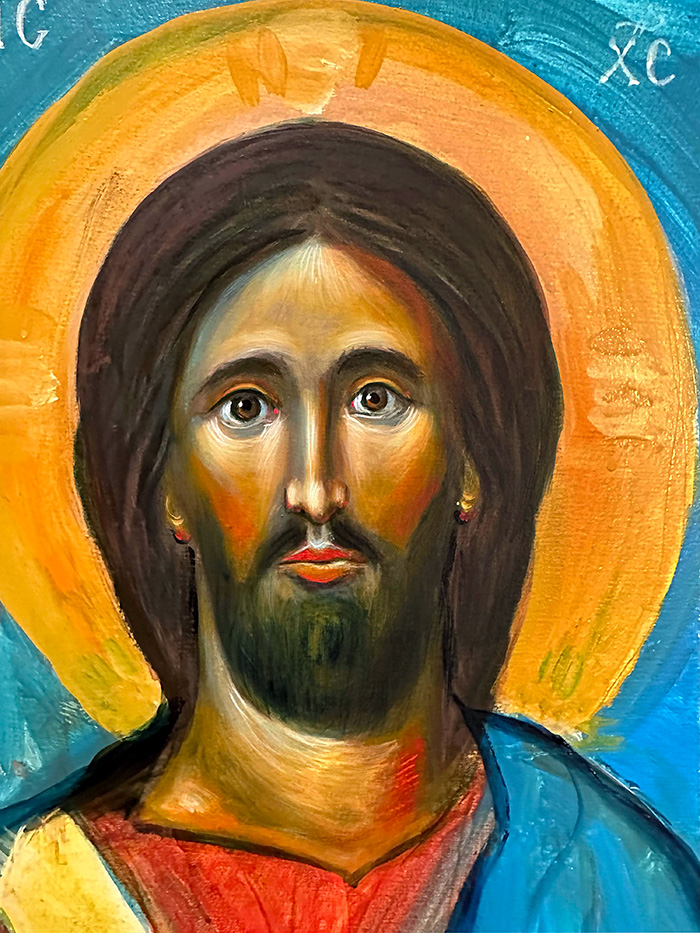
- Details
- Category: Maxim
"Jesus Christ—Thearchic Weakness", acrylic on gesso board, Bishop Maxim and Dijana Skoric, 2024
The Iconic Gaze: A Theology of Thearchic Weakness and Divine Love
Exploring the Depth of Christ’s Look in the Iconography school of Bishop Maxim
by Fr. Stamatis Skliris
Friday, February 16, 2024
This icon of Christ belongs to the icons that present Christ with love and concern for the specific person, you and me. We achieve this mainly with wide-open eyes that care about us. It is a subtle movement beyond the Paleologian school of the almighty PANTOKRATOR, here, with “thearchic weakness” (θεαρχική ἀσθένεια—the term by Dionysius Areopagite). In other words, the PANTOKRATOR humbles himself with His image before the specific man with his particular passions and weaknesses. Out of love and identification with the humbled ontological concrete man, He who transcends suffering as God nevertheless willingly humbles himself and takes on human passion. It is a profound theology of the thearchic weakness that gave birth and developed (with “Justin’s” roots, that is, of Fr. Justin Popovic, who always presupposed a Christ who cares for man and who willingly humbles himself for him) the theology of “thearchic weakness.” Bishop Athanasios Jevtic loved the hymn of St. Basil the Great: “What shall we render unto the Lord for all He hath rendered unto us? For our sake, God dwelt among us; for our corrupted nature, the Word became flesh and dwelt within us; unto the ungrateful, He is the Benefactor; unto prisoners, He is the Liberator; unto those who sat in the darkness, He is the Sun of justice; the path unto the Cross; the Light unto Hades; Life unto death; Resurrection for the fallen: to Him, we cry out: ‘Our God, glory be to Thee!’” (Octoechos, tone 7)
The Iconic Gaze: A Theology of Thearchic Weakness and Divine Love
Exploring the Depth of Christ’s Look in the Iconography school of Bishop Maxim
by Fr. Stamatis Skliris
Friday, February 16, 2024
This icon of Christ belongs to the icons that present Christ with love and concern for the specific person, you and me. We achieve this mainly with wide-open eyes that care about us. It is a subtle movement beyond the Paleologian school of the almighty PANTOKRATOR, here, with “thearchic weakness” (θεαρχική ἀσθένεια—the term by Dionysius Areopagite). In other words, the PANTOKRATOR humbles himself with His image before the specific man with his particular passions and weaknesses. Out of love and identification with the humbled ontological concrete man, He who transcends suffering as God nevertheless willingly humbles himself and takes on human passion. It is a profound theology of the thearchic weakness that gave birth and developed (with “Justin’s” roots, that is, of Fr. Justin Popovic, who always presupposed a Christ who cares for man and who willingly humbles himself for him) the theology of “thearchic weakness.” Bishop Athanasios Jevtic loved the hymn of St. Basil the Great: “What shall we render unto the Lord for all He hath rendered unto us? For our sake, God dwelt among us; for our corrupted nature, the Word became flesh and dwelt within us; unto the ungrateful, He is the Benefactor; unto prisoners, He is the Liberator; unto those who sat in the darkness, He is the Sun of justice; the path unto the Cross; the Light unto Hades; Life unto death; Resurrection for the fallen: to Him, we cry out: ‘Our God, glory be to Thee!’” (Octoechos, tone 7)
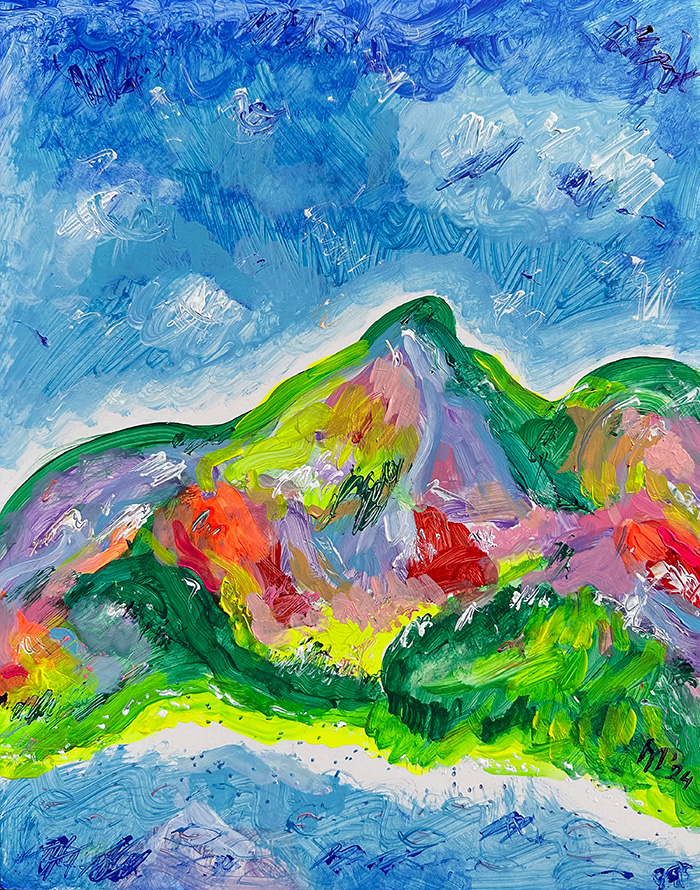
- Details
- Category: Maxim
"Impressionist Echoes", acrylic on gesso board, Bishop Maxim, 2024
Very enjoyable landscape with simplicity rendered. It recalls happy moments of French Impressionism, after Van Gogh and Cézanne. The blue of the SKY does not rest on the slope of the triangular peak, but leaves a WHITE glow, which, together with the WHITE glow of the seashore, delineates the whole massif. Nature is presented to us here as a JOYFUL face expressing the happy moment of all creation as if personifying inanimate matter and making its presence in the painting friendly to the viewer.
"A childlike face with innocent eyes cradled in the mountain."
- Stephen Muse
Very enjoyable landscape with simplicity rendered. It recalls happy moments of French Impressionism, after Van Gogh and Cézanne. The blue of the SKY does not rest on the slope of the triangular peak, but leaves a WHITE glow, which, together with the WHITE glow of the seashore, delineates the whole massif. Nature is presented to us here as a JOYFUL face expressing the happy moment of all creation as if personifying inanimate matter and making its presence in the painting friendly to the viewer.
"A childlike face with innocent eyes cradled in the mountain."
- Stephen Muse
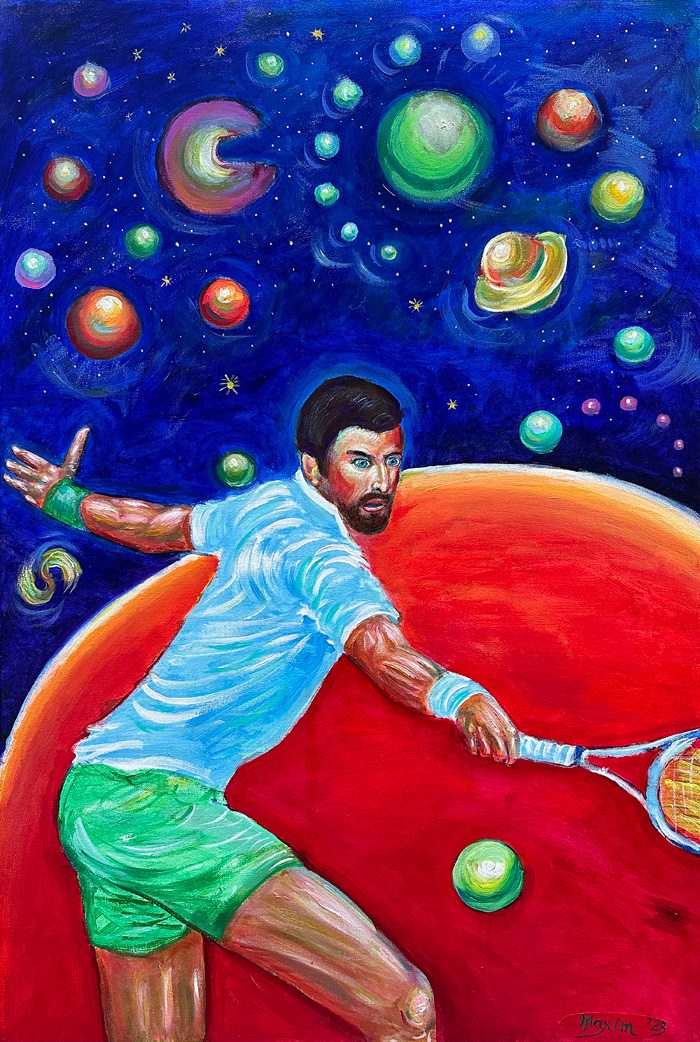
- Details
- Category: Maxim
"Cosmic Champion," acrylic on canvas, Bishop Maxim, 2023
In this imaginative artwork, a figure who embodies a tennis player stands on a globe, kicking a tennis ball that morphs into a vibrant planet, symbolizing the convergence of sports, creativity, and cosmic forces. With intense focus, the player’s gaze is locked on the ball, reflecting a deep immersion not only in the sport but in the act of creation itself, merging the artistry of athletics with visual expression. The surrounding celestial bodies in the heavens underscore the scene's cosmic scale, elevating the tennis match to an interstellar spectacle that intertwines physical sport, artistic endeavor, and the mysteries of the universe.
In this imaginative artwork, a figure who embodies a tennis player stands on a globe, kicking a tennis ball that morphs into a vibrant planet, symbolizing the convergence of sports, creativity, and cosmic forces. With intense focus, the player’s gaze is locked on the ball, reflecting a deep immersion not only in the sport but in the act of creation itself, merging the artistry of athletics with visual expression. The surrounding celestial bodies in the heavens underscore the scene's cosmic scale, elevating the tennis match to an interstellar spectacle that intertwines physical sport, artistic endeavor, and the mysteries of the universe.
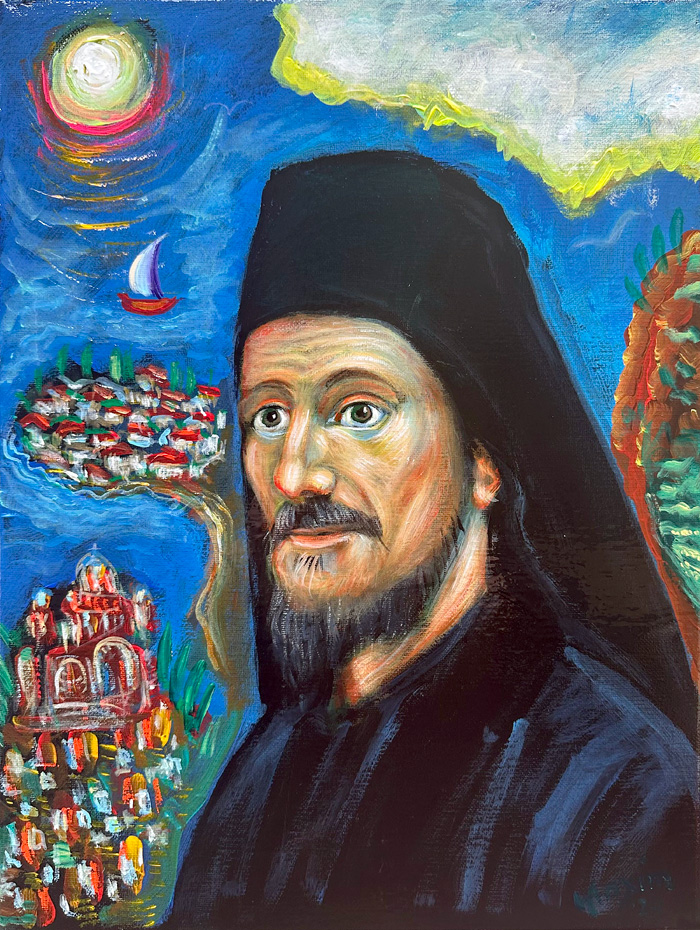
- Details
- Category: Maxim
"Vigilant Devotion: The Monk’s Prayerful Watch", acrylic on canvas, Bishop Maxim, 2024
This painting encapsulates the monk’s expectant waiting for divine grace and his prayers for the people living amidst the unfolding nature of sea, hills, and cities.
This painting encapsulates the monk’s expectant waiting for divine grace and his prayers for the people living amidst the unfolding nature of sea, hills, and cities.
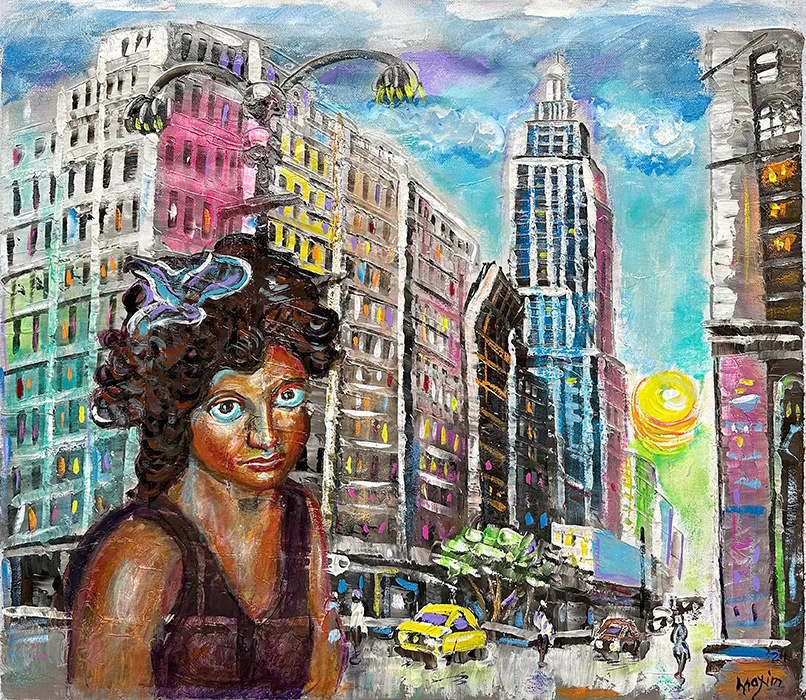
- Details
- Category: Maxim
"Harlem Stride: A Lady's Journey", acrylic on canvas, Bishop Maxim, 2024
In this Harlem painting, a young black lady traverses the dynamic streets of New York, her portrait capturing the city's pulsating essence. Amidst the high-rises, her familiar yet reflective expression embodies the unique experiences of city dwellers. The artist juxtaposes the urban hustle with her quiet, extrospective moment, evoking a yearning for connection. This artwork transcends mere cityscape; it's an existential narrative, celebrating both personal existence and the broader, ever-evolving tapestry of urban life. A vivid testament to the personal journeys within the bustling Harlem streets.
In this Harlem painting, a young black lady traverses the dynamic streets of New York, her portrait capturing the city's pulsating essence. Amidst the high-rises, her familiar yet reflective expression embodies the unique experiences of city dwellers. The artist juxtaposes the urban hustle with her quiet, extrospective moment, evoking a yearning for connection. This artwork transcends mere cityscape; it's an existential narrative, celebrating both personal existence and the broader, ever-evolving tapestry of urban life. A vivid testament to the personal journeys within the bustling Harlem streets.
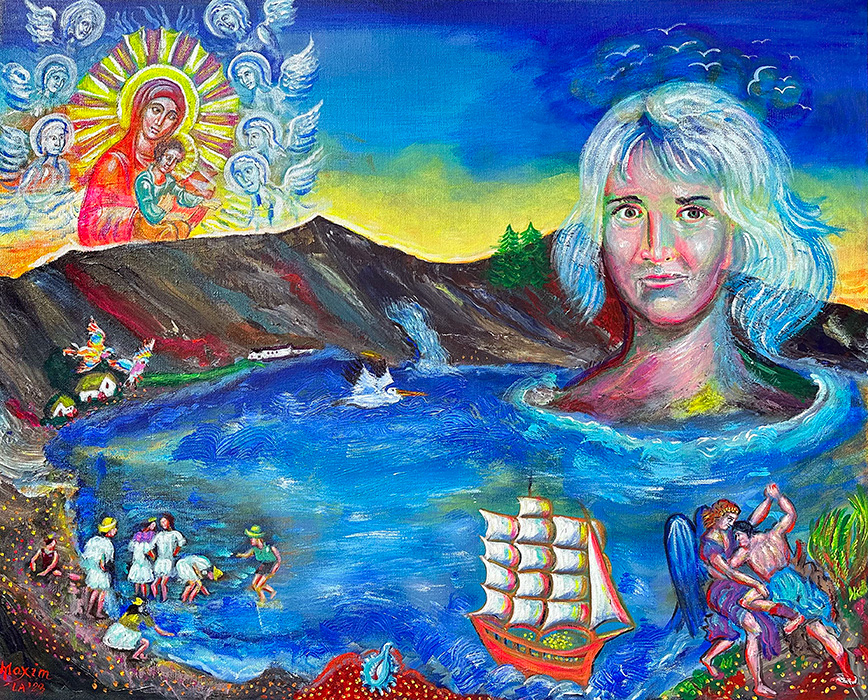
- Details
- Category: Maxim
"25,550 Sunrises: A Tapestry of Spirituality and Life", acrylic on canvas, Bishop Maxim, 2023
This painting intertwines celestial and earthly themes. A woman emerges from the sea in the foreground, symbolizing rebirth, against a vibrant backdrop of a coastal village, mountains, and playing children, suggesting innocence and devotion. The presence of the Mother of God with Christ, surrounded by angels, in the upper left corner adds a celestial dimension, implying protection or blessing. The woman’s face captures the essence of the painting, with one eye reflecting calmness and the other surprise, drawing viewers into a deeper engagement with the artwork. The resemblance to Our Lady of Guadalupe and the expressive gaze of the Panaghia and Christ towards the woman create a strong emotional impact. This combination of elements and the focal point of Claudia under the watchful eyes of her heavenly protectors infuse the scene with a dynamic energy, inviting the viewer into a harmonious blend of the divine and the mundane.
This painting intertwines celestial and earthly themes. A woman emerges from the sea in the foreground, symbolizing rebirth, against a vibrant backdrop of a coastal village, mountains, and playing children, suggesting innocence and devotion. The presence of the Mother of God with Christ, surrounded by angels, in the upper left corner adds a celestial dimension, implying protection or blessing. The woman’s face captures the essence of the painting, with one eye reflecting calmness and the other surprise, drawing viewers into a deeper engagement with the artwork. The resemblance to Our Lady of Guadalupe and the expressive gaze of the Panaghia and Christ towards the woman create a strong emotional impact. This combination of elements and the focal point of Claudia under the watchful eyes of her heavenly protectors infuse the scene with a dynamic energy, inviting the viewer into a harmonious blend of the divine and the mundane.
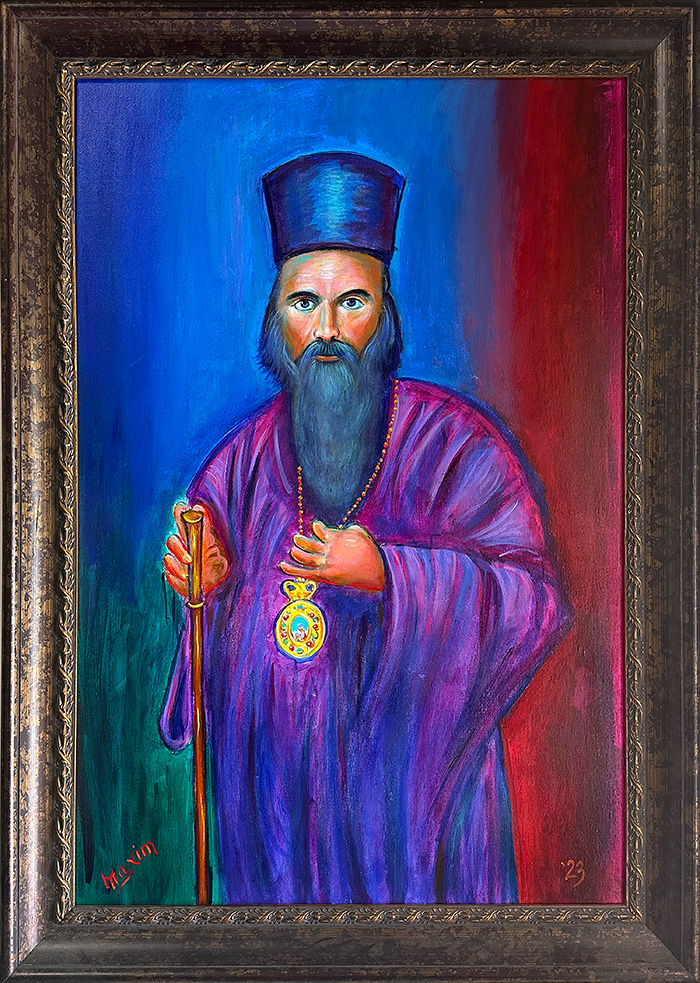
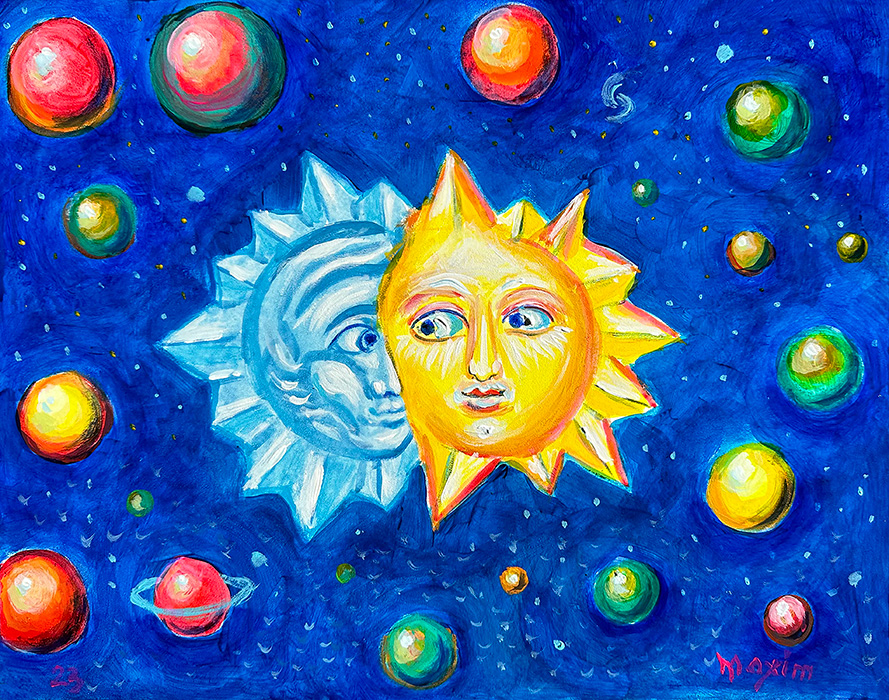
- Details
- Category: Maxim
"Praise Him, Sun and Moon... All You Shining Stars", acrylic on canvas, Bishop Maxim, 2023
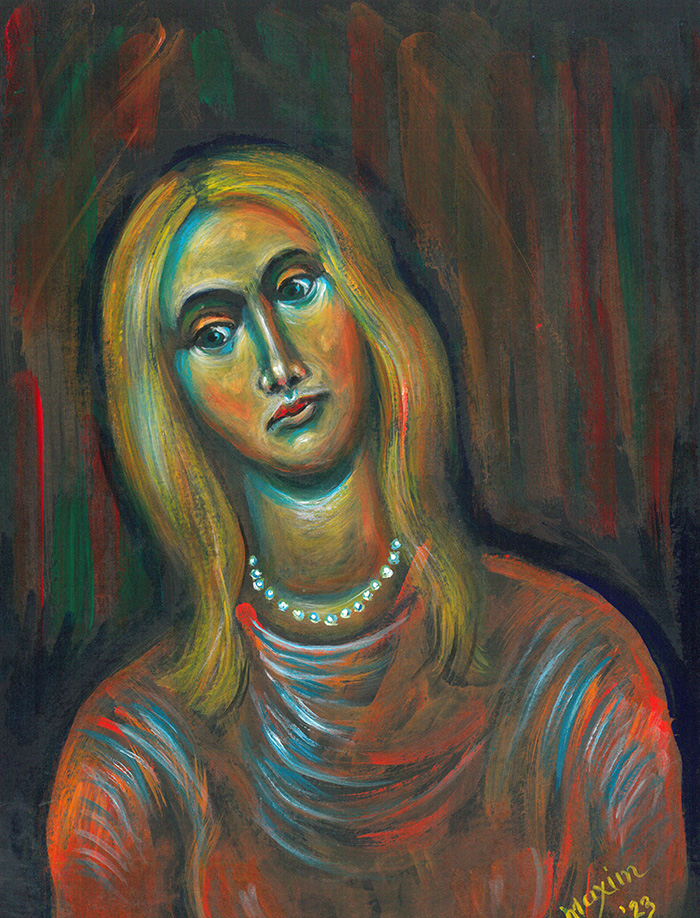
- Details
- Category: Maxim
"Reflections of the Soul: Ode to Tarkovsky's Mirror", acrylic on canvas, Bishop Maxim, 2023
We can say that this girl from the “Ode to Tarkovsky’s Mirror” is one of those works by painter Bishop Maxim in which the calm power of painting truth graces and highlights pieces of the soul of many people who identify with this mental state. Deep inner spiritual proficiency is expressed densely and without any chatter. Despite her greatness, a simple psyche recalls in the face of this girl memories of ancient Virgin Marys, where the innocent daughter emerges as "the shield and bulwark" of all humanity. Indeed, Tarkovsky brings out a subtle but true theology in his cinematographic shots and his stylistic modernity.
In any case, the eyes play an important role here as well. They do not look at us but sink into a fathomless inner depth. Just as the Virgin Mary in the Byzantine trope exclaims in awe: "What about me, this mysterious event?".
We must conclude the analysis of the work with the observation that the garment, no matter how little it appears, succeeds with its peculiar network of touches to highlight an exciting transparency of complementary colors—Orange, blue, and olive play on the dark secret color that runs underground in this extraordinary painting.
- Fr. Stamatis Skliris
We can say that this girl from the “Ode to Tarkovsky’s Mirror” is one of those works by painter Bishop Maxim in which the calm power of painting truth graces and highlights pieces of the soul of many people who identify with this mental state. Deep inner spiritual proficiency is expressed densely and without any chatter. Despite her greatness, a simple psyche recalls in the face of this girl memories of ancient Virgin Marys, where the innocent daughter emerges as "the shield and bulwark" of all humanity. Indeed, Tarkovsky brings out a subtle but true theology in his cinematographic shots and his stylistic modernity.
In any case, the eyes play an important role here as well. They do not look at us but sink into a fathomless inner depth. Just as the Virgin Mary in the Byzantine trope exclaims in awe: "What about me, this mysterious event?".
We must conclude the analysis of the work with the observation that the garment, no matter how little it appears, succeeds with its peculiar network of touches to highlight an exciting transparency of complementary colors—Orange, blue, and olive play on the dark secret color that runs underground in this extraordinary painting.
- Fr. Stamatis Skliris
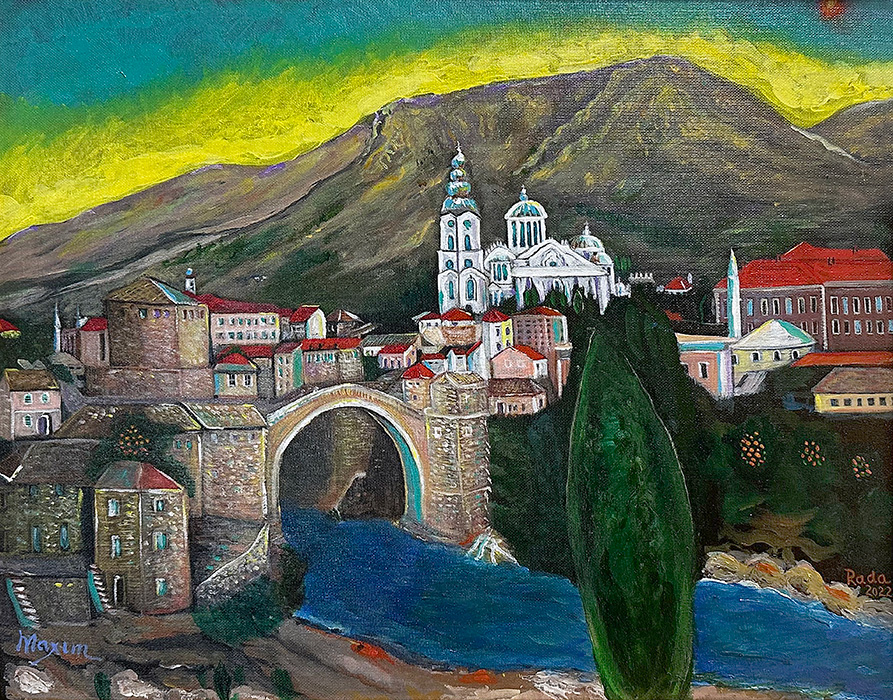
- Details
- Category: Maxim
"The Old Mostar Bridge and the Cathedral of Resurrection", acrylic on canvas, Bishop Maxim and Rada Vasiljevic, 2022
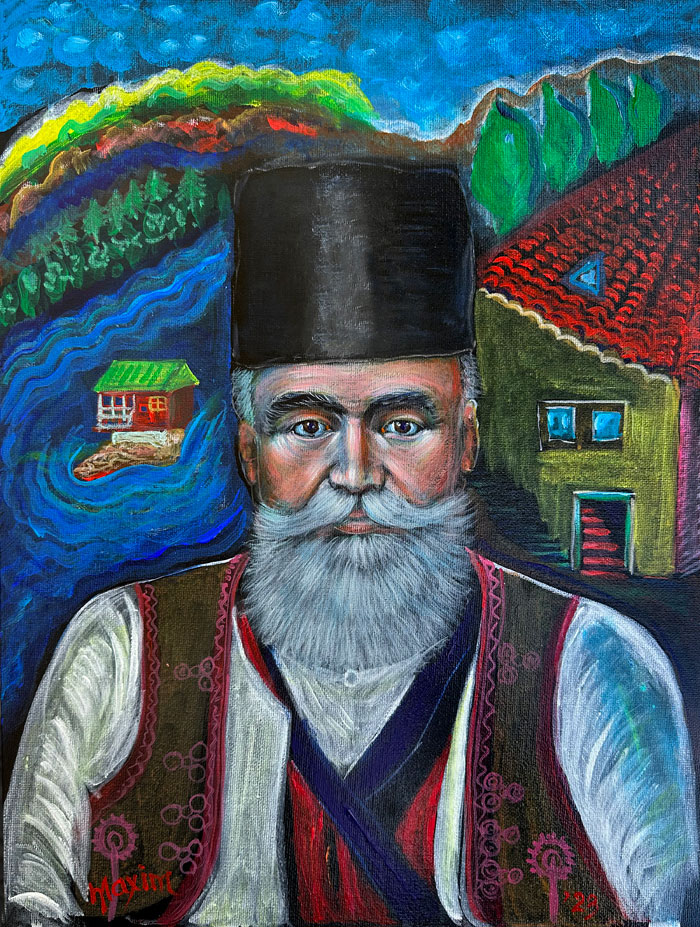
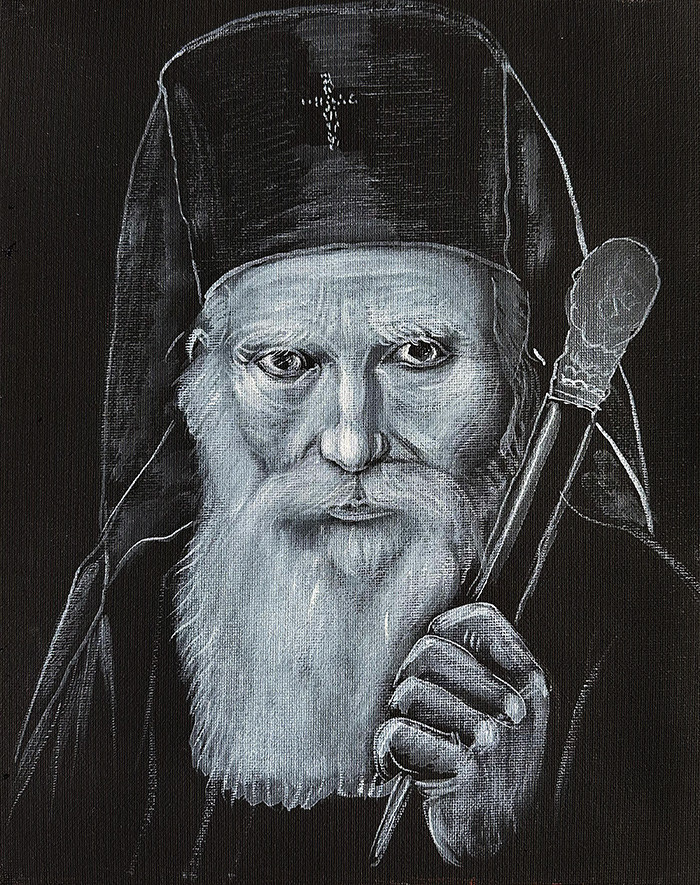
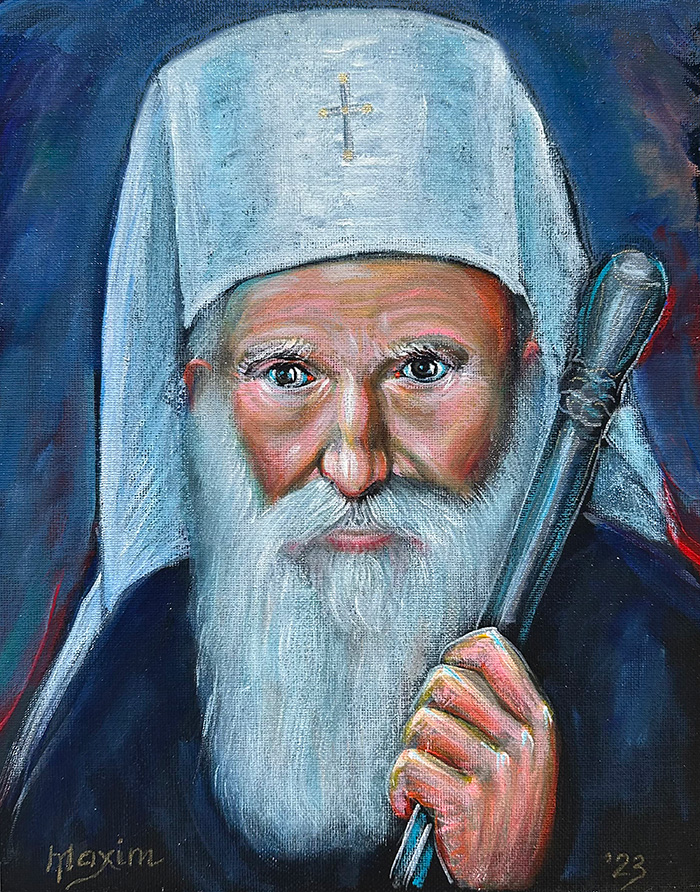
- Details
- Category: Maxim
"Synced with Gospel: Patriarch Pavle", acrylic on canvas, Bishop Maxim, 2023
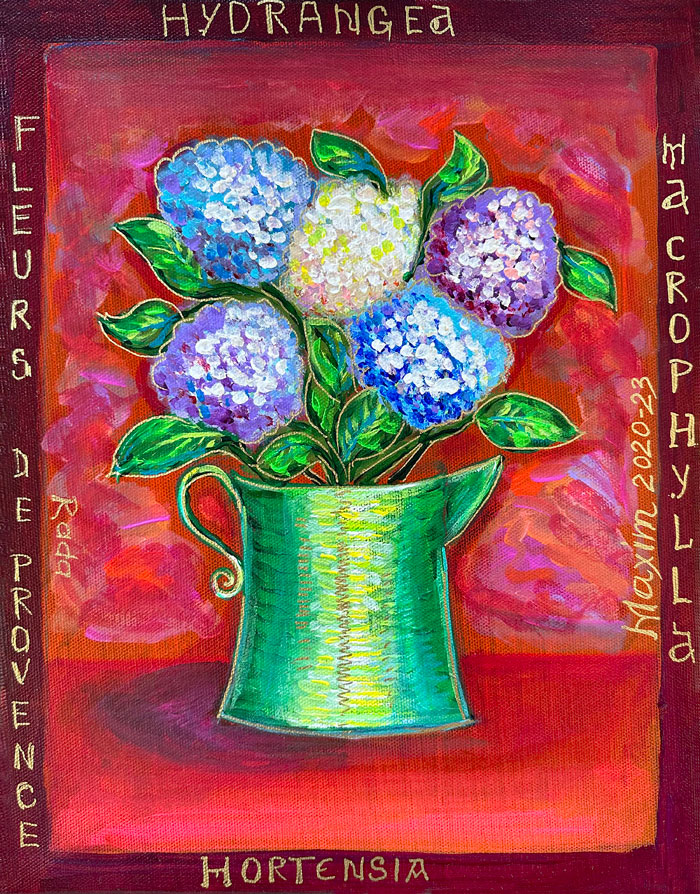
- Details
- Category: Maxim
"Hortensia 3", acrylic on canvas, 2020-23, by Bishop Maxim & Rada Vasiljevic
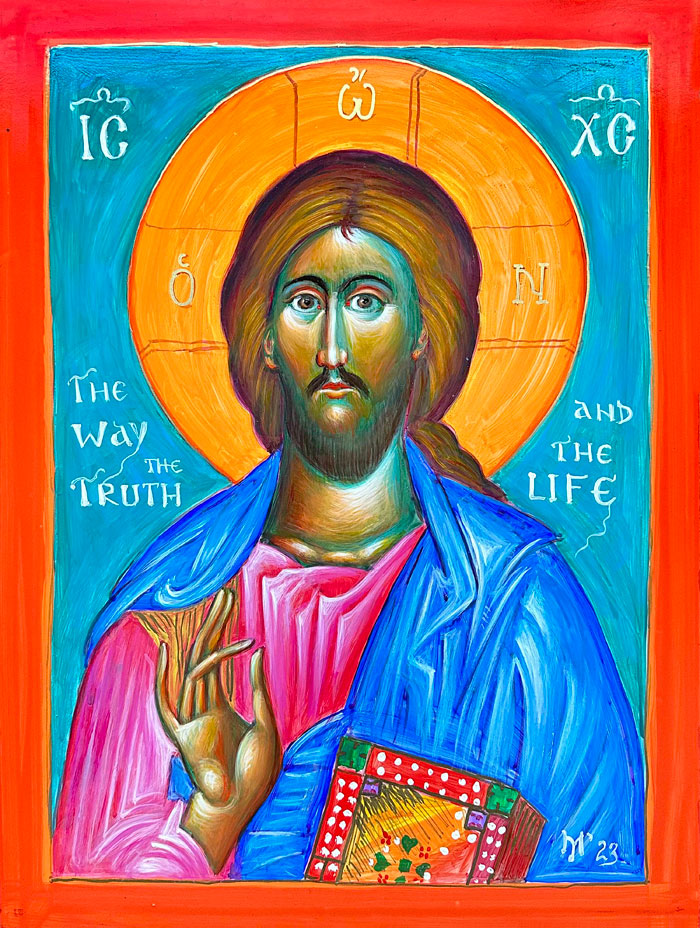
- Details
- Category: Maxim
"Eternal Christ: The Way, Truth, and Life", acrylic on gesso board, Bishop Maxim, 2023
This modern Byzantine painting, titled "Divine Light: The Way, Truth, and Life," captures Jesus Christ with a powerful gaze that radiates divine certainty, conveying His role as our Savior. Christ's hand is raised in blessing, indicating His divine mission, while His left hand holds the Gospel, the bearer of His joyful teachings. The vibrant, layered colors enhance His depiction as a divine beacon, guiding humanity with light and spiritual truth. This artwork blends traditional Byzantine elements with a contemporary flair.
This modern Byzantine painting, titled "Divine Light: The Way, Truth, and Life," captures Jesus Christ with a powerful gaze that radiates divine certainty, conveying His role as our Savior. Christ's hand is raised in blessing, indicating His divine mission, while His left hand holds the Gospel, the bearer of His joyful teachings. The vibrant, layered colors enhance His depiction as a divine beacon, guiding humanity with light and spiritual truth. This artwork blends traditional Byzantine elements with a contemporary flair.
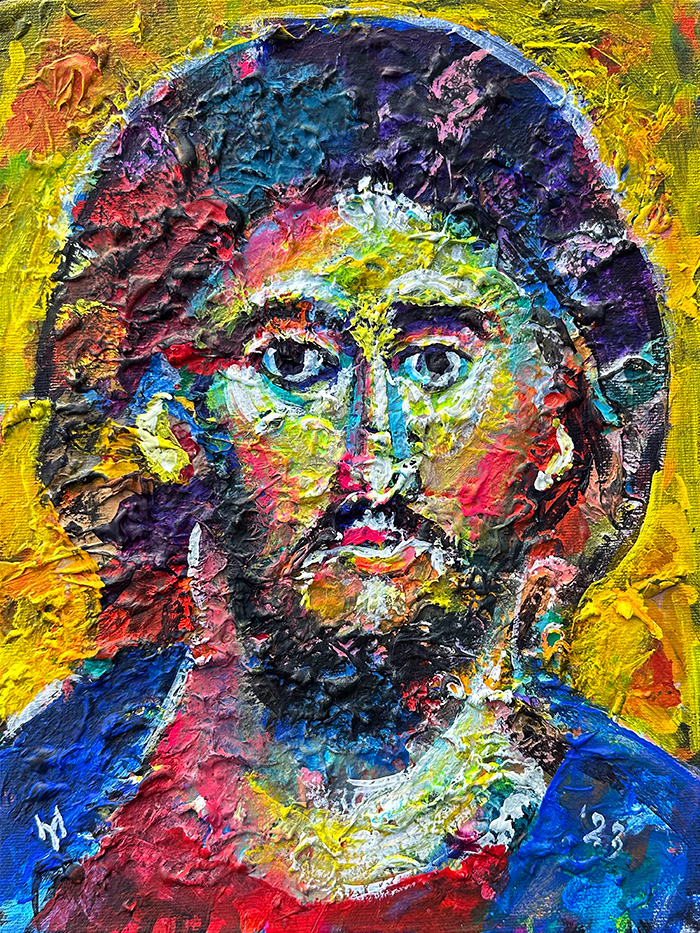
- Details
- Category: Maxim
"Divine Mosaic: The Savior Amidst Colors", acrylic on canvas panel, Bishop Maxim, 2023
The painting depicts the serene and compassionate face of Jesus Christ, rendered with striking artistry. The canvas itself is unique, previously used by the artist to mix colors for various other paintings. This results in a vibrant, multi-colored background filled with an array of mixed hues. Against this colorful chaos, the final brush strokes skillfully bring forth the face of the Savior. The image of Jesus emerges radiantly, capturing a blend of divinity and artistry. His expression is calm and benevolent, creating a sense of awe and reverence. The overall effect is a stunning portrait that blends the chaotic beauty of mixed colors with the serene depiction of Jesus, reflecting both the human and divine aspects.
The painting depicts the serene and compassionate face of Jesus Christ, rendered with striking artistry. The canvas itself is unique, previously used by the artist to mix colors for various other paintings. This results in a vibrant, multi-colored background filled with an array of mixed hues. Against this colorful chaos, the final brush strokes skillfully bring forth the face of the Savior. The image of Jesus emerges radiantly, capturing a blend of divinity and artistry. His expression is calm and benevolent, creating a sense of awe and reverence. The overall effect is a stunning portrait that blends the chaotic beauty of mixed colors with the serene depiction of Jesus, reflecting both the human and divine aspects.
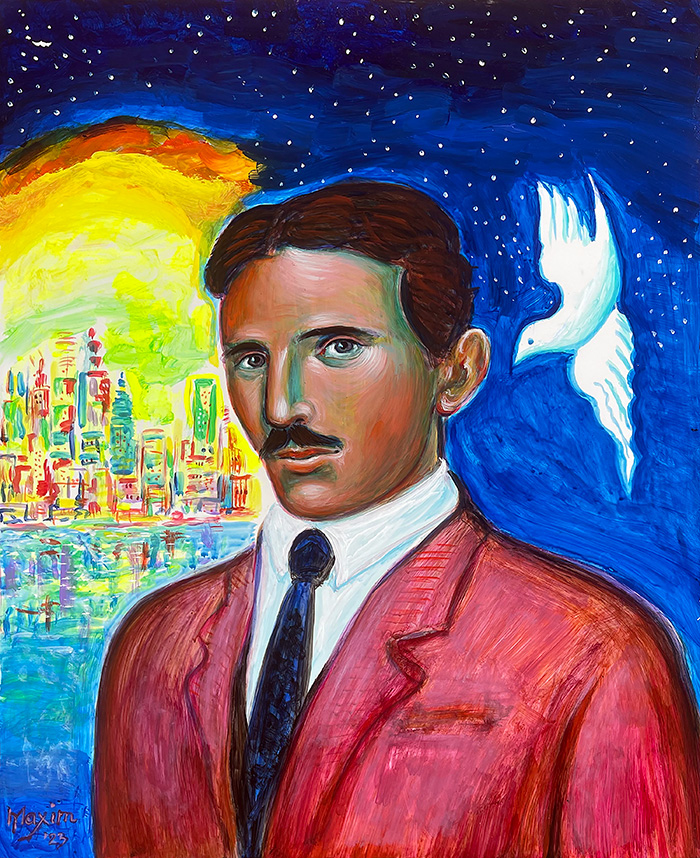
- Details
- Category: Maxim
"Light-Giving Revelation 4", acrylic on canvas, Bishop Maxim, 2023
In this distinctive painting, the artist uses metaphysical and pictorial approaches to depict the profound impact of electricity and inventor Nikola Tesla. The illumination of the city symbolizes enlightenment brought by the Holy Spirit, mirrored in the tranquil waters for balance. Tesla stands at the center as the harbinger of a new era. Employing Impressionistic techniques, the artist highlights electricity's transformative power in society. The dove and radiant city emphasize this technological revolution. Tesla's gaze hints at a profound secret, marking a pivotal moment where science and spirituality reshaped human history in "Tesla's Light-Giving-Revelation."
In this distinctive painting, the artist uses metaphysical and pictorial approaches to depict the profound impact of electricity and inventor Nikola Tesla. The illumination of the city symbolizes enlightenment brought by the Holy Spirit, mirrored in the tranquil waters for balance. Tesla stands at the center as the harbinger of a new era. Employing Impressionistic techniques, the artist highlights electricity's transformative power in society. The dove and radiant city emphasize this technological revolution. Tesla's gaze hints at a profound secret, marking a pivotal moment where science and spirituality reshaped human history in "Tesla's Light-Giving-Revelation."
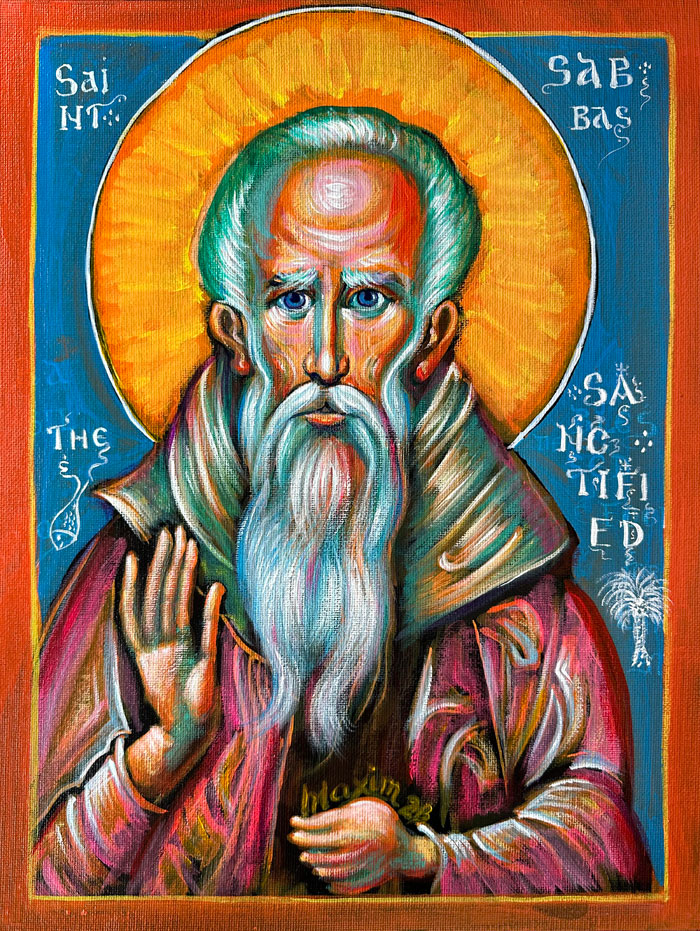
- Details
- Category: Maxim
"Peaceful Insight: Saint Sava's Timeless Vigil", acrylic on canvas, Bishop Maxim, 2023
In this painting, Saint Sava the Sanctified, a key figure in early Palestinian monasticism, is portrayed with a penetrating gaze, symbolizing his deep spiritual insight. He faces the viewer, his right hand raised in a gesture of peace and welcome. Dressed in the traditional attire of ancient monasticism, his outfit reflects his ascetic lifestyle. The artist blends a modern Byzantine style with less colors and dynamic brushwork, creating a contemporary feel while respecting historical accuracy. The background subtly suggests an ascetical environment, with minimal but meaningful details that enhance the painting's spiritual ambiance.
In this painting, Saint Sava the Sanctified, a key figure in early Palestinian monasticism, is portrayed with a penetrating gaze, symbolizing his deep spiritual insight. He faces the viewer, his right hand raised in a gesture of peace and welcome. Dressed in the traditional attire of ancient monasticism, his outfit reflects his ascetic lifestyle. The artist blends a modern Byzantine style with less colors and dynamic brushwork, creating a contemporary feel while respecting historical accuracy. The background subtly suggests an ascetical environment, with minimal but meaningful details that enhance the painting's spiritual ambiance.
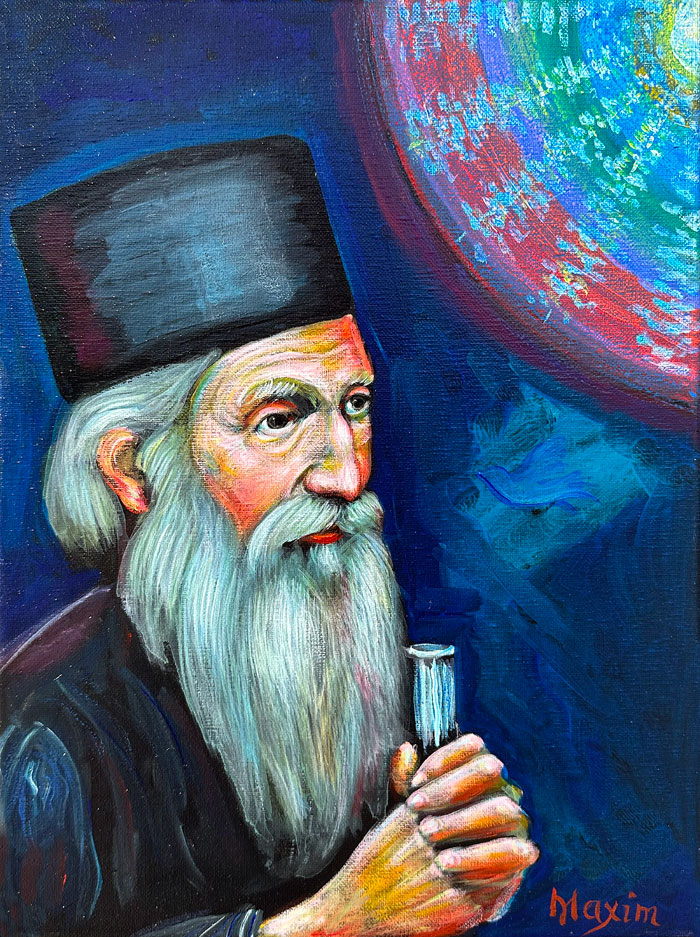
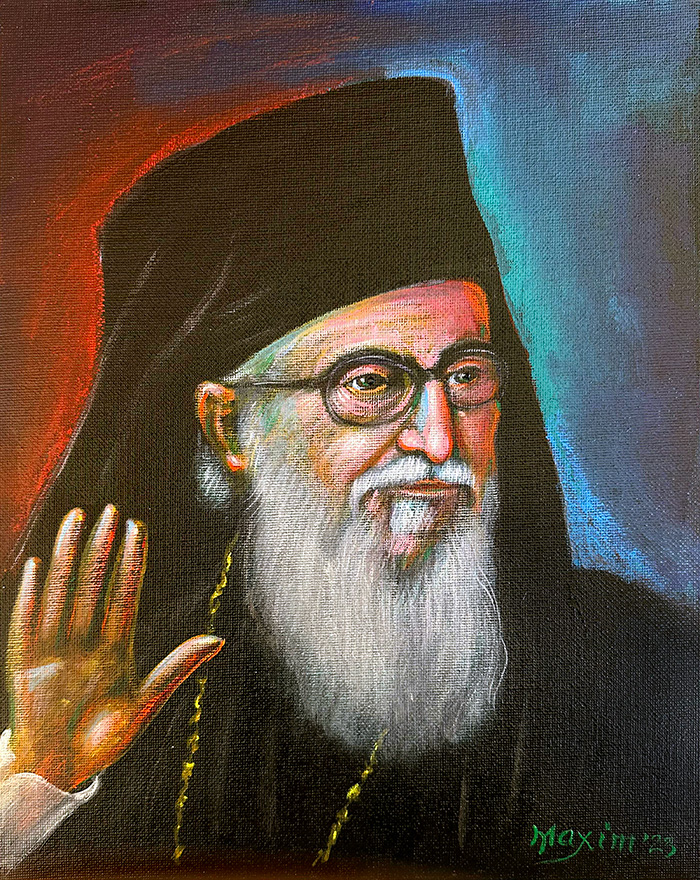
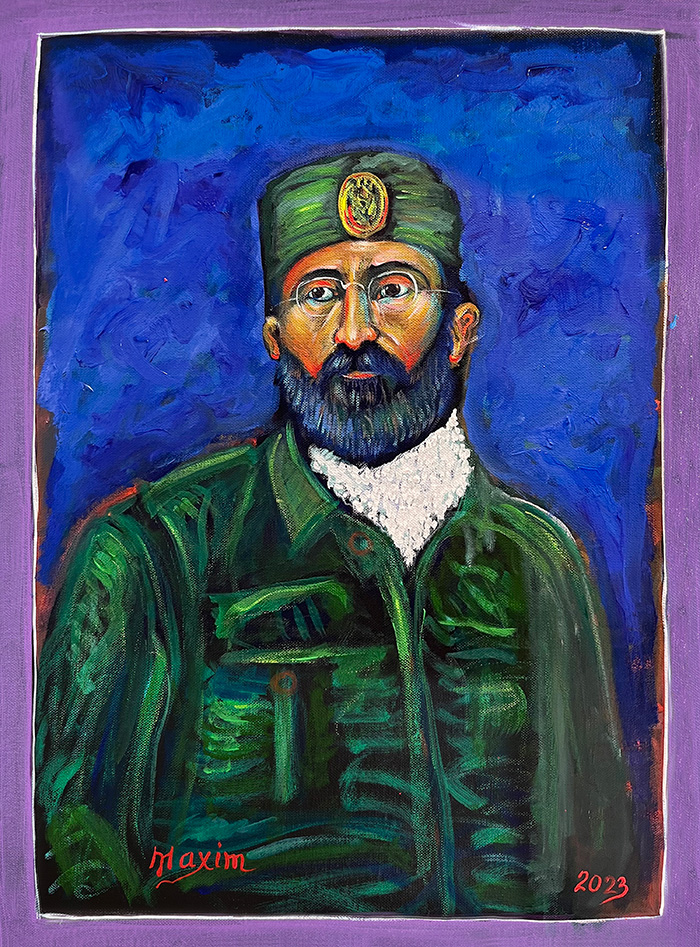
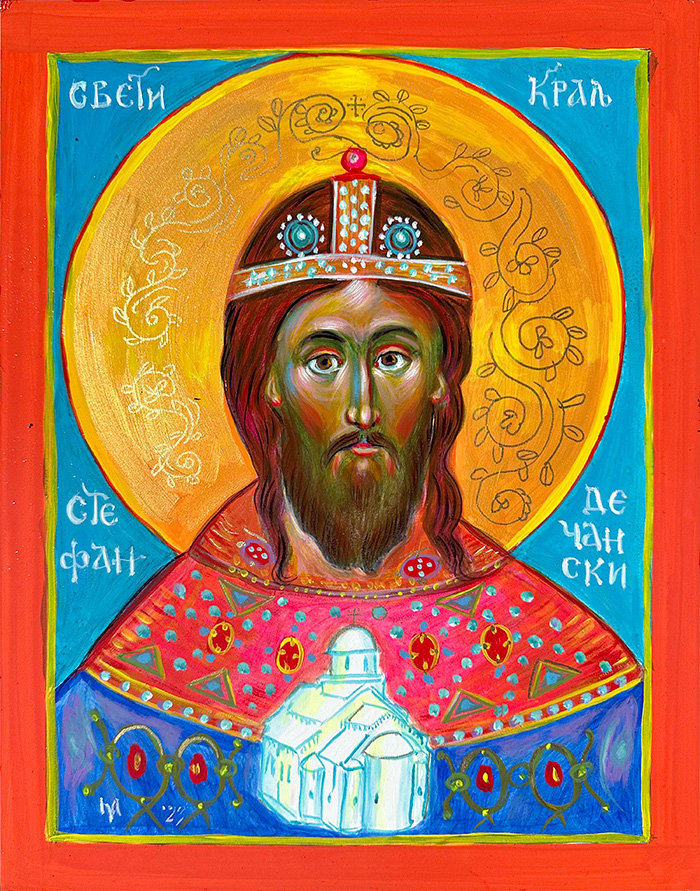
- Details
- Category: Maxim
"Stephen of Dechani: The Knightly Saint", acrylic on canvas, Bishop Maxim, 2023
The rulers of medieval Serbia had as a familiar feature the combination of chivalry (I mean they were knights, heavily armed warriors, brave) with holiness (they went to church, started the service of the king with a PRAYER, participated in the Holy Eucharist and even built many churches and monasteries that decorated them with the best iconography of the time). The ICONOGRAPHER Bishop MAXIM, expressing this tradition, began to illustrate portraits of these kings. The specific portrait of the ruler bearing the family name of the Decani monastery projects together with the royal decorations of his uniform and the expressiveness of his eyes. According to historians’ testimonies, Stephen was a powerful king but also a merciful one. He could listen to the grievances of his subjects and judge with leniency. The illustrator presents this very side of the Saint to us very convincingly. It would be as if he had the Saint come out through a mesh of heavy garments of great luxury as a gentle HUMBLE figure who looks at us with love as if to say: “Don’t see all these things that I wear. In essence, we are brothers as children of the Lord, and when we meet in the Kingdom of God, you will see that you all are equal!”
We notice that here Bishop Maxim creates his own particular visual identity, which preserves its Byzantine iconographic roots but introduces something new: the expression of the loving relationship with the pious observer of the icon. Perhaps now we do not understand in depth that a vital promotion of iconography is taking place in our days. But we believe that the historian of the future will indeed mark it one day as the progress of a painting with a history of centuries, which both in the past and in the present does not stand still but has in store for us rare and welcome surprises. — Stamatis Skliris.
The rulers of medieval Serbia had as a familiar feature the combination of chivalry (I mean they were knights, heavily armed warriors, brave) with holiness (they went to church, started the service of the king with a PRAYER, participated in the Holy Eucharist and even built many churches and monasteries that decorated them with the best iconography of the time). The ICONOGRAPHER Bishop MAXIM, expressing this tradition, began to illustrate portraits of these kings. The specific portrait of the ruler bearing the family name of the Decani monastery projects together with the royal decorations of his uniform and the expressiveness of his eyes. According to historians’ testimonies, Stephen was a powerful king but also a merciful one. He could listen to the grievances of his subjects and judge with leniency. The illustrator presents this very side of the Saint to us very convincingly. It would be as if he had the Saint come out through a mesh of heavy garments of great luxury as a gentle HUMBLE figure who looks at us with love as if to say: “Don’t see all these things that I wear. In essence, we are brothers as children of the Lord, and when we meet in the Kingdom of God, you will see that you all are equal!”
We notice that here Bishop Maxim creates his own particular visual identity, which preserves its Byzantine iconographic roots but introduces something new: the expression of the loving relationship with the pious observer of the icon. Perhaps now we do not understand in depth that a vital promotion of iconography is taking place in our days. But we believe that the historian of the future will indeed mark it one day as the progress of a painting with a history of centuries, which both in the past and in the present does not stand still but has in store for us rare and welcome surprises. — Stamatis Skliris.
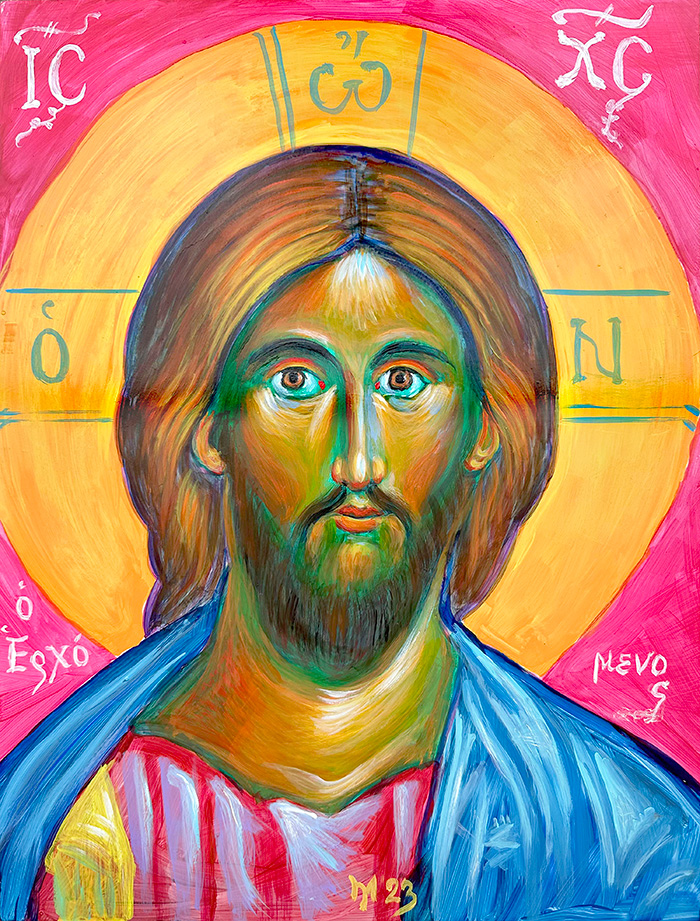
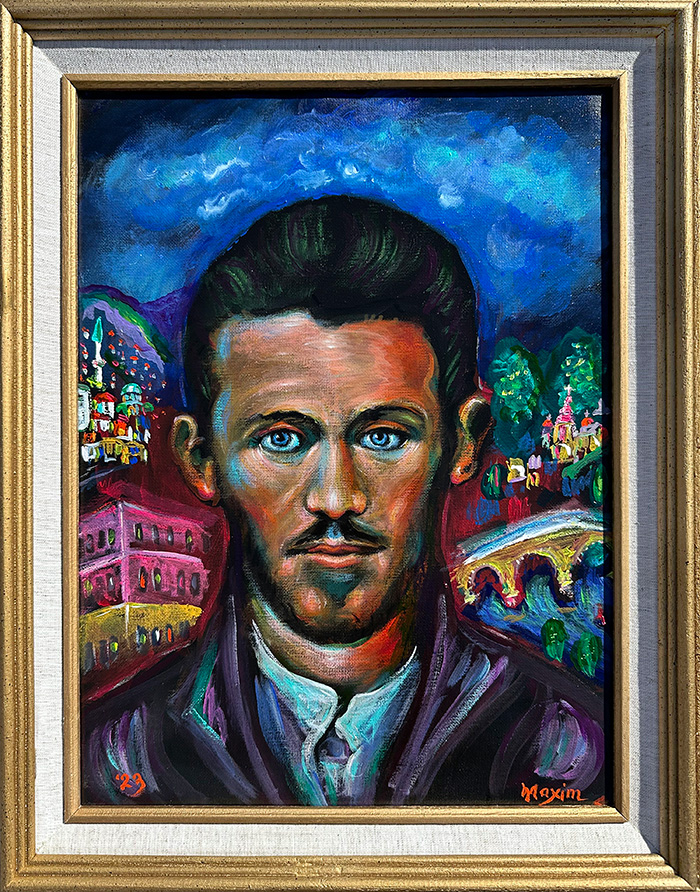
- Details
- Category: Maxim
"A Revolutionary’s Gaze: Gavril Princip Reimagined", acrylic on canvas, Bishop Maxim, 2023
In a notable departure from the conventional portrayal of Gavril Princip as a frail, ailing, and tormented figure, the artist offers a refreshing perspective in this acrylic masterpiece, dated 2023. Gone is the image of a weakened assassin, as captured in a poignant photograph taken shortly before his demise. Instead, Princip emerges as a resolute revolutionary, “a young man with an angel’s name and a surname with a powerful message.”
The painting captures the essence of a man driven by profound convictions, fully aware of the non-Christian nature of his actions, yet firmly believing in their contribution to the liberation of his people. His gaze speaks volumes, reflecting the complexity of his motives and the weight of his mission.
The backdrop showcases the city of Sarajevo, expertly rendered with impressionist brushstrokes. The elements of the city come to life—the bridge, churches, mosque, and houses—all set against a sky adorned with luminous clouds, suggesting a sense of serenity amidst the tumultuous narrative.
In a notable departure from the conventional portrayal of Gavril Princip as a frail, ailing, and tormented figure, the artist offers a refreshing perspective in this acrylic masterpiece, dated 2023. Gone is the image of a weakened assassin, as captured in a poignant photograph taken shortly before his demise. Instead, Princip emerges as a resolute revolutionary, “a young man with an angel’s name and a surname with a powerful message.”
The painting captures the essence of a man driven by profound convictions, fully aware of the non-Christian nature of his actions, yet firmly believing in their contribution to the liberation of his people. His gaze speaks volumes, reflecting the complexity of his motives and the weight of his mission.
The backdrop showcases the city of Sarajevo, expertly rendered with impressionist brushstrokes. The elements of the city come to life—the bridge, churches, mosque, and houses—all set against a sky adorned with luminous clouds, suggesting a sense of serenity amidst the tumultuous narrative.
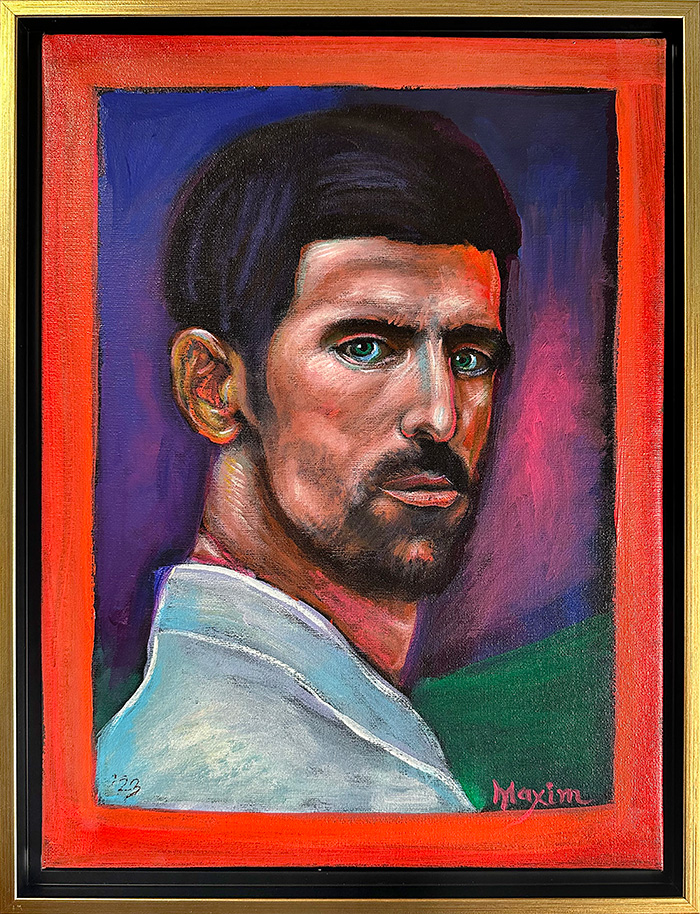
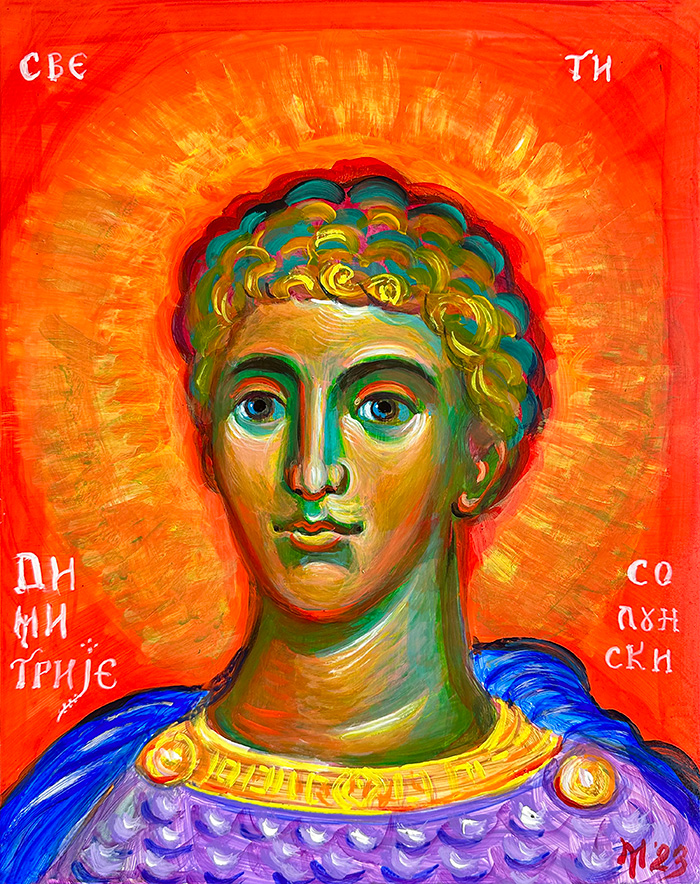
- Details
- Category: Maxim
"St Demetrios of Thessaloniki", acrylic on gesso board, Bishop Maxim, 2023
This painting captures Saint Demetrius on a gesso board using acrylics, portrayed as a Greco-Roman soldier with a direct and engaging gaze that transcends time, embodying both the valor of a soldier and the serene fortitude of a martyr. A radiant halo emphasizes his glorification as a Christian, subtly contrasting with his martial appearance. The composition marries the reverence of traditional iconography with a modern palette of vibrant colors, bringing an ancient sanctity into contemporary light. The artwork stands as a bridge between the classical and the modern, reverent yet alive with chromatic intensity.
This painting captures Saint Demetrius on a gesso board using acrylics, portrayed as a Greco-Roman soldier with a direct and engaging gaze that transcends time, embodying both the valor of a soldier and the serene fortitude of a martyr. A radiant halo emphasizes his glorification as a Christian, subtly contrasting with his martial appearance. The composition marries the reverence of traditional iconography with a modern palette of vibrant colors, bringing an ancient sanctity into contemporary light. The artwork stands as a bridge between the classical and the modern, reverent yet alive with chromatic intensity.
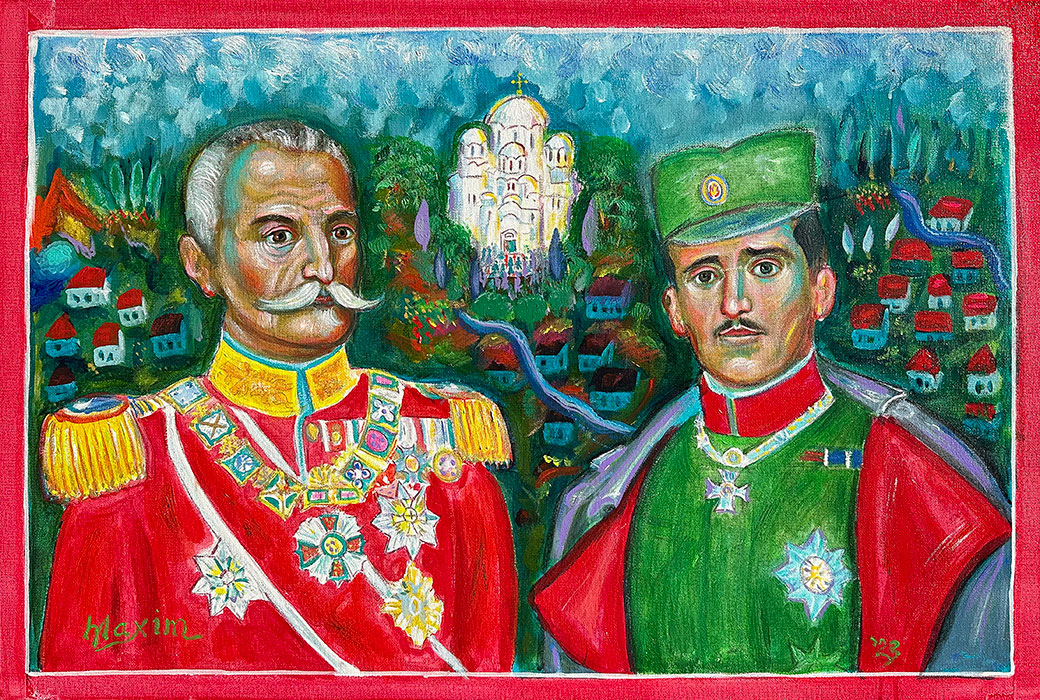
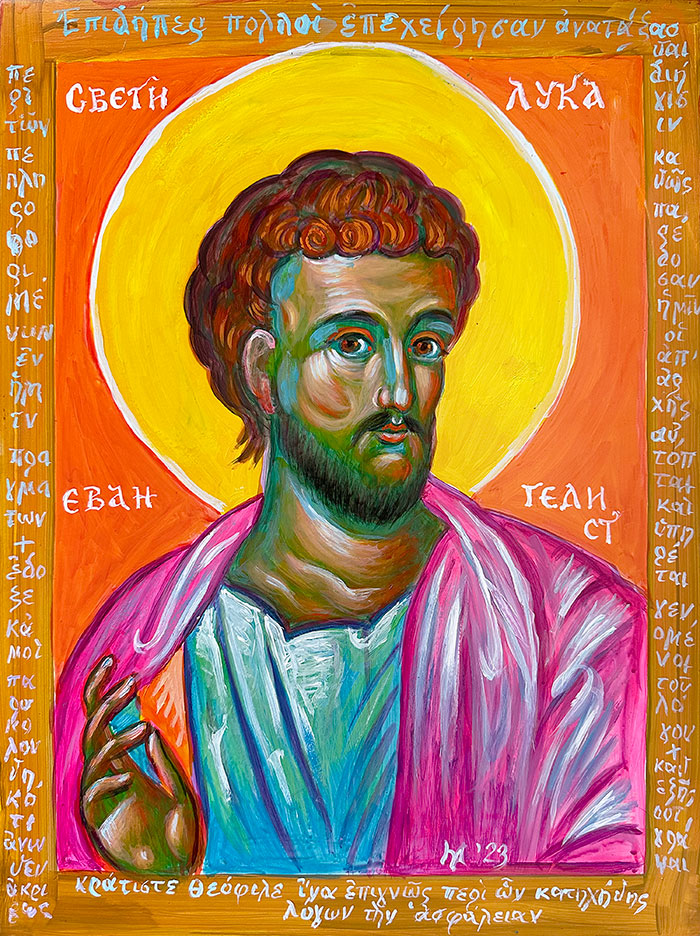
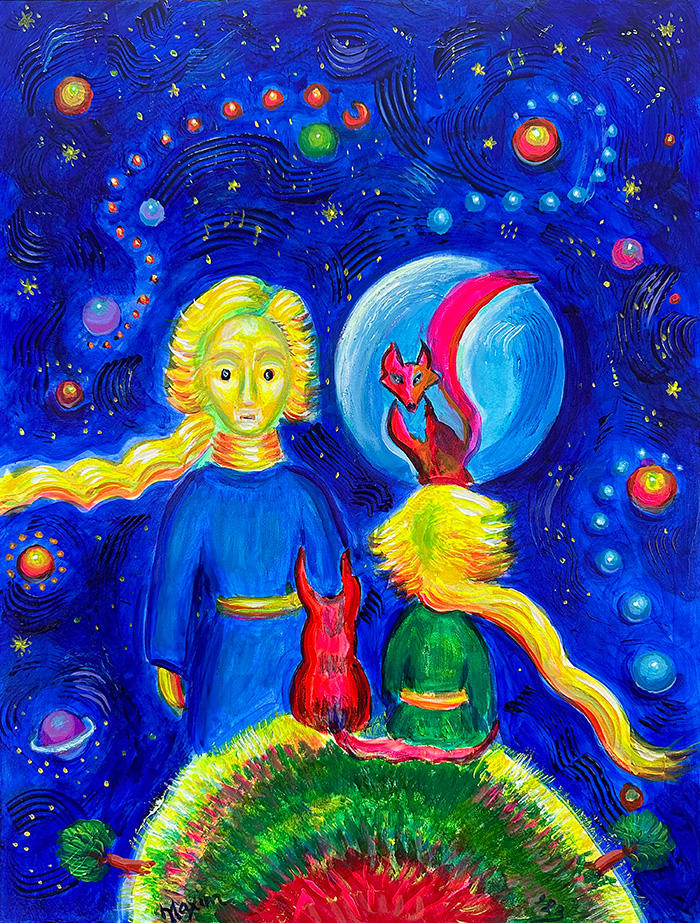
- Details
- Category: Maxim
"Interstellar Reflections: The Little Prince and the Fox", acrylic on board, Bishop Maxim, 2023
This captivating artwork, rendered in acrylic on a wooden board, beautifully captures the spirit of Saint-Exupéry's "The Little Prince." At its core, it presents a unique dual portrayal of the Little Prince and his loyal fox companion. One pair gazes outwards towards us, while the other resides on their own tiny planet, their reflections echoing this cosmic connection. This ingenious composition hints at an undying dialogue, an unending exchange between different dimensions of existence.
The celestial backdrop sets the stage for a serene cosmic ballet, with a multitude of celestial bodies contributing to the tranquil yet profound ambiance. Amidst this celestial journey, a revelation dawns upon us—the viewers—we are the cherished rose in the heart of the Little Prince, an integral part of this enchanting narrative.
This captivating artwork, rendered in acrylic on a wooden board, beautifully captures the spirit of Saint-Exupéry's "The Little Prince." At its core, it presents a unique dual portrayal of the Little Prince and his loyal fox companion. One pair gazes outwards towards us, while the other resides on their own tiny planet, their reflections echoing this cosmic connection. This ingenious composition hints at an undying dialogue, an unending exchange between different dimensions of existence.
The celestial backdrop sets the stage for a serene cosmic ballet, with a multitude of celestial bodies contributing to the tranquil yet profound ambiance. Amidst this celestial journey, a revelation dawns upon us—the viewers—we are the cherished rose in the heart of the Little Prince, an integral part of this enchanting narrative.
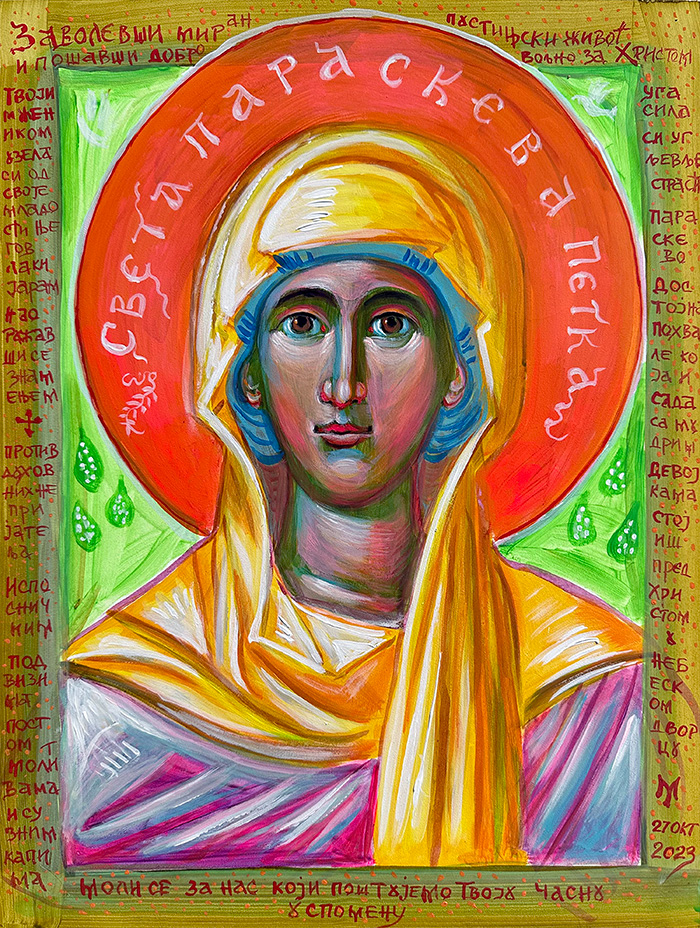
- Details
- Category: Maxim
"Transforming the Desert: St. Parasceva's Message of Metanoia" ["Radiant Asceticism: St. Parasceva of Epibatima"], acrylic on board, Bishop Maxim, 2023
In "Radiant Asceticism: St. Parasceva of Epibatima," the artist captures the heart of Christian optimism in portraying this saint of Serbian descent. St. Parasceva's serene face reflects her profound devotion to Christ, born out of a life dedicated to asceticism. Her years in the Jordan wilderness, marked by relentless commitment and trials, are conveyed through her unwavering gaze. The face of St. Parasceva emanates a longing for asceticism in the name of Christ, now met with the radiant countenance of her heavenly Bridegroom. The artist skillfully conveys the saint's enduring spirit and triumph over challenges, inviting viewers into her world of spiritual resilience. The vibrant colors in the painting symbolize the transformation brought about by the saint's presence in the wilderness, reflecting the profound impact of her holy life.
In "Radiant Asceticism: St. Parasceva of Epibatima," the artist captures the heart of Christian optimism in portraying this saint of Serbian descent. St. Parasceva's serene face reflects her profound devotion to Christ, born out of a life dedicated to asceticism. Her years in the Jordan wilderness, marked by relentless commitment and trials, are conveyed through her unwavering gaze. The face of St. Parasceva emanates a longing for asceticism in the name of Christ, now met with the radiant countenance of her heavenly Bridegroom. The artist skillfully conveys the saint's enduring spirit and triumph over challenges, inviting viewers into her world of spiritual resilience. The vibrant colors in the painting symbolize the transformation brought about by the saint's presence in the wilderness, reflecting the profound impact of her holy life.
- Details
- Category: Maxim
"Transforming the Desert: St. Parasceva's Message of Metanoia", detail, acrylic on board, Bishop Maxim, 2023
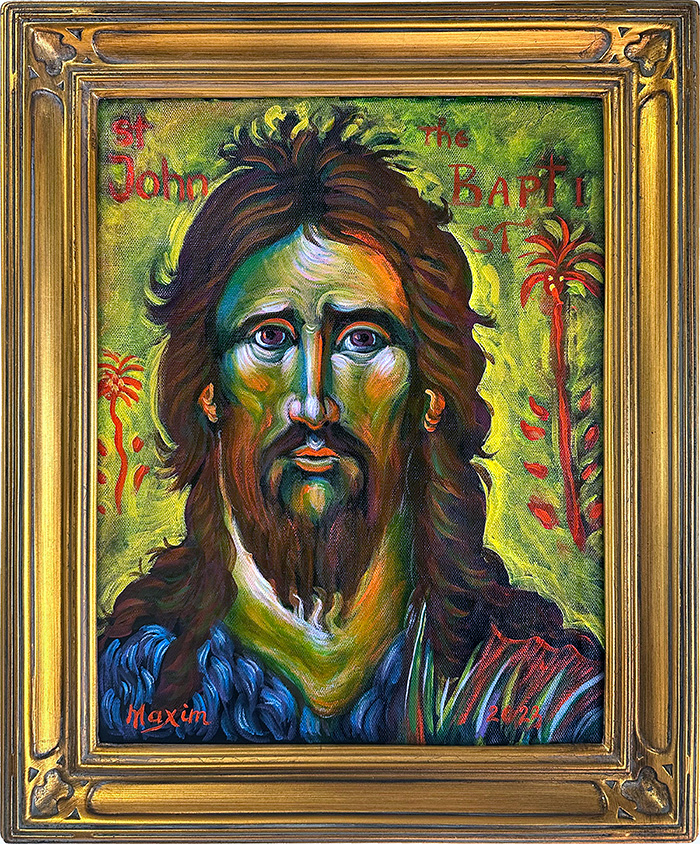
- Details
- Category: Maxim
"The Radiant Prophet: St. John the Baptist", acrylic on canvas, Bishop Maxim, 2023
In this acrylic canvas painting, the iconic figure of St. John the Baptist emerges from the desert with a prophetic gaze, calling for a transformative change in our lives as we prepare for the Lord's arrival. Despite his ascetic appearance, evident in his rugged appearance and simple attire, the artist uses Byzantine lighting techniques to illuminate his figure, symbolizing the radiant transformation that comes from orienting our lives toward the future Kingdom.
This juxtaposition of asceticism and divine luminosity is a powerful visual metaphor for the transformative journey that awaits all who turn their hearts toward the future Kingdom and endeavor to live according to the logic of the Eighth day.
In this acrylic canvas painting, the iconic figure of St. John the Baptist emerges from the desert with a prophetic gaze, calling for a transformative change in our lives as we prepare for the Lord's arrival. Despite his ascetic appearance, evident in his rugged appearance and simple attire, the artist uses Byzantine lighting techniques to illuminate his figure, symbolizing the radiant transformation that comes from orienting our lives toward the future Kingdom.
This juxtaposition of asceticism and divine luminosity is a powerful visual metaphor for the transformative journey that awaits all who turn their hearts toward the future Kingdom and endeavor to live according to the logic of the Eighth day.
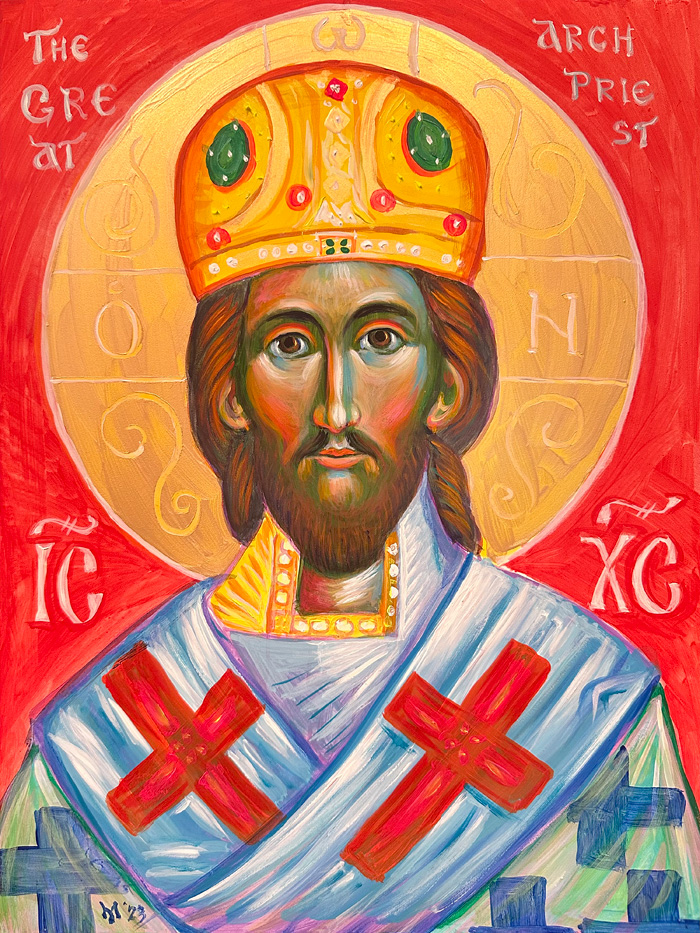
- Details
- Category: Maxim
"The Great Archpriest", acrylic on wooden board, Bishop Maxim, 2023
This is an icon of Christ the Archpriest, that we can unlock our hearts before it. He will hear us because he has clear eyes that look at us as if they are listening to us. With care (he cares about us, we are not indifferent to him). PEACE and HONESTY reign in this work. He is "the Eternal One", the Universal Lover! The fiery love is painted on His red cheeks by painter Maxim. Some would say that his colors are too bright and to tone them down. But we say, leave them as they are. Because the iconographer is LITERAL. When he puts on the pure red, he wants to tell us: “CHRIST is all flame, all warmth, all love, all revolution!”
— Stamatis Skliris
This is an icon of Christ the Archpriest, that we can unlock our hearts before it. He will hear us because he has clear eyes that look at us as if they are listening to us. With care (he cares about us, we are not indifferent to him). PEACE and HONESTY reign in this work. He is "the Eternal One", the Universal Lover! The fiery love is painted on His red cheeks by painter Maxim. Some would say that his colors are too bright and to tone them down. But we say, leave them as they are. Because the iconographer is LITERAL. When he puts on the pure red, he wants to tell us: “CHRIST is all flame, all warmth, all love, all revolution!”
— Stamatis Skliris
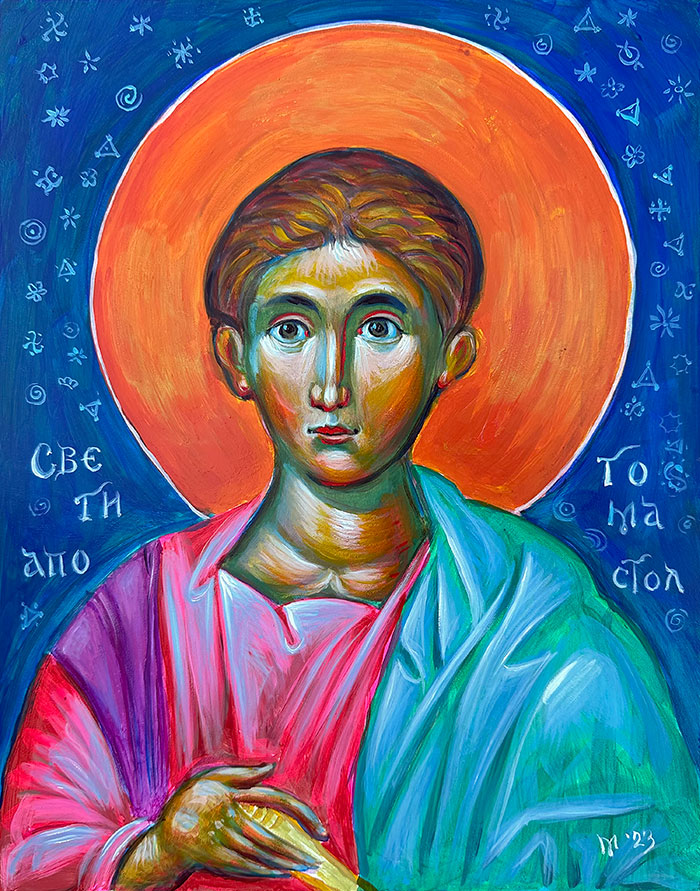
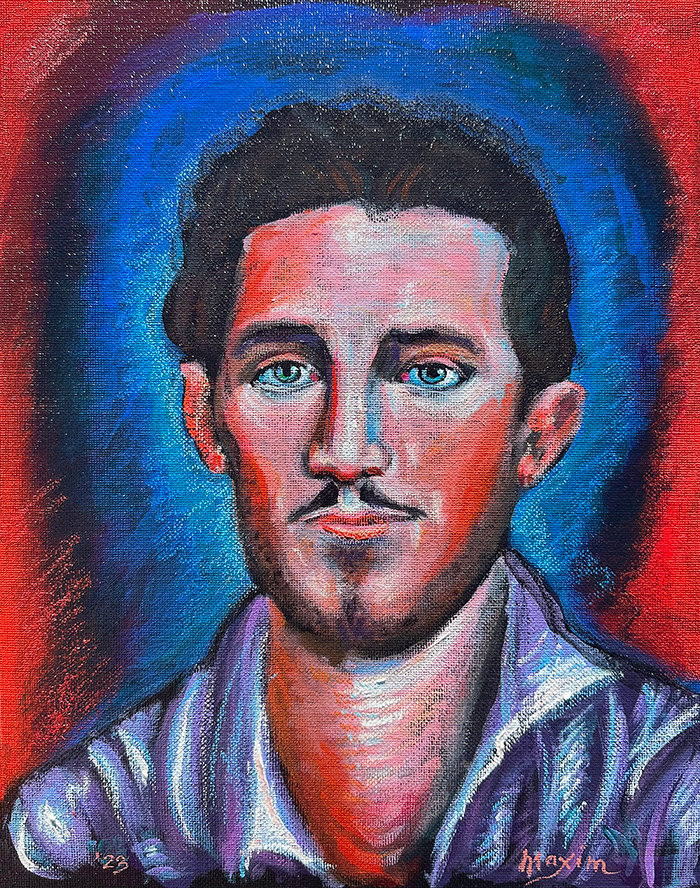
- Details
- Category: Maxim
"Gavrilo Princip: A Portrait of Resolve," acrylic on canvas, Bishop Maxim, 2023
In this evocative portrait, Gavrilo Princip emerges as a figure of unwavering dedication, the artist skillfully blending the turmoil of revolution with a calm sincerity. Princip’s countenance is portrayed with gentle strokes, imbuing him with a kindness that encourages viewers to see the revolutionary through empathetic eyes rather than passing judgment. The backdrop, a deep shade of red, stands not as a stark reminder of violence but symbolizes a complex blend of martyrdom, fervent passion for his cause, and the turbulent backdrop of his life. It engulfs him not as a symbol of violence but as a representation of the sacrifices and consequences borne from his unwavering commitment. Most compelling is Princip’s gaze—a silent narrative of determination. It neither harbors malice nor regret but resonates with profound sincerity. His eyes, delicately depicted by the artist, fixate on a distant yet imminent horizon—a testament to a man prepared to sacrifice everything for the love of his homeland.
In this evocative portrait, Gavrilo Princip emerges as a figure of unwavering dedication, the artist skillfully blending the turmoil of revolution with a calm sincerity. Princip’s countenance is portrayed with gentle strokes, imbuing him with a kindness that encourages viewers to see the revolutionary through empathetic eyes rather than passing judgment. The backdrop, a deep shade of red, stands not as a stark reminder of violence but symbolizes a complex blend of martyrdom, fervent passion for his cause, and the turbulent backdrop of his life. It engulfs him not as a symbol of violence but as a representation of the sacrifices and consequences borne from his unwavering commitment. Most compelling is Princip’s gaze—a silent narrative of determination. It neither harbors malice nor regret but resonates with profound sincerity. His eyes, delicately depicted by the artist, fixate on a distant yet imminent horizon—a testament to a man prepared to sacrifice everything for the love of his homeland.
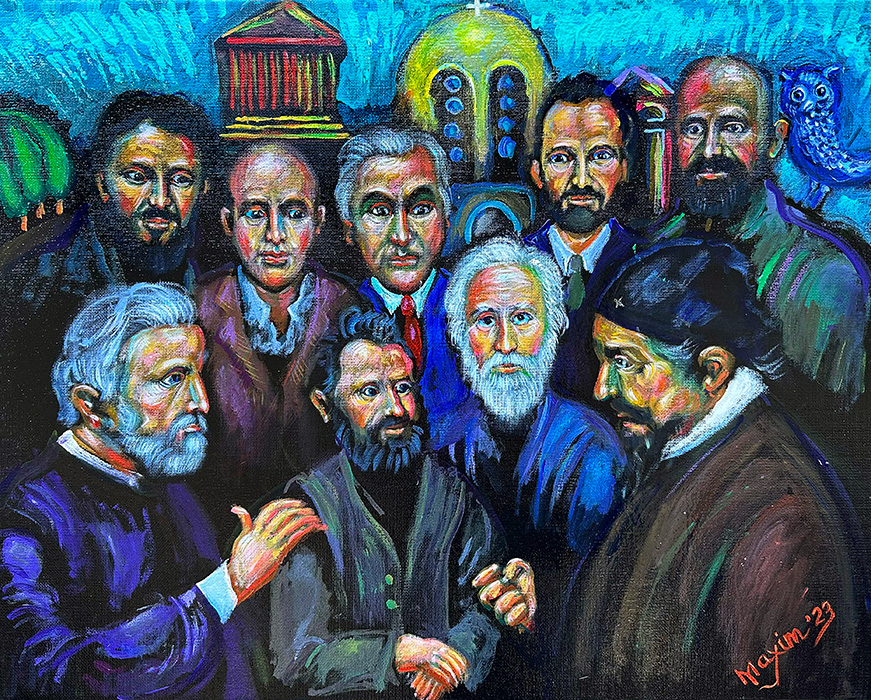
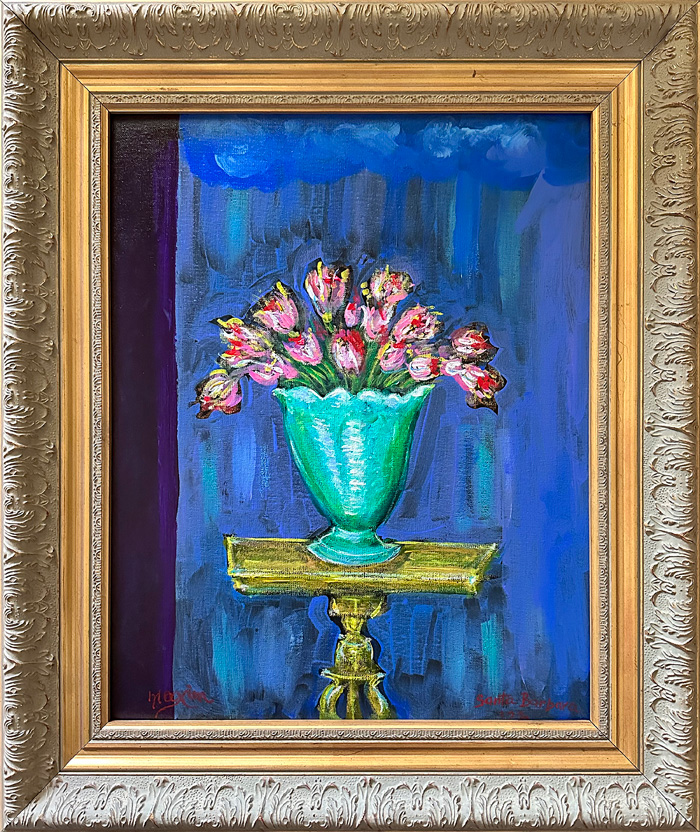
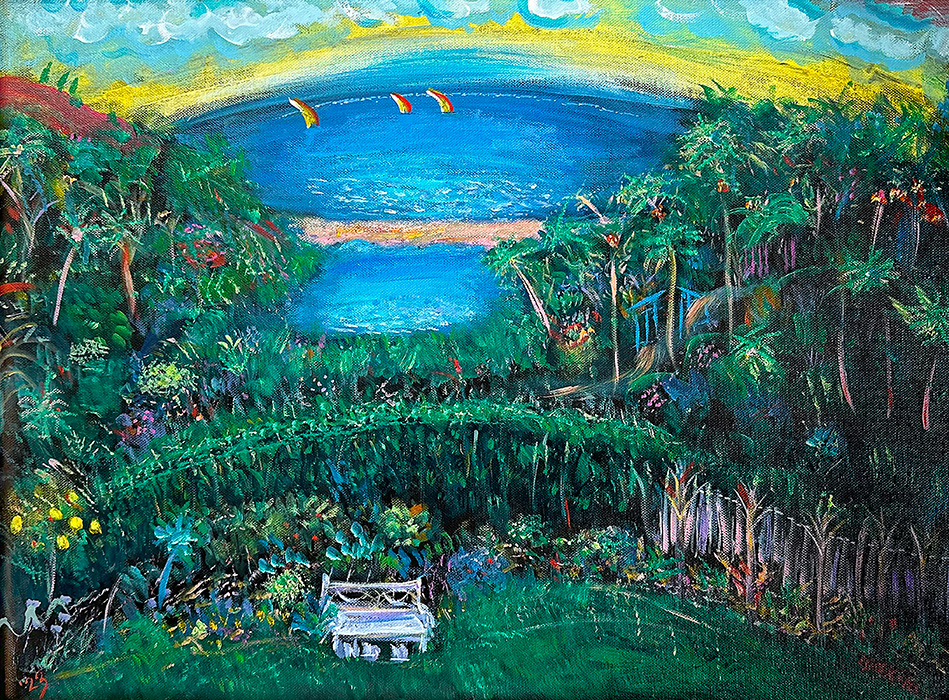
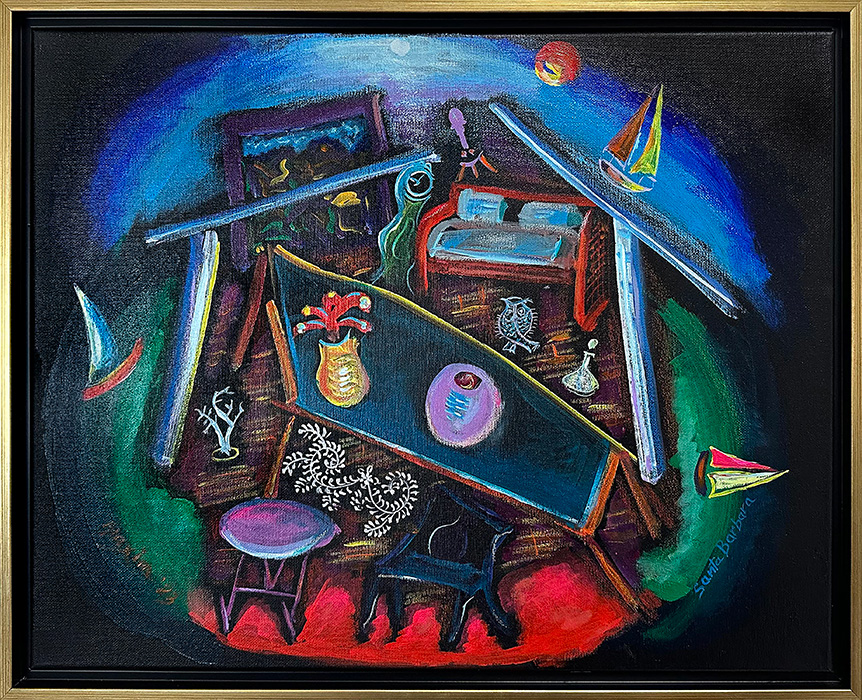
- Details
- Category: Maxim
"Coastal Cubism: Santa Barbara Serenity", acrylic on canvas, Bishop Maxim, 2023
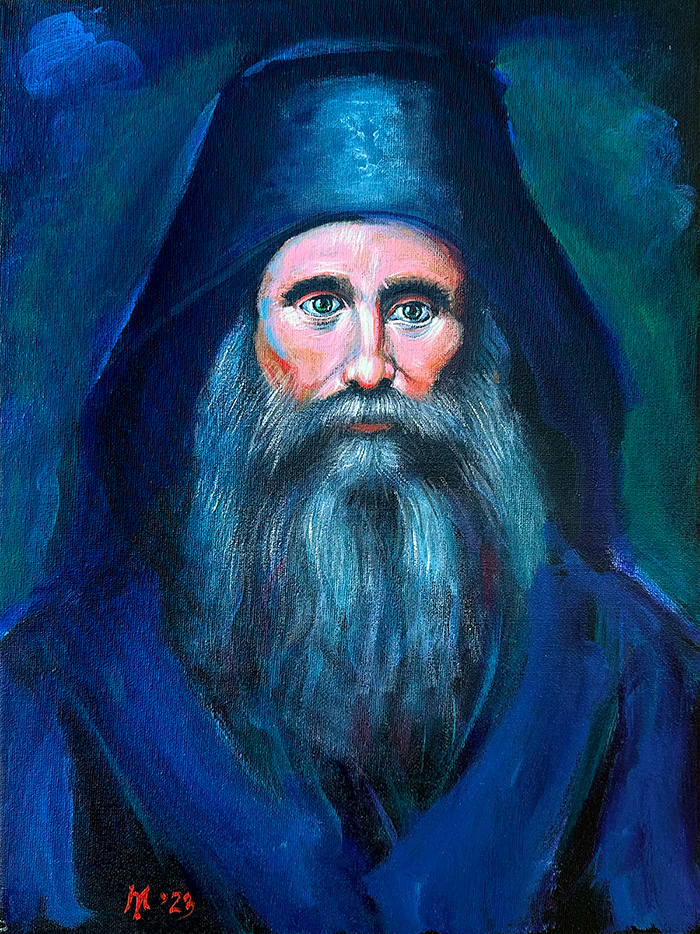
- Details
- Category: Maxim
"St. Silouan the Athonite", acrylic on canvas, Bishop Maxim, 2023
In “St. Silouan the Athonite,” the artist skillfully unravels the profound journey of Elder St. Silouan. From his modest origins in Russia to his spiritual ascent on the Holy Mountain through asceticism, the painting pays homage to Byzantine art with its color palette. St. Silouan’s humble attire mirrors his simple way of life, emphasizing detachment from worldly possessions. The artist captures the monk’s deep understanding of humanity, born from moments of supplication and a sense of divine abandonment, resulting in a life guided by grace.
The artist captures the monk's profound realization of the human condition, depicting the Elder after moments of supplication and the profound sense of abandonment that ultimately led him to live by divine grace. The painting exquisitely juxtaposes heroism and compassion, evoking deep feelings within the viewer. This artwork speaks to the enduring quest of some rare persons among us in search of the love of God. It serves as a poignant reminder of the profound insights and solace that can be found amid the complexities of modern life, offering a timeless message of hope and inspiration.
In “St. Silouan the Athonite,” the artist skillfully unravels the profound journey of Elder St. Silouan. From his modest origins in Russia to his spiritual ascent on the Holy Mountain through asceticism, the painting pays homage to Byzantine art with its color palette. St. Silouan’s humble attire mirrors his simple way of life, emphasizing detachment from worldly possessions. The artist captures the monk’s deep understanding of humanity, born from moments of supplication and a sense of divine abandonment, resulting in a life guided by grace.
The artist captures the monk's profound realization of the human condition, depicting the Elder after moments of supplication and the profound sense of abandonment that ultimately led him to live by divine grace. The painting exquisitely juxtaposes heroism and compassion, evoking deep feelings within the viewer. This artwork speaks to the enduring quest of some rare persons among us in search of the love of God. It serves as a poignant reminder of the profound insights and solace that can be found amid the complexities of modern life, offering a timeless message of hope and inspiration.
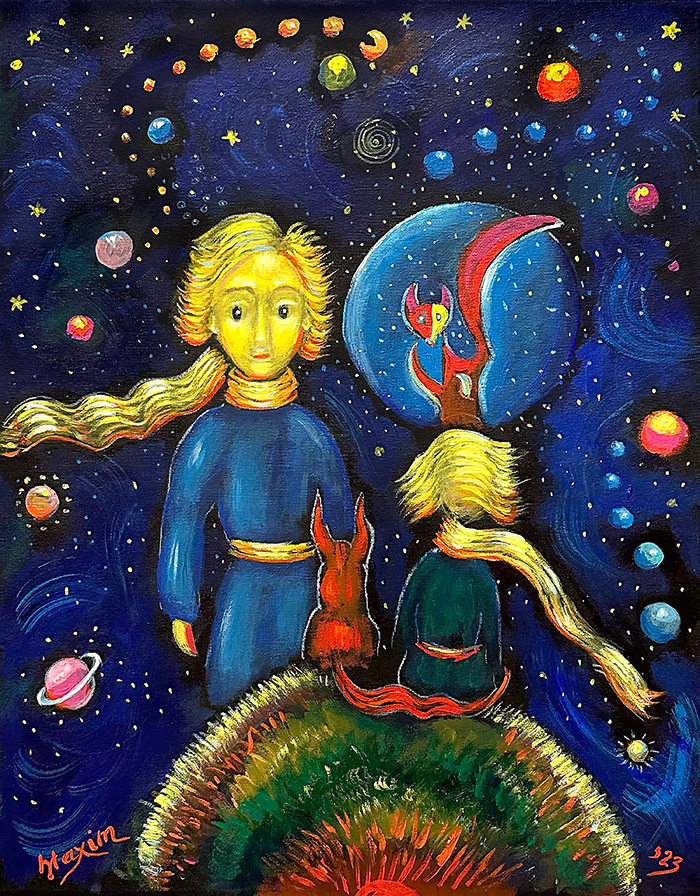
- Details
- Category: Maxim
"The Little Prince", acrylic on canvas, Bishop Maxim, 2023
Inventive and imaginative work of child naivety that speaks to children and pure innocence, invoking nostalgia in adults who long for the simplicity of youth. It offers a direct portal into Antoine de Saint-Exupéry's enchanting universe, featuring the beloved Little Prince and the wise fox against a celestial backdrop of planets and stars. As we search for the iconic Rose, the artist playfully suggests it resides within the viewer's heart, making the painting a mirror of our connection to love, innocence, and childhood magic. It invites us to rediscover simplicity and the power of imagination, keeping the spirit of youth alive in our hearts.
Inventive and imaginative work of child naivety that speaks to children and pure innocence, invoking nostalgia in adults who long for the simplicity of youth. It offers a direct portal into Antoine de Saint-Exupéry's enchanting universe, featuring the beloved Little Prince and the wise fox against a celestial backdrop of planets and stars. As we search for the iconic Rose, the artist playfully suggests it resides within the viewer's heart, making the painting a mirror of our connection to love, innocence, and childhood magic. It invites us to rediscover simplicity and the power of imagination, keeping the spirit of youth alive in our hearts.
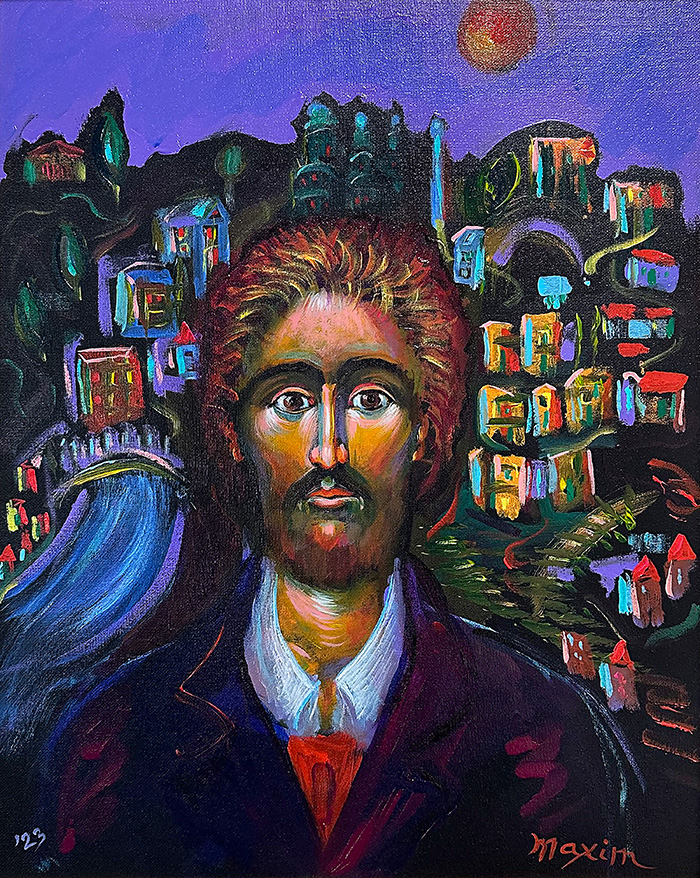
- Details
- Category: Maxim
"Violet Reverie: Prince Myshkin's Divine-Human Insight", acrylic on canvas, Bishop Maxim, 2023
In this painting depicting Prince Myshkin from Dostoyevsky’s novel “The Idiot,” the central focus is on his penetrating gaze. Myshkin’s hair appears to be in motion, creating a sense of dynamic energy around him. The portrayal of St. Petersburg in an abstract manner suggests a dreamlike or symbolic representation of the city. The violet-colored sky adds an ethereal and mystical atmosphere to the scene.
The key element of the painting is the Christ-like presence of Prince Myshkin, who seems to connect with the viewers on a profound level. His expression and demeanor convey a sense of wisdom, compassion, and understanding that transcends the boundaries of the canvas. This painting serves as a powerful reminder of Dostoyevsky’s literary genius, as it captures the essence of the character and his ability to offer solace and insight to both confident and insecure individuals alike. It symbolizes a spiritual connection with the author’s deep themes and characters.
In this painting depicting Prince Myshkin from Dostoyevsky’s novel “The Idiot,” the central focus is on his penetrating gaze. Myshkin’s hair appears to be in motion, creating a sense of dynamic energy around him. The portrayal of St. Petersburg in an abstract manner suggests a dreamlike or symbolic representation of the city. The violet-colored sky adds an ethereal and mystical atmosphere to the scene.
The key element of the painting is the Christ-like presence of Prince Myshkin, who seems to connect with the viewers on a profound level. His expression and demeanor convey a sense of wisdom, compassion, and understanding that transcends the boundaries of the canvas. This painting serves as a powerful reminder of Dostoyevsky’s literary genius, as it captures the essence of the character and his ability to offer solace and insight to both confident and insecure individuals alike. It symbolizes a spiritual connection with the author’s deep themes and characters.
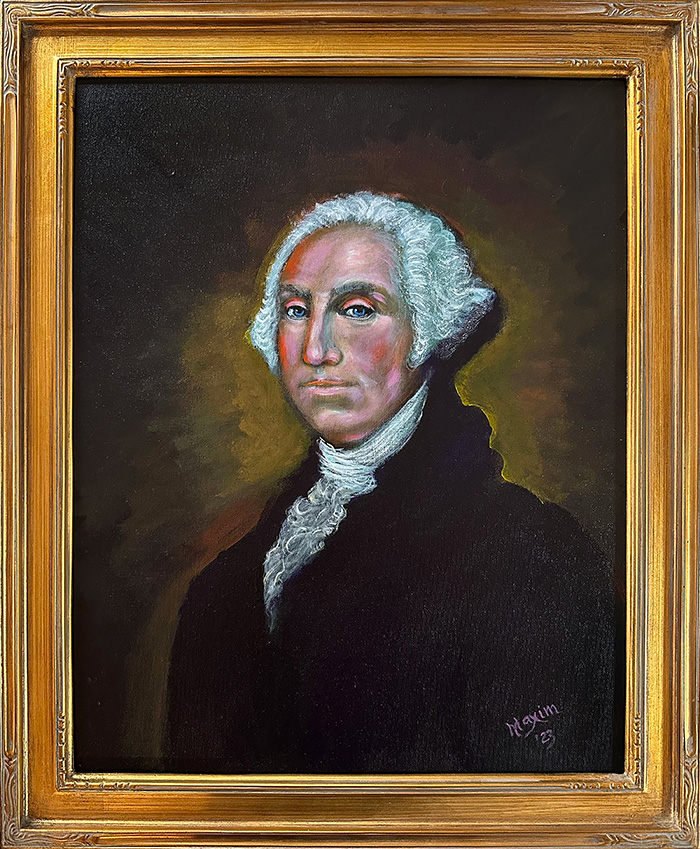
- Details
- Category: Maxim
"George Washington's Intimate Gaze: An Artistic Exploration", acrylic on canas, Bishop Maxim, 2023
In this portrait, George Washington stands before us, his gaze engaging and intimate. It beckons us to delve into the portrait through three lenses: the symbolic, the biographical, and the artistic. Draped in the regal attire of his era, Washington's face reveals a deep humanity, marked by the anxieties of his time and a resolute commitment to his historical role. This portrait transcends time, portraying a figure of courage, leadership, and timeless significance, inviting us to explore his character, history, and artistry in a profound exchange.
In this portrait, George Washington stands before us, his gaze engaging and intimate. It beckons us to delve into the portrait through three lenses: the symbolic, the biographical, and the artistic. Draped in the regal attire of his era, Washington's face reveals a deep humanity, marked by the anxieties of his time and a resolute commitment to his historical role. This portrait transcends time, portraying a figure of courage, leadership, and timeless significance, inviting us to explore his character, history, and artistry in a profound exchange.
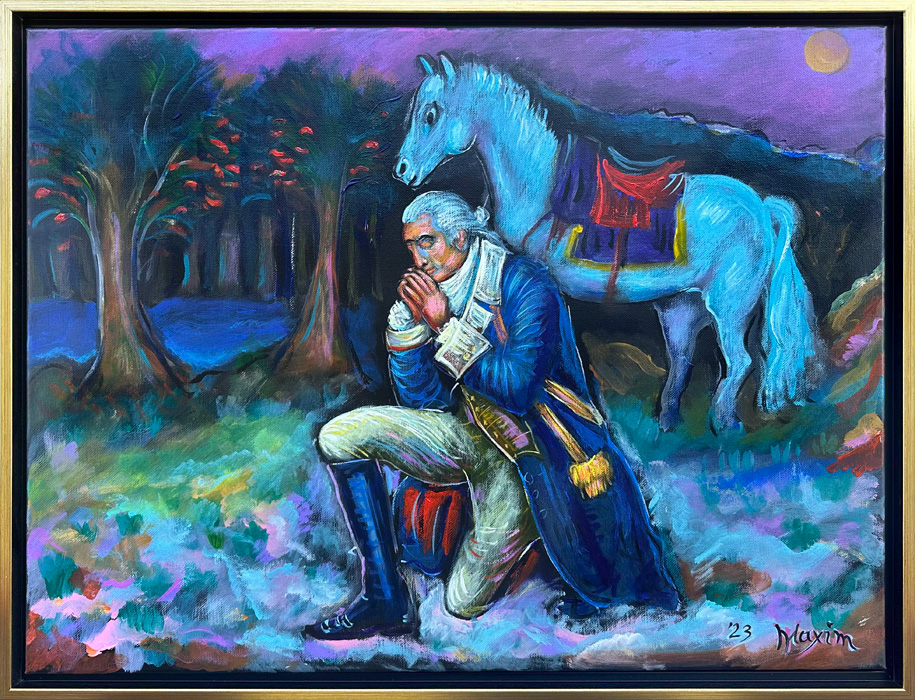
- Details
- Category: Maxim
“Washington’s Solitary Supplication at Valley Forge,” acrylic on canvas, Bishop Maxim, 2023
The artist masterfully achieves a compelling composition—simple, pristine, and evocative. President George Washington is depicted in the foreground, caught in a transitional moment between standing and kneeling, his left knee hovering just above the earth. In quiet obeisance, his horse stands sentinel in the backdrop. The natural surroundings—from the stoic trees to the imposing black mountain and the emotive purple sky—appear unresponsive, almost indifferent to Washington's profound distress. The focal point gravitates toward his closed eyelids, tracing a line from his eyes to his nose, mouth, chin, and fingers. Amidst palpable solitude, his PRAYER deepens, resonating potently with its divine receiver. One can’t help but feel the echoes of Gethsemane in this solemn tableau. — Stamatis Skliris
The artist masterfully achieves a compelling composition—simple, pristine, and evocative. President George Washington is depicted in the foreground, caught in a transitional moment between standing and kneeling, his left knee hovering just above the earth. In quiet obeisance, his horse stands sentinel in the backdrop. The natural surroundings—from the stoic trees to the imposing black mountain and the emotive purple sky—appear unresponsive, almost indifferent to Washington's profound distress. The focal point gravitates toward his closed eyelids, tracing a line from his eyes to his nose, mouth, chin, and fingers. Amidst palpable solitude, his PRAYER deepens, resonating potently with its divine receiver. One can’t help but feel the echoes of Gethsemane in this solemn tableau. — Stamatis Skliris
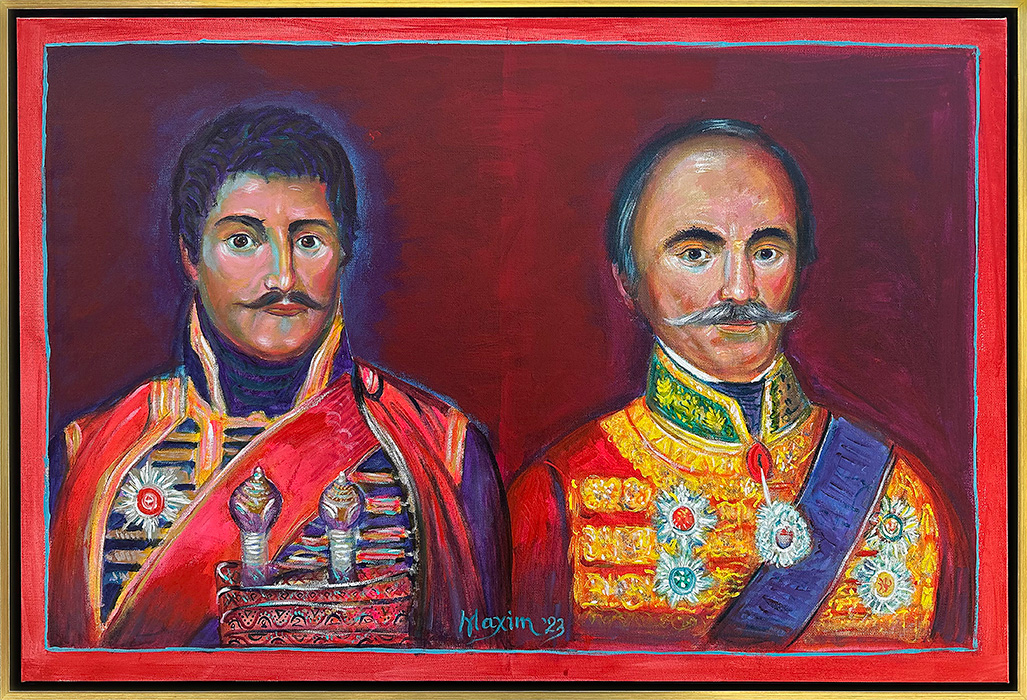
- Details
- Category: Maxim
"Leader Karadjordje and Prince Milos: Redemption in Unity", acrylic on canvas, Bishop Maxim, 2023
This evocative masterpiece weaves a narrative of historic significance. Depicting two figures, Leader Karadjordje and Prince Milos, who have transcended a past marred by bitter animosity, they now unite in a moment frozen by the artist's vision.
The backdrop, saturated in a deep, opulent red, chronicles their tumultuous past—a past tinged with the pain of conflict. Yet, amidst this overpowering crimson, the figures bask in a soft, ethereal light that bathes their countenances in a gentle radiance. Their faces, no longer marred by anger or bitterness, now bear the serene expressions of those who have transcended their differences. The artist's brushwork captures the essence of redemption, revealing a shared journey of forgiveness and healing.
In this canvas, history is rewritten, and the viewer is drawn into a world where adversaries become allies, and the very colors on the palette conspire to tell a story of hope, transformation, and the power of reconciliation.
This evocative masterpiece weaves a narrative of historic significance. Depicting two figures, Leader Karadjordje and Prince Milos, who have transcended a past marred by bitter animosity, they now unite in a moment frozen by the artist's vision.
The backdrop, saturated in a deep, opulent red, chronicles their tumultuous past—a past tinged with the pain of conflict. Yet, amidst this overpowering crimson, the figures bask in a soft, ethereal light that bathes their countenances in a gentle radiance. Their faces, no longer marred by anger or bitterness, now bear the serene expressions of those who have transcended their differences. The artist's brushwork captures the essence of redemption, revealing a shared journey of forgiveness and healing.
In this canvas, history is rewritten, and the viewer is drawn into a world where adversaries become allies, and the very colors on the palette conspire to tell a story of hope, transformation, and the power of reconciliation.
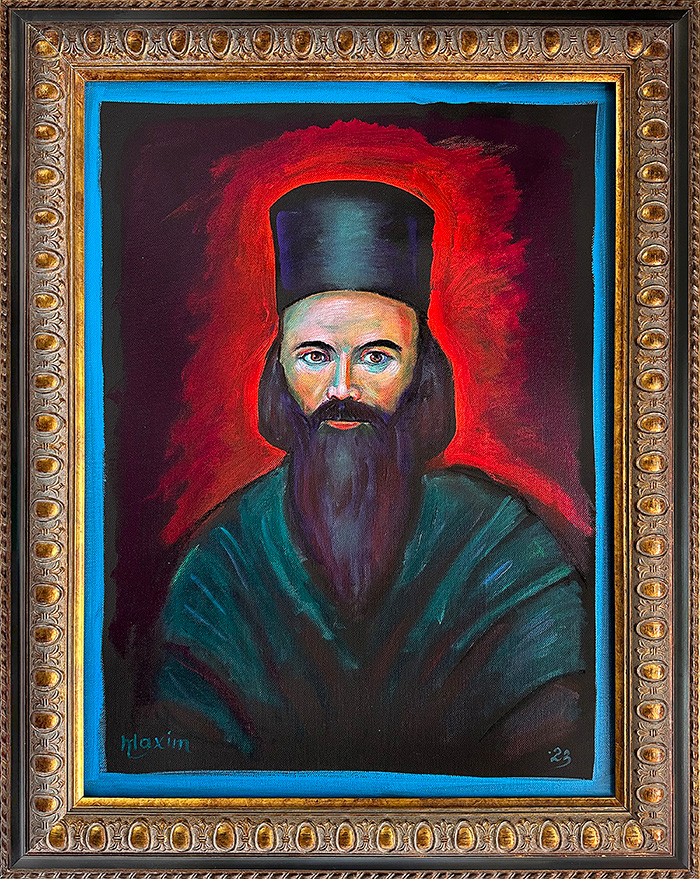
- Details
- Category: Maxim
"Monk Nicholai: A Confluence of Spiritual Traditions", acrylic on canvas, Bishop Maxim, 2023
Within "A Confluence of Spiritual Traditions," the canvas pulsates with a captivating dance of colors—the fiery reds juxtaposed against tranquil greens, manifesting the delicate interweaving of Eastern and Western spiritual narratives. Central to this vibrant tableau is the ascetic figure of young monk Nicholai. His visage, imbued with the wisdom and tranquility of both traditions, stands as a testament to the universality of spiritual insight. His eyes, deep wells of benediction and insight, serve as a portal, challenging viewers to transcend dichotomies and embrace the harmonious convergence of human spiritual journeys.
Within "A Confluence of Spiritual Traditions," the canvas pulsates with a captivating dance of colors—the fiery reds juxtaposed against tranquil greens, manifesting the delicate interweaving of Eastern and Western spiritual narratives. Central to this vibrant tableau is the ascetic figure of young monk Nicholai. His visage, imbued with the wisdom and tranquility of both traditions, stands as a testament to the universality of spiritual insight. His eyes, deep wells of benediction and insight, serve as a portal, challenging viewers to transcend dichotomies and embrace the harmonious convergence of human spiritual journeys.
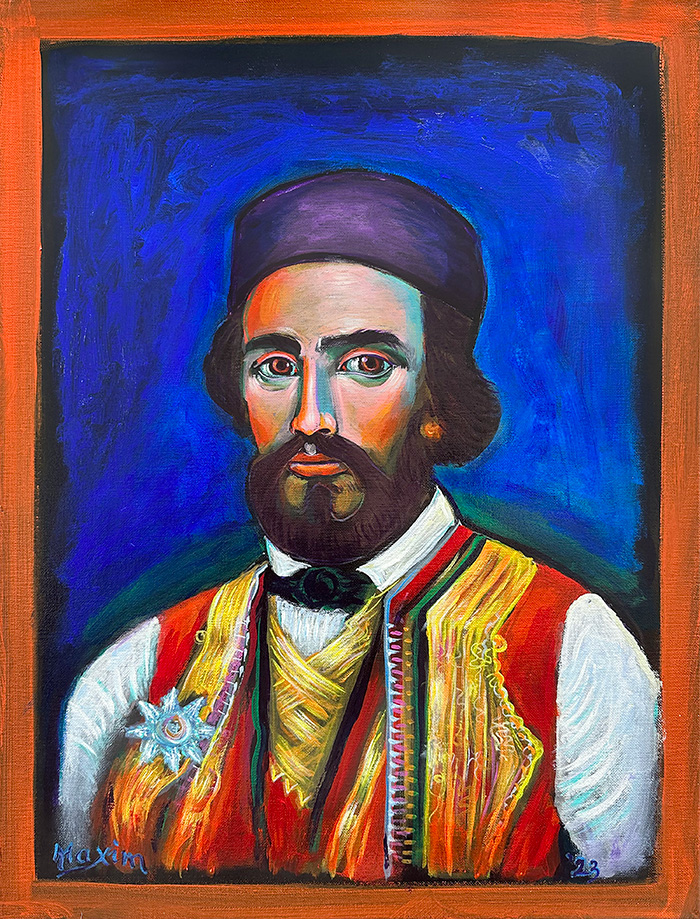
- Details
- Category: Maxim
"Visions of Transcendent Leadership: The Enigmatic Njegoš", acrylic on canvas, Bishop Maxim, 2023
Njegoš is depicted not merely as the striking figure he undeniably is, but also as a symbol of Montenegrin leadership, adorned with his distinct insignia. Yet, beneath the emblematic heroism, there resides a heart brimming with sensitivity, contemplation, and compassion. The artist, Maxim, conveys these layers of complexity through the portrayal of Njegoš’s eyes. They do not gleam with suspicion or fixate on tangible entities; instead, they veer slightly sideways, lost in expansive contemplation, exploring abstract dimensions. They emit emotions and navigate through intricate queries, discarding the superficial and delving profoundly into the enigma of existence.
These eyes are not caught in passive abstraction but are actively engaged in the realm of vision, perceiving the unseen and the incomprehensible, tapping into the unspoken and unseen facets of existence, akin to discovering the unseen side of the moon. They seem to anticipate the unforeseen, reflecting concern for the profound destinies of his people. Every element of this portrait echoes the unprecedented perceptiveness and sensitivity of the artist bishop.
Each rendition of him feels like a venture beyond established boundaries, a dance of colors, lines, landscapes, and human forms. It’s as if Maxim is enamored with every stroke and hue, pushing the boundaries of artistic expression. We might be witnessing the inception of an artistic journey, an ascent aiming to redefine the realms of high painting!
- Stamatis Skliris
Njegoš is depicted not merely as the striking figure he undeniably is, but also as a symbol of Montenegrin leadership, adorned with his distinct insignia. Yet, beneath the emblematic heroism, there resides a heart brimming with sensitivity, contemplation, and compassion. The artist, Maxim, conveys these layers of complexity through the portrayal of Njegoš’s eyes. They do not gleam with suspicion or fixate on tangible entities; instead, they veer slightly sideways, lost in expansive contemplation, exploring abstract dimensions. They emit emotions and navigate through intricate queries, discarding the superficial and delving profoundly into the enigma of existence.
These eyes are not caught in passive abstraction but are actively engaged in the realm of vision, perceiving the unseen and the incomprehensible, tapping into the unspoken and unseen facets of existence, akin to discovering the unseen side of the moon. They seem to anticipate the unforeseen, reflecting concern for the profound destinies of his people. Every element of this portrait echoes the unprecedented perceptiveness and sensitivity of the artist bishop.
Each rendition of him feels like a venture beyond established boundaries, a dance of colors, lines, landscapes, and human forms. It’s as if Maxim is enamored with every stroke and hue, pushing the boundaries of artistic expression. We might be witnessing the inception of an artistic journey, an ascent aiming to redefine the realms of high painting!
- Stamatis Skliris
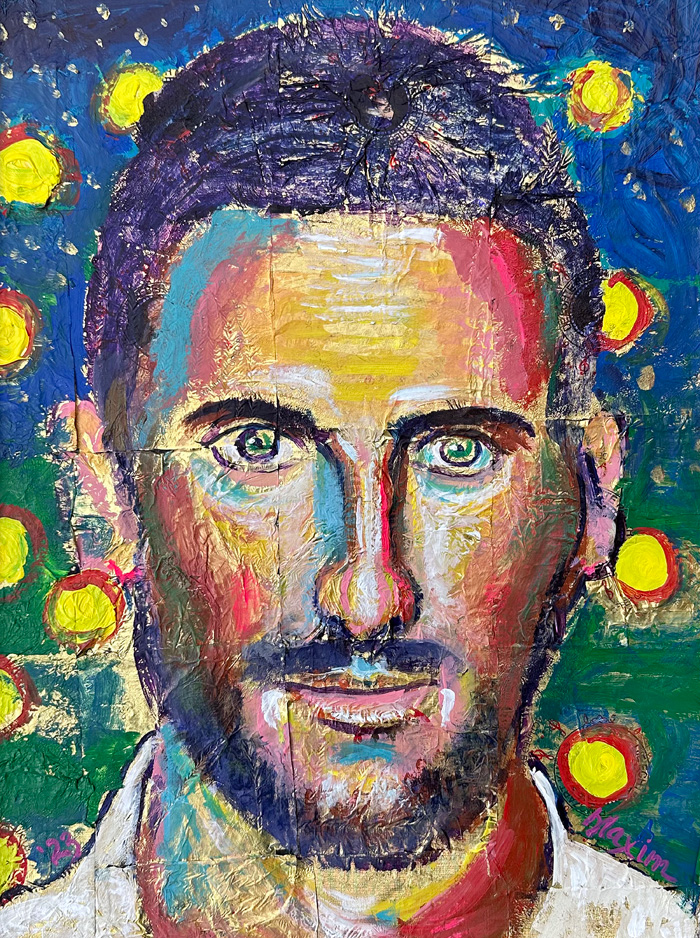
- Details
- Category: Maxim
"Resilient, Passionate Champion", acrylic on gold foil canvas, Bishop Maxim, 2023
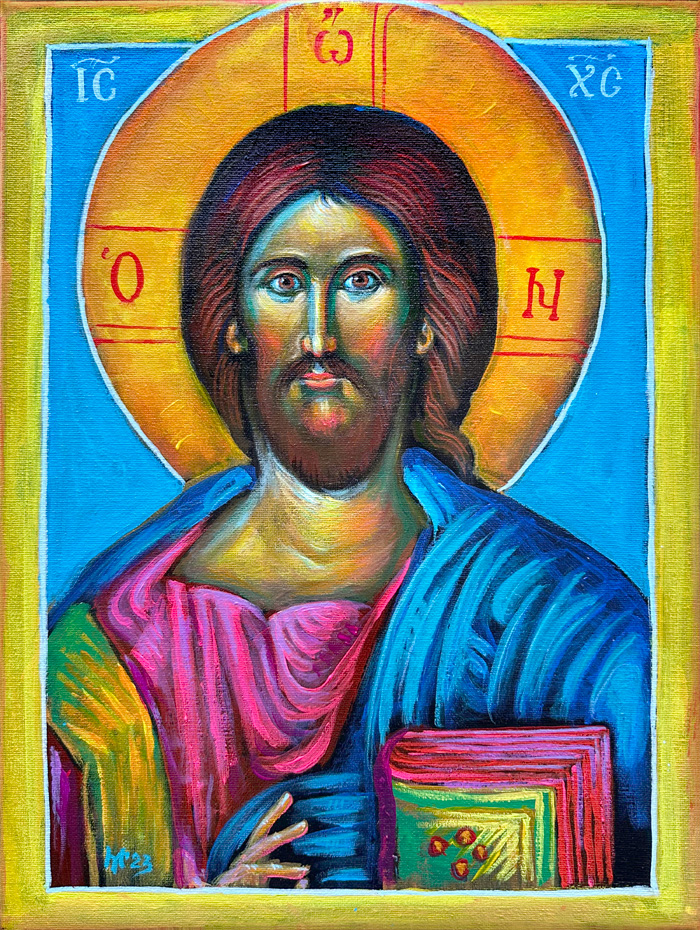
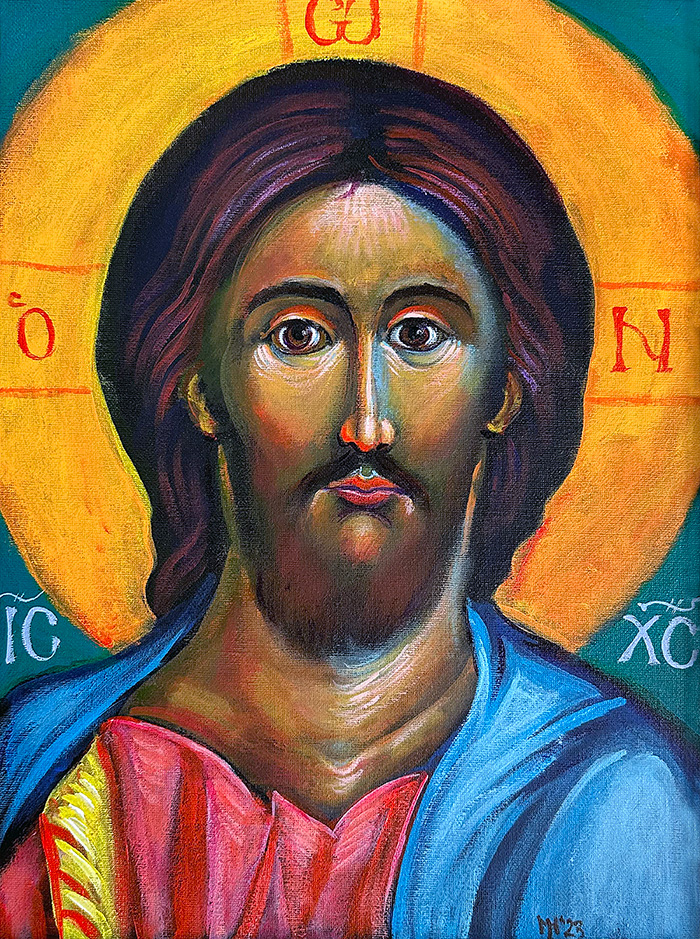
- Details
- Category: Maxim
"Christ the Savior", acrylic on canvas, Bishop Maxim, 2023
This image of Christ conveys an immediate and intense heat in the rich vibrance of the colors which command attention, but slowly the focal point of the icon becomes the face and particularly the eyes. Their gaze matches the intensity of the colors that blaze out as an expression of the “O W N.” Gradually they reveal a subtle difference, like the eyes of the famous St Catherine Icon of the Pantokrator. The left eye of Christ is wide open, all-seeing of the human condition yet with a subtle gentleness and humility evident, while the right eye has a more sustained and sober focus. Subtle differences in the left and right side of the face in addition convey the mystery of human and divine that remains true, even with the intensity of the now risen Lord. In its vivid expressionistic caste the image moves beyond the more representational icons that emphasize the human qualities of Christ more than the infinite power and love of God that shines through him to reveal the "glory of God in the face of Jesus Christ!" - Stephen Muse
This image of Christ conveys an immediate and intense heat in the rich vibrance of the colors which command attention, but slowly the focal point of the icon becomes the face and particularly the eyes. Their gaze matches the intensity of the colors that blaze out as an expression of the “O W N.” Gradually they reveal a subtle difference, like the eyes of the famous St Catherine Icon of the Pantokrator. The left eye of Christ is wide open, all-seeing of the human condition yet with a subtle gentleness and humility evident, while the right eye has a more sustained and sober focus. Subtle differences in the left and right side of the face in addition convey the mystery of human and divine that remains true, even with the intensity of the now risen Lord. In its vivid expressionistic caste the image moves beyond the more representational icons that emphasize the human qualities of Christ more than the infinite power and love of God that shines through him to reveal the "glory of God in the face of Jesus Christ!" - Stephen Muse
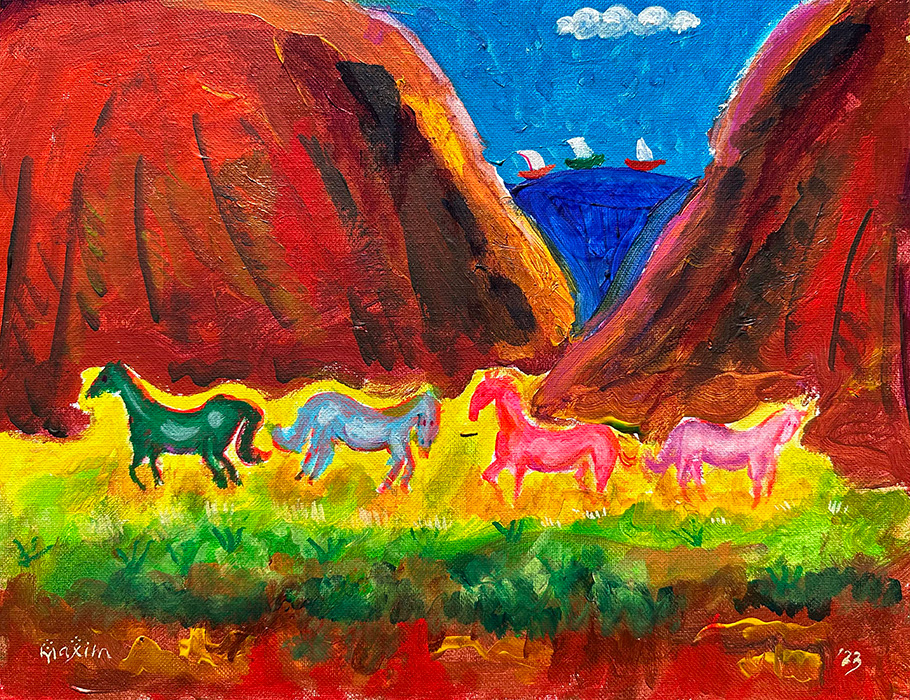
- Details
- Category: Maxim
"Discovering Pacifica", acrylic on canvas, Bishop Maxim, 2023
On a vast canvas that seems to capture the untouched spirit of the Pacific, we are met with a harmonious blend of land, sea, and sky. The dry, golden grasses underfoot serve as nature's rugged carpet, swaying gently, hinting at the coastal breezes. Amidst this sea of grass stand four majestic horses, each distinct in color and stature, perhaps representing the diverse spirit of the land itself.
Two imposing mountains rise to the sides, framing the scene, their jagged peaks reaching for the skies as ancient guardians of the terrain. These natural behemoths cast faint shadows, providing contrast to the luminous day.
Beyond, the grand Pacific stretches infinitely, its vastness broken only by three boats sailing gracefully. They float in the distance, their sails capturing the essence of exploration and adventure. Above them, a solitary cloud drifts, a gentle reminder of the unpredictable yet nurturing nature of the world.
The abundant sunshine seems to be nature's affirmation of life's endless possibilities.
"Discovering Pacifica" invites viewers to observe and feel the pulse of this wild, magnificent world, where land, sea, and sky converge in a timeless dance.
On a vast canvas that seems to capture the untouched spirit of the Pacific, we are met with a harmonious blend of land, sea, and sky. The dry, golden grasses underfoot serve as nature's rugged carpet, swaying gently, hinting at the coastal breezes. Amidst this sea of grass stand four majestic horses, each distinct in color and stature, perhaps representing the diverse spirit of the land itself.
Two imposing mountains rise to the sides, framing the scene, their jagged peaks reaching for the skies as ancient guardians of the terrain. These natural behemoths cast faint shadows, providing contrast to the luminous day.
Beyond, the grand Pacific stretches infinitely, its vastness broken only by three boats sailing gracefully. They float in the distance, their sails capturing the essence of exploration and adventure. Above them, a solitary cloud drifts, a gentle reminder of the unpredictable yet nurturing nature of the world.
The abundant sunshine seems to be nature's affirmation of life's endless possibilities.
"Discovering Pacifica" invites viewers to observe and feel the pulse of this wild, magnificent world, where land, sea, and sky converge in a timeless dance.
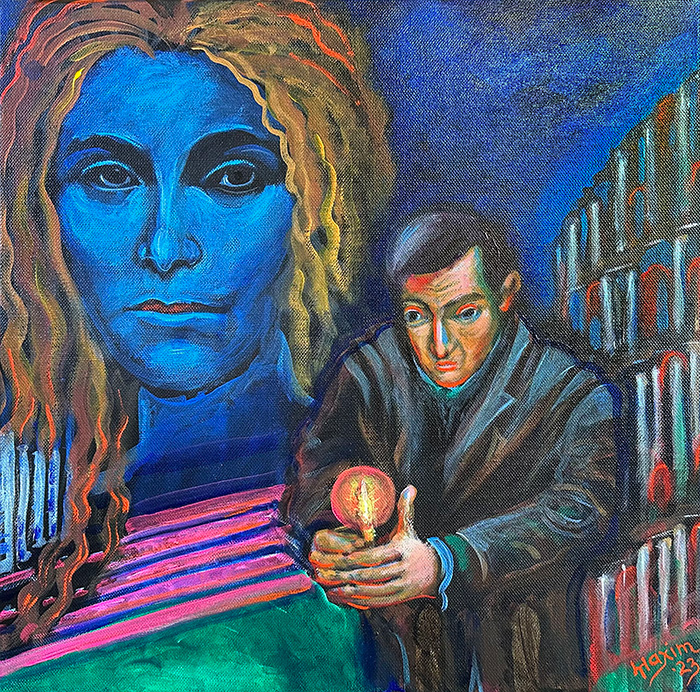
- Details
- Category: Maxim
"Andrei’s Journey (Nostalghia)", acrylic on canvas, 40x40cm, Bishop Maxim, 2023
In Tarkovsky’s “Nostalghia,” the delicate dance of a candle's flame encapsulates life's fleeting essence within the vastness of existence. A lone figure's journey across an empty pool becomes a mesmerizing ballet against the capricious winds of fate. Entranced by the artist's lens, we are drawn into a timeless waltz, where heartbeats, droplets, and fire’s whisper intertwine. This poignant tableau captures humanity’s eternal cycle of birth, longing, and inevitable end. Amid the dance of existence, Eugenia’s silhouette with flowing curls subtly graces the background. Her ethereal presence adds mystery, witnessing and partaking in life’s transient tapestry. Her shadow, set against the broader narrative, poetically captures the interplay of individual paths within life’s endless cycle.
In Tarkovsky’s “Nostalghia,” the delicate dance of a candle's flame encapsulates life's fleeting essence within the vastness of existence. A lone figure's journey across an empty pool becomes a mesmerizing ballet against the capricious winds of fate. Entranced by the artist's lens, we are drawn into a timeless waltz, where heartbeats, droplets, and fire’s whisper intertwine. This poignant tableau captures humanity’s eternal cycle of birth, longing, and inevitable end. Amid the dance of existence, Eugenia’s silhouette with flowing curls subtly graces the background. Her ethereal presence adds mystery, witnessing and partaking in life’s transient tapestry. Her shadow, set against the broader narrative, poetically captures the interplay of individual paths within life’s endless cycle.
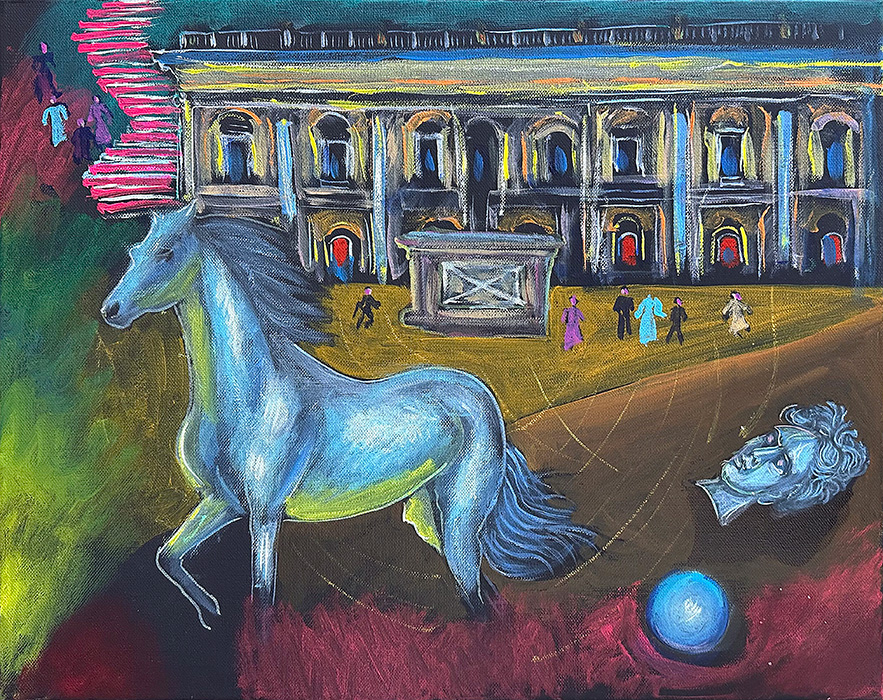
- Details
- Category: Maxim
"Piazza del Campidoglio (Nostalghia)", acrylic on canvas, 40x50cm, Bishop Maxim, 2023
In the heart of the square, a solitary voice weaves a tapestry of existential lament while dispassion-ate onlookers steep in veils of skepticism. The artist bathes the scene in an alchemy of diffused luminescence and the vibrant hues of a fleeing stallion, anchoring the moment in dreamlike surrealism. Within this ethereal tableau, the artist's brush strokes evoke humanity's eternal quest for connection amidst the fragments of a splintered cosmos. In Tarkovsky’s “Nostalgia,” the square becomes a poignant backdrop for Domenico’s heartfelt speech, epitomizing deep longing and existential angst. As Domenico fervently speaks, the initially indifferent crowd transforms into a canvas of skepticism and understanding. Tarkovsky’s diffused light and ambient sounds immerse the viewer, grounding the scene in palpable realism. Amidst this setting, the film captures humanity's ceaseless search for purpose and connection in a disjointed world.
In the heart of the square, a solitary voice weaves a tapestry of existential lament while dispassion-ate onlookers steep in veils of skepticism. The artist bathes the scene in an alchemy of diffused luminescence and the vibrant hues of a fleeing stallion, anchoring the moment in dreamlike surrealism. Within this ethereal tableau, the artist's brush strokes evoke humanity's eternal quest for connection amidst the fragments of a splintered cosmos. In Tarkovsky’s “Nostalgia,” the square becomes a poignant backdrop for Domenico’s heartfelt speech, epitomizing deep longing and existential angst. As Domenico fervently speaks, the initially indifferent crowd transforms into a canvas of skepticism and understanding. Tarkovsky’s diffused light and ambient sounds immerse the viewer, grounding the scene in palpable realism. Amidst this setting, the film captures humanity's ceaseless search for purpose and connection in a disjointed world.
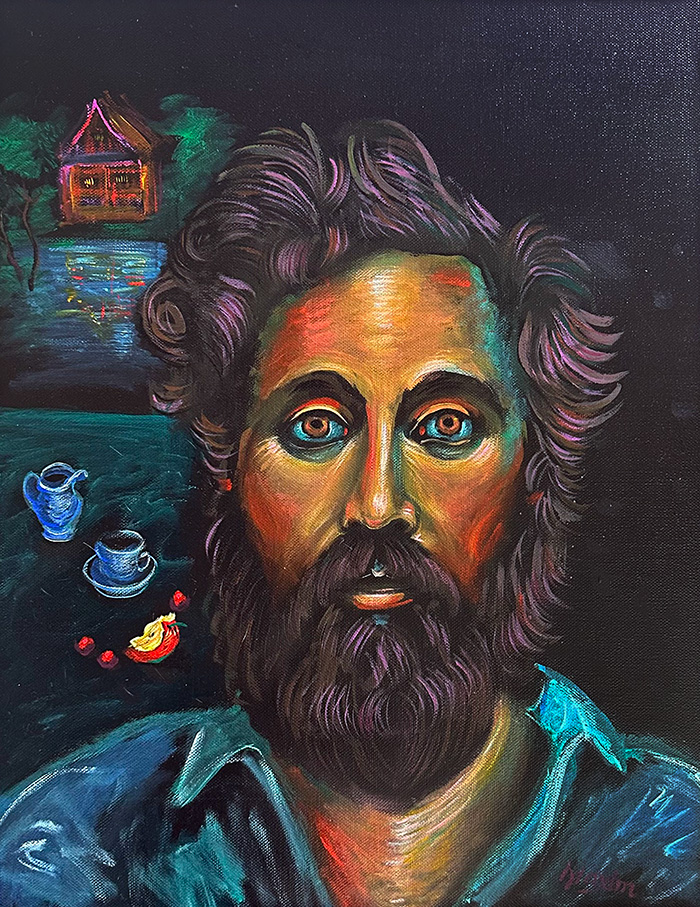
- Details
- Category: Maxim
"Sacrifice No 1", acrylic on canvas, 45x35cm, Bishop Maxim, 2023
In Tarkovsky’s enigmatic film “Sacrifice,” the main character is Alexander, an intellectual and former actor. Alexander’s character grapples with profound existential and spiritual questions in the shadow of impending nuclear apocalypse. On the eve of his birthday, amidst news of the impending doom, he makes a desperate plea to God: he offers to give up everything he holds dear, including his beloved family and newly acquired home, in exchange for the world's salvation. Alexander’s character serves as a symbol of humanity’s deep-seated spiritual anguish and the lengths one might go to find meaning and redemption. The act of “sacrifice” stands as a testament to the profound human need for spiritual connection and the internal battles one faces when confronting the abyss of despair. In essence, through Alexander, Tarkovsky delves deep into the themes of faith, despair, and redemption, challenging viewers to confront their own beliefs about sacrifice and the nature of existence.
In Tarkovsky’s enigmatic film “Sacrifice,” the main character is Alexander, an intellectual and former actor. Alexander’s character grapples with profound existential and spiritual questions in the shadow of impending nuclear apocalypse. On the eve of his birthday, amidst news of the impending doom, he makes a desperate plea to God: he offers to give up everything he holds dear, including his beloved family and newly acquired home, in exchange for the world's salvation. Alexander’s character serves as a symbol of humanity’s deep-seated spiritual anguish and the lengths one might go to find meaning and redemption. The act of “sacrifice” stands as a testament to the profound human need for spiritual connection and the internal battles one faces when confronting the abyss of despair. In essence, through Alexander, Tarkovsky delves deep into the themes of faith, despair, and redemption, challenging viewers to confront their own beliefs about sacrifice and the nature of existence.
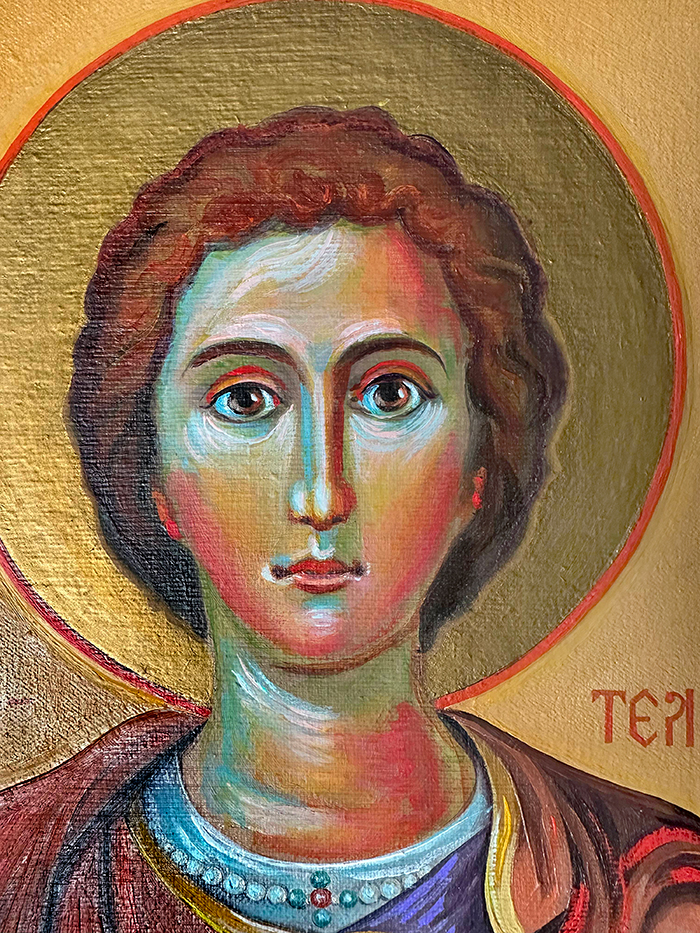
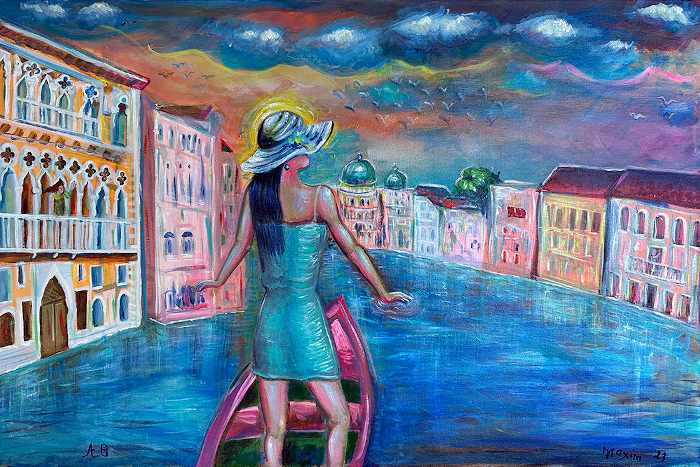
- Details
- Category: Maxim
“Life Rushes into a City Museum”, acrylic on canvas, Bishop Maxim, 2023
In history's archived “class”, the disorder of youthful otherness invades! As a city museum, Venice is unexpectedly visited by the swelling life of youthful freedom, which awakens the archived past from its museum enchantment. A girl balancing on a boat gondola associates a carefree walk-through of antiquity and the present—toward the future. The details of the hair and hat of the young woman, all scenes from behind, make a focal point as she surveys the way ahead unfolding in front of her. This future is what is all promised and unknown. Her hands suggest a delicate balance as she moves with the current without oars, trusting the water and more interested in what she is seeing and experiencing than in rushing to get somewhere. It is an image of active presence to “what is” embodied and watchful. We cannot see her feet or whether there is one in the boat who steers it for her and protect her. A glorious sunset beckons with billowing clouds hiding the fullness of the sun. She feels free enough to stand, suggesting there is someone with her even though there are no other people to be seen in the painting. She is the center of our attention, and the world is the center of hers.
In history's archived “class”, the disorder of youthful otherness invades! As a city museum, Venice is unexpectedly visited by the swelling life of youthful freedom, which awakens the archived past from its museum enchantment. A girl balancing on a boat gondola associates a carefree walk-through of antiquity and the present—toward the future. The details of the hair and hat of the young woman, all scenes from behind, make a focal point as she surveys the way ahead unfolding in front of her. This future is what is all promised and unknown. Her hands suggest a delicate balance as she moves with the current without oars, trusting the water and more interested in what she is seeing and experiencing than in rushing to get somewhere. It is an image of active presence to “what is” embodied and watchful. We cannot see her feet or whether there is one in the boat who steers it for her and protect her. A glorious sunset beckons with billowing clouds hiding the fullness of the sun. She feels free enough to stand, suggesting there is someone with her even though there are no other people to be seen in the painting. She is the center of our attention, and the world is the center of hers.
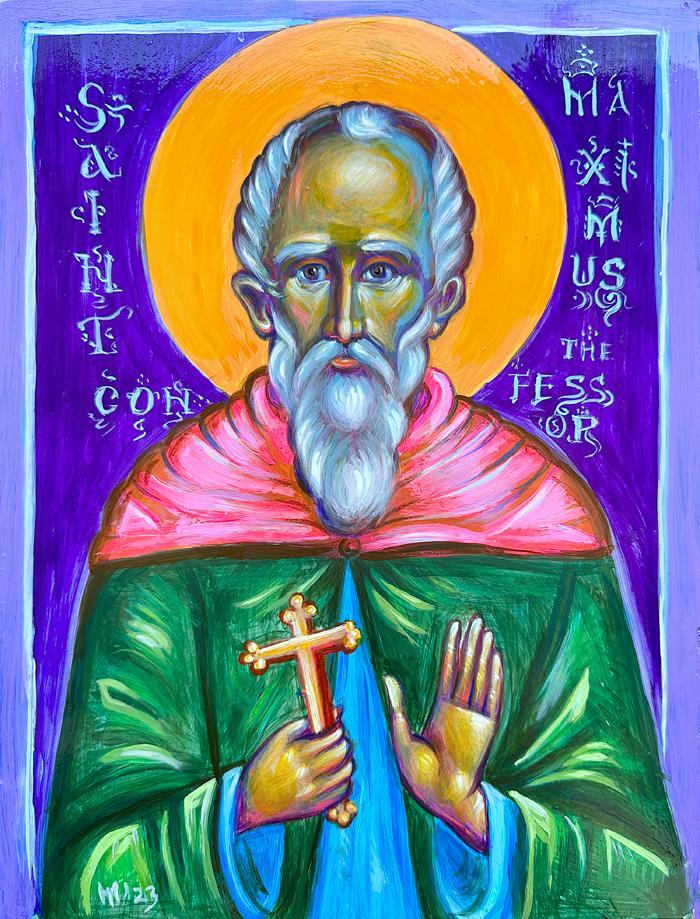
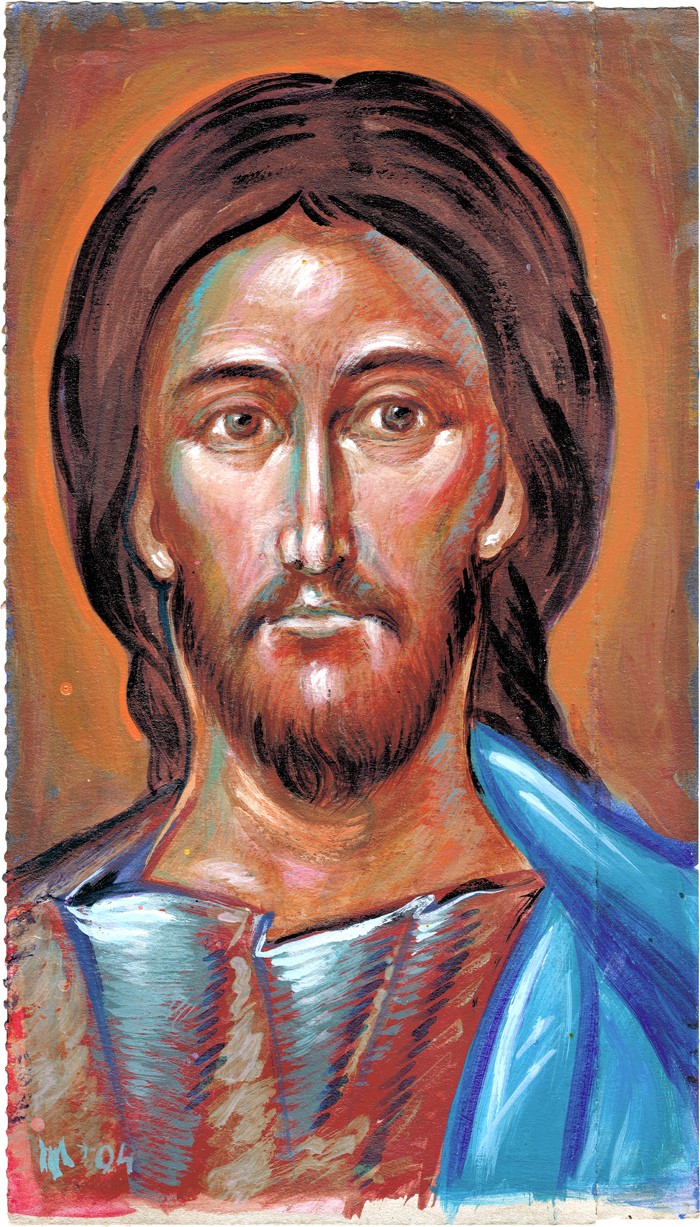
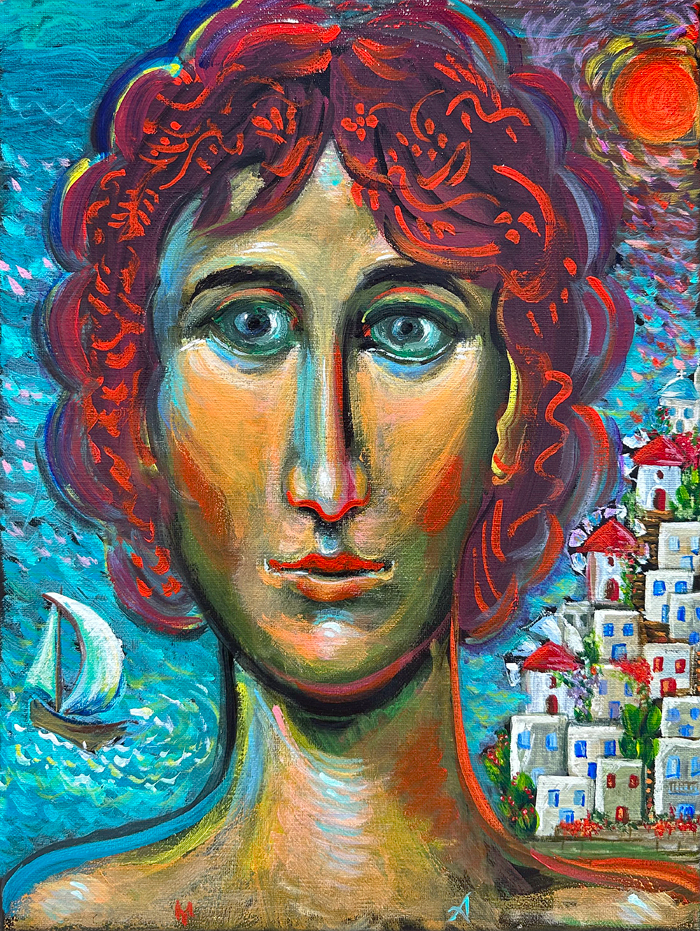
- Details
- Category: Maxim
"The Enigma Has Not Been Explained", acrylic on canvas, Bishop Maxim & A. Thermou, 2023
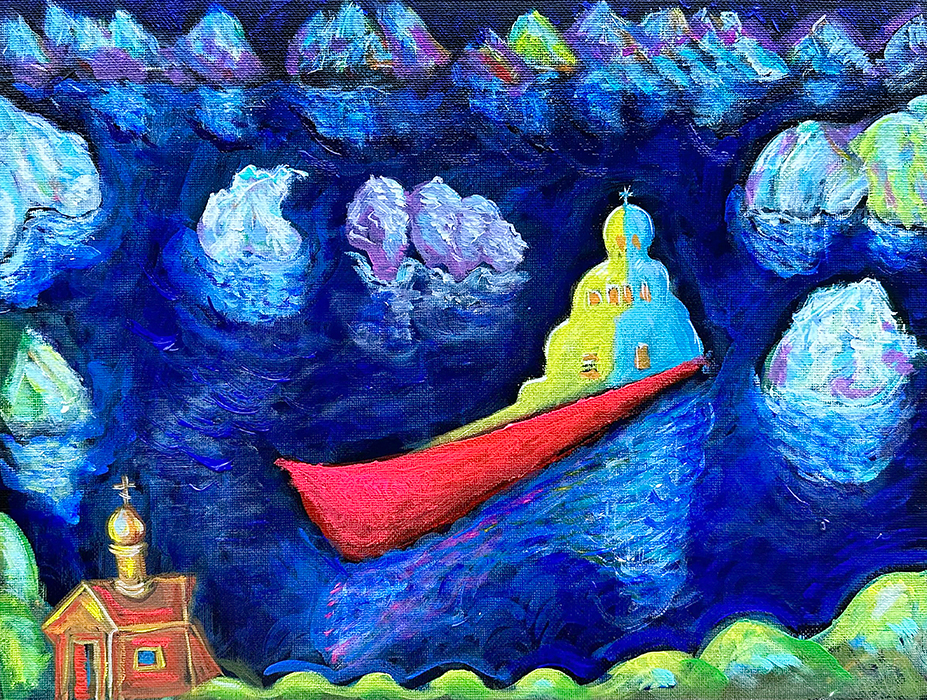
- Details
- Category: Maxim
"Midnight Scene in Alaska Lit Up by Moonlight and Aurora Borealis", acrylic on canvas, Bishop Maxim, 2023
Although it is modern and has many arbitrary elements due to modernité, it still maintains realism in convincingly rendering the wet element, the frozen element, and the feeling of being illuminated by the sun, as in the cabin of the ship shining in the sunshine.
The little church is a golden jewel; you feel like leaving the ship and going down to pray. The opposite icebergs are mirrored very successfully in the waters of the sea. The painter has put some purple highlights on them successfully.
The most successful is the steamboat that dominates the middle of the painting, thanks to its original shape and bright colors, red, yellow, and blue. Here the painter achieved real originality. He did what Picasso wrote: "When I build a boat, I want it to be my own boat and not an imitation of another."
Although it is modern and has many arbitrary elements due to modernité, it still maintains realism in convincingly rendering the wet element, the frozen element, and the feeling of being illuminated by the sun, as in the cabin of the ship shining in the sunshine.
The little church is a golden jewel; you feel like leaving the ship and going down to pray. The opposite icebergs are mirrored very successfully in the waters of the sea. The painter has put some purple highlights on them successfully.
The most successful is the steamboat that dominates the middle of the painting, thanks to its original shape and bright colors, red, yellow, and blue. Here the painter achieved real originality. He did what Picasso wrote: "When I build a boat, I want it to be my own boat and not an imitation of another."
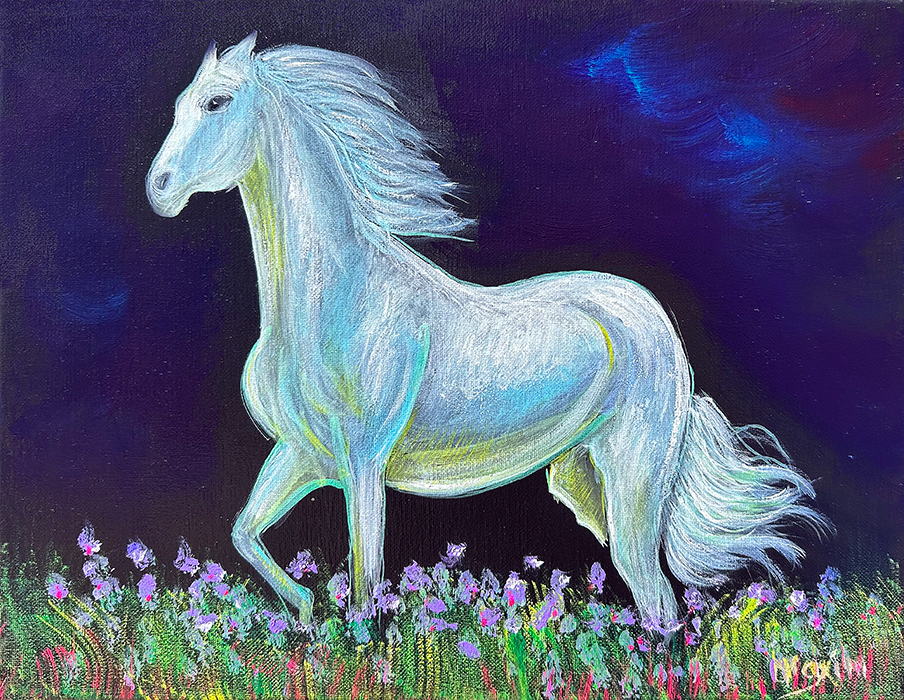
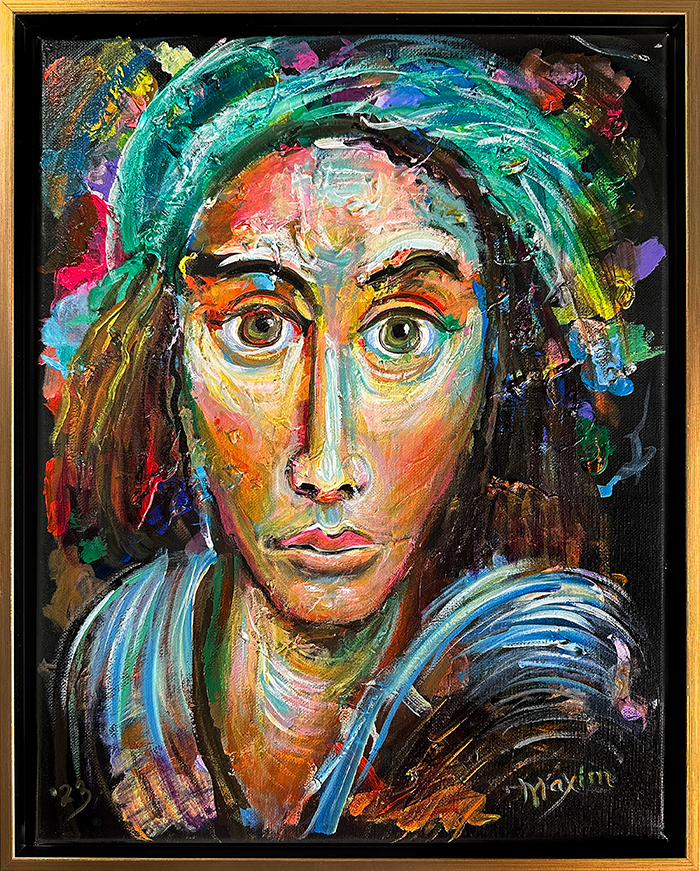
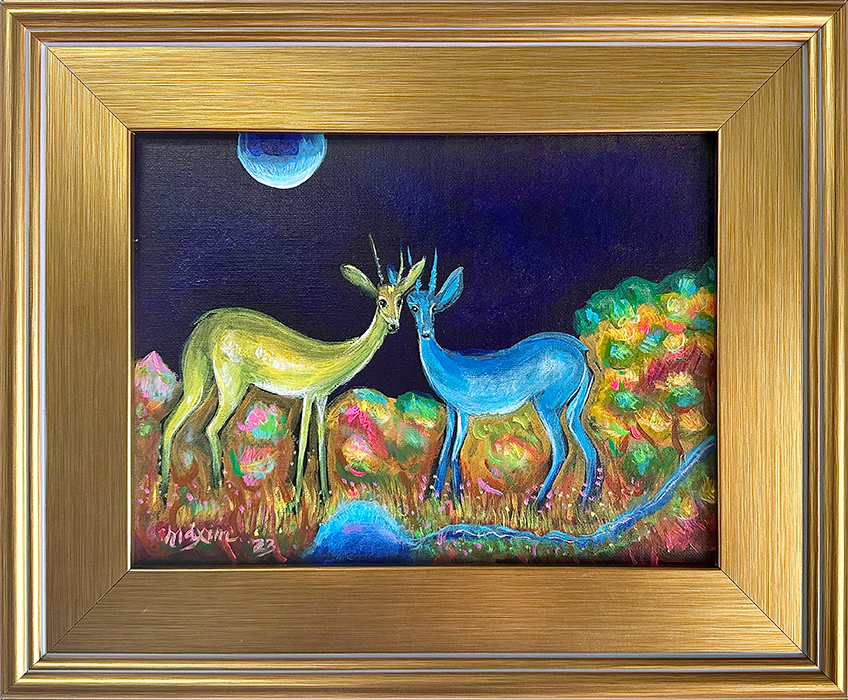
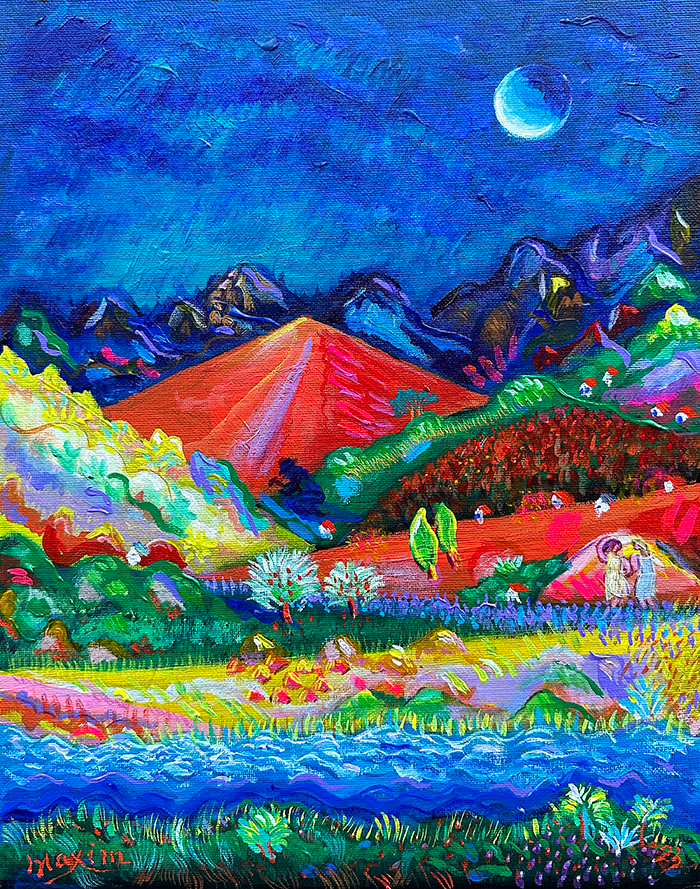
- Details
- Category: Maxim
"Surreal Landscape", acrylic on canvas, Bishop Maxim, 2023
The dazzling clarity of the atmosphere and the almost metaphysical purity of the colors are the virtues of the painting, which transports us to a surreal landscape, where all the depicted beings and all their details are illuminated by an endless light.
The dazzling clarity of the atmosphere and the almost metaphysical purity of the colors are the virtues of the painting, which transports us to a surreal landscape, where all the depicted beings and all their details are illuminated by an endless light.
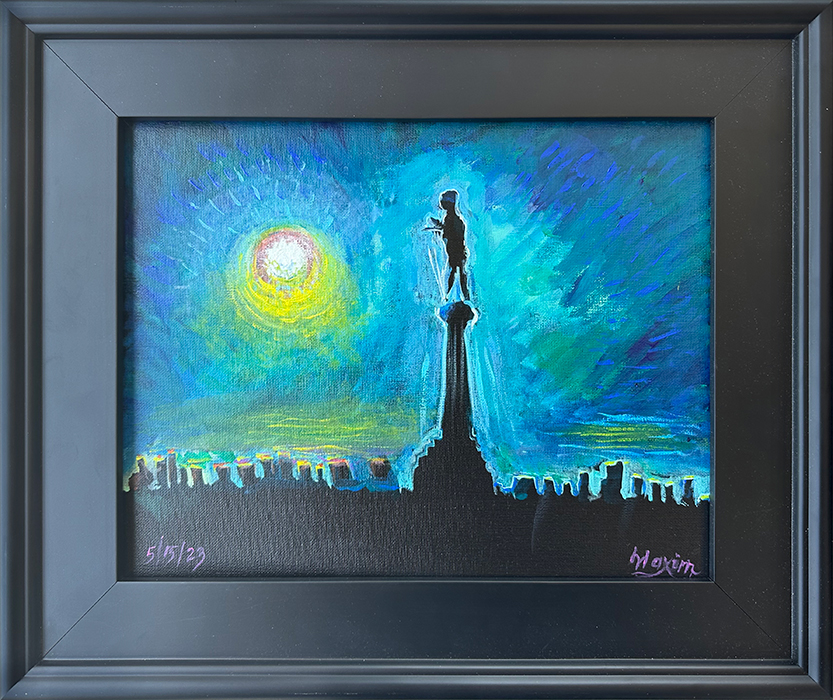
- Details
- Category: Maxim
"Belgrade is Awakening—Pobednik (The Victor) Monument in Belgrade”, acrylic on canvas, Bishop Maxim, 2023
With simple means, it gives the sense of “here I am, in the middle, the hero, and beyond the others.” The hero is another light source parallel to the sun or moon. Here my loneliness (perhaps very fruitful), in the middle, is the ONTOLOGY of the hero who has no complex but the greatness of his TRUTH, which was tested and remained historical, self-evident. And beyond the crowd that is made up of lonely people, each of whom might emerge as a hero. There are two kinds of existential relationships in this painting: 1. The crowd and me. What role am I playing? Will I become a great hero one day or sink into obscurity? 2. The hero and me. I admire him. I honor him and his ethos. But will I succeed in becoming a person, someone who has something special? Will the gifts I admire in the hero lead me to become an archetypal persona, or will I simply remain in admiration? — Stamatis Skliris
With simple means, it gives the sense of “here I am, in the middle, the hero, and beyond the others.” The hero is another light source parallel to the sun or moon. Here my loneliness (perhaps very fruitful), in the middle, is the ONTOLOGY of the hero who has no complex but the greatness of his TRUTH, which was tested and remained historical, self-evident. And beyond the crowd that is made up of lonely people, each of whom might emerge as a hero. There are two kinds of existential relationships in this painting: 1. The crowd and me. What role am I playing? Will I become a great hero one day or sink into obscurity? 2. The hero and me. I admire him. I honor him and his ethos. But will I succeed in becoming a person, someone who has something special? Will the gifts I admire in the hero lead me to become an archetypal persona, or will I simply remain in admiration? — Stamatis Skliris
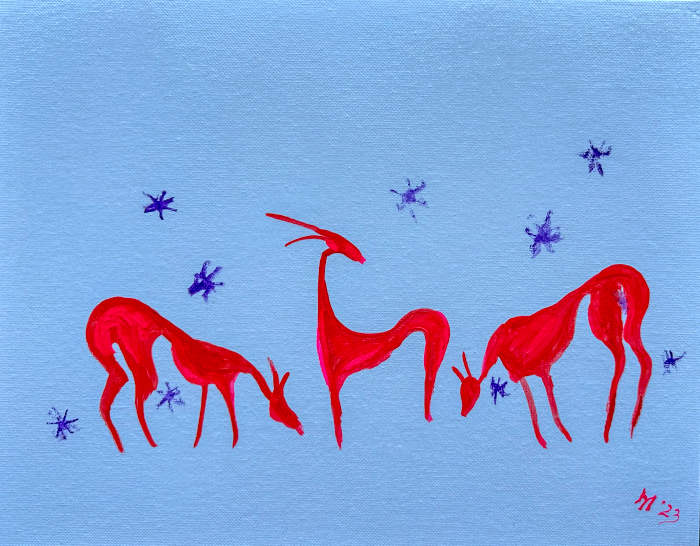
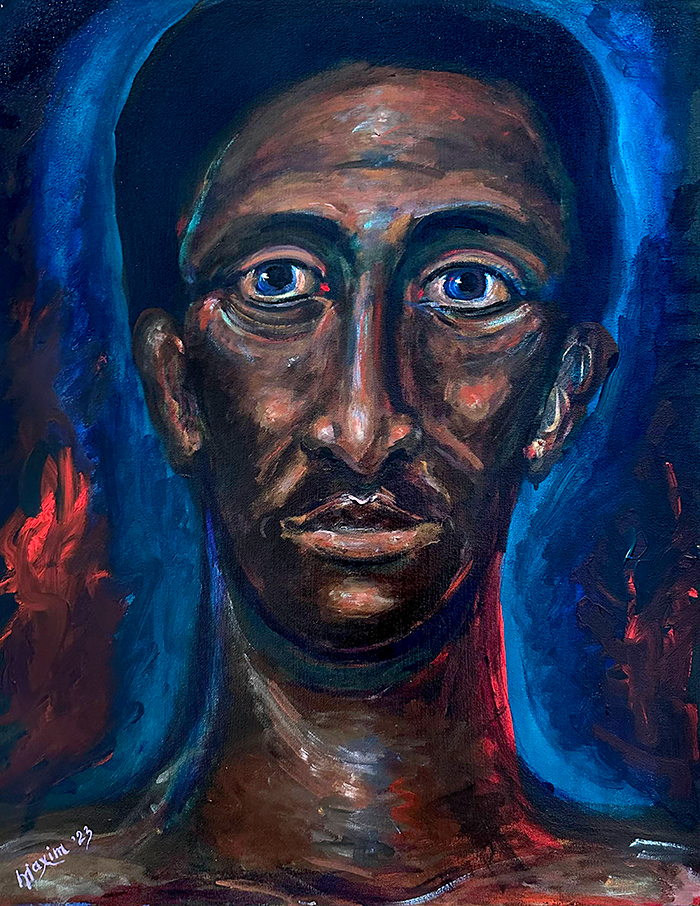
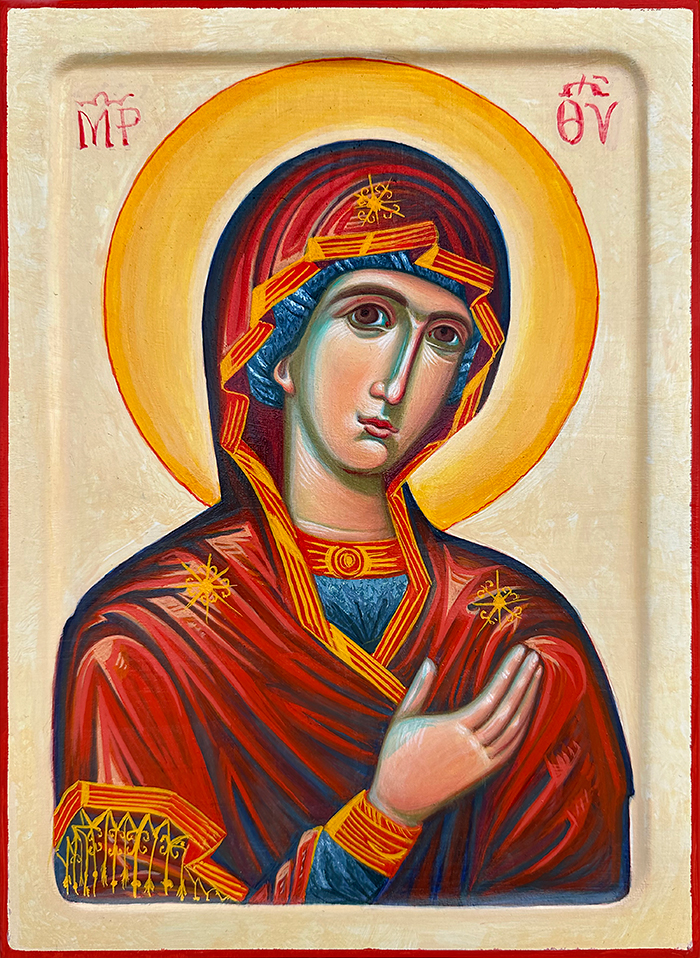
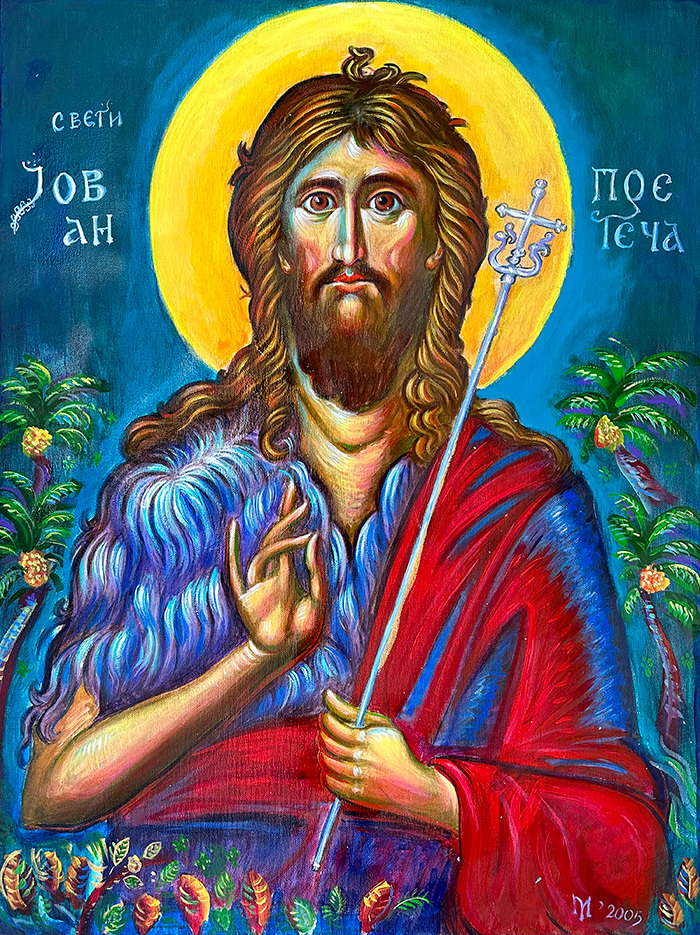
- Details
- Category: Maxim
"Holy Forerunner", acrylic on canvas, Sarajevo-Kraljevo, Bishop Maxim, 2005-2023
It is one of the mature works of Bishop Maxim, with which he is now listed as one of the important and original Orthodox iconographers. Without imitating any specific School from the old ones, but also without escaping from the real traditional ethos of the icons of the Orthodox Church, he gives us an image that presents all the hagiological characteristics that constitute the Orthodox icon of the Holy Forerunner John. This image can enter the churches, and we can pray to this Preacher of repentance, in the desert of Jordan, to the courageous judge of authority, and at the same time to the Saint who experiences the adventure of man and cares and helps him to overcome temptations walking with difficulty the path of love towards Christ and people. In front of us is a significant portrait that looks at us with a strong eagle’s gaze that prophetically refers to the words that Christ would later address to his disciples: “Take courage; I have overcome the world.”
This image, which we believe will inspire iconographers of the future, is addressed mainly to young people who struggle with spiritual courage against evil and indifference. No less, however, it refers, with the unbeatable strength it emanates, to the future Kingdom, where we will live the overcoming of evil and love one another “in the likeness” of the Christ Archetype throughout the ages.
- Fr Stamatis Skliris
It is one of the mature works of Bishop Maxim, with which he is now listed as one of the important and original Orthodox iconographers. Without imitating any specific School from the old ones, but also without escaping from the real traditional ethos of the icons of the Orthodox Church, he gives us an image that presents all the hagiological characteristics that constitute the Orthodox icon of the Holy Forerunner John. This image can enter the churches, and we can pray to this Preacher of repentance, in the desert of Jordan, to the courageous judge of authority, and at the same time to the Saint who experiences the adventure of man and cares and helps him to overcome temptations walking with difficulty the path of love towards Christ and people. In front of us is a significant portrait that looks at us with a strong eagle’s gaze that prophetically refers to the words that Christ would later address to his disciples: “Take courage; I have overcome the world.”
This image, which we believe will inspire iconographers of the future, is addressed mainly to young people who struggle with spiritual courage against evil and indifference. No less, however, it refers, with the unbeatable strength it emanates, to the future Kingdom, where we will live the overcoming of evil and love one another “in the likeness” of the Christ Archetype throughout the ages.
- Fr Stamatis Skliris
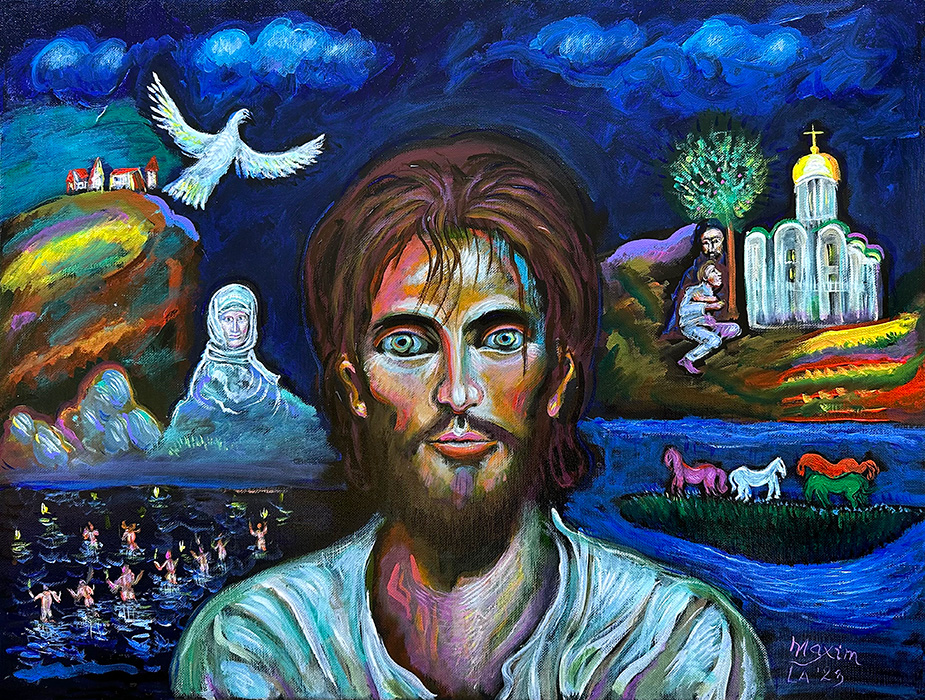
- Details
- Category: Maxim
"Beholding the Trinity - Andrei Rublev of Andrei Tarkovsky", acrylic on canvas, Bishop Maxim, 2023
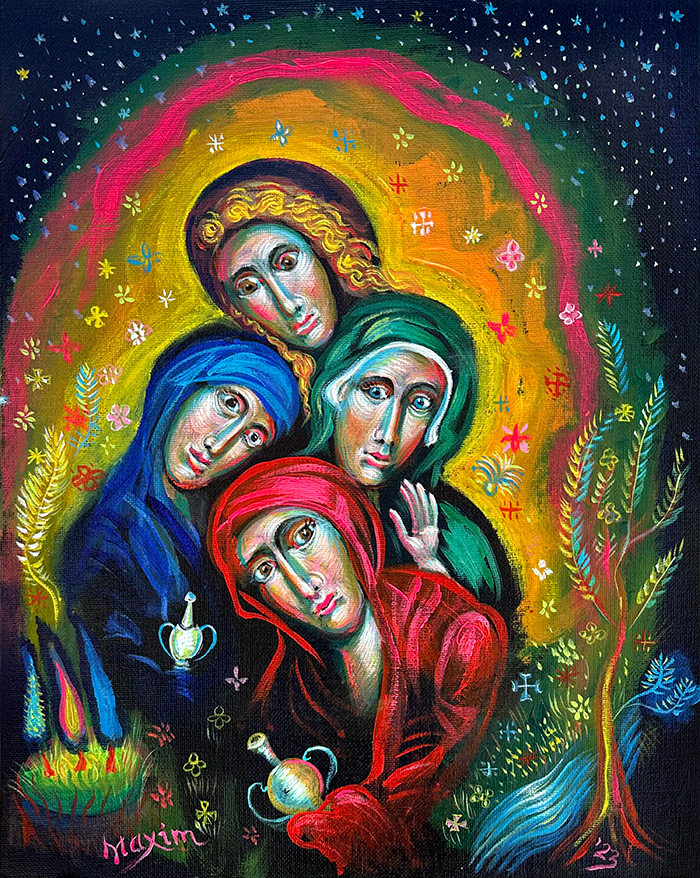
- Details
- Category: Maxim
"Myrrh-bearing Women", acrylic on canvas, 11x14 inch, Bishop Maxim, 2023
Leaving their spices behind, Myrrh-bearing Women fled from the tomb trembling and astonished, having been anointed themselves with the scent of holiness, its fragrance trailing behind them.
Leaving their spices behind, Myrrh-bearing Women fled from the tomb trembling and astonished, having been anointed themselves with the scent of holiness, its fragrance trailing behind them.
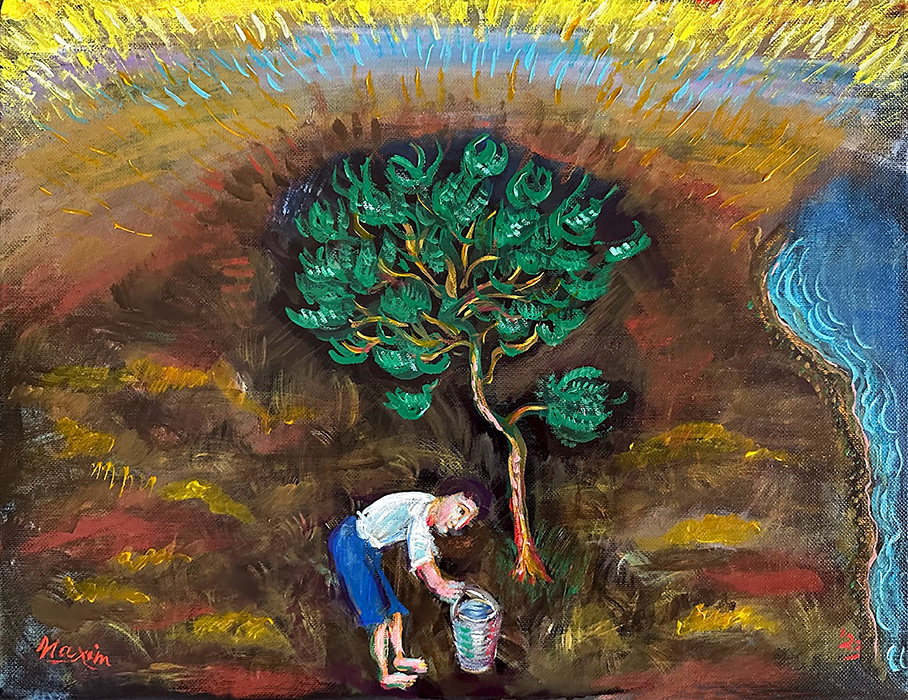
- Details
- Category: Maxim
"How a Wood Sprouted and Grew into a Fruitful Tree", acrylic on canvas, Bishop Maxim, 2023
John the Dwarf is best known for his obedience. The most famous story about his obedience is that one day Abba Pambo gave John a piece of dry wood and ordered him to plant and water it. John obeyed and went on watering it twice a day even though the water was about 12 miles from where they lived. After three years, the piece of wood sprouted and grew into a fruitful tree. Pambo took some of this tree's fruits and went around to all the elder monks, saying "take, eat from the fruit of obedience". Postumian, who was in Egypt in 402, assured that he was shown this tree which grew in the yard of the monastery and which he saw covered with shoots and green leaves.
John the Dwarf is best known for his obedience. The most famous story about his obedience is that one day Abba Pambo gave John a piece of dry wood and ordered him to plant and water it. John obeyed and went on watering it twice a day even though the water was about 12 miles from where they lived. After three years, the piece of wood sprouted and grew into a fruitful tree. Pambo took some of this tree's fruits and went around to all the elder monks, saying "take, eat from the fruit of obedience". Postumian, who was in Egypt in 402, assured that he was shown this tree which grew in the yard of the monastery and which he saw covered with shoots and green leaves.
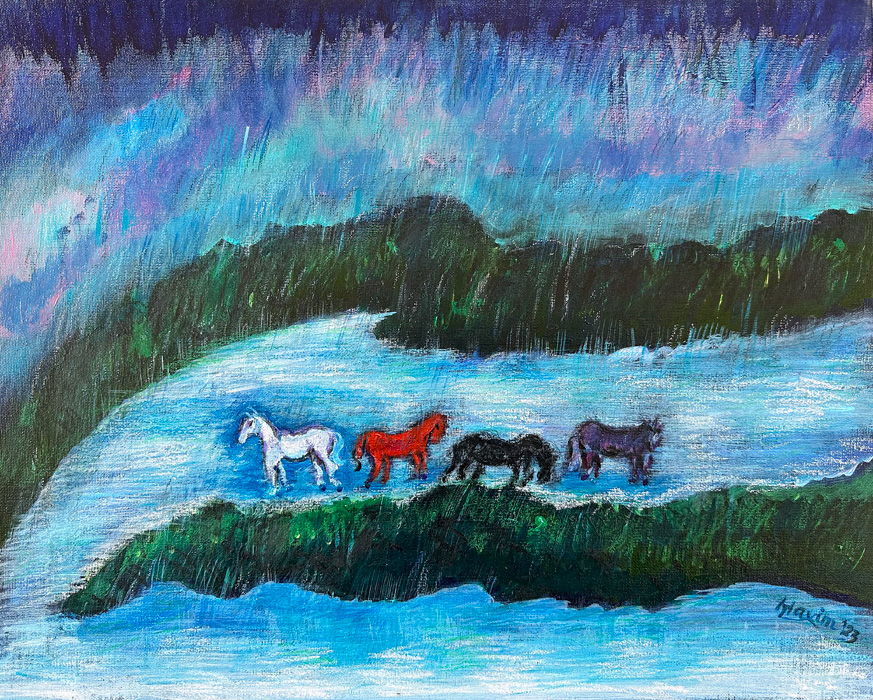
- Details
- Category: Maxim
"Apocalyptic Imagery in Tarkovsky's 'Andrei Rublev'," acrylic on canvas, 16x20 inch, Bishop Maxim, 2023
"I’d like to point out the film ['Andrei Rublev'] ends with an image of horses in the rain. It is a symbolic image as the horse for me is a synonym for life. When I’m looking at a horse, I have a feeling I’m in direct contact with the essence of life itself. Perhaps it’s because the horse is a very beautiful animal, friendly to man, and is moreover so characteristic of the Russian landscape. There are many scenes with horses in Rublev. Take the scene in which a man dies after an unsuccessful attempt to fly. A sad-looking horse is a silent witness to the scene. The presence of horses in the last, final scene means that life itself was the source of all of Rublev’s art." - Andrei Tarkovsky (Interview L'artiste dans l'ancienne Russe et dans l'URSS nouvelle, 1969)
"I’d like to point out the film ['Andrei Rublev'] ends with an image of horses in the rain. It is a symbolic image as the horse for me is a synonym for life. When I’m looking at a horse, I have a feeling I’m in direct contact with the essence of life itself. Perhaps it’s because the horse is a very beautiful animal, friendly to man, and is moreover so characteristic of the Russian landscape. There are many scenes with horses in Rublev. Take the scene in which a man dies after an unsuccessful attempt to fly. A sad-looking horse is a silent witness to the scene. The presence of horses in the last, final scene means that life itself was the source of all of Rublev’s art." - Andrei Tarkovsky (Interview L'artiste dans l'ancienne Russe et dans l'URSS nouvelle, 1969)
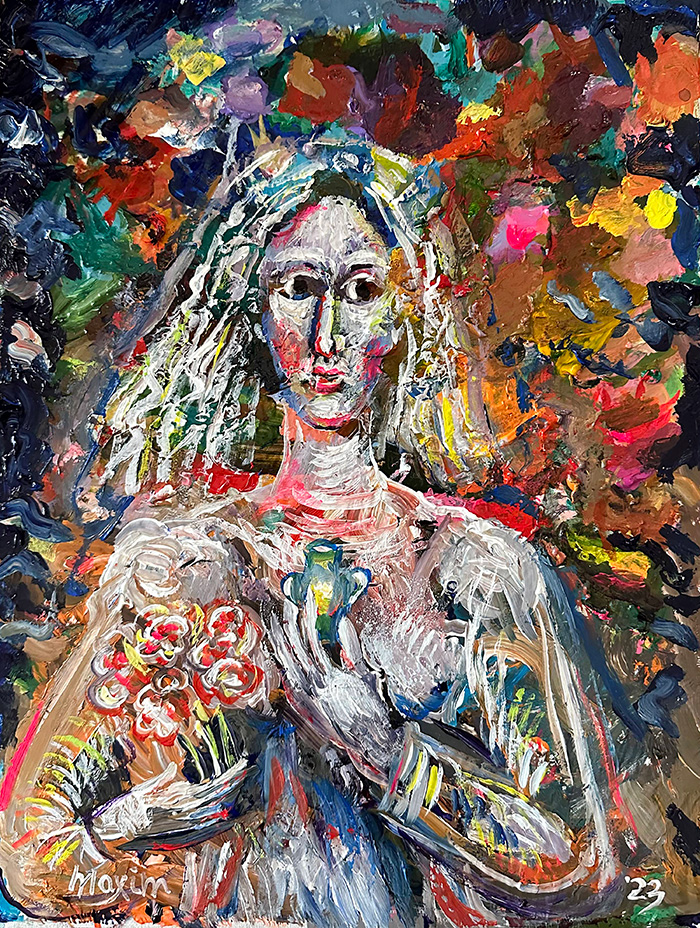
- Details
- Category: Maxim
"Myrrhbearer", acrylic on canvas, Bishop Maxim, 2023
A Myrrh Bearing Woman brings her spices to the tomb to honor the body of Jesus, trembling and astonished. And with myrrh, she wants to show that she does not compromise with the body's decay and that the final purpose of the body is not its decay but life. This treatment of the Lord’s body with myrrh shows us that love and tenderness is the only way to face death. Death hurts love, and love reacts in this way, so it seems that in the end, with the resurrection, love will win and not separation, which death seeks. As we heard in the Gospel passage, the myrrh-bearing women going to the Lord’s tomb were preoccupied with a question: “Who will move the stone for us so that we can anoint the Lord's body with myrrh?” Somehow, however, they found the stone moved. That the stone was moved tells us that death does not have the final word in history, in the life of the world, but life does, God does—this is the great message of the Lord's Resurrection.
A Myrrh Bearing Woman brings her spices to the tomb to honor the body of Jesus, trembling and astonished. And with myrrh, she wants to show that she does not compromise with the body's decay and that the final purpose of the body is not its decay but life. This treatment of the Lord’s body with myrrh shows us that love and tenderness is the only way to face death. Death hurts love, and love reacts in this way, so it seems that in the end, with the resurrection, love will win and not separation, which death seeks. As we heard in the Gospel passage, the myrrh-bearing women going to the Lord’s tomb were preoccupied with a question: “Who will move the stone for us so that we can anoint the Lord's body with myrrh?” Somehow, however, they found the stone moved. That the stone was moved tells us that death does not have the final word in history, in the life of the world, but life does, God does—this is the great message of the Lord's Resurrection.
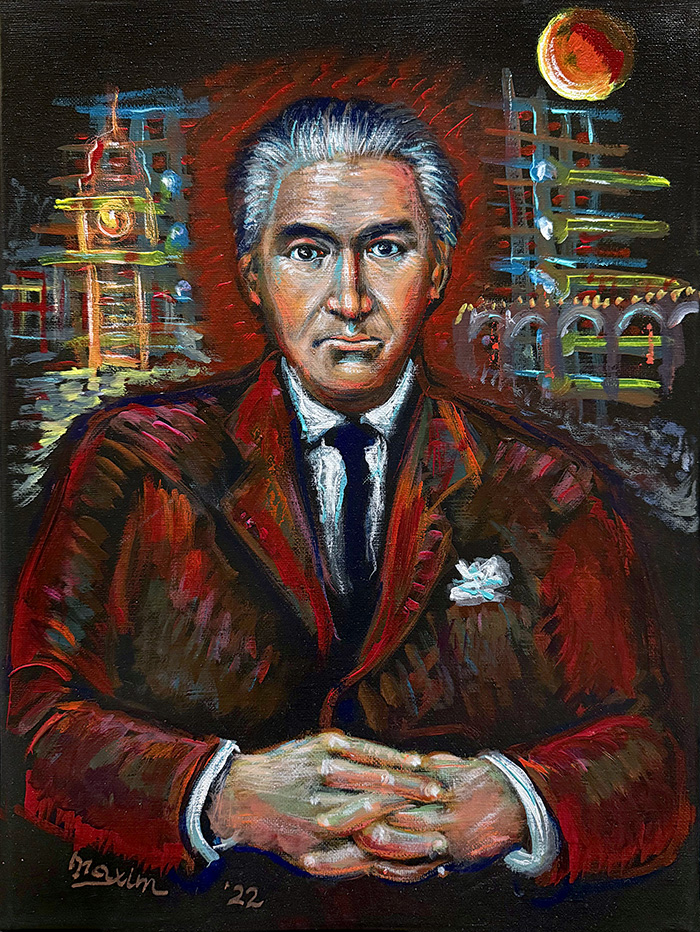
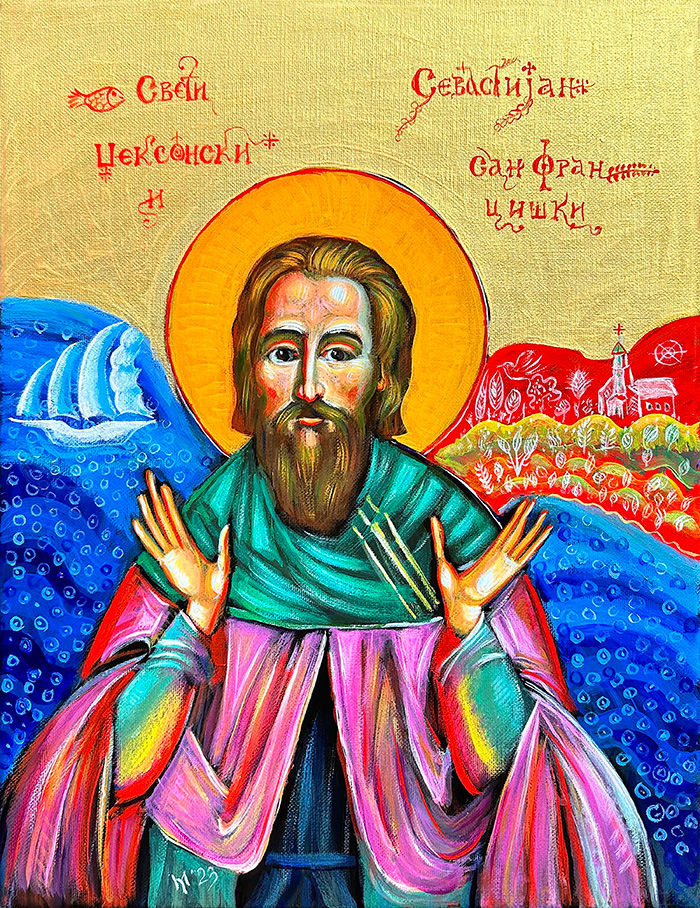
- Details
- Category: Maxim
"St. Sebastian of Jackson and San Francisco", acrylic on canvas, 14x18 inch, Bishop Maxim, 2023
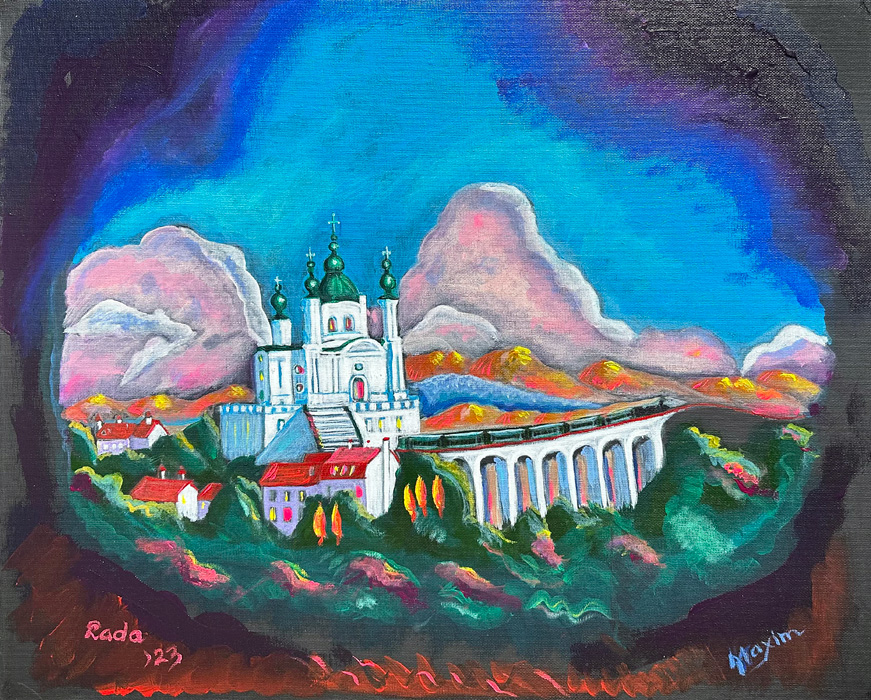
- Details
- Category: Maxim
"Ukraine Resurrected", acrylic on canvas, 16x20 inch, by Bishop Maxim and Rada Vasiljevic, 2023
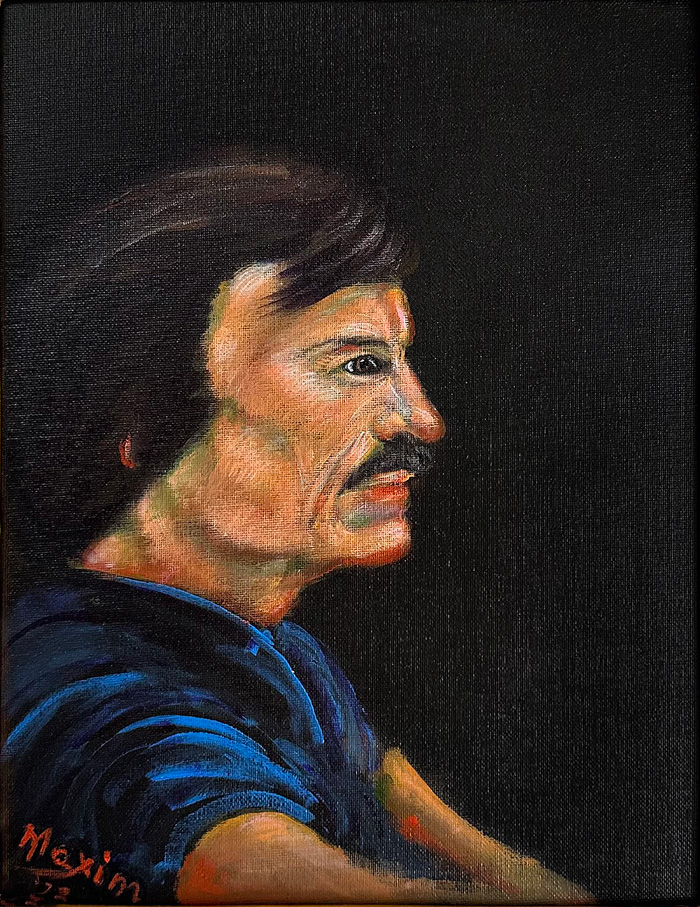
- Details
- Category: Maxim
"A Study of Andrei Tarkovsky's Portrait", acrylic on canvas, 11x14 inch, Bishop Maxim, 2023
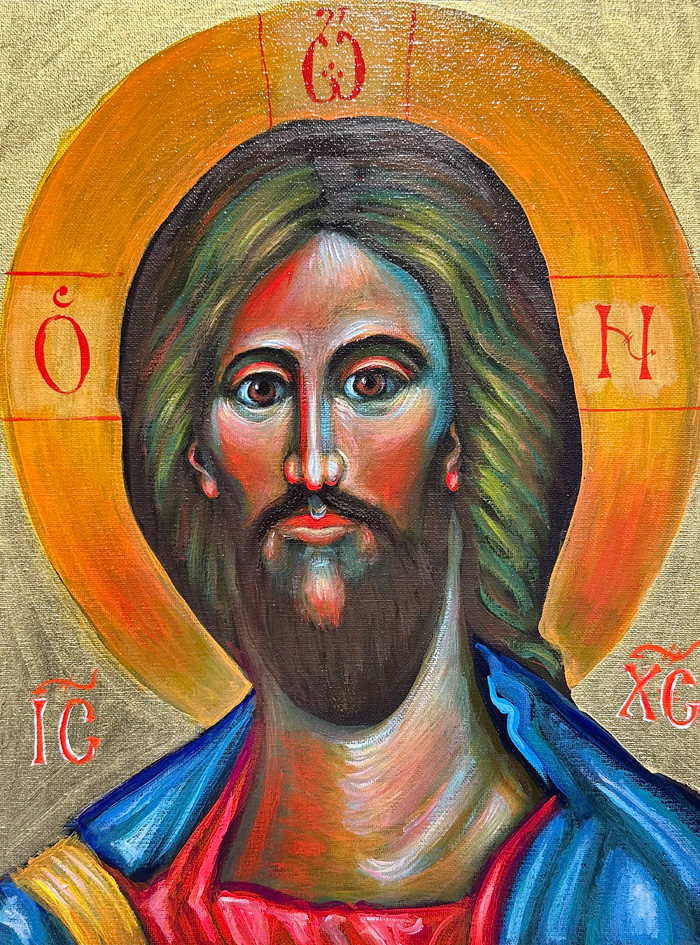
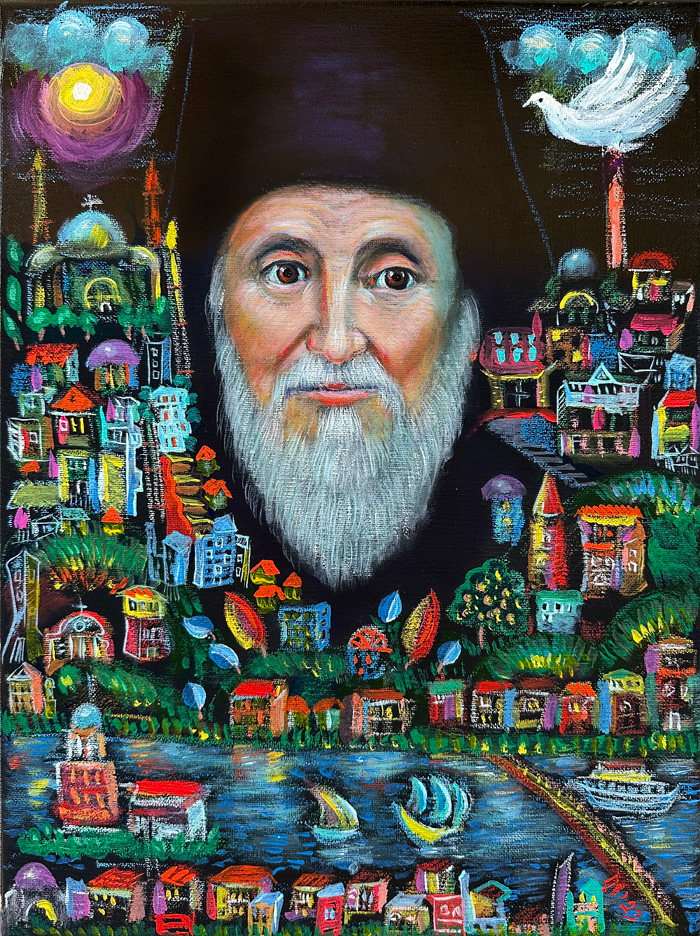
- Details
- Category: Maxim
"The Saint of the City—Metropolitan Germanos of Theodoroupolis", acrylic and pastel on canvas, Bishop Maxim, 2023
In a simple way, the face of Bishop Germanos shines a benevolent expression of love towards God and creation. On the one hand, it goes towards the great God and, on the other, towards His little tiny creatures to whom He gives something of His greatness. The work’s success is that it doesn’t scream joy and love but lives them without being tight-lipped. This charisma adorns the author’s character in this painting and is genuinely and spontaneously expressed in his work.
This masterpiece shows that the new language that Orthodoxy should speak has already been found by a few and is being spoken. This work announces a bright future for our Iconography. The author should take his steps without fear. We will not be the ones to make the “big bang,” but God sends us as forerunners to foreshadow the ways of the Lord.
In a simple way, the face of Bishop Germanos shines a benevolent expression of love towards God and creation. On the one hand, it goes towards the great God and, on the other, towards His little tiny creatures to whom He gives something of His greatness. The work’s success is that it doesn’t scream joy and love but lives them without being tight-lipped. This charisma adorns the author’s character in this painting and is genuinely and spontaneously expressed in his work.
This masterpiece shows that the new language that Orthodoxy should speak has already been found by a few and is being spoken. This work announces a bright future for our Iconography. The author should take his steps without fear. We will not be the ones to make the “big bang,” but God sends us as forerunners to foreshadow the ways of the Lord.
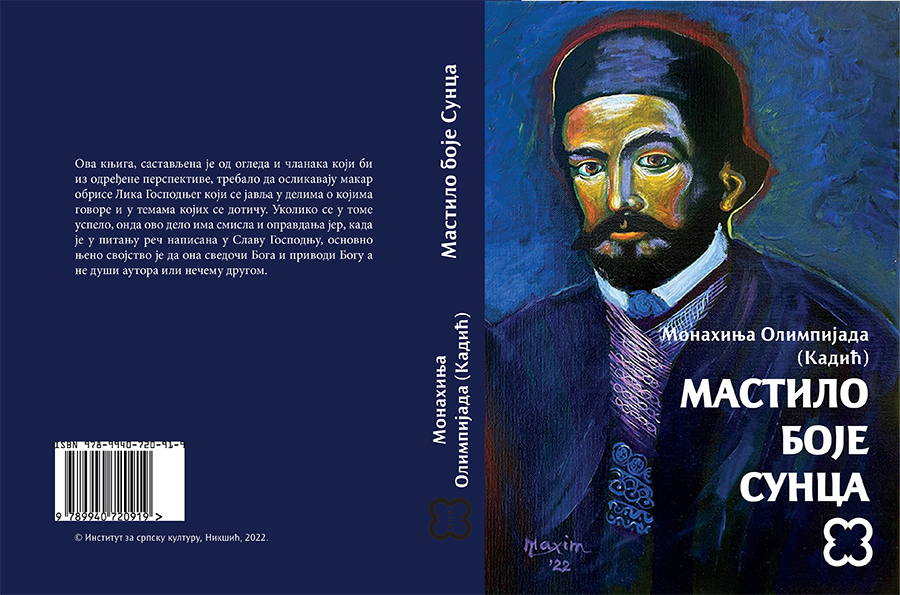
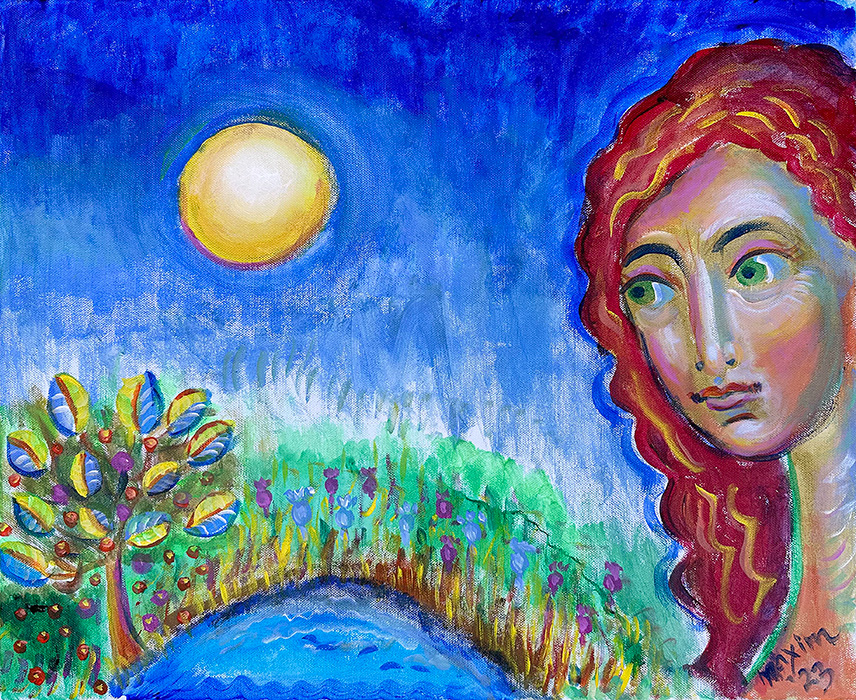
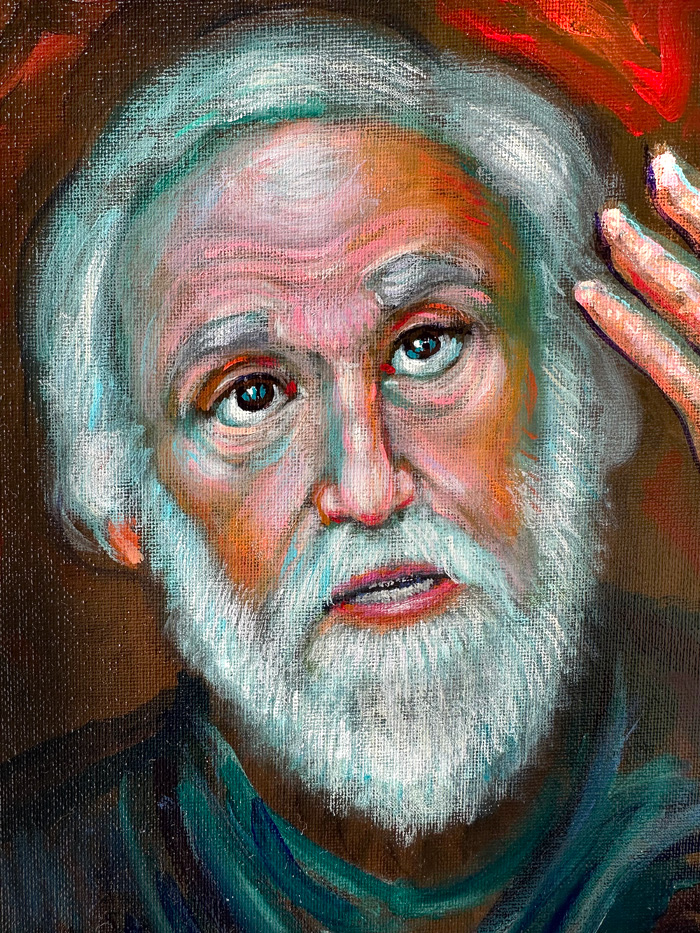
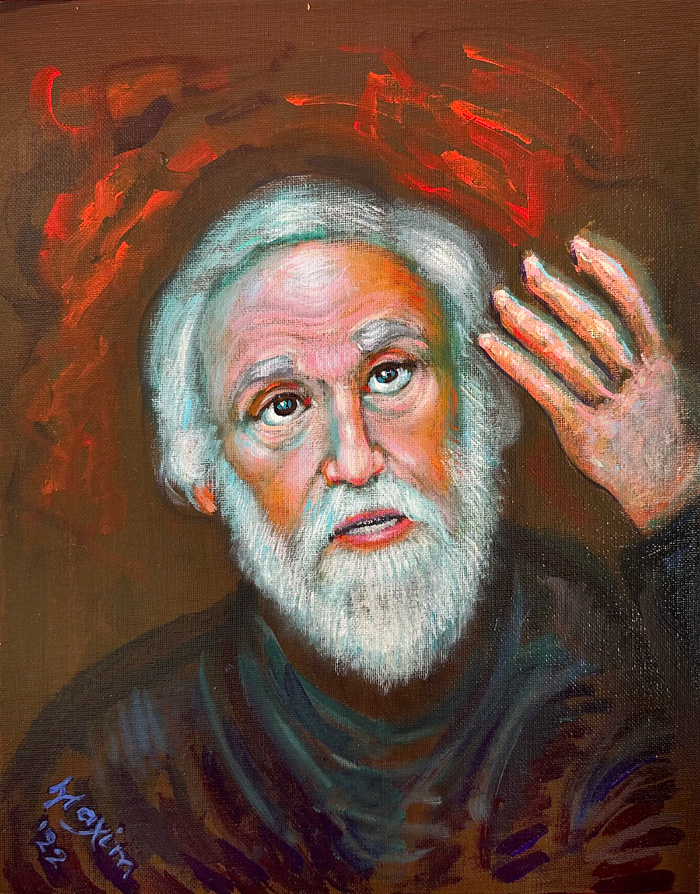
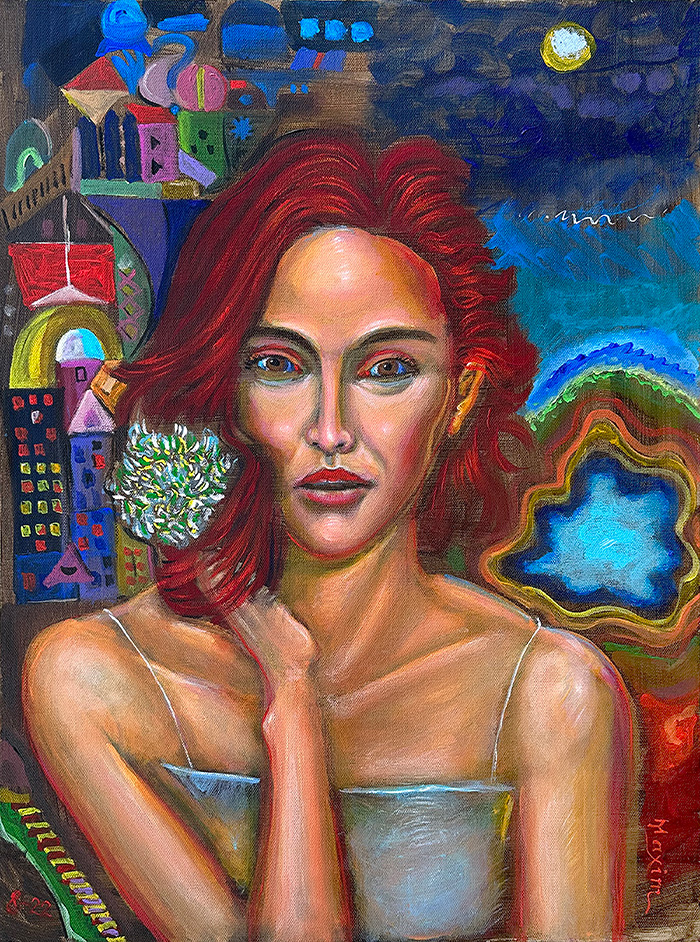
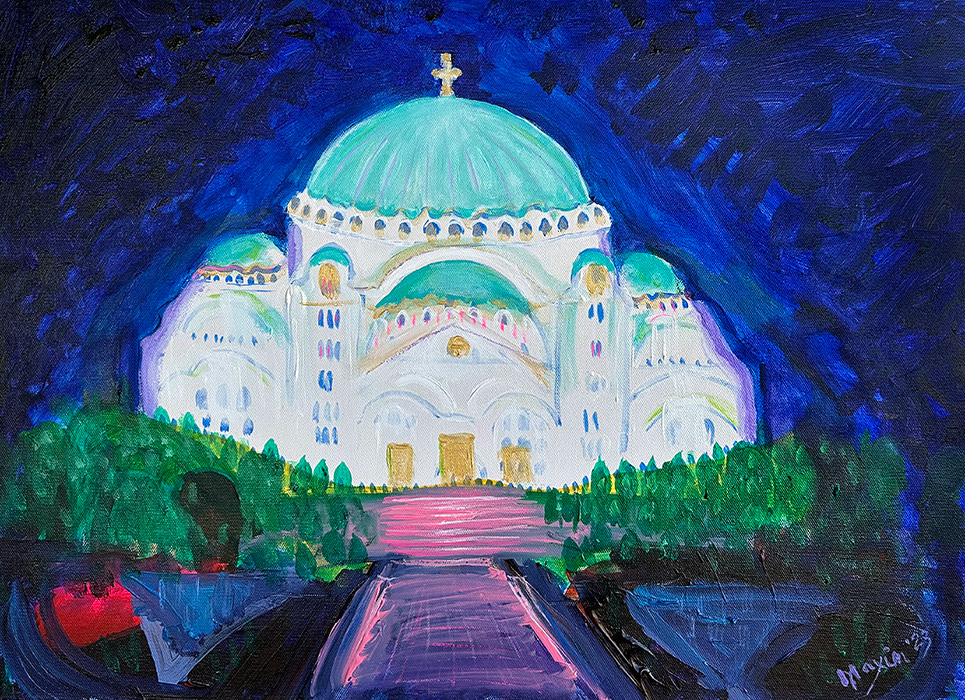
- Details
- Category: Maxim
"Saint Sava Cathedral At Night, Belgrade", acrylic on canvas, Bishop Maxim, 2023
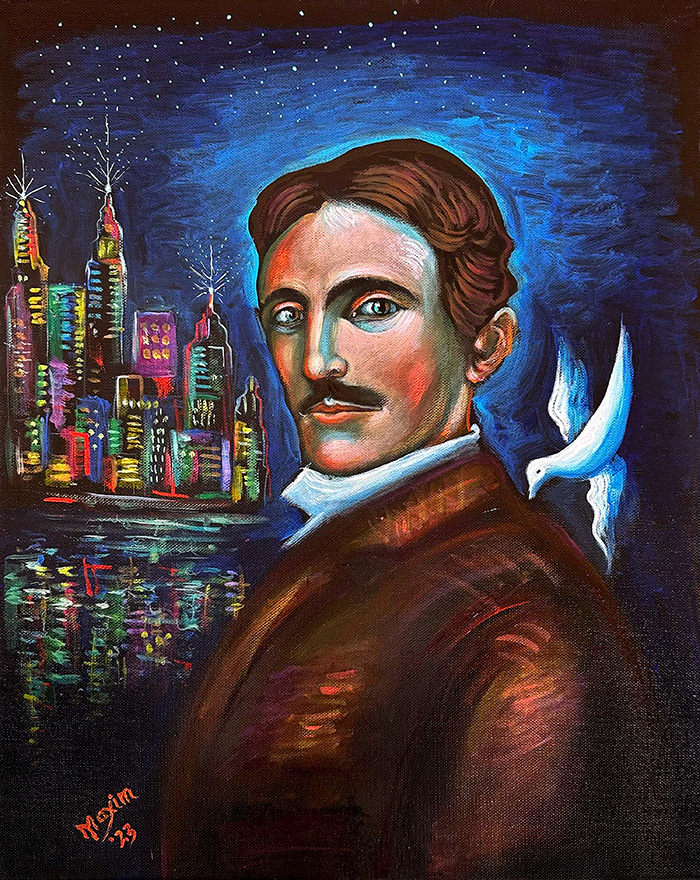
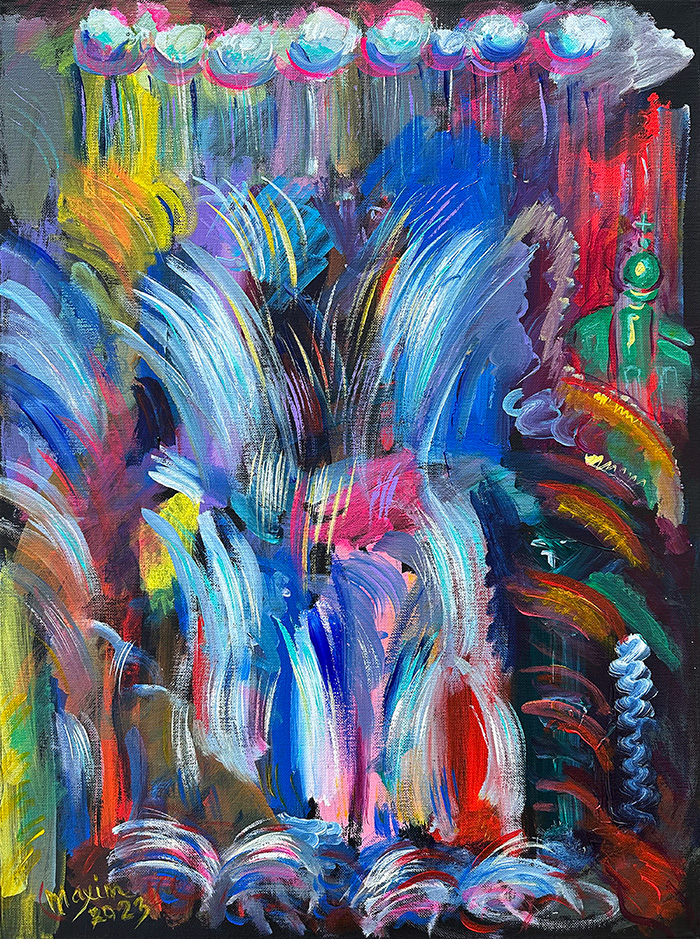
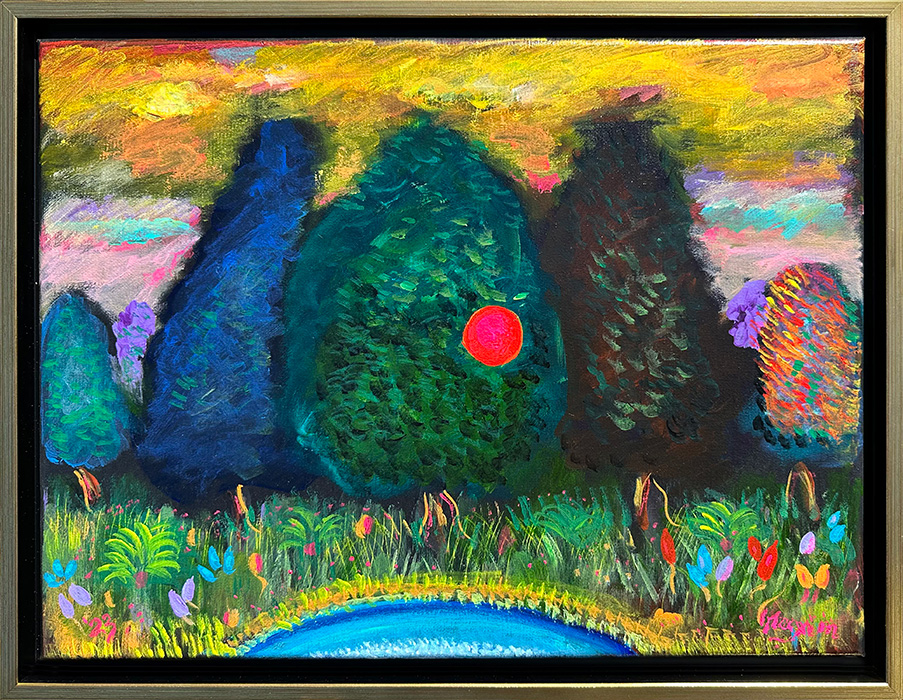
- Details
- Category: Maxim
"Мoon Fell Asleep in the Canopy" (Thank You Rene Magritte), acrylic on canvas, Bishop Maxim, 2023
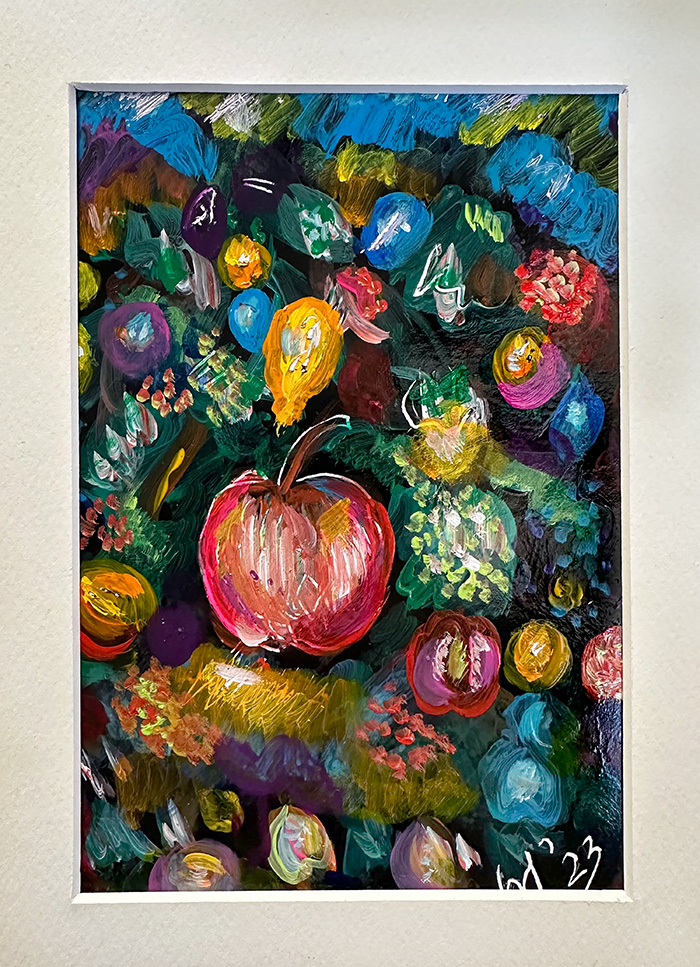
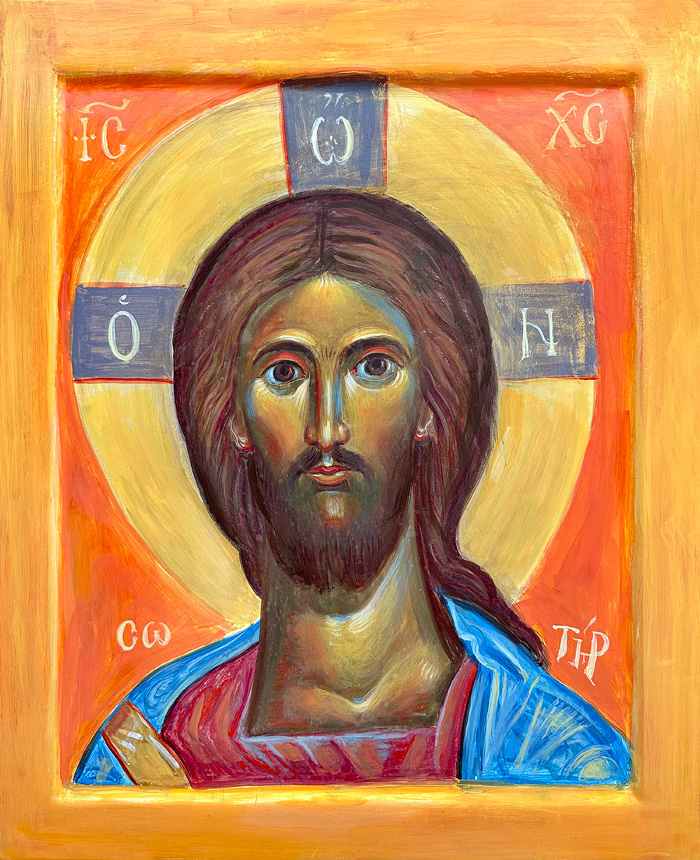
- Details
- Category: Maxim
"Jesus Christ the Savior", egg tempera on wooden board, Bishop Maxim, Volos, January 12, 2023
This Christ has the following significant thing, the Lord's eyes have a visionary look, that is, not usual but the revelatory look that reveals that he is not a simple person but something very remarkable, that by worshiping this icon, we enter into an existential relationship with the God-Man. Time stops before His gaze, and the image calls us into a eucharistic and doxological relationship with the King of Kings. Jesus, with His significant gaze, does not simply invite us to Him. He changes our minds to have nothing else to look at because the culmination of the adventure of this life is to stick to Christ with what the Holy Fathers say, DIVINE LOVE (which is the only ontologically eternal and permanent and faithful love according to the experience of the Saints of our Church, whose love and faith in Christ was unwavering and unwavering and endless as the eternal love of the Beloved. Our Iconographer reveals that, ultimately, the image of CHRIST is a matter of love expressed through bright colors. For her here, our lives, moreover, the Iconographer proves to us the positive power that emanates from the Theandric Face, which infuses us with a divine and joyful tenacity for a life full of action and struggle. As if to say to us: "Take courage; I have conquered the world." In other words, the Iconographer caught the quiet power of a RISEN BRIDEGROOM CROWNED WITH THORNS.
This Christ has the following significant thing, the Lord's eyes have a visionary look, that is, not usual but the revelatory look that reveals that he is not a simple person but something very remarkable, that by worshiping this icon, we enter into an existential relationship with the God-Man. Time stops before His gaze, and the image calls us into a eucharistic and doxological relationship with the King of Kings. Jesus, with His significant gaze, does not simply invite us to Him. He changes our minds to have nothing else to look at because the culmination of the adventure of this life is to stick to Christ with what the Holy Fathers say, DIVINE LOVE (which is the only ontologically eternal and permanent and faithful love according to the experience of the Saints of our Church, whose love and faith in Christ was unwavering and unwavering and endless as the eternal love of the Beloved. Our Iconographer reveals that, ultimately, the image of CHRIST is a matter of love expressed through bright colors. For her here, our lives, moreover, the Iconographer proves to us the positive power that emanates from the Theandric Face, which infuses us with a divine and joyful tenacity for a life full of action and struggle. As if to say to us: "Take courage; I have conquered the world." In other words, the Iconographer caught the quiet power of a RISEN BRIDEGROOM CROWNED WITH THORNS.
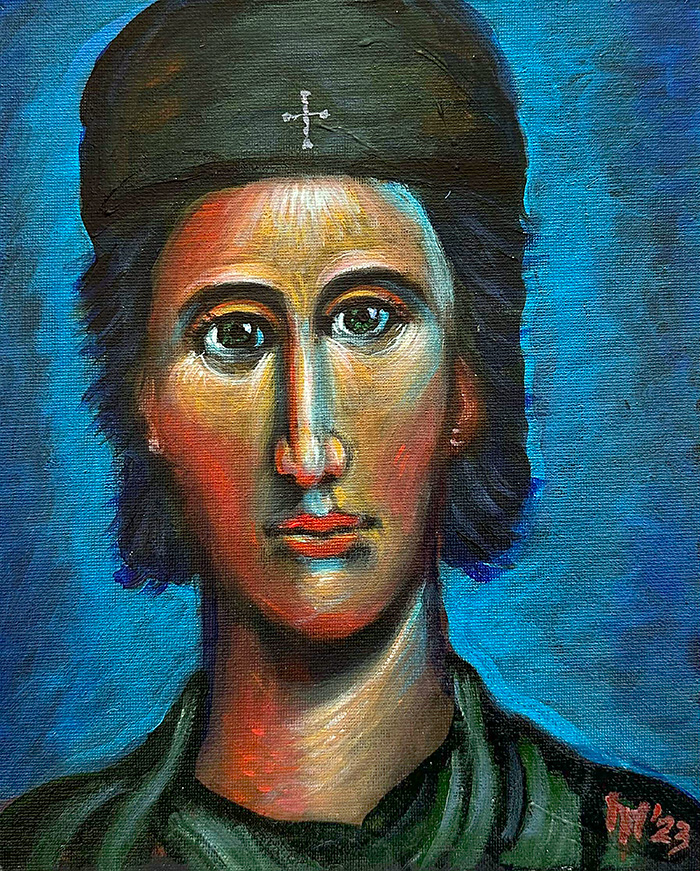
- Details
- Category: Maxim
"Alyosha Karamazov", acrylic on canvas, Bishop Maxim, 2023
"As long as I look at him, I go crazy. He is so simple and small and close to us, but he is also a giant hero of the Gospel of Christ. Glory be to You, Lord, who shows the light of Your FACE and the light of the face of Your humble servant Alyosha. By... mistake, you did something so big and so simple. Kind of like a self-taught genius." - Stamatis Skliris
"As long as I look at him, I go crazy. He is so simple and small and close to us, but he is also a giant hero of the Gospel of Christ. Glory be to You, Lord, who shows the light of Your FACE and the light of the face of Your humble servant Alyosha. By... mistake, you did something so big and so simple. Kind of like a self-taught genius." - Stamatis Skliris
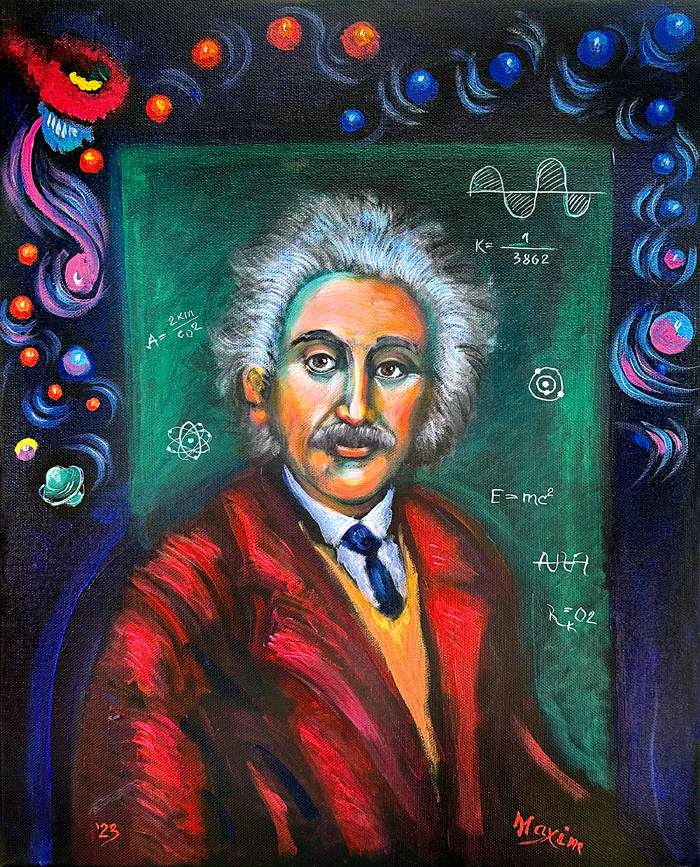
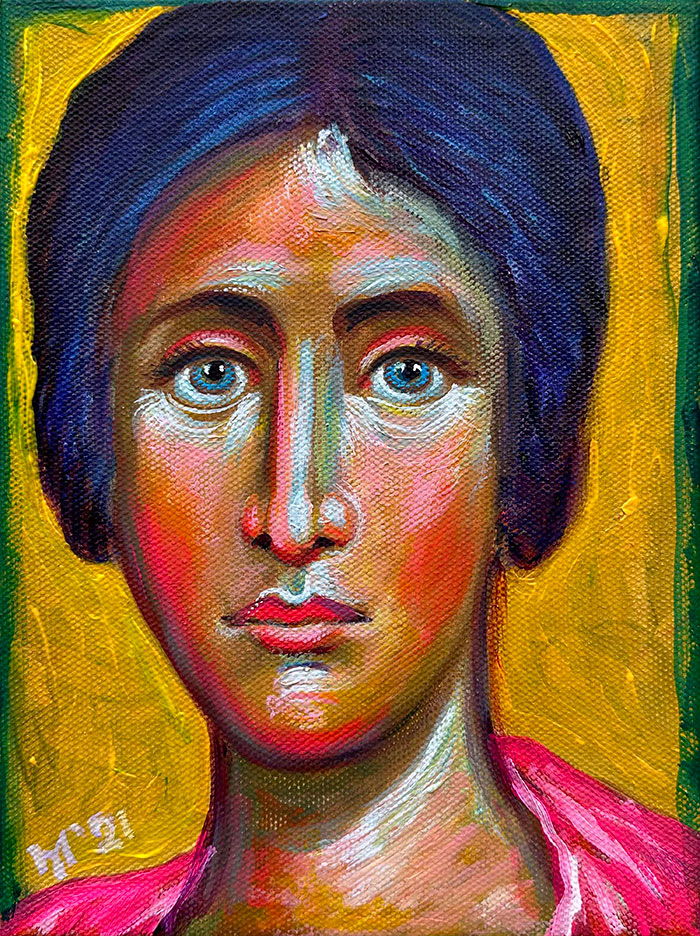
- Details
- Category: Maxim
"Krotka: A Gentle Creature by Dostoevsky" (Fayum style), acrylic on canvas, Bishop Maxim, 2023
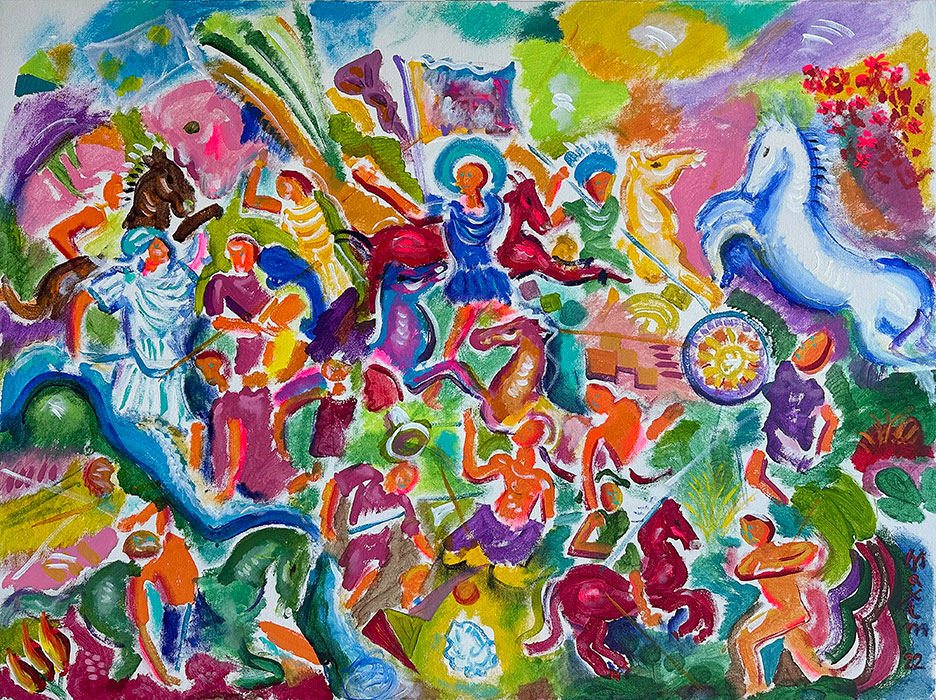
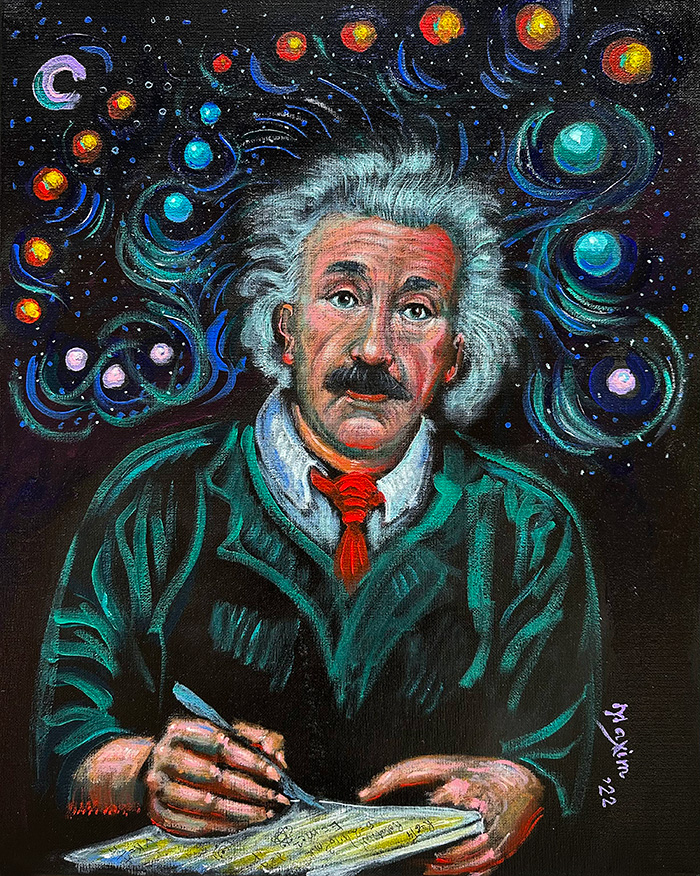
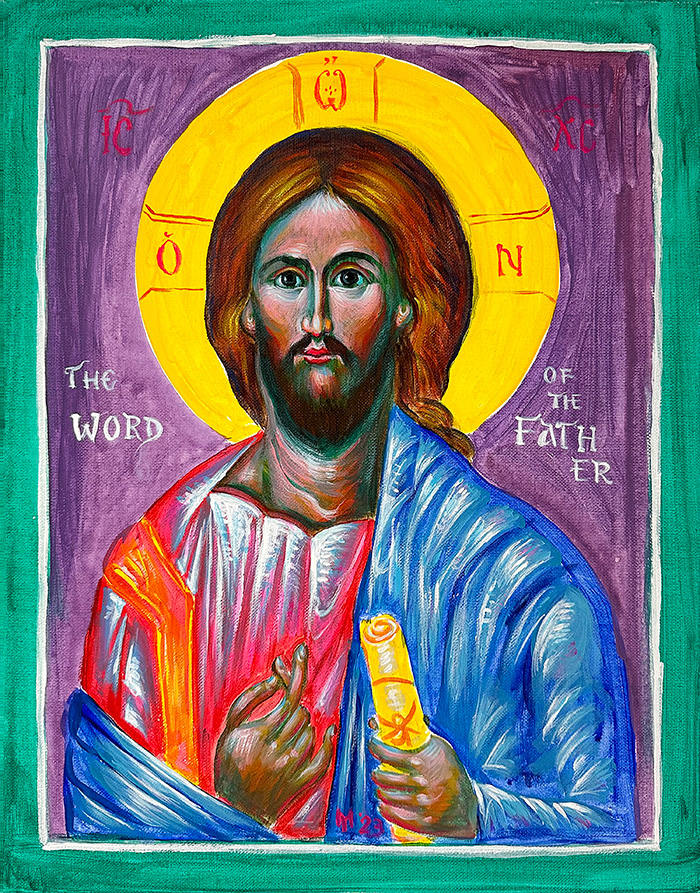
- Details
- Category: Maxim
"Christ the Word of the Father," acrylic on canvas, Bishop Maxim, Los Angeles, 2023
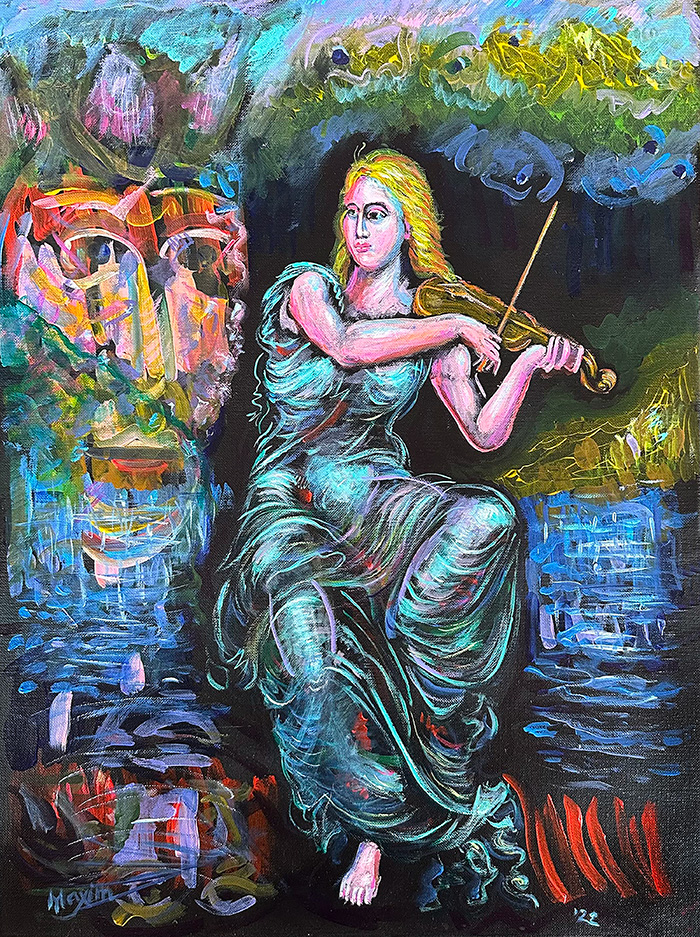
- Details
- Category: Maxim
"Euterpe the Muse of Music and Lyric Poetry," acrylic on canvas, Bishop Maxim, Half Moon Bay, 2022
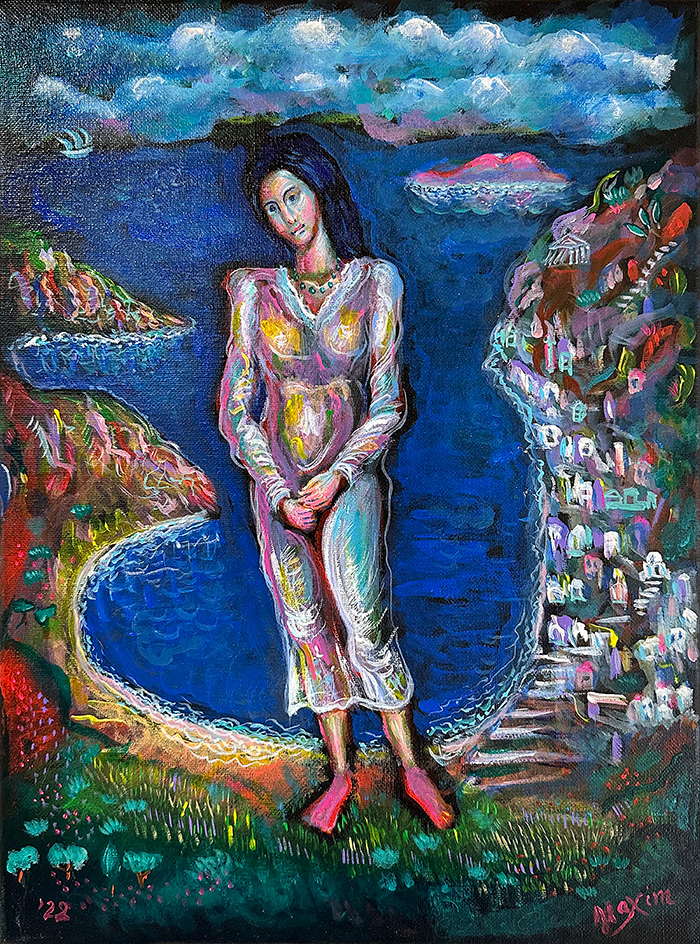
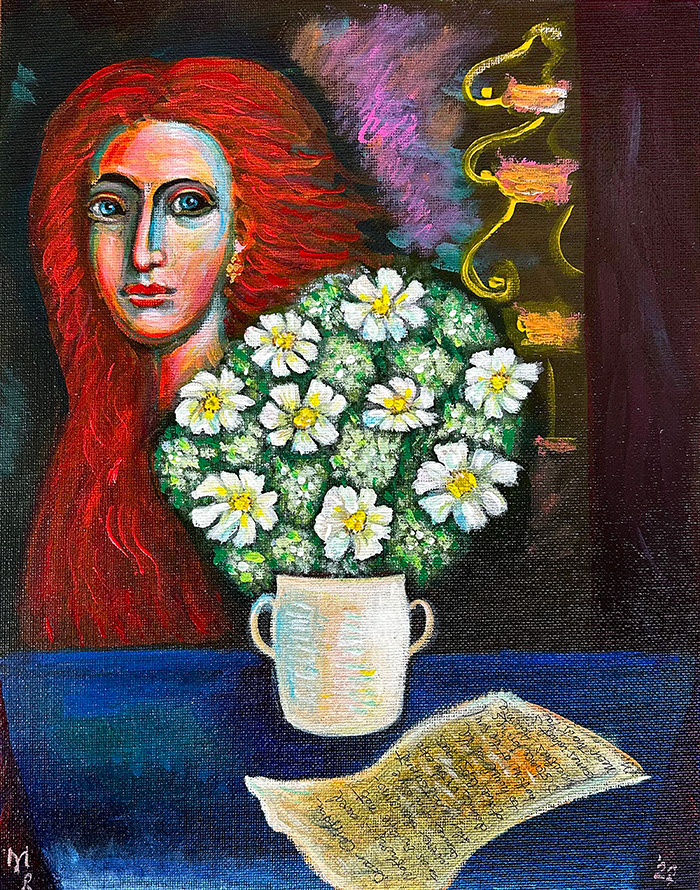
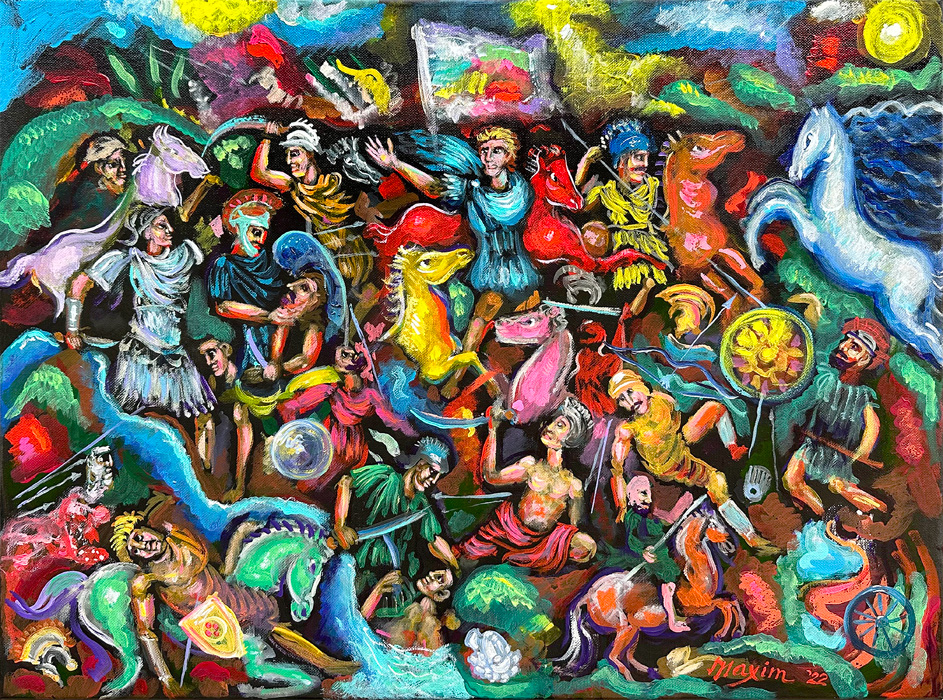
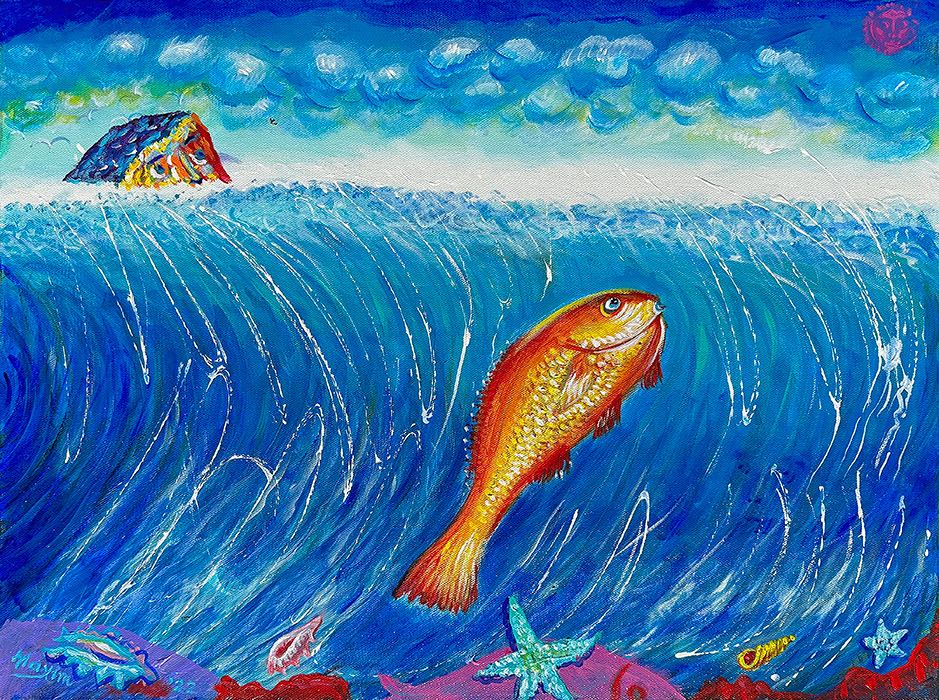
- Details
- Category: Maxim
"Ichthys", acrylic on canvas, Bishop Maxim, 2022
"On this forefeast of the Nativity, the painter gives us ICHTHYS (the fish, Greek ichthys, ἰχθύς, is a symbol for Christ, an acronym for Ιησους Χριστος Θεου Υιος Σωτηρ = Jesus Christ Son [of] God [our] Savior) marked by a star as he leaps from the vibrant blue life-giving and life-destroying waters. Above, bearing similar colors of red and yellow as the central figure of ICHTHYS, along with the blue reflection of the waves upon his head, the partially submerged figure drifts toward the edge of the tumbling tidal wave.
Both figures have their eyes fixed on the small disc of the sun in the upper right-hand corner linking these three in an invisible triangle which deepens the question that is posed by the tension captured between them at this precise moment of the painting.
Dividing water and air is a thin white space, and only the image with two eyes and a partially revealed head unites both water and air. The fish with one eye visible and one hidden, though in the air, is a creature of the water. The man is a creature out of his depths in need of solid rock upon which to regain his balance." — Stephen Muse
"On this forefeast of the Nativity, the painter gives us ICHTHYS (the fish, Greek ichthys, ἰχθύς, is a symbol for Christ, an acronym for Ιησους Χριστος Θεου Υιος Σωτηρ = Jesus Christ Son [of] God [our] Savior) marked by a star as he leaps from the vibrant blue life-giving and life-destroying waters. Above, bearing similar colors of red and yellow as the central figure of ICHTHYS, along with the blue reflection of the waves upon his head, the partially submerged figure drifts toward the edge of the tumbling tidal wave.
Both figures have their eyes fixed on the small disc of the sun in the upper right-hand corner linking these three in an invisible triangle which deepens the question that is posed by the tension captured between them at this precise moment of the painting.
Dividing water and air is a thin white space, and only the image with two eyes and a partially revealed head unites both water and air. The fish with one eye visible and one hidden, though in the air, is a creature of the water. The man is a creature out of his depths in need of solid rock upon which to regain his balance." — Stephen Muse
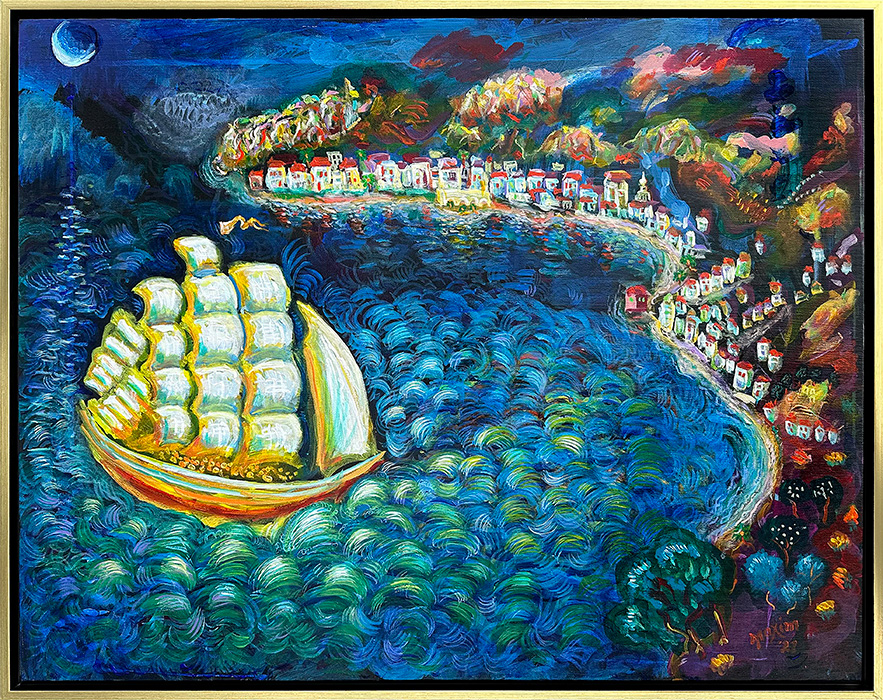
- Details
- Category: Maxim
"Pride of the Pacific", acrylic on canvas, 22 x 28 inch, Bishop Maxim, 2022
"If the sails had a soul, if the little houses had life inside them and laughed at us, if the children of the sea were constantly chattering, then all these would write a painting like the one here by painter Maxim. God knows how he experiences them in the depths of his being and calls them to "write" with strokes the glory of the Creator." — Stamatis Skliris
"If the sails had a soul, if the little houses had life inside them and laughed at us, if the children of the sea were constantly chattering, then all these would write a painting like the one here by painter Maxim. God knows how he experiences them in the depths of his being and calls them to "write" with strokes the glory of the Creator." — Stamatis Skliris
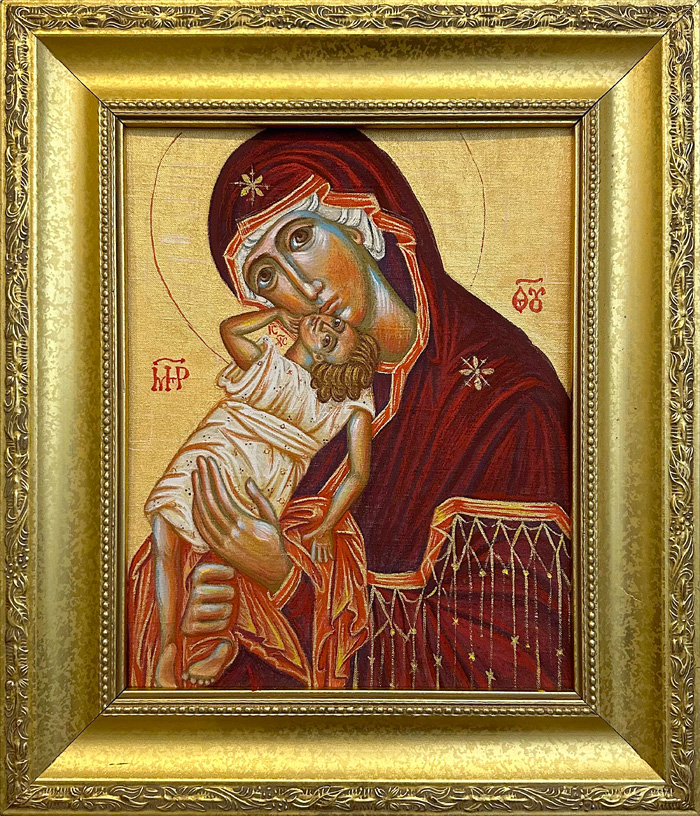
- Details
- Category: Maxim
"Theotokos—It is Truly Meet”, egg-tempera on cotton, by Radmila Vasiljevic, 2020
The Full of Grace, or the Mother of God, is the person within whom was revealed all the love of God, and the salvation of world was accomplished. Through her all mankind freely said “yes” to God. The Mother of God became the revelation of God’s love for the world, and for all of us! For that reason she is linked inseparably with Christ. Fittingly, the icons of Orthodox Churches always and according to canon depict her holding Christ in her arms. She is neither depicted as individual, nor is her presence ever solitary.
The Full of Grace, or the Mother of God, is the person within whom was revealed all the love of God, and the salvation of world was accomplished. Through her all mankind freely said “yes” to God. The Mother of God became the revelation of God’s love for the world, and for all of us! For that reason she is linked inseparably with Christ. Fittingly, the icons of Orthodox Churches always and according to canon depict her holding Christ in her arms. She is neither depicted as individual, nor is her presence ever solitary.
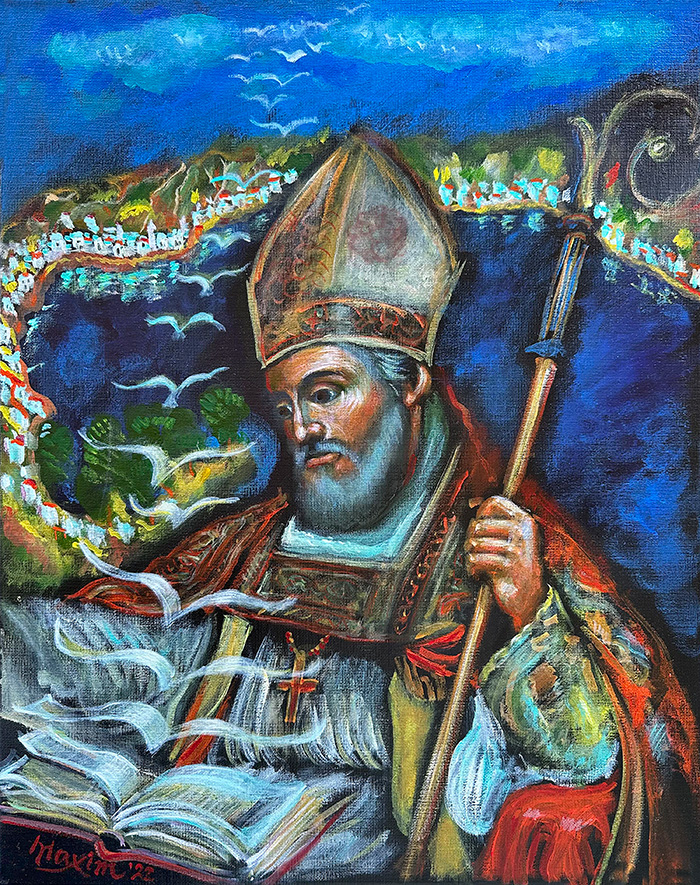
- Details
- Category: Maxim
"St. Isidore of Seville", acrylic on canvas, 16x20 inch, Bishop Maxim, 2022
Jn 3:13! All ‘Words into Spirit’ are translations of Spirit into words. The eyes of Isidore suggest great attention to the pages of the book. He is looking down at what is coming from above—in a sense, the pages go in both directions, like Jacob’s ladder. The meaning written on pages of the book comes to life moving in his heart to lift him in the heart to direction from which the Spirit illumines them. This is the position of a true Bishop and shepherd of the people! Historically his scholarly ‘assembling of many books’ might give it another turn! Isidore (636) is remembered for being the most learned person of his time, defending the true Faith, and assisting in the conversion of the Arian Goths. During his episcopate, he was known as a defender of justice, he founded schools and monasteries, and developed the Mozarabic Liturgy. His many writings became a primary source of knowledge in the West during the Middle Ages.
Jn 3:13! All ‘Words into Spirit’ are translations of Spirit into words. The eyes of Isidore suggest great attention to the pages of the book. He is looking down at what is coming from above—in a sense, the pages go in both directions, like Jacob’s ladder. The meaning written on pages of the book comes to life moving in his heart to lift him in the heart to direction from which the Spirit illumines them. This is the position of a true Bishop and shepherd of the people! Historically his scholarly ‘assembling of many books’ might give it another turn! Isidore (636) is remembered for being the most learned person of his time, defending the true Faith, and assisting in the conversion of the Arian Goths. During his episcopate, he was known as a defender of justice, he founded schools and monasteries, and developed the Mozarabic Liturgy. His many writings became a primary source of knowledge in the West during the Middle Ages.
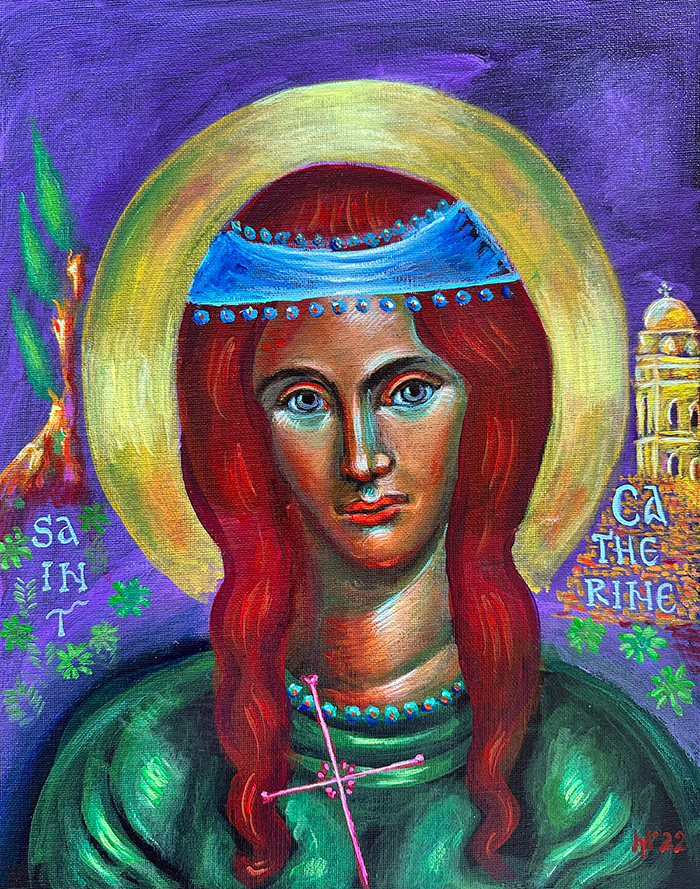
- Details
- Category: Maxim
"St. Catherine the Great-Martyr", acrylic on canvas, 11x24 inch, Bishop Maxim, 2022
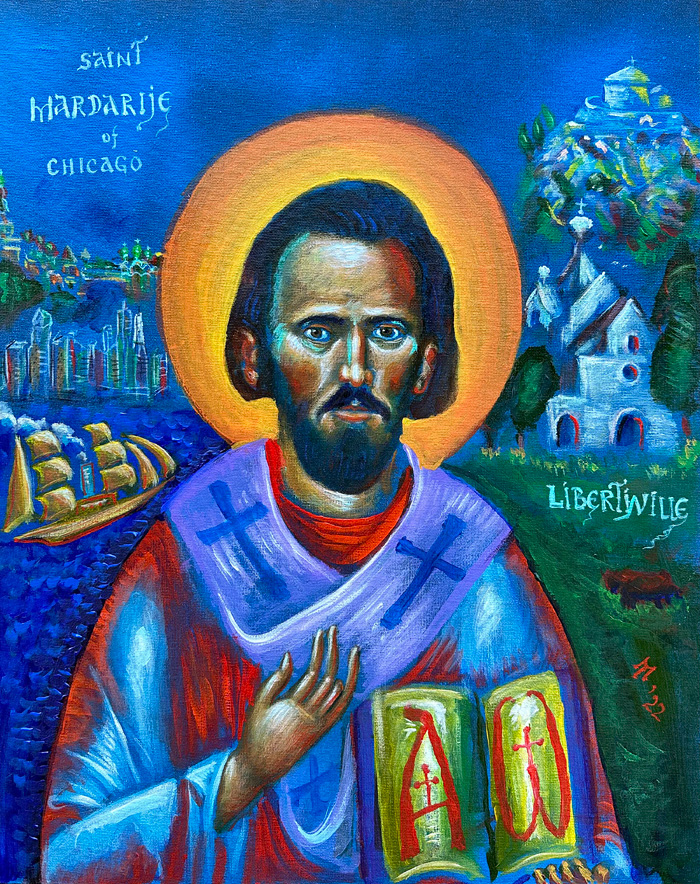
- Details
- Category: Maxim
St. Mardarije of Chicago and Libertyville", acrylic on canvas, Bishop Maxim, 2022
The great Montenegrin guslar, Petar Perunovic-Perun epically described the Holy Bishop Mardarije as not only a martyr but a great-martyr, who suffered at the hands of his clergy and laity, while battling his own illness.
Bishop Maxim was thus inspired to select a brilliant red with which he executed the felon, which appears as the fire of Christ in which the Saint was clothed, while at the same time, it is associated with blood and his illness, soothed by the cooling pale blue highlights.
Situated before his spheres of influence and legacy, we are summoned by their calm dynamics, as an expression of elements that call for their own attention. Lovćen and Libertyville mostly, which are on high and illumined, while Chicago and Moscow are quietly present in the background.
The ship, in which he so often traversed the seas of the world, forms a unique tandem with the Gospel, and becomes a symbol that indicates the constancy of these journeys.
The quietly highlighted boat in the tranquil haven of the encompassing azure sea, also represents the Church. Together with the Gospel, radiating with the Light of Christ, Alpha that emanated at Creation, and Omega from the Tomb alike, they are the very symbols of Saint Mardarije’s life.
The great Montenegrin guslar, Petar Perunovic-Perun epically described the Holy Bishop Mardarije as not only a martyr but a great-martyr, who suffered at the hands of his clergy and laity, while battling his own illness.
Bishop Maxim was thus inspired to select a brilliant red with which he executed the felon, which appears as the fire of Christ in which the Saint was clothed, while at the same time, it is associated with blood and his illness, soothed by the cooling pale blue highlights.
Situated before his spheres of influence and legacy, we are summoned by their calm dynamics, as an expression of elements that call for their own attention. Lovćen and Libertyville mostly, which are on high and illumined, while Chicago and Moscow are quietly present in the background.
The ship, in which he so often traversed the seas of the world, forms a unique tandem with the Gospel, and becomes a symbol that indicates the constancy of these journeys.
The quietly highlighted boat in the tranquil haven of the encompassing azure sea, also represents the Church. Together with the Gospel, radiating with the Light of Christ, Alpha that emanated at Creation, and Omega from the Tomb alike, they are the very symbols of Saint Mardarije’s life.
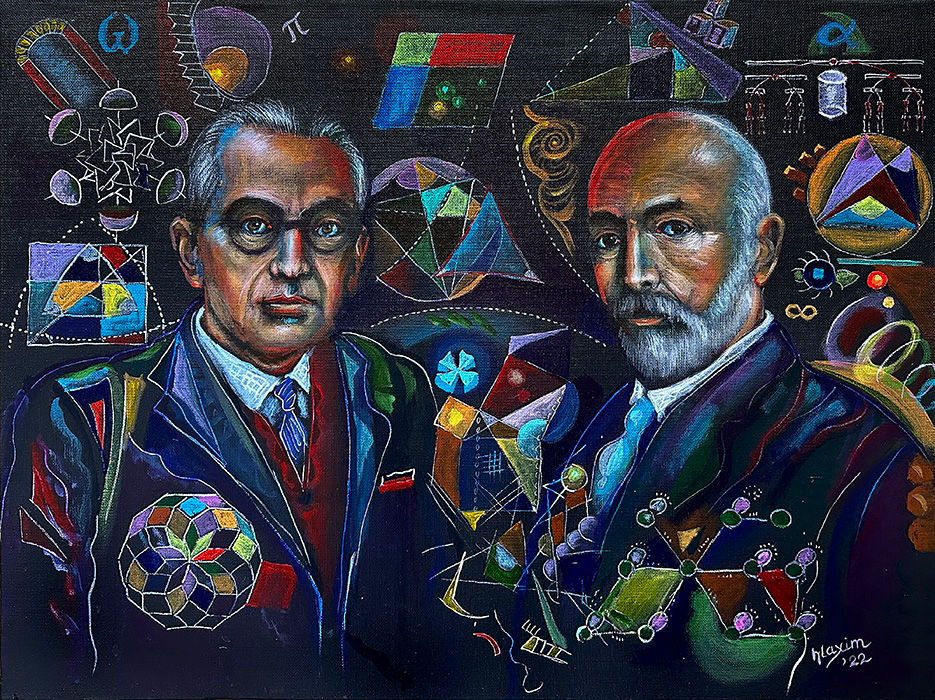
- Details
- Category: Maxim
"From Georg Cantor’s Set Theory to Kurt Gödel’s Incompleteness Theorem", acrylic on canvas, Bishop Maxim, 2022
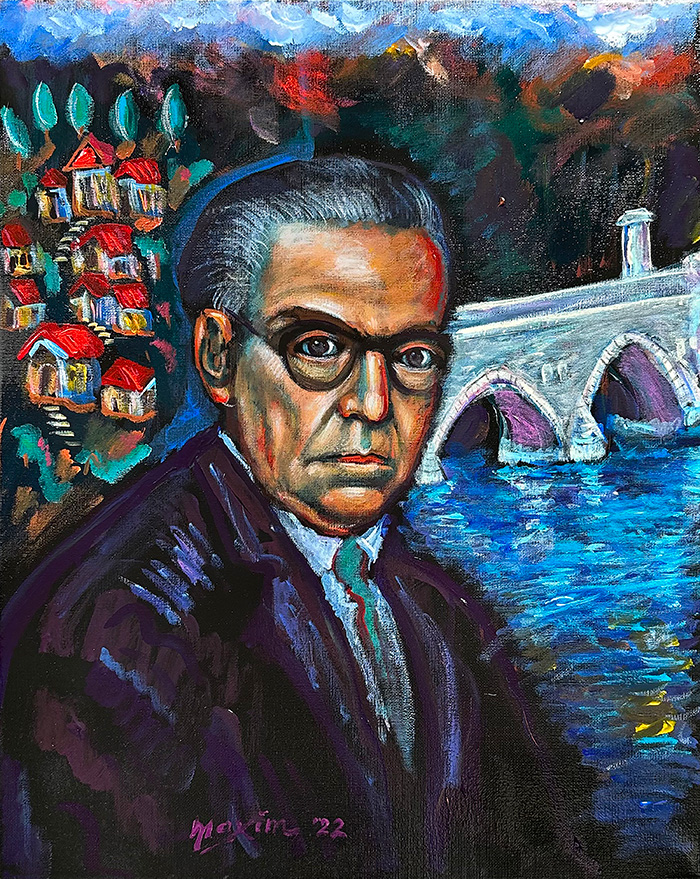
- Details
- Category: Maxim
"Ivo Andrić and the Bridge on the Drina", acrylic on canvas, Bishop Maxim, 2022
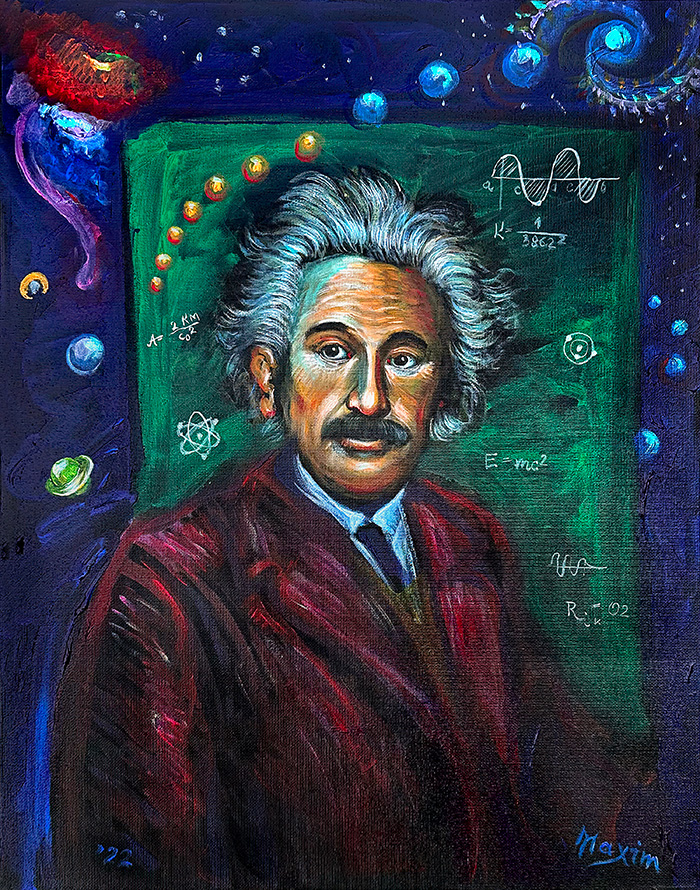
- Details
- Category: Maxim
“Albert Einstein”, acrylic on canvas, Bishop Maxim, 2022
"Thou, Who, as God, adornest the heaven with stars
Who through Thy Saints dost enlighten
and guide with splendor all thē earth,
O Thou Creator of all things,
save them that hymn Thee with praises."
(Exapostilarion of Saturday)
"Thou, Who, as God, adornest the heaven with stars
Who through Thy Saints dost enlighten
and guide with splendor all thē earth,
O Thou Creator of all things,
save them that hymn Thee with praises."
(Exapostilarion of Saturday)
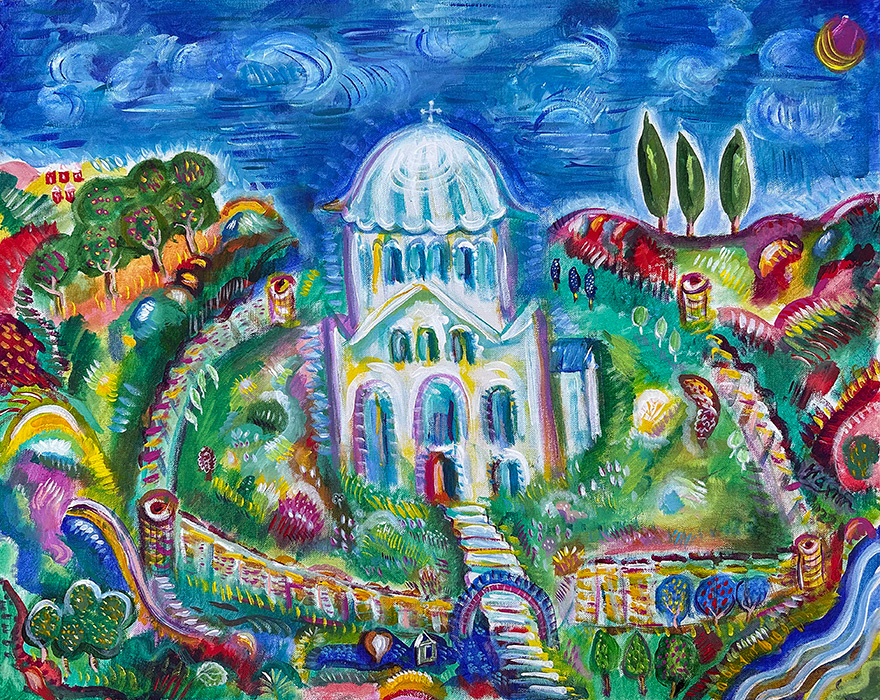
- Details
- Category: Maxim
"Djurdjevi Stupovi: Pillars of St George Monastery 2", acrylic on canvas, Bishop Maxim, 2022
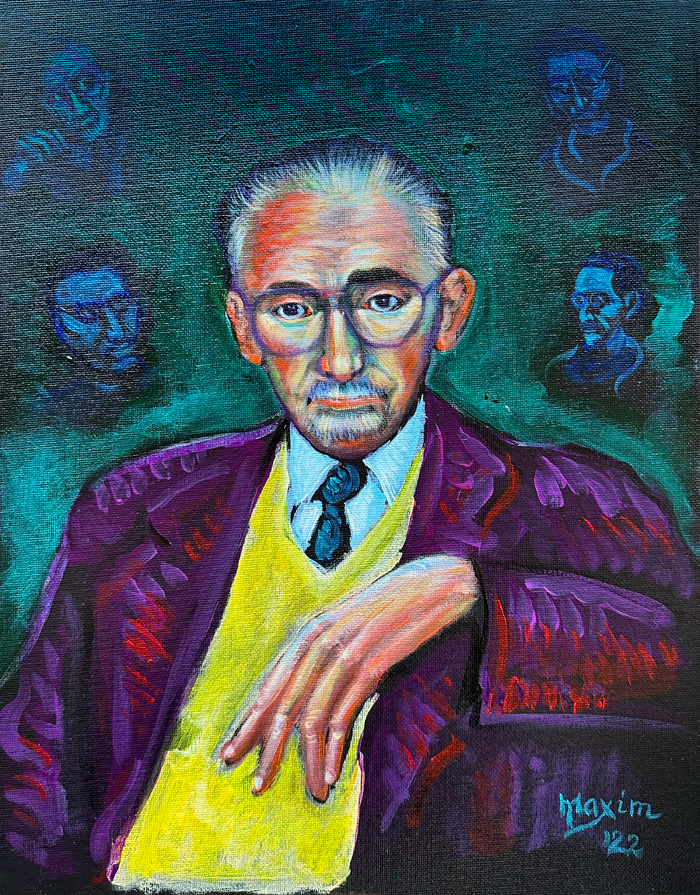
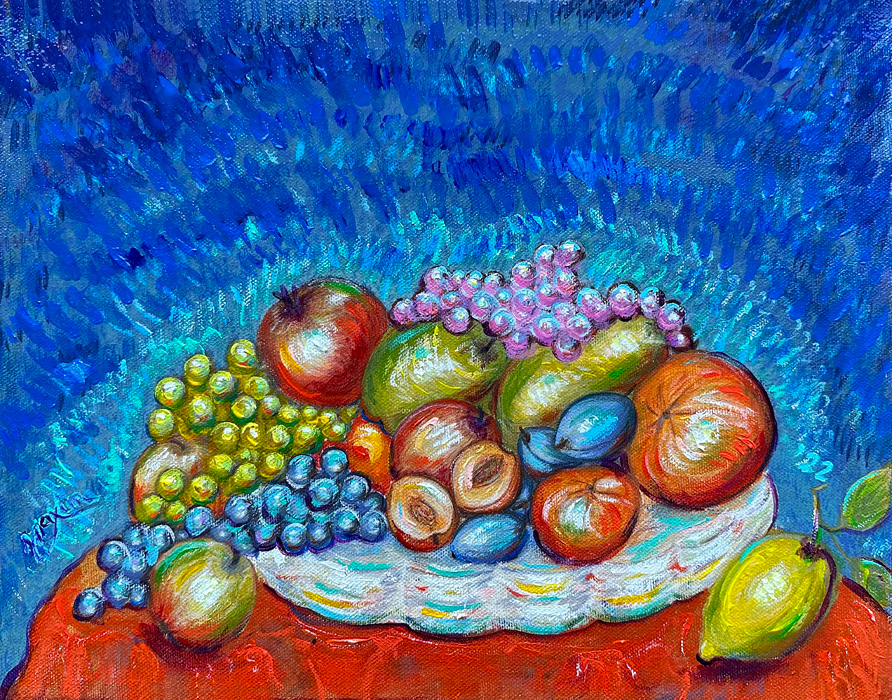
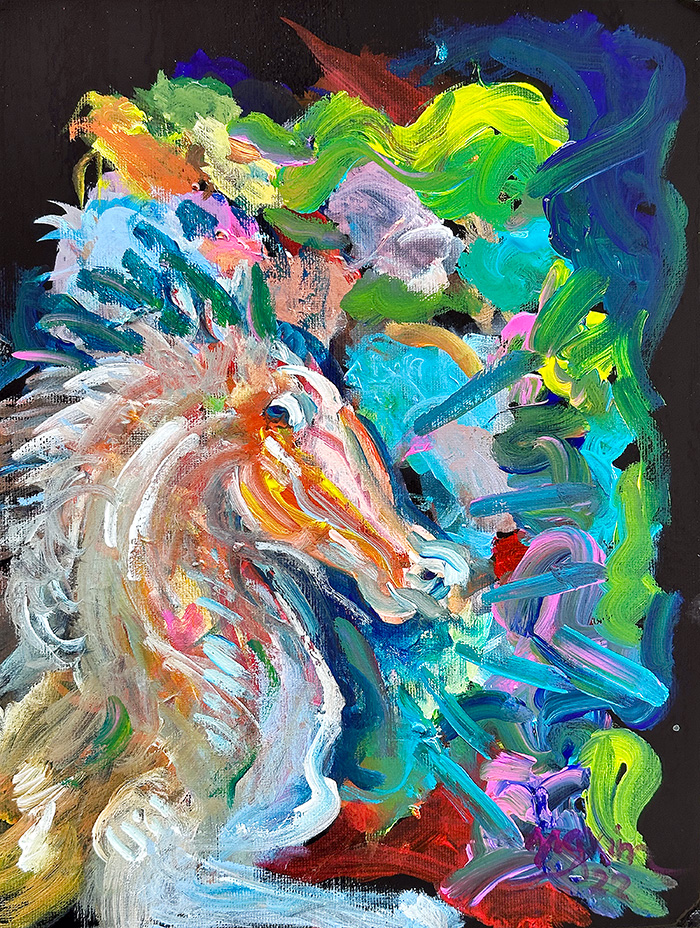
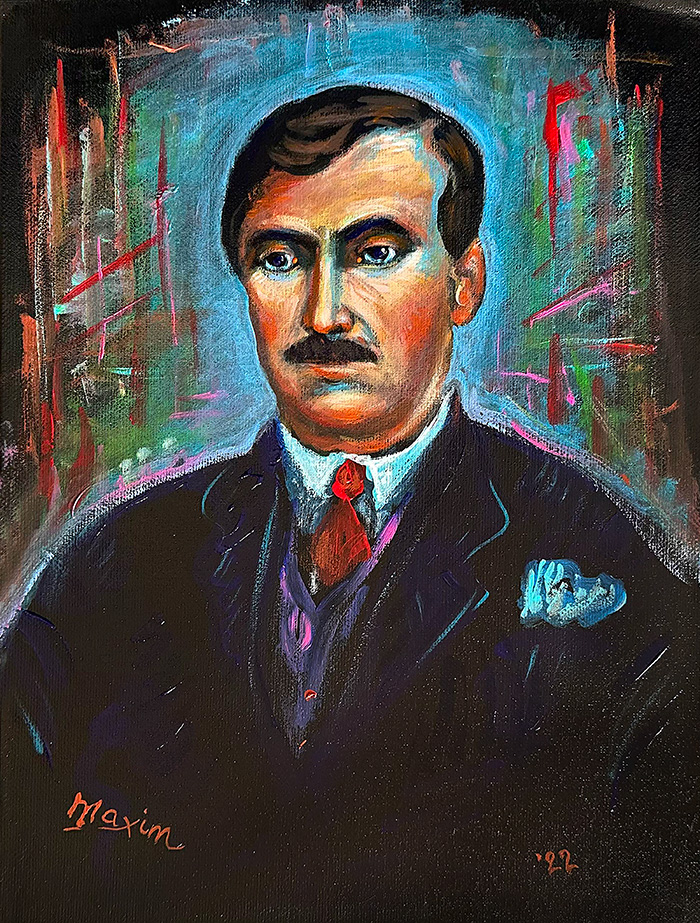
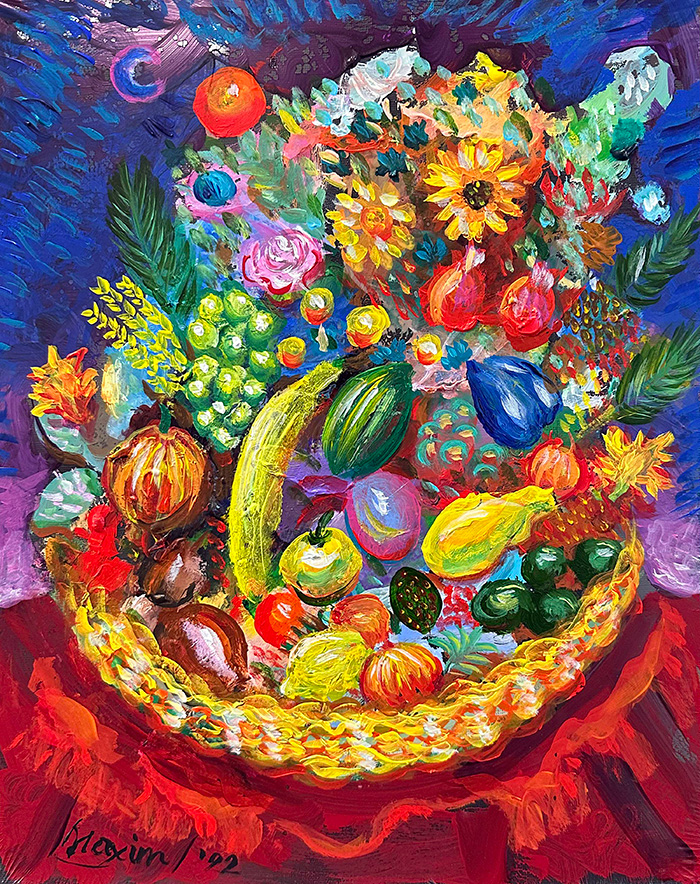
- Details
- Category: Maxim
"Thanksgiving Basket", acrylic on canvas, Bishop Maxim, 2022
Bishop Maxim presently sets before us his unique, lavishly festal, Thanksgiving Basket. In verity, this bold, colorful bouquet of fragrant appreciation is an embellished presentation of such delectable resplendence—les fruits de la terre, for which humanity offers gratitude to the Creator of all and in all.
Vested in its glory and splendor, beyond Solomonic riches, this plentiful harvest offering of such radiant flora and sumptuous, edible delights is a metaphysical rendition of plenty offered through the free and laden strokes of the artist’s brush, vivifying the magnificent bounties of the earth.
Through our anointed senses of inviting sight and, in anticipation, tantalizing smell, gratifying touch, flavorful taste and the sounds of satisfaction, we come to comprehend how our Lord has truly sealed creation with His beauty and goodness, for which we now offer thanksgiving and worship.
Bishop Maxim presently sets before us his unique, lavishly festal, Thanksgiving Basket. In verity, this bold, colorful bouquet of fragrant appreciation is an embellished presentation of such delectable resplendence—les fruits de la terre, for which humanity offers gratitude to the Creator of all and in all.
Vested in its glory and splendor, beyond Solomonic riches, this plentiful harvest offering of such radiant flora and sumptuous, edible delights is a metaphysical rendition of plenty offered through the free and laden strokes of the artist’s brush, vivifying the magnificent bounties of the earth.
Through our anointed senses of inviting sight and, in anticipation, tantalizing smell, gratifying touch, flavorful taste and the sounds of satisfaction, we come to comprehend how our Lord has truly sealed creation with His beauty and goodness, for which we now offer thanksgiving and worship.
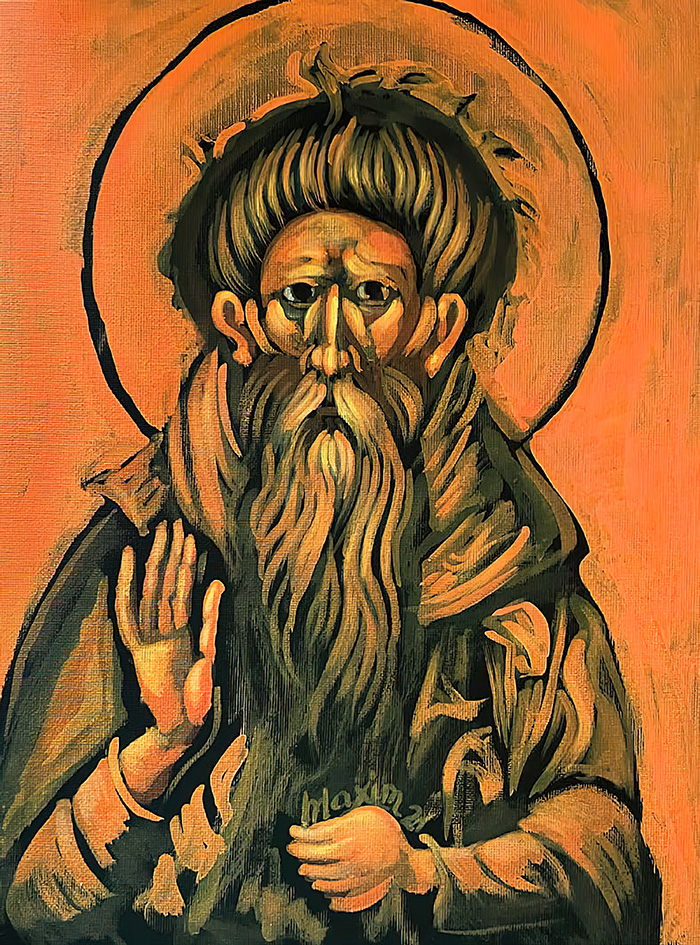
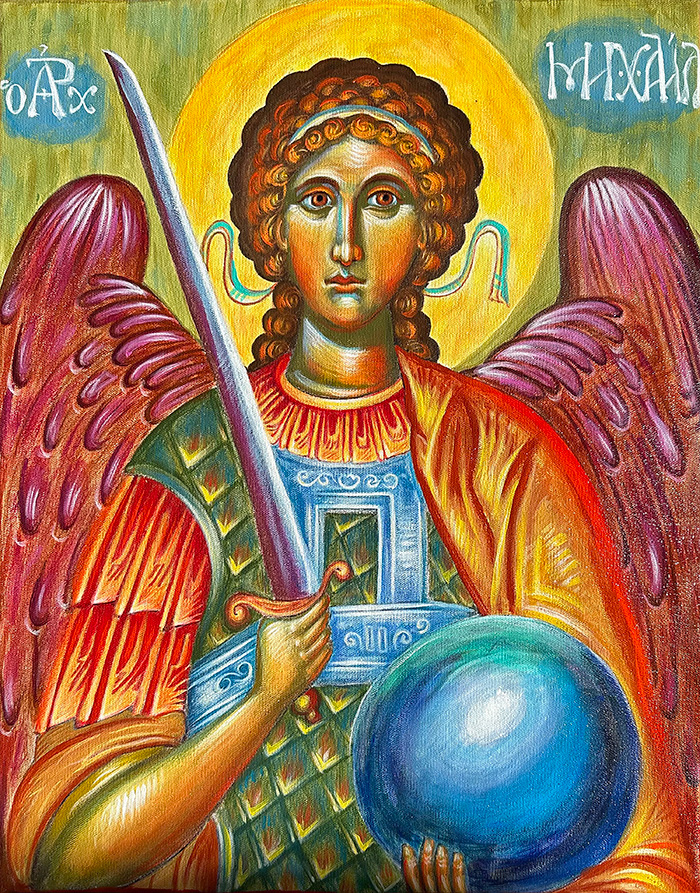
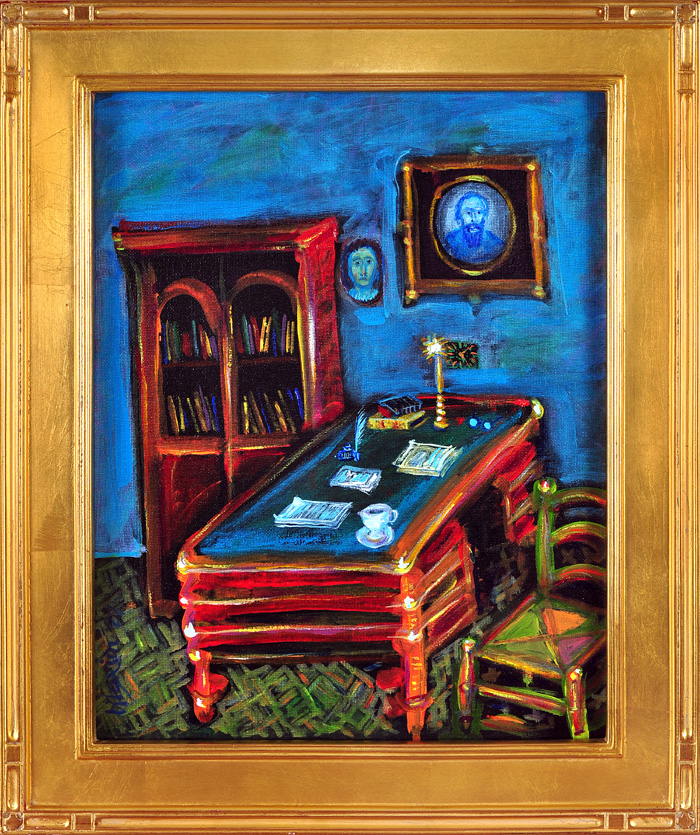
- Details
- Category: Maxim
"Dostoevsky's Room", acrylic on canvas, Bishop Maxim, 2022
The artist succeeded in the shading; the leather on the desk shines, and the wood shines with a subtle touch of yellow within and adjacent to it, with complementary olive and crimson lava cinnabar. Very good and convincing. Also, the chair is a masterpiece, as the frame, the wall, etc. The artist has come (because of his love of images) to the point of controlling his means of expression and painting whatever he wants. Now that he has learned the language, what rests is—Freedom! No copy, no imitation! Discover your solutions! Constantly change things! Monet’s impressionism taught us constant transformation!
The artist succeeded in the shading; the leather on the desk shines, and the wood shines with a subtle touch of yellow within and adjacent to it, with complementary olive and crimson lava cinnabar. Very good and convincing. Also, the chair is a masterpiece, as the frame, the wall, etc. The artist has come (because of his love of images) to the point of controlling his means of expression and painting whatever he wants. Now that he has learned the language, what rests is—Freedom! No copy, no imitation! Discover your solutions! Constantly change things! Monet’s impressionism taught us constant transformation!
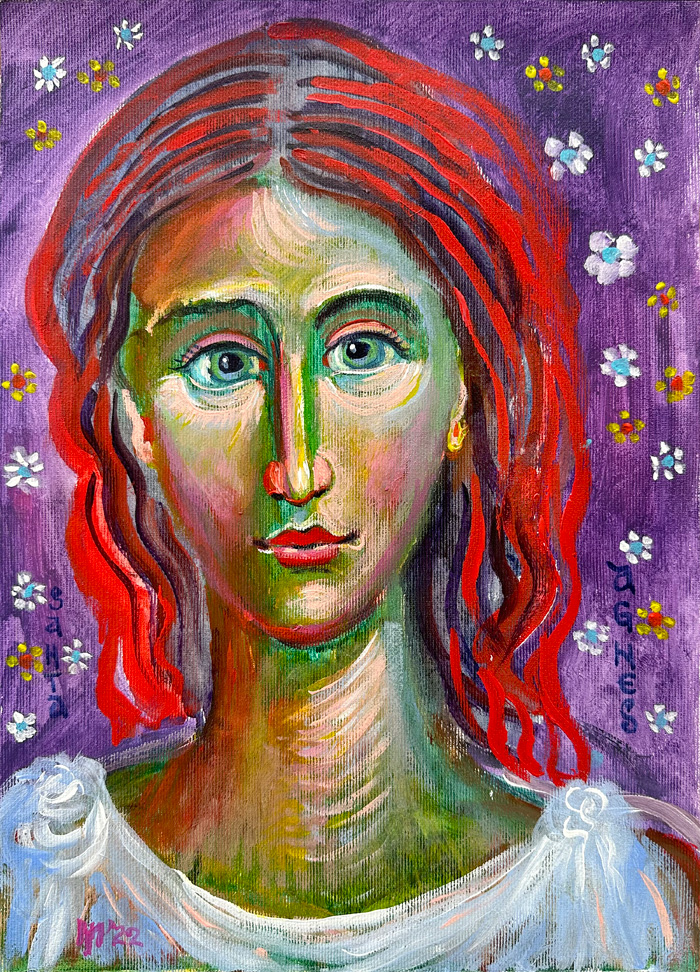
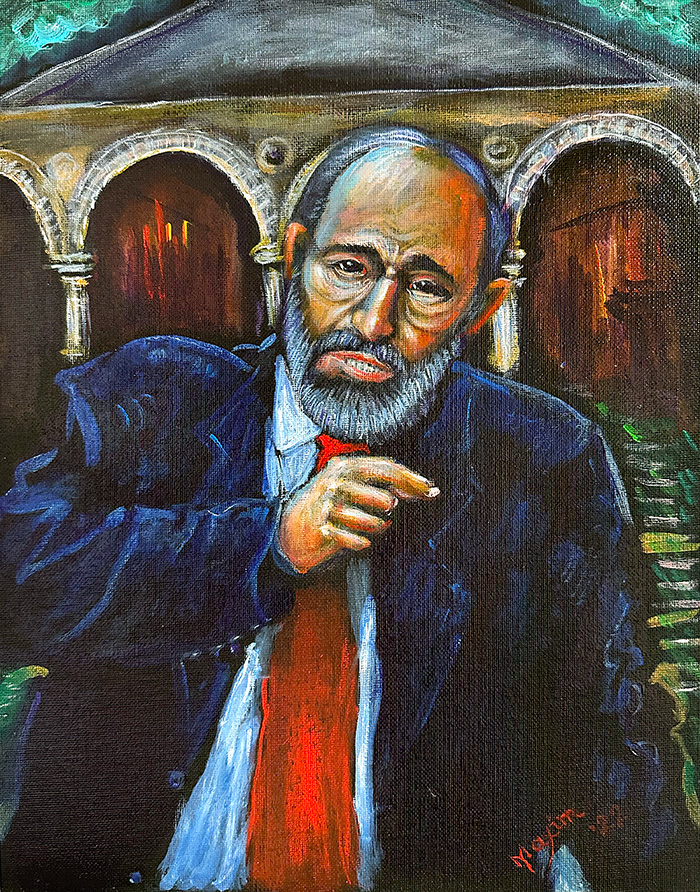
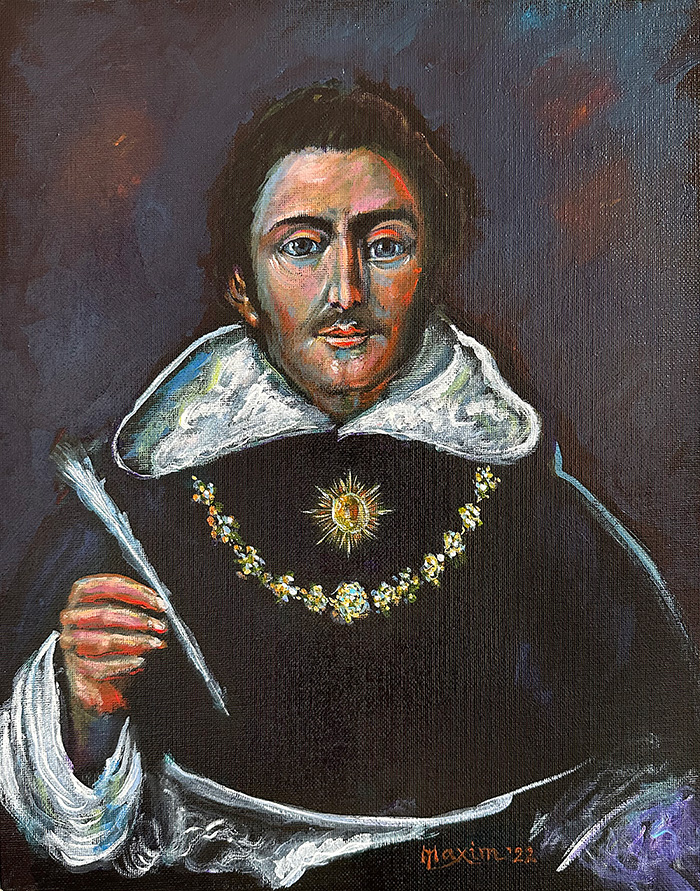
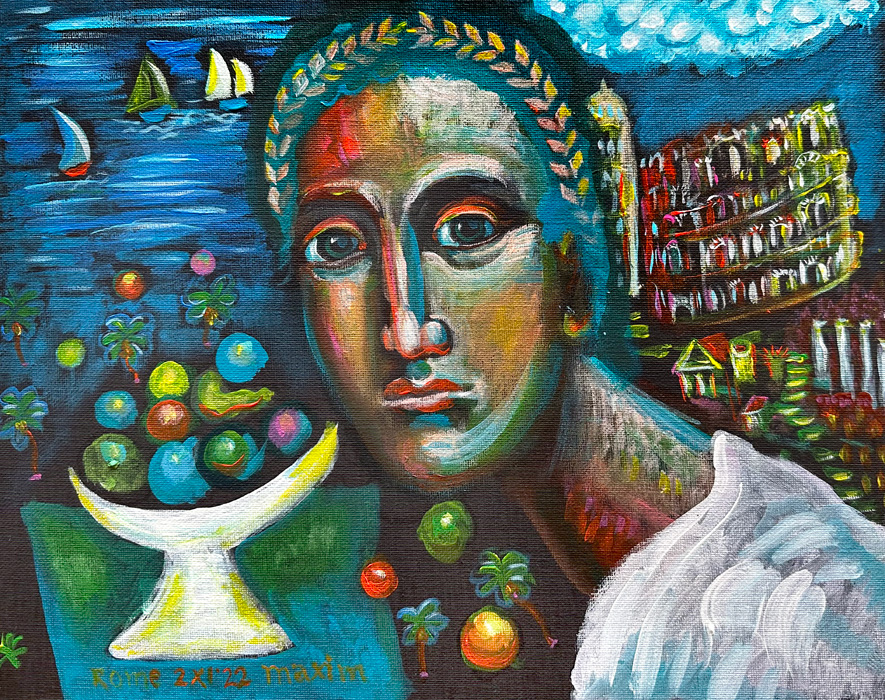
- Details
- Category: Maxim
"Roman Martyr", acrylic on canvas panel, 11x14 inch, Bishop Maxim, 2022
The figure of one between two worlds toward life to come. On the figure’s left is the Colosseum built from the gold taken by the conquering Romans from the Jewish Temple. It is a place where gladiators and lions devour Christians for the entertainment of the people. Above the Colosseum is a pillar of cloud, half hidden as a mandorla, reminding of the Holy Spirit’s invisible presence comforting and strengthening the martyr. On the right, idyllic scenes of peace and abundance fill the space, sails lifted by the Spirit who is in all places and filling all things. A table with a chalice of paradisical fruit overflows as the foundation of the restored Eden. The figure is clothed in a white baptismal garment indicative of the purified martyr and the wedding garment of Grace for the betrothed of Christ. The head of the central figure stretches from left to right accentuated by an elongated neck, away from the colosseum of death, tilting toward the life to come, while the face remains facing fully toward the onlooker thus bringing the action of the scene and its intent toward the viewer face to face. The wreath of the victorious struggler adorns the head and the central action of the painting coalesces to the plaintive face with doe-like eyes who turns toward the onlooker with a beckoning question to the heart. — Stephen Muse
The figure of one between two worlds toward life to come. On the figure’s left is the Colosseum built from the gold taken by the conquering Romans from the Jewish Temple. It is a place where gladiators and lions devour Christians for the entertainment of the people. Above the Colosseum is a pillar of cloud, half hidden as a mandorla, reminding of the Holy Spirit’s invisible presence comforting and strengthening the martyr. On the right, idyllic scenes of peace and abundance fill the space, sails lifted by the Spirit who is in all places and filling all things. A table with a chalice of paradisical fruit overflows as the foundation of the restored Eden. The figure is clothed in a white baptismal garment indicative of the purified martyr and the wedding garment of Grace for the betrothed of Christ. The head of the central figure stretches from left to right accentuated by an elongated neck, away from the colosseum of death, tilting toward the life to come, while the face remains facing fully toward the onlooker thus bringing the action of the scene and its intent toward the viewer face to face. The wreath of the victorious struggler adorns the head and the central action of the painting coalesces to the plaintive face with doe-like eyes who turns toward the onlooker with a beckoning question to the heart. — Stephen Muse
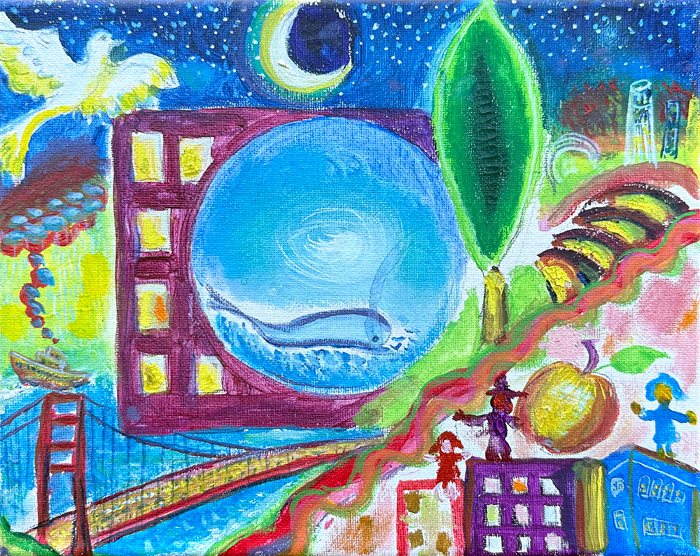
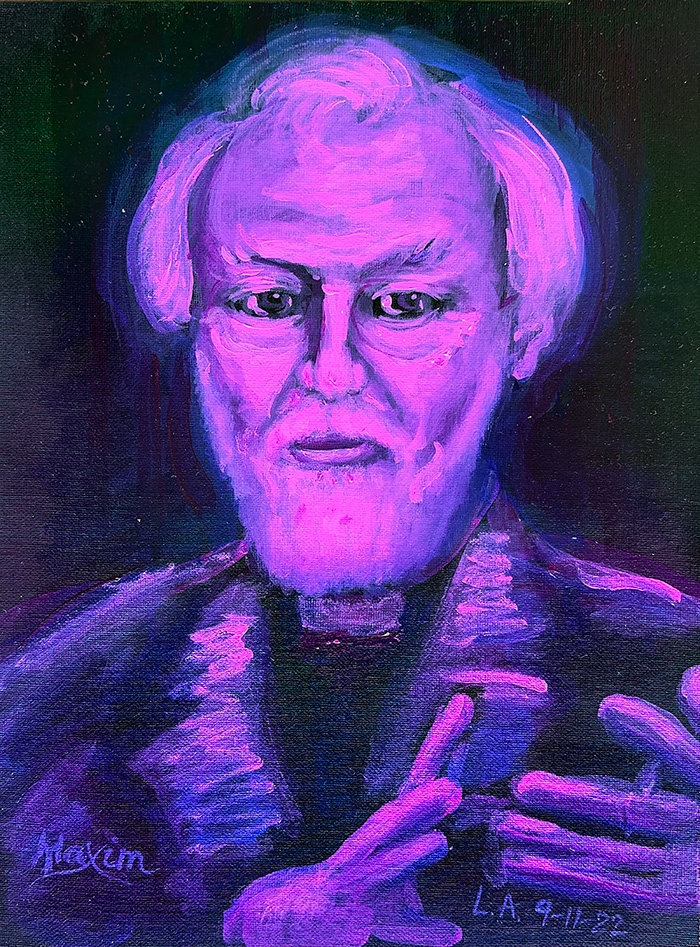
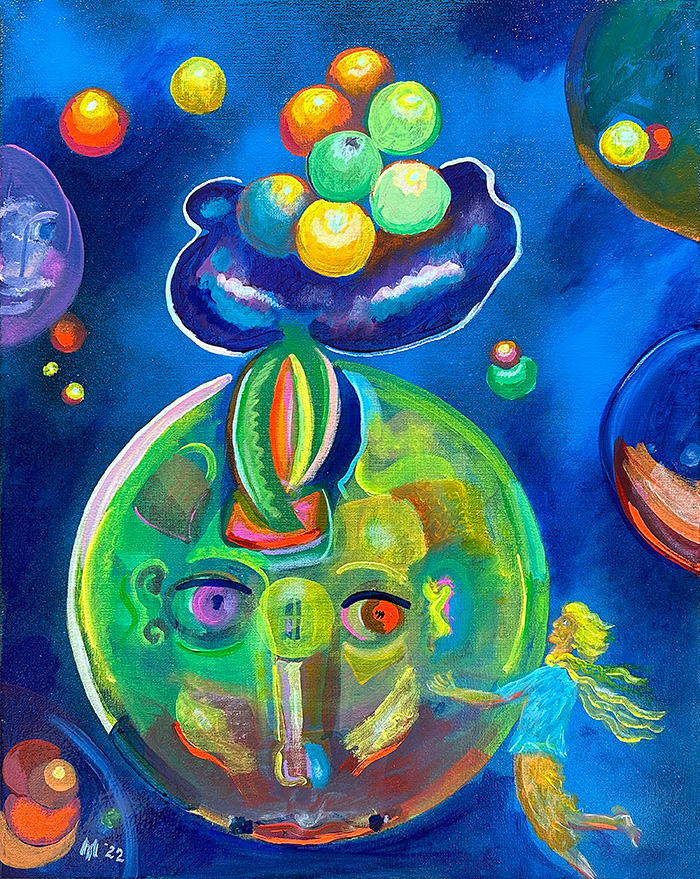
- Details
- Category: Maxim
"Cosmic Liturgy", acrylic on canvas, 16x20 inch, Bishop Maxim, 2022
One of the rarest things in life is to meet the innocent, the blameless, and the childish in a good sense. Such a rare and indescribably innocent thing is encountered by whoever sees this painting by Bishop Maxim Vasiljevich. First, the black universe (due to the lack of atmosphere) seems to us as if it were breathing and pulsating with its blue shimmers. It is not the vast faceless space in which the fixed stars run their curved courses. And the stars do not seem to be of the hard and heavy material of the congealed lava but rather appear like soft and juicy fruits in a heavenly fruit bowl. Their lighting, which results from the artist’s rare color work, makes us feel like children playing a space game in a friendly and welcoming environment. And suddenly, in the center of the enormous sphere, we perceive a gigantic child’s face, looking at us with innocent eyes, which look at us as if to detect if there is any trace of unfailing love left in the depths of our hearts. Perhaps the Little PRINCE on the right has the innocence that gives him the audacity to stretch out his little arms and embrace the mysterious majestic FACE OF THE UNIVERSE. In this painting, the unexpected originality achieves three points: the unique color work, the incredible lightness that holds the meteor planets, and the waving scarf that transforms the Little Prince into a flying CHERUBIM.
One of the rarest things in life is to meet the innocent, the blameless, and the childish in a good sense. Such a rare and indescribably innocent thing is encountered by whoever sees this painting by Bishop Maxim Vasiljevich. First, the black universe (due to the lack of atmosphere) seems to us as if it were breathing and pulsating with its blue shimmers. It is not the vast faceless space in which the fixed stars run their curved courses. And the stars do not seem to be of the hard and heavy material of the congealed lava but rather appear like soft and juicy fruits in a heavenly fruit bowl. Their lighting, which results from the artist’s rare color work, makes us feel like children playing a space game in a friendly and welcoming environment. And suddenly, in the center of the enormous sphere, we perceive a gigantic child’s face, looking at us with innocent eyes, which look at us as if to detect if there is any trace of unfailing love left in the depths of our hearts. Perhaps the Little PRINCE on the right has the innocence that gives him the audacity to stretch out his little arms and embrace the mysterious majestic FACE OF THE UNIVERSE. In this painting, the unexpected originality achieves three points: the unique color work, the incredible lightness that holds the meteor planets, and the waving scarf that transforms the Little Prince into a flying CHERUBIM.
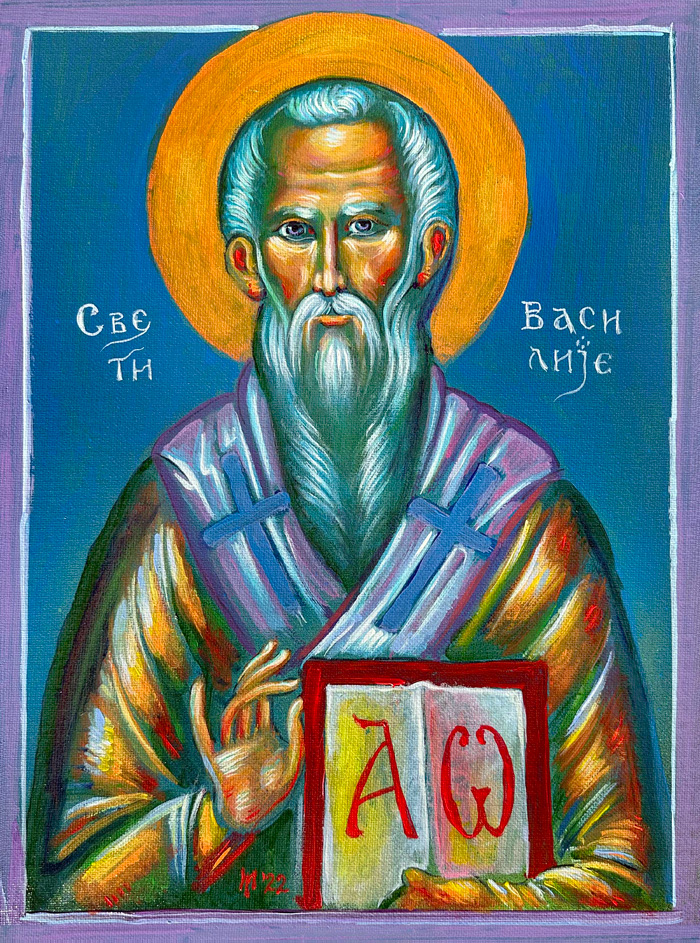
- Details
- Category: Maxim
"St. Vasillije of Ostrog", acrylic on canvas, 12x16 inch, Bishop Maxim, 2022
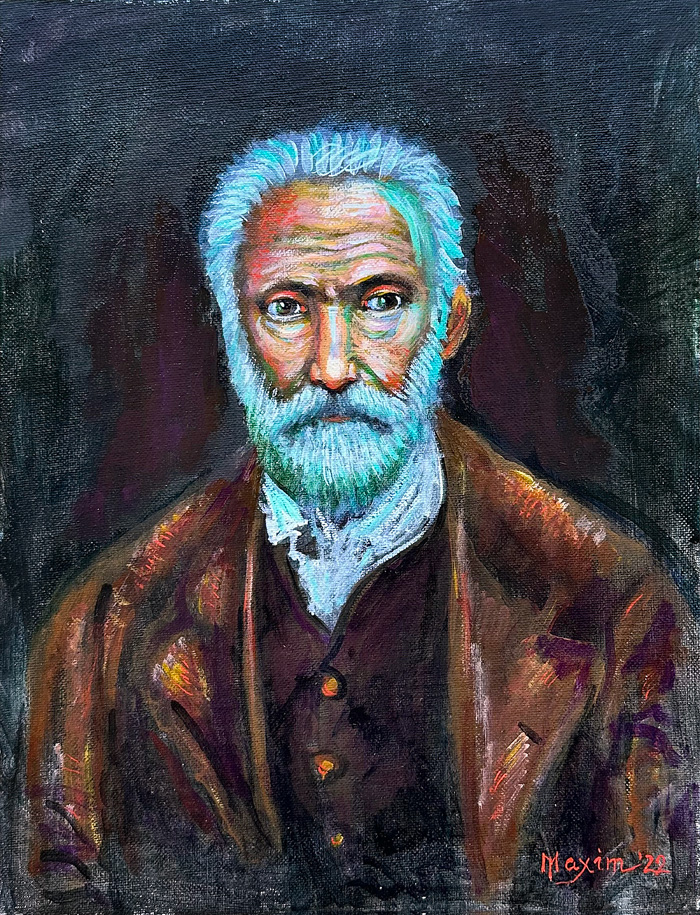
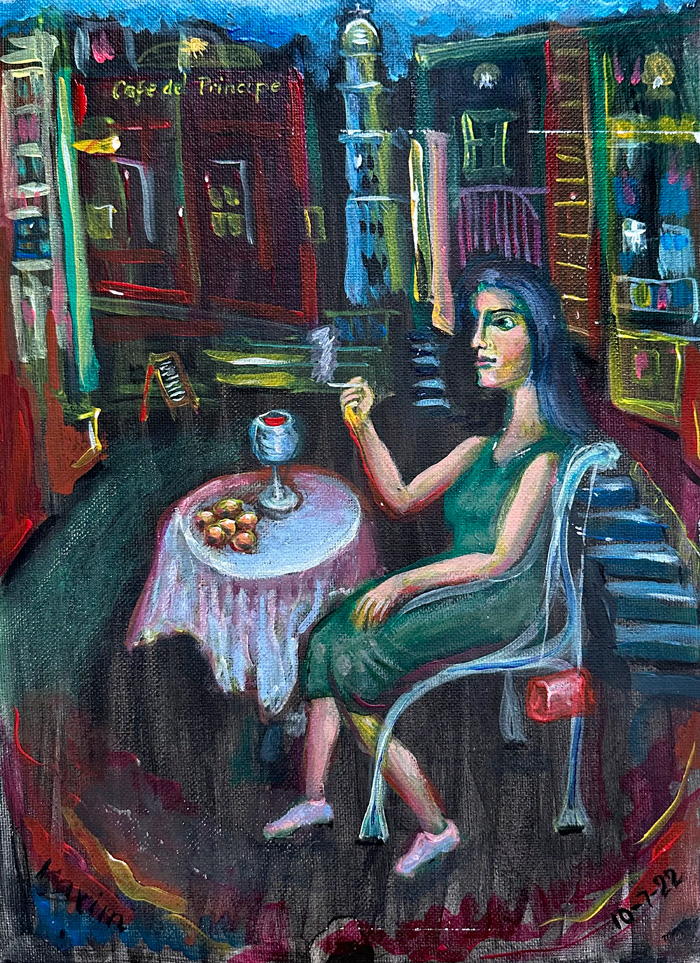
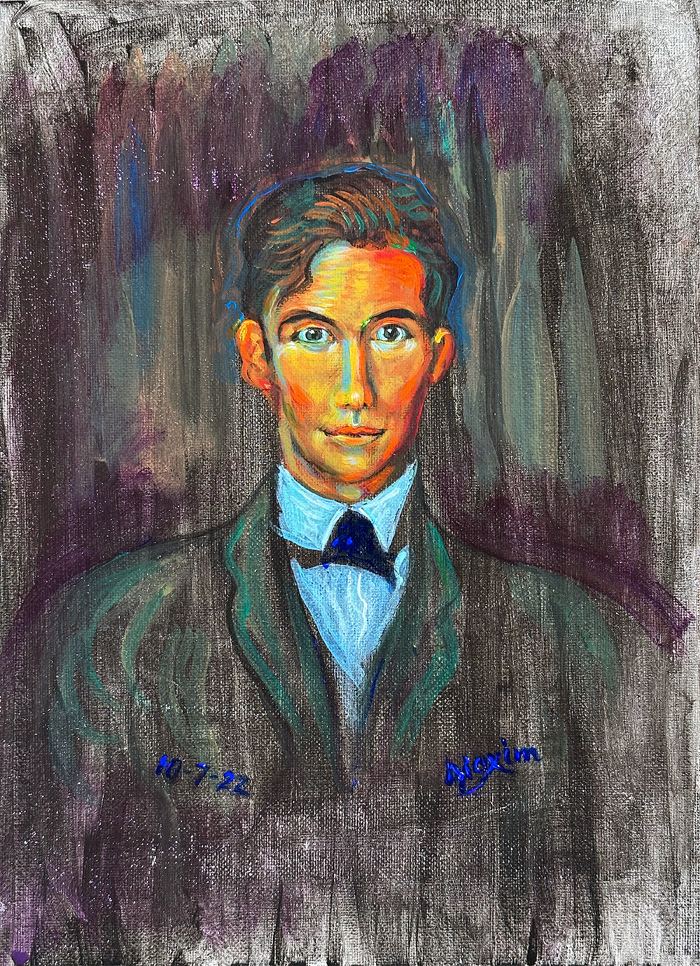
- Details
- Category: Maxim
"Federico Garcia Lorca", acrylic on canvas panel, 33x24 cm, Bishop Maxim, 2022
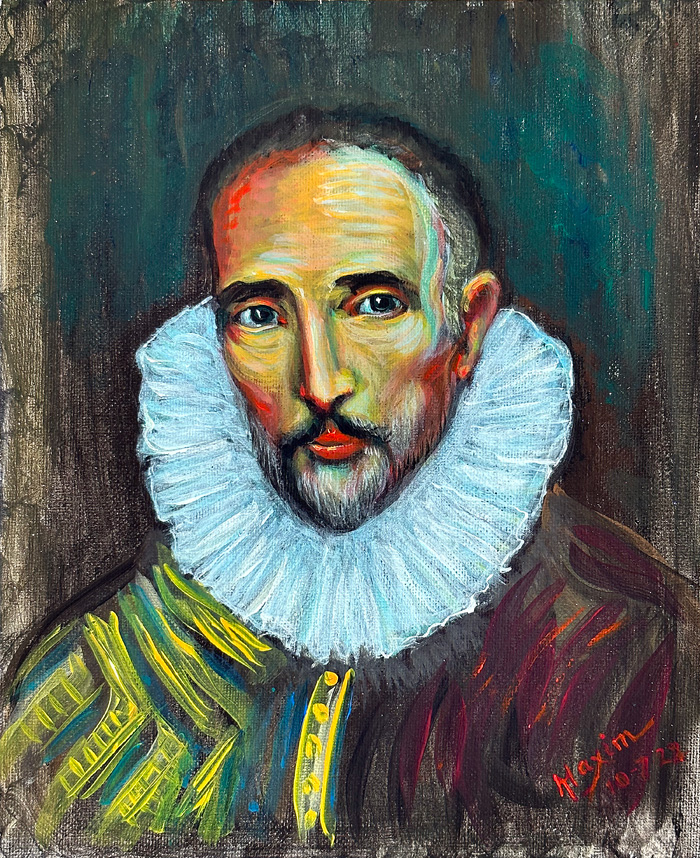
- Details
- Category: Maxim
"Miguel de Cervantes", acrylic on canvas panel, 27x22 cm, Bishop Maxim, 2022
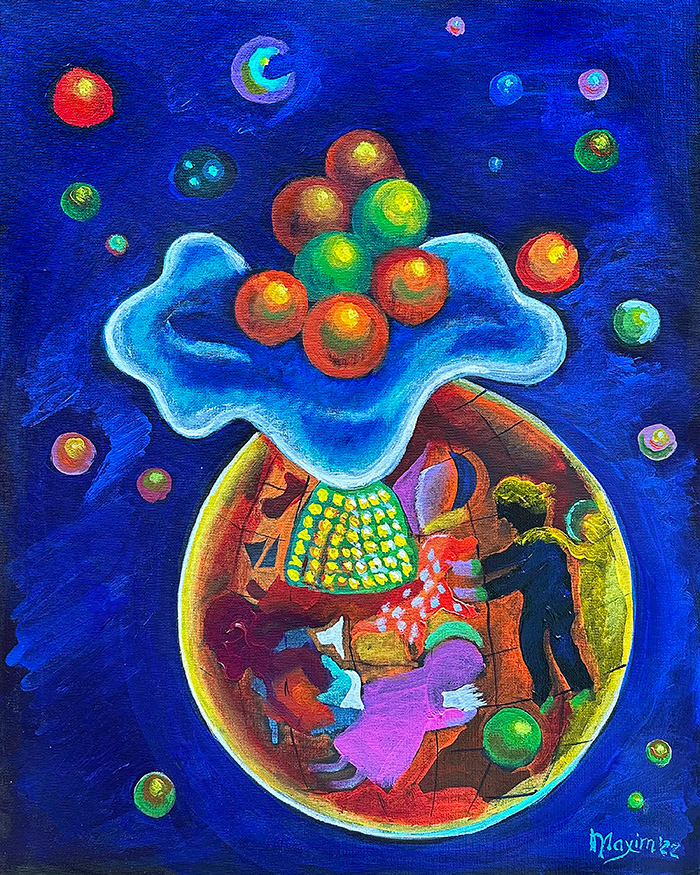
- Details
- Category: Maxim
“Сosmic Liturgy” (Kandinsky & Stamatis in Dialogue), acrylic on canvas, 16x20 inch, Bishop Maxim, 2022
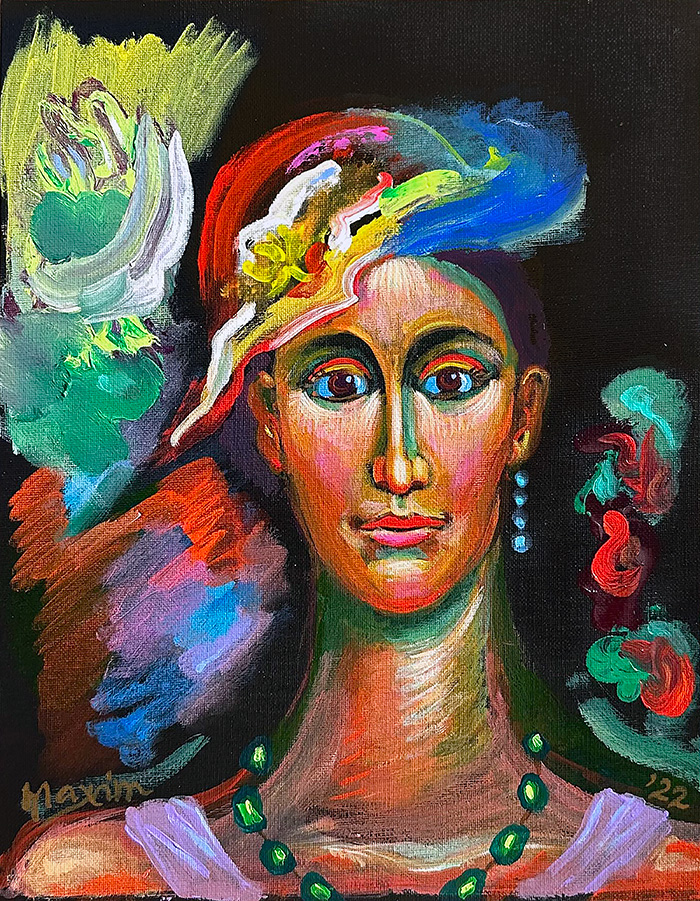
- Details
- Category: Maxim
"Perennial Fayum Lady", acrylic on canvas, Bishop Maxim, 2022
The bejeweled Fayum woman is portrayed with elegance, sophistication, and sweet, refined features. The necklace is inset with precious stones; the hat and jewelry detail add an external element to her nobility.
The bejeweled Fayum woman is portrayed with elegance, sophistication, and sweet, refined features. The necklace is inset with precious stones; the hat and jewelry detail add an external element to her nobility.
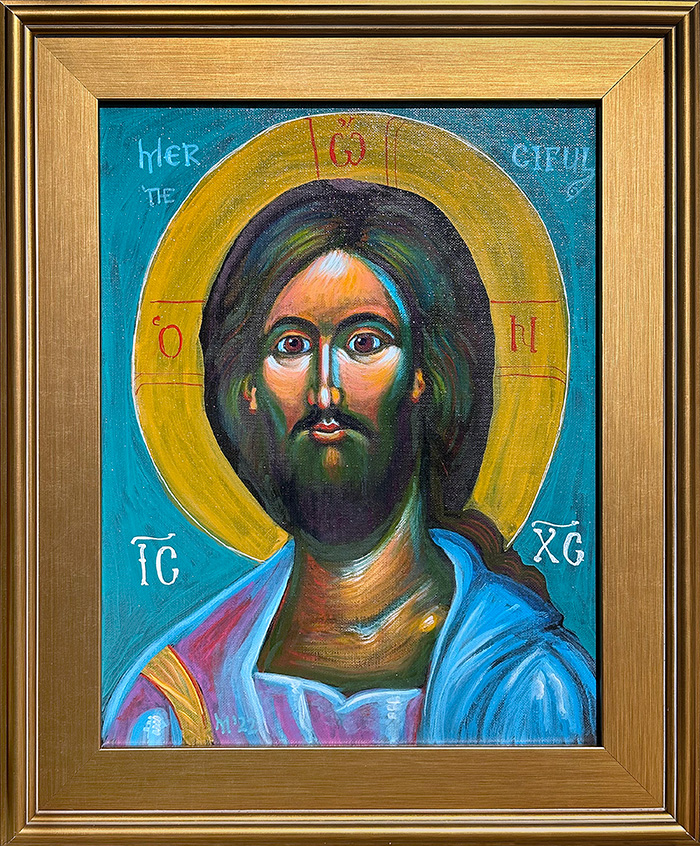
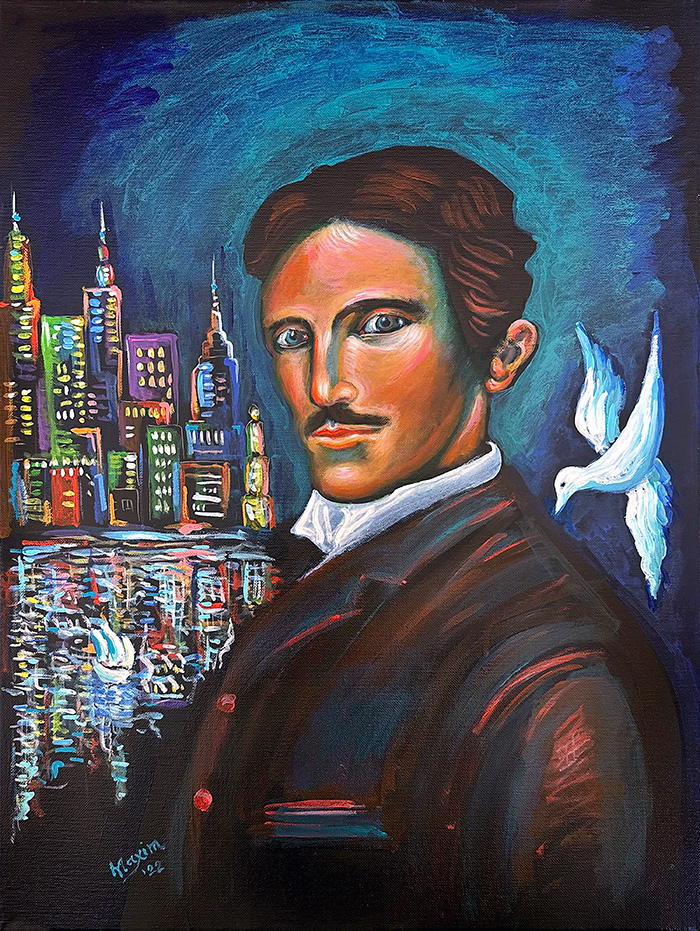
- Details
- Category: Maxim
"Light-Giving Revelation 2", acrylic on canvas, 18x24 inch, Bishop Maxim, 2022
METAPHYSICAL APPROACH. We can say that the megalopolis’ illumination comes from the illumination of the Spirit. And we have evidence that the great inventor had powerful metaphysical tendencies. The dove’s descent refers to the Holy Spirit, who leads to discoveries and theological surprises with His inspiration. And the reflections of the city in the waters balance the action of the painting from the left side with the surprise of electrification in a world dark before. In the middle of the painting, the author of the surprise of a new era for humanity.
PICTORIAL APPROACH. Having all the tools of Impressionism in his quiver, the painter convinces us that the depicted dove, a symbol of the Spirit, and the shining electrified city, express the significant change brought about by electricity in society, which is equivalent to a cultural revolution. The existential side of this miracle is painted in Tesla’s gaze, which takes on a metaphysical dimension. The inventor is depicted as knowing some great secret as if something has been revealed to him that the rest of us are unaware of. And the body language speaks of certainty, of a new reality—a photo transformation of people’s lives.
METAPHYSICAL APPROACH. We can say that the megalopolis’ illumination comes from the illumination of the Spirit. And we have evidence that the great inventor had powerful metaphysical tendencies. The dove’s descent refers to the Holy Spirit, who leads to discoveries and theological surprises with His inspiration. And the reflections of the city in the waters balance the action of the painting from the left side with the surprise of electrification in a world dark before. In the middle of the painting, the author of the surprise of a new era for humanity.
PICTORIAL APPROACH. Having all the tools of Impressionism in his quiver, the painter convinces us that the depicted dove, a symbol of the Spirit, and the shining electrified city, express the significant change brought about by electricity in society, which is equivalent to a cultural revolution. The existential side of this miracle is painted in Tesla’s gaze, which takes on a metaphysical dimension. The inventor is depicted as knowing some great secret as if something has been revealed to him that the rest of us are unaware of. And the body language speaks of certainty, of a new reality—a photo transformation of people’s lives.
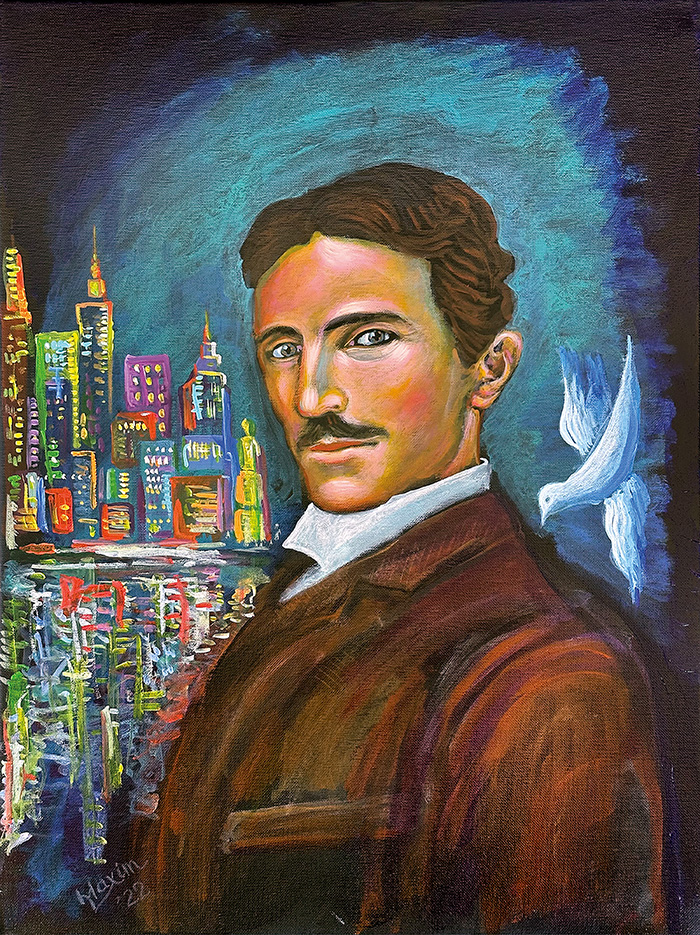
- Details
- Category: Maxim
"Light-Giving Revelation", acrylic on canvas, 18x24 inch, Bishop Maxim, 2022
METAPHYSICAL APPROACH. We can say that the megalopolis’ illumination comes from the illumination of the Spirit. And we have evidence that the great inventor had powerful metaphysical tendencies. The dove’s descent refers to the Holy Spirit, who leads to discoveries and theological surprises with His inspiration. And the reflections of the city in the waters balance the action of the painting from the left side with the surprise of electrification in a world dark before. In the middle of the painting, the author of the surprise of a new era for humanity.
PICTORIAL APPROACH. Having all the tools of Impressionism in his quiver, the painter convinces us that the depicted dove, a symbol of the Spirit, and the shining electrified city, express the significant change brought about by electricity in society, which is equivalent to a cultural revolution. The existential side of this miracle is painted in Tesla’s gaze, which takes on a metaphysical dimension. The inventor is depicted as knowing some great secret as if something has been revealed to him that the rest of us are unaware of. And the body language speaks of certainty, of a new reality—a photo transformation of people’s lives.
METAPHYSICAL APPROACH. We can say that the megalopolis’ illumination comes from the illumination of the Spirit. And we have evidence that the great inventor had powerful metaphysical tendencies. The dove’s descent refers to the Holy Spirit, who leads to discoveries and theological surprises with His inspiration. And the reflections of the city in the waters balance the action of the painting from the left side with the surprise of electrification in a world dark before. In the middle of the painting, the author of the surprise of a new era for humanity.
PICTORIAL APPROACH. Having all the tools of Impressionism in his quiver, the painter convinces us that the depicted dove, a symbol of the Spirit, and the shining electrified city, express the significant change brought about by electricity in society, which is equivalent to a cultural revolution. The existential side of this miracle is painted in Tesla’s gaze, which takes on a metaphysical dimension. The inventor is depicted as knowing some great secret as if something has been revealed to him that the rest of us are unaware of. And the body language speaks of certainty, of a new reality—a photo transformation of people’s lives.
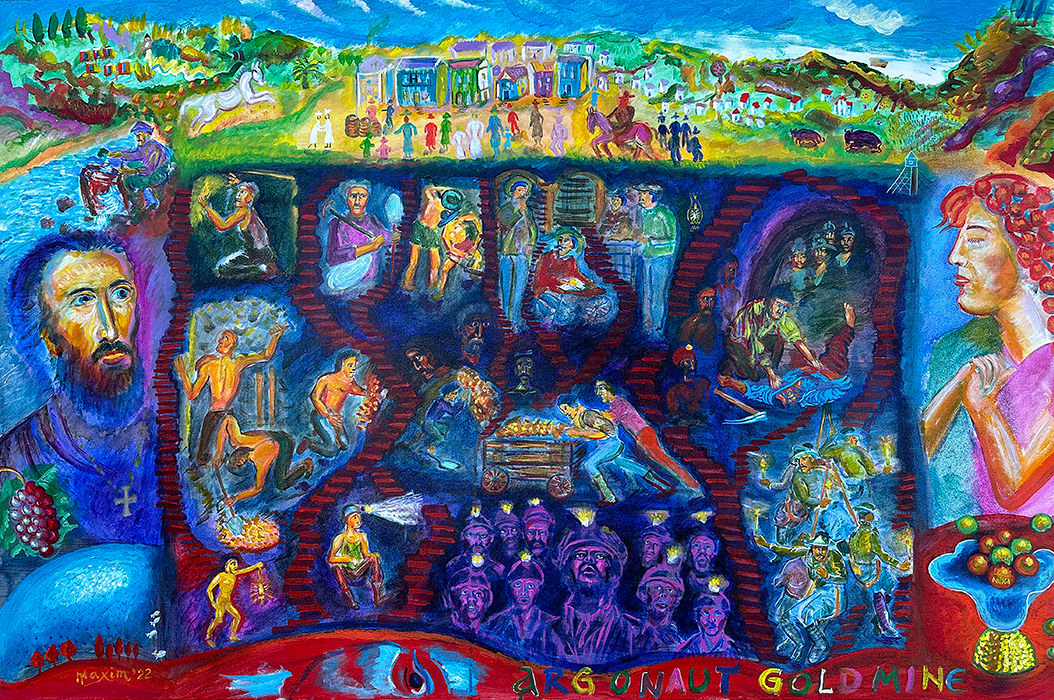
- Details
- Category: Maxim
"Argonaut California Gold Mine 1922", acrylic on canvas, Bishop Maxim, 2022
This moving painting presents two different worlds above the indifferent society where "life goes on" under the indifference of everyone who deals with indifference regarding the tragic event. Below is the world of the mine where we see workers performing various collaborations while they search for the lost persons in the treacherous darkness where we humans search to find coal, gold, or silver. At the same time, we know it is fate some will be lost in the earth's bowels.
This moving painting presents two different worlds above the indifferent society where "life goes on" under the indifference of everyone who deals with indifference regarding the tragic event. Below is the world of the mine where we see workers performing various collaborations while they search for the lost persons in the treacherous darkness where we humans search to find coal, gold, or silver. At the same time, we know it is fate some will be lost in the earth's bowels.
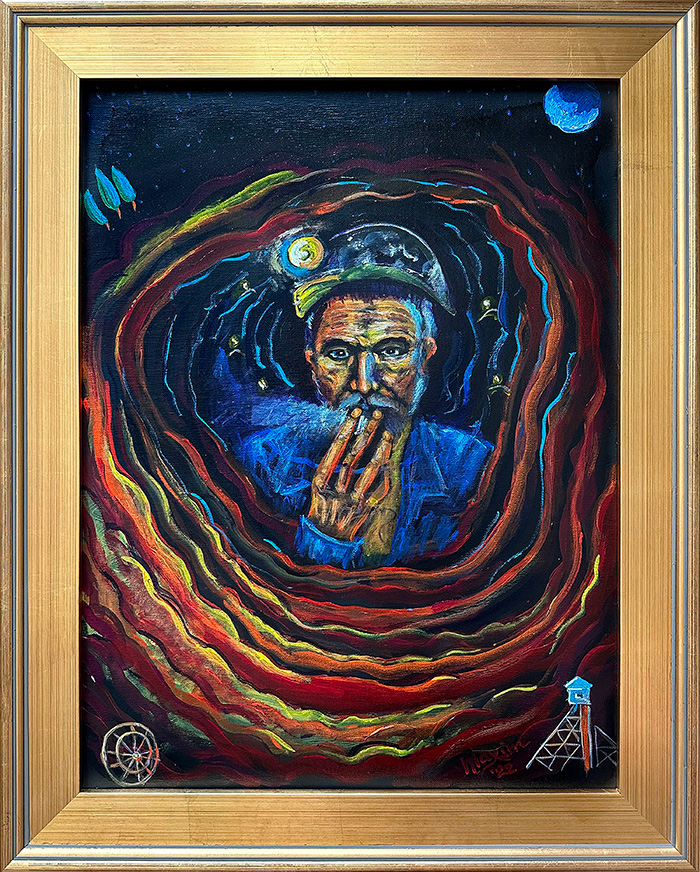
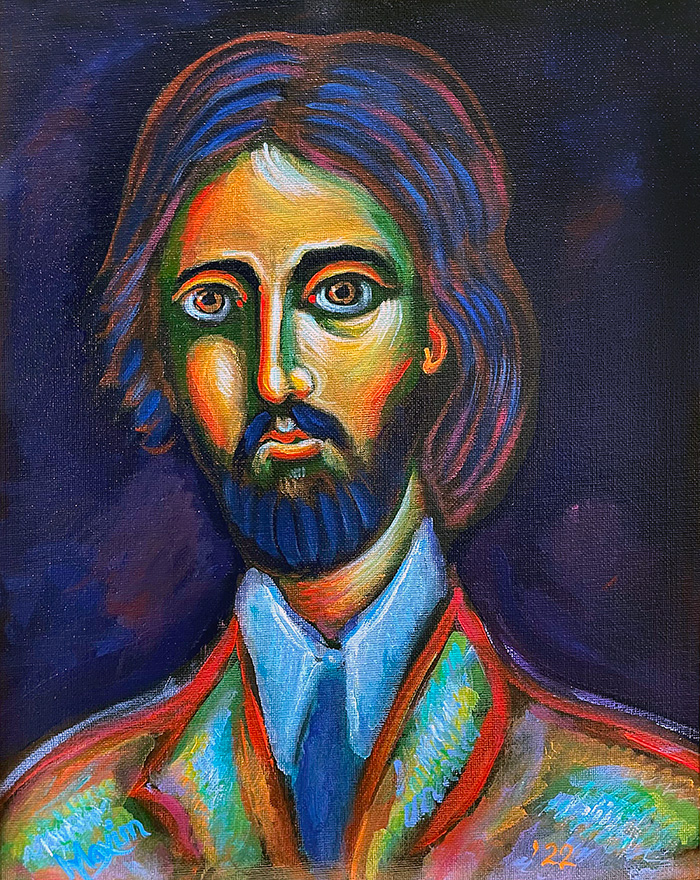
- Details
- Category: Maxim
"Ivan Karamazov: I Hasten to Give Back My Entrance Ticket", acrylic on canvas, 11x14 inch, Bishop Maxim, 2022
We observe a suit painted with “heavenly” colors that we cannot find in any clothing store. The jacket’s structure is warm, brownish-red, and the collar and shoulders come out of those lines, with a combination of greenish, yellowish, and azure-turquoise brush strokes, from which a miracle jacket is obtained! This miracle jacket allows a thin, noble neck and a face lit by direct light to be shown, with eyes that are “protruding” (ecstatic) because they see something we have not seen, and the character remains ecstatic and voiceless. This ecstatic figure is covered with hair with bluish strands, similar to the mustache and beard. But all this is similar to a decorative frame that frames the bright face of an ecstatic look.
We observe a suit painted with “heavenly” colors that we cannot find in any clothing store. The jacket’s structure is warm, brownish-red, and the collar and shoulders come out of those lines, with a combination of greenish, yellowish, and azure-turquoise brush strokes, from which a miracle jacket is obtained! This miracle jacket allows a thin, noble neck and a face lit by direct light to be shown, with eyes that are “protruding” (ecstatic) because they see something we have not seen, and the character remains ecstatic and voiceless. This ecstatic figure is covered with hair with bluish strands, similar to the mustache and beard. But all this is similar to a decorative frame that frames the bright face of an ecstatic look.
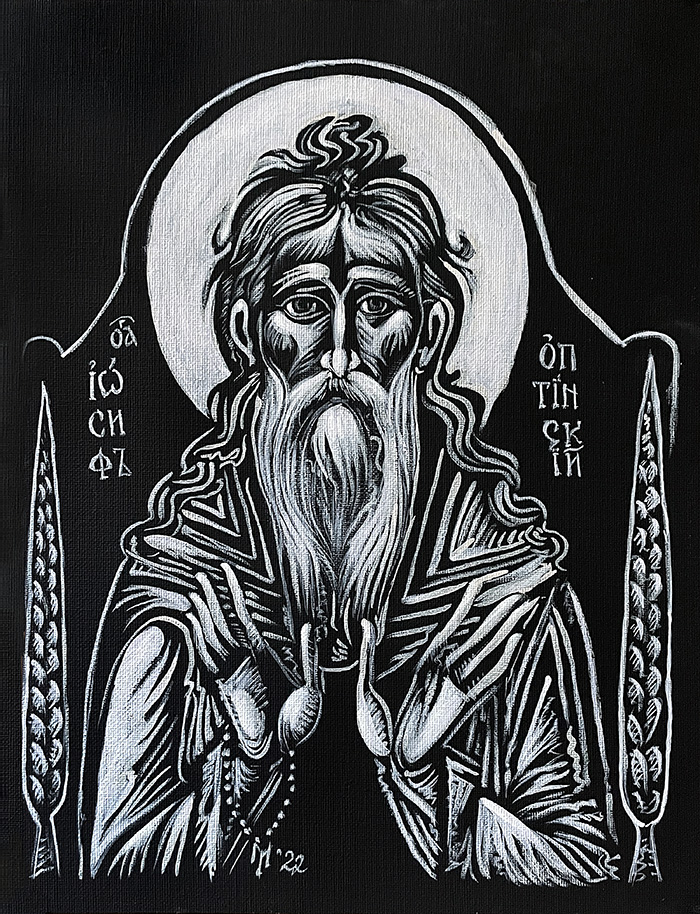
- Details
- Category: Maxim
"Starets Joseph of Optina", acrylic on canvas, 12x16 inch, Bishop Maxim, 2022
The venerable father Joseph (Litovkin) of Optina was starets and hieroschemamonk among the group of monastics of Optina Monastery in the nineteenth century who were known as the Optina Elders. Elder Joseph is venerated on May 9 and with the Synaxis of the Optina Elders on October 11. In June 1861, Joseph was asked by the Superior of the skete, Fr. Paphnutius, to become the cell attendant of the Elder Ambrose, a position he would retain for the next fifty years. As Fr. Ambrose's cell attendant, he found time to read spiritual books, especially the Philokalia and the writings of the Fathers, finding in them spiritual wisdom that he shared with those who came to him for advice. Foreseeing that Fr. Joseph would serve as Elder after him, Fr. Ambrose blessed some people to start going to Fr. Joseph for their spiritual needs. The Russian novelist Fyodor Dostoevsky said that Saint Ambrose was the model for the character of Father Zossima in his novel "The Brothers Karamazov."
The venerable father Joseph (Litovkin) of Optina was starets and hieroschemamonk among the group of monastics of Optina Monastery in the nineteenth century who were known as the Optina Elders. Elder Joseph is venerated on May 9 and with the Synaxis of the Optina Elders on October 11. In June 1861, Joseph was asked by the Superior of the skete, Fr. Paphnutius, to become the cell attendant of the Elder Ambrose, a position he would retain for the next fifty years. As Fr. Ambrose's cell attendant, he found time to read spiritual books, especially the Philokalia and the writings of the Fathers, finding in them spiritual wisdom that he shared with those who came to him for advice. Foreseeing that Fr. Joseph would serve as Elder after him, Fr. Ambrose blessed some people to start going to Fr. Joseph for their spiritual needs. The Russian novelist Fyodor Dostoevsky said that Saint Ambrose was the model for the character of Father Zossima in his novel "The Brothers Karamazov."
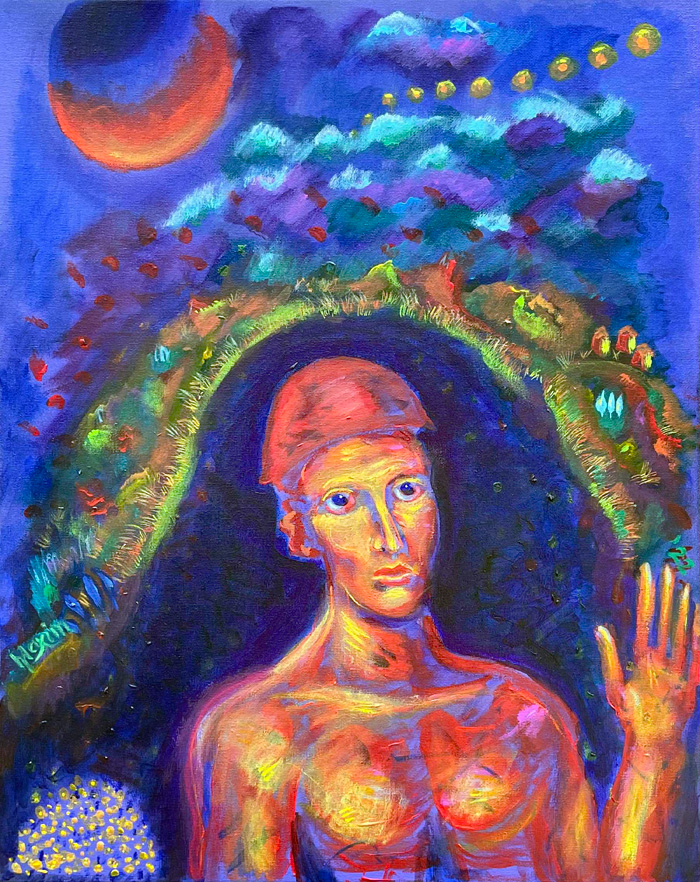
- Details
- Category: Maxim
"The Gold Country Miner Coming Out of the Mine", acrylic on canvas, 16x20, Bishop Maxim, 2022
I admire the expression of the Californian red man, who is young, dynamic, and fighting with his destiny. The contrast between red and blue and the cave is impressive, while the colors of the colorful land are captivating. The much-loved Moon with the orange crescent is very original. This miner is the heart of the earth that beats deep within it and churns its blood; in terms of the earth, we call it "lava" (when it comes out as a volcano) and "magma" when it is hidden in the depths. - Stamatis Skliris
I admire the expression of the Californian red man, who is young, dynamic, and fighting with his destiny. The contrast between red and blue and the cave is impressive, while the colors of the colorful land are captivating. The much-loved Moon with the orange crescent is very original. This miner is the heart of the earth that beats deep within it and churns its blood; in terms of the earth, we call it "lava" (when it comes out as a volcano) and "magma" when it is hidden in the depths. - Stamatis Skliris
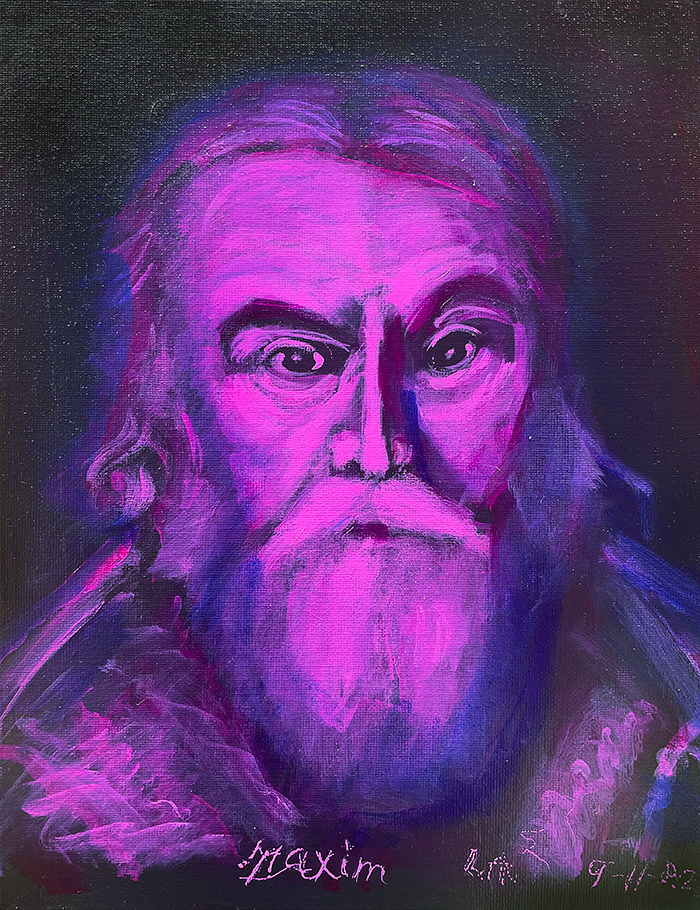
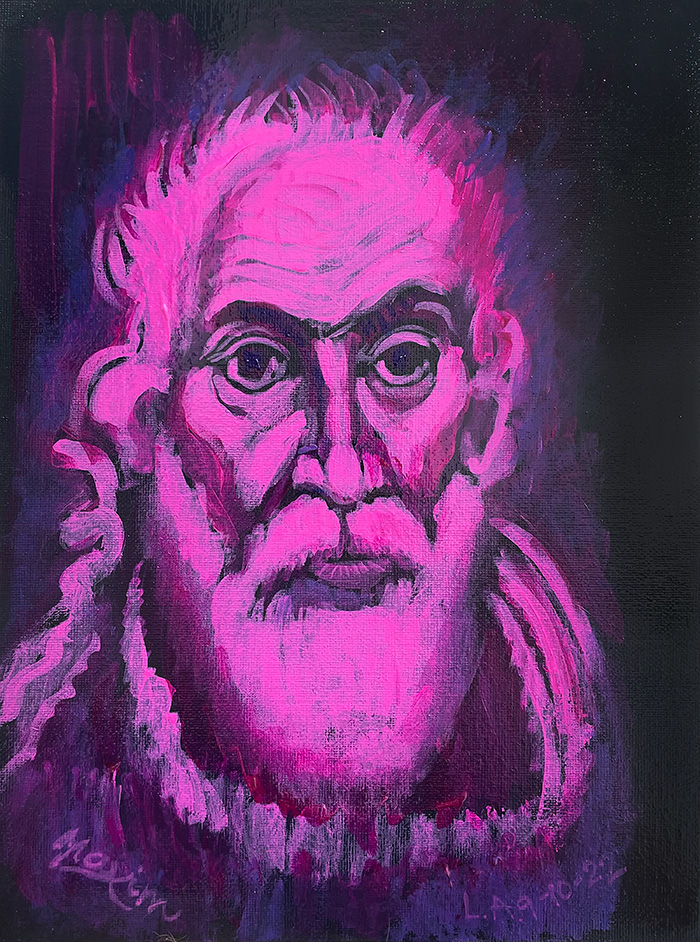
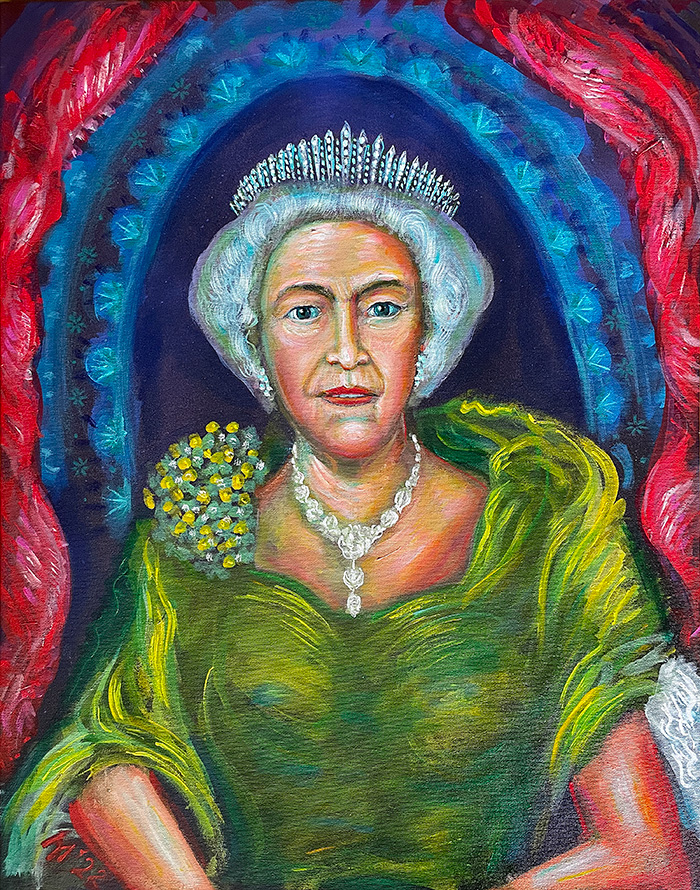
- Details
- Category: Maxim
"Majesty", acrylic on canvas, 28x22 inch, Bishop Maxim, 2022
With imaginative observation and creative freedom of expression in painting, the artist stands in earnest awe before the Queen, awaiting permission to speak, contemplating within: "I do not see in your person merely a woman of such longevity, rather one of a venerable multitude of years of devoted and steadfast service, who deserves our respect in not daring to touch sensitivity of Majesty within."
In the portrait, one can see the elements of an elusive royal persona, whose eyes reveal a sense of humor and joy. She possesses a silent firmness, a subtle authoritarianism, yet the caring guise of a likable grandmother. She ruled wisely and efficiently, commanding respect, without a demanding power complex.
With imaginative observation and creative freedom of expression in painting, the artist stands in earnest awe before the Queen, awaiting permission to speak, contemplating within: "I do not see in your person merely a woman of such longevity, rather one of a venerable multitude of years of devoted and steadfast service, who deserves our respect in not daring to touch sensitivity of Majesty within."
In the portrait, one can see the elements of an elusive royal persona, whose eyes reveal a sense of humor and joy. She possesses a silent firmness, a subtle authoritarianism, yet the caring guise of a likable grandmother. She ruled wisely and efficiently, commanding respect, without a demanding power complex.
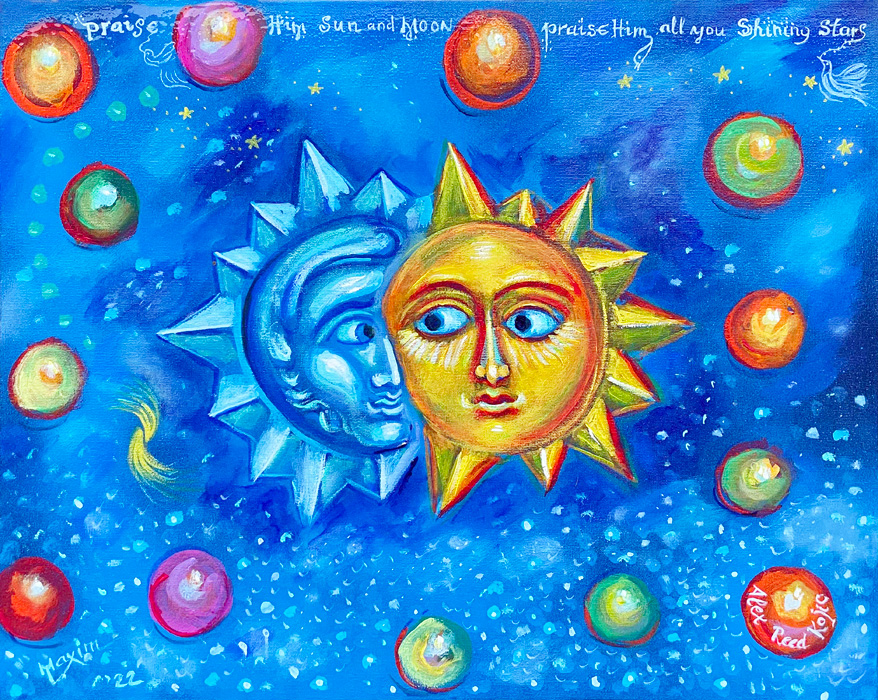
- Details
- Category: Maxim
"Praise Him, Sun and Moon... All You Shining Stars", acrylic on canvas, by Bishop Maxim, 2022
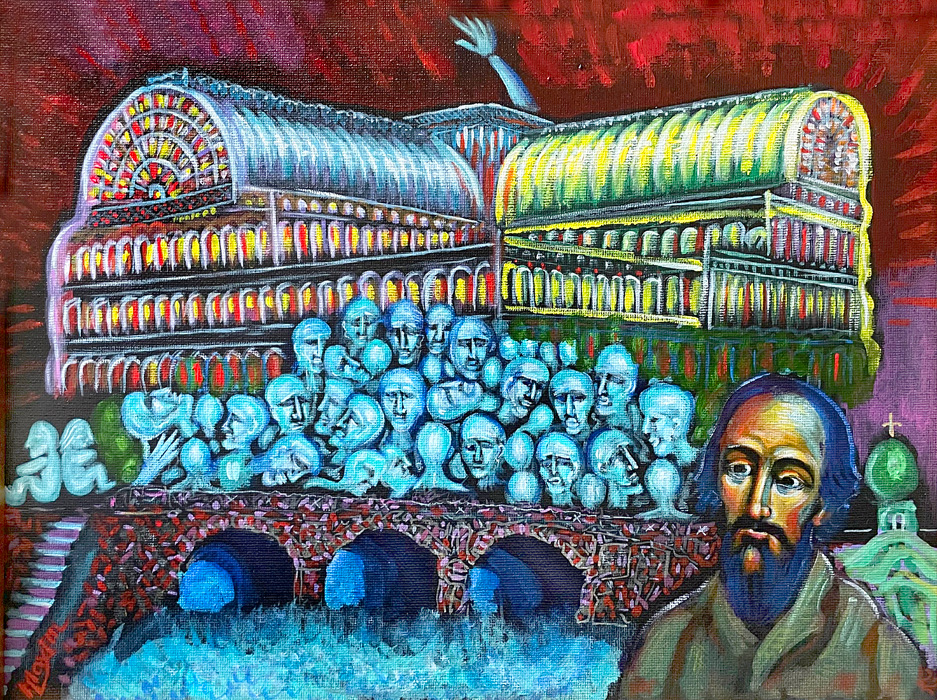
- Details
- Category: Maxim
"Dostoevsky and the Symbol of The Crystal Palace", acrylic on canvas, by Bishop Maxim, 2022
In his Winter Notes on Summer Impressions, Dostoyevsky presented the Crystal Palace as a symbol of the controlling mechanism of utilitarian rationalism, a creation of Baal that would offer material abundance while demanding the sacrifice of spirit, autonomy, and authenticity. The painter sees this place as a cold, senseless emptiness of hell for many generations with the involuntary handicap of a loveless life. The other--although close to me--is my failure to live fully; he confirms my loneliness. Our emotions don't coincide, but our inner pain of traveling together without companionship is the same. Our nakedness reveals us as impersonal objects of pleasure, outside the bounds of relation, of mutual self-offering. The blindness in the eyes points to the deprivation of the vision of our real goal.
In his Winter Notes on Summer Impressions, Dostoyevsky presented the Crystal Palace as a symbol of the controlling mechanism of utilitarian rationalism, a creation of Baal that would offer material abundance while demanding the sacrifice of spirit, autonomy, and authenticity. The painter sees this place as a cold, senseless emptiness of hell for many generations with the involuntary handicap of a loveless life. The other--although close to me--is my failure to live fully; he confirms my loneliness. Our emotions don't coincide, but our inner pain of traveling together without companionship is the same. Our nakedness reveals us as impersonal objects of pleasure, outside the bounds of relation, of mutual self-offering. The blindness in the eyes points to the deprivation of the vision of our real goal.
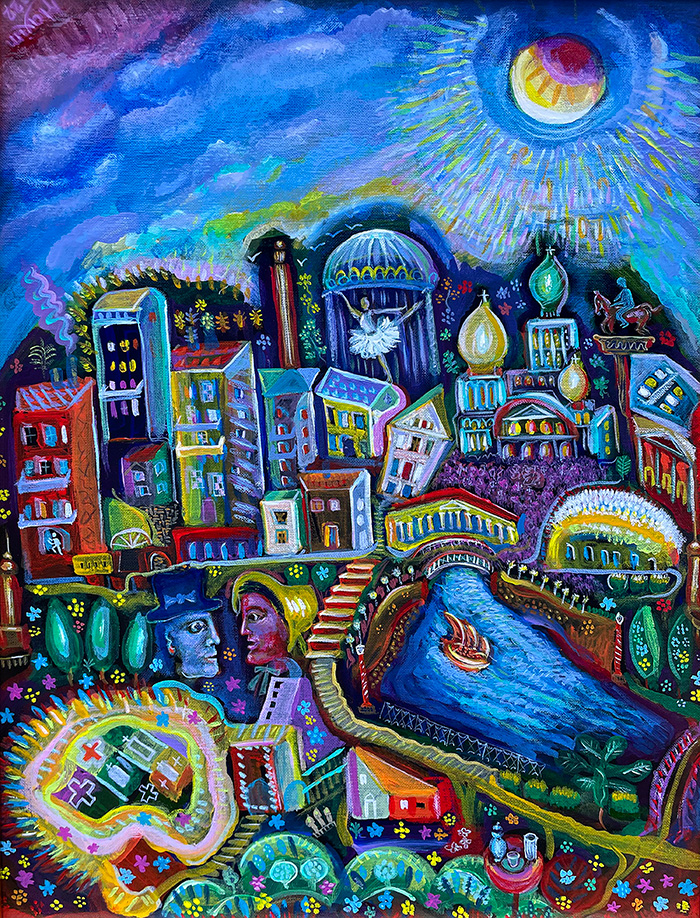
- Details
- Category: Maxim
"Dostoevsky's White Nights (Beliye Nochi) in Sankt Petersburg", acrylic on canvas, by Bishop Maxim, 2022
Dostoevsky spent much of his life in St. Petersburg, which became the backdrop to his many novels. Like in his books so also in this painting, Dostoevsky's characters inhabit the streets of St. Petersburg and come to life. Here one can recognize the house of Raskolnikov and Sonya Marmeladova.
In the "White Nights," he conveys the experience of his hero, who walks in the streets of St. Petersburg during the so-called "White Nights." He loves the city at night and feels comfortable in it. He drew his emotions from people: if they were content, he was content; if they were disheartened, he was discouraged. As he walked, the houses would talk to him and tell him how they were being renovated, painted a new color, or torn down.
Dostoevsky spent much of his life in St. Petersburg, which became the backdrop to his many novels. Like in his books so also in this painting, Dostoevsky's characters inhabit the streets of St. Petersburg and come to life. Here one can recognize the house of Raskolnikov and Sonya Marmeladova.
In the "White Nights," he conveys the experience of his hero, who walks in the streets of St. Petersburg during the so-called "White Nights." He loves the city at night and feels comfortable in it. He drew his emotions from people: if they were content, he was content; if they were disheartened, he was discouraged. As he walked, the houses would talk to him and tell him how they were being renovated, painted a new color, or torn down.
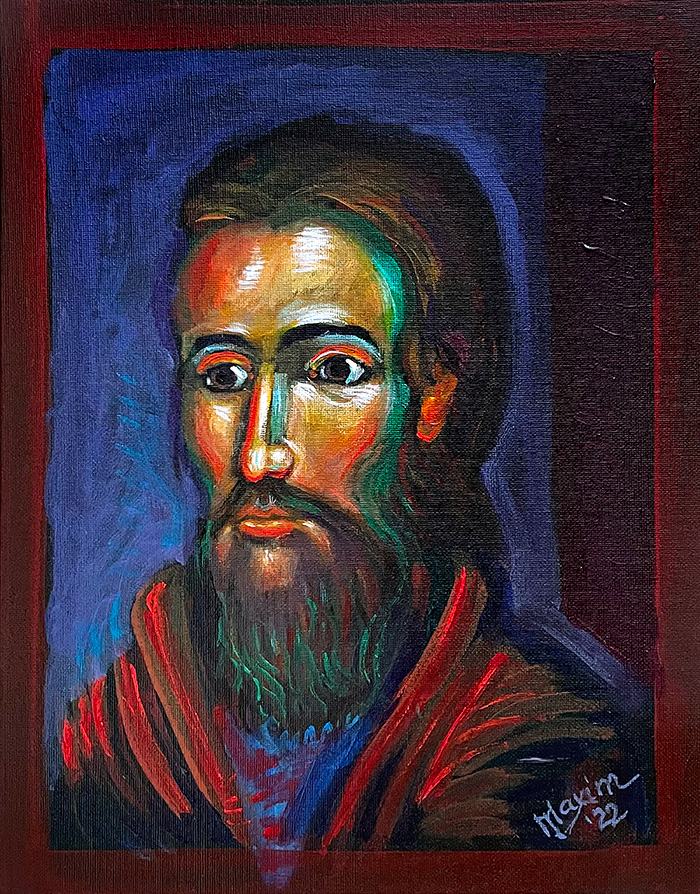
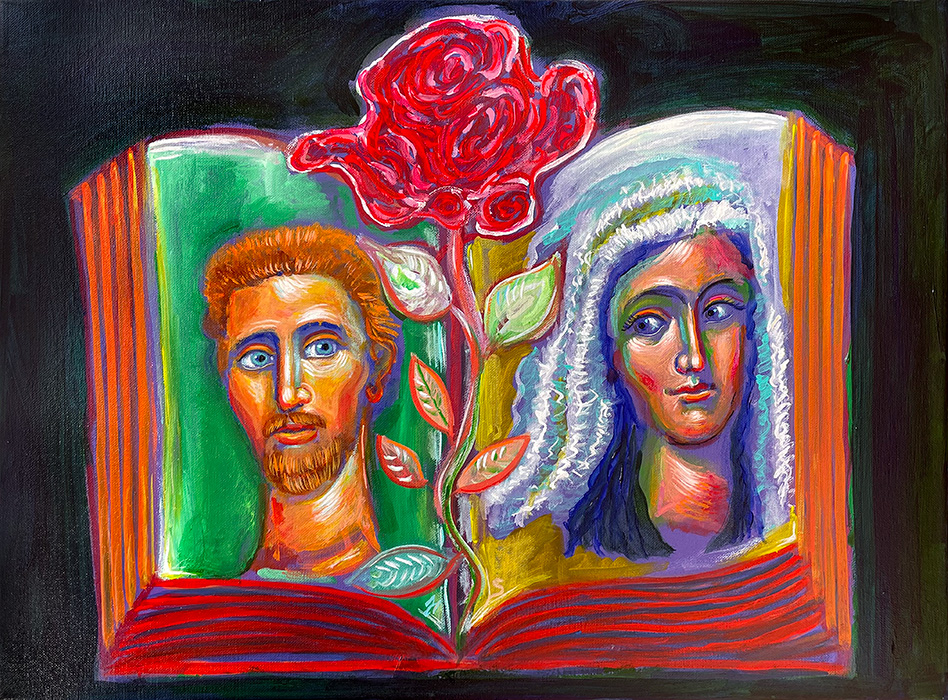
- Details
- Category: Maxim
“The Wedding That Didn't Happen—Myshkin and Nastasya”, acrylic on canvas, by Bishop Maxim (with the assistance of Savo Miljic), 2022
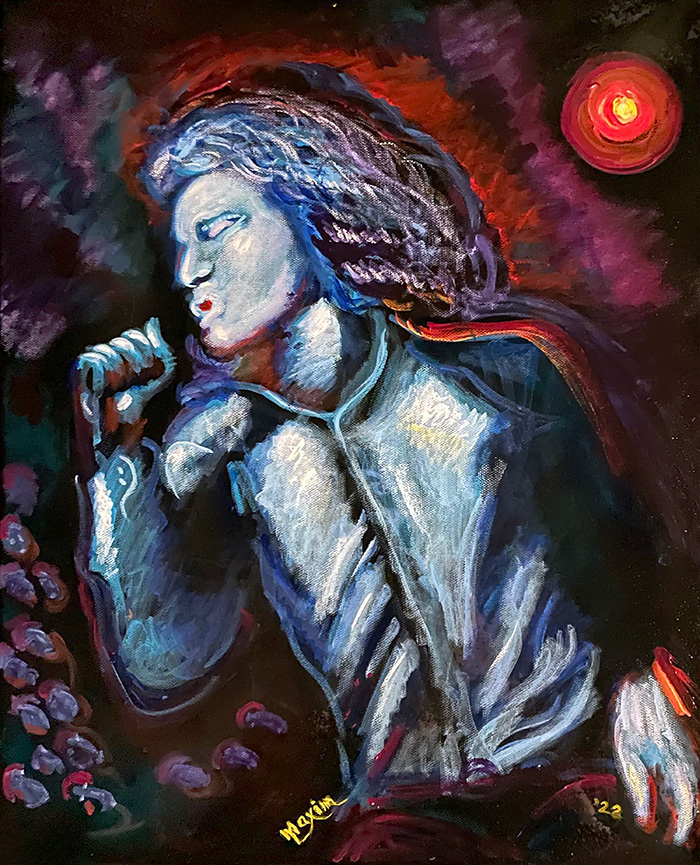
- Details
- Category: Maxim
"Drunk the drug of forgetfulness-Jim Morrison", acrylic on canvas, by Bishop Maxim, 2022
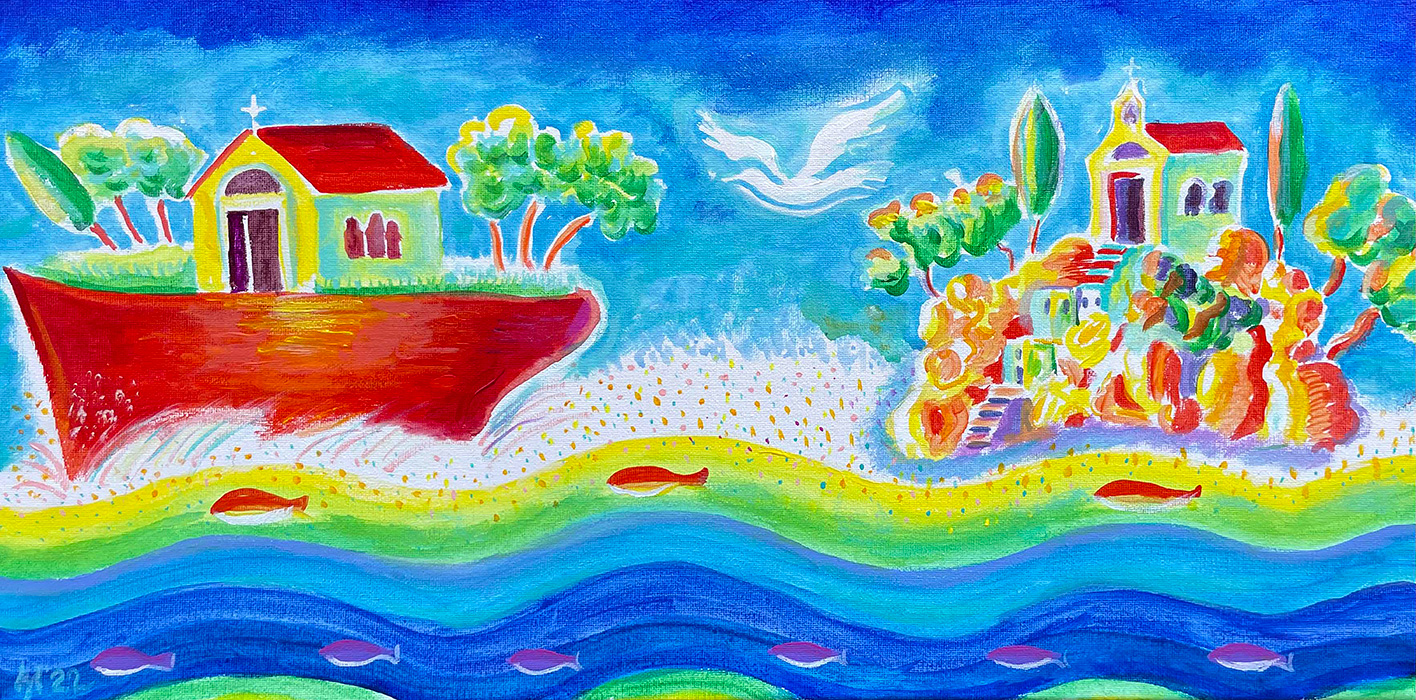
- Details
- Category: Maxim
"The Mystical Island and the Ship of Salvation", acrylic on canvas, by Bishop Maxim, 2022
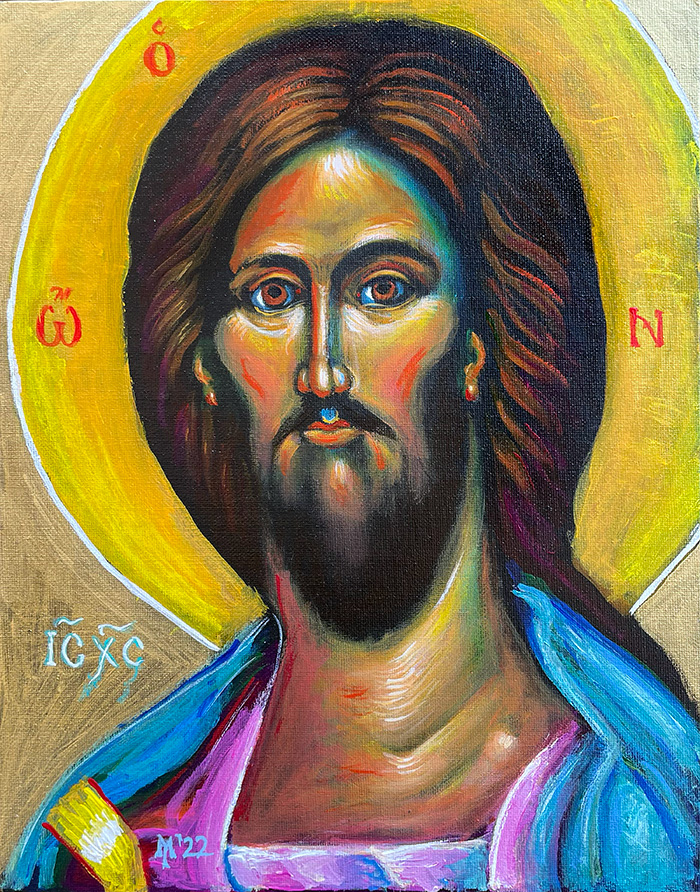
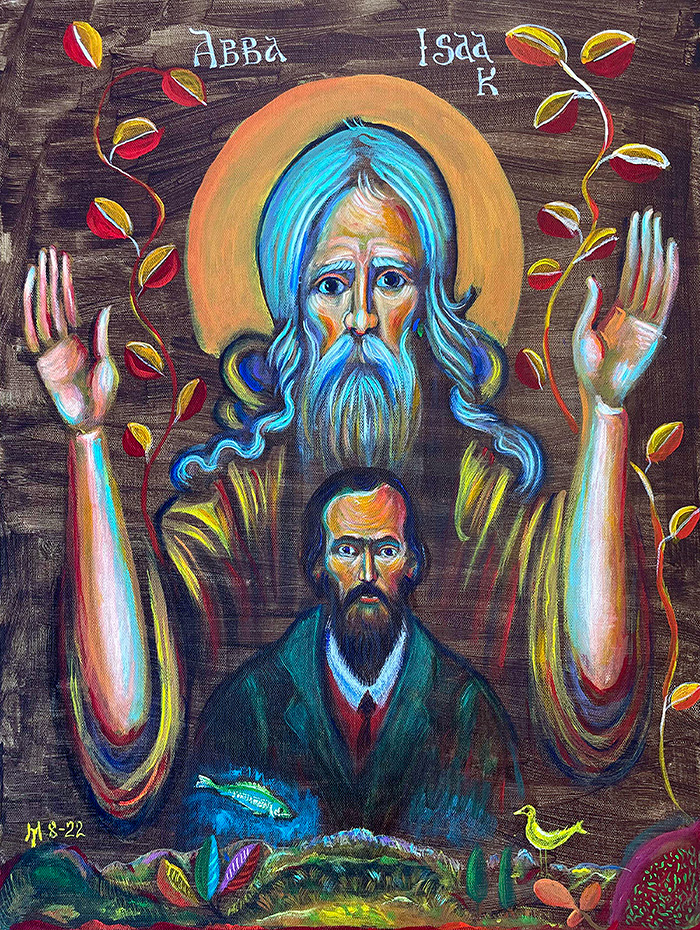
- Details
- Category: Maxim
"Saint Isaak Syrian and Dostoevsky", acrylic on canvas, by Bishop Maxim, 2022
St. Isaac the Syrian, a seventh-century monk mentioned by name several times in "The Brothers Karamazov"; to whose "Ascetical Discourses" Dostoevsky is said to have returned repeatedly; and who likely inspired many of the ideas expressed by Dostoevsky’s figure of Zosima. St. Isaac of Syria had a substantial and decisive influence on Dostoevsky’s thought, especially regarding the relationship between God and nature and its meaning for humanity. Dostoevsky’s heroes revere the earth, kiss it and water it with their tears, and admit to it its darkness, mystery, and holy integrity.
St. Isaac the Syrian, a seventh-century monk mentioned by name several times in "The Brothers Karamazov"; to whose "Ascetical Discourses" Dostoevsky is said to have returned repeatedly; and who likely inspired many of the ideas expressed by Dostoevsky’s figure of Zosima. St. Isaac of Syria had a substantial and decisive influence on Dostoevsky’s thought, especially regarding the relationship between God and nature and its meaning for humanity. Dostoevsky’s heroes revere the earth, kiss it and water it with their tears, and admit to it its darkness, mystery, and holy integrity.
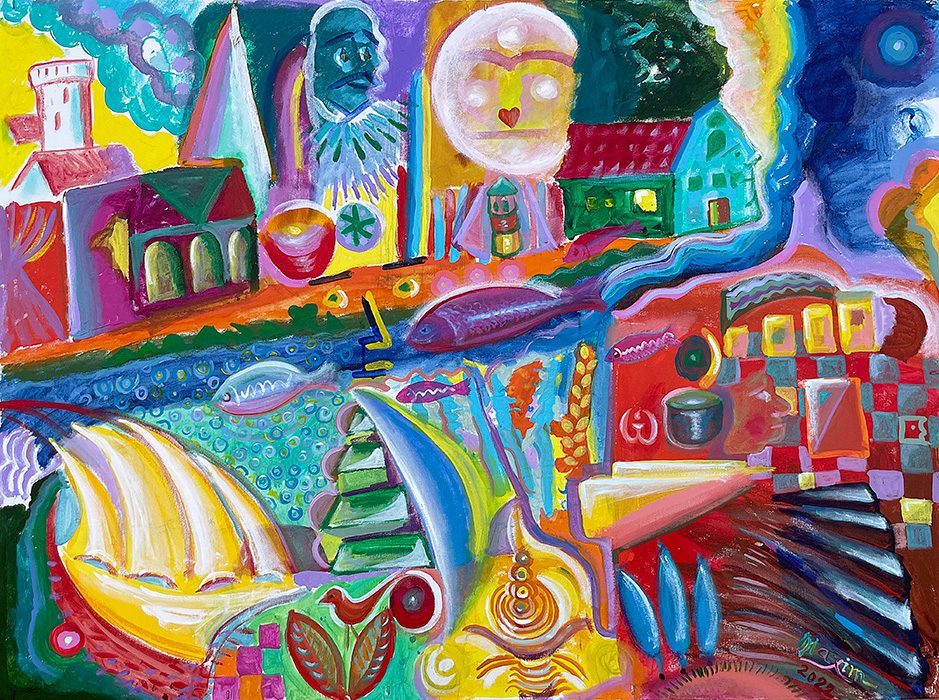
- Details
- Category: Maxim
"Тhe miracle of eternal surprises bursts forth...", acrylic on canvas, by Bishop Maxim, 2022
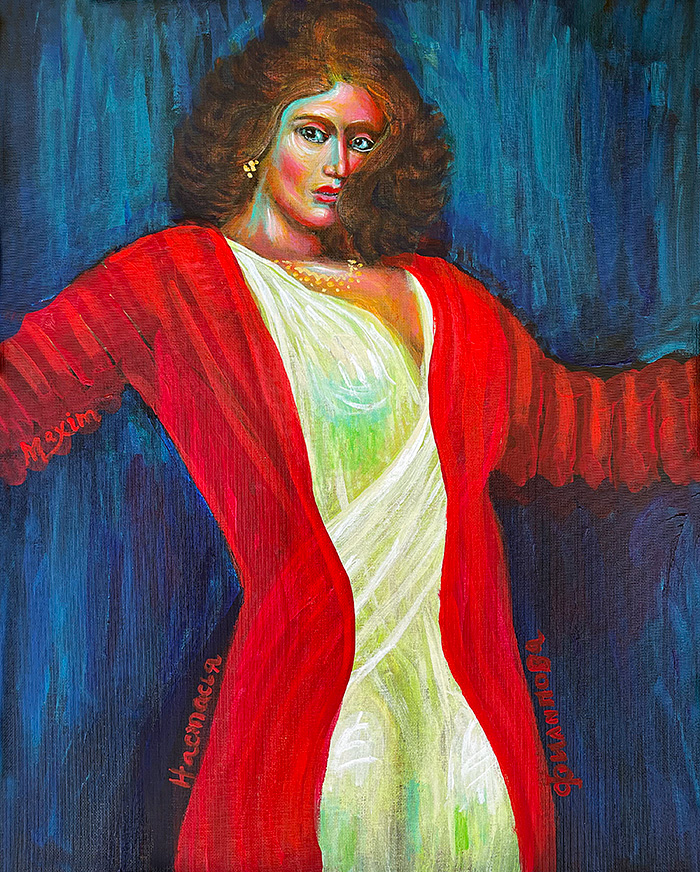
- Details
- Category: Maxim
"Amour Propre of Nastasya Filippovna", acrylic on canvas, by Bishop Maxim, 2022
Of the many characters we see in Dostoyevsky's novels, few of the principal characters are female. However, in one of his more famous novels, The Idiot, we find perhaps one of the strongest female characters of most nineteenth-century literature, if not of Europe, then at least of Russia. Nastassya is the most dramatic and complex character in the novel The Idiot. Defined by her sensual beauty and remarkable looks, she steers the course of this novel and the fate of Prince Myshkin and Rogozhin. Nastasya Filippovna, a proud, yet exploited woman, is by far one of Dostoyevsky's most intriguing characters. She has an instantaneous and dramatic effect on the characters surrounding her. The Idiot can understand Nastasya Filippovna's abrupt changes of mood, and perhaps we should not attempt to narrow the formula for her motivations.
Of the many characters we see in Dostoyevsky's novels, few of the principal characters are female. However, in one of his more famous novels, The Idiot, we find perhaps one of the strongest female characters of most nineteenth-century literature, if not of Europe, then at least of Russia. Nastassya is the most dramatic and complex character in the novel The Idiot. Defined by her sensual beauty and remarkable looks, she steers the course of this novel and the fate of Prince Myshkin and Rogozhin. Nastasya Filippovna, a proud, yet exploited woman, is by far one of Dostoyevsky's most intriguing characters. She has an instantaneous and dramatic effect on the characters surrounding her. The Idiot can understand Nastasya Filippovna's abrupt changes of mood, and perhaps we should not attempt to narrow the formula for her motivations.
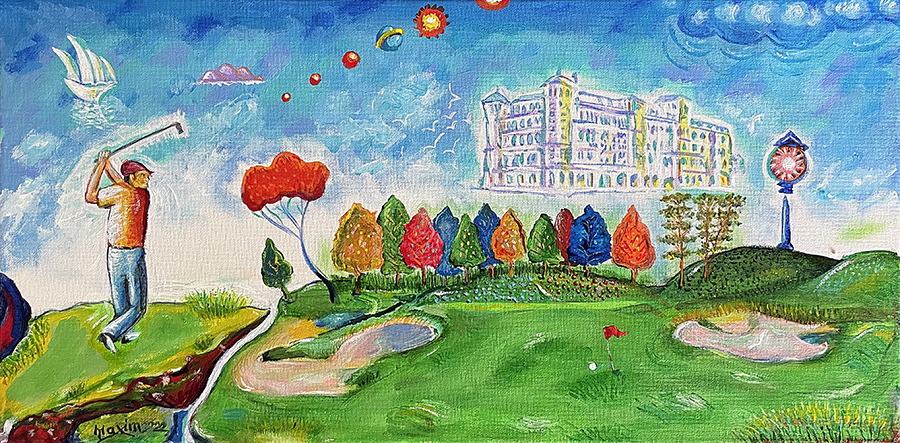
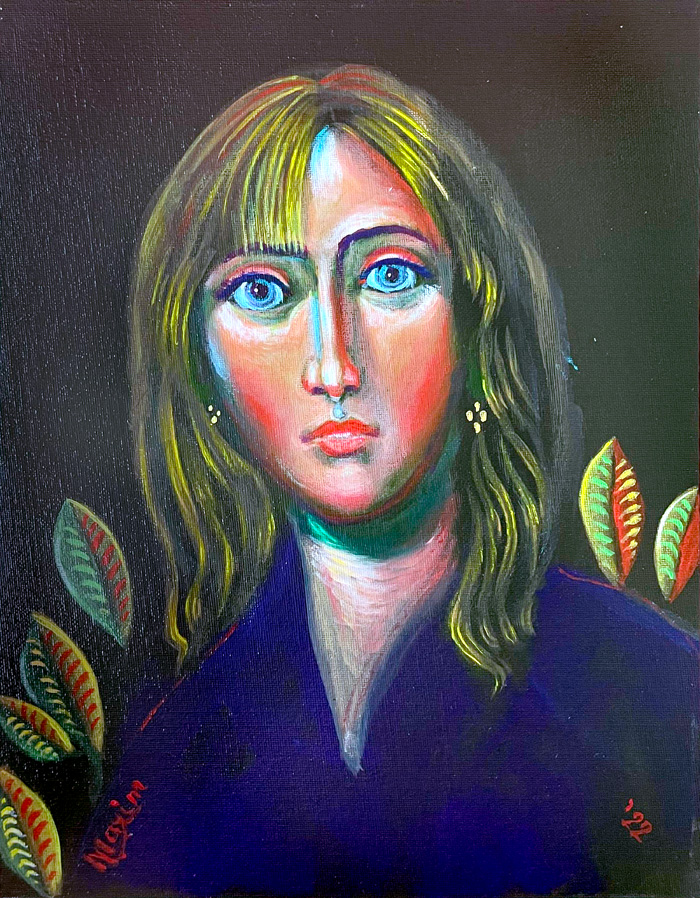
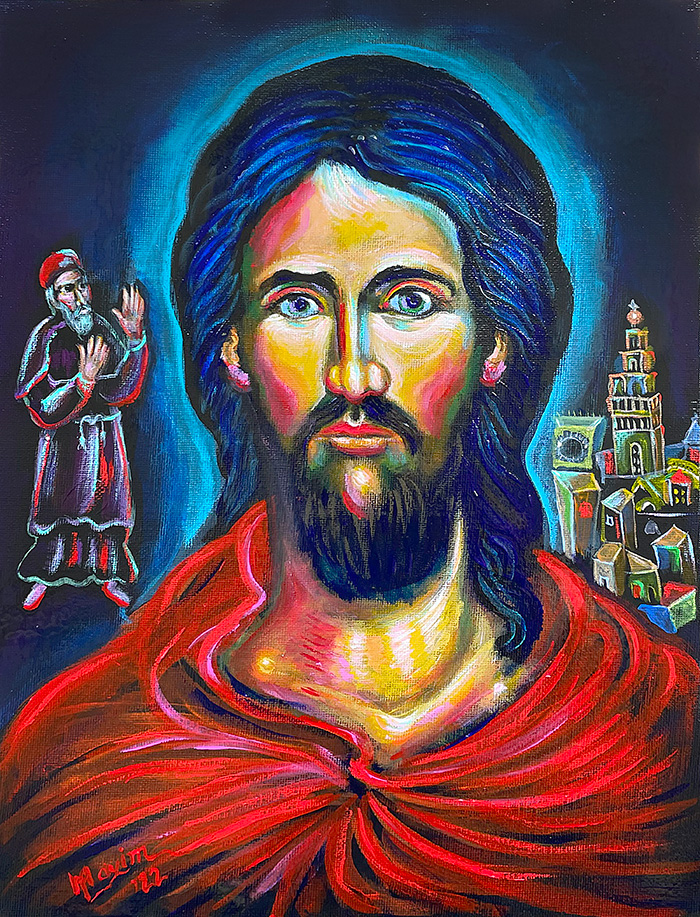
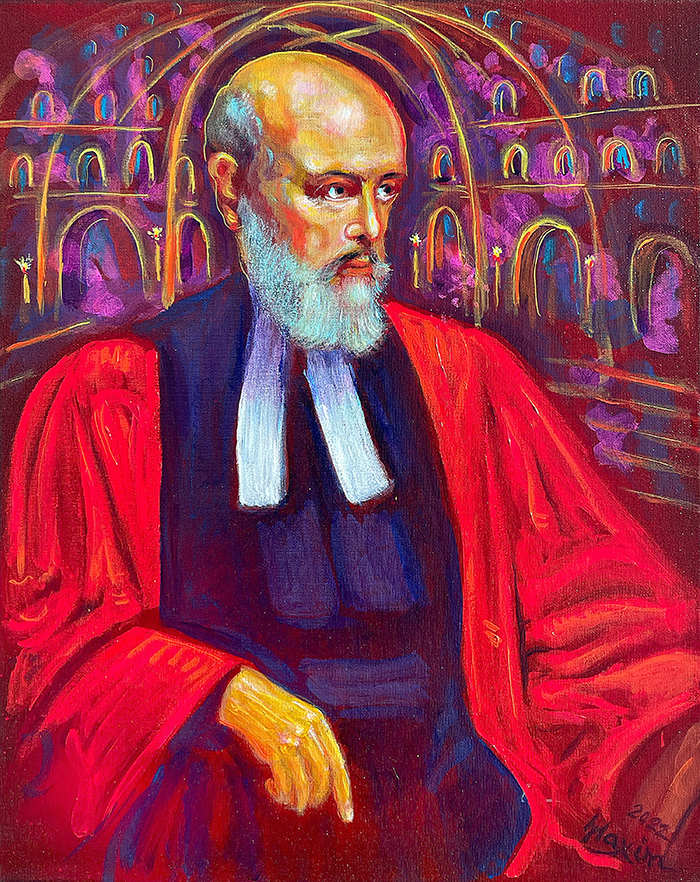
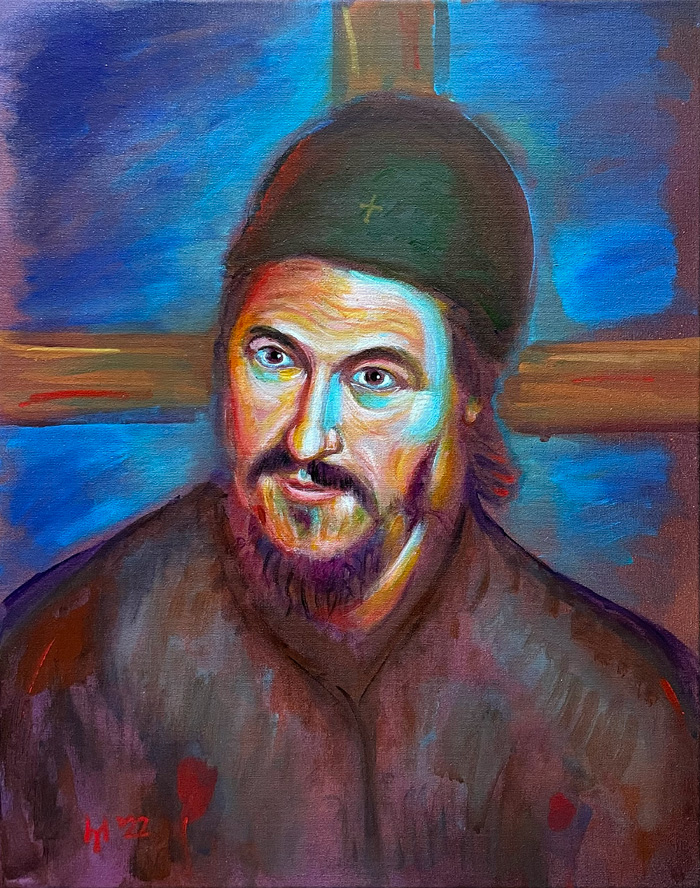
- Details
- Category: Maxim
"The Endless, Blue Circle with a Cross in It—Hieromonk Atanasije", acrylic on canvas, by Bishop Maxim, 2022
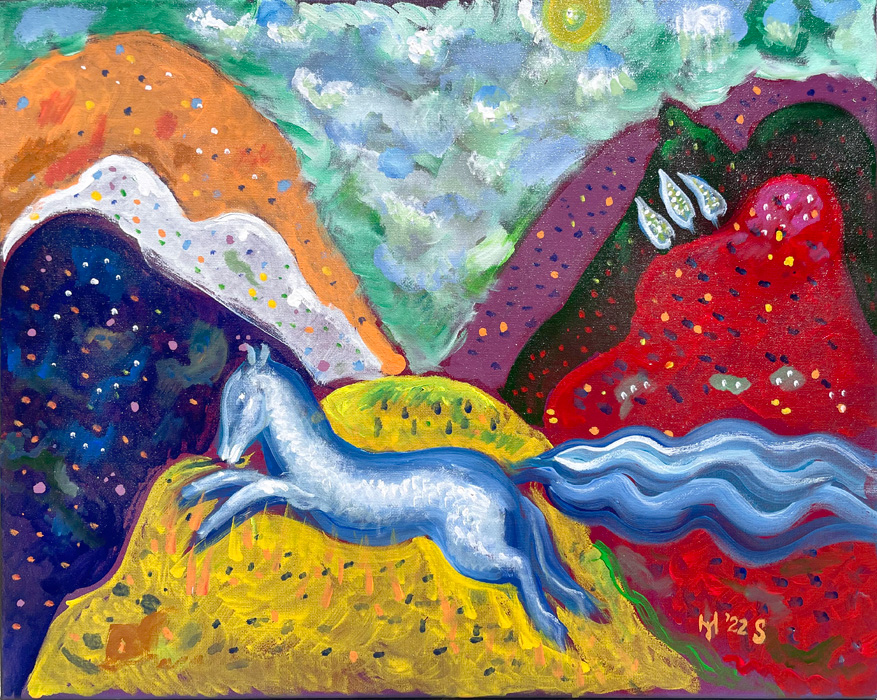
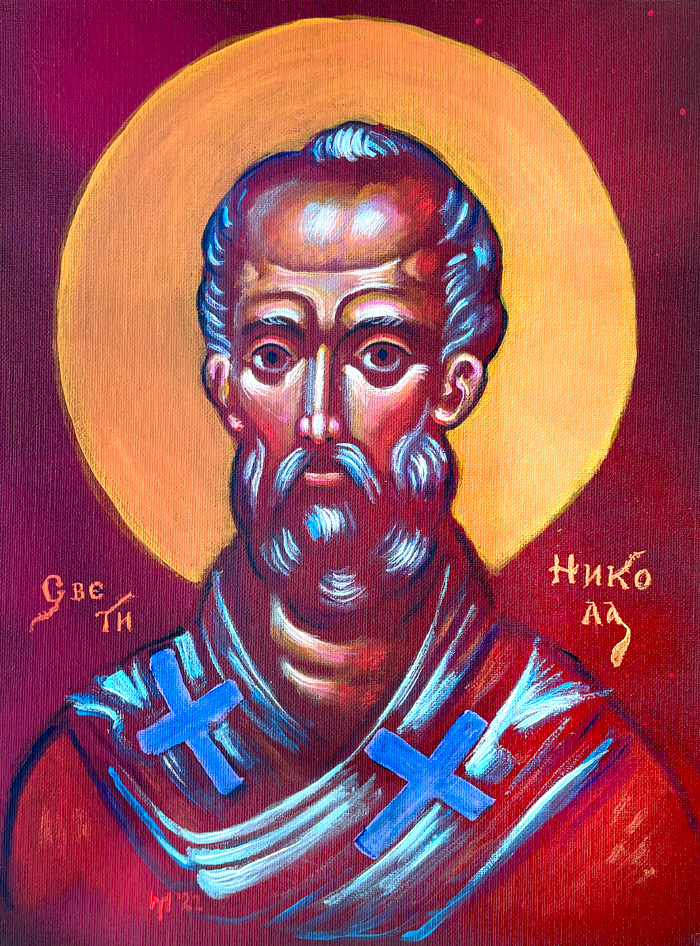
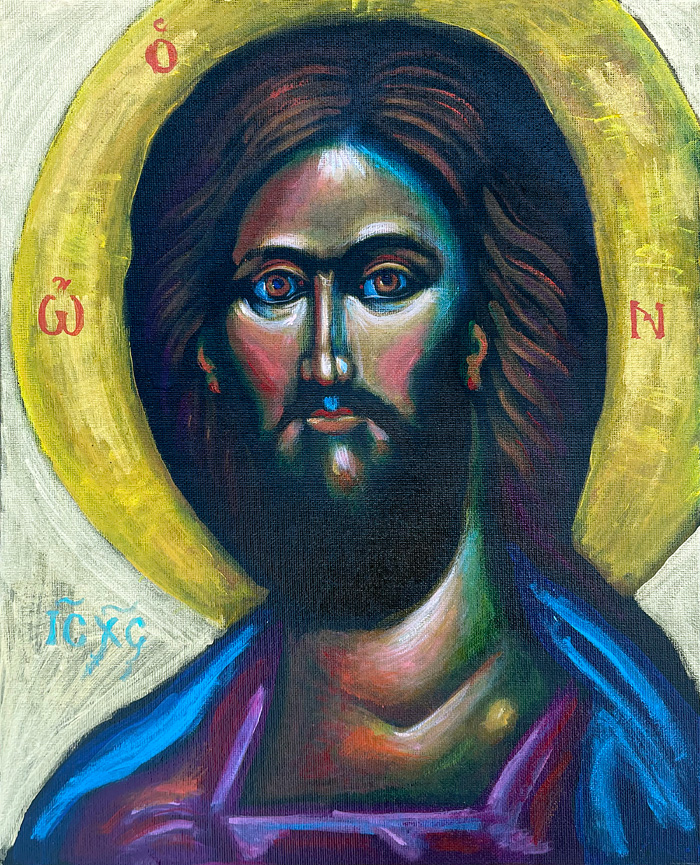
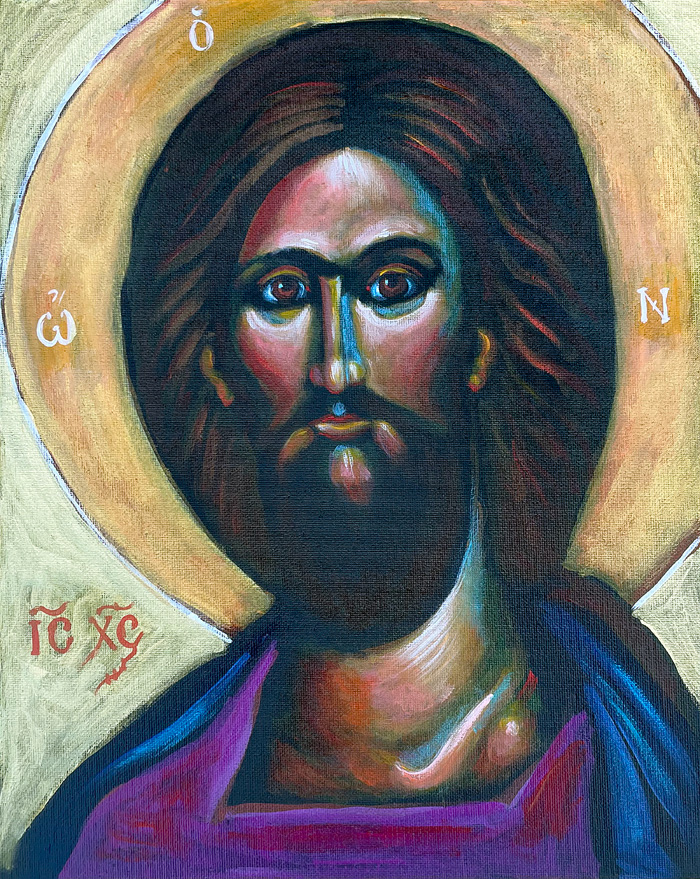
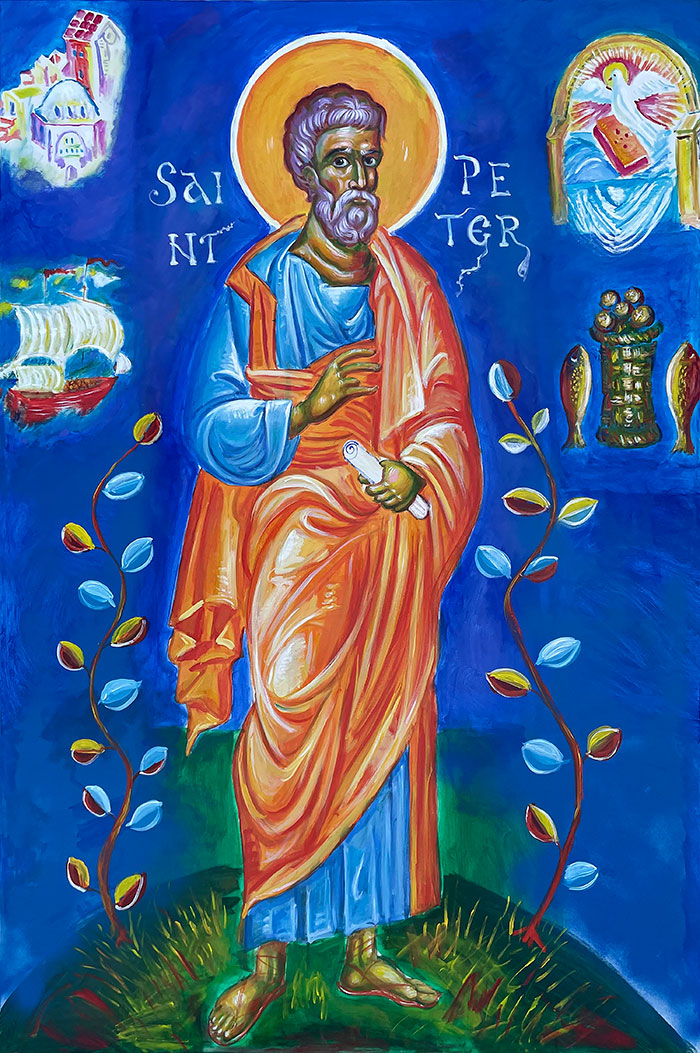
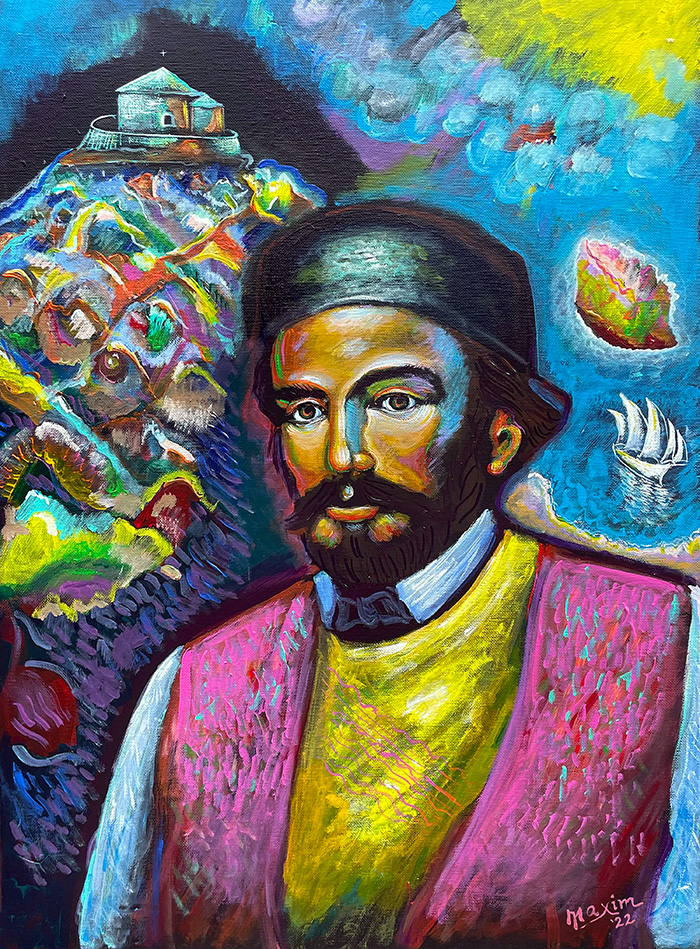
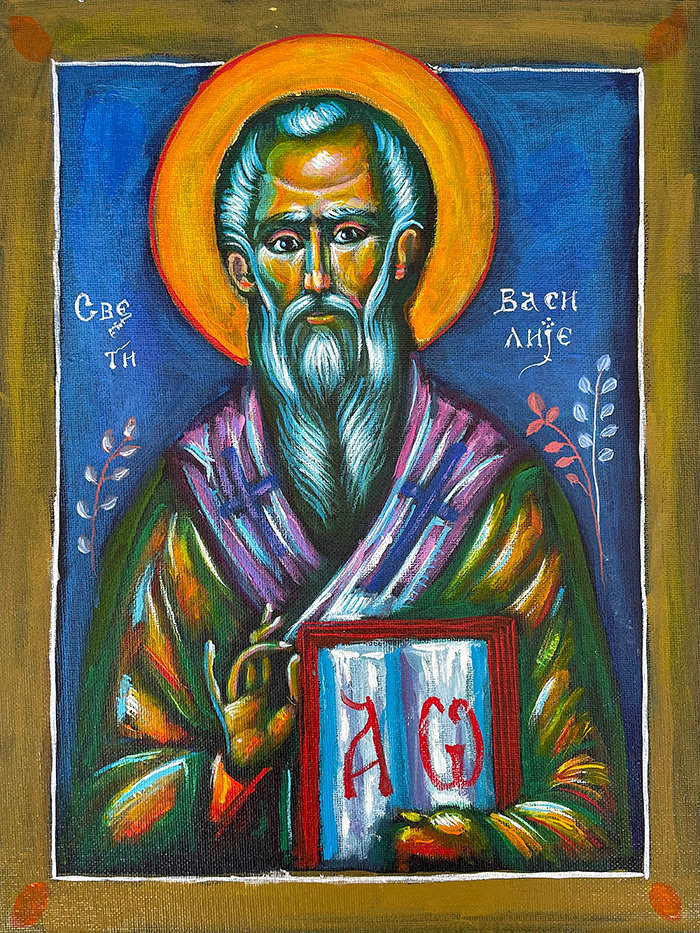
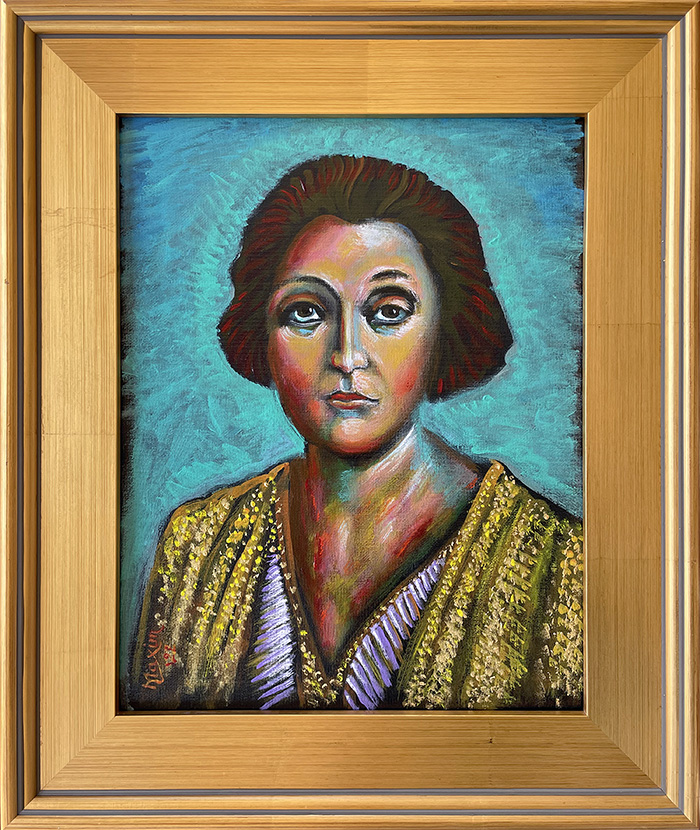
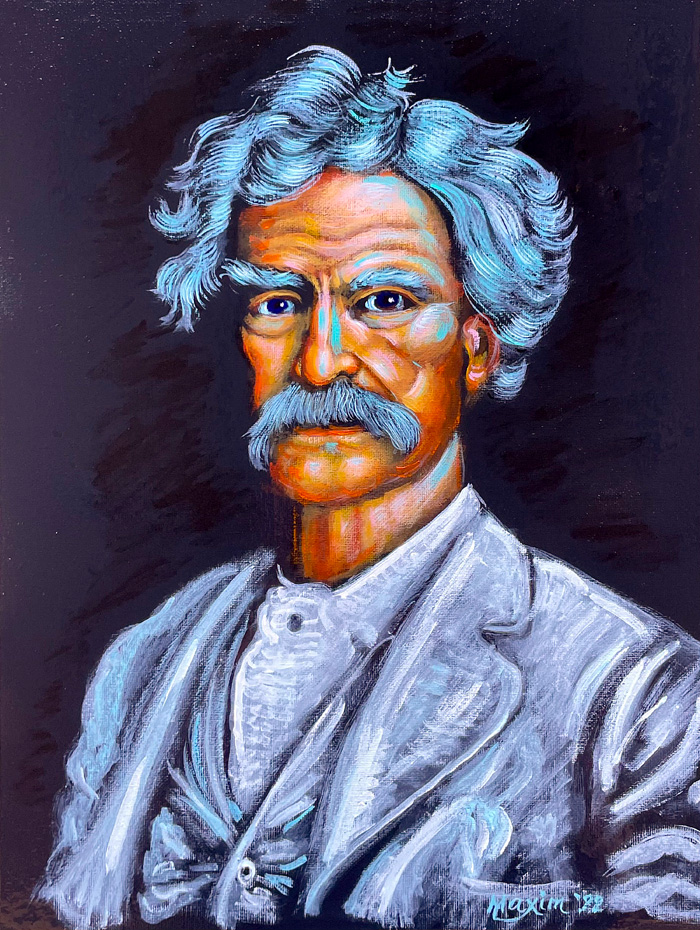
- Details
- Category: Maxim
"Great American Novelist - Mark Twain", acrylic on canvas, by Bishop Maxim, 2022
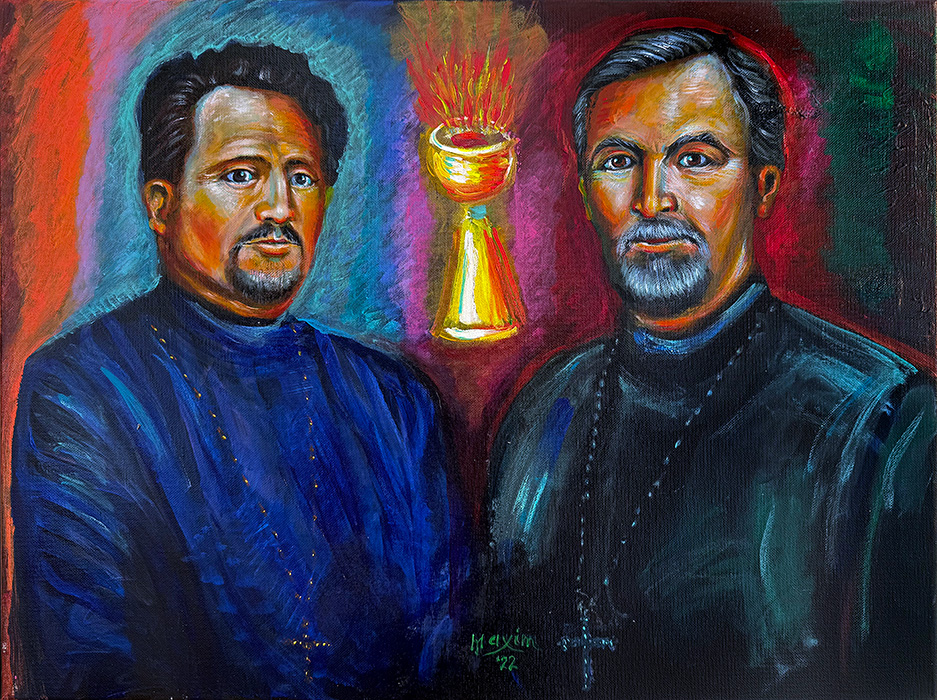
- Details
- Category: Maxim
"The Sacred Pillars of Orthodoxy in the West", acrylic on canvas, by Bishop Maxim, 2022
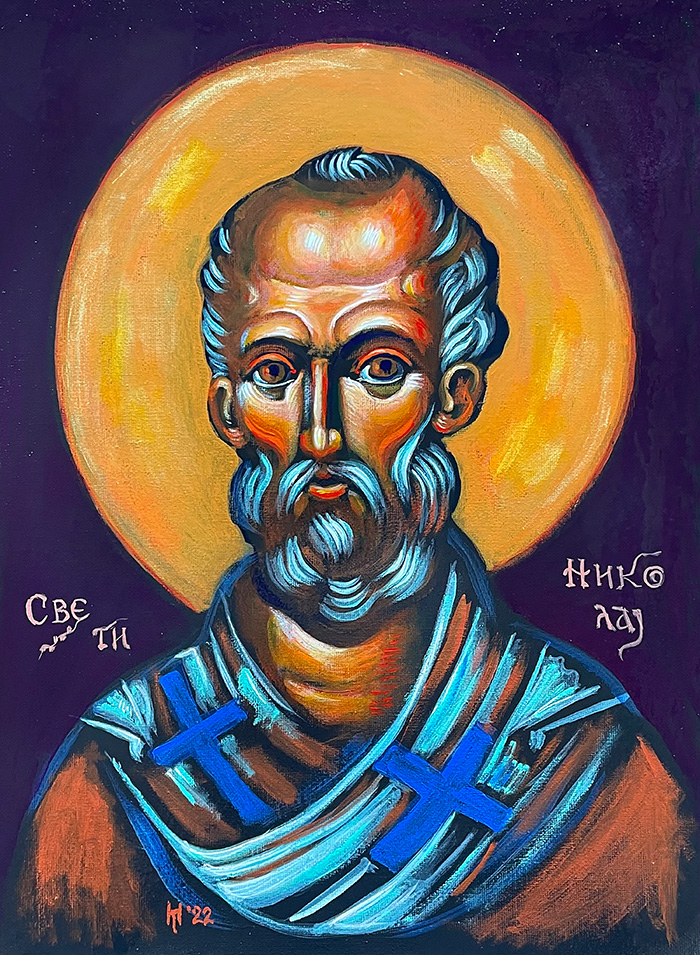
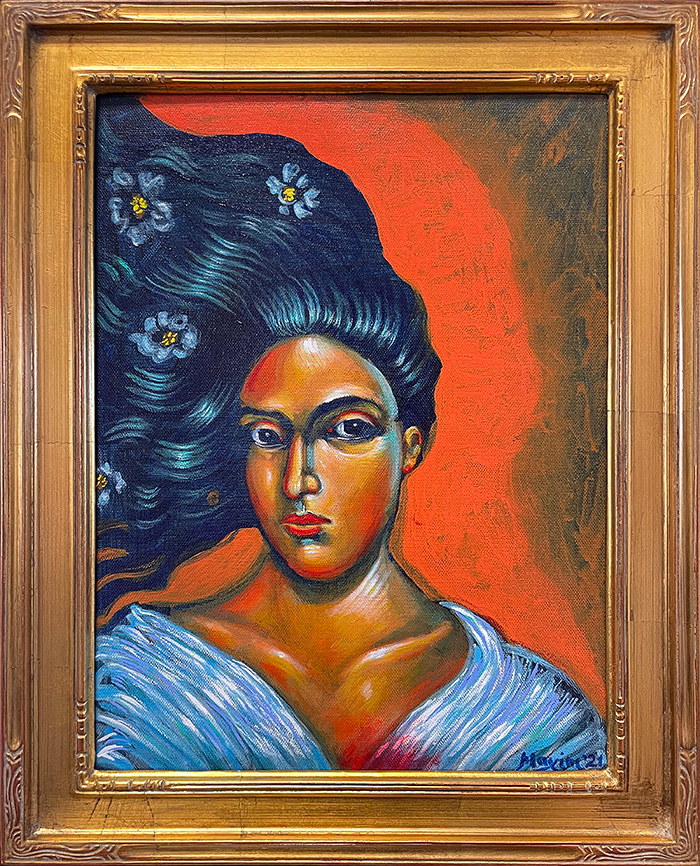
- Details
- Category: Maxim
"The Last Look of Nastasya Filippovna", from Dostoevsky's The Idiot, acrylic on canvas, by Bishop Maxim, 2021
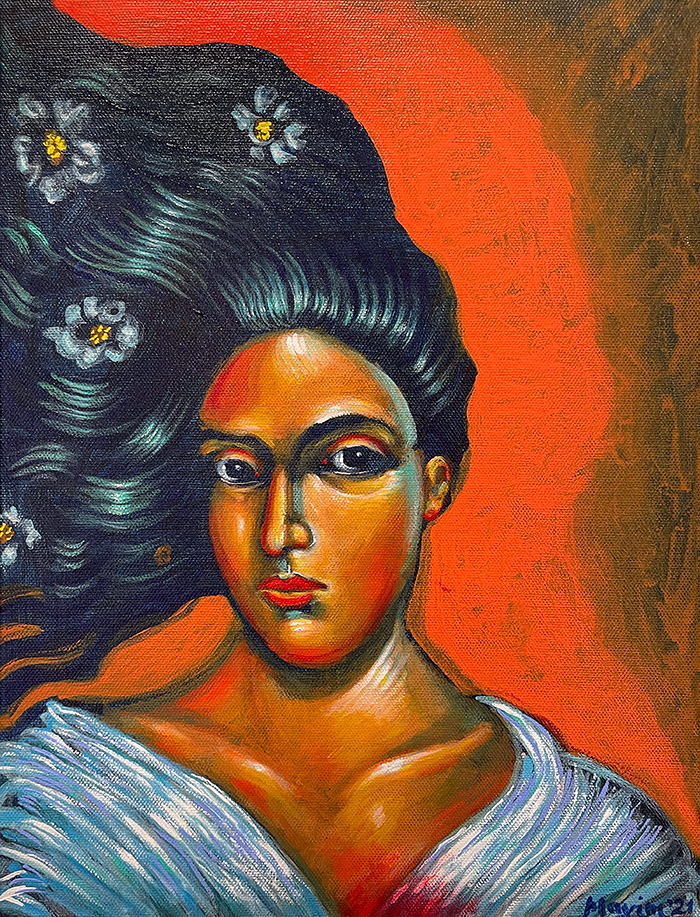
- Details
- Category: Maxim
"The Last Look of Nastasya Filippovna", from Dostoevsky's The Idiot, acrylic on canvas, by Bishop Maxim, 2021
The painting depicts Nastasya’s death scene. Rogozhin stabbed her under the left breast, and there was no more than half a tablespoon of blood; the bleeding was internal. Without a doubt, Nastasya is the most dramatic and complex character in the novel The Idiot; she steers the course of this novel and the fate of Prince Myshkin and Rogozhin. No one in The Idiot can understand Nastasya Filippovna’s abrupt mood changes. Nastasya is highly emotional, full of guilt, and out for revenge. Prince Myshkin insists that Nastasya is not what she seems; she is more kind than her haughty demeanor indicates. One can see suffering beauty in her eyes. She sees an absurd morality play with good and evil on either side. So, not knowing what role she must play, she plunges into the comedy and turns the course of events upside down. Nastasya’s imminent death hovers ominously throughout the novel. What makes the scene horrible is not the murder but Myshkin’s comforting of Rogozhin. Myshkin’s goodness and compassion are more terrifying than Rogozhin’s murder of Nastasya. Dostoevsky shows us the ultimate in goodness, and it is paradoxical: Myshkin’s embracing the murderer, forgiving him as it were, weeping on his cheek as though in sorrow but also in relief that, at last, the fate of the three has unraveled itself.
The painting depicts Nastasya’s death scene. Rogozhin stabbed her under the left breast, and there was no more than half a tablespoon of blood; the bleeding was internal. Without a doubt, Nastasya is the most dramatic and complex character in the novel The Idiot; she steers the course of this novel and the fate of Prince Myshkin and Rogozhin. No one in The Idiot can understand Nastasya Filippovna’s abrupt mood changes. Nastasya is highly emotional, full of guilt, and out for revenge. Prince Myshkin insists that Nastasya is not what she seems; she is more kind than her haughty demeanor indicates. One can see suffering beauty in her eyes. She sees an absurd morality play with good and evil on either side. So, not knowing what role she must play, she plunges into the comedy and turns the course of events upside down. Nastasya’s imminent death hovers ominously throughout the novel. What makes the scene horrible is not the murder but Myshkin’s comforting of Rogozhin. Myshkin’s goodness and compassion are more terrifying than Rogozhin’s murder of Nastasya. Dostoevsky shows us the ultimate in goodness, and it is paradoxical: Myshkin’s embracing the murderer, forgiving him as it were, weeping on his cheek as though in sorrow but also in relief that, at last, the fate of the three has unraveled itself.
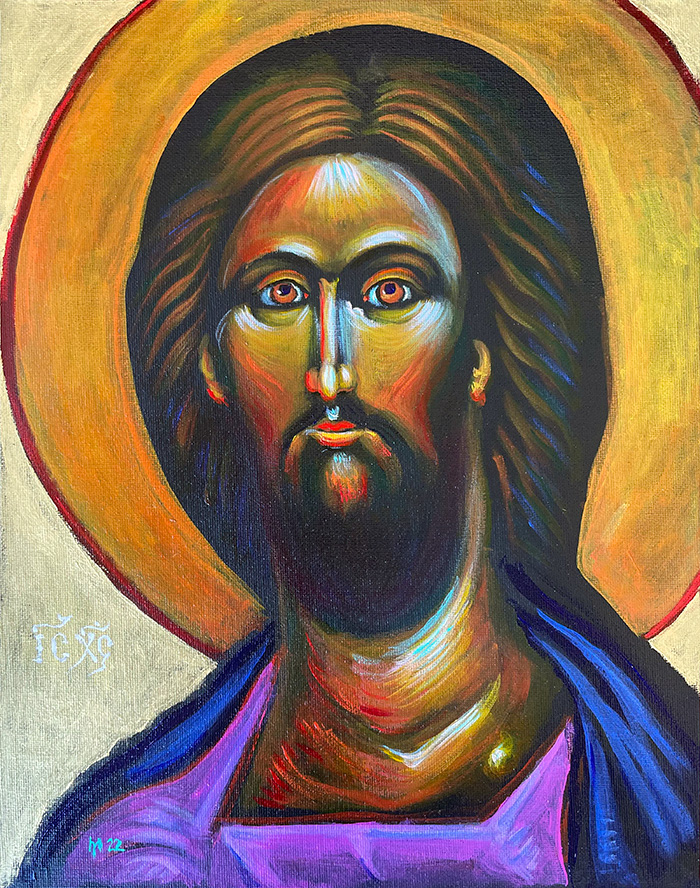
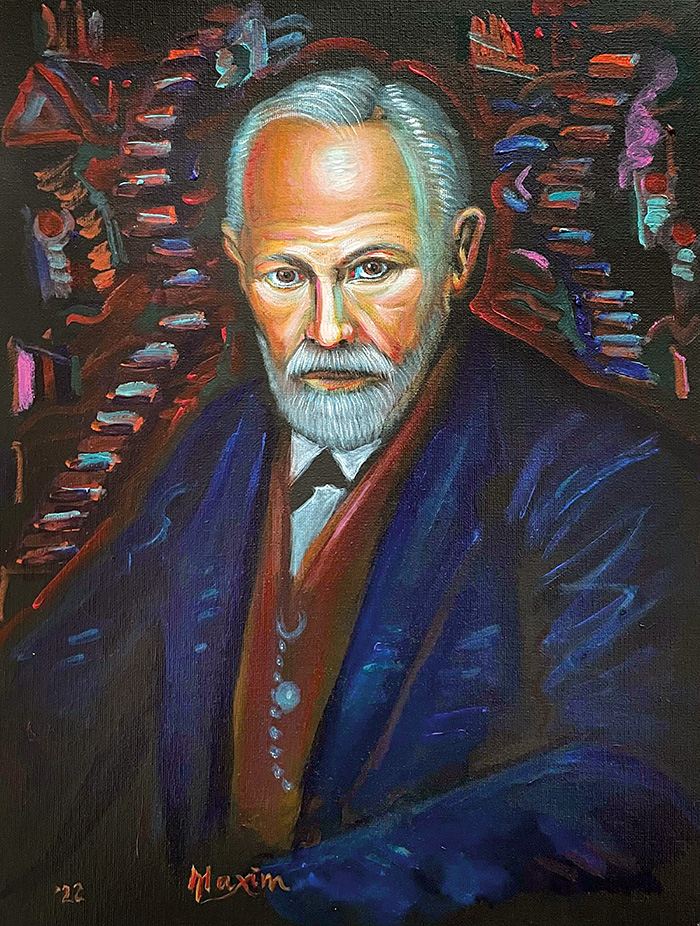
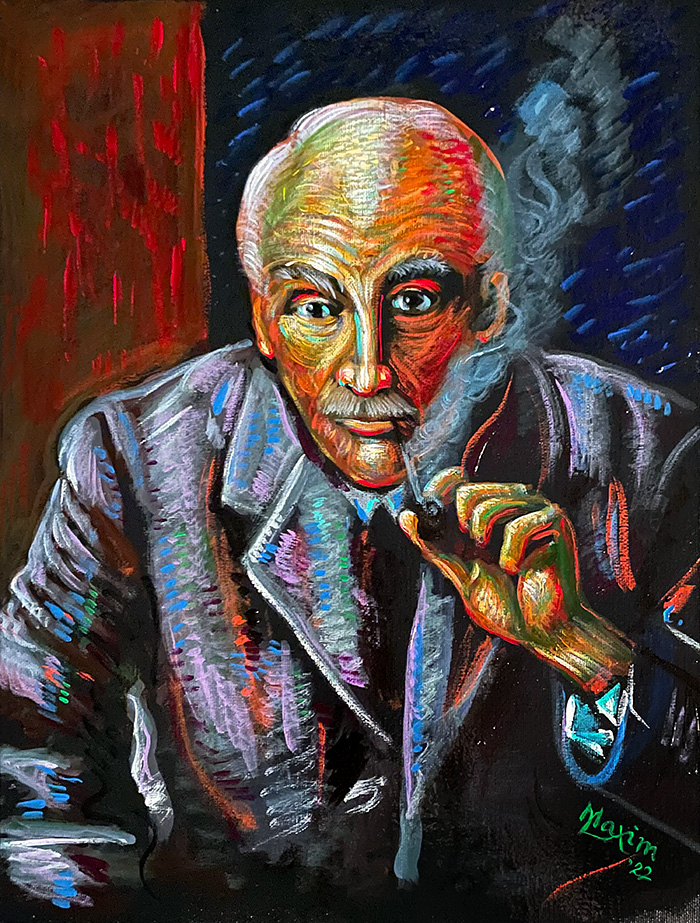
- Details
- Category: Maxim
"Carl Jung", acrylic on canvas, by Bishop Maxim, 2022
Pipe-smoking founder of analytical psychology is depicted as he methodically analyzes a person's ego, personal unconscious, and collective unconscious.
Pipe-smoking founder of analytical psychology is depicted as he methodically analyzes a person's ego, personal unconscious, and collective unconscious.
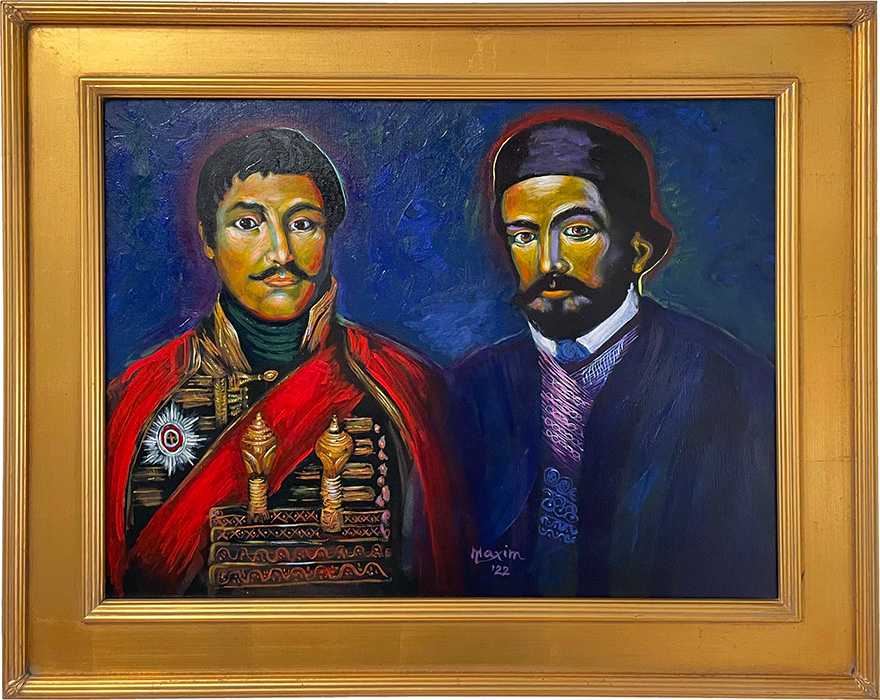
- Details
- Category: Maxim
"Grand Vožd Karageorge and Bishop Rade-Njegoš", acrylic on canvas, by Bishop Maxim, 2022
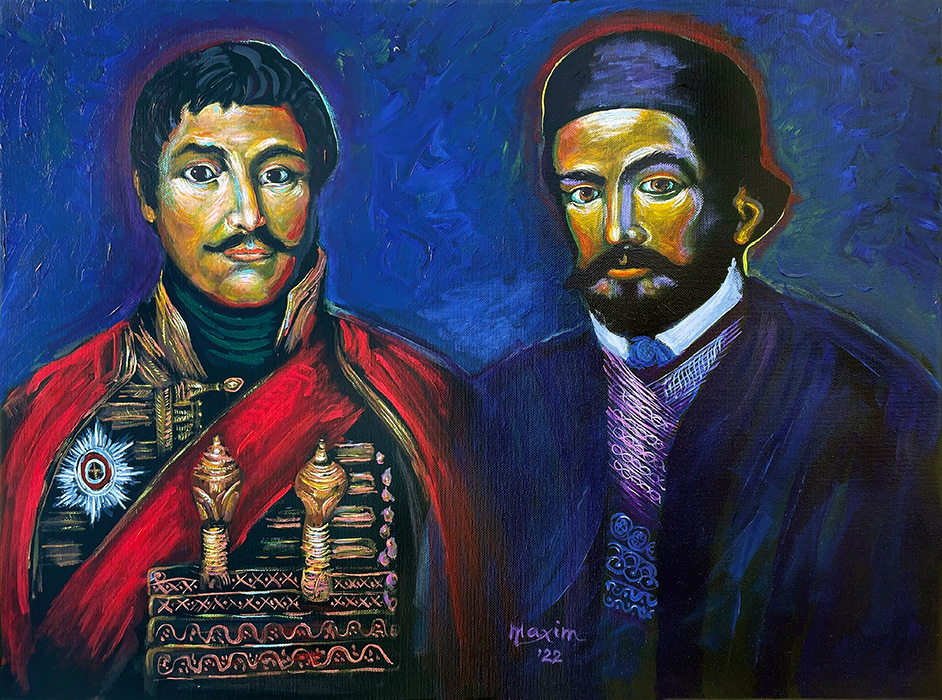
- Details
- Category: Maxim
"Grand Vožd Karageorge and Bishop Rade-Njegoš", acrylic on canvas, 18x24, by Bishop Maxim, 2022
Ivo Andrić, the 1962 Yugoslav Nobel prize laureate, called the Montenegrin Bishop Rade-Njegoš (1830–1850) “the Jeremiah of Kosovo” who carried “the message of Obilić.” In his philosophical epic, The Mountain Wreath, Njegoš prophesied, “the name of Montenegro will be resurrected from the Kosovo graveyard.” “Praise to the ashes of Serbia’s father (Karageorge),” wrote the poet: “…Their crowns will shine again …The dawn is coming to our mountains!” The Kosovo tradition also deeply influenced the revolutionary youth in Bosnia. Gavrilo Princip knew Njegoš’s Mountain Wreath by heart. “There was not a single struggle of the people for liberation in which the heroes from the Kosovo battle were not present. The Montenegrins, fighting in their rocky mountains quenched their thirst from the Kosovo spring. Karageorge breathed the air from Kosovo” (Čedomilj Mijatović).
Ivo Andrić, the 1962 Yugoslav Nobel prize laureate, called the Montenegrin Bishop Rade-Njegoš (1830–1850) “the Jeremiah of Kosovo” who carried “the message of Obilić.” In his philosophical epic, The Mountain Wreath, Njegoš prophesied, “the name of Montenegro will be resurrected from the Kosovo graveyard.” “Praise to the ashes of Serbia’s father (Karageorge),” wrote the poet: “…Their crowns will shine again …The dawn is coming to our mountains!” The Kosovo tradition also deeply influenced the revolutionary youth in Bosnia. Gavrilo Princip knew Njegoš’s Mountain Wreath by heart. “There was not a single struggle of the people for liberation in which the heroes from the Kosovo battle were not present. The Montenegrins, fighting in their rocky mountains quenched their thirst from the Kosovo spring. Karageorge breathed the air from Kosovo” (Čedomilj Mijatović).
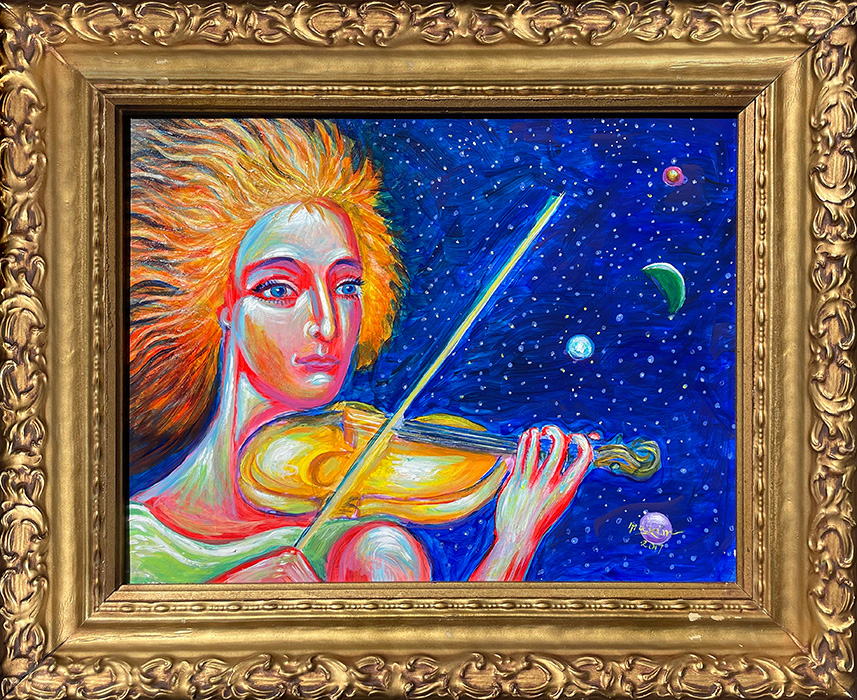
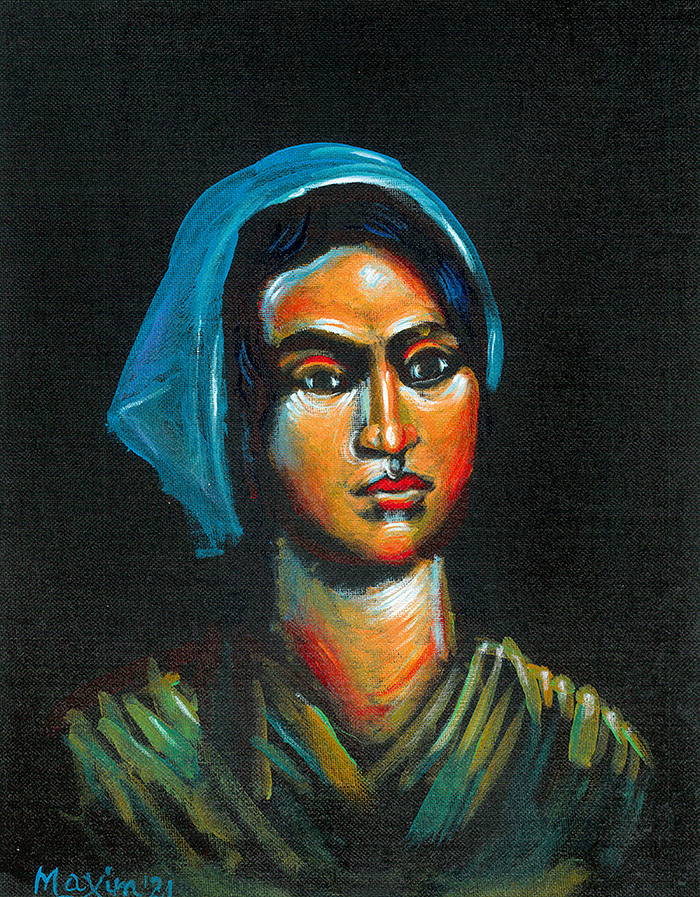
- Details
- Category: Maxim
"Grushenkа's Maid", acrylic on canvas, by Bishop Maxim, 2021.
I don't know how to portray a maid, a character who entered the paintings "like Pilate in the Faith". But the painter Maxim conveys her world not only with her clothes and characteristic scarf and simple work clothes but also with her eyes, mouth, and eyebrows. To understand a person's character, it is important to consider the eyes, together with the eyebrows and mouth. I don't know how the painter managed to crystallize in her eyes the expression of a girl who works, listens, works, and suffers in calm. The lips also contribute to that, as if asking the question: why am I enduring all this? The maid has a lay expression, but also a blessed expressive activity of the anatomical elements of the character. This picture is so convincing that we think that the girl seemed to have just finished cleaning with rags, put her hands on her hips, and walked toward us. From the painter's point of view, we ask how this painter bypasses the mere stylistic expression of the painted character and with free hands shows a wide forehead and eyes, and a strong neck which represents a girl who has matured and strengthened through work and suffering, so she is now ready to endure hard days. The way in which the painter painted this girl serves as a halo that crowns her character. (Fr Stamatis Skliris)
I don't know how to portray a maid, a character who entered the paintings "like Pilate in the Faith". But the painter Maxim conveys her world not only with her clothes and characteristic scarf and simple work clothes but also with her eyes, mouth, and eyebrows. To understand a person's character, it is important to consider the eyes, together with the eyebrows and mouth. I don't know how the painter managed to crystallize in her eyes the expression of a girl who works, listens, works, and suffers in calm. The lips also contribute to that, as if asking the question: why am I enduring all this? The maid has a lay expression, but also a blessed expressive activity of the anatomical elements of the character. This picture is so convincing that we think that the girl seemed to have just finished cleaning with rags, put her hands on her hips, and walked toward us. From the painter's point of view, we ask how this painter bypasses the mere stylistic expression of the painted character and with free hands shows a wide forehead and eyes, and a strong neck which represents a girl who has matured and strengthened through work and suffering, so she is now ready to endure hard days. The way in which the painter painted this girl serves as a halo that crowns her character. (Fr Stamatis Skliris)
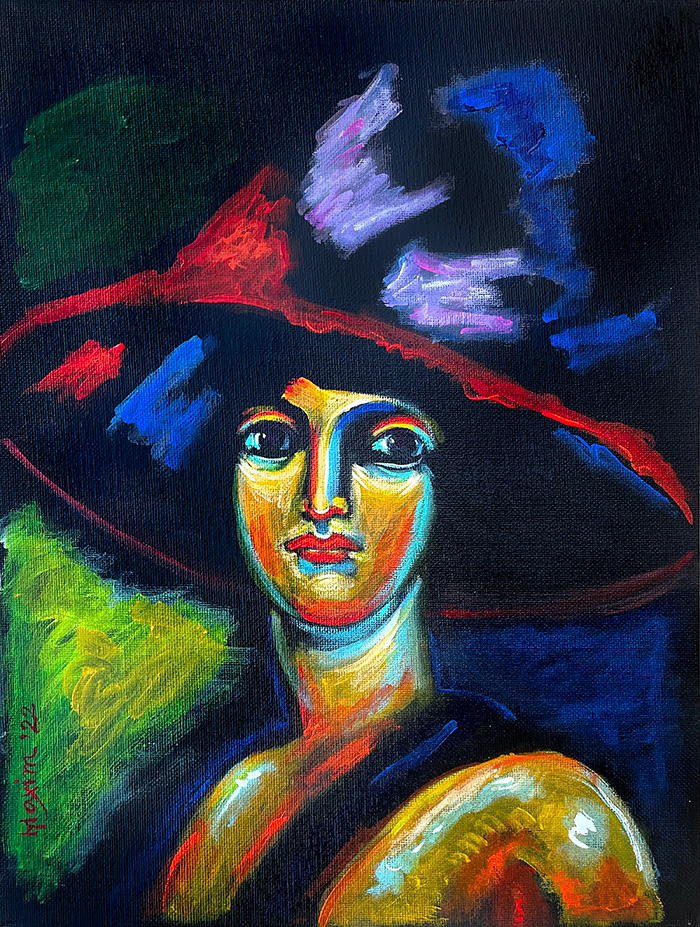
- Details
- Category: Maxim
“Netochka Nezvanova 2", acrylic on canvas, by Bishop Maxim, 2022
This is a woman who, from an uninvited girl to high society, managed, despite obstacles, to become an artist. But how to show all this in a painting? The face and neck stand upright like a pillar holding the whole temple. The look of two strong eyes of a strong female idiosyncrasy is added to this factor of balance. The portraitist made his eyes beautiful and his eyes strong. Eyelids and eyelashes contribute to that, as well as lips that show a woman, on the one hand beautiful, but also strong, who won and proved herself despite the opposite reactions and jealousy of others. An aristocratic hat on her head introduces an imbalance towards the vertical axis and assures us that this woman fought and achieved through struggle.
This is a woman who, from an uninvited girl to high society, managed, despite obstacles, to become an artist. But how to show all this in a painting? The face and neck stand upright like a pillar holding the whole temple. The look of two strong eyes of a strong female idiosyncrasy is added to this factor of balance. The portraitist made his eyes beautiful and his eyes strong. Eyelids and eyelashes contribute to that, as well as lips that show a woman, on the one hand beautiful, but also strong, who won and proved herself despite the opposite reactions and jealousy of others. An aristocratic hat on her head introduces an imbalance towards the vertical axis and assures us that this woman fought and achieved through struggle.
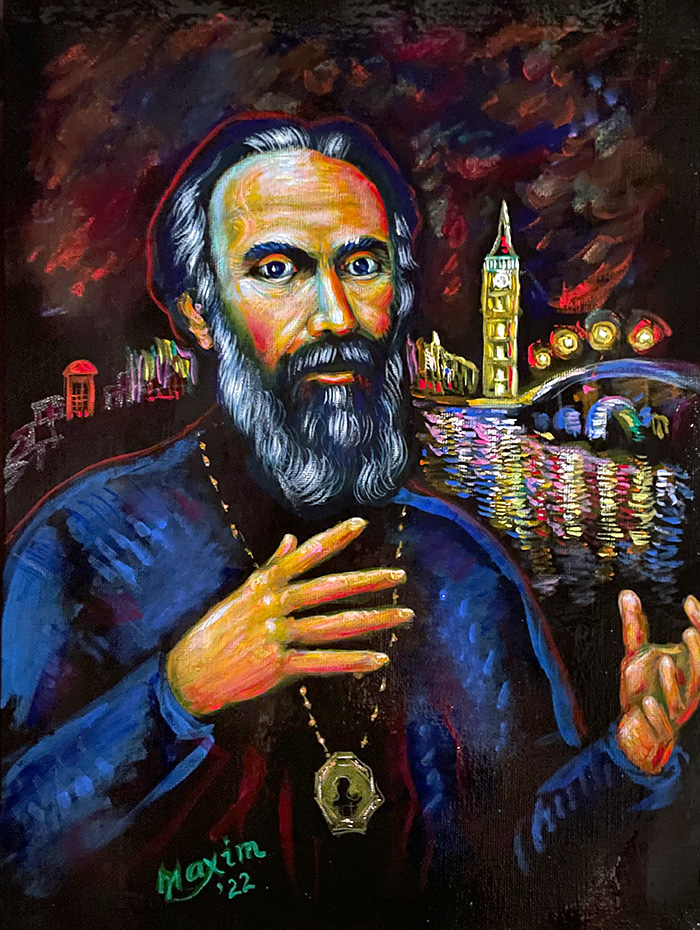
- Details
- Category: Maxim
"Metropolitan Anthony Bloom of Sourozh", acrylic on canvas, by Bishop Maxim, 2022
Metropolitan Anthony of Sourozh, who served as a bishop in London from 1957 to 2003, was best known as a writer and broadcaster on prayer and the Christian life. This remarkable, indeed saintly, bishop said: "We should try to live in such a way that if the Gospels were lost, they could be re-written by looking at us.” After reading classics, he went on to study physics, chemistry, and biology at the Sorbonne School of Science. In 1939 he was qualified as a physician. During the years the German army occupied France when he was a physician active in the Maquis, a section of the French resistance, he had the occasion to use his medical skills to save the life of a German soldier. In 1953 he was appointed hegoumen, in 1956 archimandrite, then in 1962 archbishop of the newly created Diocese of Sourozh, encompassing Britain and Ireland.
Metropolitan Anthony of Sourozh, who served as a bishop in London from 1957 to 2003, was best known as a writer and broadcaster on prayer and the Christian life. This remarkable, indeed saintly, bishop said: "We should try to live in such a way that if the Gospels were lost, they could be re-written by looking at us.” After reading classics, he went on to study physics, chemistry, and biology at the Sorbonne School of Science. In 1939 he was qualified as a physician. During the years the German army occupied France when he was a physician active in the Maquis, a section of the French resistance, he had the occasion to use his medical skills to save the life of a German soldier. In 1953 he was appointed hegoumen, in 1956 archimandrite, then in 1962 archbishop of the newly created Diocese of Sourozh, encompassing Britain and Ireland.
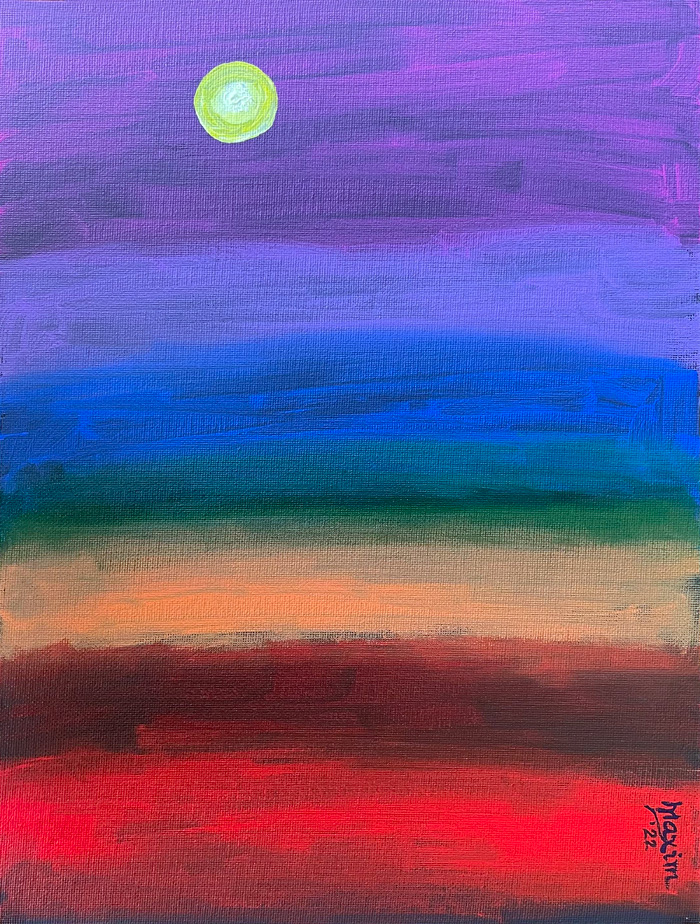
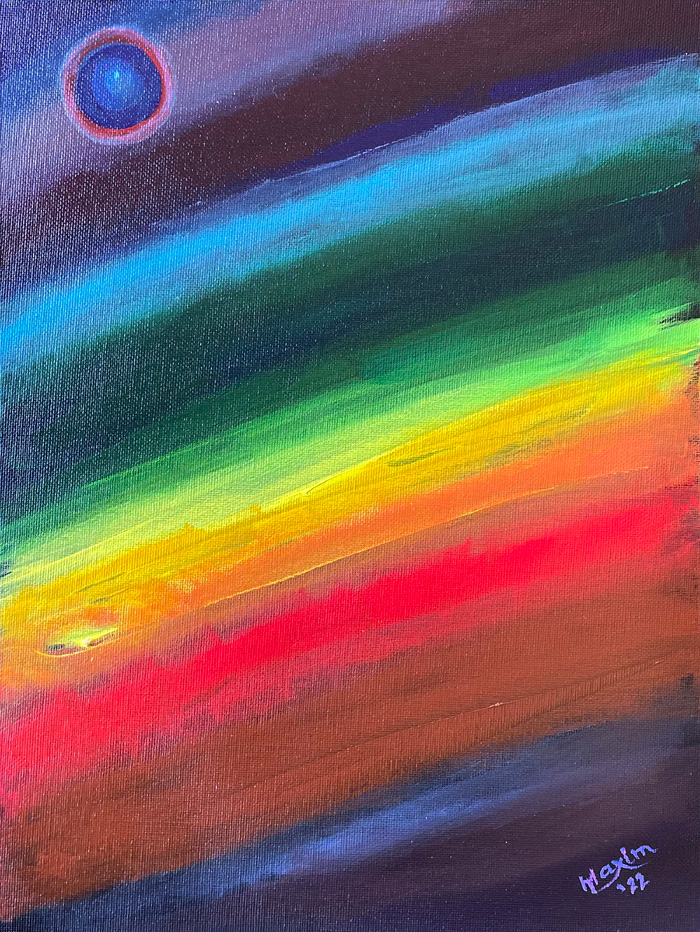
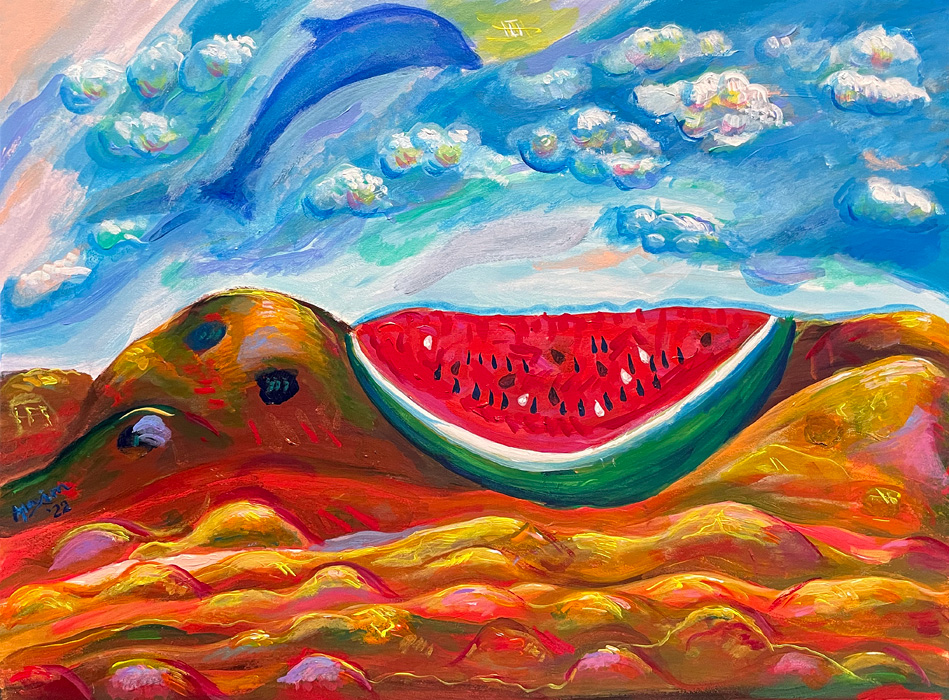
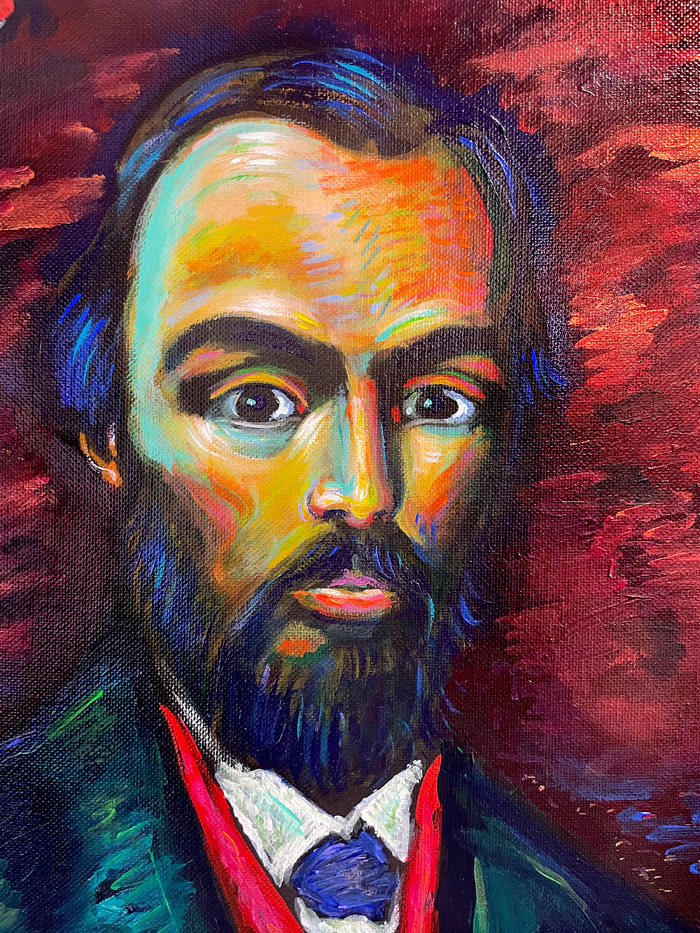
- Details
- Category: Maxim
"Young Wakening Dostoevsky", detail, acrylic on canvas, by Bishop Maxim, 2022
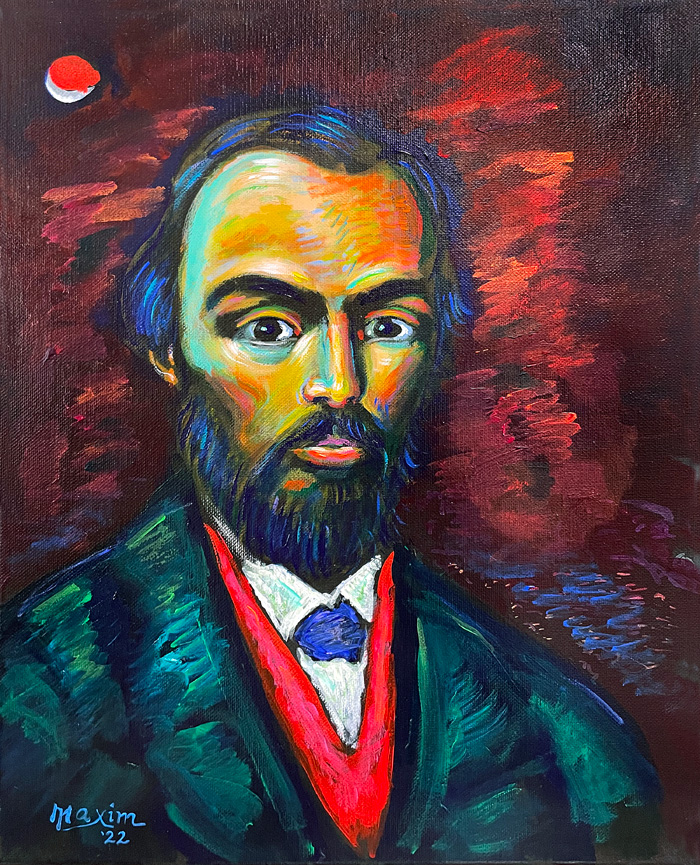
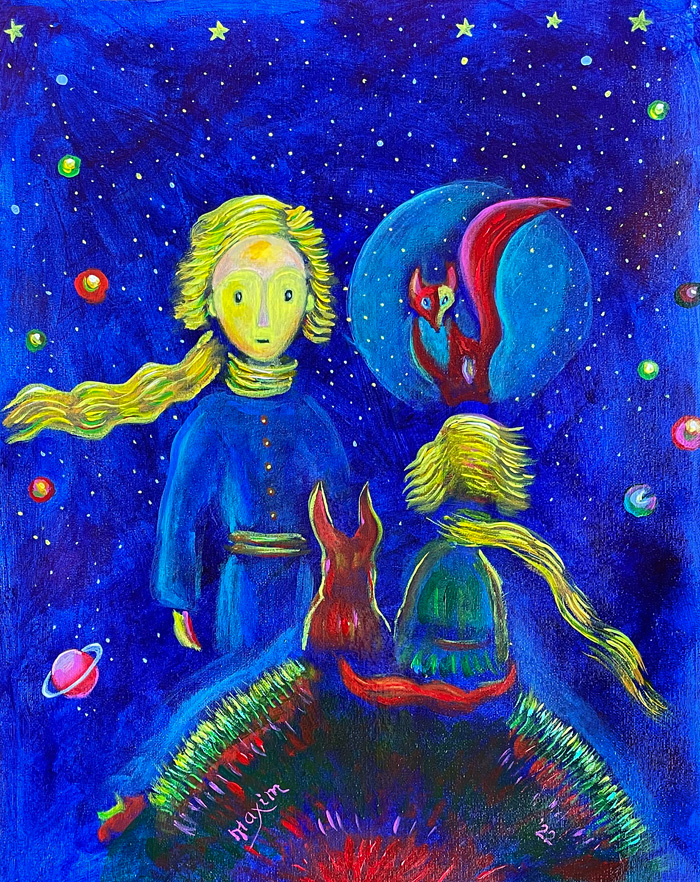
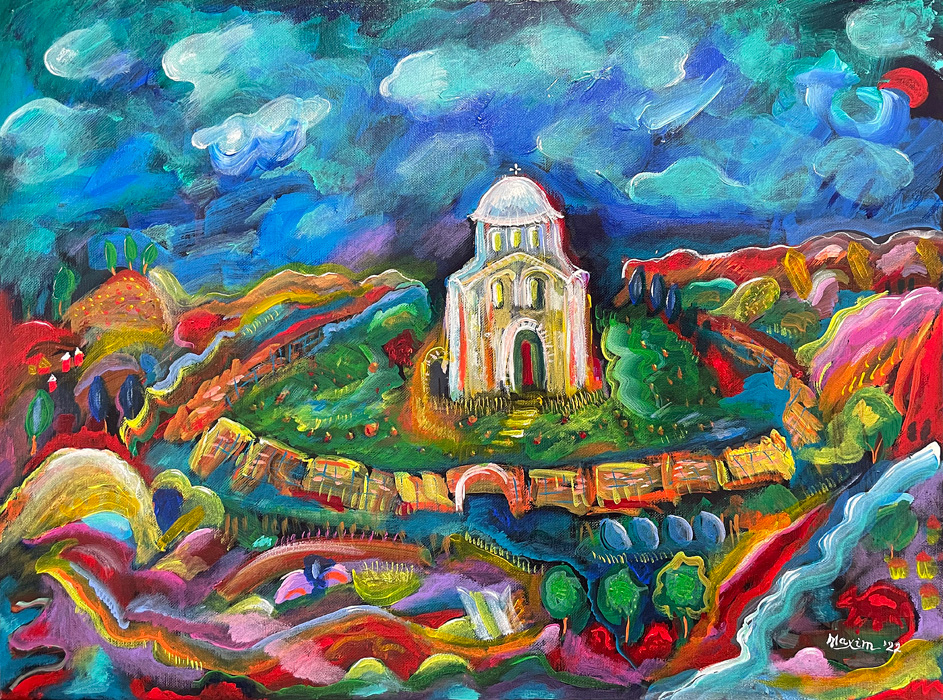
- Details
- Category: Maxim
"Djurdjevi Stupovi" (Pillars of St George Monastery), acrylic on canvas, by Bishop Maxim, 2022
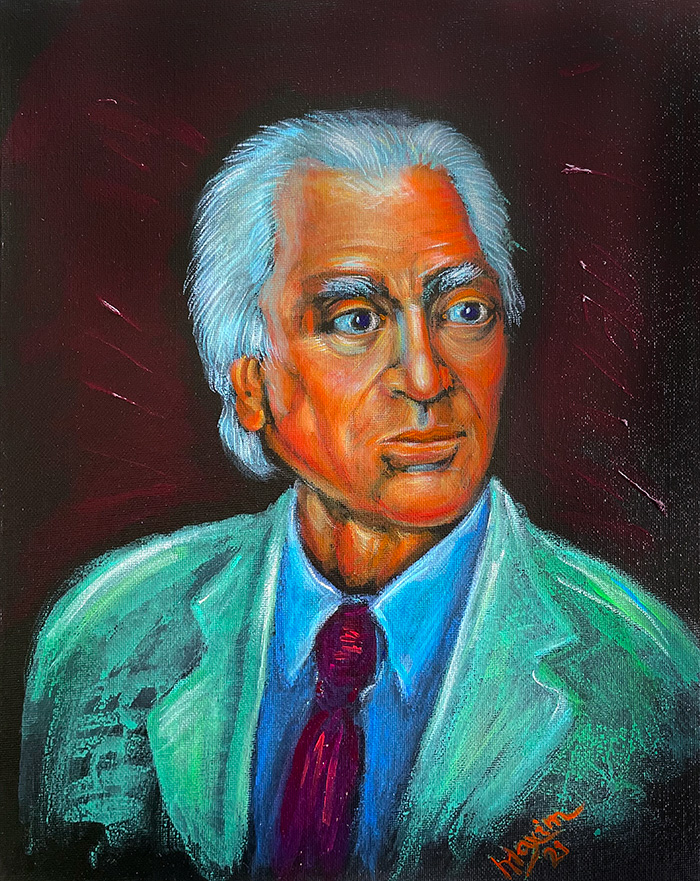
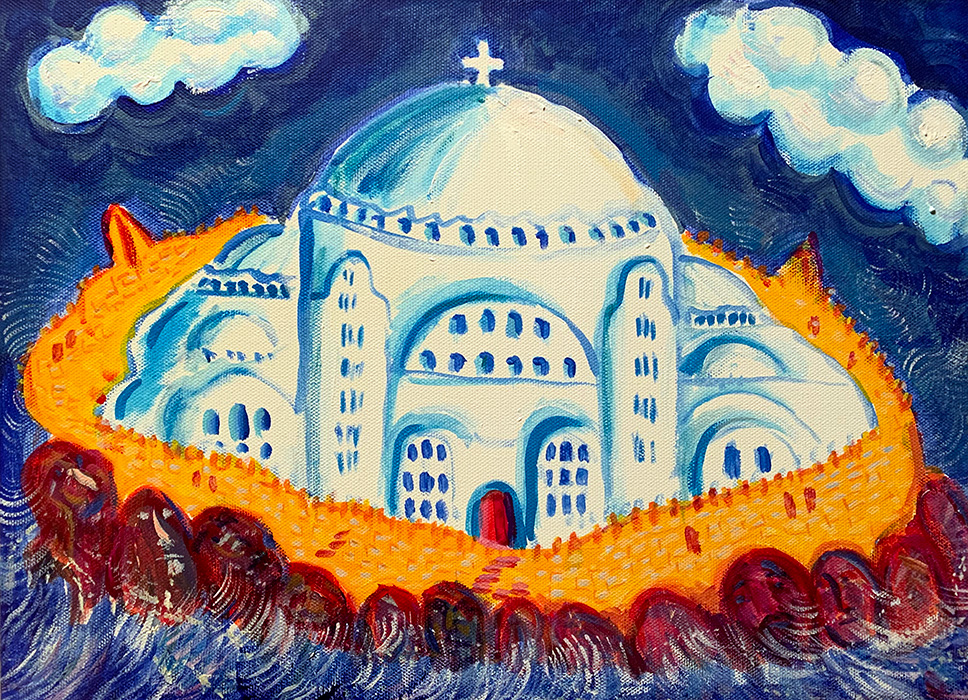
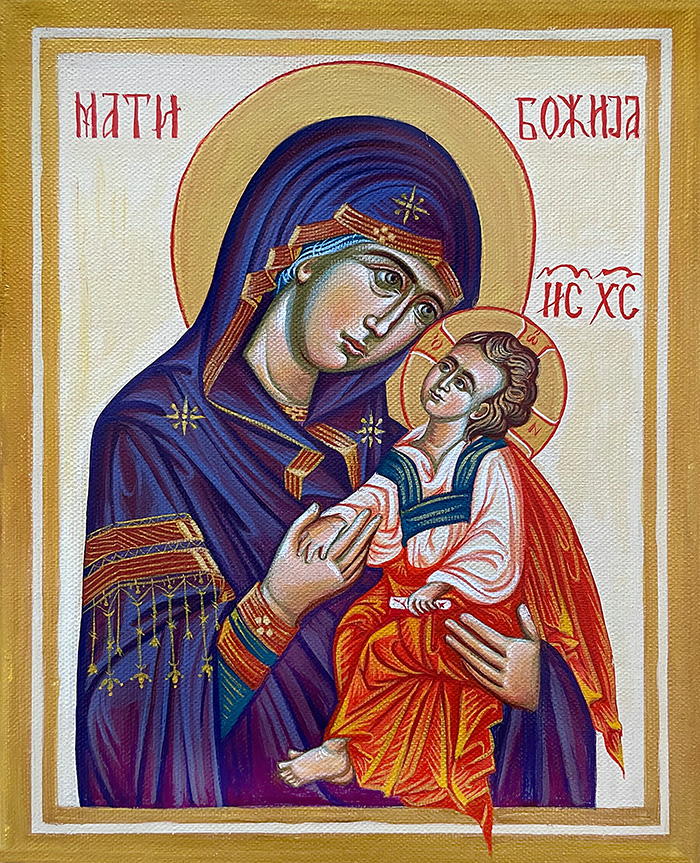
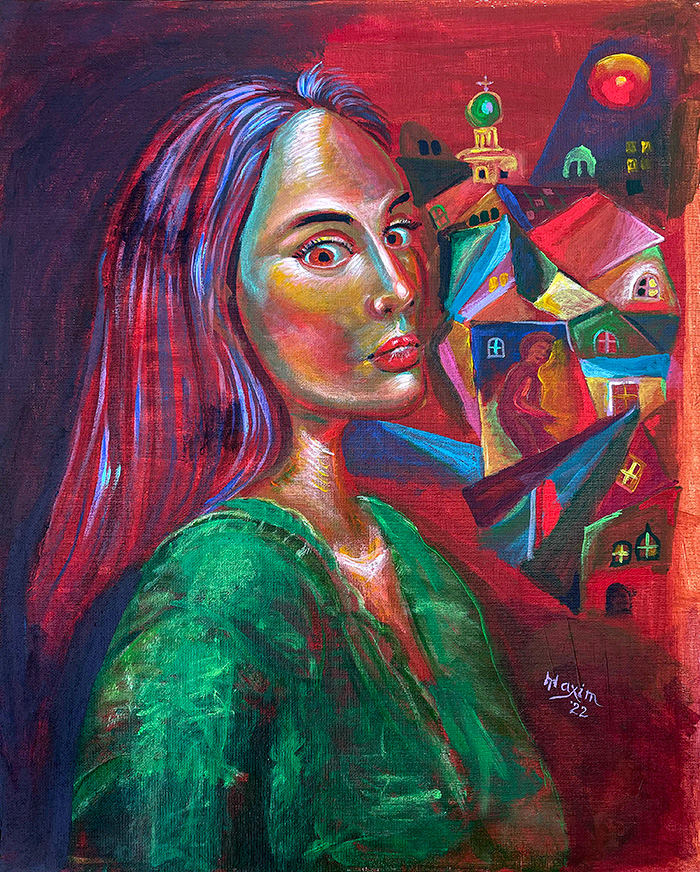
- Details
- Category: Maxim
"Portrait of Sonya Marmeladova, Dostoyevsky’s Heroine," acrylic on canvas, Bishop Maxim, 2022
The architecture of the axes of the painting is well-constructed. The left half is occupied by the protagonist, and the other half by her environment, unfolding the narrative for us.
What stands out in this painting is Sonia’s expression. The way the painter has crafted this face is striking, presenting a personality that challenges social conventions and affirms freedom as the ultimate purpose of the universe's creation. Everything exists to move from inanimate to living, and all living things culminate in “living in freedom.”
This concept is symbolized by the lightning we observe. As Elder Athanasios said, man found his troubles from the moment God granted man freedom.
However, we examine these existential, theological, and anthropological issues from an aesthetic perspective. How did the painter make colors, strokes, and lines embody freedom? How does this Spartan being reveal itself, making us forget we are observing a composition of materials? Essentially, the way materials are composed transcends materiality. In such moments, we witness the miracle of art. These moments are beyond interpretation; they are like structures that overcome the stress of building, sidestep anxiety, and seem not handcrafted.
Such moments defy time and remain eternally significant in art history. Opinions like “I like it or I don’t like it” do not apply here. It is what it is. These moments advocate for the mystery of creation ex nihilo.
Creating from nothing defines arbitrariness, the ultimate challenge to logic. It’s as if the artist is saying: “Listen, understand this well. There was nothing. Then ‘something’ was made. From this ‘something,’ various conventions developed.” The true novel creates masterpieces that remind us of the existential freshness of creation from nothing.
The environment around the protagonist: A wise decision led Maximus to use a rosy to magenta brulée color in the right half of the background, overlaying it with decorative embroidery dominated by wonderful complementary green. This green appears in the foreground as the protagonist’s dress and in the background’s upper right corner as a luminous dome, bringing a metaphysical whisper, a “mining,” as Papadiamantis would say. From the front dress to the distant dome, it encompasses human suffering.
Suffering is expressed through jagged lines contrasting the gentle curves of the face, forming cube-like, conical, or pyramidal houses that create a three-dimensional space. In these narrow alleys, a Dostoevskian existence, pained by the unfulfilled and irreparable, grazes its dreams. Some buildings, with their knife-like tips, threaten to strike her neck, symbolizing existential torment. Henri Focillon was right to exclaim, “Oh, brush stroke, you contend with fate to extract from it rare innovations.”
Destiny corresponds to death. Our innovations bring a scent of eternal life. Dostoevsky drew his ink from the darkness of sunless alleys, but his writings illuminate the darkness.
Fr. Stamatis Skliris
The architecture of the axes of the painting is well-constructed. The left half is occupied by the protagonist, and the other half by her environment, unfolding the narrative for us.
What stands out in this painting is Sonia’s expression. The way the painter has crafted this face is striking, presenting a personality that challenges social conventions and affirms freedom as the ultimate purpose of the universe's creation. Everything exists to move from inanimate to living, and all living things culminate in “living in freedom.”
This concept is symbolized by the lightning we observe. As Elder Athanasios said, man found his troubles from the moment God granted man freedom.
However, we examine these existential, theological, and anthropological issues from an aesthetic perspective. How did the painter make colors, strokes, and lines embody freedom? How does this Spartan being reveal itself, making us forget we are observing a composition of materials? Essentially, the way materials are composed transcends materiality. In such moments, we witness the miracle of art. These moments are beyond interpretation; they are like structures that overcome the stress of building, sidestep anxiety, and seem not handcrafted.
Such moments defy time and remain eternally significant in art history. Opinions like “I like it or I don’t like it” do not apply here. It is what it is. These moments advocate for the mystery of creation ex nihilo.
Creating from nothing defines arbitrariness, the ultimate challenge to logic. It’s as if the artist is saying: “Listen, understand this well. There was nothing. Then ‘something’ was made. From this ‘something,’ various conventions developed.” The true novel creates masterpieces that remind us of the existential freshness of creation from nothing.
The environment around the protagonist: A wise decision led Maximus to use a rosy to magenta brulée color in the right half of the background, overlaying it with decorative embroidery dominated by wonderful complementary green. This green appears in the foreground as the protagonist’s dress and in the background’s upper right corner as a luminous dome, bringing a metaphysical whisper, a “mining,” as Papadiamantis would say. From the front dress to the distant dome, it encompasses human suffering.
Suffering is expressed through jagged lines contrasting the gentle curves of the face, forming cube-like, conical, or pyramidal houses that create a three-dimensional space. In these narrow alleys, a Dostoevskian existence, pained by the unfulfilled and irreparable, grazes its dreams. Some buildings, with their knife-like tips, threaten to strike her neck, symbolizing existential torment. Henri Focillon was right to exclaim, “Oh, brush stroke, you contend with fate to extract from it rare innovations.”
Destiny corresponds to death. Our innovations bring a scent of eternal life. Dostoevsky drew his ink from the darkness of sunless alleys, but his writings illuminate the darkness.
Fr. Stamatis Skliris
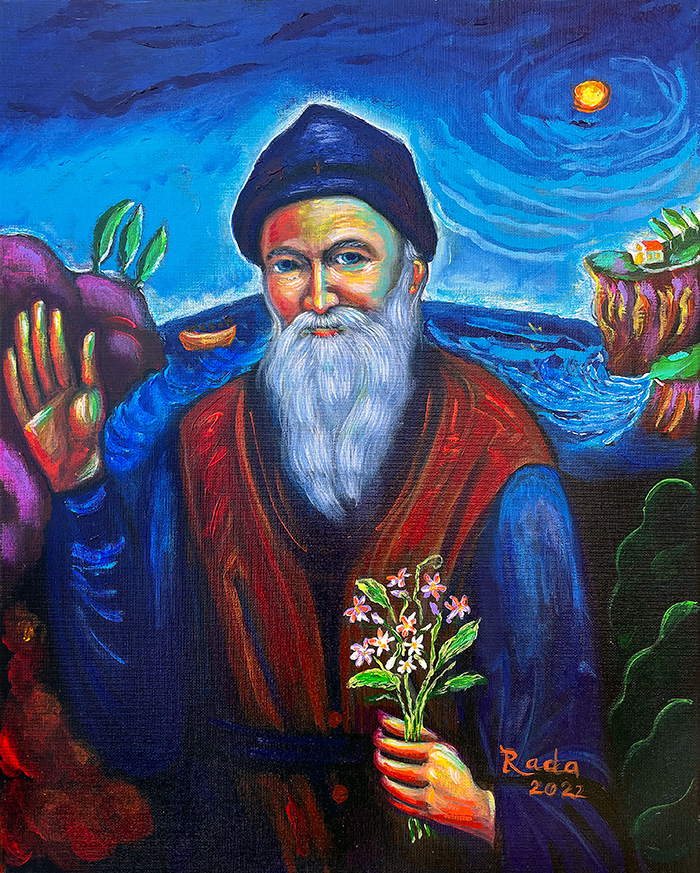
- Details
- Category: Maxim
“St. Porphyrios Greeting Us”, acrylic on canvas, by Radmila Vasiljevic, 2022
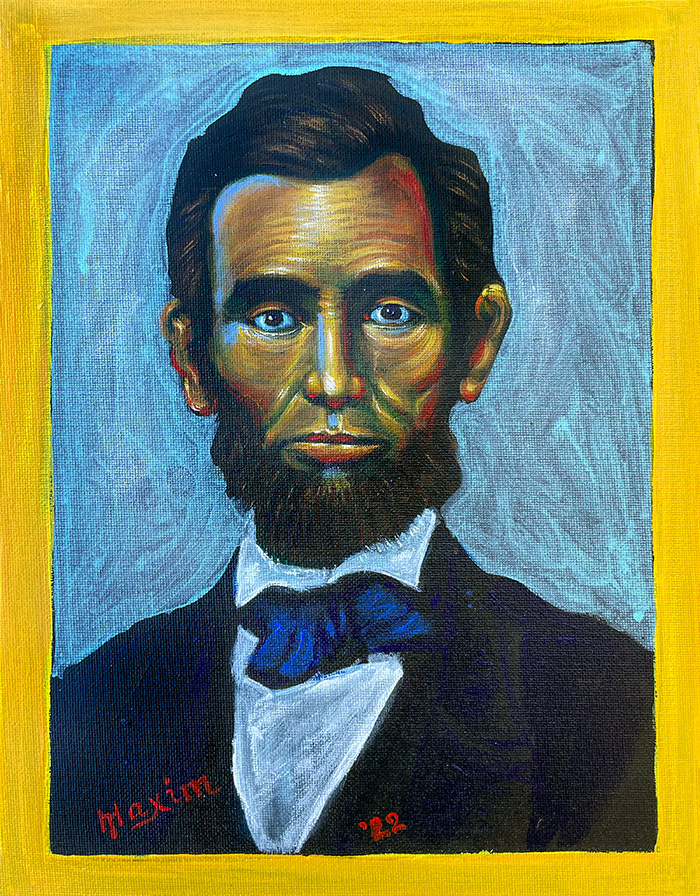
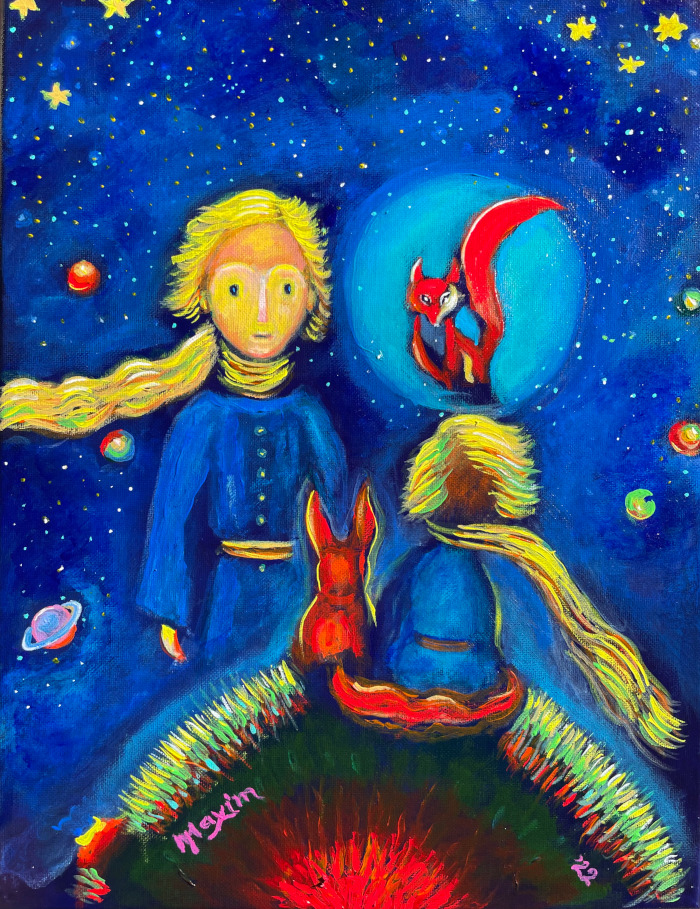
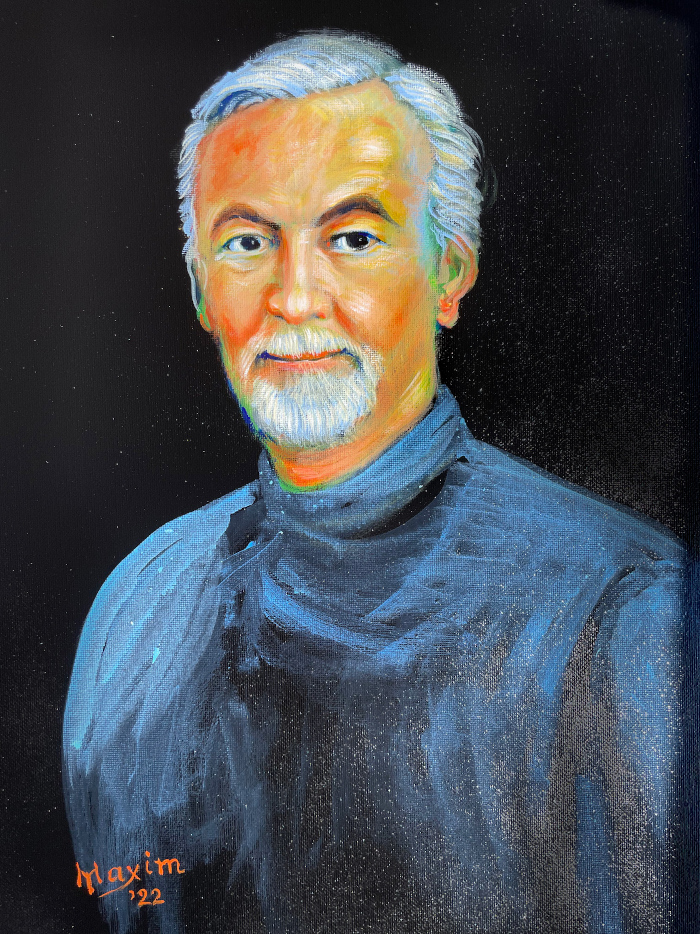
- Details
- Category: Maxim
"Alexander Schmemann: Fr. Paschal Eucharist”, acrylic on canvas, by Bishop Maxim, 2022
At Pascha during the service before the closed doors of the chapel, everyone noticed how his face would entirely transfigure and be full of light.
Alexander Dmitrievich Schmemann (1921-1983) was an influential Orthodox priest, theologian, and author who had most of his career in the United States. Born in Estonia to émigrés from the Russian Revolution, he grew up primarily in France, where there was a large émigré community in Paris.
At Pascha during the service before the closed doors of the chapel, everyone noticed how his face would entirely transfigure and be full of light.
Alexander Dmitrievich Schmemann (1921-1983) was an influential Orthodox priest, theologian, and author who had most of his career in the United States. Born in Estonia to émigrés from the Russian Revolution, he grew up primarily in France, where there was a large émigré community in Paris.
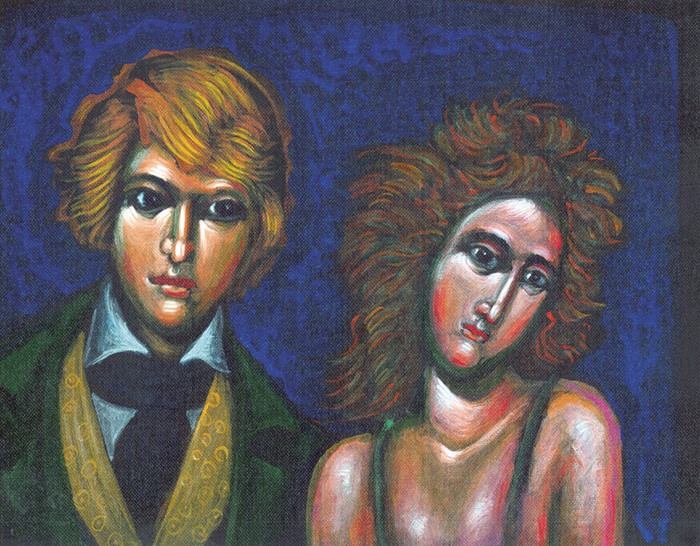
- Details
- Category: Maxim
Alexei & Polina, acrylic on canvas, by Bishop Maxim, 2021
“Every now and then I would glance at Polina Alexandrovna, but she paid me no attention; until eventually I became so irritated that I decided to play the boor… Polina was not at all pleased with my questions; I could see that she was doing her best to irritate me with the brusquerie of her answers. But I took no notice of this… Again, therefore, I put to myself the question: ‘Do I, or do I not love her?’ and again I could return myself no answer or, rather, for the hundredth time I told myself that I detested her.” Through The Gambler Dostoevsky rationalized his dependence on gambling. From that point on, the novel can be considered as some kind of self-condemnation and excuse.
“Every now and then I would glance at Polina Alexandrovna, but she paid me no attention; until eventually I became so irritated that I decided to play the boor… Polina was not at all pleased with my questions; I could see that she was doing her best to irritate me with the brusquerie of her answers. But I took no notice of this… Again, therefore, I put to myself the question: ‘Do I, or do I not love her?’ and again I could return myself no answer or, rather, for the hundredth time I told myself that I detested her.” Through The Gambler Dostoevsky rationalized his dependence on gambling. From that point on, the novel can be considered as some kind of self-condemnation and excuse.
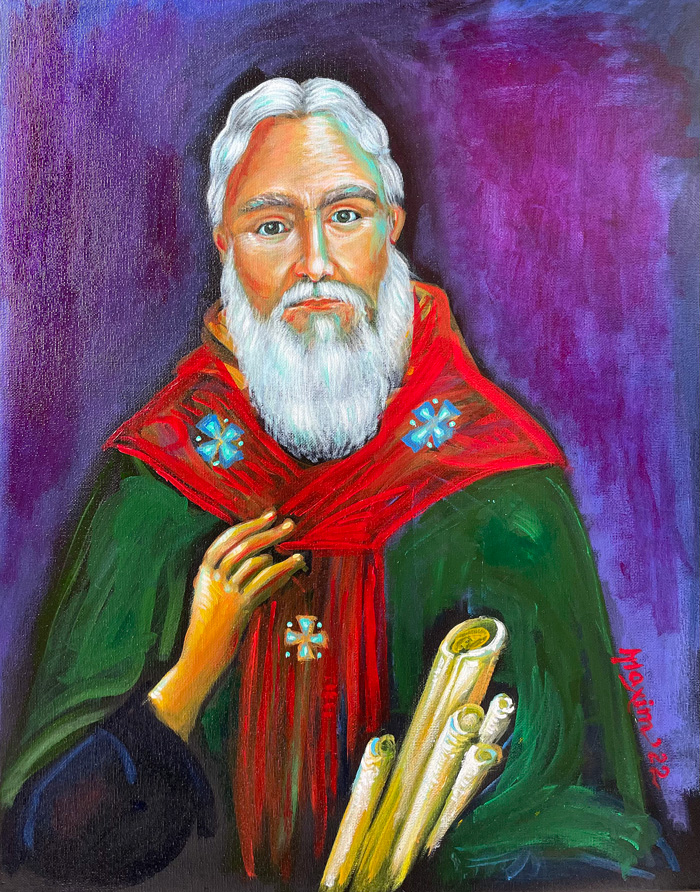
- Details
- Category: Maxim
"Kallistos Ware", acrylic on canvas, by Bishop Maxim, 2022
Peaceful look, without the need to control. As if experiencing the weight of the blessing given to him, the Bishop lifts the blessed weight of the Divine gift he has received and says: “For my yoke is easy, and my burden is light.”
Kallistos Ware is an English bishop and theologian of the Eastern Orthodox Church. Since 1982, he has held the titular bishopric of Diokleia in Phrygia, later made a titular metropolitan bishopric in 2007, under the Ecumenical Patriarchate of Constantinople. From 1966 to 2001, he was Spalding Lecturer of Eastern Orthodox Studies at the University of Oxford.
Peaceful look, without the need to control. As if experiencing the weight of the blessing given to him, the Bishop lifts the blessed weight of the Divine gift he has received and says: “For my yoke is easy, and my burden is light.”
Kallistos Ware is an English bishop and theologian of the Eastern Orthodox Church. Since 1982, he has held the titular bishopric of Diokleia in Phrygia, later made a titular metropolitan bishopric in 2007, under the Ecumenical Patriarchate of Constantinople. From 1966 to 2001, he was Spalding Lecturer of Eastern Orthodox Studies at the University of Oxford.
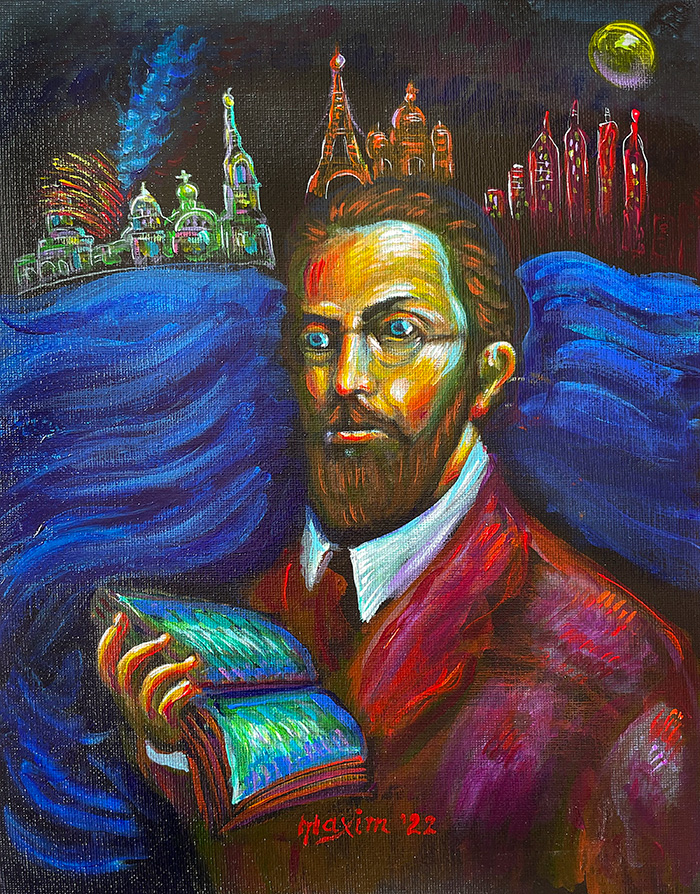
- Details
- Category: Maxim
"Young Georges Florovsky from his hometown Odessa, through Paris to New York", acrylic on canvas, by Bishop Maxim, 2022
Young Florovsky is immersed in his thoughts, while on the horizon are discerned his hometown Odessa in flames of a then distant war, Paris and New York. Georges Florovsky was born on August 28, 1893, in Elisavetgrad (the city of Kirovograd in present-day southern Ukraine) and grew up in the cosmopolitan city-port of Odessa. He moved between different European centers-Sofia, Prague, Paris, and Belgrad. In 1925 he became a professor of patristics at the St. Serge Institute of Orthodox Theology in Paris. He spent his working life in Paris (1920–1949) and New York (1949–1979). With Sergei Bulgakov, Vladimir Lossky, Justin Popović, and Dumitru Stăniloae he was one of the more influential Eastern Orthodox Christian theologians of the mid-20th century.
Young Florovsky is immersed in his thoughts, while on the horizon are discerned his hometown Odessa in flames of a then distant war, Paris and New York. Georges Florovsky was born on August 28, 1893, in Elisavetgrad (the city of Kirovograd in present-day southern Ukraine) and grew up in the cosmopolitan city-port of Odessa. He moved between different European centers-Sofia, Prague, Paris, and Belgrad. In 1925 he became a professor of patristics at the St. Serge Institute of Orthodox Theology in Paris. He spent his working life in Paris (1920–1949) and New York (1949–1979). With Sergei Bulgakov, Vladimir Lossky, Justin Popović, and Dumitru Stăniloae he was one of the more influential Eastern Orthodox Christian theologians of the mid-20th century.
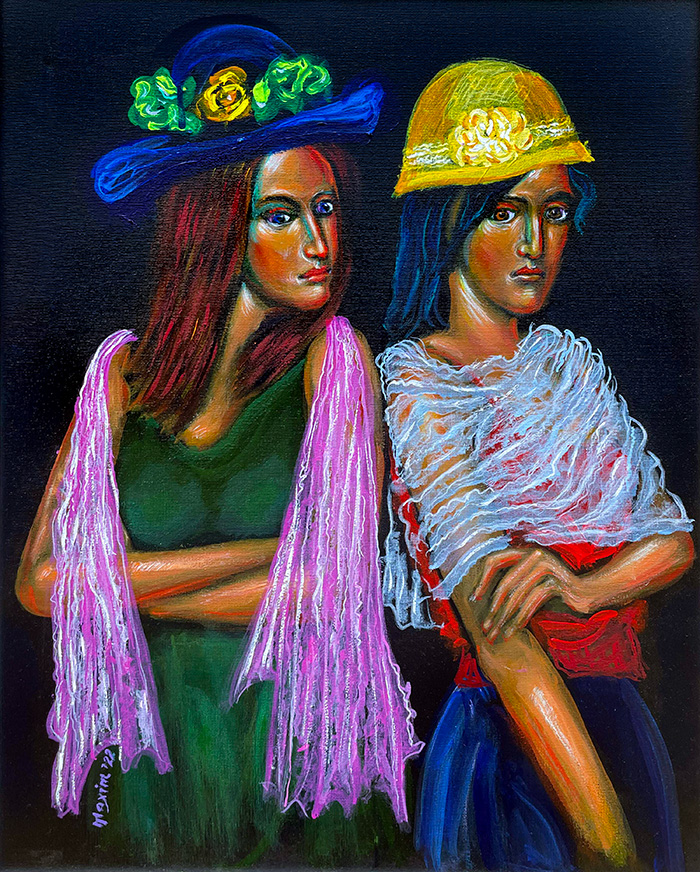
- Details
- Category: Maxim
"How on earth all this happened?—Alexandra and Aglaya Ivanovna", acrylic on canvas, by Bishop Maxim, 2022
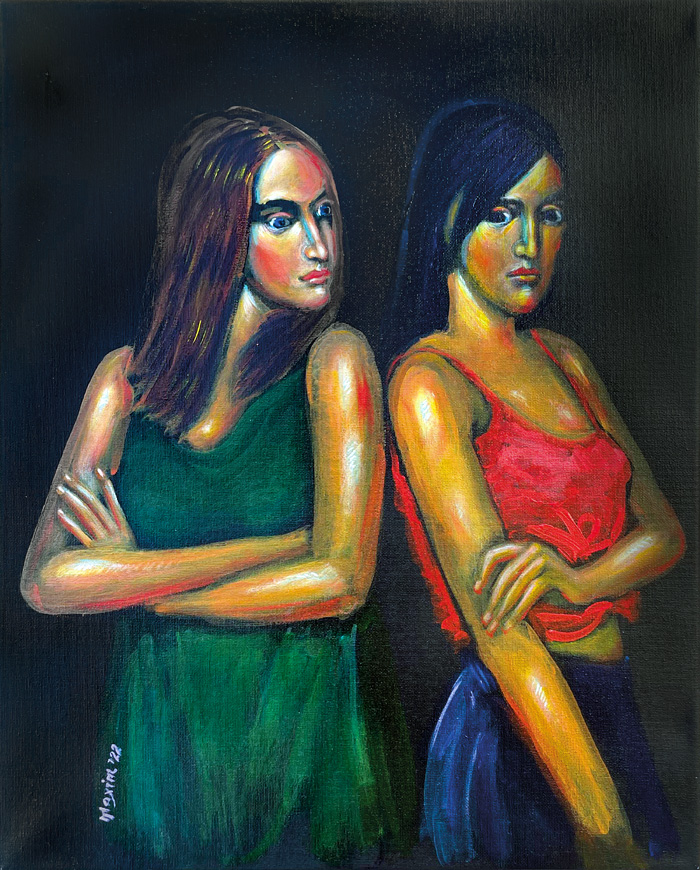
- Details
- Category: Maxim
"Madeleine Was Still an Enigma to Her", acrylic on canvas, by Bishop Maxim, 2022
"TWO GIRLS
A canvas that came out simply and gave the unpretentious sophistication of the sloppy young people with great success. Their expression and attitude are very natural and convincing. Clothes with SIMPLICITY express immobility and, at the same time, restrained movement.
I can not understand how this painting expresses a real relationship between the two friends while they have turned their backs. Their FRIENDSHIP is imprinted on the canvas with tremendous conviction." (Fr. Stamatis Skliris)
"TWO GIRLS
A canvas that came out simply and gave the unpretentious sophistication of the sloppy young people with great success. Their expression and attitude are very natural and convincing. Clothes with SIMPLICITY express immobility and, at the same time, restrained movement.
I can not understand how this painting expresses a real relationship between the two friends while they have turned their backs. Their FRIENDSHIP is imprinted on the canvas with tremendous conviction." (Fr. Stamatis Skliris)
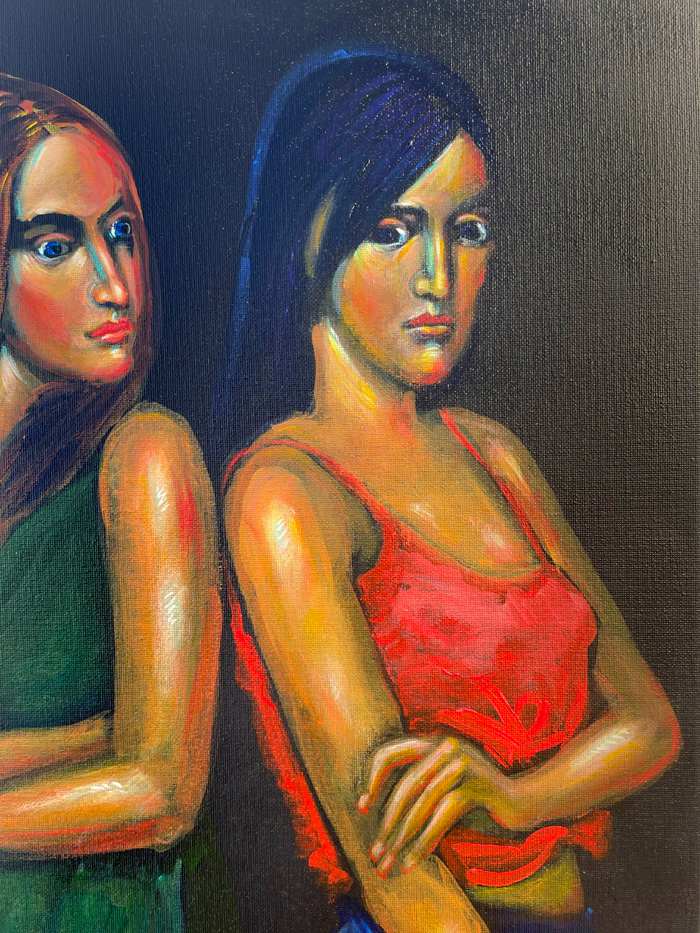
- Details
- Category: Maxim
"Madeleine Was Still an Enigma to Her", detail, acrylic on canvas, by Bishop Maxim, 2022
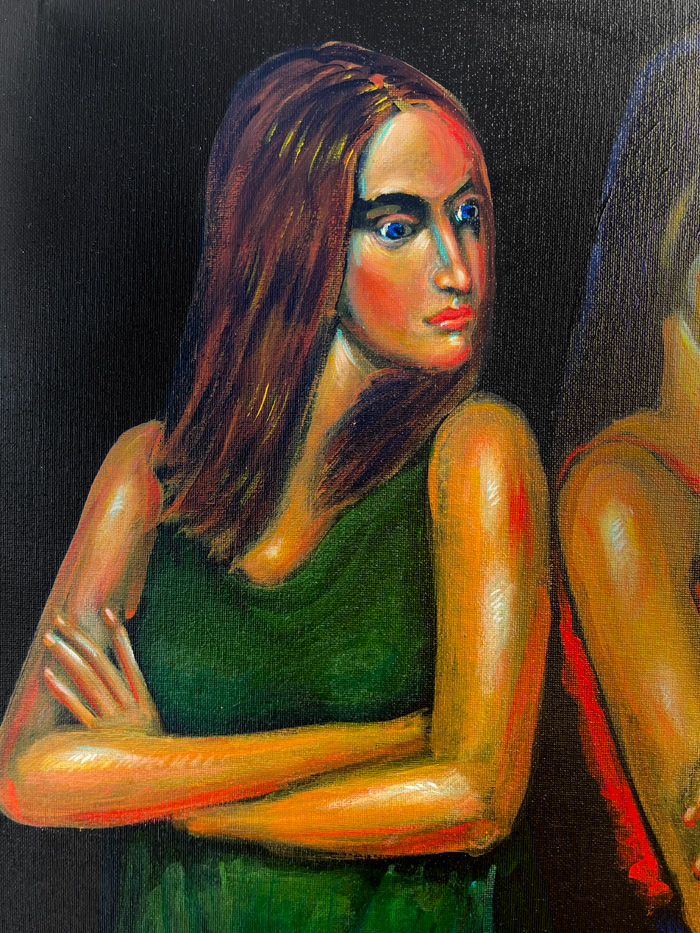
- Details
- Category: Maxim
"Madeleine Was Still an Enigma to Her", detail, acrylic on canvas, by Bishop Maxim, 2022
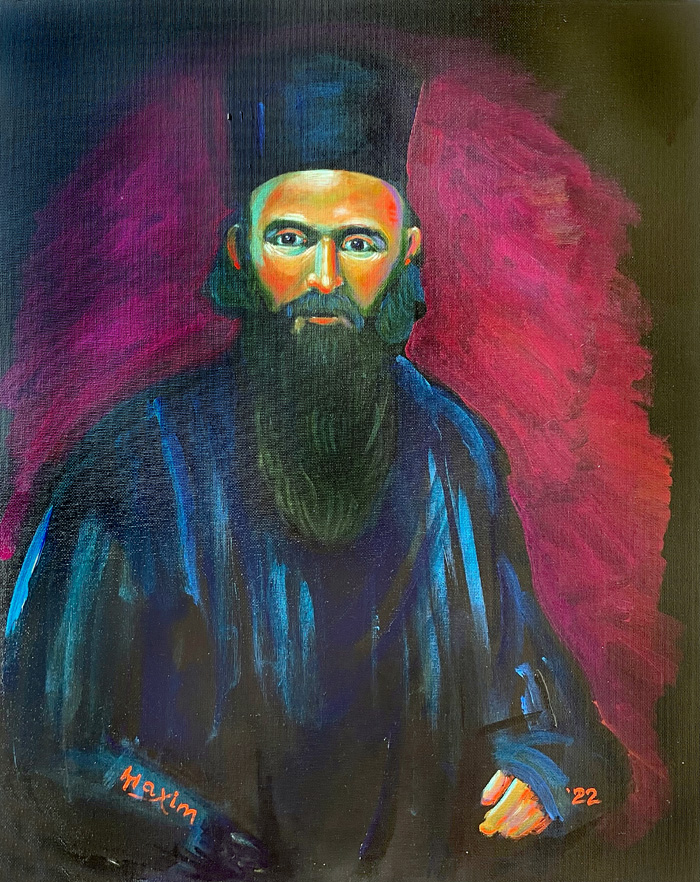
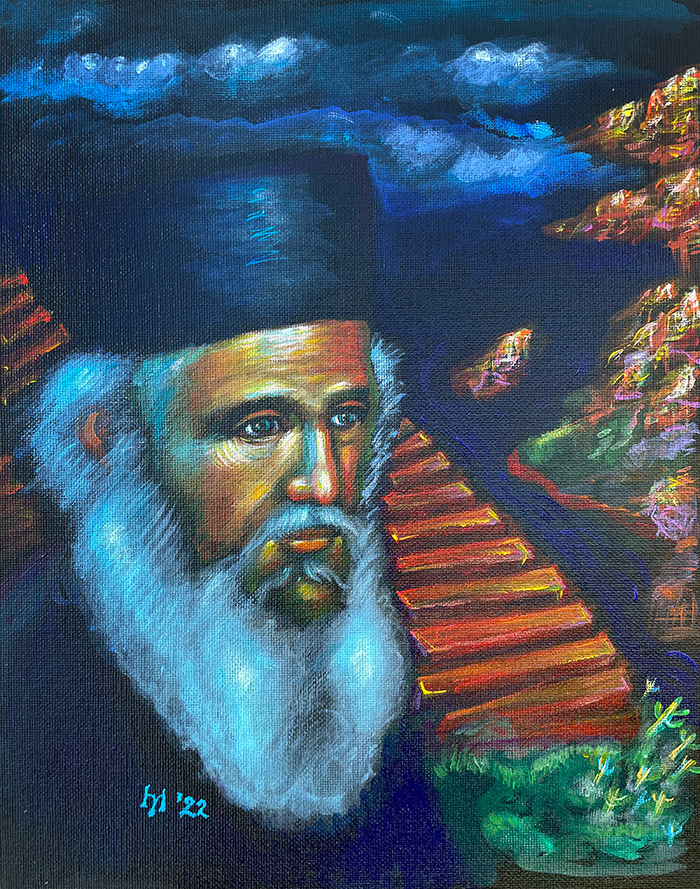
- Details
- Category: Maxim
"My Foundations Are in the Mountains" (Elder Vasileios of Iveron in Sedona, Arizona, 2012), acrylic on canvas, by Bishop Maxim, 2022
My foundations are in the mountains (Odysseus Elytis, Axion estin)
My foundations are in the mountains
and people carry the mountains on their shoulders
and memory is burning on top of them
like an unburnt bush.
Memory of my people your name is Pindos, your name is Athos.
My foundations are in the mountains (Odysseus Elytis, Axion estin)
My foundations are in the mountains
and people carry the mountains on their shoulders
and memory is burning on top of them
like an unburnt bush.
Memory of my people your name is Pindos, your name is Athos.
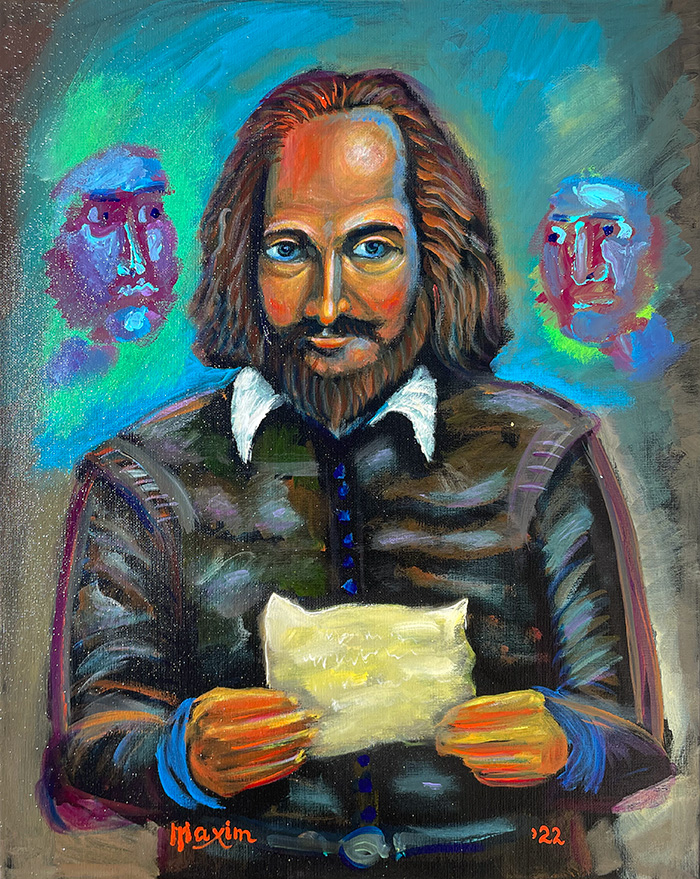
- Details
- Category: Maxim
“Shakespeare”, acrylic on canvas, by Bishop Maxim, 2022
A strong portrait, nice posture, especially the face, weighty, thinking, with a discrete smile. The paper he reads has tremendous success as a little crumpled, maybe a little stained. However, on paper, imprints of lived time, the portrait brings to life the inanimate time. The garment is as convincing as it is of its time. Тhe horizontal strokes of Shakespearean clothing point to a writer who meditates and walks, a little bent over and is the intellectual who writes the history of the spirit, and does not need uniforms, medals, and crowns. The background discreetly but expressively reveals the inner spiritual storms that Shakespeare lived while fighting with the spirits.
A strong portrait, nice posture, especially the face, weighty, thinking, with a discrete smile. The paper he reads has tremendous success as a little crumpled, maybe a little stained. However, on paper, imprints of lived time, the portrait brings to life the inanimate time. The garment is as convincing as it is of its time. Тhe horizontal strokes of Shakespearean clothing point to a writer who meditates and walks, a little bent over and is the intellectual who writes the history of the spirit, and does not need uniforms, medals, and crowns. The background discreetly but expressively reveals the inner spiritual storms that Shakespeare lived while fighting with the spirits.
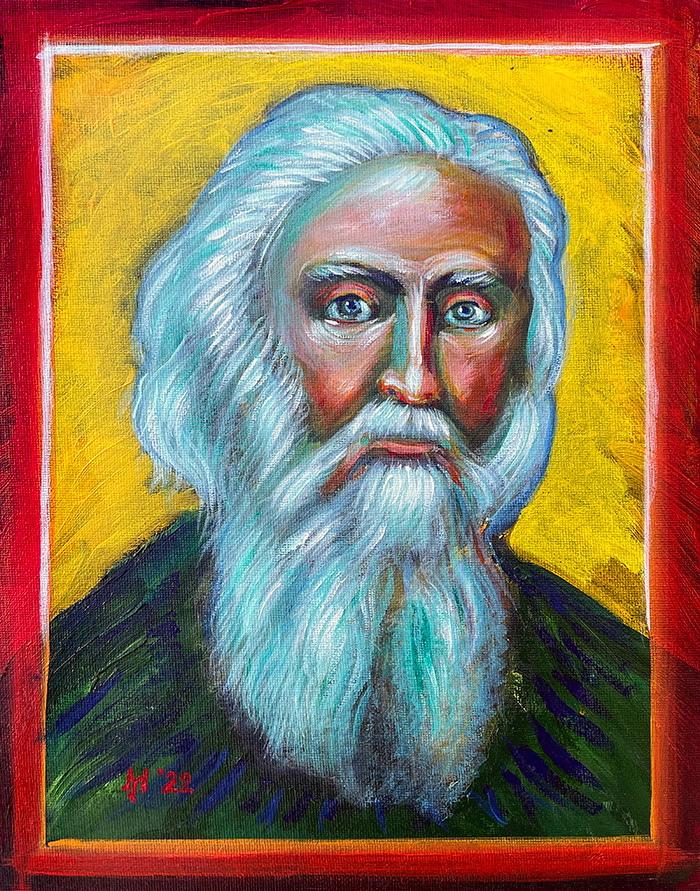
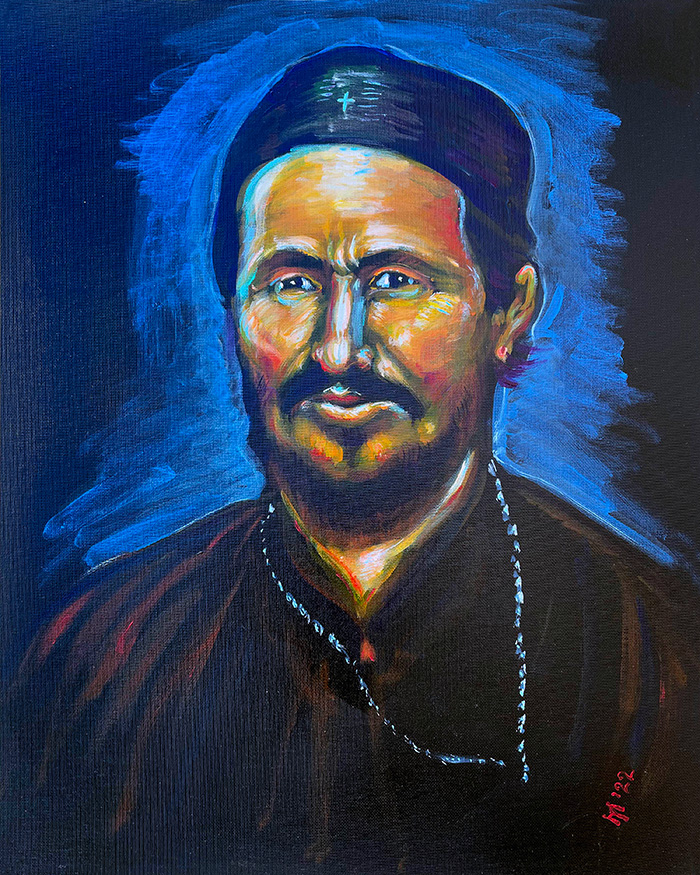
- Details
- Category: Maxim
"Vladika of Herzegovina", acrylic on canvas, by Bishop Maxim, 2022
"Тhe painting of Bishop Athanasios of Herzegovina--like all the works of Bishop Maxim--is a completed work. He has succeeded the Elder’s indescribable dynamism and calm power, a challenging combination. It is a painting with complex risks, a piece with difficult keys." - Fr. Stamatis Skliris
"Тhe painting of Bishop Athanasios of Herzegovina--like all the works of Bishop Maxim--is a completed work. He has succeeded the Elder’s indescribable dynamism and calm power, a challenging combination. It is a painting with complex risks, a piece with difficult keys." - Fr. Stamatis Skliris
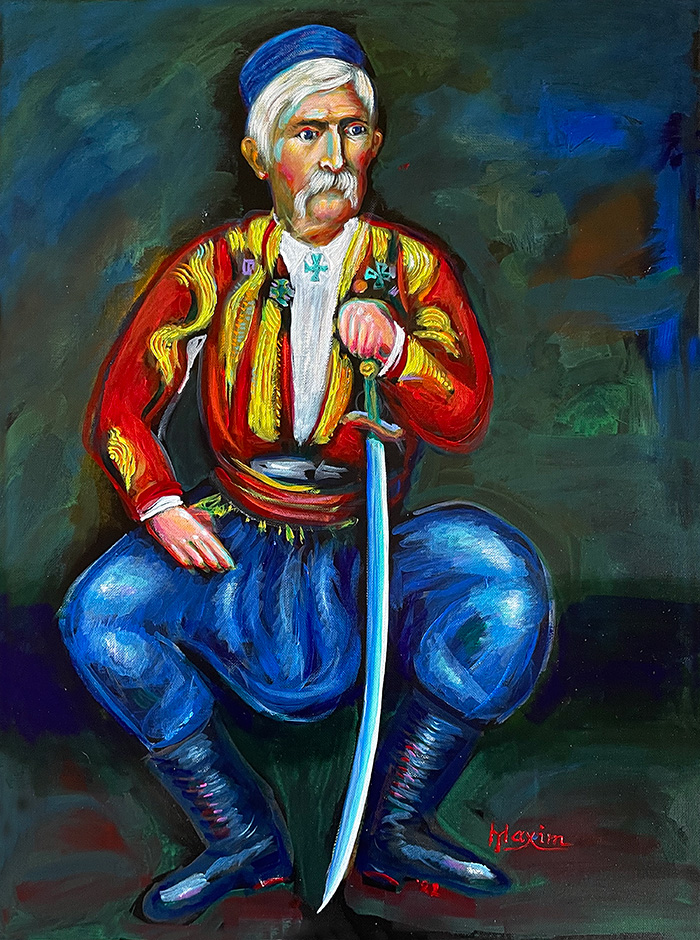
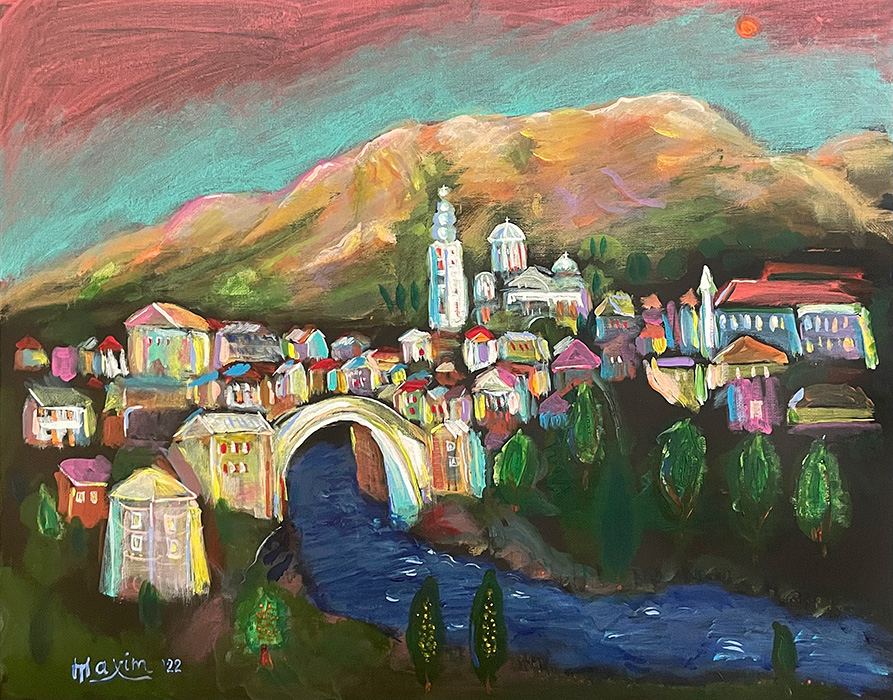
- Details
- Category: Maxim
"The Old Mostar Bridge and the Cathedral of Resurrection", acrylic on canvas, Bishop Maxim, 2022
A city with a pink sky is another approach as a naif, like a painting of a willingly childish soul. It has the features of Matisse with a balanced perspective. A very personal, authentic expression that approaches the world and the landscape with optimism. - Stamatis Skliris
A city with a pink sky is another approach as a naif, like a painting of a willingly childish soul. It has the features of Matisse with a balanced perspective. A very personal, authentic expression that approaches the world and the landscape with optimism. - Stamatis Skliris
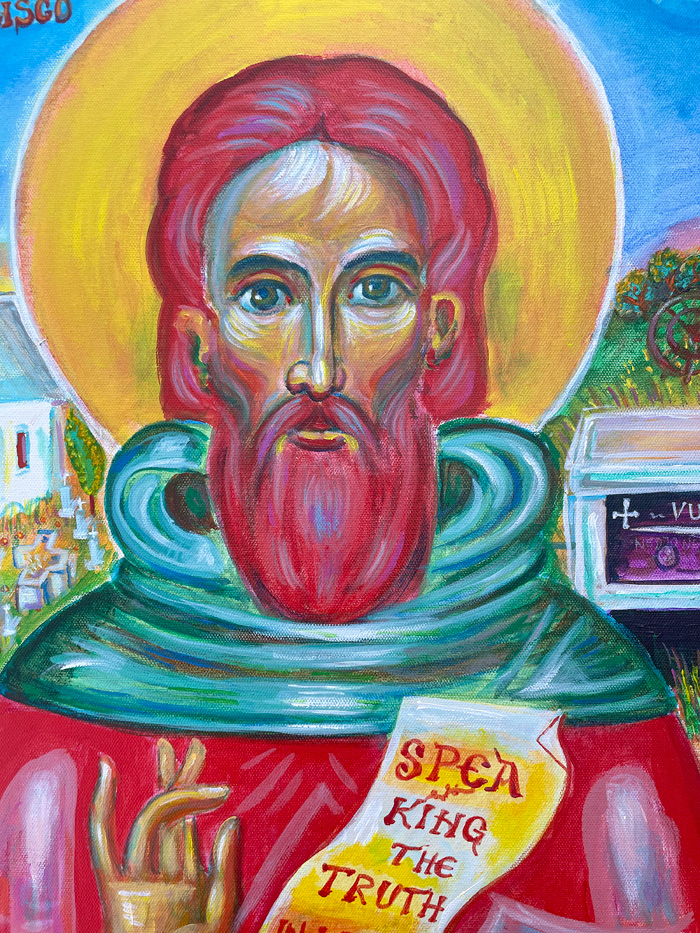
- Details
- Category: Maxim
"St. Sebastian of San Francisco and Jackson", detail, acrylic on canvas, by Bishop Maxim, 2022
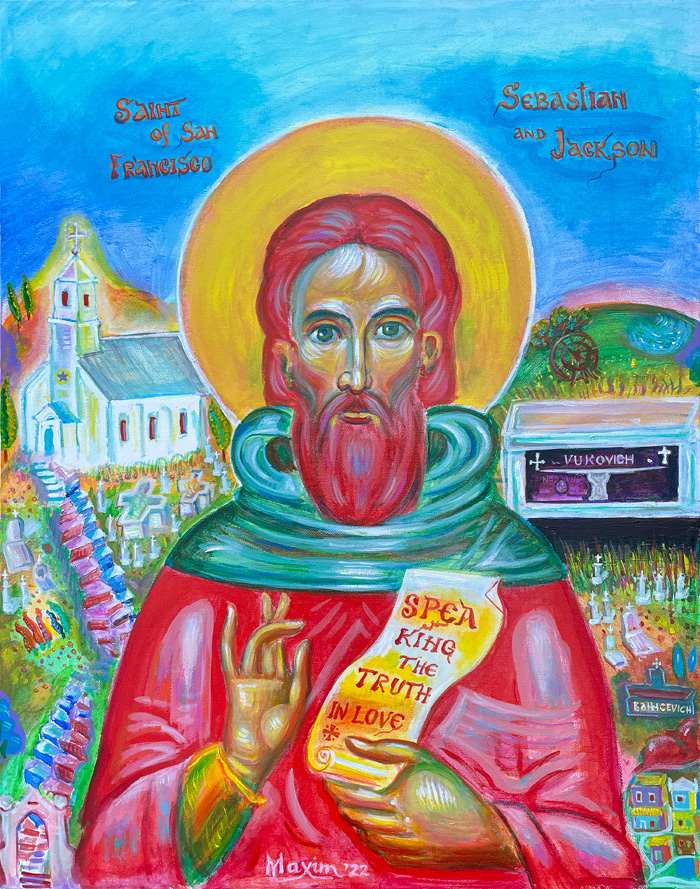
- Details
- Category: Maxim
"St. Sebastian of San Francisco and Jackson", acrylic on canvas, by Bishop Maxim, 2022
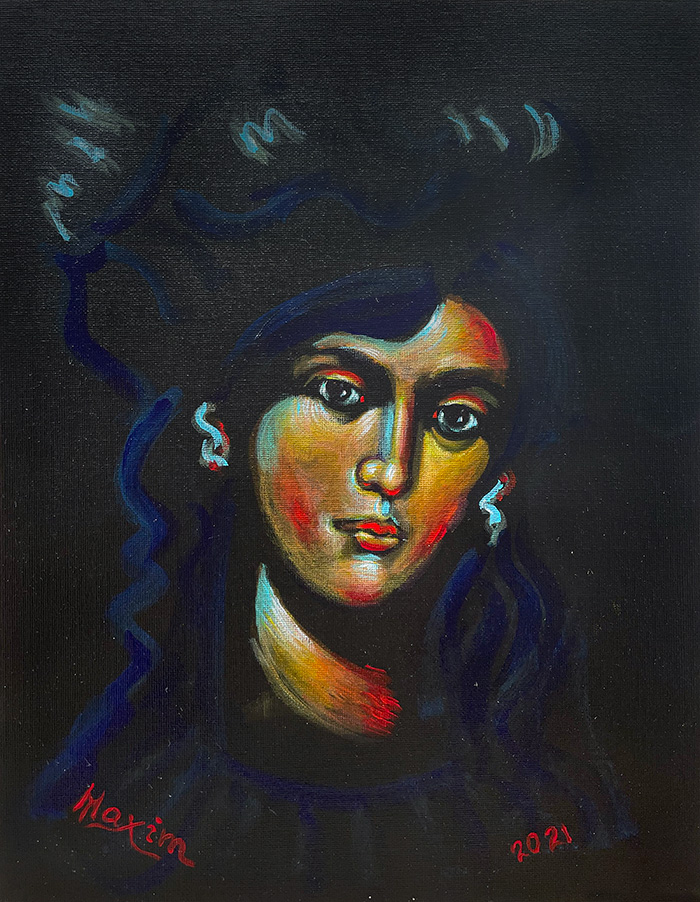
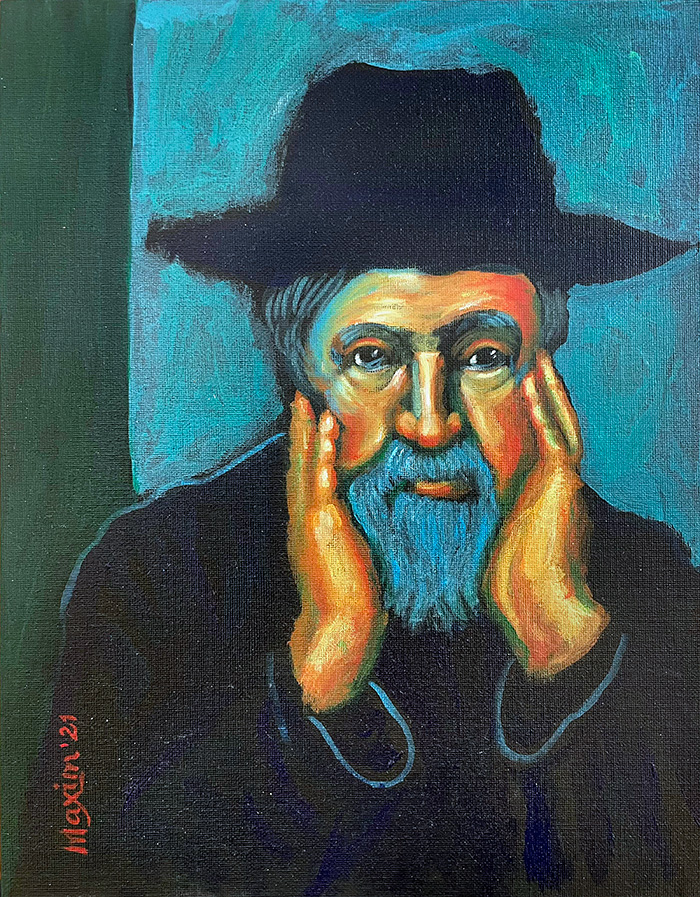
- Details
- Category: Maxim
"Father Dumitru: The Theologian of the Prisons", acrylic on canvas, by Bishop Maxim, 2021
Fr Dumitru “sits in silence, with no wish to speak” (Saint Silouan), recalling the joy of life in prison described by Elder Sofian Boghiu: “I can say that I had days, many days, in prison that were more joyful than outside, because joy comes from within, not from outside". He remembers entering his cell and seeing other inmates writing biblical verses from memory on their boot soles–verses which he as a professor of theology had not yet inscribed on the tablet of his heart; he longs for the unceasing prayer God granted him amidst the inhumane tortures and deprivations; he gazes upon God’s suffering people, wishing to console them through the living, grace-filled theology welling up in his heart, through the experience of Christ Whom he met within the four walls of a prison cell.
Fr Dumitru “sits in silence, with no wish to speak” (Saint Silouan), recalling the joy of life in prison described by Elder Sofian Boghiu: “I can say that I had days, many days, in prison that were more joyful than outside, because joy comes from within, not from outside". He remembers entering his cell and seeing other inmates writing biblical verses from memory on their boot soles–verses which he as a professor of theology had not yet inscribed on the tablet of his heart; he longs for the unceasing prayer God granted him amidst the inhumane tortures and deprivations; he gazes upon God’s suffering people, wishing to console them through the living, grace-filled theology welling up in his heart, through the experience of Christ Whom he met within the four walls of a prison cell.
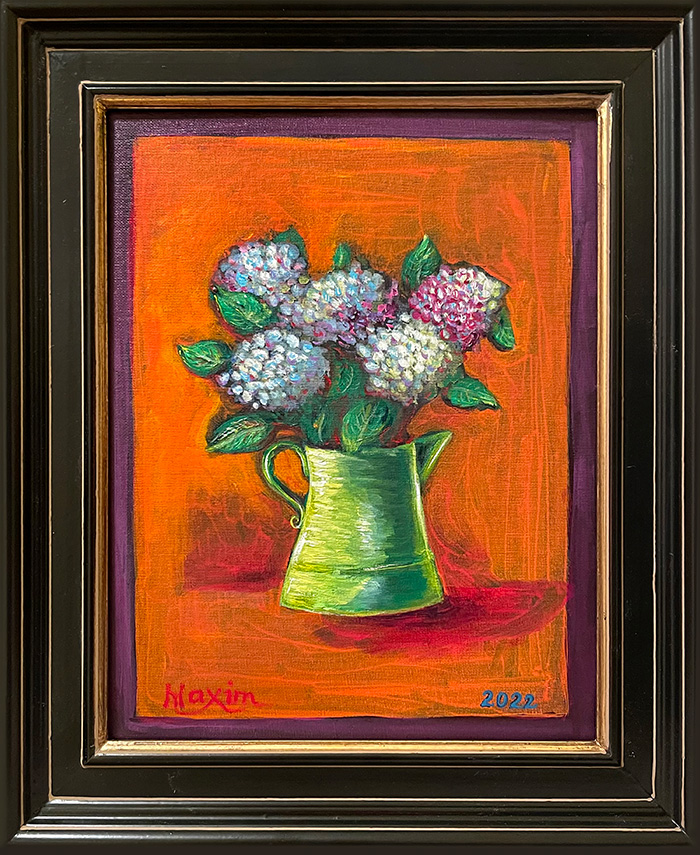
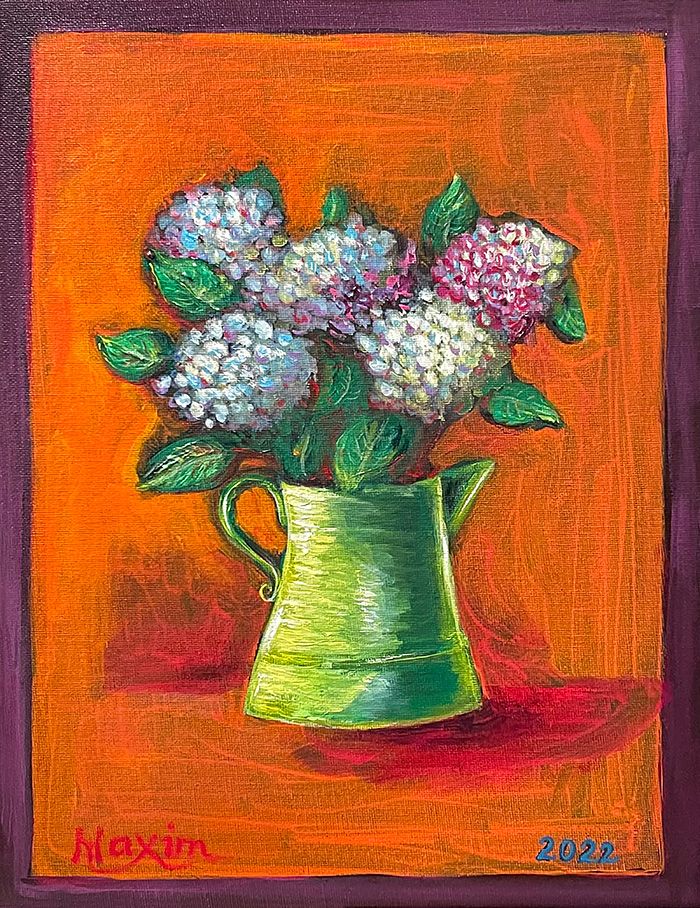
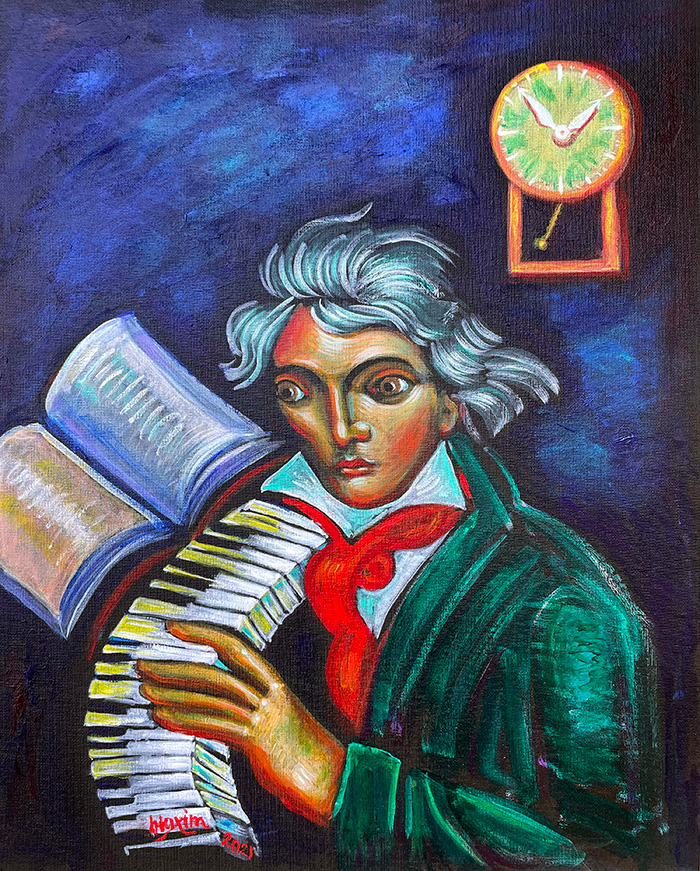
- Details
- Category: Maxim
"Beethoven 2", acrylic on canvas, by Bishop Maxim, 2021
This is a surprising "Beethoven". Hair flies from the urge of inspiration. The eyes - the strongest point of the painting - are in ecstasy. The red cow also participates in ecstasy. A book, a keyboard, and a clock - everything floats, terrified by the invisible waves of fate. The presence of a floating clock is important, indicating the connection between the mystery of time and the mystery of music. Beethoven's wide gaze and the semicircular keyboard indicate the comprehensiveness, enormous energy, and great momentum which envelops the drama of existence, from the germ of the Big Bang to the future mystery (Eschaton).
This is a surprising "Beethoven". Hair flies from the urge of inspiration. The eyes - the strongest point of the painting - are in ecstasy. The red cow also participates in ecstasy. A book, a keyboard, and a clock - everything floats, terrified by the invisible waves of fate. The presence of a floating clock is important, indicating the connection between the mystery of time and the mystery of music. Beethoven's wide gaze and the semicircular keyboard indicate the comprehensiveness, enormous energy, and great momentum which envelops the drama of existence, from the germ of the Big Bang to the future mystery (Eschaton).
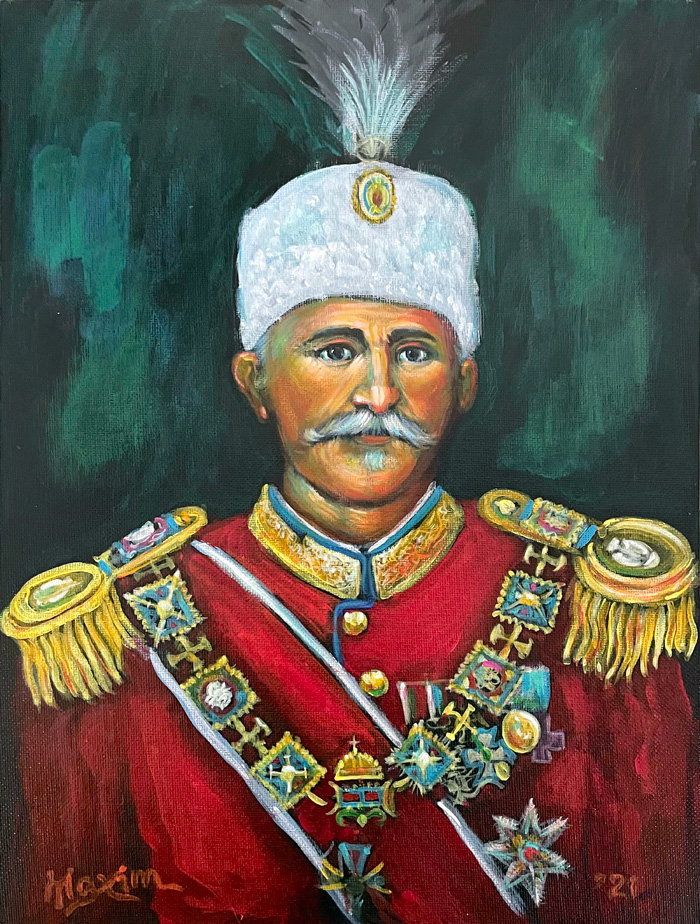
- Details
- Category: Maxim
"King Peter I of Serbia and Yugoslavia" No 6, acrylic on canvas, by Bishop Maxim, 2021
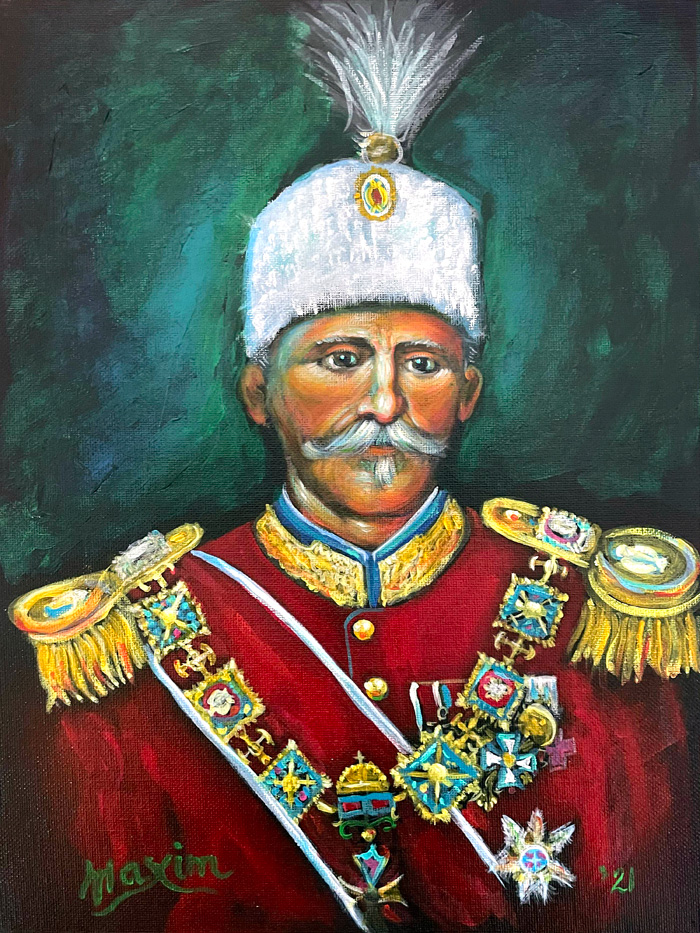
- Details
- Category: Maxim
"King Peter I of Serbia and Yugoslavia" No 5, acrylic on canvas, by Bishop Maxim, 2021
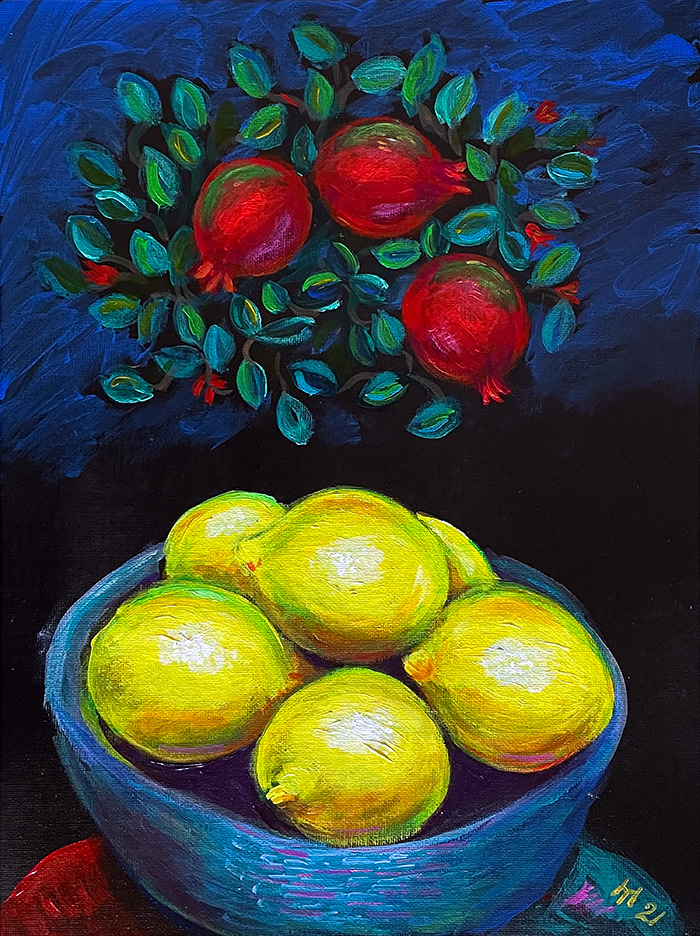
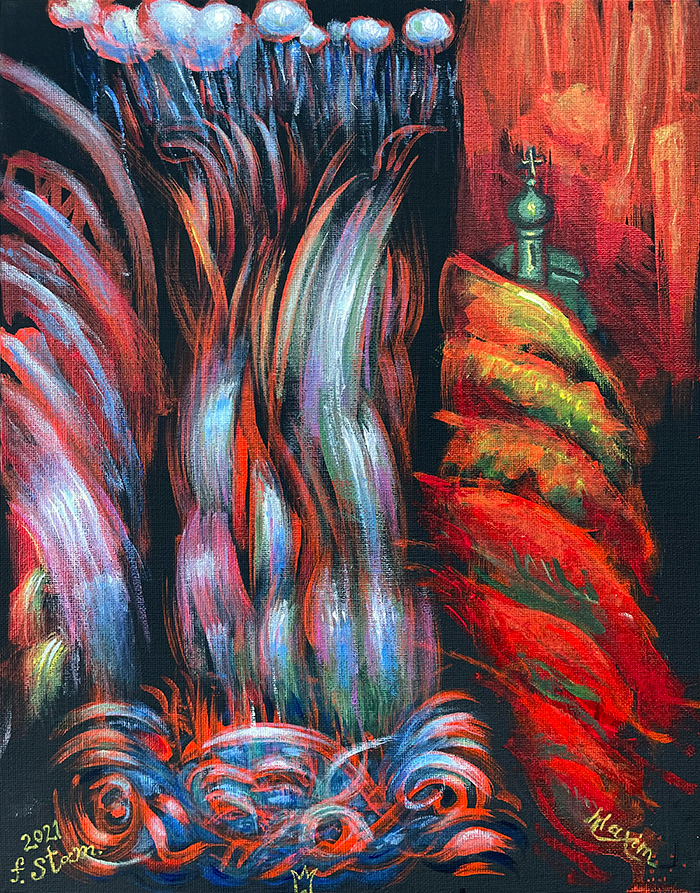
- Details
- Category: Maxim
“Melody of Waters”, acrylic on canvas, by father Stamatis and bishop Maxim, 2021
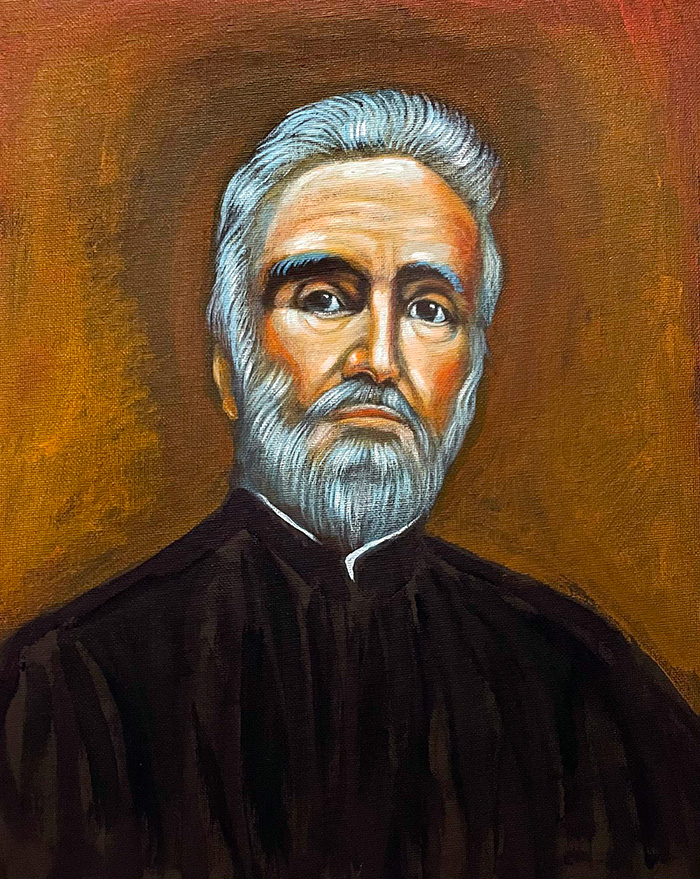
- Details
- Category: Maxim
"Metropolitan John (Zizioulas)", acrylic on canvas, Bishop Maxim, 2021
INTERPRETATION OF THE PORTRAIT OF THE METROPOLITAN OF PERGAMON JOHN (ZIZIOULAS) by the hand of Bishop MAXIMOS (VASILJEVIC)
An invisible axis connects the gaze of the depicted Metropolitan with the spectator. This gaze looks at us seriously and thoughtfully, and together with the soft wrinkles of the forehead and the ambiguous lips, it is as if they immobilize time and look not exactly at us, but as if they are penetrating our being and exploring something deep and hidden. The painter succeeded with great simplicity in expressing something ontological: the question of the depicted about life and its meaning. The raised eyebrows of the portrait also contribute to this. After all, this very profound look is like wondering: do you really exist, spectator? Is this relationship real? In other words, they allow for hope to transpire in a relationship of the eyes that brings us into a real relationship. It is what we say in theological language: a true eschatological loving relationship of persons.
Here Bishop Maxim surpassed himself and reached the ideal of the orthodox iconographer. And we are left with the right to ask ourselves: could Maxim get there if his long patient and obedient apprenticeship in Metropolitan of Pergamon hadn’t preceded?
In Athens on the 24th of November 2021.
Fr. Stamatis Skliris
INTERPRETATION OF THE PORTRAIT OF THE METROPOLITAN OF PERGAMON JOHN (ZIZIOULAS) by the hand of Bishop MAXIMOS (VASILJEVIC)
An invisible axis connects the gaze of the depicted Metropolitan with the spectator. This gaze looks at us seriously and thoughtfully, and together with the soft wrinkles of the forehead and the ambiguous lips, it is as if they immobilize time and look not exactly at us, but as if they are penetrating our being and exploring something deep and hidden. The painter succeeded with great simplicity in expressing something ontological: the question of the depicted about life and its meaning. The raised eyebrows of the portrait also contribute to this. After all, this very profound look is like wondering: do you really exist, spectator? Is this relationship real? In other words, they allow for hope to transpire in a relationship of the eyes that brings us into a real relationship. It is what we say in theological language: a true eschatological loving relationship of persons.
Here Bishop Maxim surpassed himself and reached the ideal of the orthodox iconographer. And we are left with the right to ask ourselves: could Maxim get there if his long patient and obedient apprenticeship in Metropolitan of Pergamon hadn’t preceded?
In Athens on the 24th of November 2021.
Fr. Stamatis Skliris
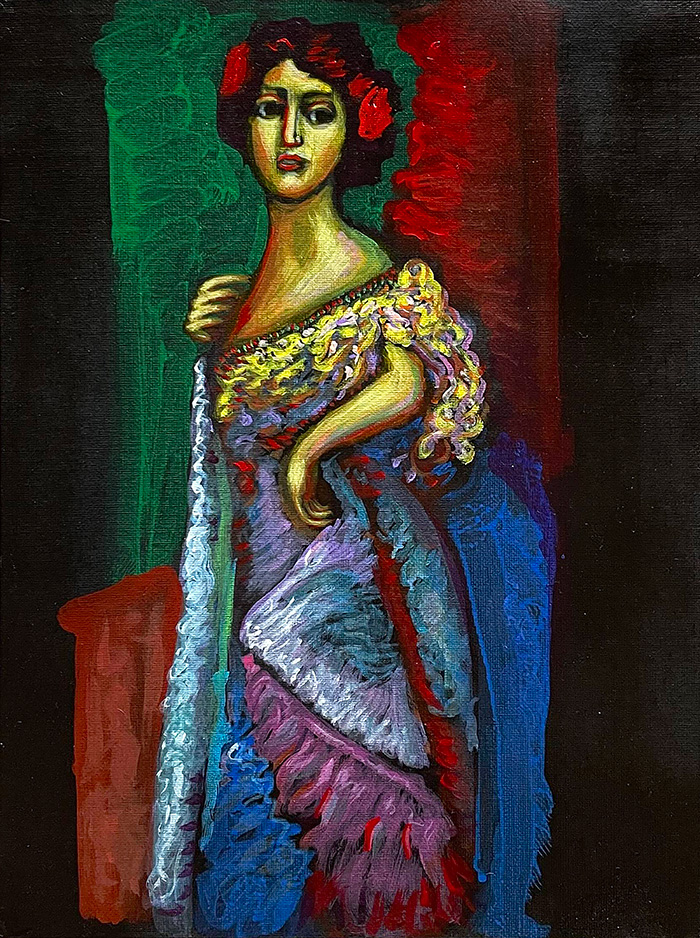
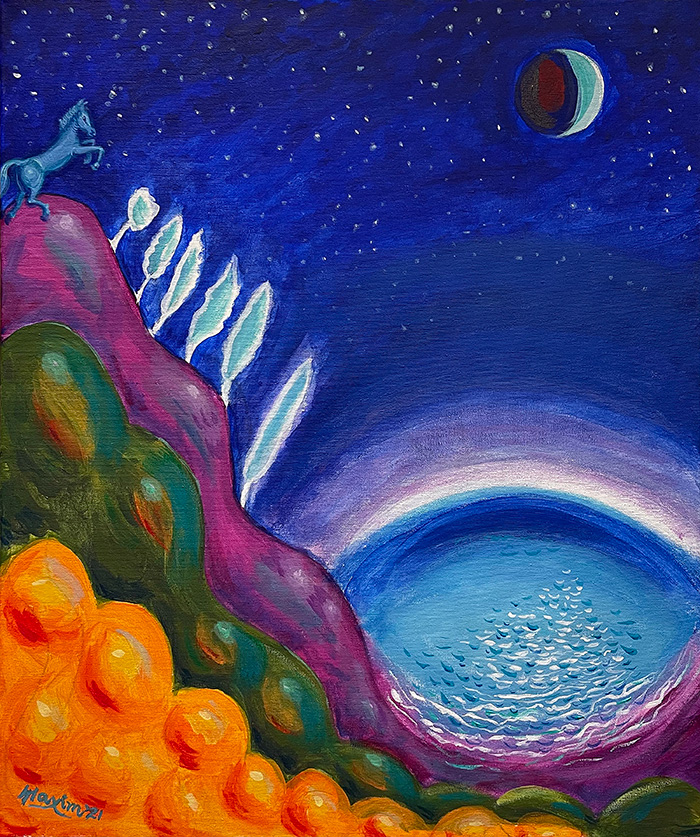
- Details
- Category: Maxim
"Abstract Painting with a Horse", acrylic on canvas, Bishop Maxim, 2021
Night, with a moon and a silent starry sky above the landscape of rocks and a lake. Suddenly, a raging white horse in a dream jumps and sweetens the lonely desert landscape. The silent and peaceful presence of the night and of the lake converse with the dynamic relationship between animal and nature. The scene is pervaded by a sense of loneliness, quiet peace and of man’s awe before the indeterminism of nature. Abstract painting changes the way we look at the world around us. Rather than presenting a strict likeness abstract art focuses on achieving an effect. The shapes and colors of the various natural elements are used to form a rhythm of the composition.
Night, with a moon and a silent starry sky above the landscape of rocks and a lake. Suddenly, a raging white horse in a dream jumps and sweetens the lonely desert landscape. The silent and peaceful presence of the night and of the lake converse with the dynamic relationship between animal and nature. The scene is pervaded by a sense of loneliness, quiet peace and of man’s awe before the indeterminism of nature. Abstract painting changes the way we look at the world around us. Rather than presenting a strict likeness abstract art focuses on achieving an effect. The shapes and colors of the various natural elements are used to form a rhythm of the composition.
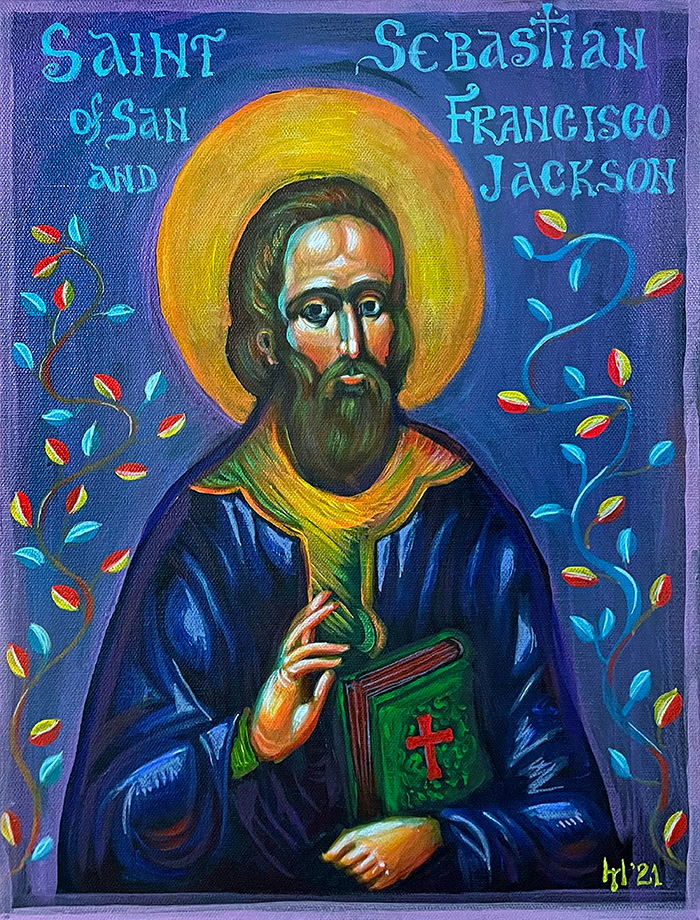
- Details
- Category: Maxim
"St. Sebastian of Jackson and San Francisco", acrylic on canvas, Bishop Maxim, 2021
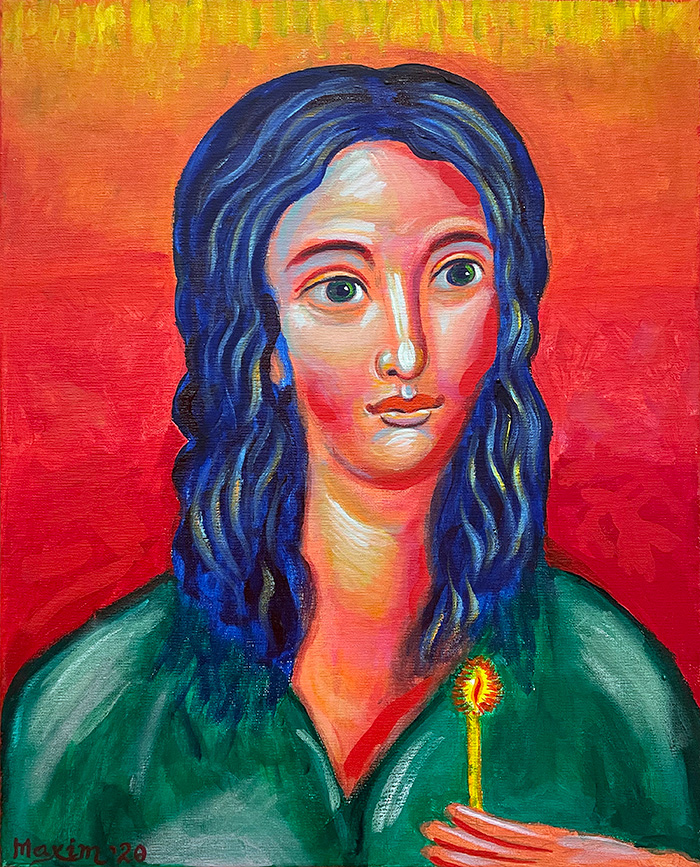
- Details
- Category: Maxim
"Marija Receives the Light", acrylic on canvas, Bishop Maxim, 2018
Marija comes for the vigil on the Holy Saturday night outside the temple with wakeful and vigilant face and candles (its flame burning brightly) in her hands to celebrate Christ’s resurrection. “Come, receive the light!” is exclaimed three times as a promise that no matter how dark our world gets, the light will never be overtaken. After Holy Friday, she is transported to the moment “very early in the morning” when the light of the Resurrection is just beginning to dawn. A gladness of soul is a record of the Eucharistic experience.
Marija comes for the vigil on the Holy Saturday night outside the temple with wakeful and vigilant face and candles (its flame burning brightly) in her hands to celebrate Christ’s resurrection. “Come, receive the light!” is exclaimed three times as a promise that no matter how dark our world gets, the light will never be overtaken. After Holy Friday, she is transported to the moment “very early in the morning” when the light of the Resurrection is just beginning to dawn. A gladness of soul is a record of the Eucharistic experience.
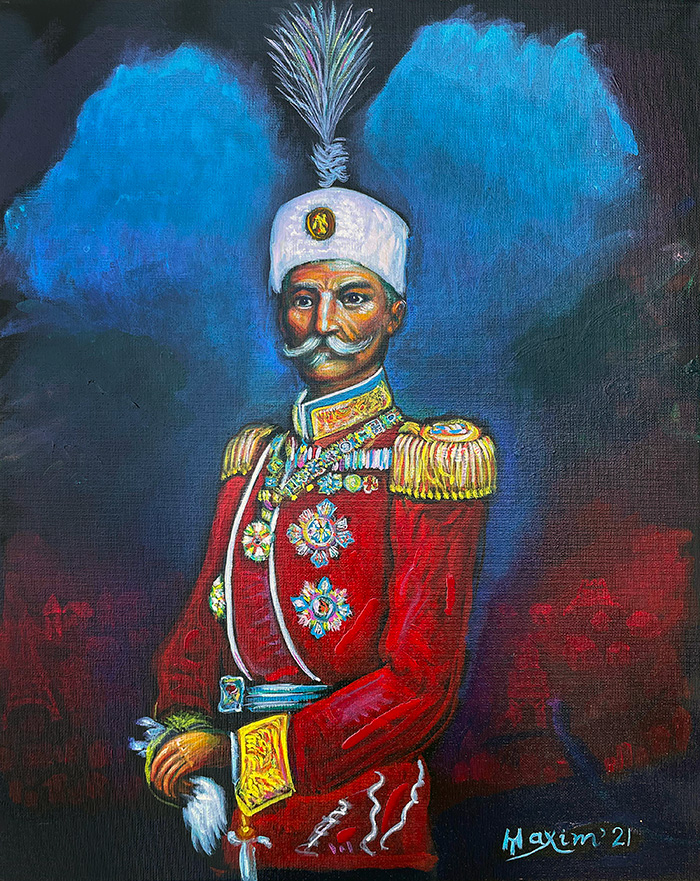
- Details
- Category: Maxim
"King Peter I of Serbia and Yugoslavia, No 4", acrylic on canvas, Bishop Maxim, 2021
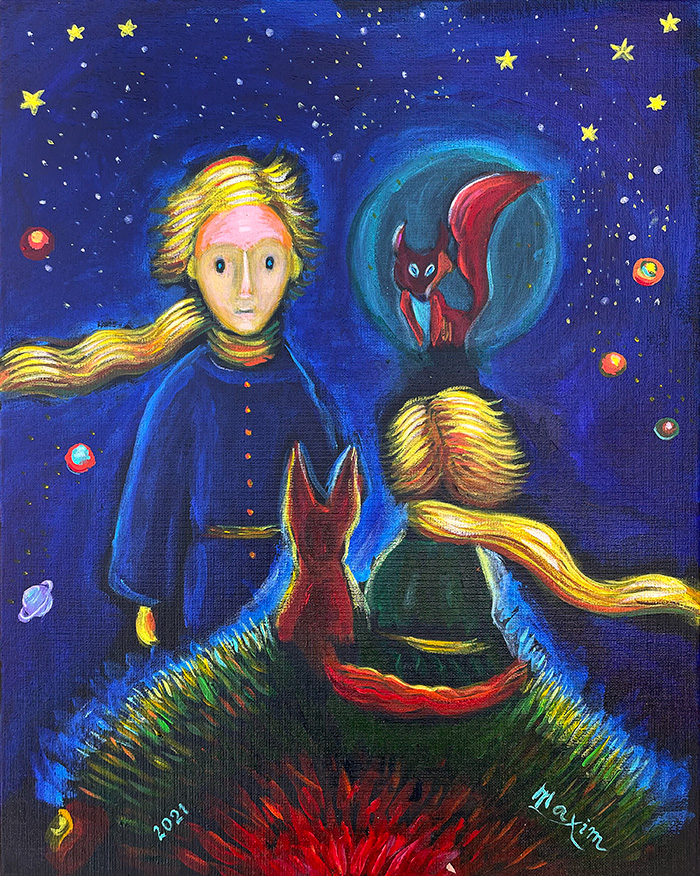
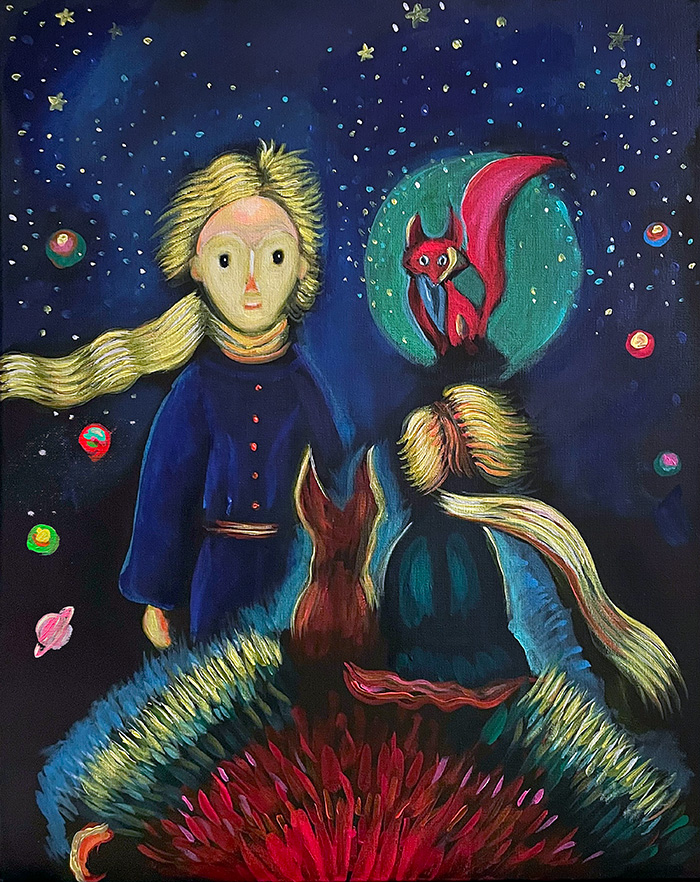
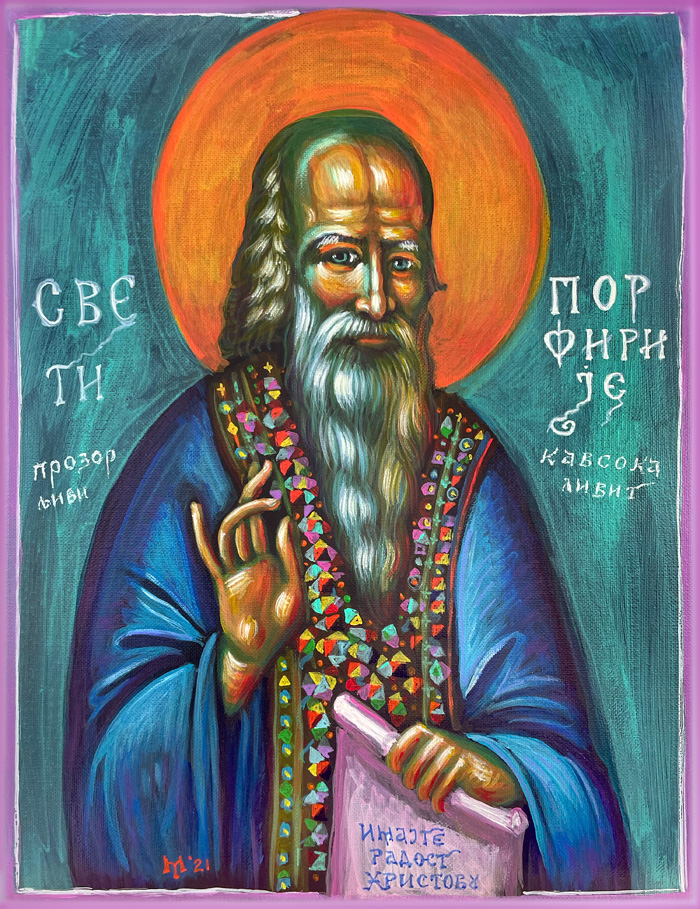
- Details
- Category: Maxim
"St. Porphyrius the Kafsokalyvite", acrylic on canvas, by Bishop Maxim, 2021
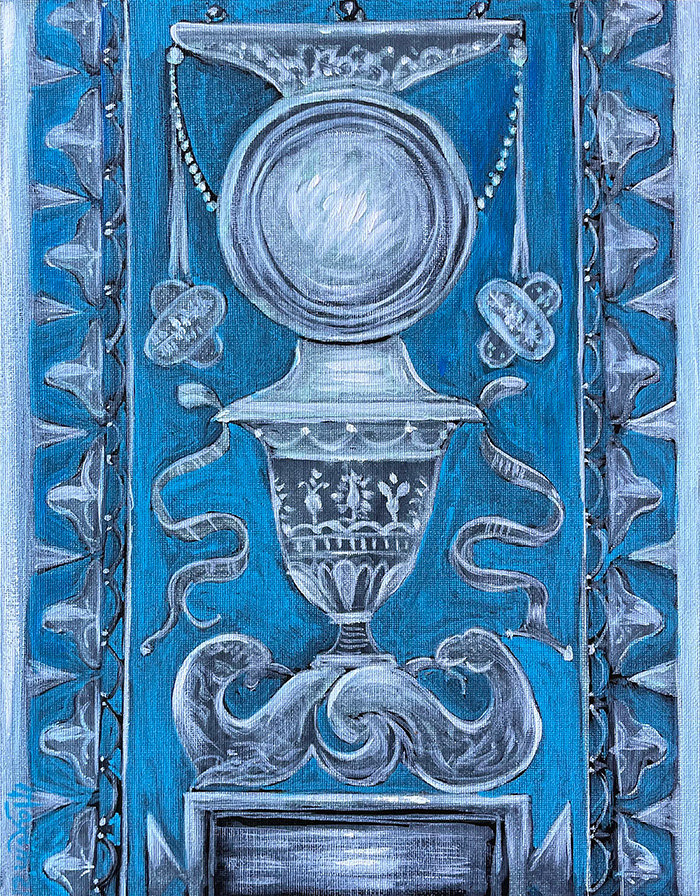
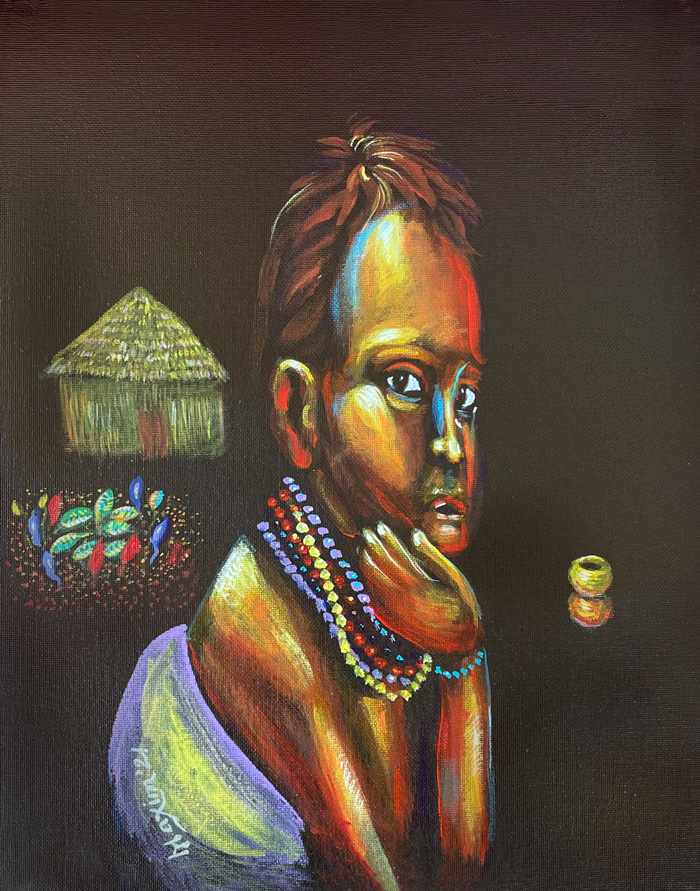
- Details
- Category: Maxim
"African Child", acrylic on canvas, by Bishop Maxim, 2021
Among the traditional characteristics of African children are (a) the early maturity in self-discipline, (b) the aspiration for education, (c) respect for traditional values, (d) early search for identity, and (e) a wholesome spirit of cooperation and dependence on one another.
In his “Four Studies of the Head of a Black Man” Peter Paul Rubens explored a variety of facial expressions and poses of a black person. Using a single dim source of light, he created strong contrasts of brightness and shadow on the man's skin, varying these along with the different expressions.
Among the traditional characteristics of African children are (a) the early maturity in self-discipline, (b) the aspiration for education, (c) respect for traditional values, (d) early search for identity, and (e) a wholesome spirit of cooperation and dependence on one another.
In his “Four Studies of the Head of a Black Man” Peter Paul Rubens explored a variety of facial expressions and poses of a black person. Using a single dim source of light, he created strong contrasts of brightness and shadow on the man's skin, varying these along with the different expressions.
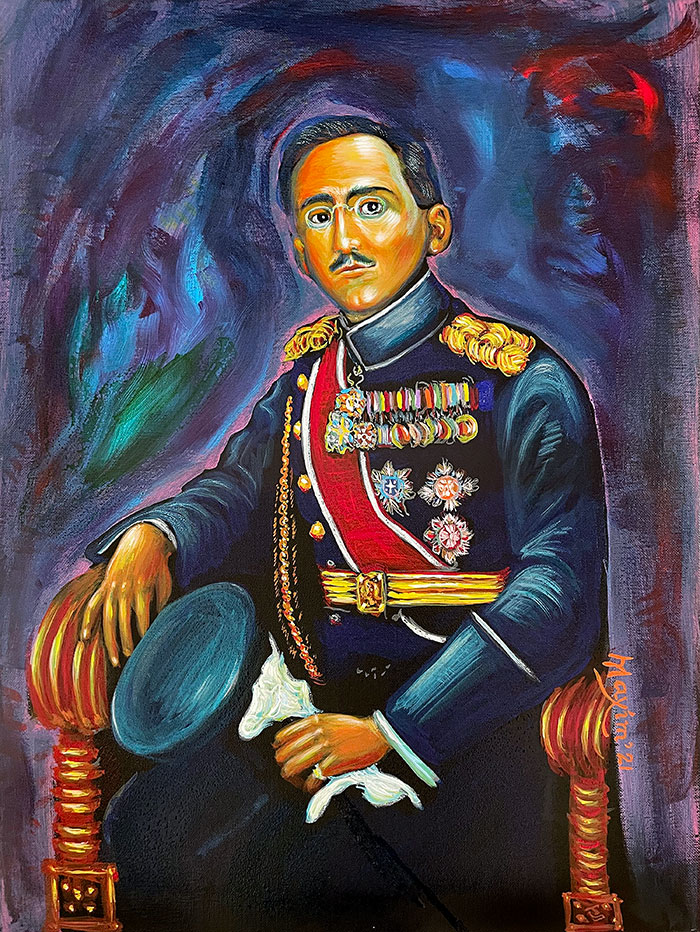
- Details
- Category: Maxim
"Young King Alexander I of Before All", acrylic on canvas, by Bishop Maxim, 2021
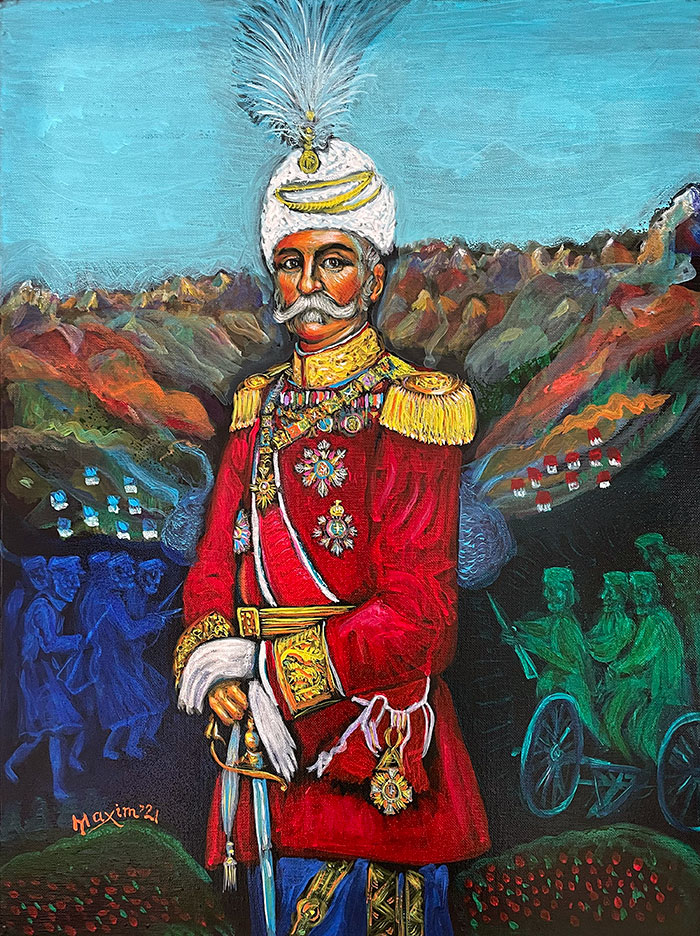
- Details
- Category: Maxim
"King Peter I of Yugoslavia After All", acrylic on canvas, by Bishop Maxim, 2021
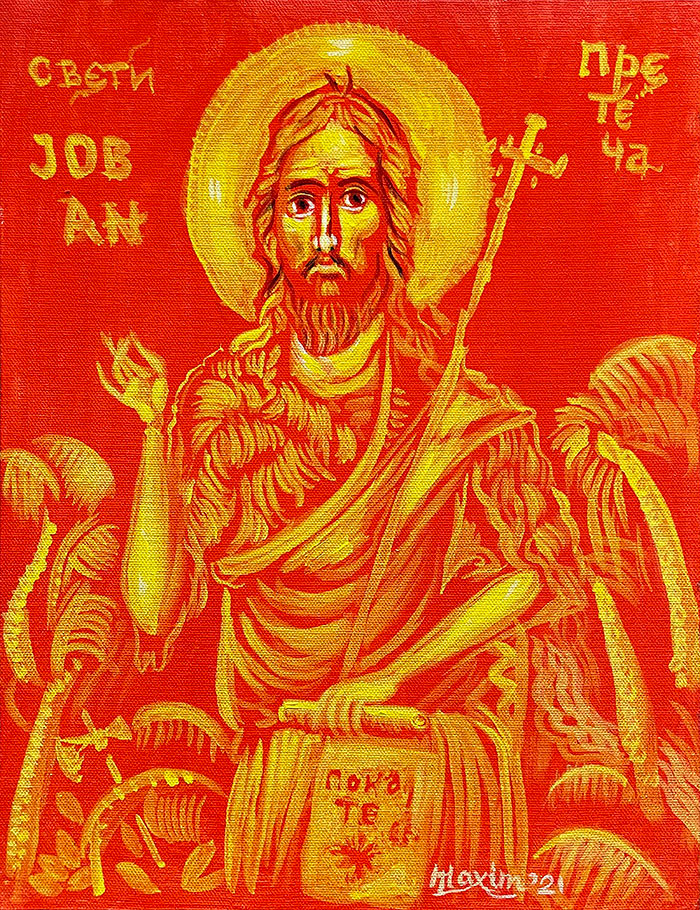
- Details
- Category: Maxim
"St John the Baptist", acrylic on canvas, by Bishop Maxim, 2021
Inspiration: Rodin, Norton Simon Museum and Fr. Stamatis Skliris: http://holyicon.org/images/01/expressionism/292.jpg
Inspiration: Rodin, Norton Simon Museum and Fr. Stamatis Skliris: http://holyicon.org/images/01/expressionism/292.jpg
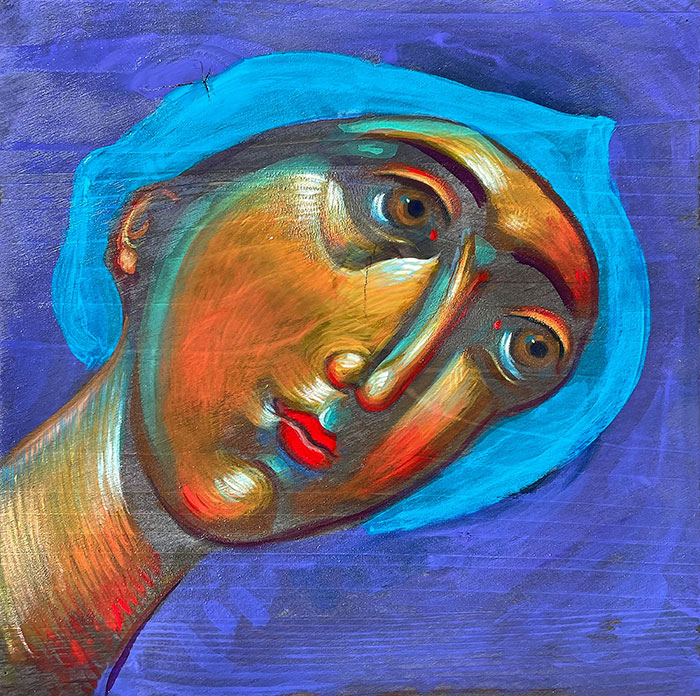
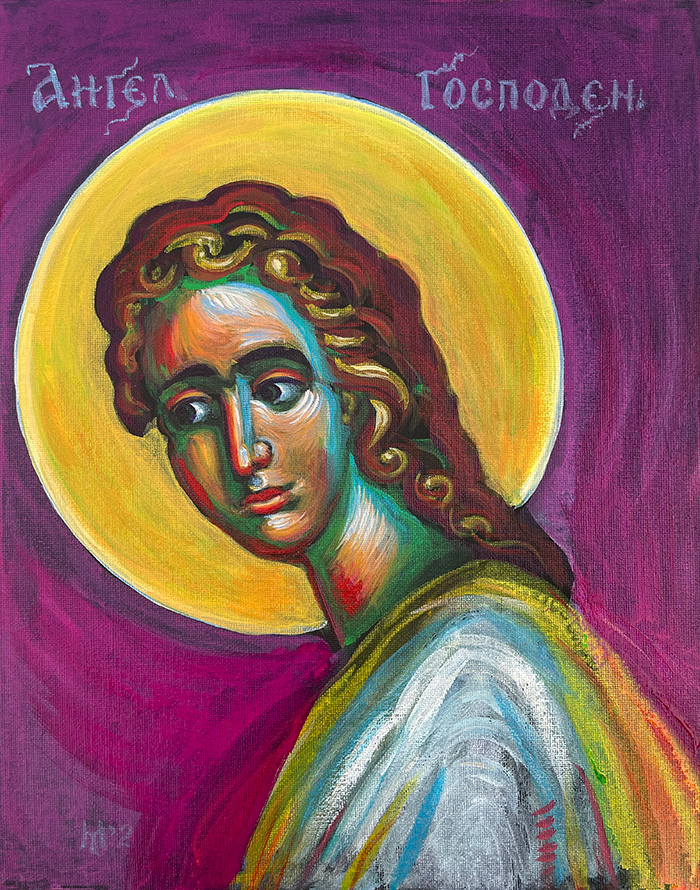
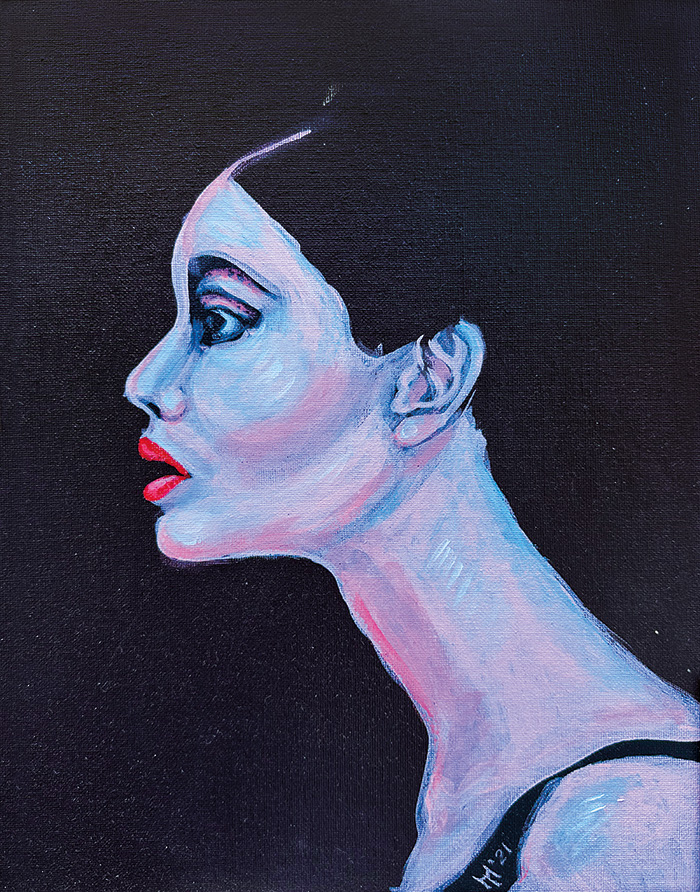
- Details
- Category: Maxim
"Tale of Dreams That Never Die", acrylic on canvas, 2021
Existence created by light and love. A character staring at a scene with a vague outcome. Plasticity achieved by applying thick brush strokes. In this two-tone canvas a being emerges with the call of love (red) and shedding of light (white).
Existence created by light and love. A character staring at a scene with a vague outcome. Plasticity achieved by applying thick brush strokes. In this two-tone canvas a being emerges with the call of love (red) and shedding of light (white).
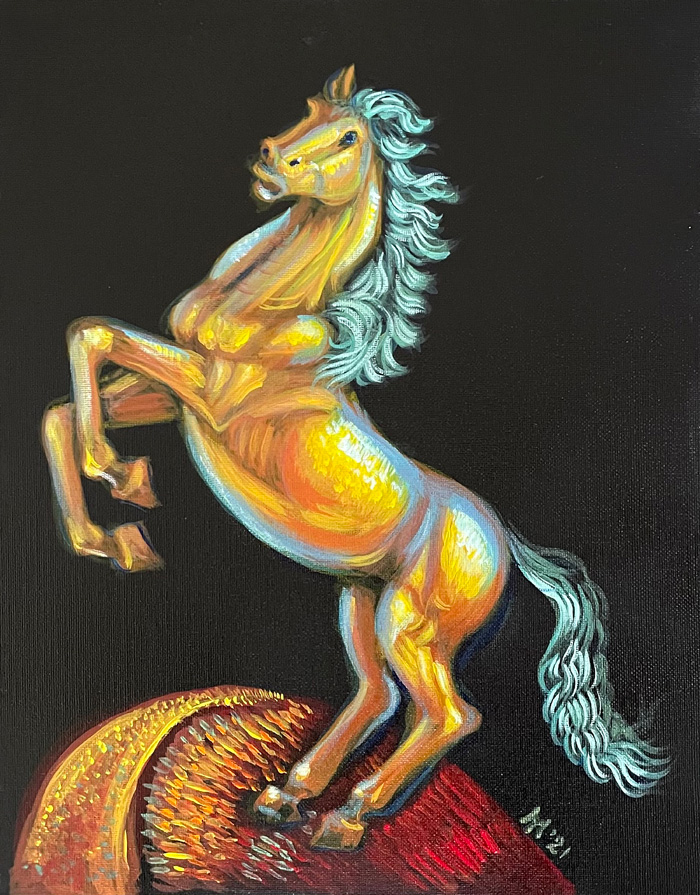
- Details
- Category: Maxim
"Like a Horse Prepared for Battle", acrylic on canvas, 2021
The expression and body language of this swift horse with lightning-fast reflexes, communicates the wonder caused by viewer’s sudden presence. Physically refined, it is shown as jumping for joy (horse can jump 8 ft 1.25 or 2.47 m). This wonder horse, having high energy, is very powerful due to its strong muscles and leg structure. The author “immortalies” this waltzing horse on the very crust of the earth which hides a fiery maze beneath.
The expression and body language of this swift horse with lightning-fast reflexes, communicates the wonder caused by viewer’s sudden presence. Physically refined, it is shown as jumping for joy (horse can jump 8 ft 1.25 or 2.47 m). This wonder horse, having high energy, is very powerful due to its strong muscles and leg structure. The author “immortalies” this waltzing horse on the very crust of the earth which hides a fiery maze beneath.
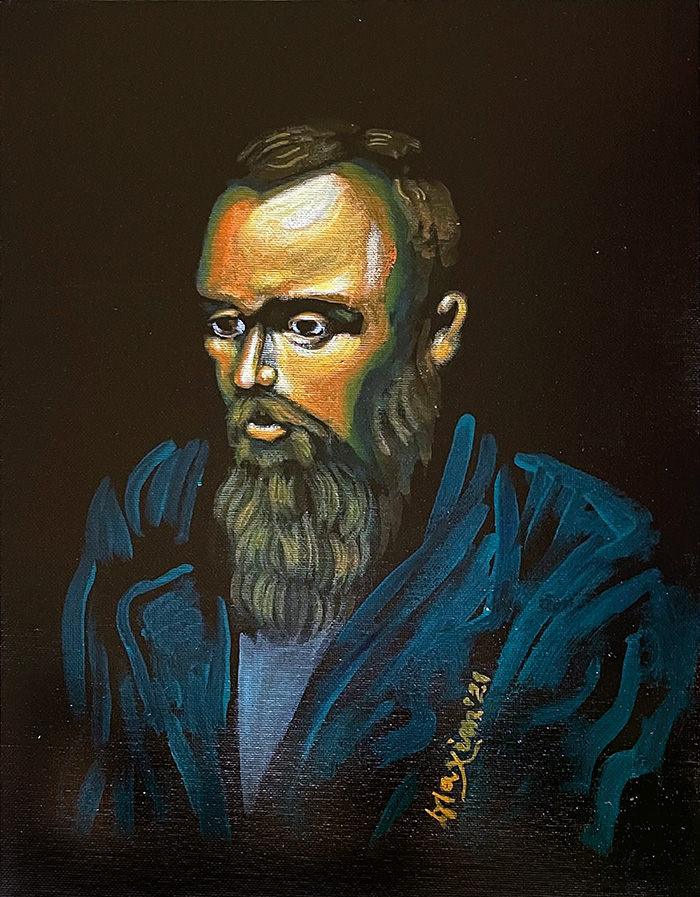
- Details
- Category: Maxim
Dostoevsky 4, acrylic on canvas, by Bishop Maxim, 2021
"Dostoevsky’s face is the face of a peasant. An ashen hue pervades the hollow cheeks, making them appear almost grimy, emphasizing the furrows caused by many years of suffering; the skin, dry and parched, is stretched tight over the bony framework, and is bereft of blood and color, sucked clean of life by the vampire which has preyed on it for a score of years. To right and left, two huge boulders jut forth, the prominent cheekbones typical of his race; a sparse moustache and a straggling beard veil the sad-looking mouth and delicate chin. Earth, rock, and forest; a tragic and primitive landscape; such are the basic lineaments of Dostoevsky’s countenance. All is dark and preeminently earthly in this unbeautiful face. I have called it a peasant’s, but I might almost term it a beggar’s, so flat and colorless is it, so lacking in brightness: a piece of the Russian steppe cast high and dry upon the stones. Even the deep-set eyes, gleaming from within their sockets, are incapable of imparting a spark of light to the grim visage, for their radiance is directed inward. As soon as the lids close over them, the face becomes a death mask, and the nervous tension which otherwise grips the frail features is relaxed into a lifeless lethargy". (Dostoevsky by Stefan Zweig)
"Dostoevsky’s face is the face of a peasant. An ashen hue pervades the hollow cheeks, making them appear almost grimy, emphasizing the furrows caused by many years of suffering; the skin, dry and parched, is stretched tight over the bony framework, and is bereft of blood and color, sucked clean of life by the vampire which has preyed on it for a score of years. To right and left, two huge boulders jut forth, the prominent cheekbones typical of his race; a sparse moustache and a straggling beard veil the sad-looking mouth and delicate chin. Earth, rock, and forest; a tragic and primitive landscape; such are the basic lineaments of Dostoevsky’s countenance. All is dark and preeminently earthly in this unbeautiful face. I have called it a peasant’s, but I might almost term it a beggar’s, so flat and colorless is it, so lacking in brightness: a piece of the Russian steppe cast high and dry upon the stones. Even the deep-set eyes, gleaming from within their sockets, are incapable of imparting a spark of light to the grim visage, for their radiance is directed inward. As soon as the lids close over them, the face becomes a death mask, and the nervous tension which otherwise grips the frail features is relaxed into a lifeless lethargy". (Dostoevsky by Stefan Zweig)
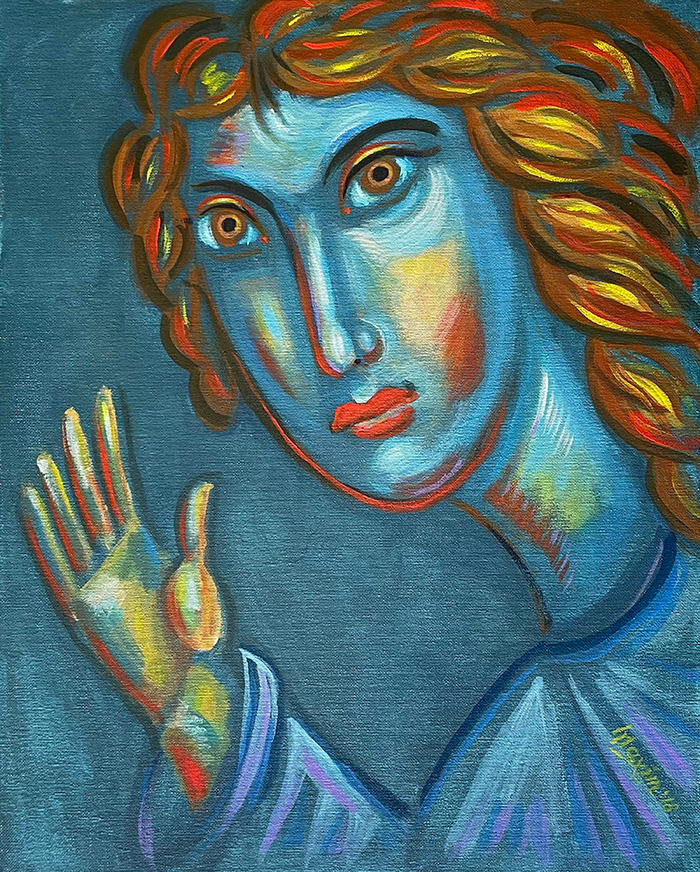
- Details
- Category: Maxim
"Angel Mermaid", acrylic on canvas, 2021
“It is as if he takes out his soul to give it to you, as if he is looking at you in the middle floors of Your existence, he accompanies you not to hit your foot on the rock, it is your “deacon” that the Maker of life gave you. Do not forget him, do not set him aside, do not turn your back on him. When you catch such company with your Angel, then whatever happens to you, you will be able to overcome it. His fiery hair, his fiery eyes, his fiery cheeks, remove the contour, unite with the hair color like a divine lava to smell the angelic face. And yet he is a person like a mermaid, a mermaid Angel, Angel of youth, Angel of power, Angel that we dare and paint since the Son of God took flesh!” (Stamatis Skliris)
“It is as if he takes out his soul to give it to you, as if he is looking at you in the middle floors of Your existence, he accompanies you not to hit your foot on the rock, it is your “deacon” that the Maker of life gave you. Do not forget him, do not set him aside, do not turn your back on him. When you catch such company with your Angel, then whatever happens to you, you will be able to overcome it. His fiery hair, his fiery eyes, his fiery cheeks, remove the contour, unite with the hair color like a divine lava to smell the angelic face. And yet he is a person like a mermaid, a mermaid Angel, Angel of youth, Angel of power, Angel that we dare and paint since the Son of God took flesh!” (Stamatis Skliris)
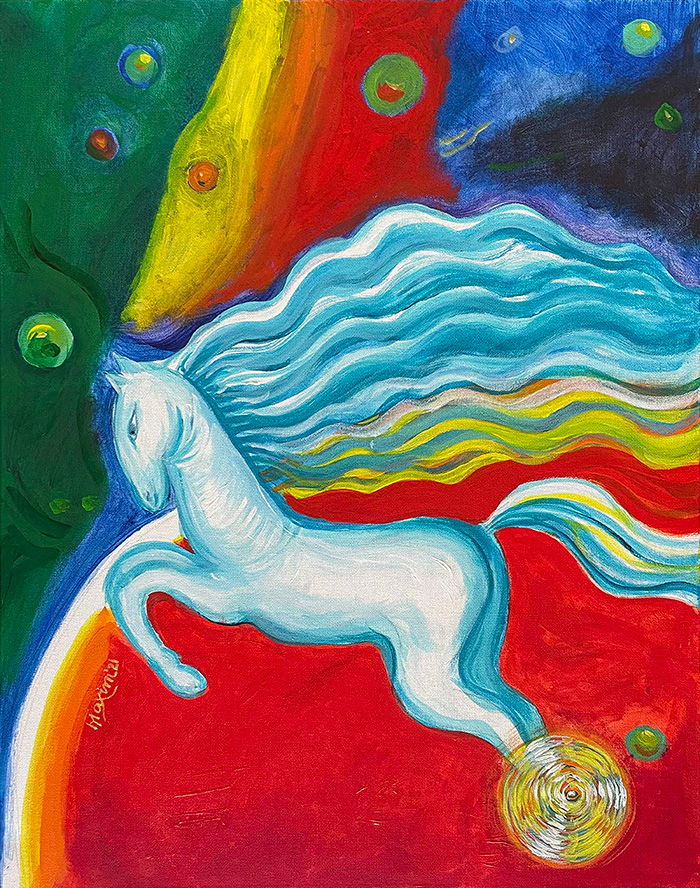
- Details
- Category: Maxim
"Stationary Movement", acrylic on canvas, Bishop Maxim, 2021
In eternity, the human existence will “acquire an ever-moving repose and a stationary movement”. This signifies the existential freedom from every necessity of motion or repose, the realization of existence as relation, the freedom of love as the mode of the fullness of existence. “A stationary movement that is simultaneously eternally-moving stasis, presupposes that outside of this is the Other in whom room is found: movement turns toward God and is stationary in Him. Stasis is also eternally-moving, because it is not exhausted in its limits, but turns out of itself.” (St. Maximus the Confessor)
In eternity, the human existence will “acquire an ever-moving repose and a stationary movement”. This signifies the existential freedom from every necessity of motion or repose, the realization of existence as relation, the freedom of love as the mode of the fullness of existence. “A stationary movement that is simultaneously eternally-moving stasis, presupposes that outside of this is the Other in whom room is found: movement turns toward God and is stationary in Him. Stasis is also eternally-moving, because it is not exhausted in its limits, but turns out of itself.” (St. Maximus the Confessor)
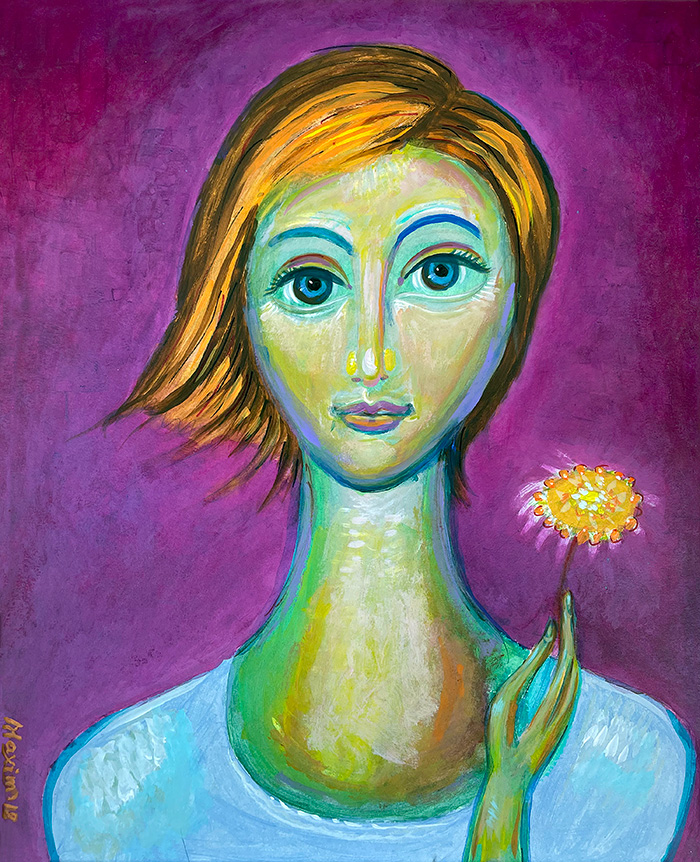
- Details
- Category: Maxim
"Emily from Our Town (1938)", acrylic on cardboard, 2018
In a 1938 metatheatrical play Our Town by an American novelist and playwright Thornton Wilder, an extremely interesting dialogue between Emily, one of the characters, and the stage manager takes place. Emily returns to earth to relive one day, her twelfth birthday. She watches with joy at being able to see her parents and some of the people of her childhood. Her joy, however, quickly turns to sorrow when she realizes how little people appreciate the simple joys of life. The memory proves too painful for her, and she turns toward the stage manager and asks: "Do any human beings ever realize life while they live it, every, every minute?" At first, he responds, "No," but after a moment he adds, "saints and poets, maybe—they do some."
In a 1938 metatheatrical play Our Town by an American novelist and playwright Thornton Wilder, an extremely interesting dialogue between Emily, one of the characters, and the stage manager takes place. Emily returns to earth to relive one day, her twelfth birthday. She watches with joy at being able to see her parents and some of the people of her childhood. Her joy, however, quickly turns to sorrow when she realizes how little people appreciate the simple joys of life. The memory proves too painful for her, and she turns toward the stage manager and asks: "Do any human beings ever realize life while they live it, every, every minute?" At first, he responds, "No," but after a moment he adds, "saints and poets, maybe—they do some."
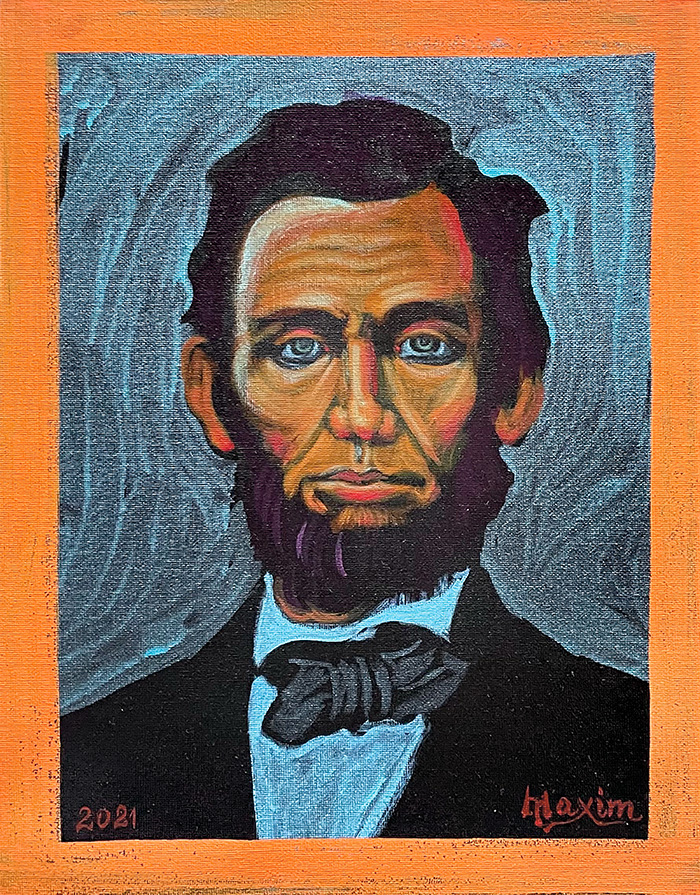
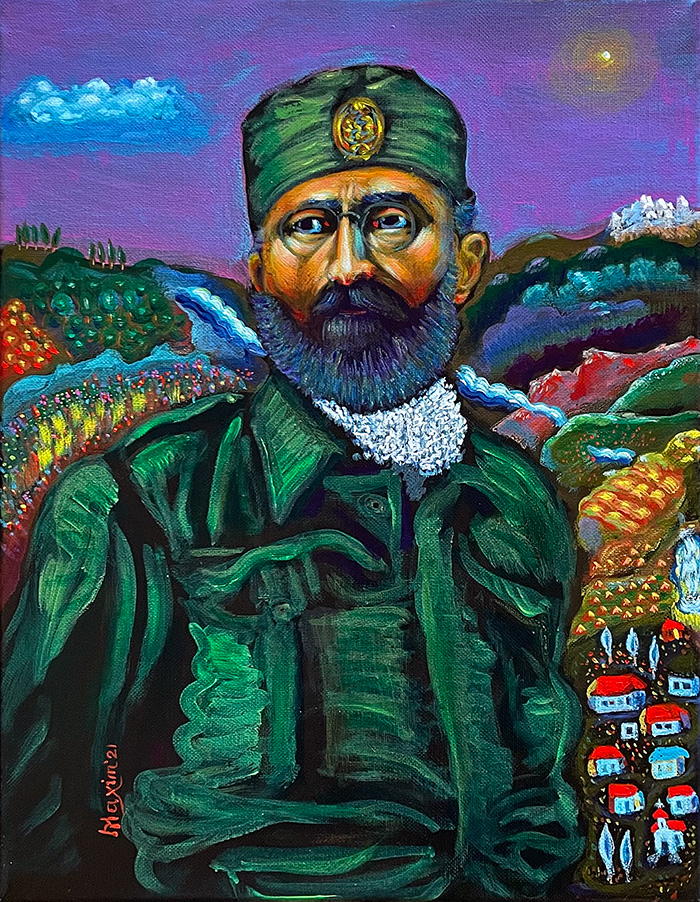
- Details
- Category: Maxim
"Čiča Draža", acrylic on canvas, 2021
Father Stamatis Skliris: "This work establishes the distinctive artistic identity of the painter Bishop Maxim. We emphasize the particular way of writing the sky that contains the warmth of red, with the glittering city in the far distance, the rivers, forests, flowers, and fields neo-Impressionist, with the houses echoing of Serbian folk art and the "hard realism" of the General's uniform and especially his face that dominates in the center of the composition. A strong face like a wood-carved bust of a hard statue, but which distills from the bluish pearly glare of his eyes and nose the sensitivity of his ideals: We fight not to kill, but to prevent impending dehumanization."
Father Stamatis Skliris: "This work establishes the distinctive artistic identity of the painter Bishop Maxim. We emphasize the particular way of writing the sky that contains the warmth of red, with the glittering city in the far distance, the rivers, forests, flowers, and fields neo-Impressionist, with the houses echoing of Serbian folk art and the "hard realism" of the General's uniform and especially his face that dominates in the center of the composition. A strong face like a wood-carved bust of a hard statue, but which distills from the bluish pearly glare of his eyes and nose the sensitivity of his ideals: We fight not to kill, but to prevent impending dehumanization."
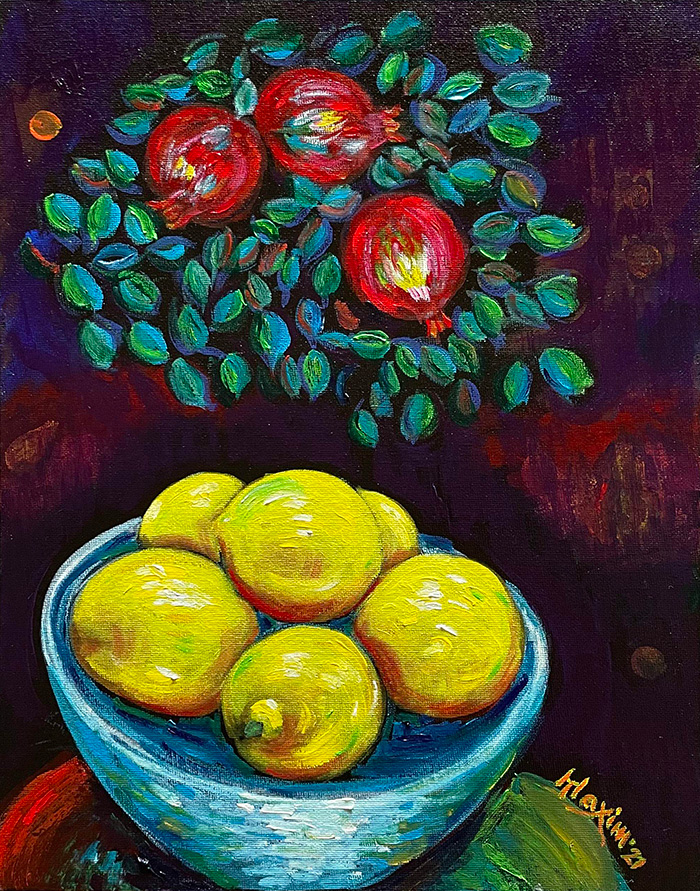
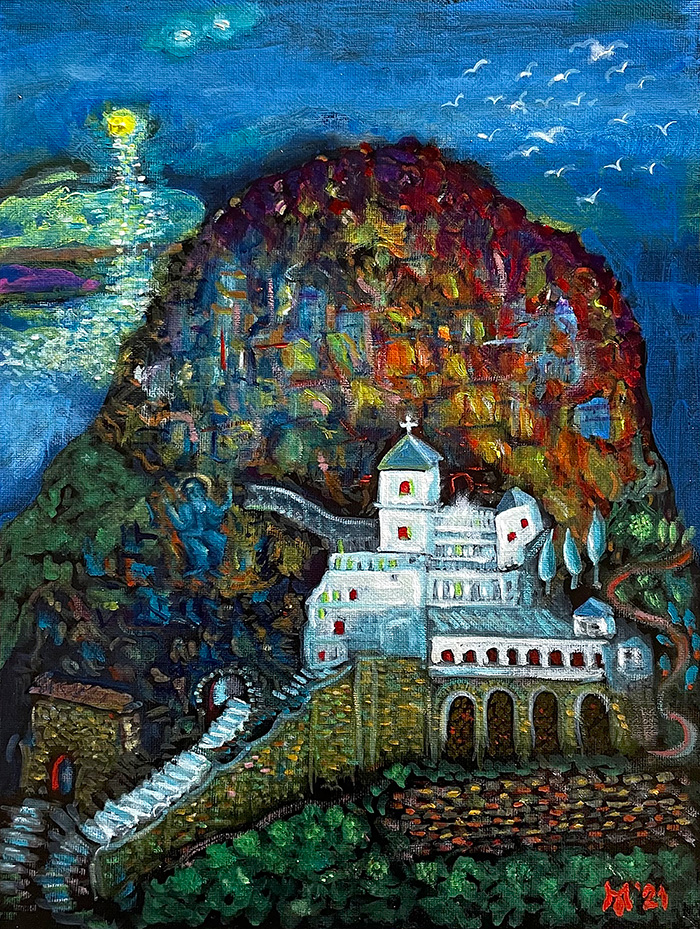
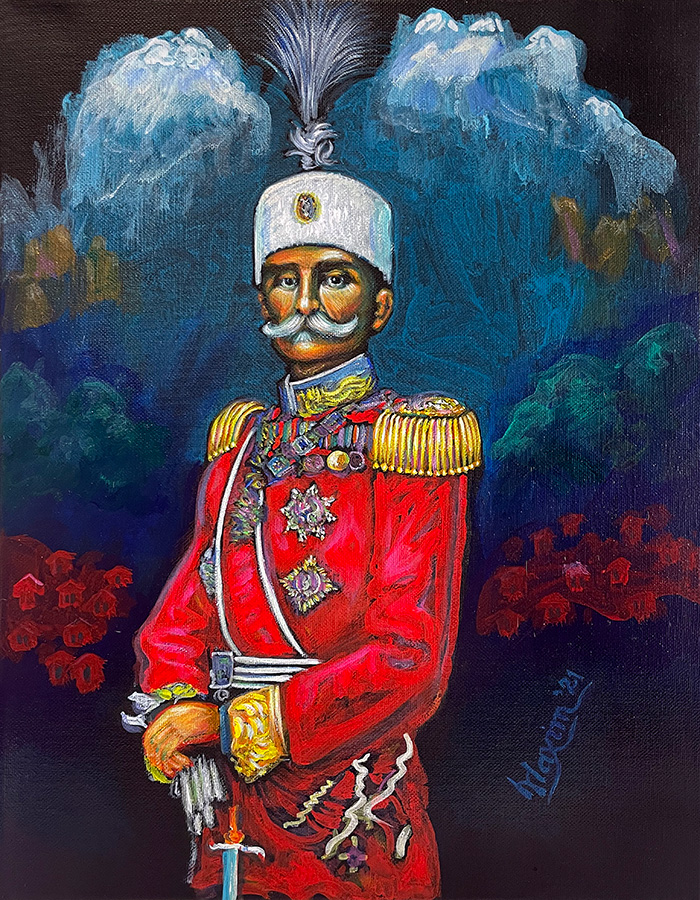
- Details
- Category: Maxim
"King Peter I", acrylic on canvas, 2021
After the Albanian Golgotha, one of the greatest exoduses in Serbian history, King Petar I the Liberator stands upright, dignified, and honorable, while the snow-capped mountains of Albania and Montenegro, from the winter of 1915/16, can be seen behind him, during the First World War.
After the Albanian Golgotha, one of the greatest exoduses in Serbian history, King Petar I the Liberator stands upright, dignified, and honorable, while the snow-capped mountains of Albania and Montenegro, from the winter of 1915/16, can be seen behind him, during the First World War.
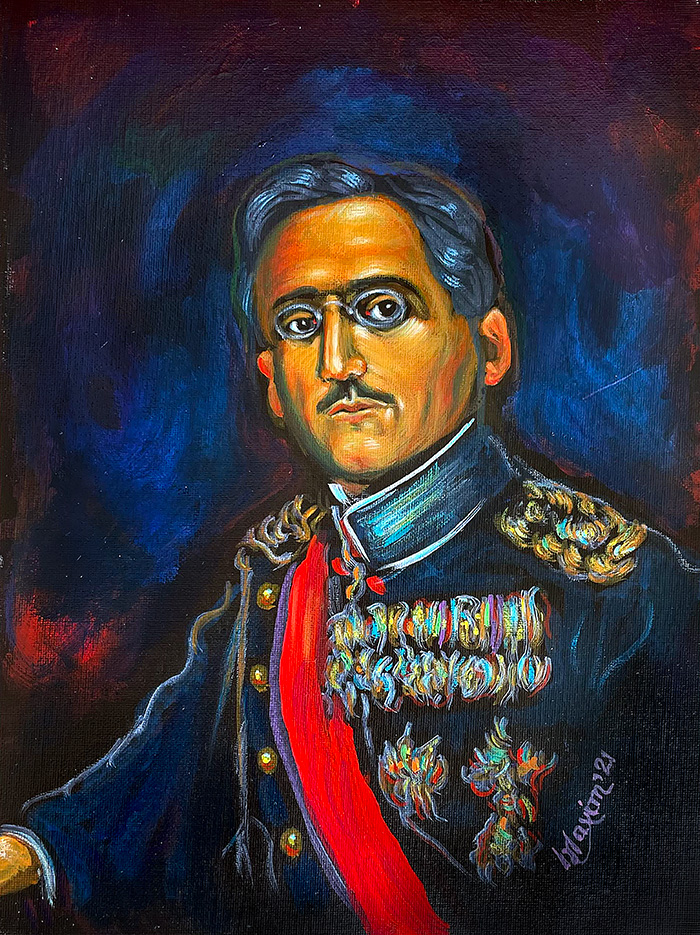
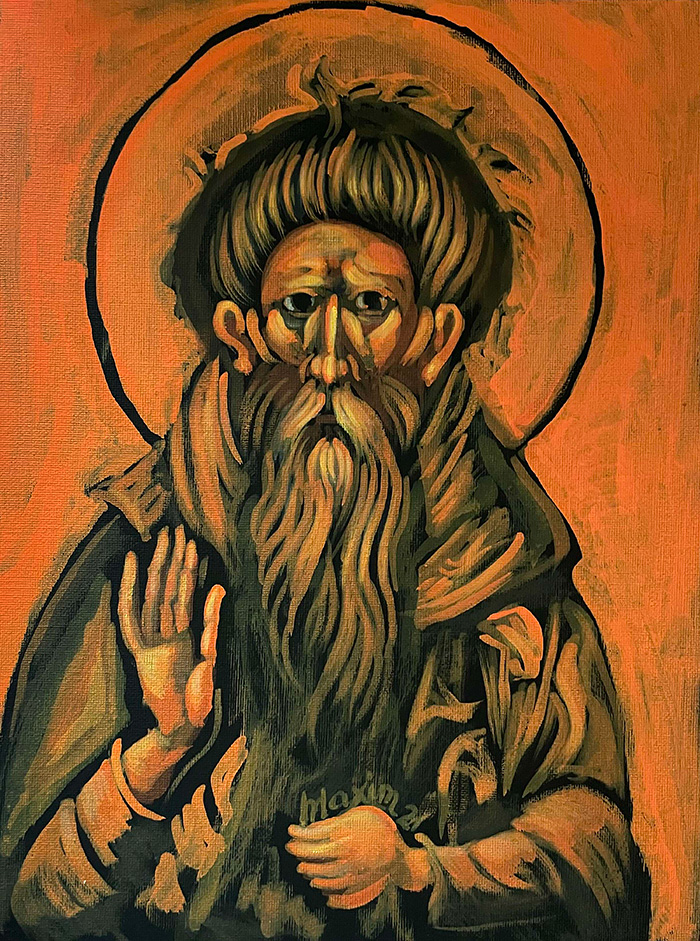
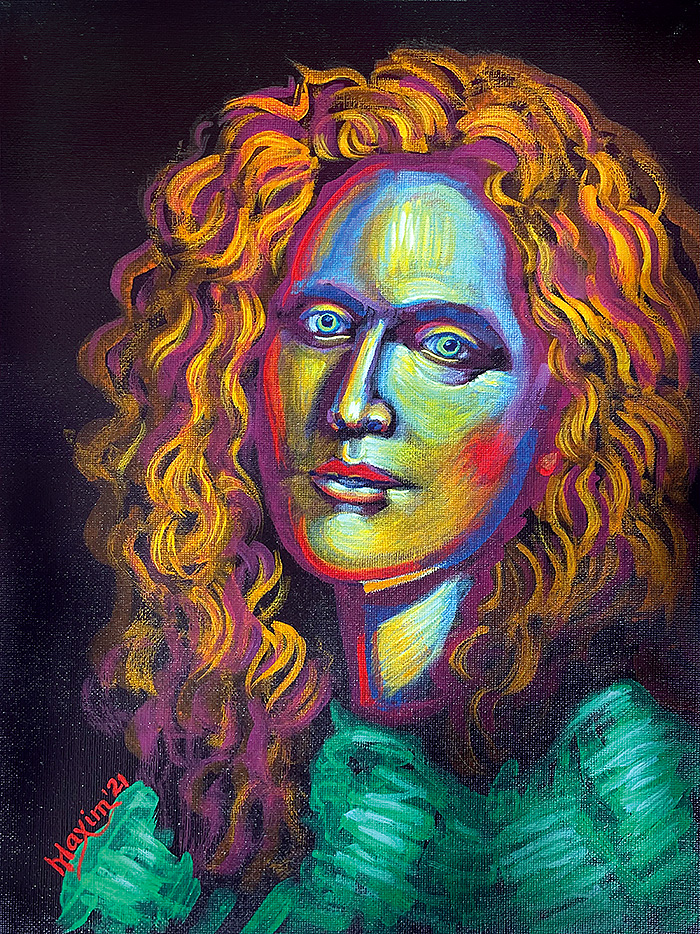
- Details
- Category: Maxim
“Klara Olsufyevna” (The Double, by Dostoyevsky), acrylic on canvas, 2021
In the novel The Double, Klara Olsufyevna, “pale, tired and sad, but richly dressed”, gradually becomes a “enchantress” for Goliadkin’s bipolar personality. Klara is Osulfy Ivanovitch’s only daughter. Engaged to marry a Prince she doesn't want to marry, Klara contacts Golyadkin and asks him to take her away.
In the novel The Double, Klara Olsufyevna, “pale, tired and sad, but richly dressed”, gradually becomes a “enchantress” for Goliadkin’s bipolar personality. Klara is Osulfy Ivanovitch’s only daughter. Engaged to marry a Prince she doesn't want to marry, Klara contacts Golyadkin and asks him to take her away.
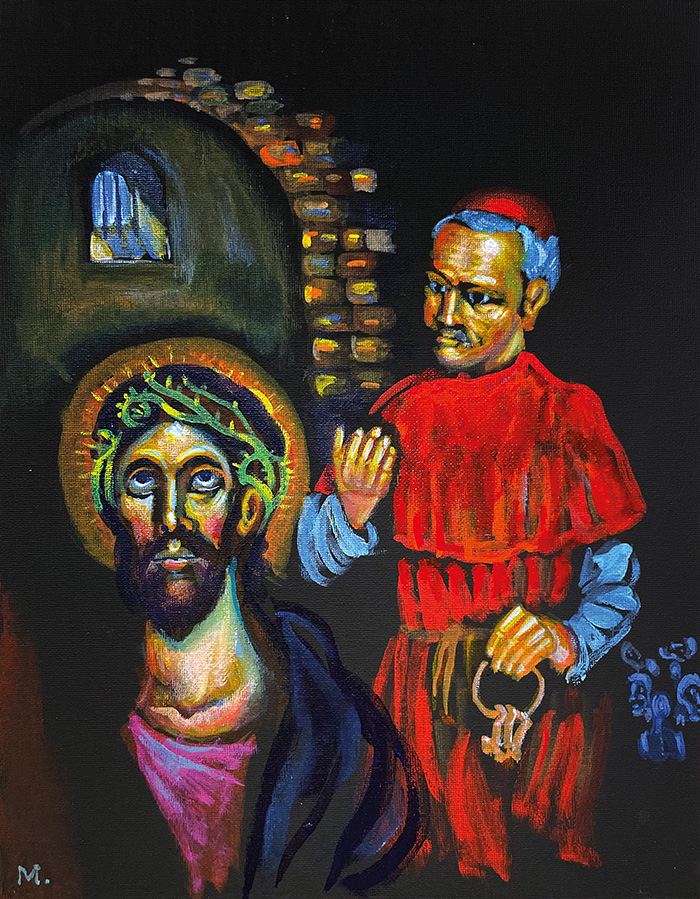
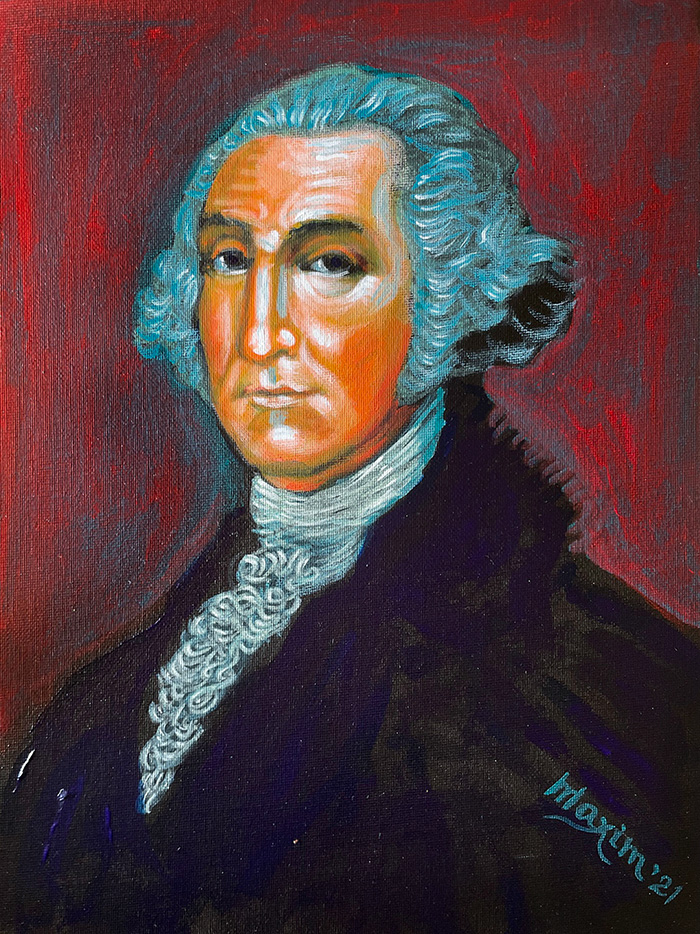
- Details
- Category: Maxim
“George Washington”, acrylic on canvas, 2021, by Bishop Maxim
“It's a serious work with all the seriousness they owe to the founding fathers who made the United States truly the United States of America. I like the seriousness of the lips of the nose and the paths of the face, and the scarf around his neck and the deep red background that leaves the dark model visible.” (Fr. Stamatis Skliris)
“It's a serious work with all the seriousness they owe to the founding fathers who made the United States truly the United States of America. I like the seriousness of the lips of the nose and the paths of the face, and the scarf around his neck and the deep red background that leaves the dark model visible.” (Fr. Stamatis Skliris)
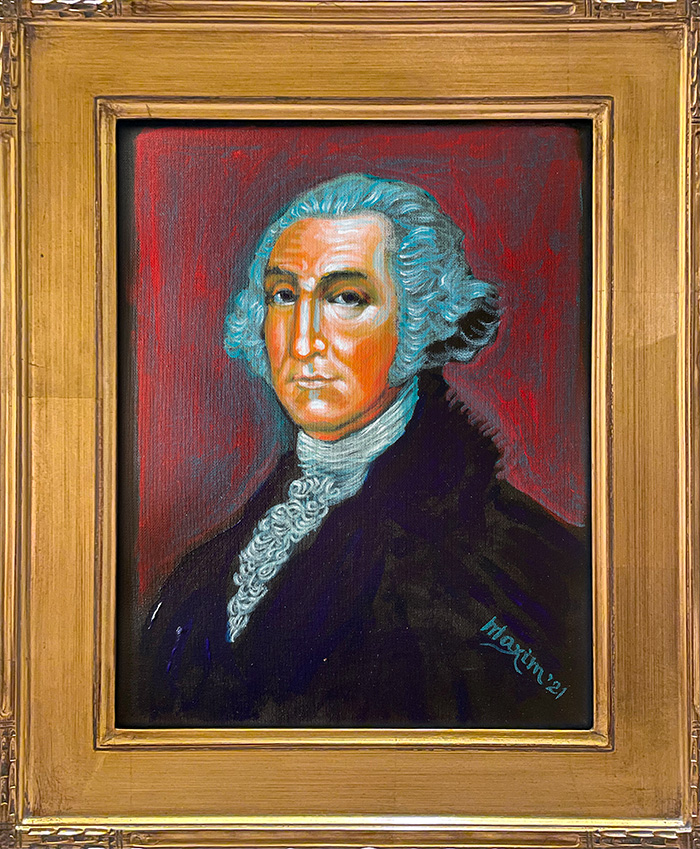
- Details
- Category: Maxim
“George Washington”, acrylic on canvas, 2021, by Bishop Maxim
“It's a serious work with all the seriousness they owe to the founding fathers who made the United States truly the United States of America. I like the seriousness of the lips of the nose and the paths of the face, and the scarf around his neck and the deep red background that leaves the dark model visible.” (Fr. Stamatis Skliris)
“It's a serious work with all the seriousness they owe to the founding fathers who made the United States truly the United States of America. I like the seriousness of the lips of the nose and the paths of the face, and the scarf around his neck and the deep red background that leaves the dark model visible.” (Fr. Stamatis Skliris)
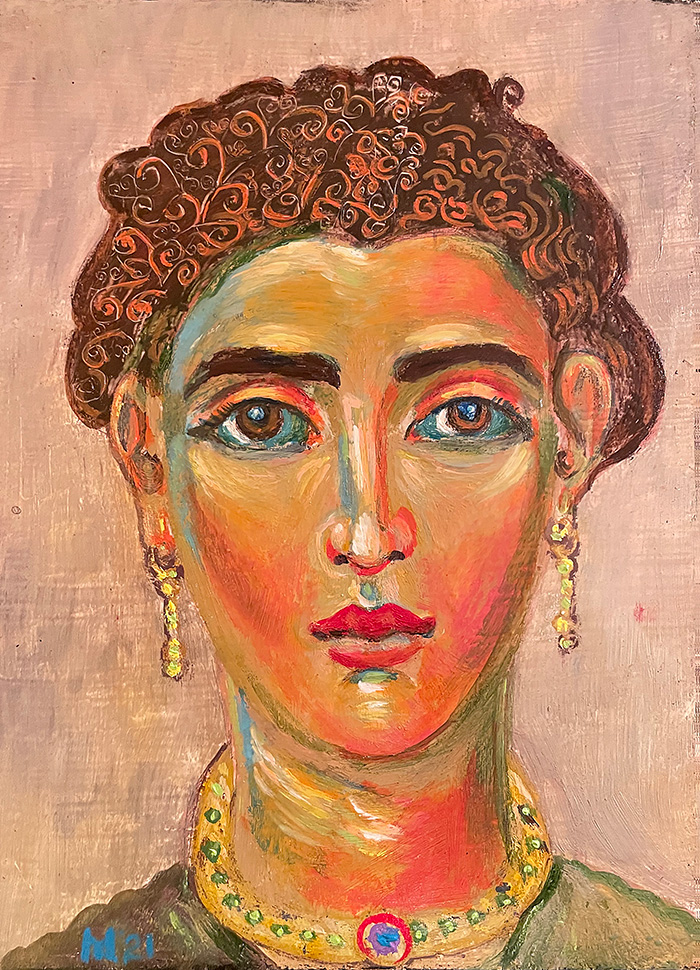
- Details
- Category: Maxim
"Sonya Marmeladova à la Fayum", acrylic on wooden board, 2021
"This is a noble portrait, which after many centuries continues the tradition of Fayum portraits (naturalistic painted portrait on wooden boards attached to upper class mummies from Roman Egypt). It is characterized by an unspeakable aristocratic nobility, for which we cannot understand how it came about. This painting follows all the Byzantine lessons that the artist has in himself, but at the same time he has one ‘fabric’ of high artistic breath, one breath that can turn and speak to modern man. It is a portrait that we can say is contemporary, a portrait of the 21st century." (Stamatis Skliris)
"This is a noble portrait, which after many centuries continues the tradition of Fayum portraits (naturalistic painted portrait on wooden boards attached to upper class mummies from Roman Egypt). It is characterized by an unspeakable aristocratic nobility, for which we cannot understand how it came about. This painting follows all the Byzantine lessons that the artist has in himself, but at the same time he has one ‘fabric’ of high artistic breath, one breath that can turn and speak to modern man. It is a portrait that we can say is contemporary, a portrait of the 21st century." (Stamatis Skliris)
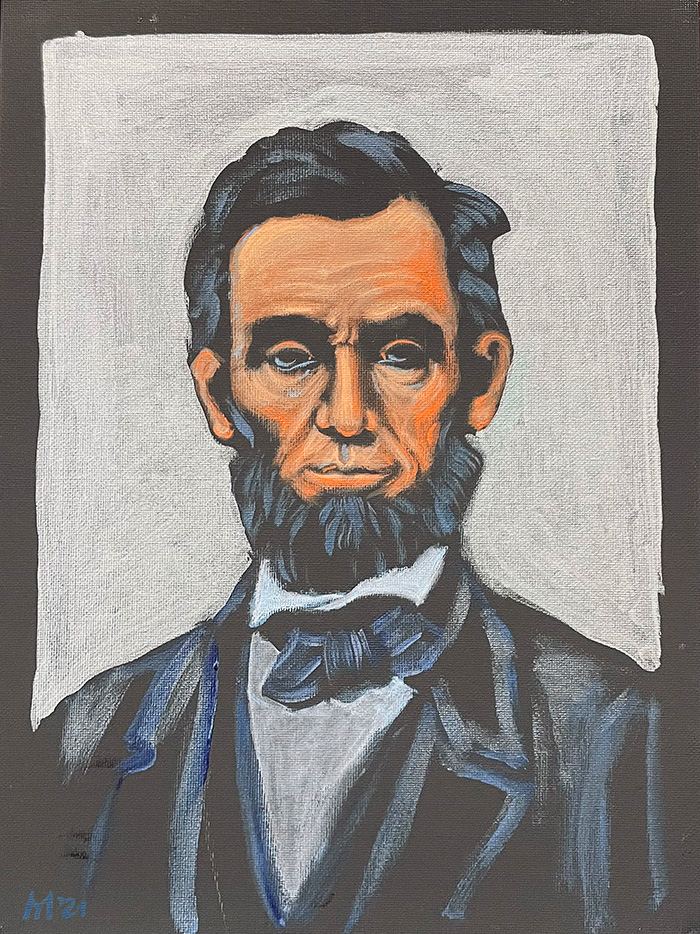
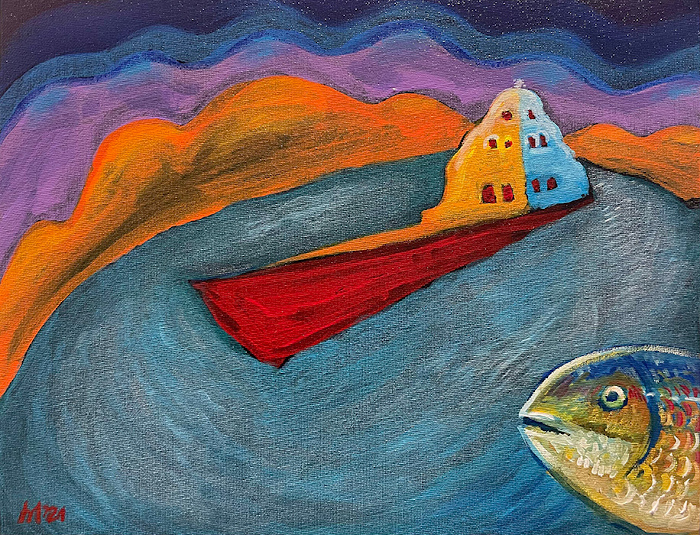
- Details
- Category: Maxim
"Prayers by the Lake of Ohrid and a Fish", acrylic on canvas, 2021
This is the Lake that inspired the ascetic of Ohrid to utter prayers—vibrant in their lyrical mood and characterized by a Christian view of the cosmos. It invites us to express reverently and poetically our longing for Christ, inflamed by divine eros. The fish appears as a mysterious presence.
This is the Lake that inspired the ascetic of Ohrid to utter prayers—vibrant in their lyrical mood and characterized by a Christian view of the cosmos. It invites us to express reverently and poetically our longing for Christ, inflamed by divine eros. The fish appears as a mysterious presence.
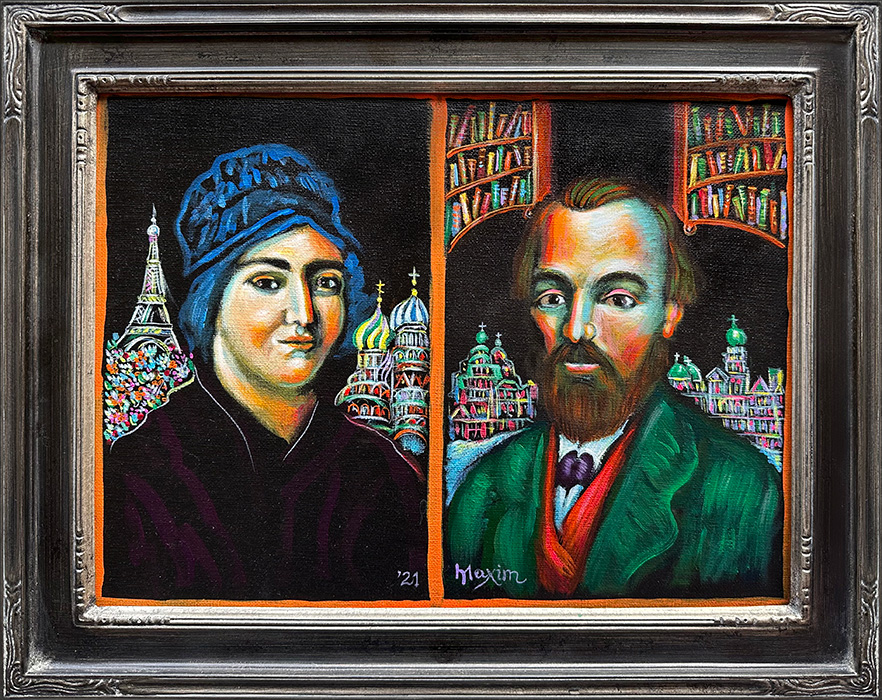
- Details
- Category: Maxim
"Fyodor Dostoevsky and Maria Skobtsova", acrylic on canvas, 2021
Mother Maria Skobtsova admired the dramatic Dostoevsky. In this contemporary icon of young Maria, it can be seen that she is eagerly rushing toward her martyrdom. Here, the painter-portraitist, who put the Moscow domes and the Eiffel Tower in the background, conveys a restrained but persuasive smile, which, combined with a sideways glance, hints at her future life as a martyr. Young and beautiful, foreboding where she is going, Marija reveals that unique personal expression with an incomparable smile, which is rarely found in portraits.
Mother Maria Skobtsova admired the dramatic Dostoevsky. In this contemporary icon of young Maria, it can be seen that she is eagerly rushing toward her martyrdom. Here, the painter-portraitist, who put the Moscow domes and the Eiffel Tower in the background, conveys a restrained but persuasive smile, which, combined with a sideways glance, hints at her future life as a martyr. Young and beautiful, foreboding where she is going, Marija reveals that unique personal expression with an incomparable smile, which is rarely found in portraits.
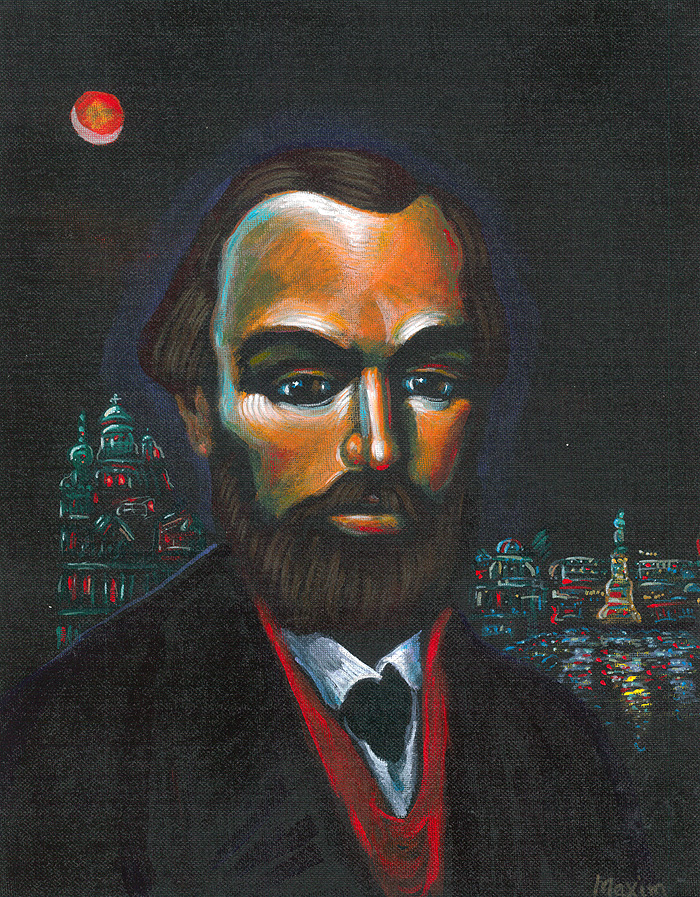
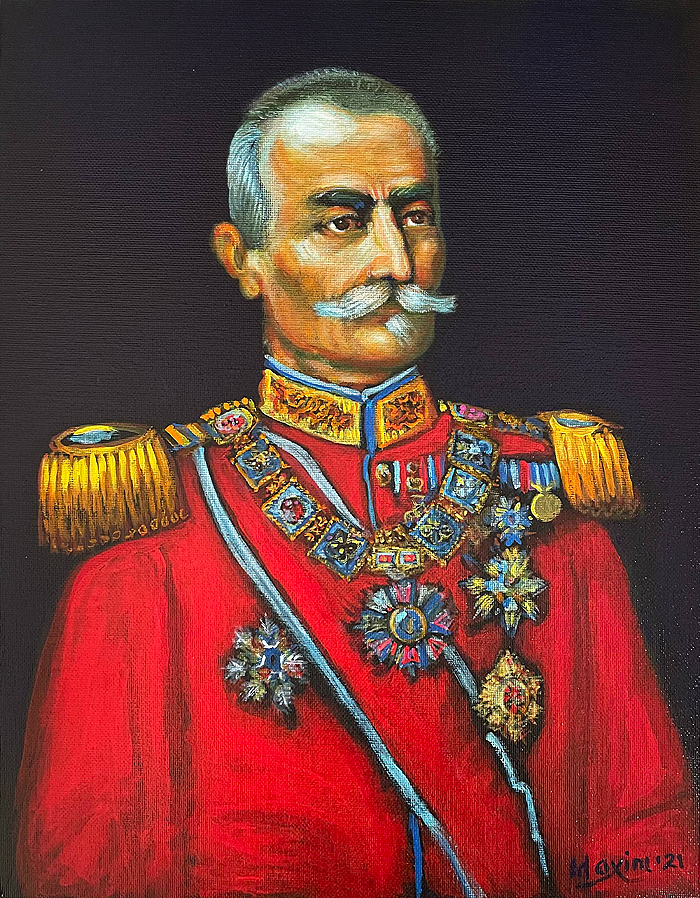
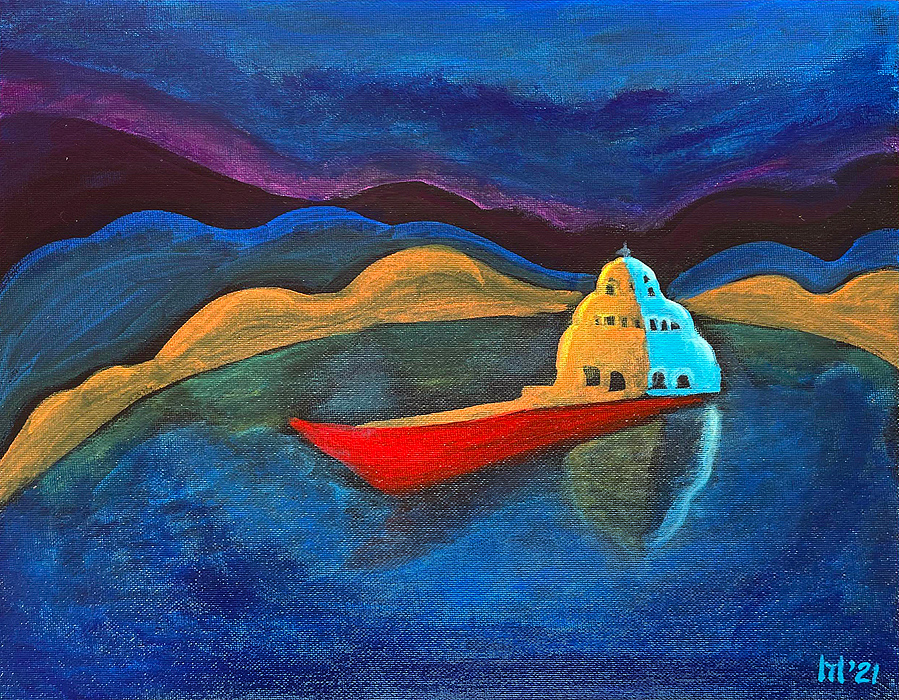
- Details
- Category: Maxim
"Prayers by the Lake of Ohrid 2", acrylic on canvas, 2021
This is the Lake that inspired the ascetic of Ohrid to utter prayers—vibrant in their lyrical mood and characterized by a Christian view of the cosmos. It invites us to express reverently and poetically our longing for Christ, inflamed by divine eros.
This is the Lake that inspired the ascetic of Ohrid to utter prayers—vibrant in their lyrical mood and characterized by a Christian view of the cosmos. It invites us to express reverently and poetically our longing for Christ, inflamed by divine eros.
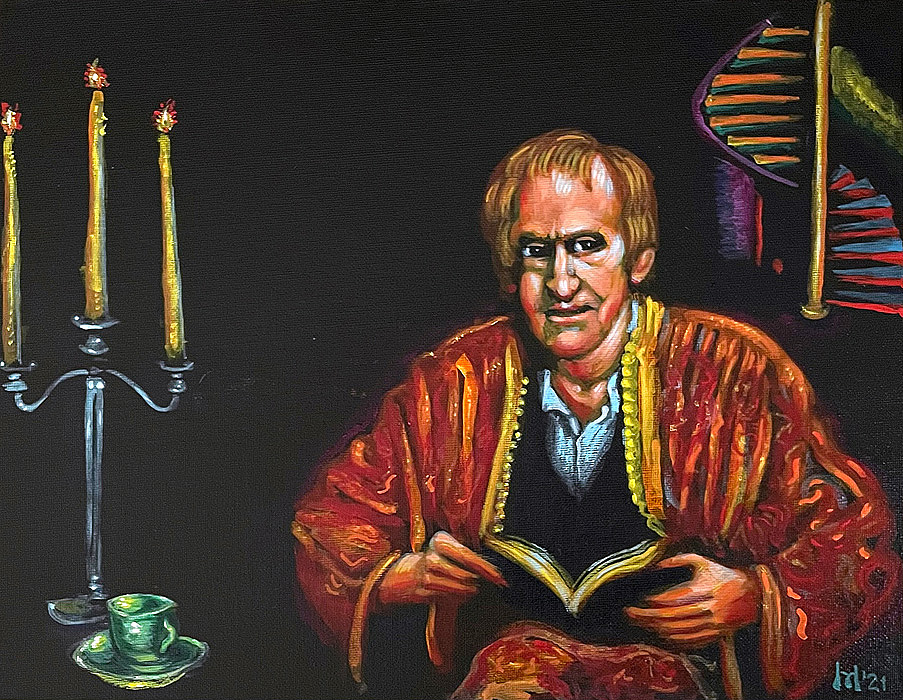
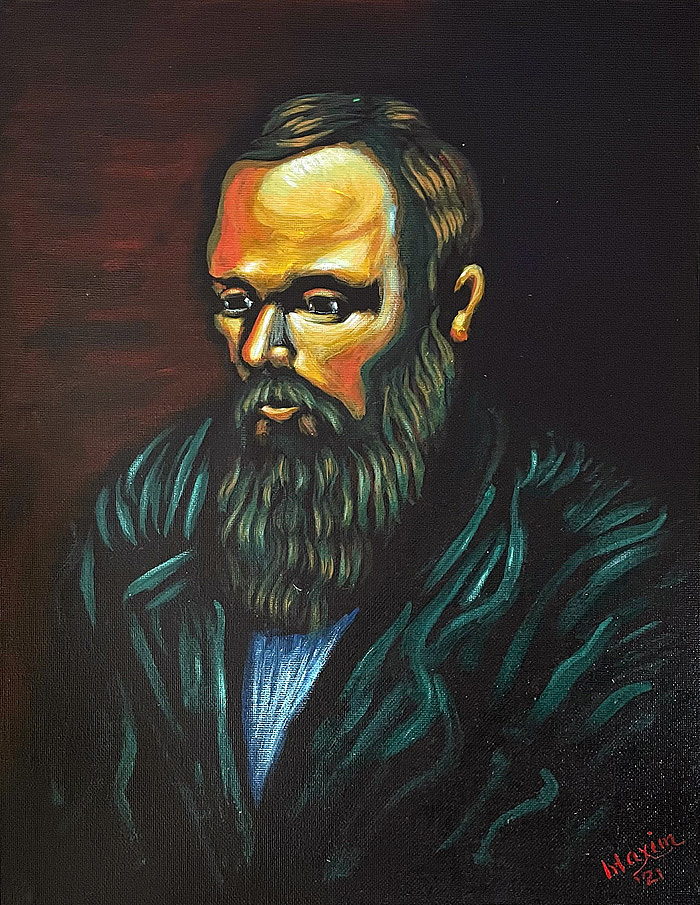
- Details
- Category: Maxim
"Dostoevsky 2", acrylic on canvas, 2021
"Dostoevsky’s face is the face of a peasant. An ashen hue pervades the hollow cheeks, making them appear almost grimy, emphasizing the furrows caused by many years of suffering; the skin, dry and parched, is stretched tight over the bony framework, and is bereft of blood and color, sucked clean of life by the vampire which has preyed on it for a score of years. To right and left, two huge boulders jut forth, the prominent cheekbones typical of his race; a sparse moustache and a straggling beard veil the sad-looking mouth and delicate chin. Earth, rock, and forest; a tragic and primitive landscape; such are the basic lineaments of Dostoevsky’s countenance. All is dark and preeminently earthly in this unbeautiful face. I have called it a peasant’s, but I might almost term it a beggar’s, so flat and colorless is it, so lacking in brightness: a piece of the Russian steppe cast high and dry upon the stones. Even the deep-set eyes, gleaming from within their sockets, are incapable of imparting a spark of light to the grim visage, for their radiance is directed inward. As soon as the lids close over them, the face becomes a death mask, and the nervous tension which otherwise grips the frail features is relaxed into a lifeless lethargy". (Dostoevsky by Stefan Zweig)
"Dostoevsky’s face is the face of a peasant. An ashen hue pervades the hollow cheeks, making them appear almost grimy, emphasizing the furrows caused by many years of suffering; the skin, dry and parched, is stretched tight over the bony framework, and is bereft of blood and color, sucked clean of life by the vampire which has preyed on it for a score of years. To right and left, two huge boulders jut forth, the prominent cheekbones typical of his race; a sparse moustache and a straggling beard veil the sad-looking mouth and delicate chin. Earth, rock, and forest; a tragic and primitive landscape; such are the basic lineaments of Dostoevsky’s countenance. All is dark and preeminently earthly in this unbeautiful face. I have called it a peasant’s, but I might almost term it a beggar’s, so flat and colorless is it, so lacking in brightness: a piece of the Russian steppe cast high and dry upon the stones. Even the deep-set eyes, gleaming from within their sockets, are incapable of imparting a spark of light to the grim visage, for their radiance is directed inward. As soon as the lids close over them, the face becomes a death mask, and the nervous tension which otherwise grips the frail features is relaxed into a lifeless lethargy". (Dostoevsky by Stefan Zweig)
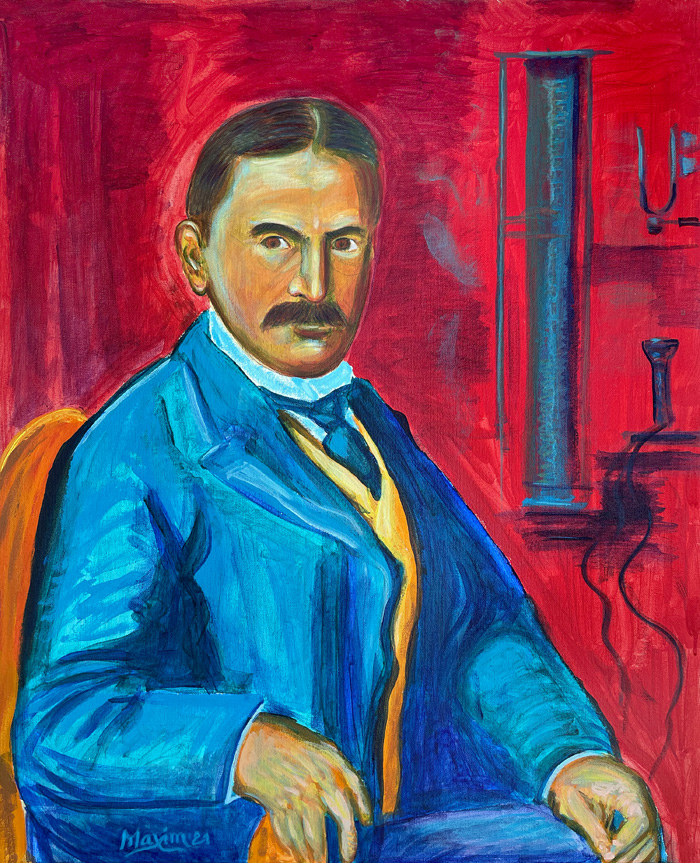
- Details
- Category: Maxim
Mihajlo Pupin / Michael Pupin, acrylic on canvas, 2021
This work is painted after a portrait of Mihajlo Pupin, done in 1903 by the great Serbian painter Paja Jovanović in the USA. Feeling confident in himself, Pupin has a decisive and direct look into investing in new technologies understanding the risks. The warmth of red represents the heat of the laboratory and the passion of a scientific experiment. The viewer feels the warmth in red color and the coolness in blue. Blue color of Pupin’s suits represents complete calmness, peace and tranquillity and has a pacifying effect on the entire atmosphere. Blue means responsibility and reliability.
This work is painted after a portrait of Mihajlo Pupin, done in 1903 by the great Serbian painter Paja Jovanović in the USA. Feeling confident in himself, Pupin has a decisive and direct look into investing in new technologies understanding the risks. The warmth of red represents the heat of the laboratory and the passion of a scientific experiment. The viewer feels the warmth in red color and the coolness in blue. Blue color of Pupin’s suits represents complete calmness, peace and tranquillity and has a pacifying effect on the entire atmosphere. Blue means responsibility and reliability.
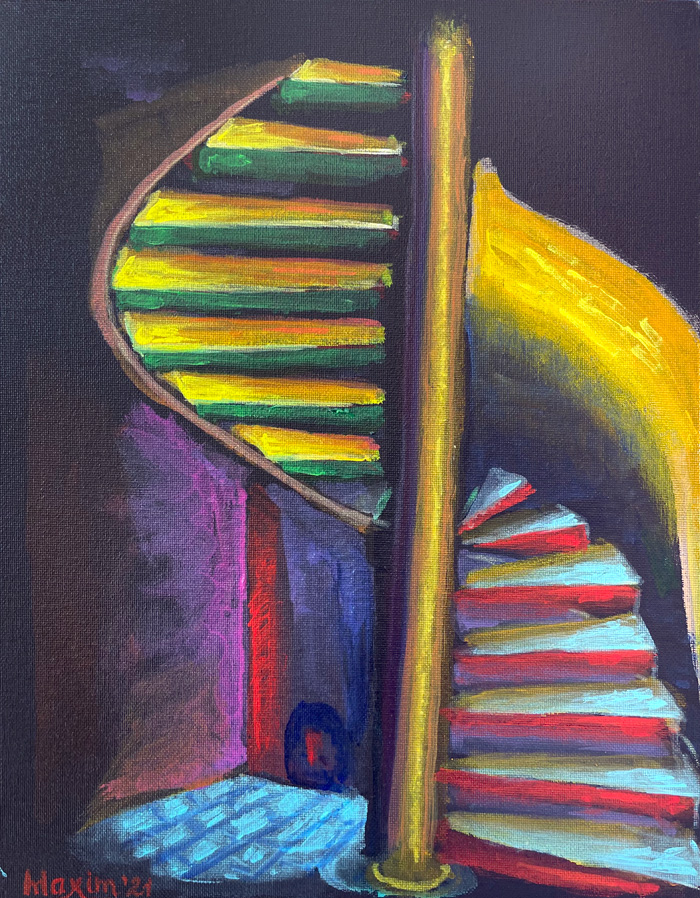
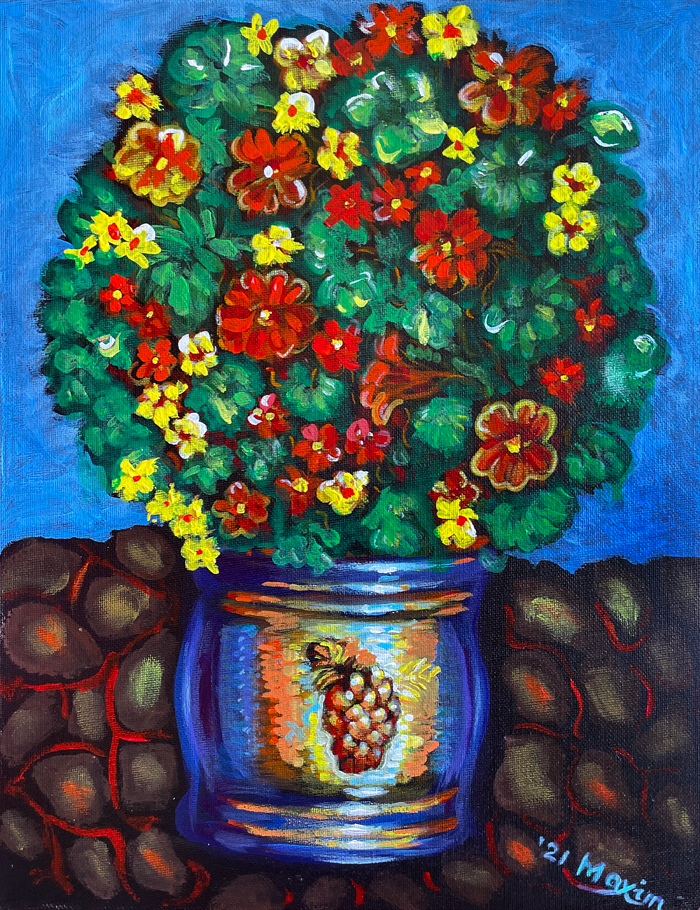
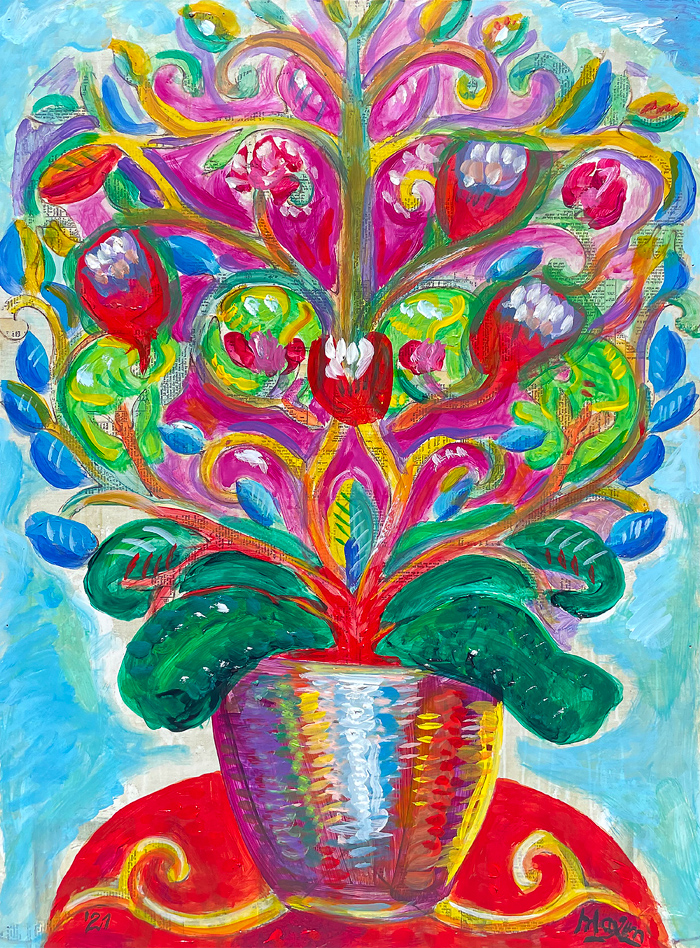
- Details
- Category: Maxim
“A Vase of Evangelism”, acrylic on canvas, 2021
Leaves and flowers rejoice in a transmission of joy that overflows from the vase and fills our hearts.
Leaves and flowers rejoice in a transmission of joy that overflows from the vase and fills our hearts.
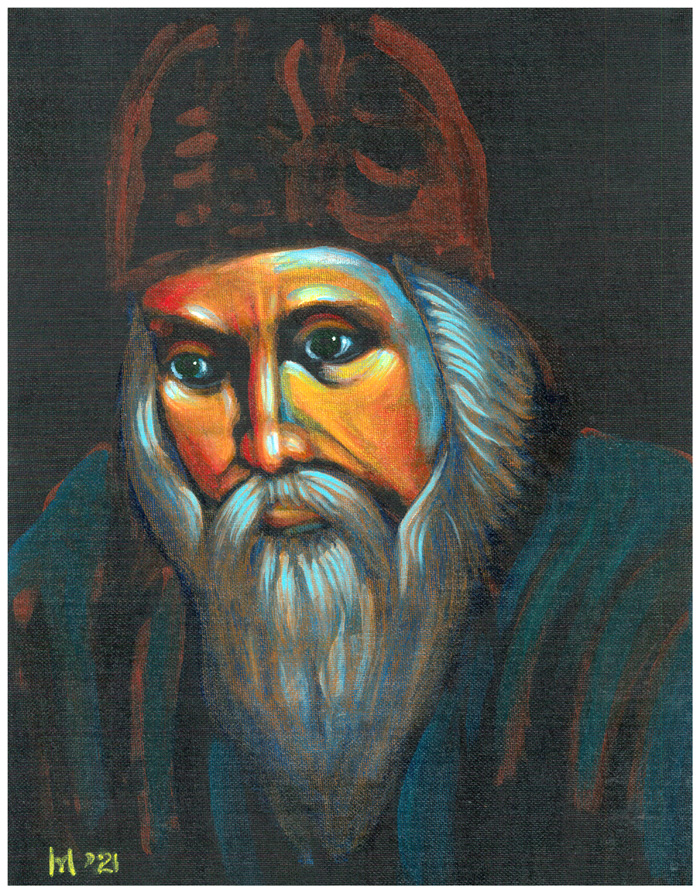
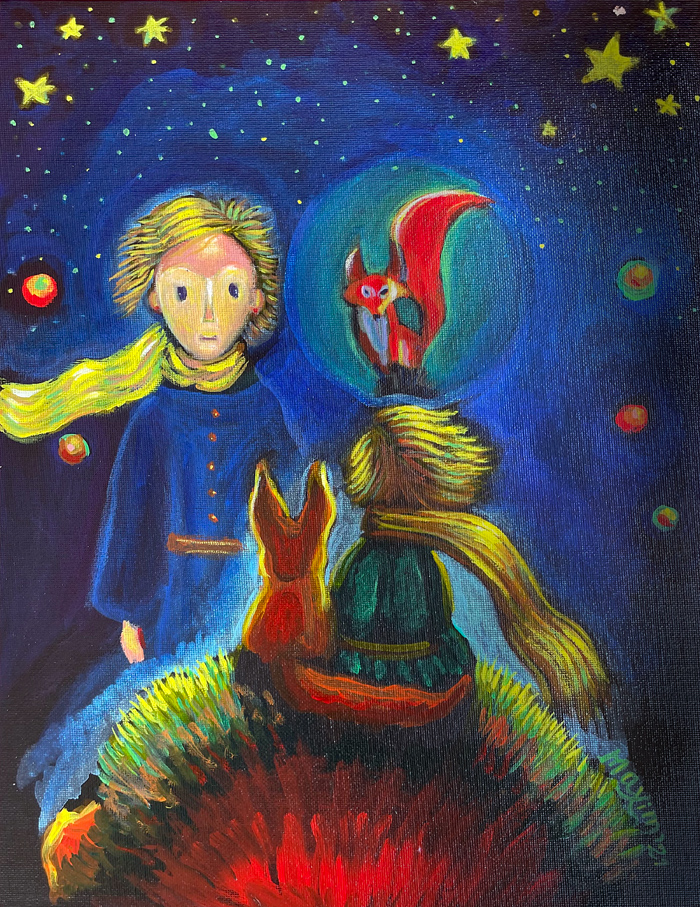
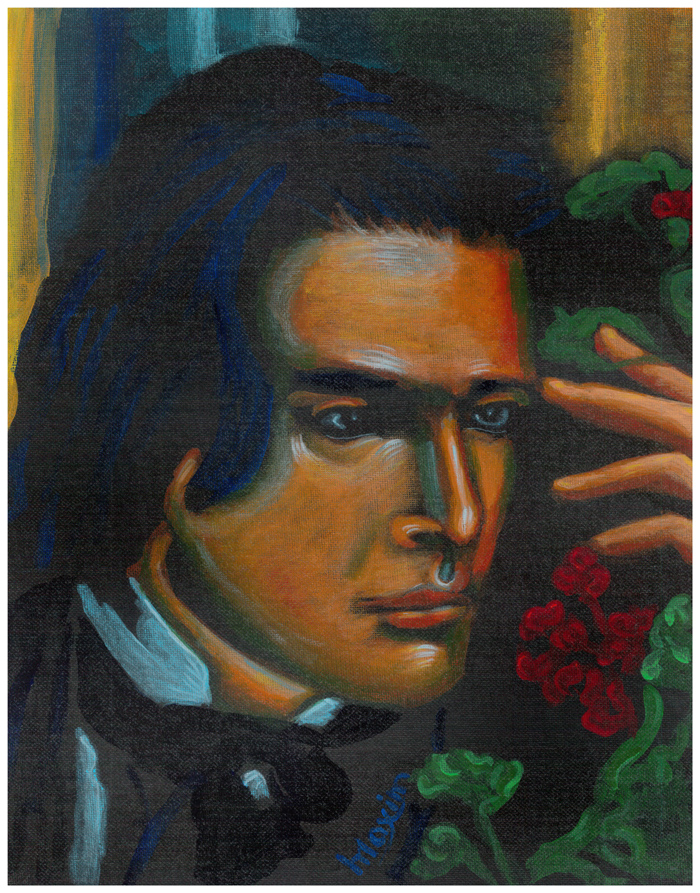
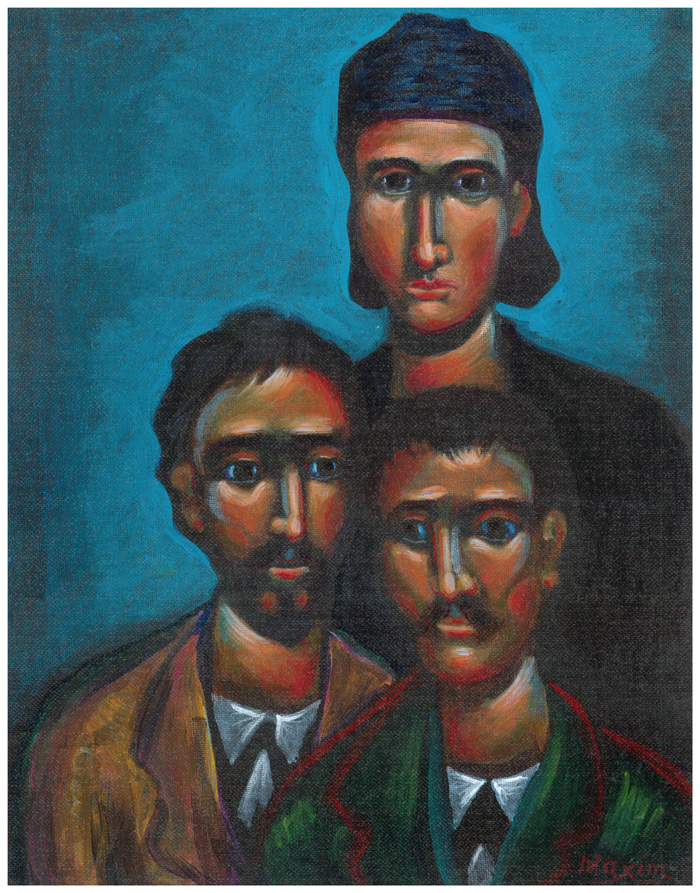
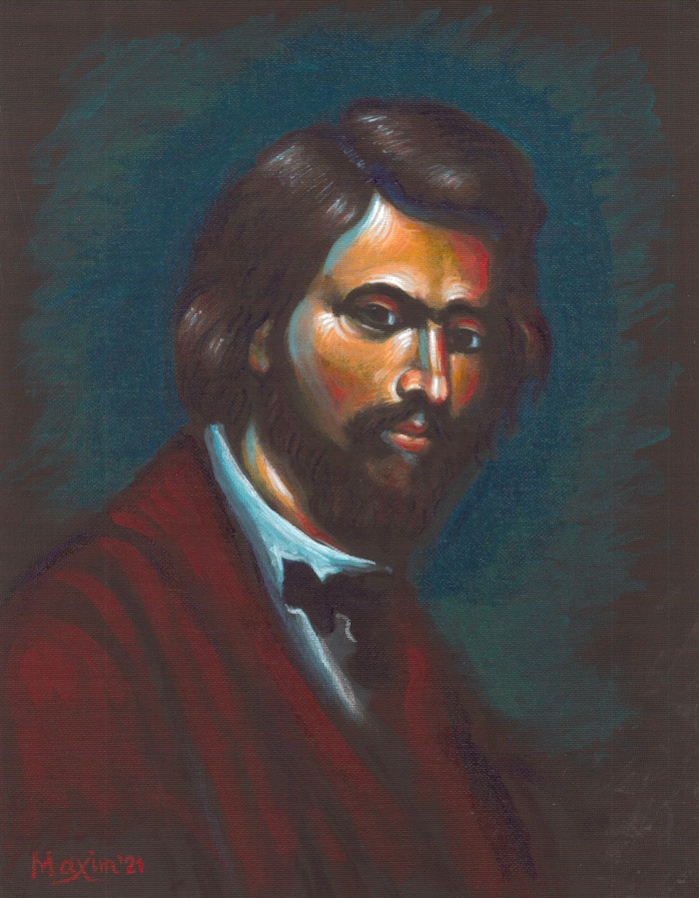
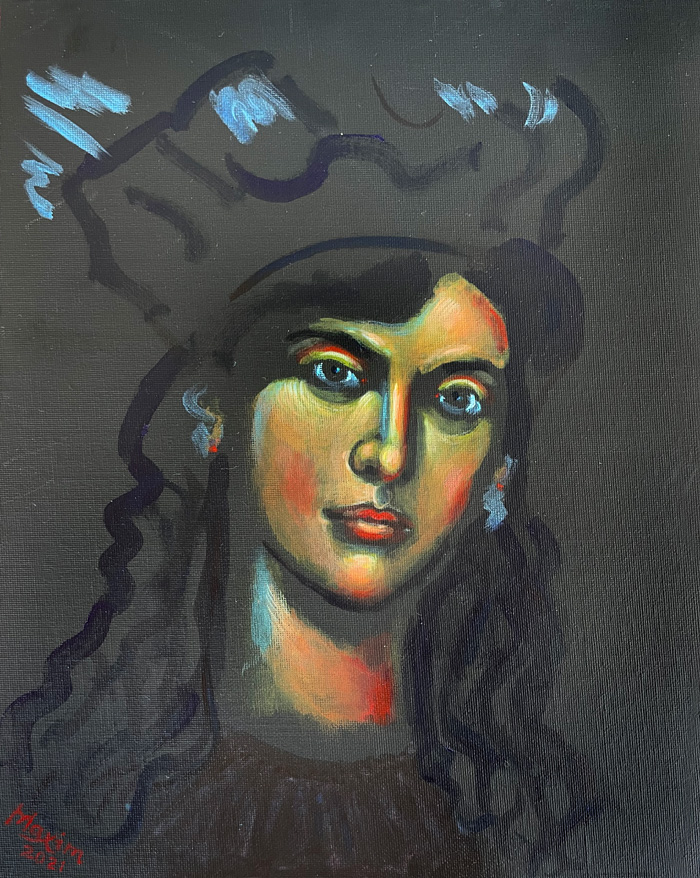
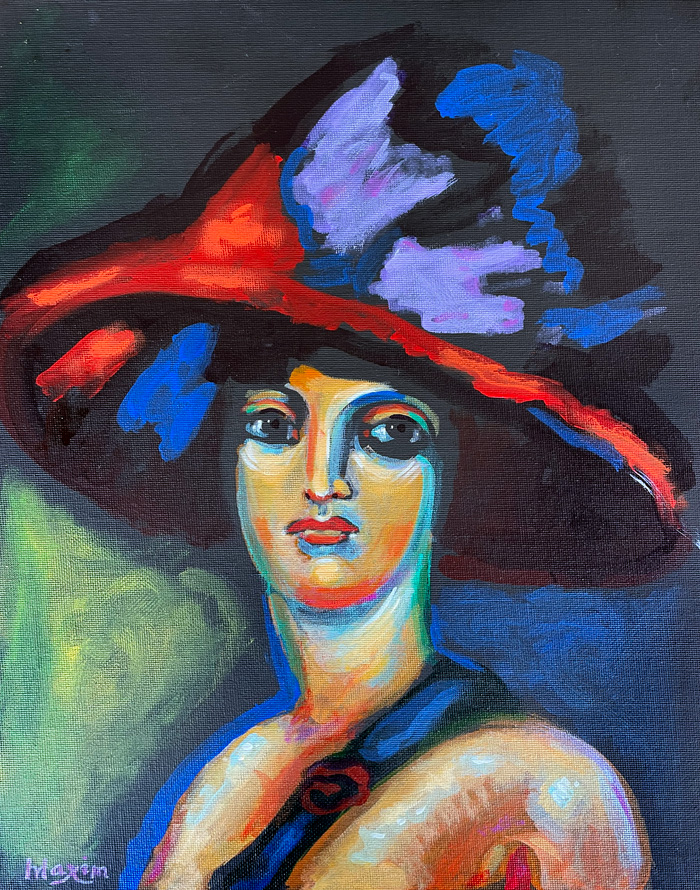
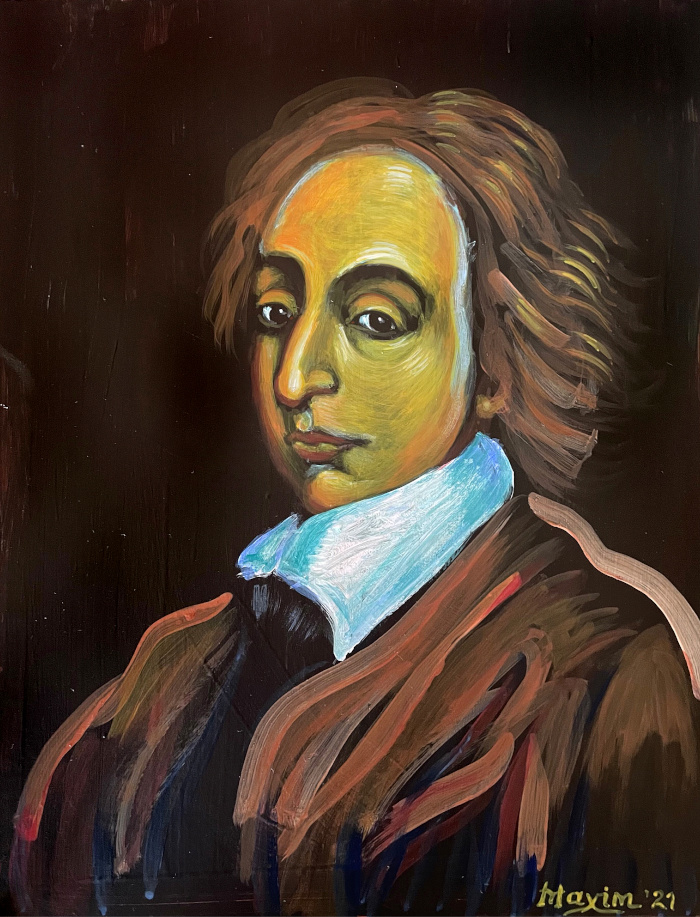
- Details
- Category: Maxim
Blaise Pascal, acrylic on cardboard, 2021
Pascal was a brilliant child prodigy, who went on to become one of the greatest mathematicians, physicists, inventors, and writers of the seventeenth century. The author of Pensees and the Provincial Letters has said, “Eloquence is a painting of the thoughts.” This work of older Pascal, with long and curly hair, seated and facing to the left, is painted after a portrait done by French painter Philippe de Champagne (1602-1674). Adopting an ascetic lifestyle, Pascal wrote eloquently about the insoluble paradoxes of the human condition, blending stoic and skeptical arguments to bring his readers to a point of confusion and despair, at which they would accept his famous wager and embrace God.
Pascal was a brilliant child prodigy, who went on to become one of the greatest mathematicians, physicists, inventors, and writers of the seventeenth century. The author of Pensees and the Provincial Letters has said, “Eloquence is a painting of the thoughts.” This work of older Pascal, with long and curly hair, seated and facing to the left, is painted after a portrait done by French painter Philippe de Champagne (1602-1674). Adopting an ascetic lifestyle, Pascal wrote eloquently about the insoluble paradoxes of the human condition, blending stoic and skeptical arguments to bring his readers to a point of confusion and despair, at which they would accept his famous wager and embrace God.
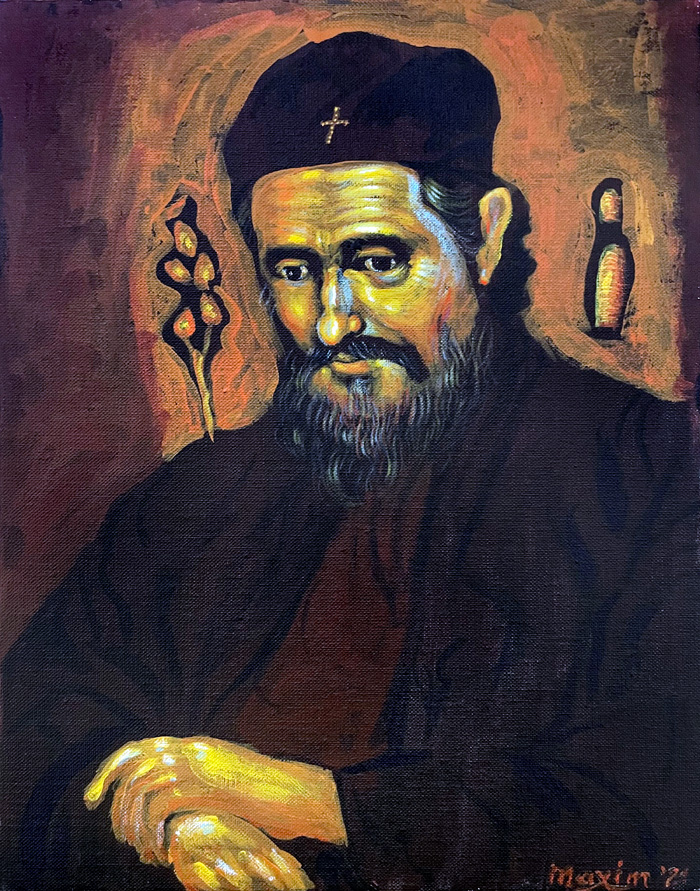
- Details
- Category: Maxim
“The Elder Atanasije Breaks Through The Darkness Of Night With Prayer”, acrylic on canvas, by Bishop Maxim, 2021
Divinity emanating through his expression, the broad shoulders and the blessed peace of mind of the Elder Atanasije describe the balance between physical and spiritual strength.
Divinity emanating through his expression, the broad shoulders and the blessed peace of mind of the Elder Atanasije describe the balance between physical and spiritual strength.
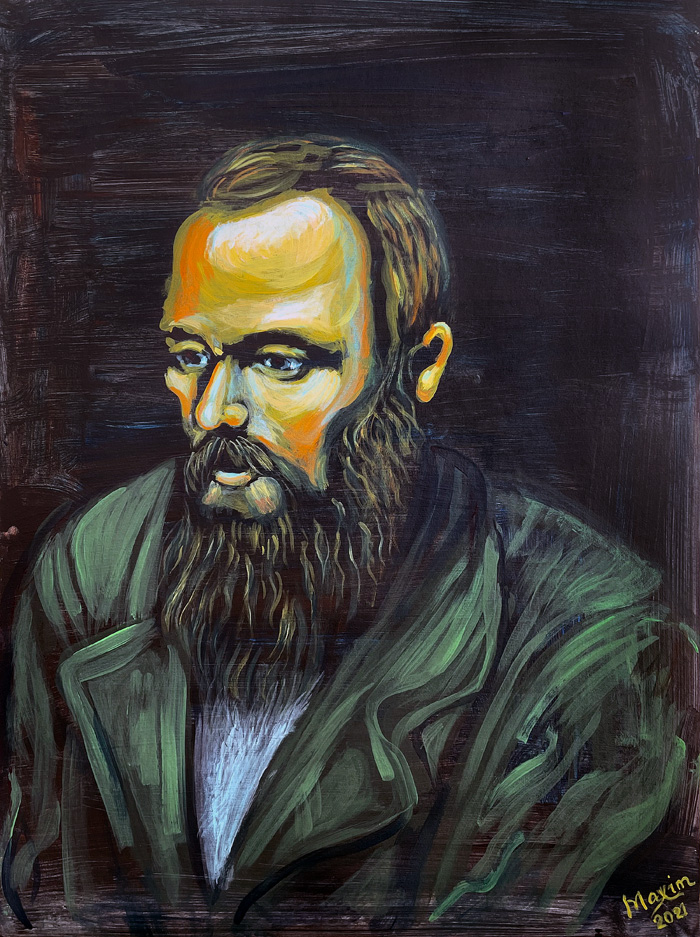
- Details
- Category: Maxim
“Dostoevsky”, acrylic on cardboard, by Bishop Maxim, 2021
Father Stamatis Skliris:
Did you see the charm of the dark background? "Dostoyevsky" is very nice, the design stands and the expression is serious, as it should be. The jacket with two touches brush is finished and is complete, with a clever artistic gesture. I especially like the atmosphere or the mentality. A serious man, thinking eyes, troubled, and a jacket spaciously wrapped around his body that betrays his Van Goghian suffering and existential difficulty to be caught by existence, to be clung to and not to fall into non-existence.
Father Stamatis Skliris:
Did you see the charm of the dark background? "Dostoyevsky" is very nice, the design stands and the expression is serious, as it should be. The jacket with two touches brush is finished and is complete, with a clever artistic gesture. I especially like the atmosphere or the mentality. A serious man, thinking eyes, troubled, and a jacket spaciously wrapped around his body that betrays his Van Goghian suffering and existential difficulty to be caught by existence, to be clung to and not to fall into non-existence.
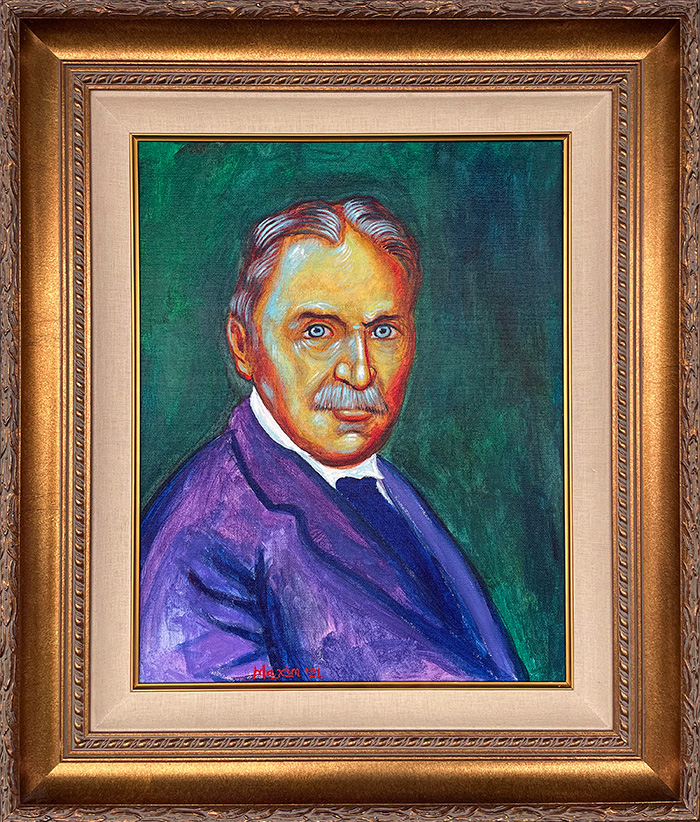
- Details
- Category: Maxim
"Mihajlo Idvorski Pupin - Michael Idvorsky Pupin", acrylic on canvas, by Bishop Maxim, april 2021
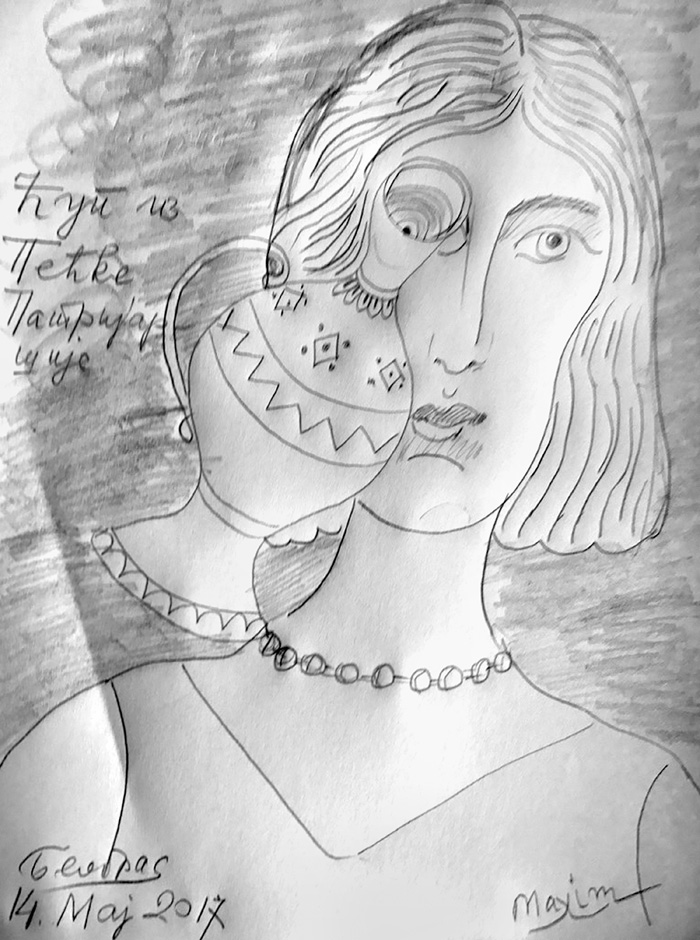
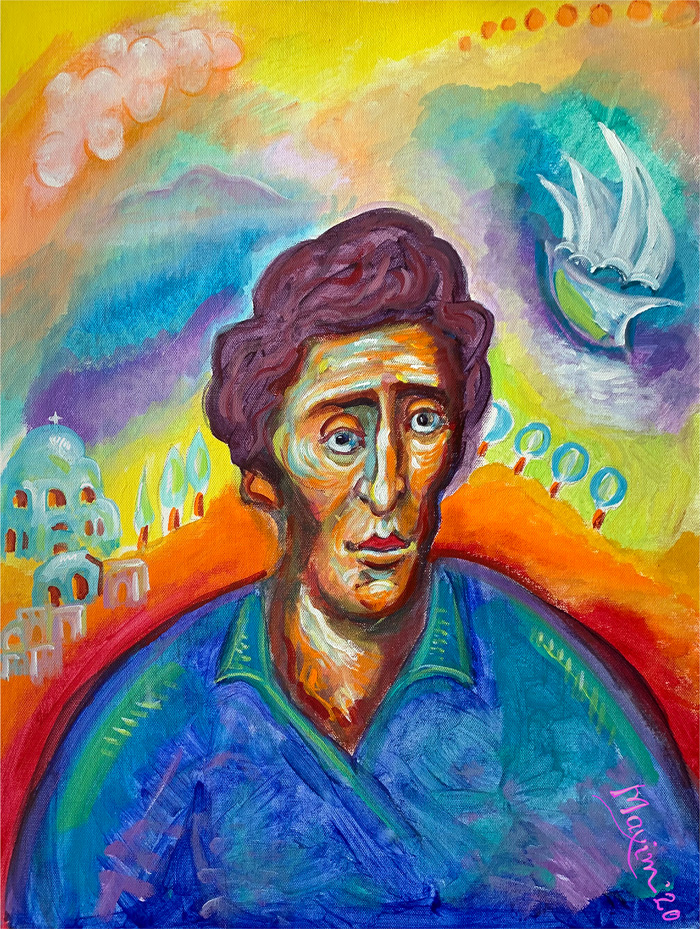
- Details
- Category: Maxim
"A Patient of 2020", acrylic on canvas, by bp. Maxim
This acrylic painting conveys vulnerable human beings' battles with the novel SARS-CoV-2 virus, which is not yet contained, leaving suffering and death in its wake. Yet, coexisting with Covid-19 implies faith, hope, dreams...
This acrylic painting conveys vulnerable human beings' battles with the novel SARS-CoV-2 virus, which is not yet contained, leaving suffering and death in its wake. Yet, coexisting with Covid-19 implies faith, hope, dreams...
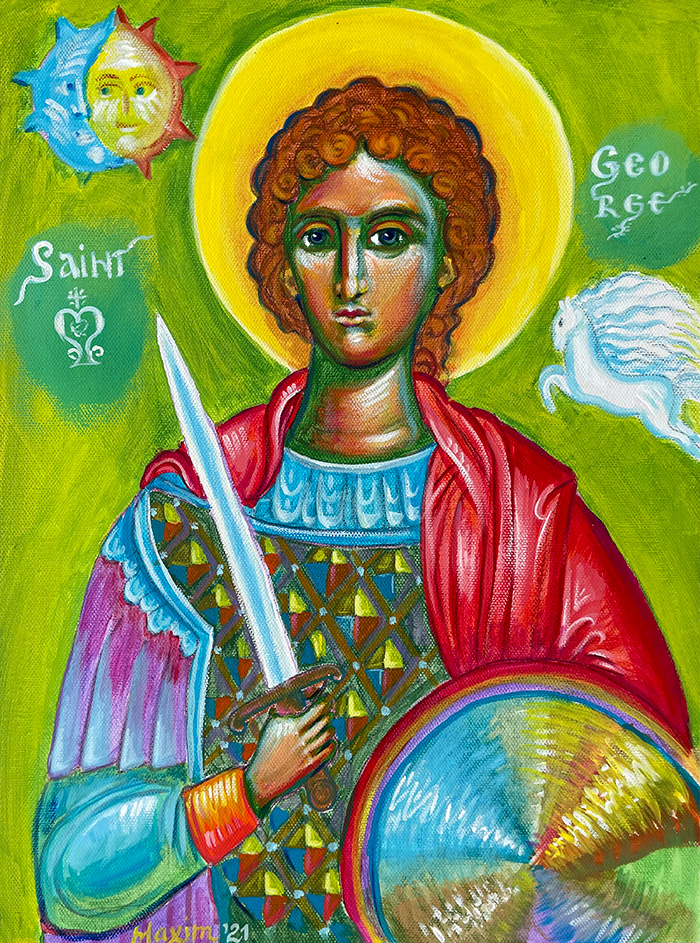
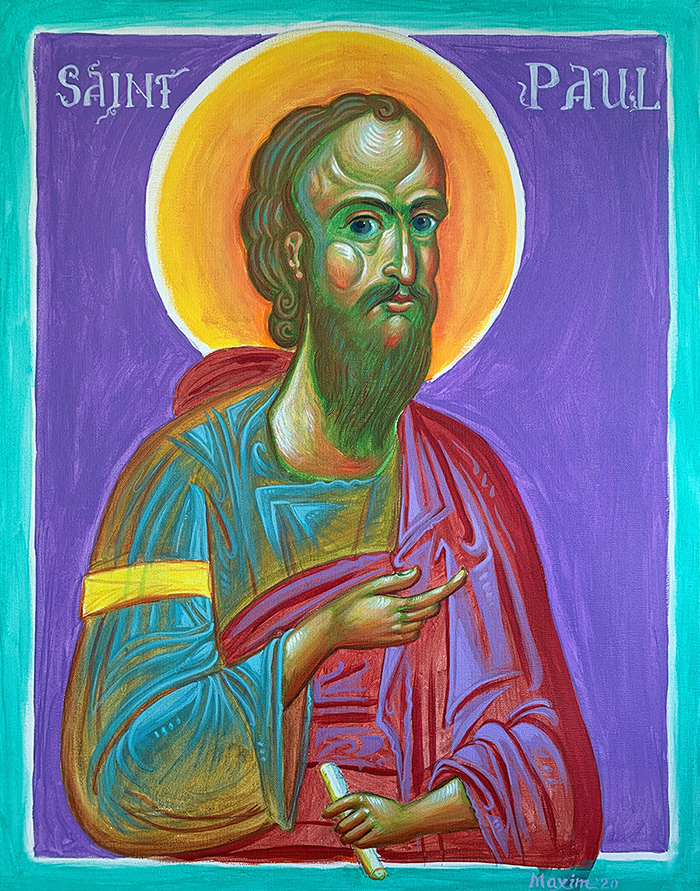
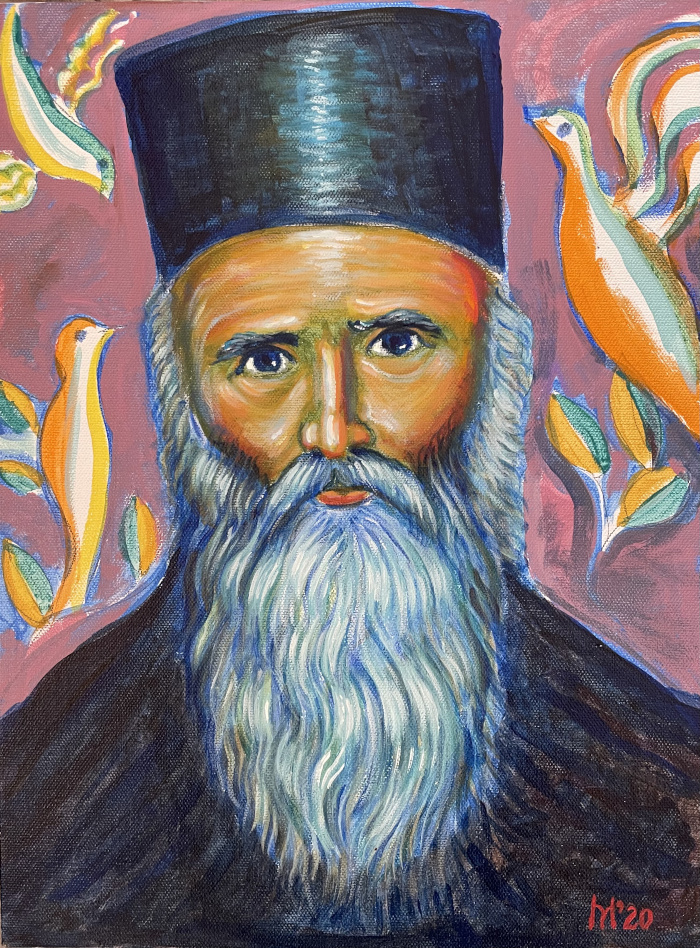
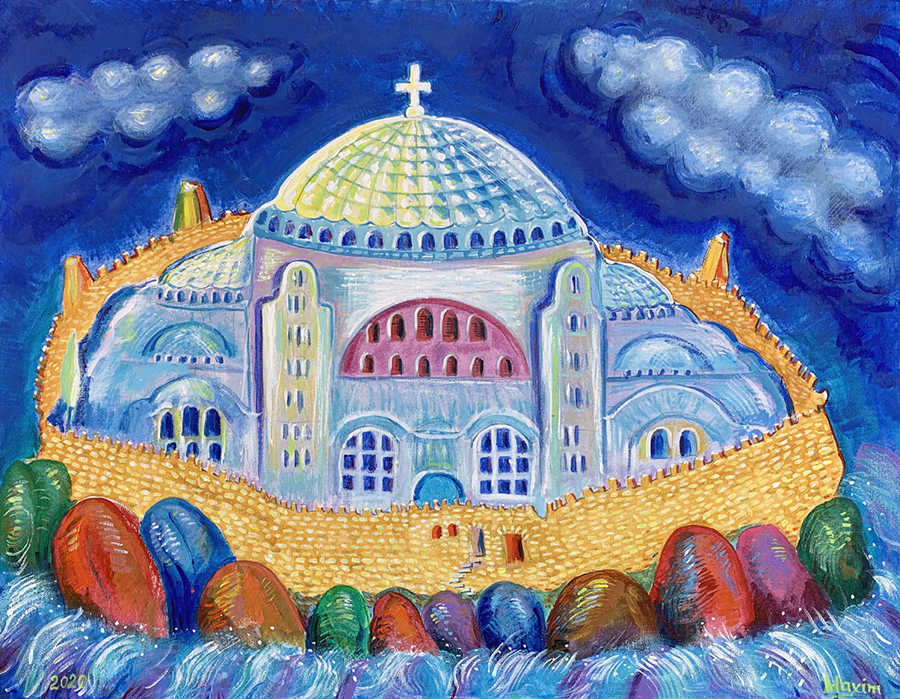
- Details
- Category: Maxim
"The Hagia Sophia", acrylic on canvas, by Bishop Maxim, 2020
The Hagia Sophia is а marvelous building that transcends time and still impacts Christianity’s history. Its importance came to light recently with the decision to convert it into a mosque. This acrylic painting depicts the exterior of the Hagia Sophia (“Holy Wisdom”, Sancta Sophia, Ayasofya) with the sea walls of Constantinople. It seems that Justinian’s dream of the Eastern Roman Empire’s sea power was imprinted here. The ellipticity of the dome seems to be the origin and the crowning of the peculiar light of the Hagia Sophia.
The Hagia Sophia is а marvelous building that transcends time and still impacts Christianity’s history. Its importance came to light recently with the decision to convert it into a mosque. This acrylic painting depicts the exterior of the Hagia Sophia (“Holy Wisdom”, Sancta Sophia, Ayasofya) with the sea walls of Constantinople. It seems that Justinian’s dream of the Eastern Roman Empire’s sea power was imprinted here. The ellipticity of the dome seems to be the origin and the crowning of the peculiar light of the Hagia Sophia.
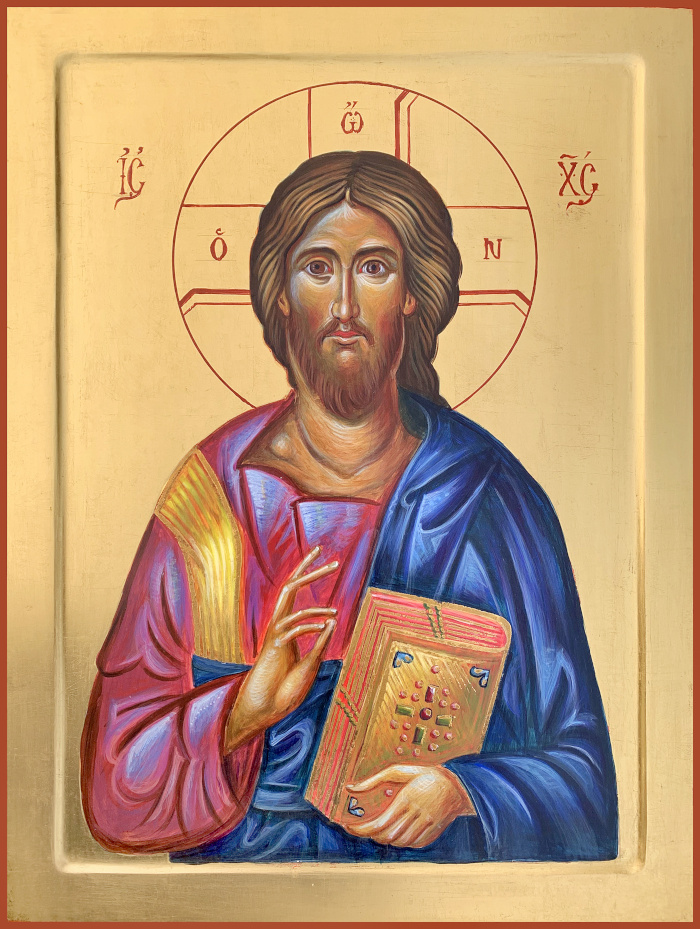
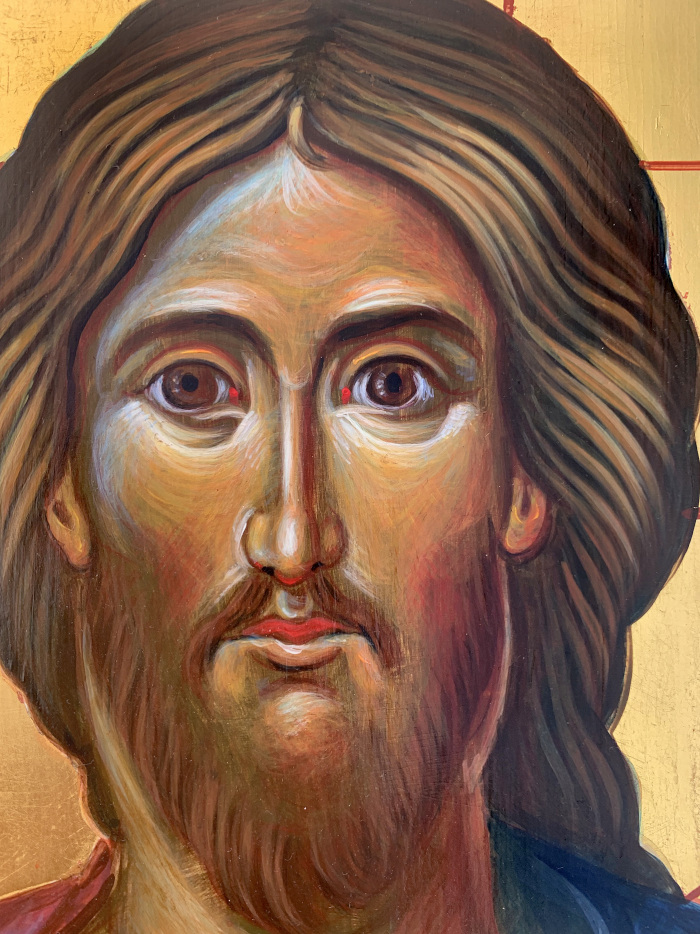
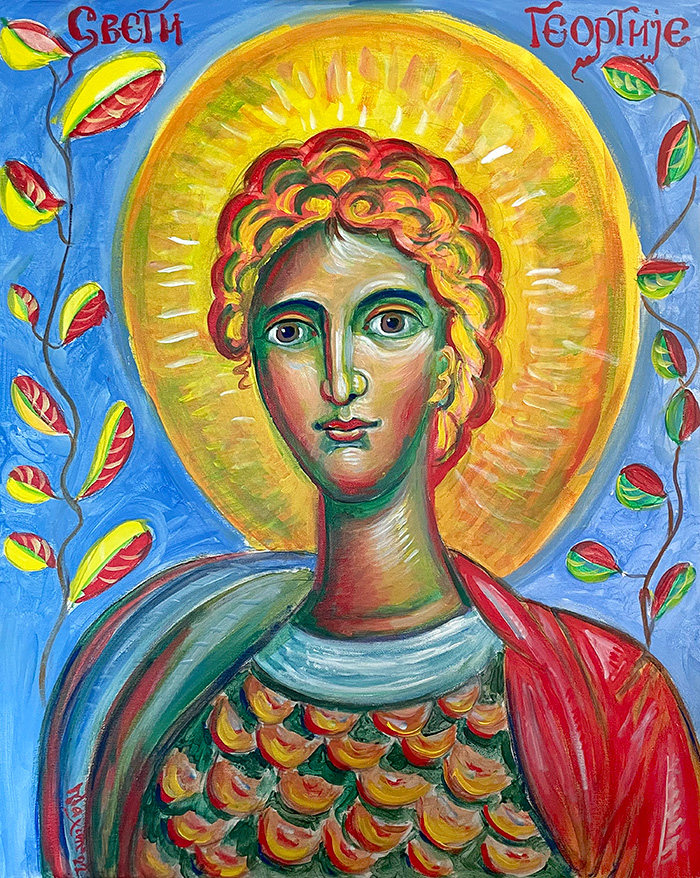
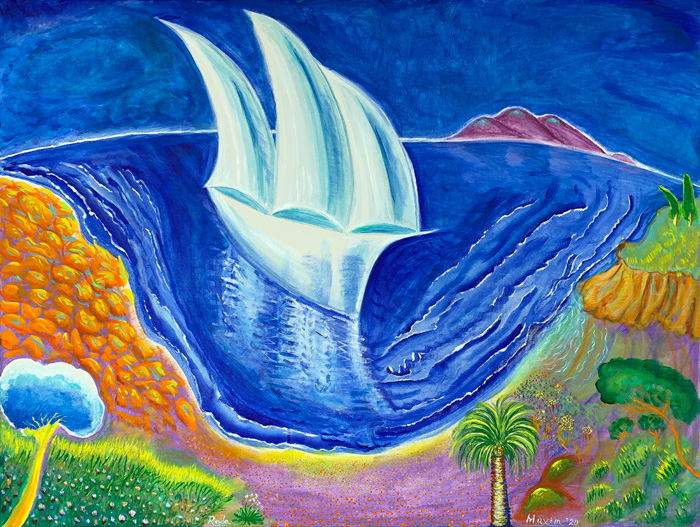
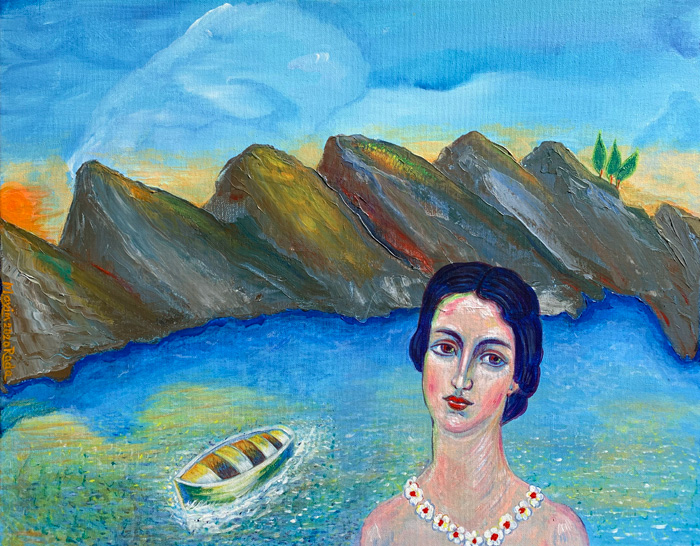
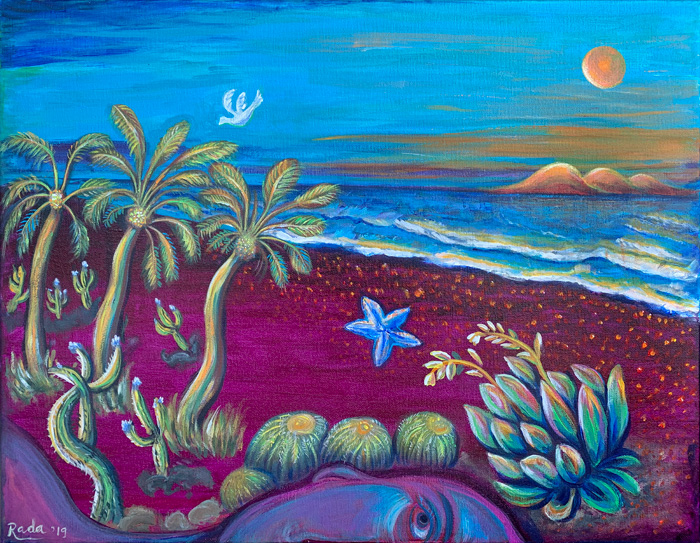
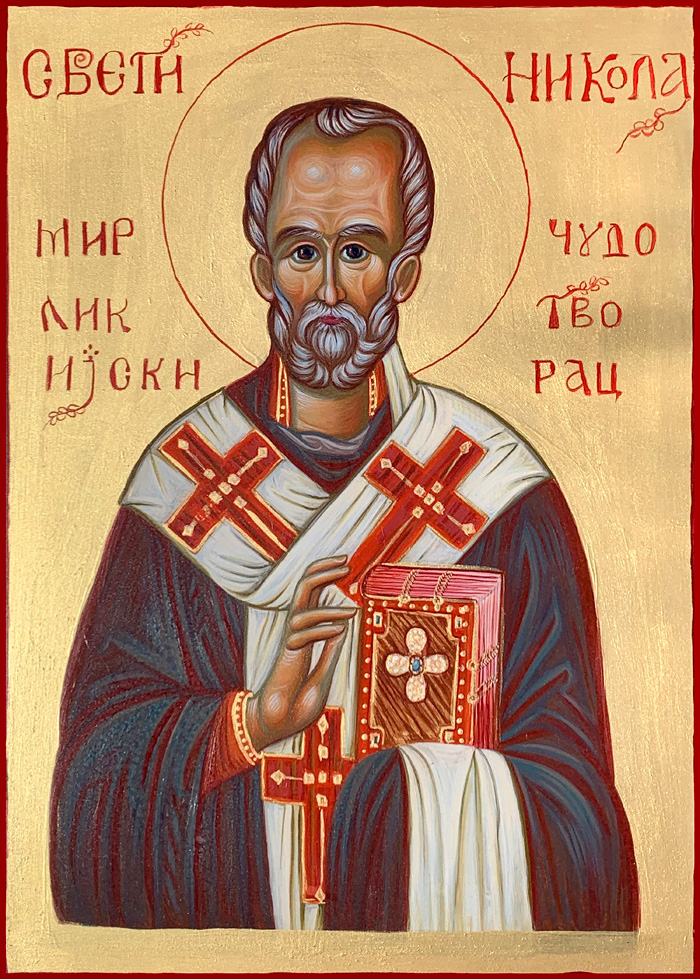
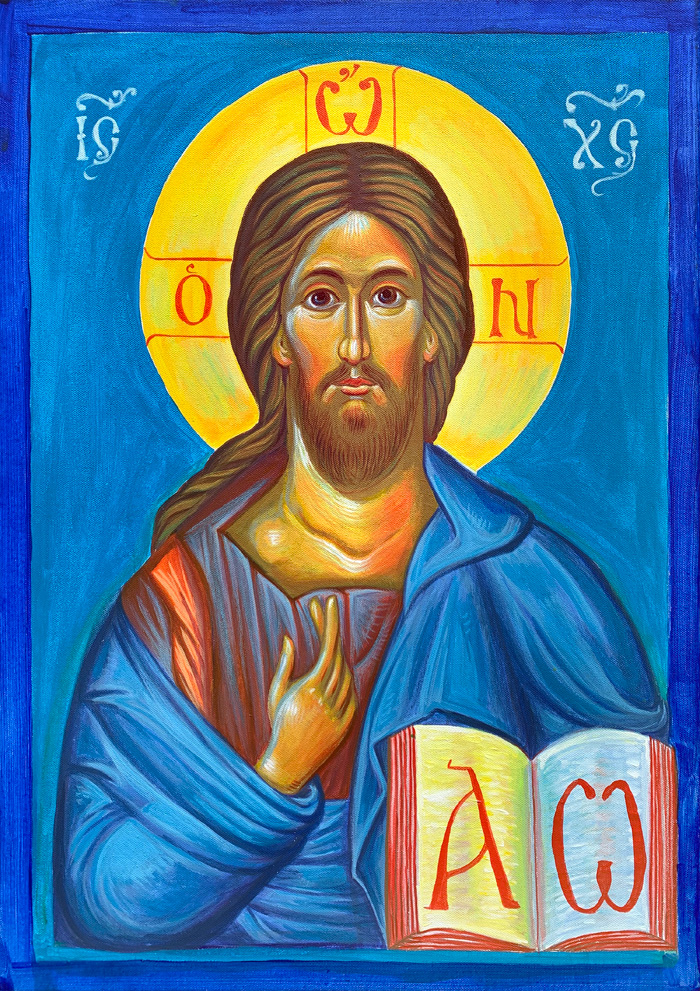
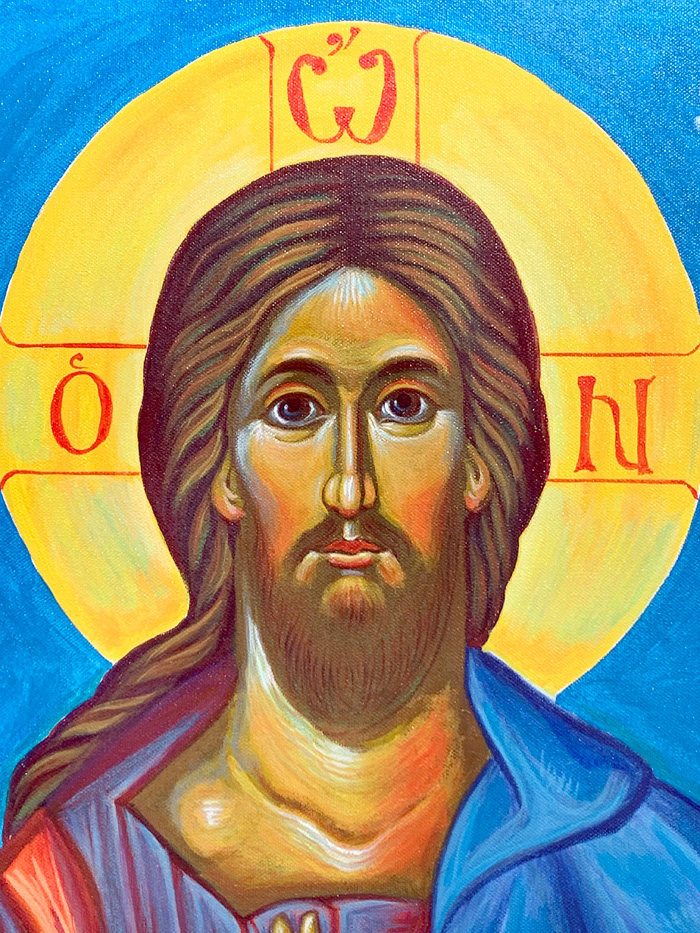
- Details
- Category: Maxim
“Jesus Christ - Alpha and Omega”, detail, acrylic on canvas, by bp Maxim, 2020
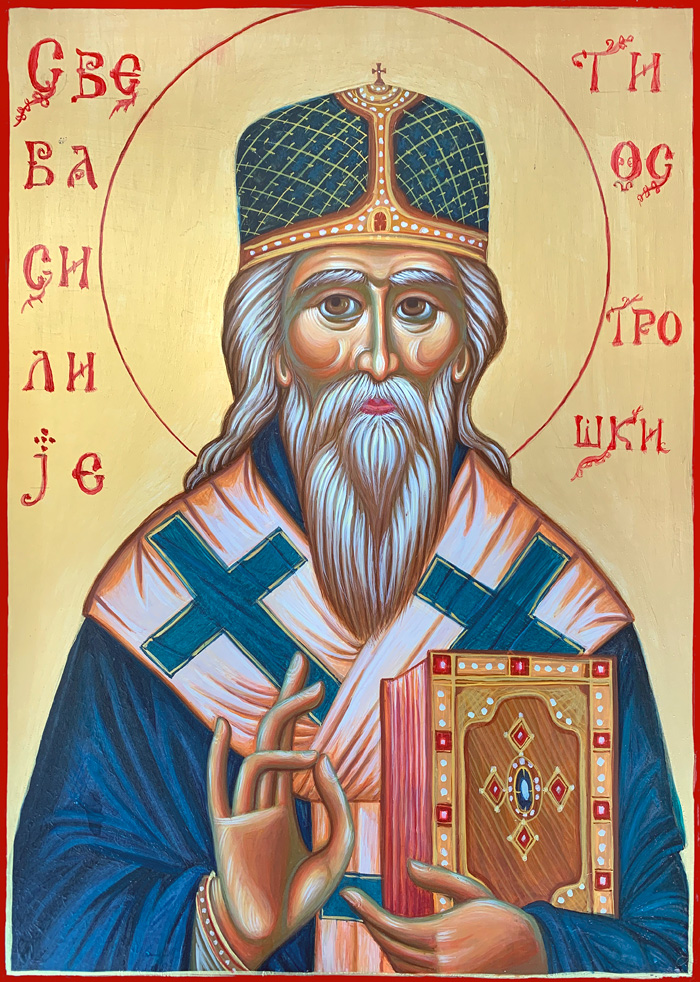
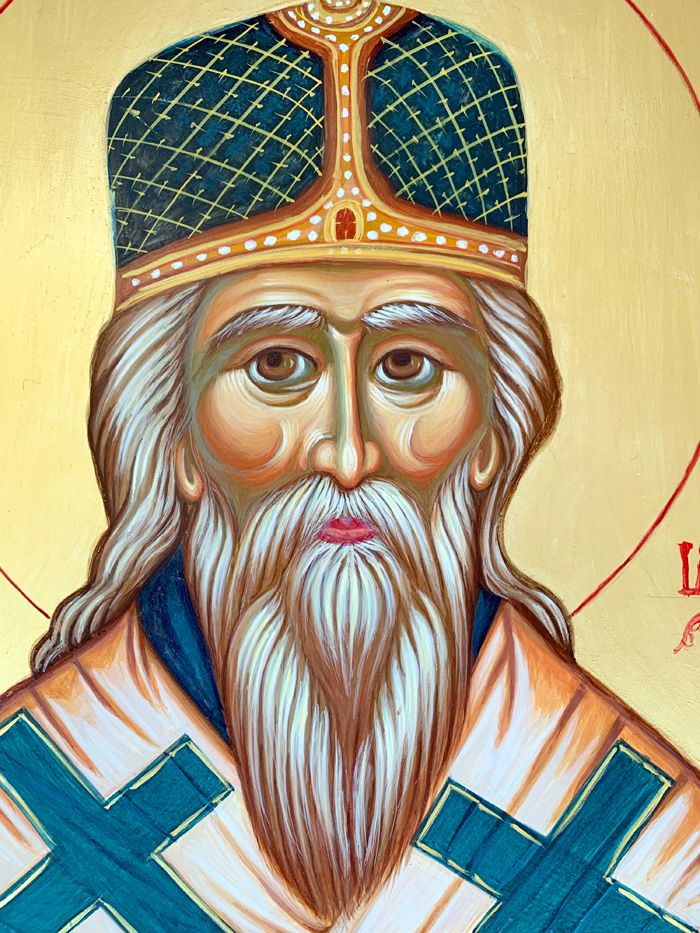
- Details
- Category: Maxim
"St Vasilije of Ostrog", detail, egg tempera on board, by Radmila Vasiljevic, 2015
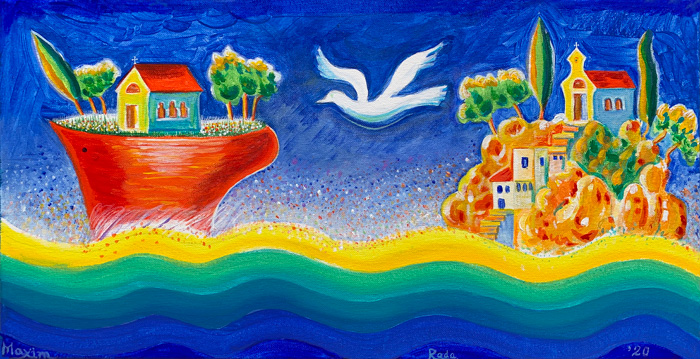
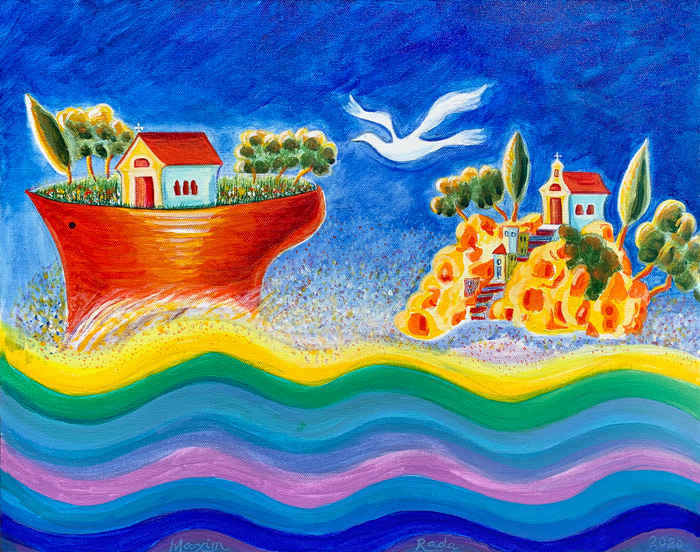
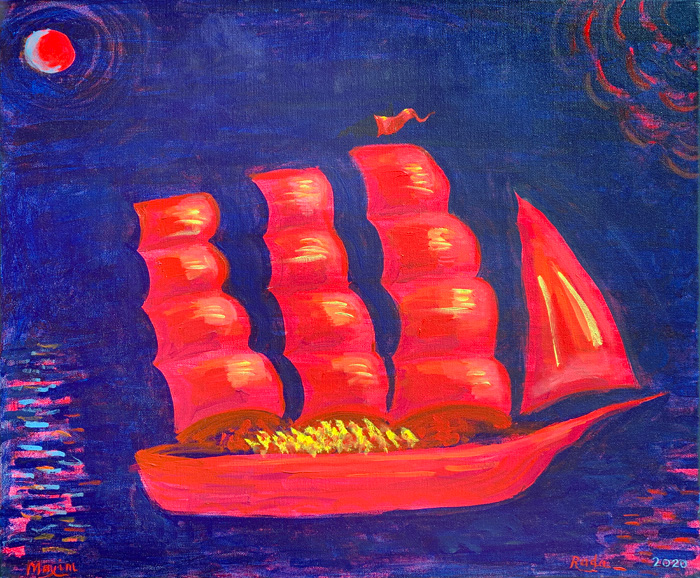
- Details
- Category: Maxim
"Thanksgiving Ship", acrylic on canvas, by bp. Maxim and Radmila Vasiljevic, 2020
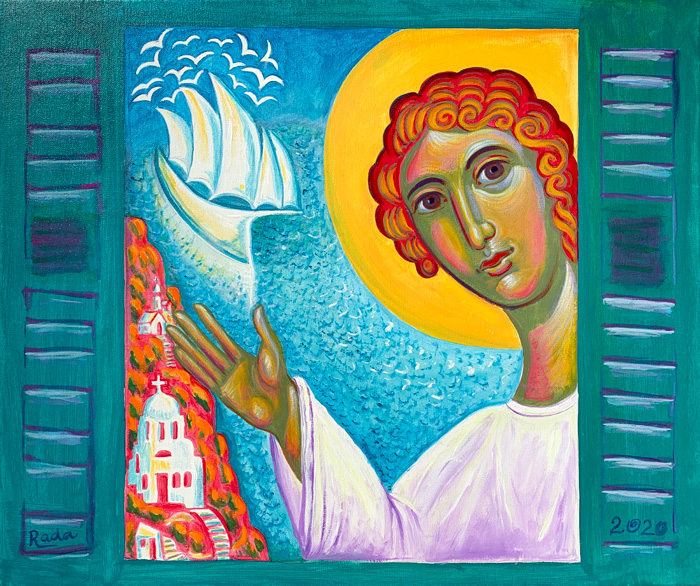
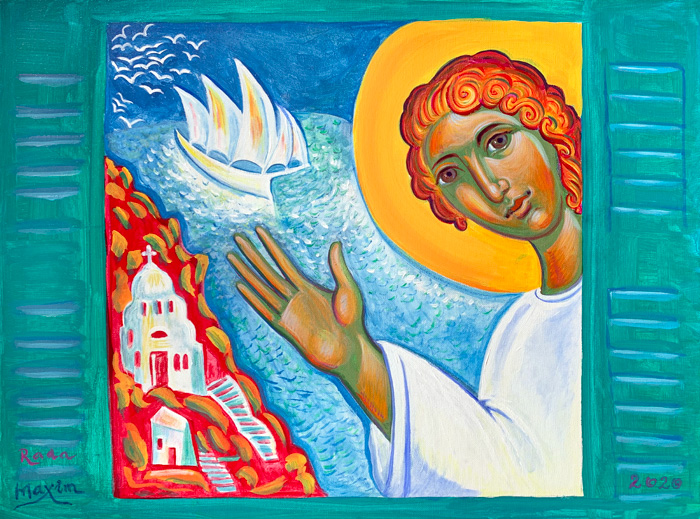
- Details
- Category: Maxim
St George of San Francisco acrylic on canvas, by bp. Maxim & Radmila Vasiljevic 2020
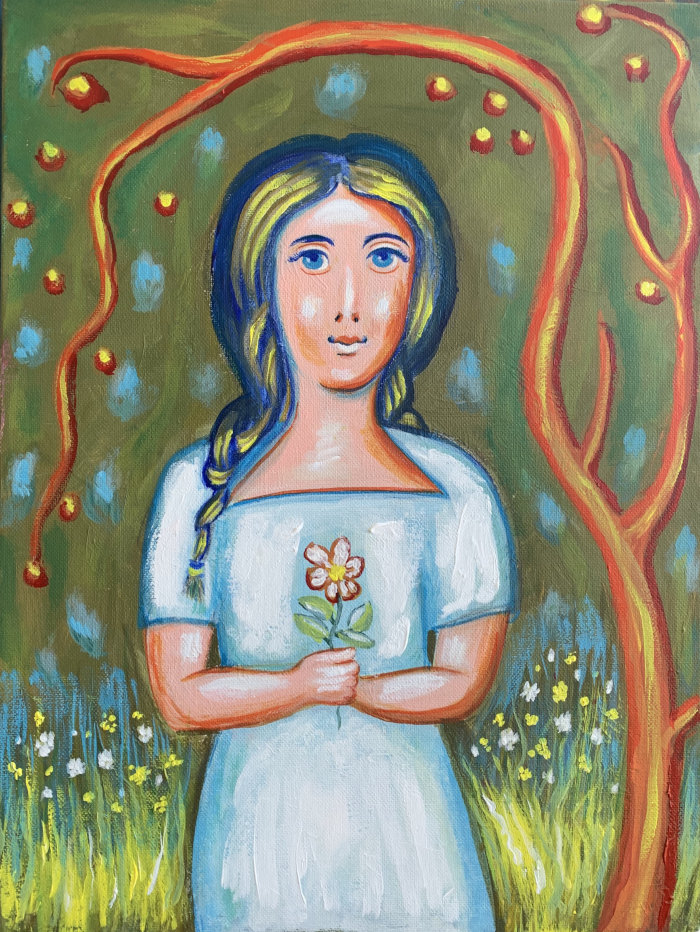
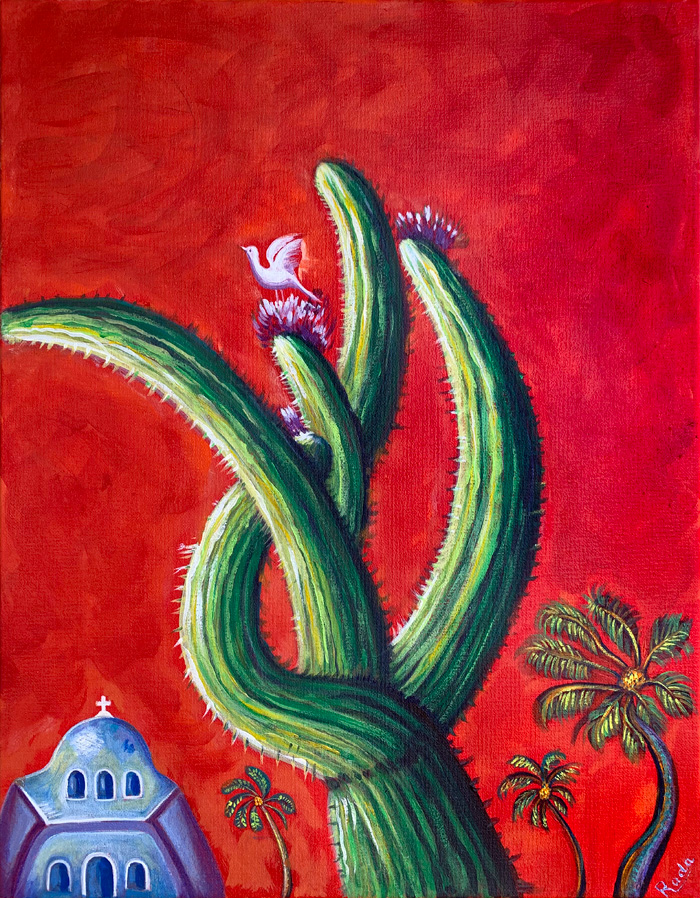
- Details
- Category: Maxim
“Cactus of Elder Ephraim of St. Anthony's”, acrylic on canvas, by Radmila Vasiljevic, 2020
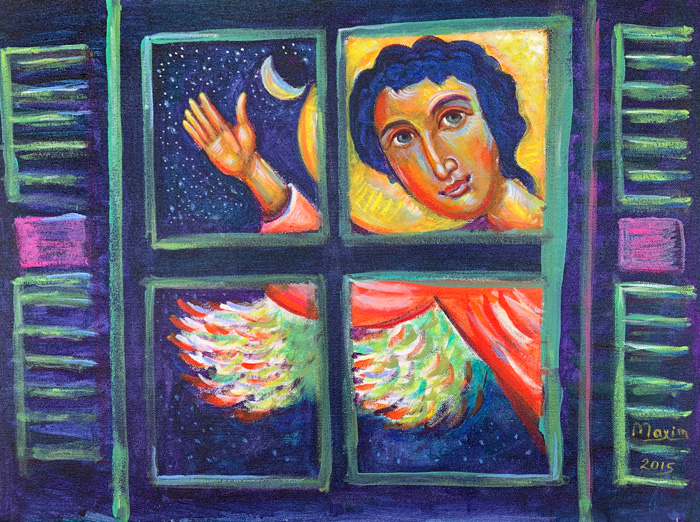
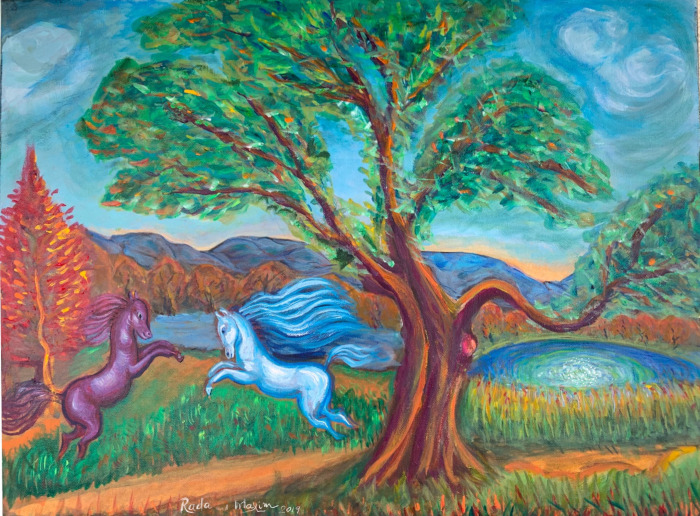
- Details
- Category: Maxim
"Horses playing", acrylic on canvas, by bp Maxim and Radmila Vasiljevic, 2019
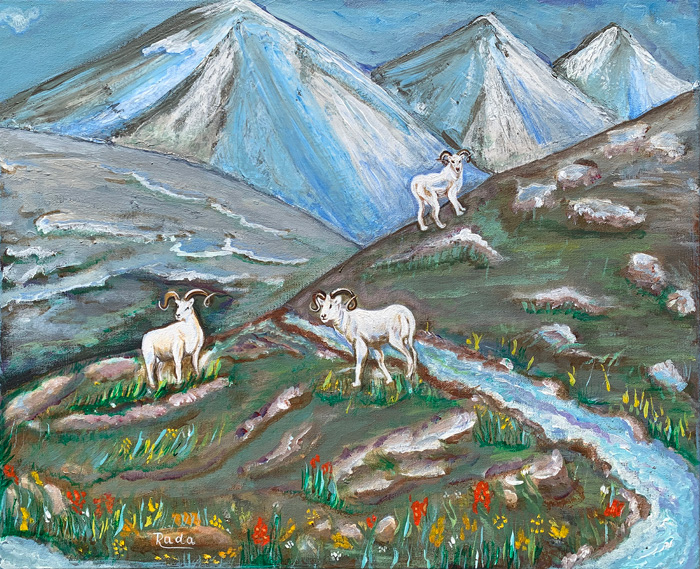
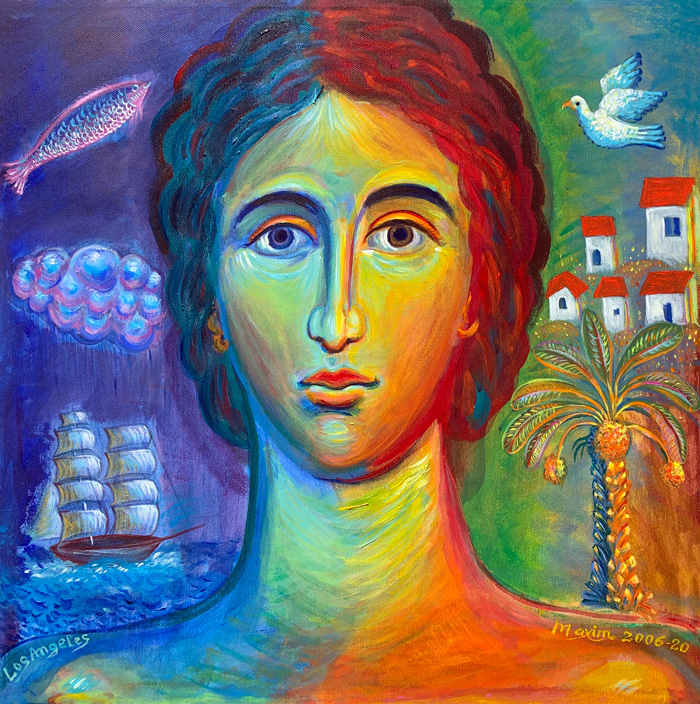
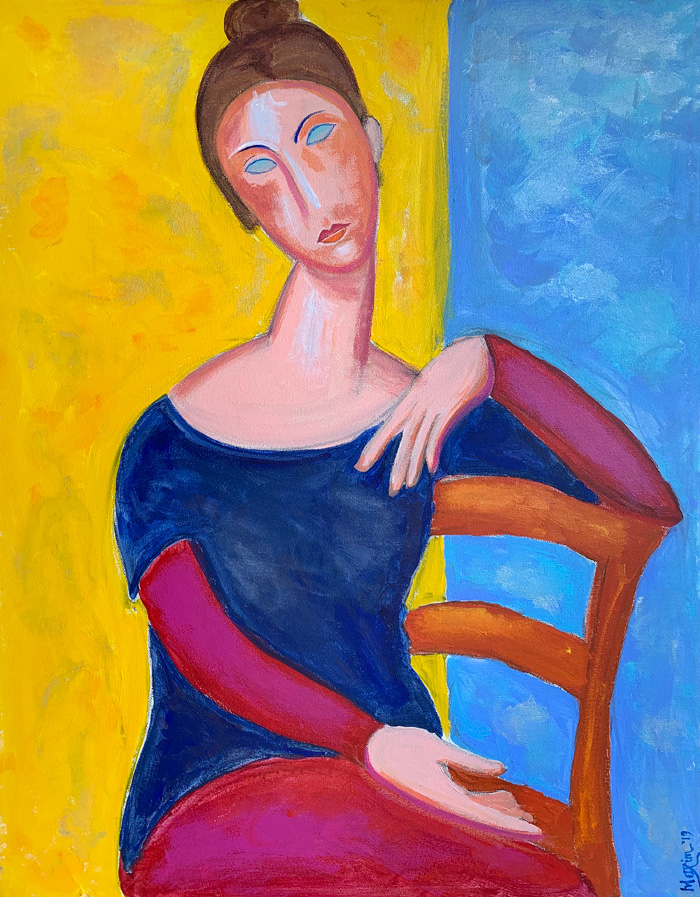
- Details
- Category: Maxim
"Mirjana", acrylic on board, by bishop Maxim, 2019
Abstract expressionism inspired by Modigliani. The plain background offers no distractions and allows us to gaze at the model’s beauty and her serene expressions. Modigliani would not paint the model’s eyes because they were too beautiful and too intimate. Elongated, angular lines and the sculptural tranquility on the sitter’s face allows for the possibility of the grasp of model’s personality through the eyes. The blue color of the empty eyes for this case matches with the blue background color on the right side as if we see the background through the empty eyes. When Modigliani left the eyes empty, it is considered that he then had difficulties in understanding the character of the model. Every model has more characters. For the model having an ambiguous character, he blurred the eyes, or pupils. “I will paint your eyes when I find your soul.” It seems that the model looks at the world while we look into the model’s eyes to get into her thoughts.
Abstract expressionism inspired by Modigliani. The plain background offers no distractions and allows us to gaze at the model’s beauty and her serene expressions. Modigliani would not paint the model’s eyes because they were too beautiful and too intimate. Elongated, angular lines and the sculptural tranquility on the sitter’s face allows for the possibility of the grasp of model’s personality through the eyes. The blue color of the empty eyes for this case matches with the blue background color on the right side as if we see the background through the empty eyes. When Modigliani left the eyes empty, it is considered that he then had difficulties in understanding the character of the model. Every model has more characters. For the model having an ambiguous character, he blurred the eyes, or pupils. “I will paint your eyes when I find your soul.” It seems that the model looks at the world while we look into the model’s eyes to get into her thoughts.
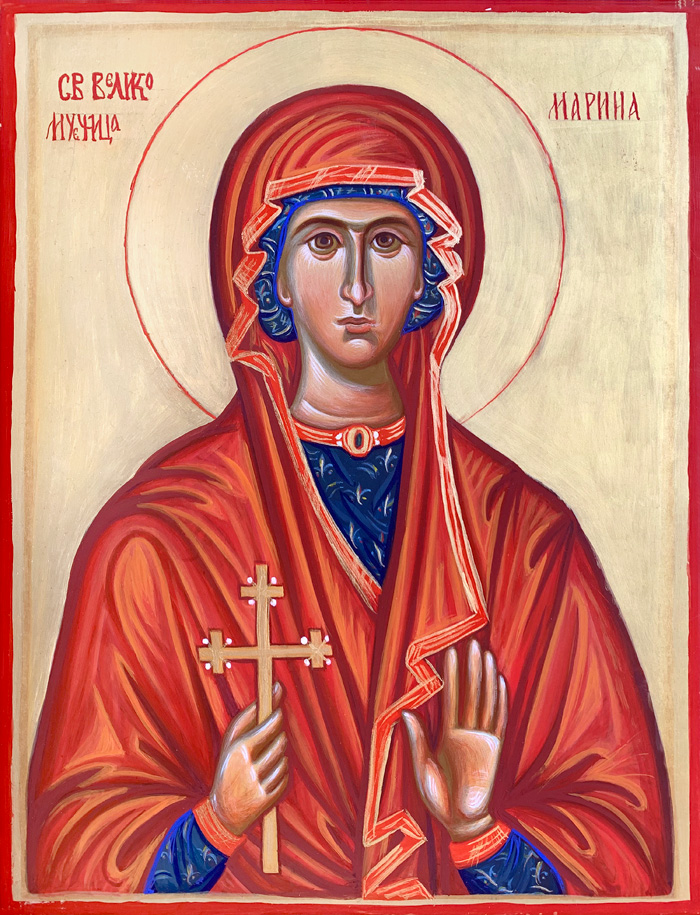
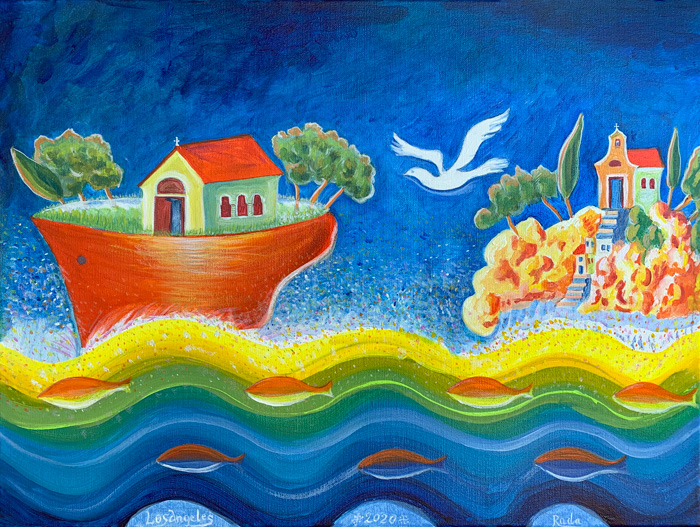
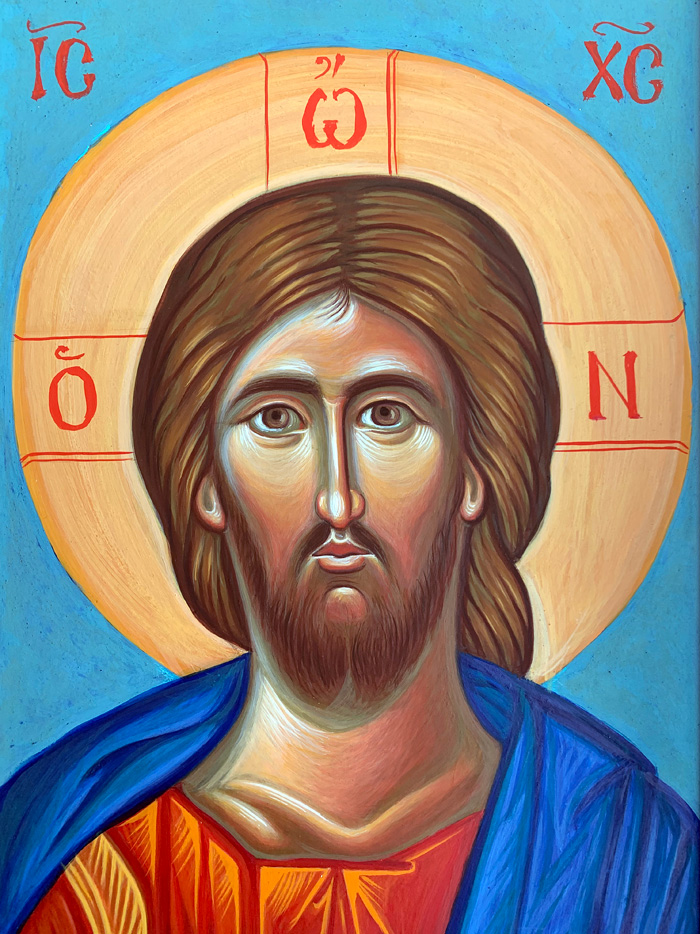
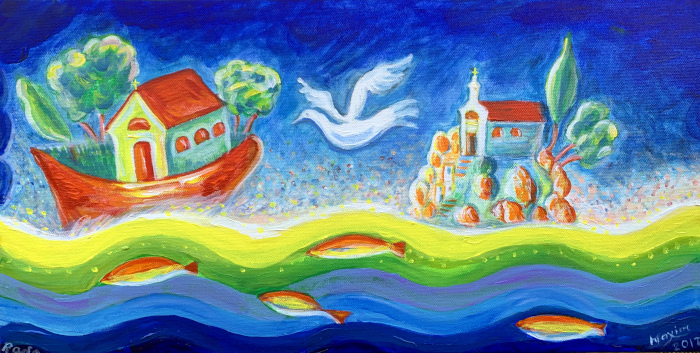
- Details
- Category: Maxim
“Ship of Salvation”, acrylic on canvas, by bishop Maxim and Radmila Vasiljevic, 2020
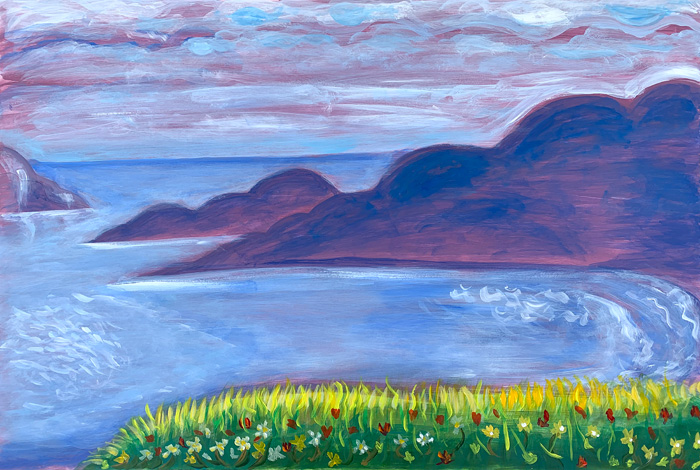
- Details
- Category: Maxim
“Flathead Lake Montana”, acrylic on board, by bp. Maxim and Radmila Vasiljevic, 2020
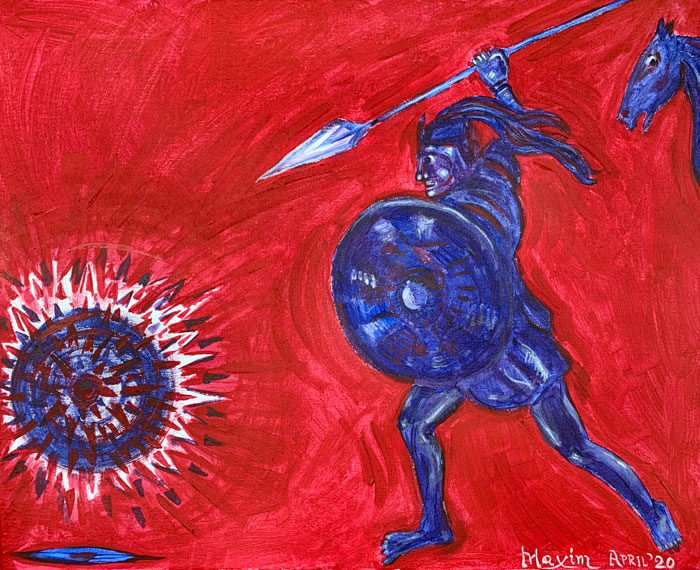
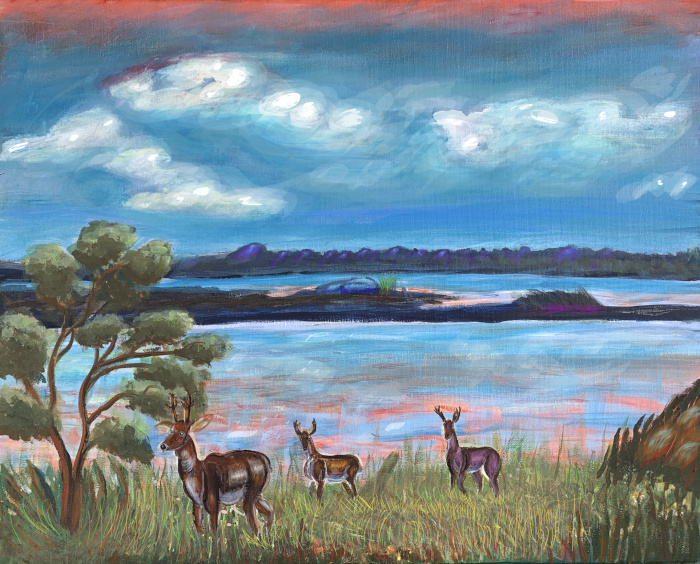
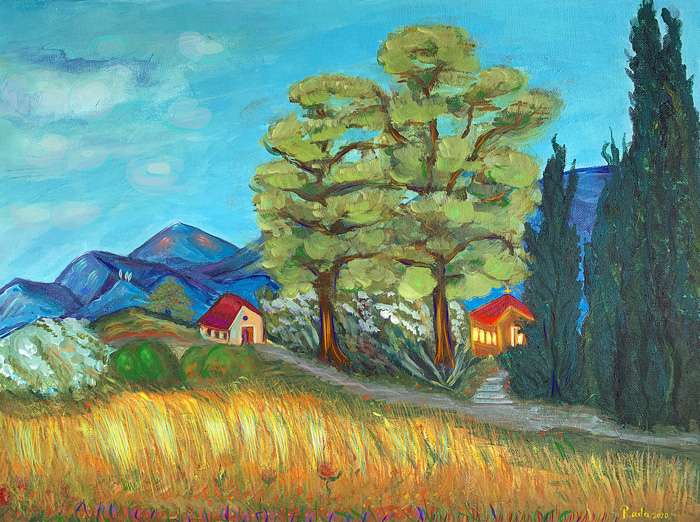
- Details
- Category: Maxim
"Summer Pascha in a Skete in the North Star", acrylic on canvas, Radmila Vasiljevic, 2020
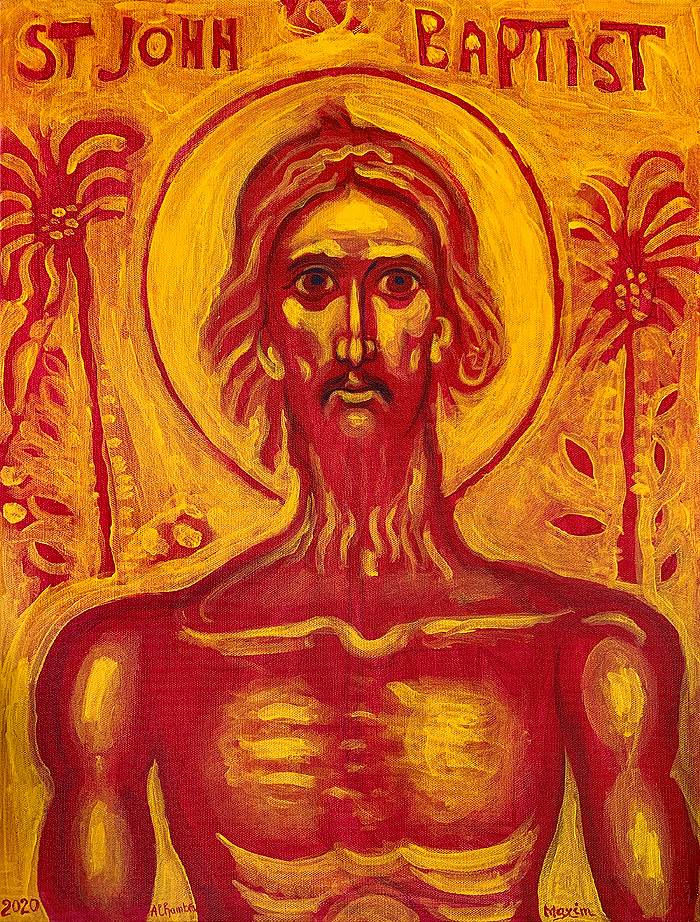
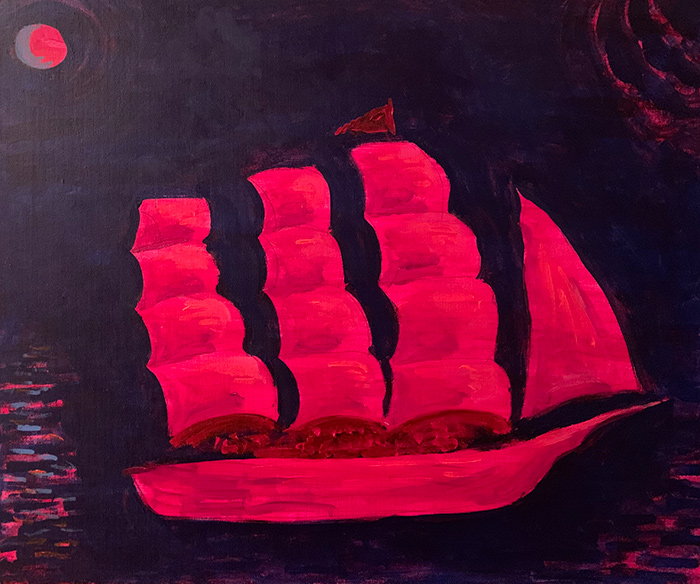
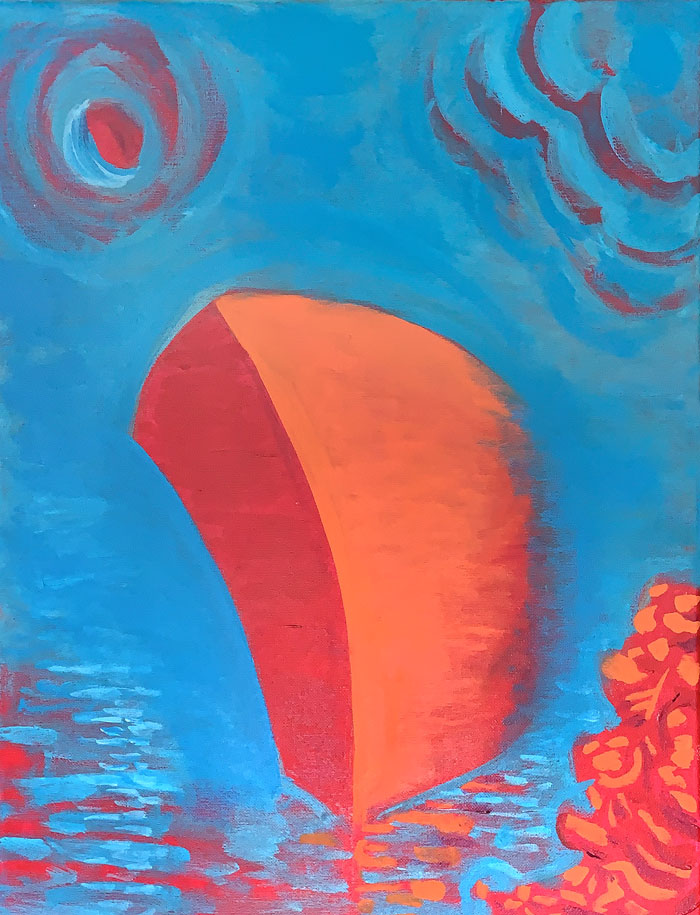
- Details
- Category: Maxim
"The Boat we are Waiting for", acrylic on canvas, Alhambra, 2019
It is night on the island. We are waiting for the boat. It has been two days. Suddenly, the boat is approaching, coming out of the void, to take us on a voyage.
It is night on the island. We are waiting for the boat. It has been two days. Suddenly, the boat is approaching, coming out of the void, to take us on a voyage.
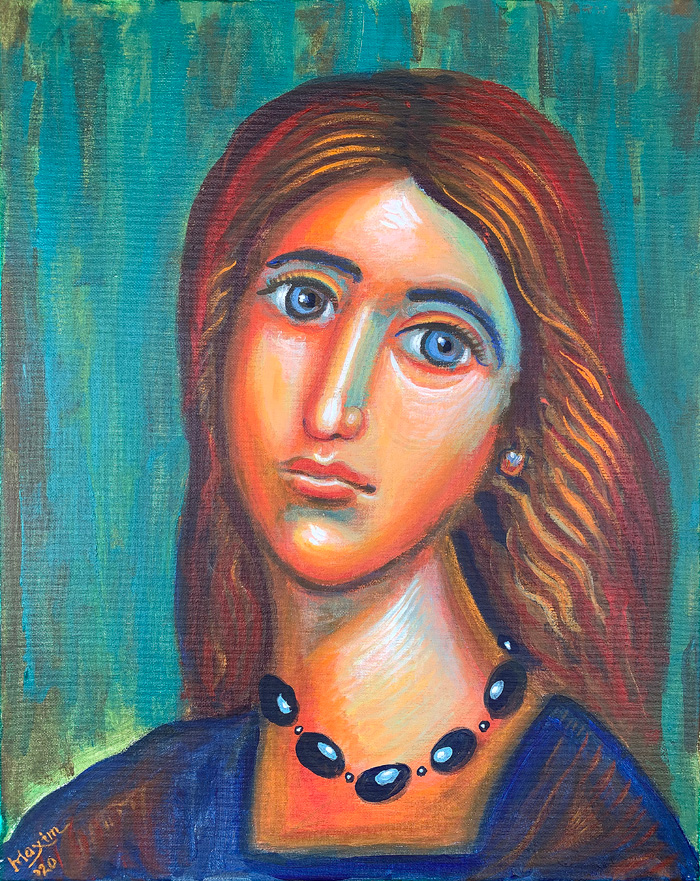
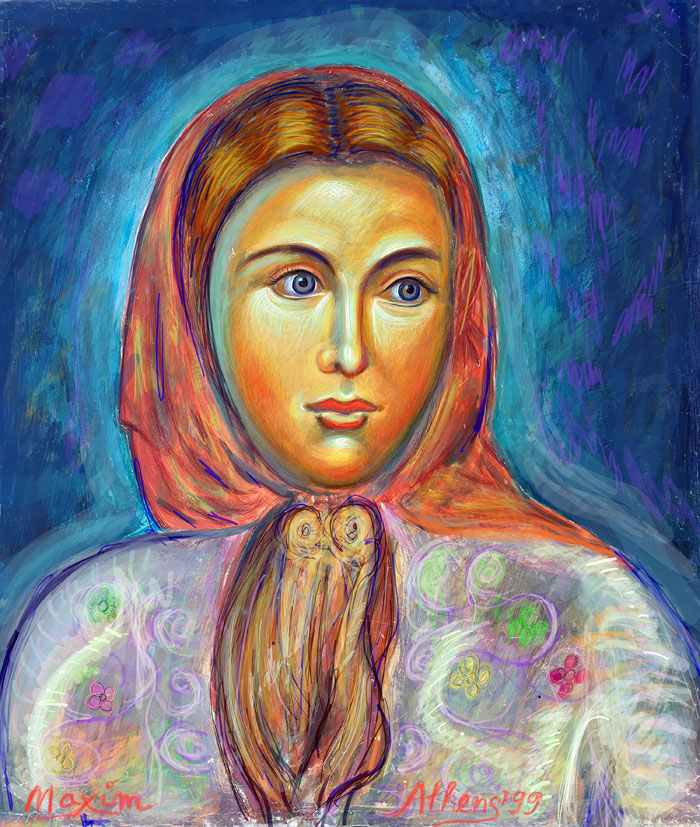
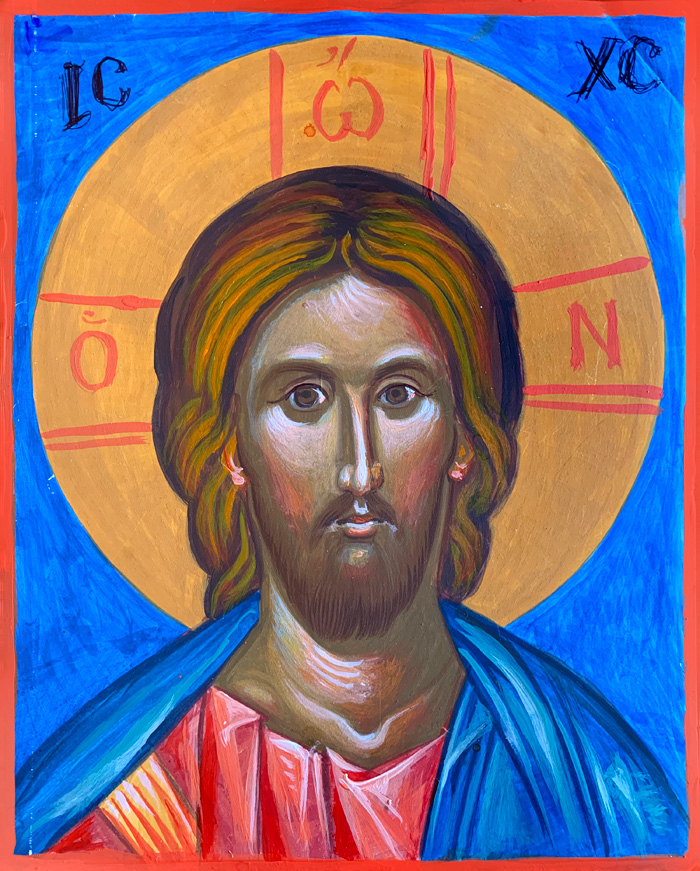
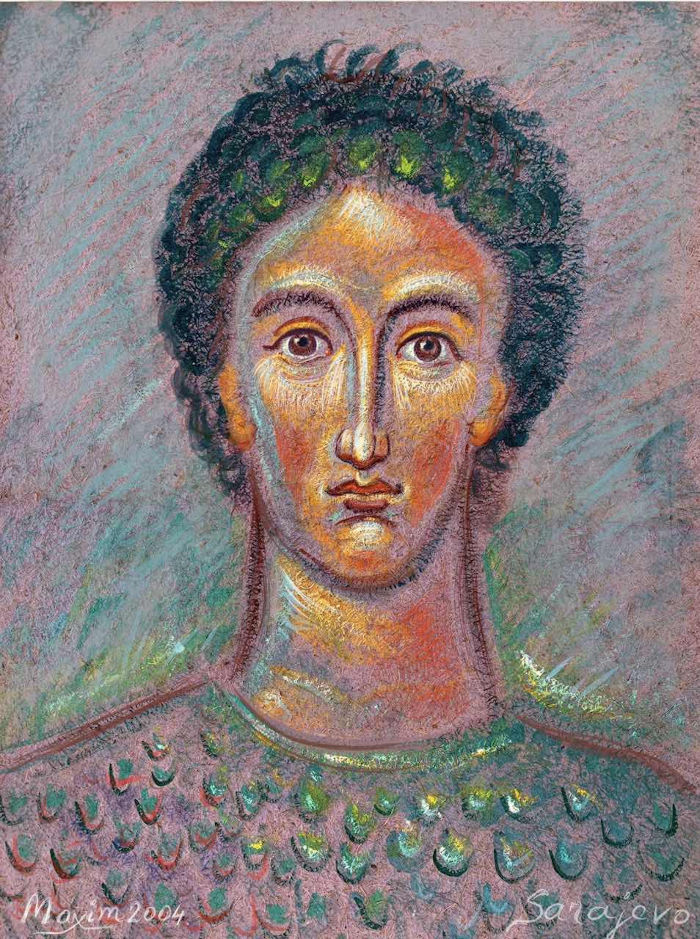
- Details
- Category: Maxim
"A Young Man Before the Martyrdom", acrylic on cardboard box, 2004
The painting depicts the moment before the martyrdom of a man of noble blood. He is portrayed standing anxiously in modesty and courage. The painter has instilled feeling into his colors, mingling humility with bravery, two naturally contradictory feelings.
The painting depicts the moment before the martyrdom of a man of noble blood. He is portrayed standing anxiously in modesty and courage. The painter has instilled feeling into his colors, mingling humility with bravery, two naturally contradictory feelings.
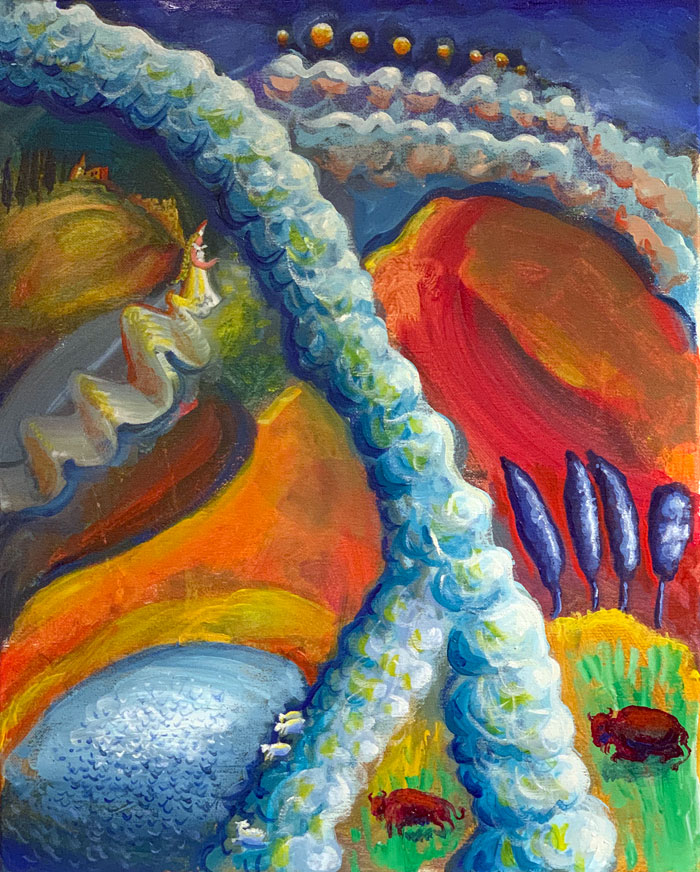
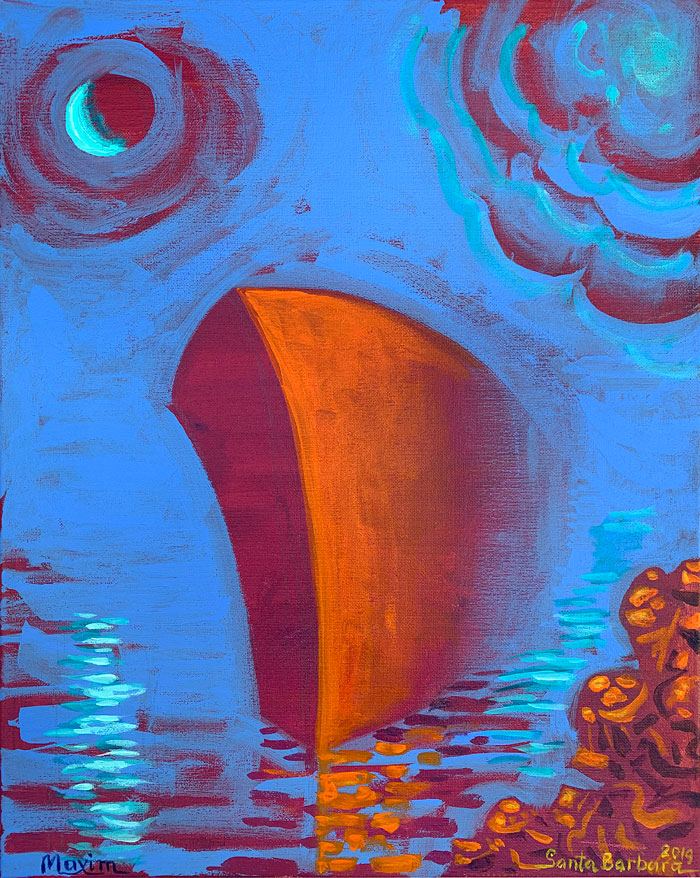
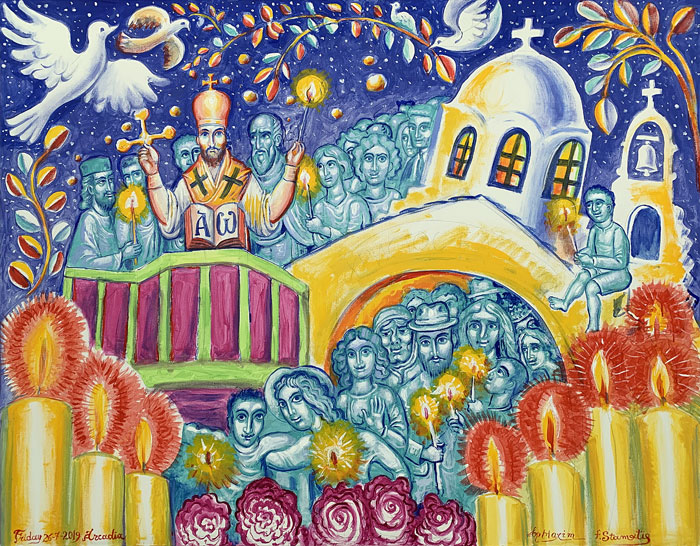
- Details
- Category: Maxim
"Lambri", or "How the Orthodox celebrate the Night of the Resurrection", acrylic on canvas, 2019
It is a gladness of soul, a record of the Eucharist's experience, that all these years I thanked my Parish, with all these people of God who came to for the vigil on the Holy Saturday night outside the temple with smiling faces and candles in their hands and celebrating Christ who was THEIR OWN.
It is a gladness of soul, a record of the Eucharist's experience, that all these years I thanked my Parish, with all these people of God who came to for the vigil on the Holy Saturday night outside the temple with smiling faces and candles in their hands and celebrating Christ who was THEIR OWN.
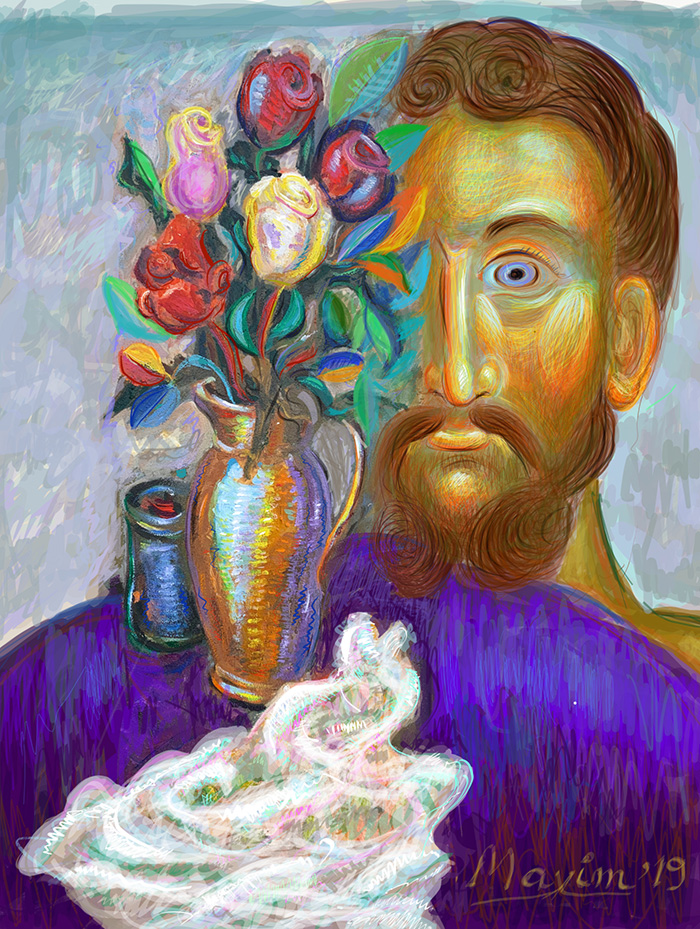
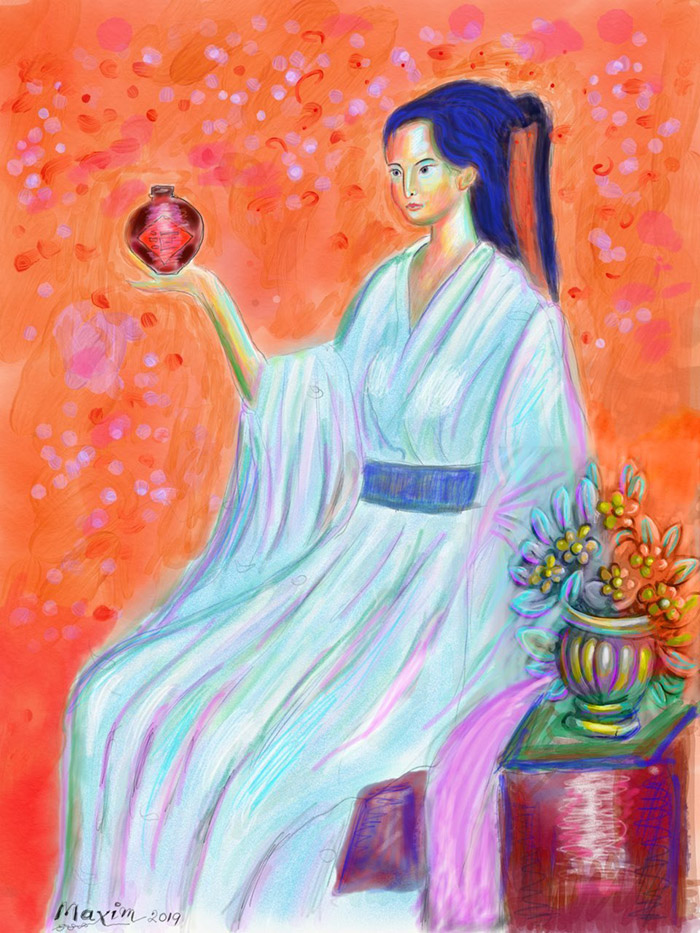
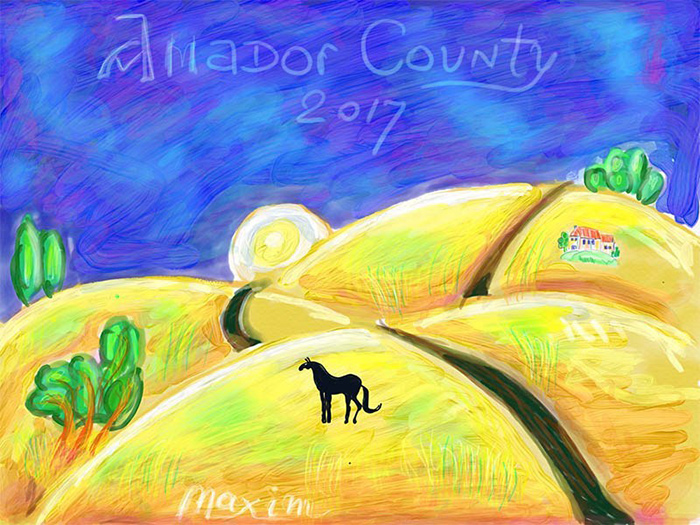
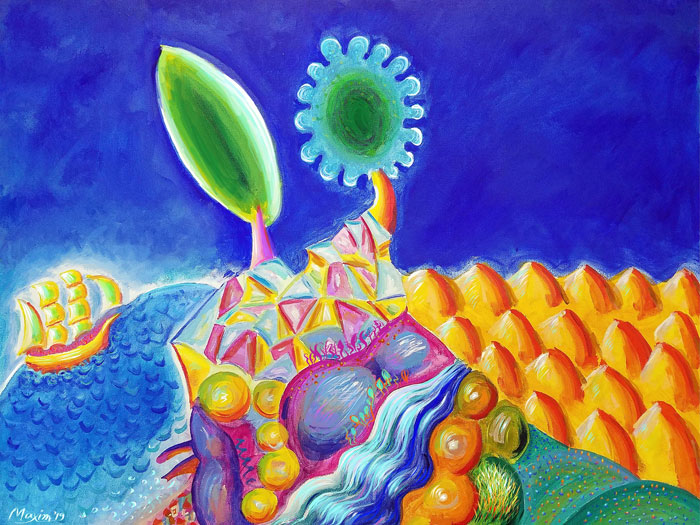
- Details
- Category: Maxim
Californian Impressionism, 2019
Travel companions with creation. Creation “bends” over our “journeys.” It beautifies and enriches the journey of our life.
Travel companions with creation. Creation “bends” over our “journeys.” It beautifies and enriches the journey of our life.
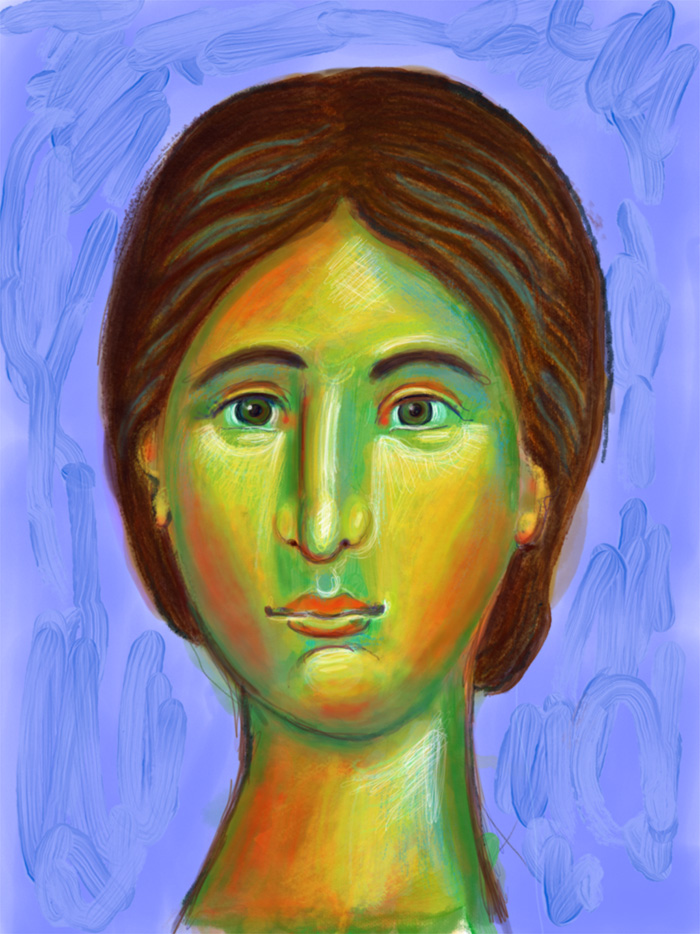
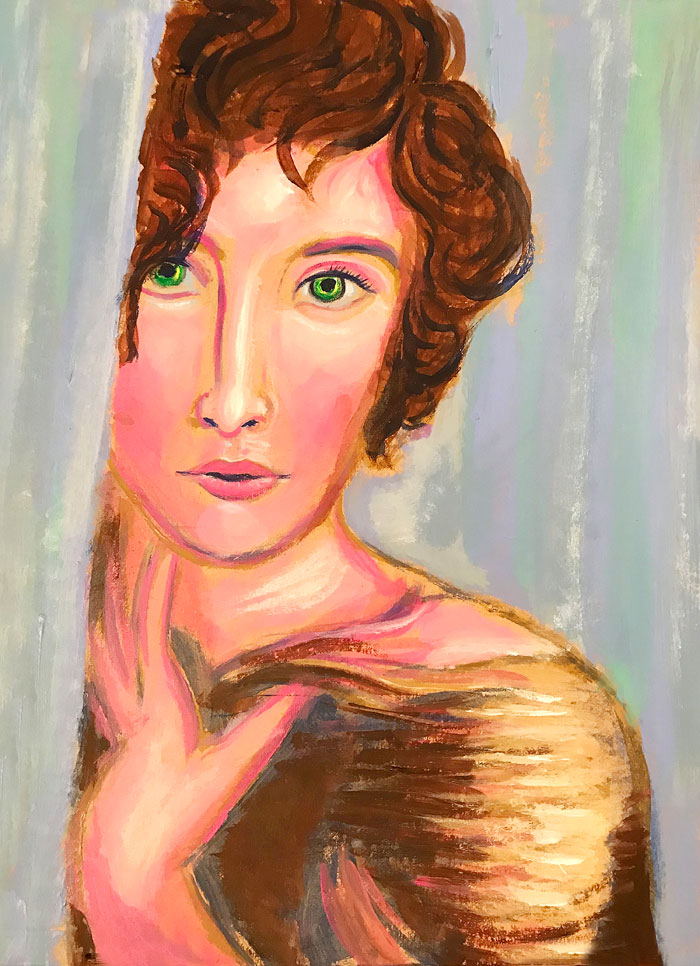
- Details
- Category: Maxim
"Veiled Discovery", acrylic on carton board, Bishop Maxim, 2018
This acrylic painting on carton paper skillfully captures a moment of intrigue and innocence. The subject, a woman, is partially concealed behind a curtain, revealing only her face and shoulder, creating a sense of mystery. Her expression, a mix of curiosity and surprise, is delicately rendered, highlighting her complex character. The curtain serves as both a secretive veil and a frame for her face, while the carton paper's texture adds a rustic touch to the vivid portrayal. The interplay of light and shadow accentuates her features, adding depth to this captivating composition that eloquently conveys the subject's emotions and the artist's proficiency in acrylics.
This acrylic painting on carton paper skillfully captures a moment of intrigue and innocence. The subject, a woman, is partially concealed behind a curtain, revealing only her face and shoulder, creating a sense of mystery. Her expression, a mix of curiosity and surprise, is delicately rendered, highlighting her complex character. The curtain serves as both a secretive veil and a frame for her face, while the carton paper's texture adds a rustic touch to the vivid portrayal. The interplay of light and shadow accentuates her features, adding depth to this captivating composition that eloquently conveys the subject's emotions and the artist's proficiency in acrylics.
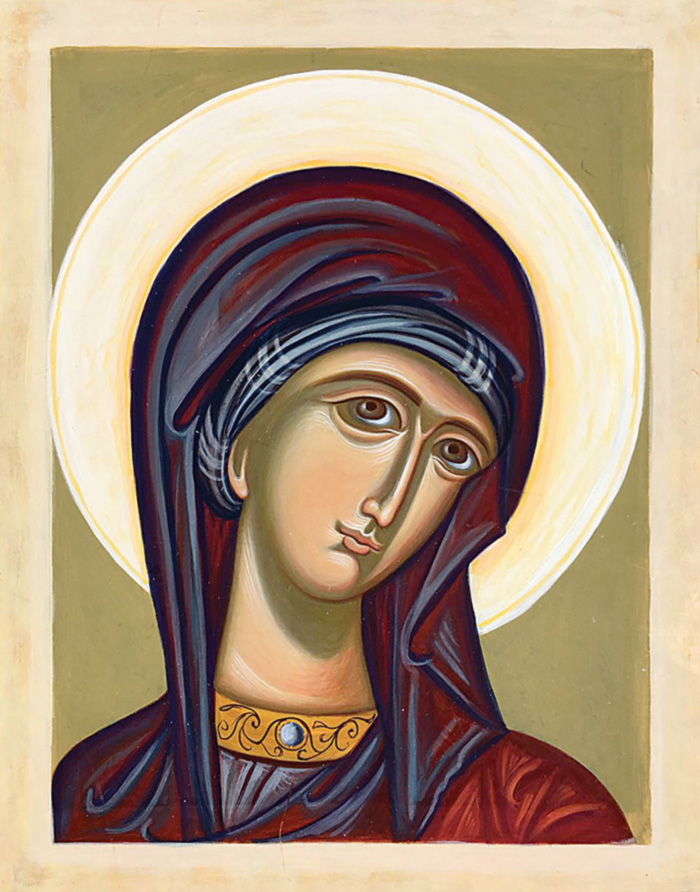
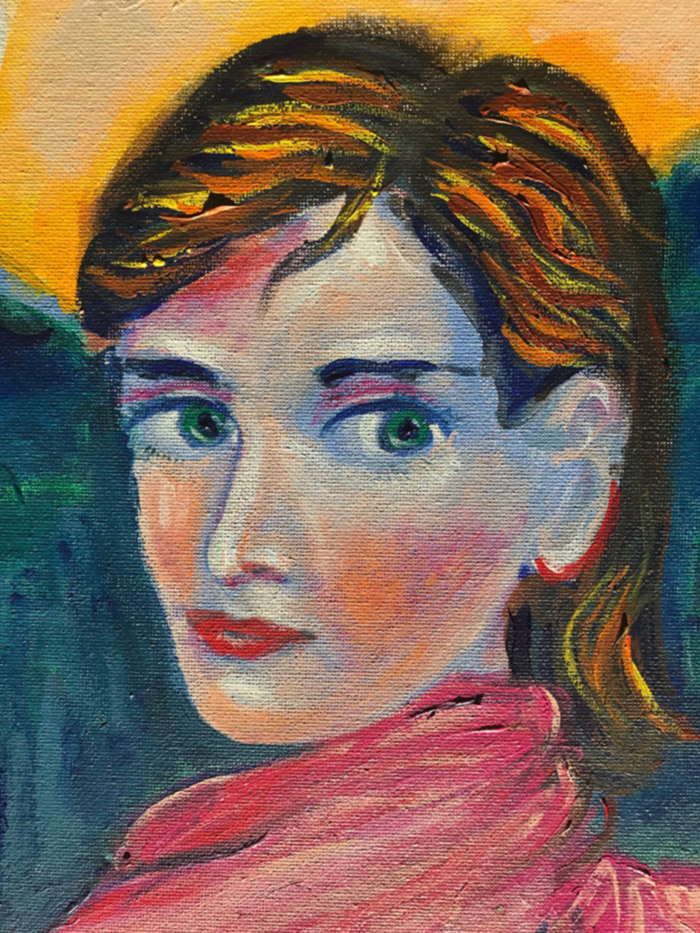
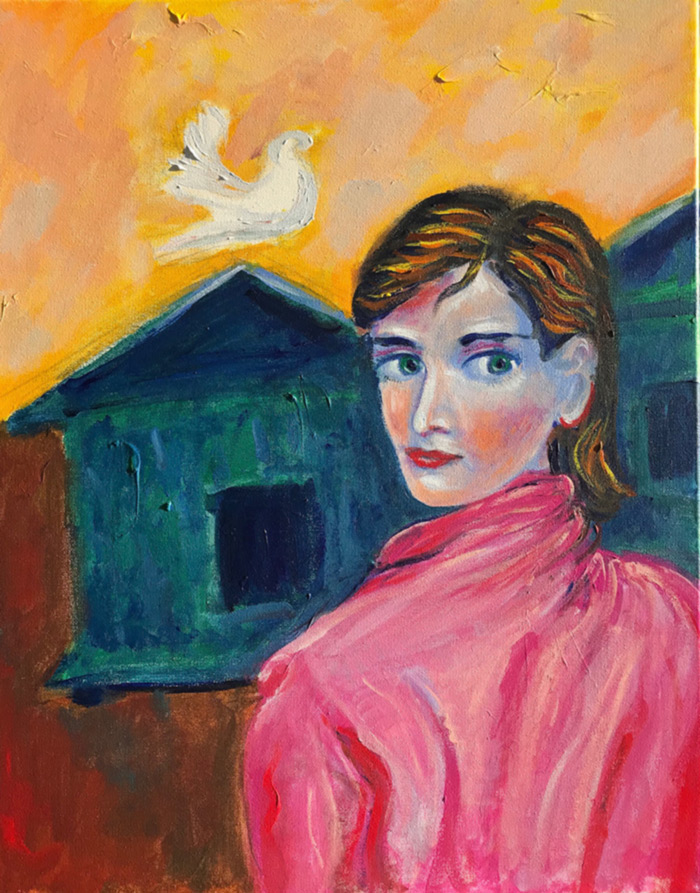
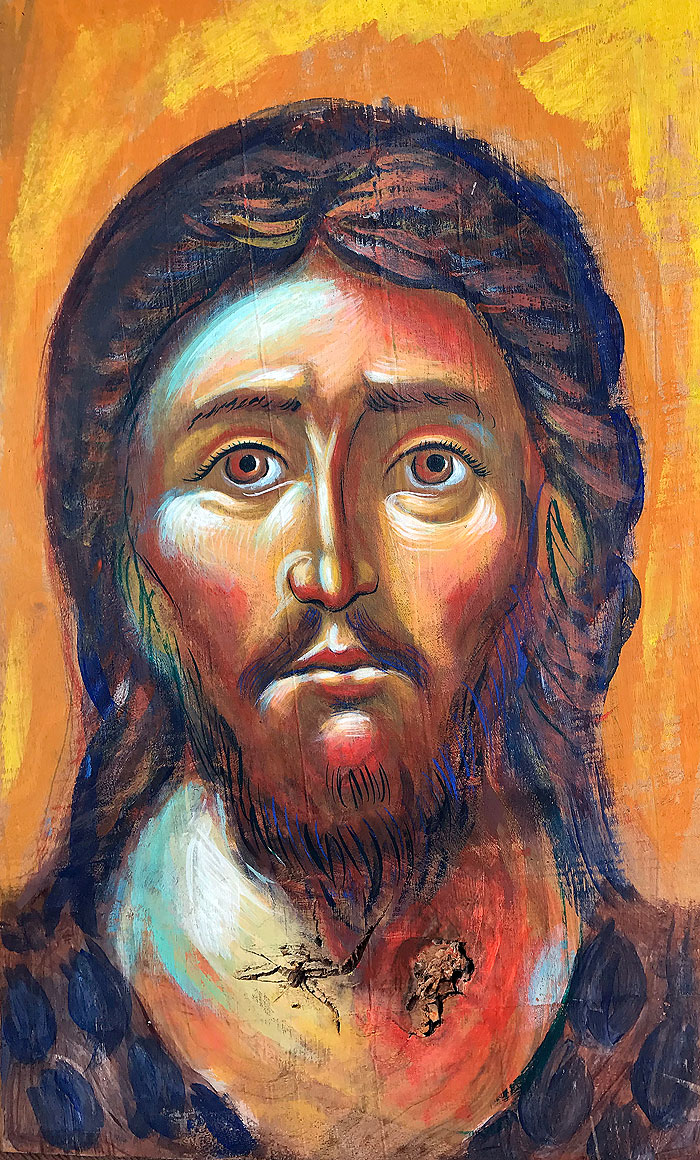
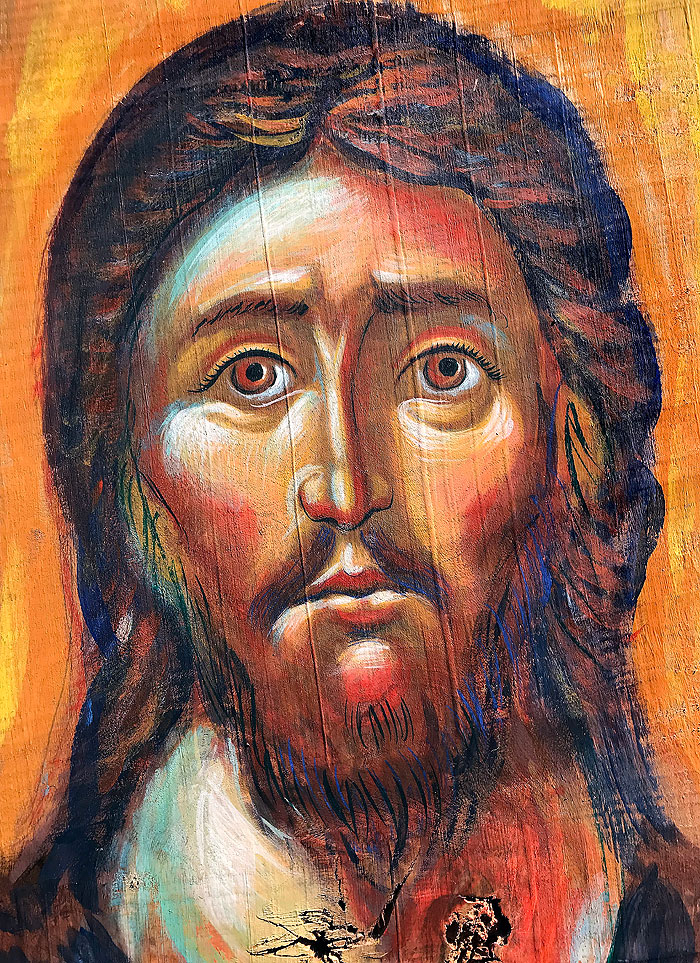
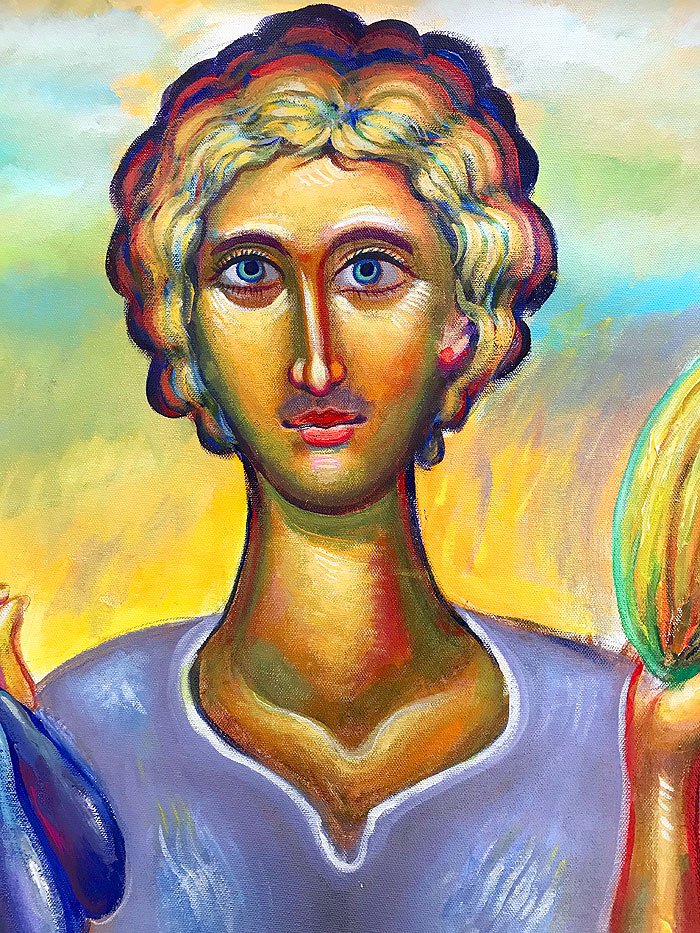
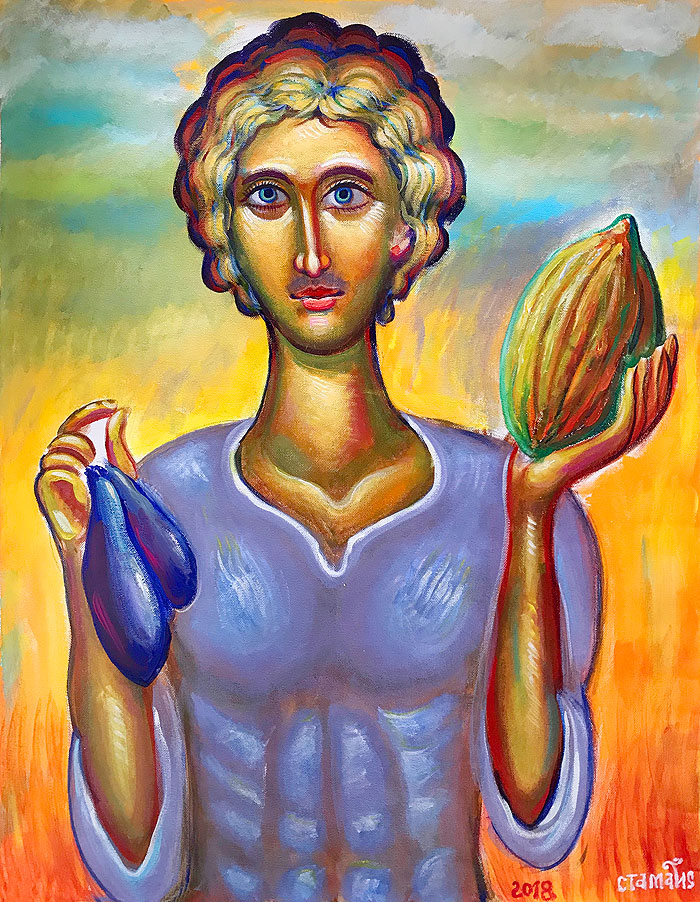
- Details
- Category: Maxim
"August in Herzegovina", acrylic on canvas, Father Stamatis Skliris and Bishop Maxim, 2021
A radiant figure stands against a glowing August sky, his hands bearing the fruits of East Herzegovina—plump eggplants in one, a ripened melon or fig in the other. His youthful form, both strong and serene, reflects the harmony of man and land at the height of the harvest season. Behind him, the warm light of the month burns like a blessing. He is both a reaper and a witness to the divine rhythm of nature.
A radiant figure stands against a glowing August sky, his hands bearing the fruits of East Herzegovina—plump eggplants in one, a ripened melon or fig in the other. His youthful form, both strong and serene, reflects the harmony of man and land at the height of the harvest season. Behind him, the warm light of the month burns like a blessing. He is both a reaper and a witness to the divine rhythm of nature.
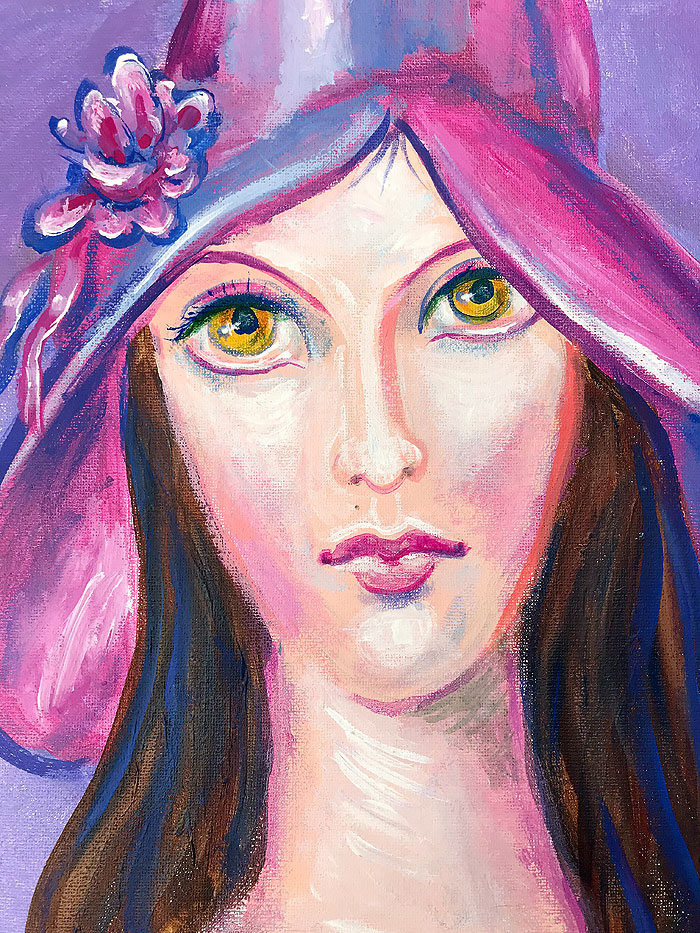
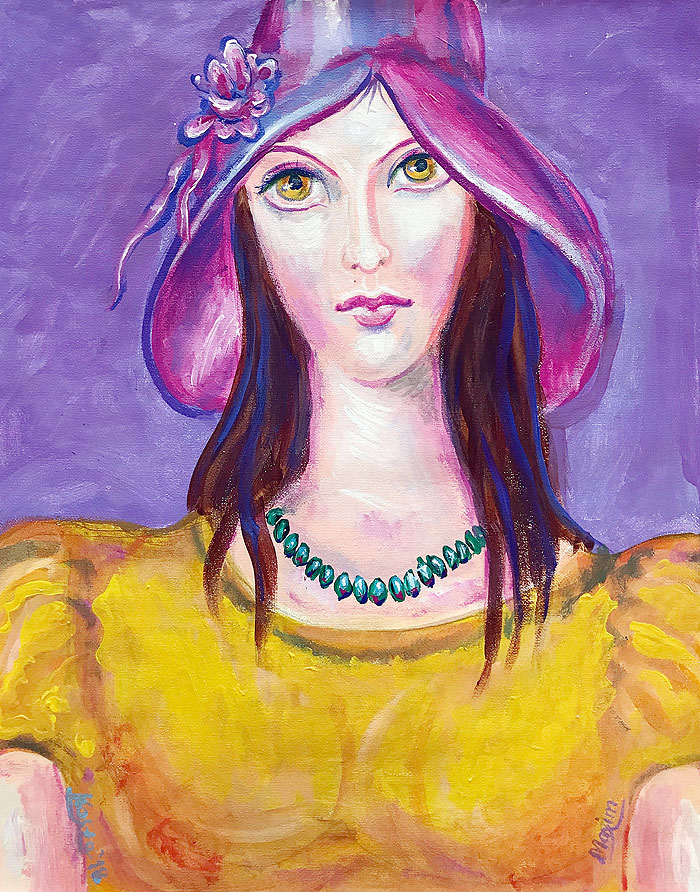
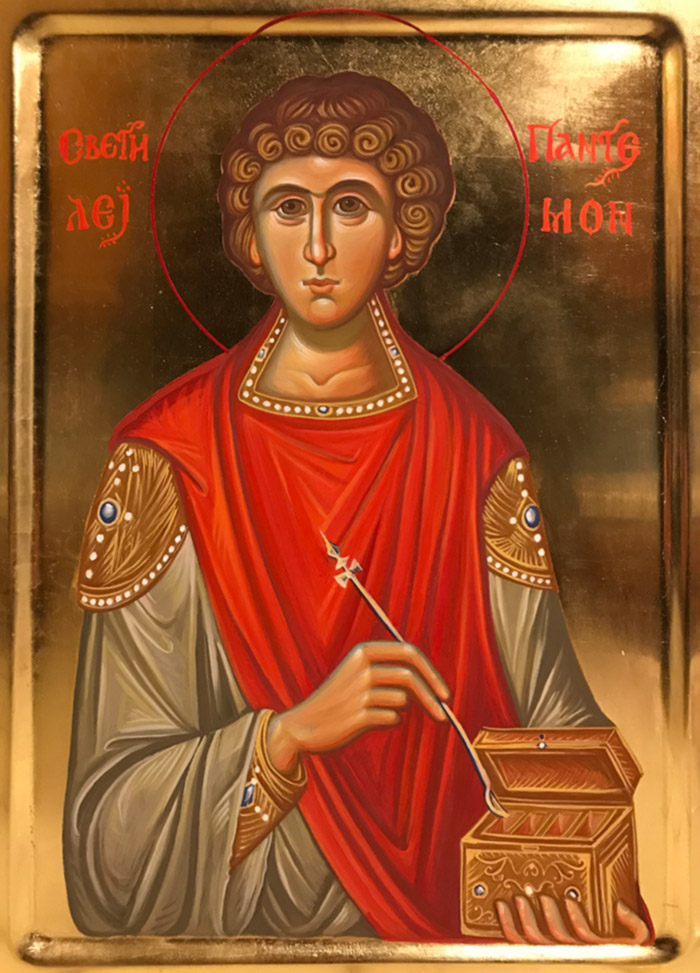
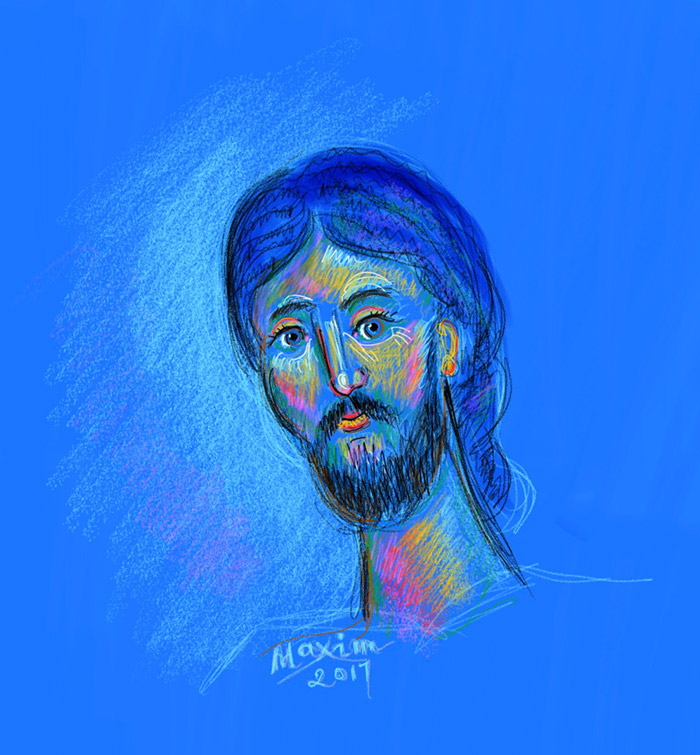
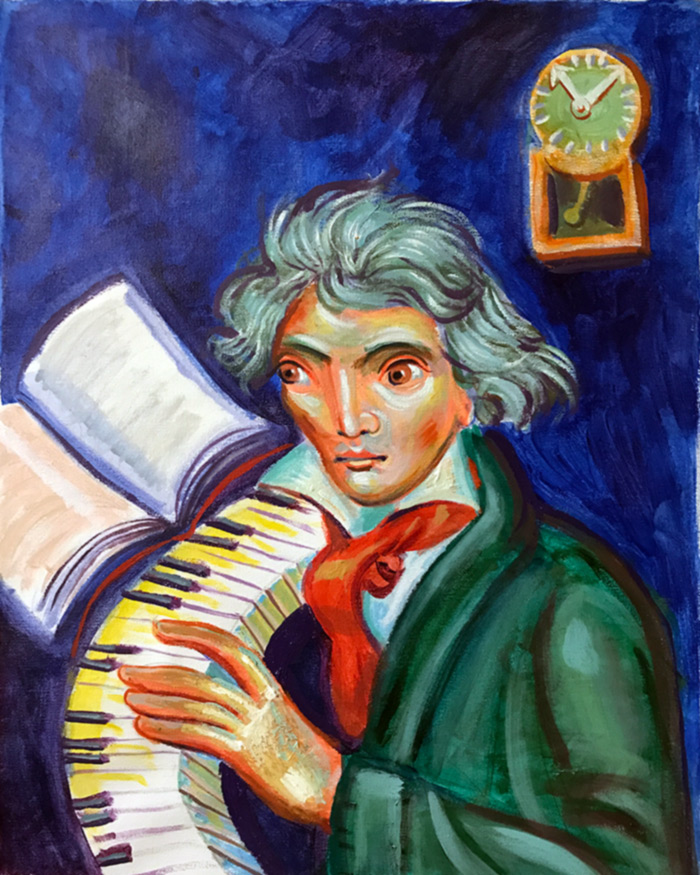
- Details
- Category: Maxim
"Beethoven", acrylic on canvas, by Bishop Maxim, october 2017
This is a surprising "Beethoven". Hair flies from the urge of inspiration. The eyes - the strongest point of the painting - are in ecstasy. The red cow also participates in ecstasy. A book, a keyboard, and a clock - everything floats, terrified by the invisible waves of fate. The presence of a floating clock is important, indicating the connection between the mystery of time and the mystery of music. Beethoven's wide gaze and the semicircular keyboard indicate the comprehensiveness, enormous energy, and great momentum which envelops the drama of existence, from the germ of the Big Bang to the future mystery (Eschaton).
This is a surprising "Beethoven". Hair flies from the urge of inspiration. The eyes - the strongest point of the painting - are in ecstasy. The red cow also participates in ecstasy. A book, a keyboard, and a clock - everything floats, terrified by the invisible waves of fate. The presence of a floating clock is important, indicating the connection between the mystery of time and the mystery of music. Beethoven's wide gaze and the semicircular keyboard indicate the comprehensiveness, enormous energy, and great momentum which envelops the drama of existence, from the germ of the Big Bang to the future mystery (Eschaton).
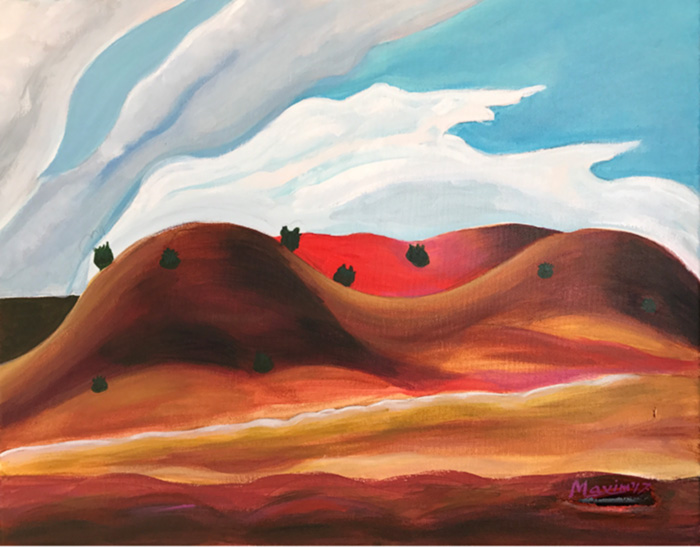
- Details
- Category: Maxim
"New Mexico", inspired by Georgia O'Keeffe, Acrylic on canvas, september 2017
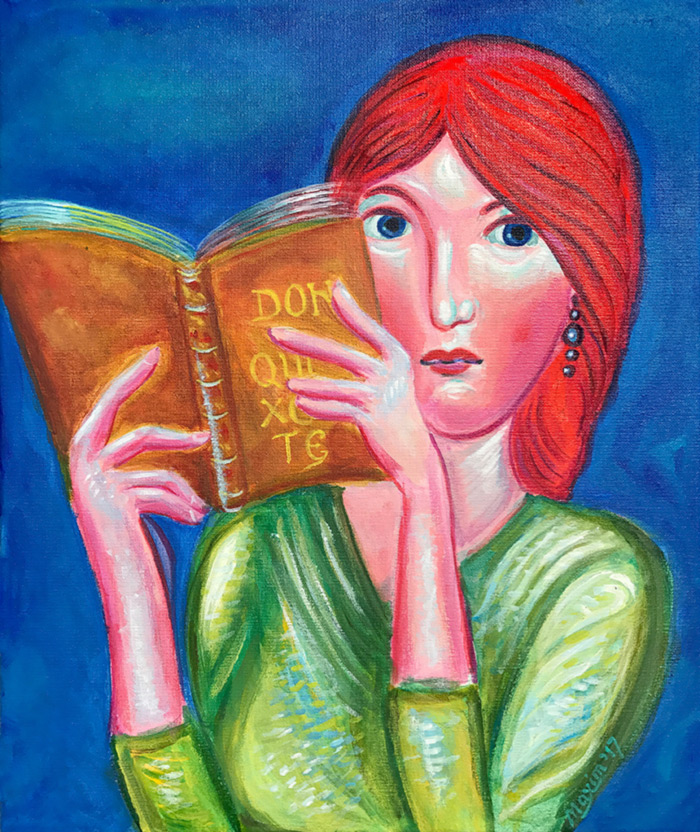
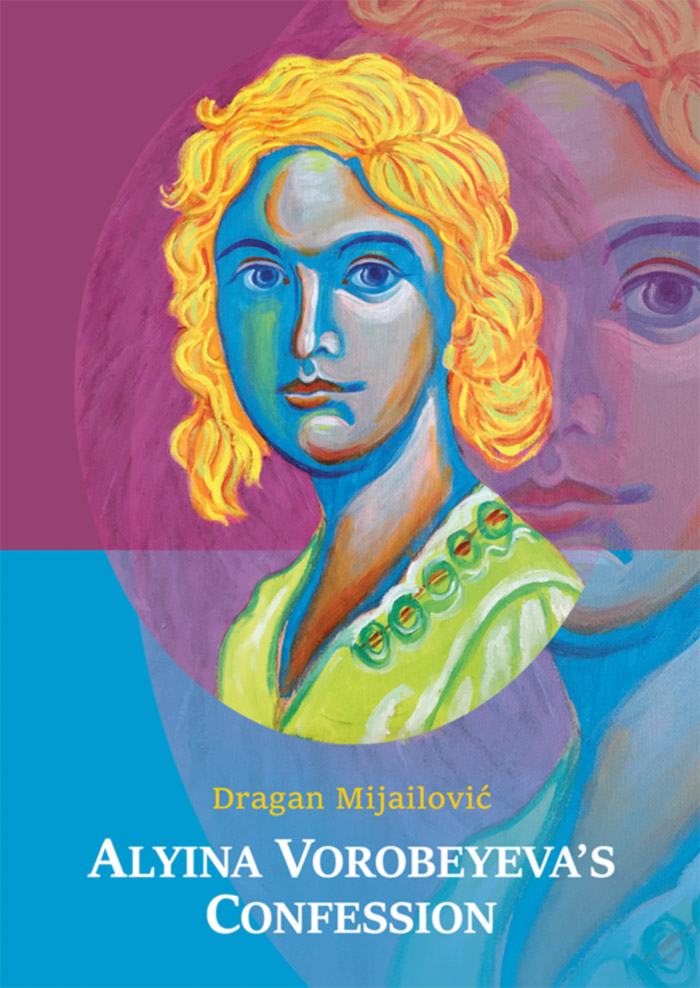
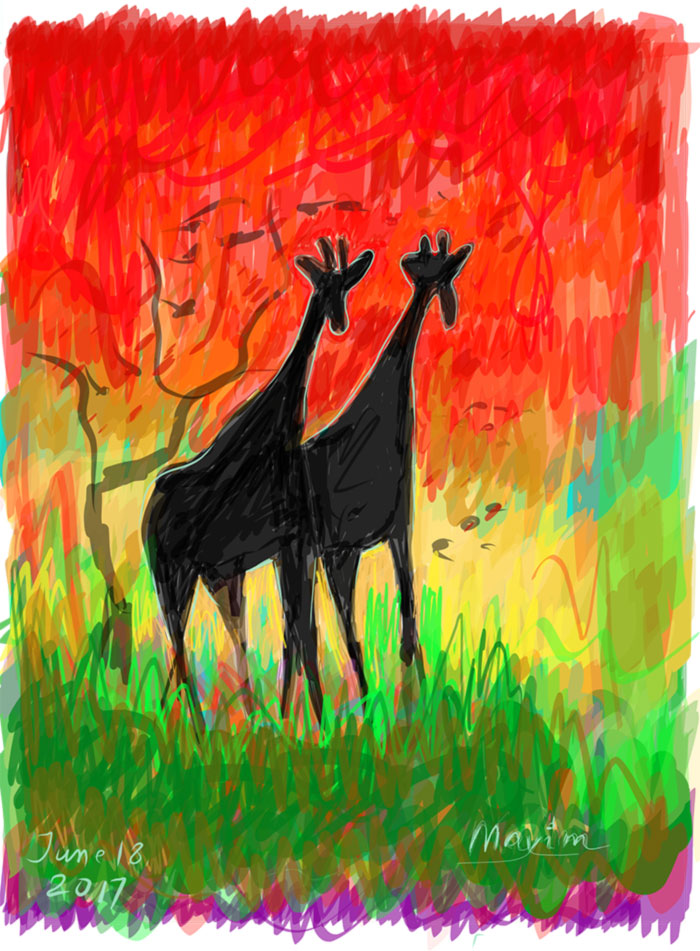
- Details
- Category: Maxim
"Safari - South Africa" (digital painting made with Adobe Illustrator Draw, iPadPro), June 18, 2017
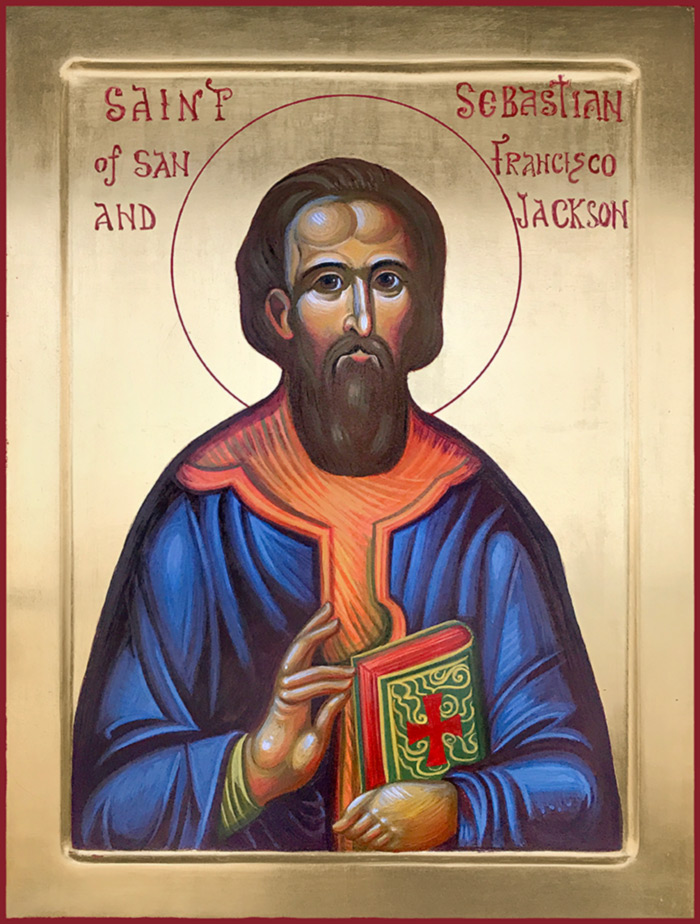
- Details
- Category: Maxim
"Saint Sebastian of San Francisco and Jackson", by Protinica Radmila and Bishop Maxim, 2017
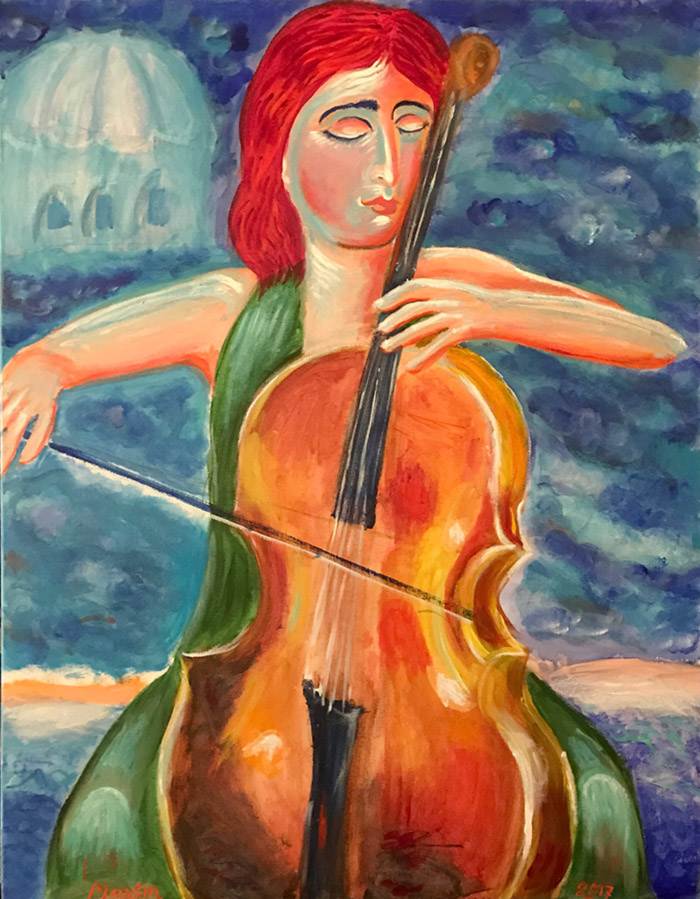
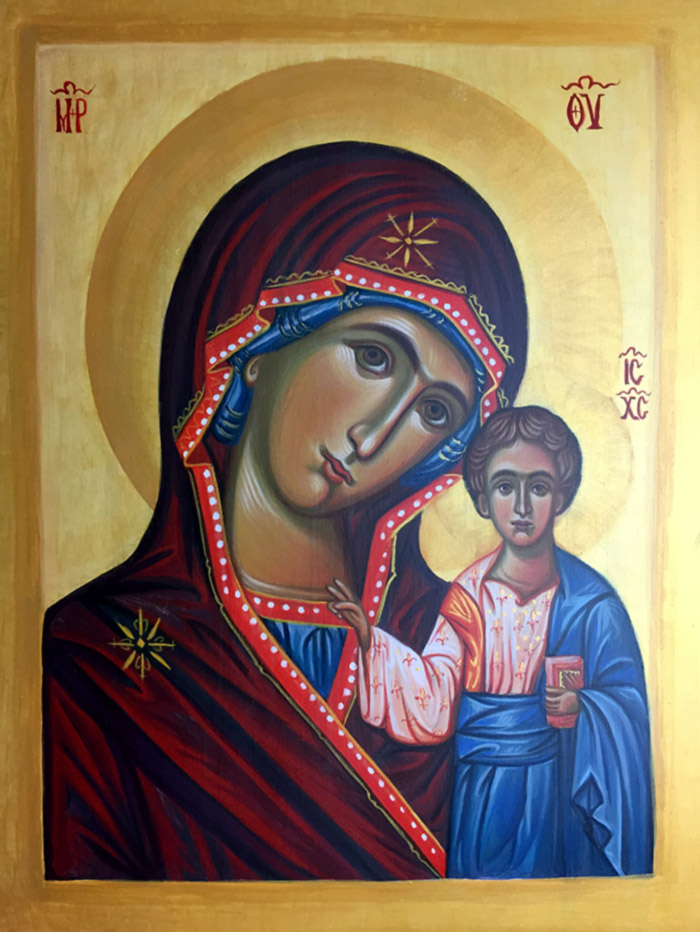
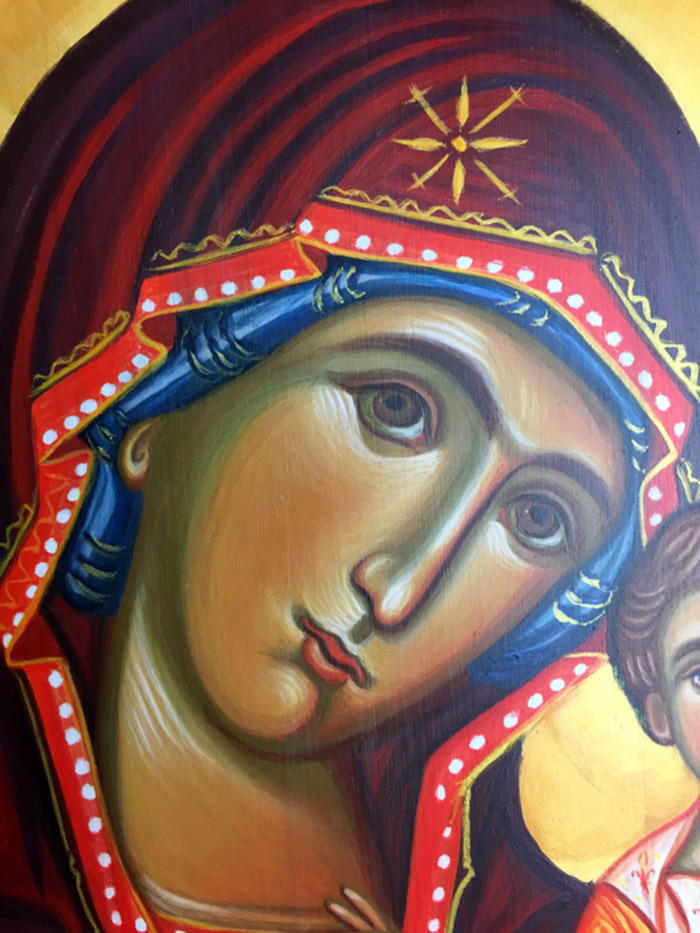
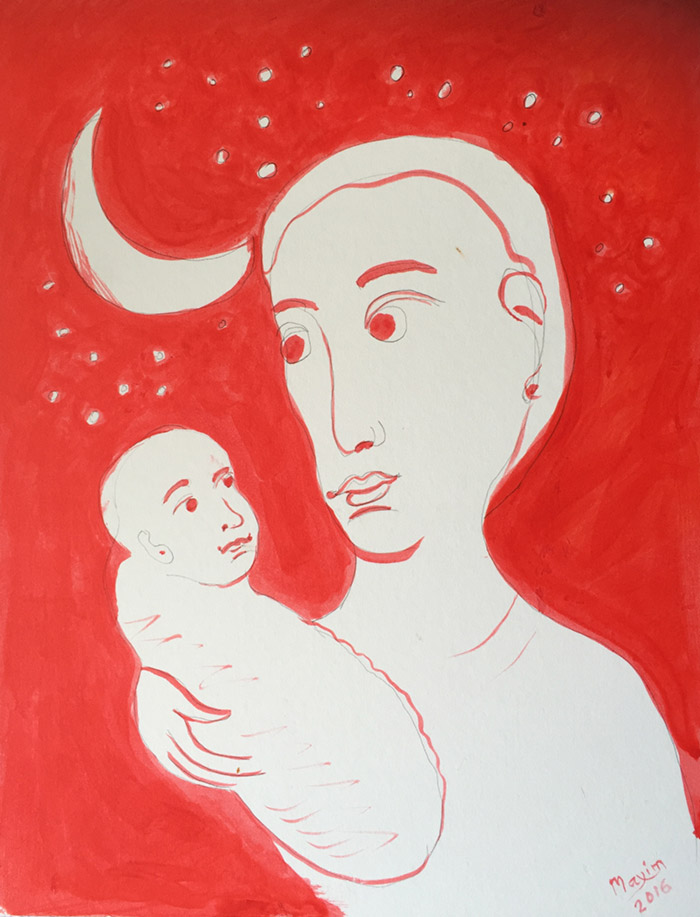
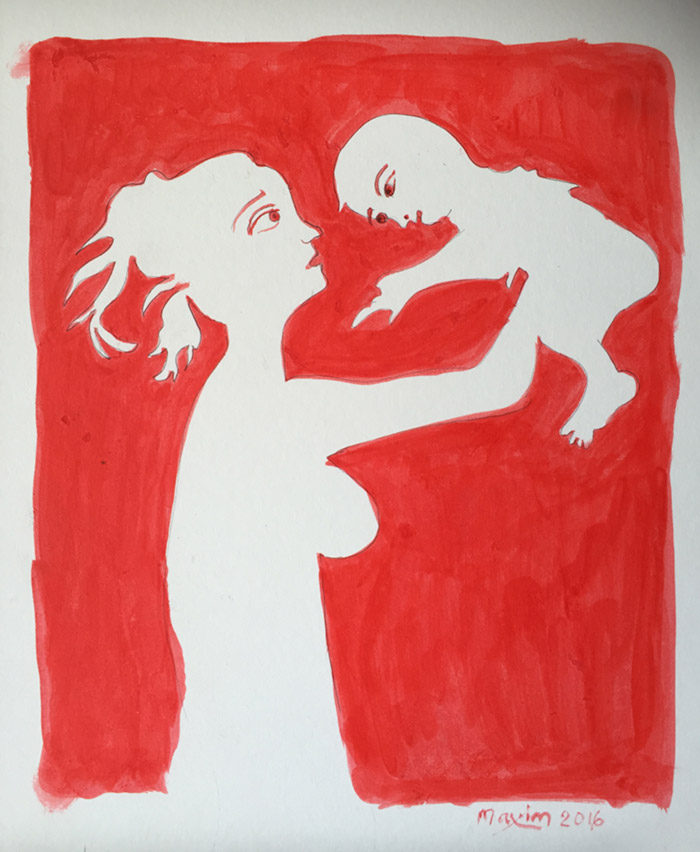
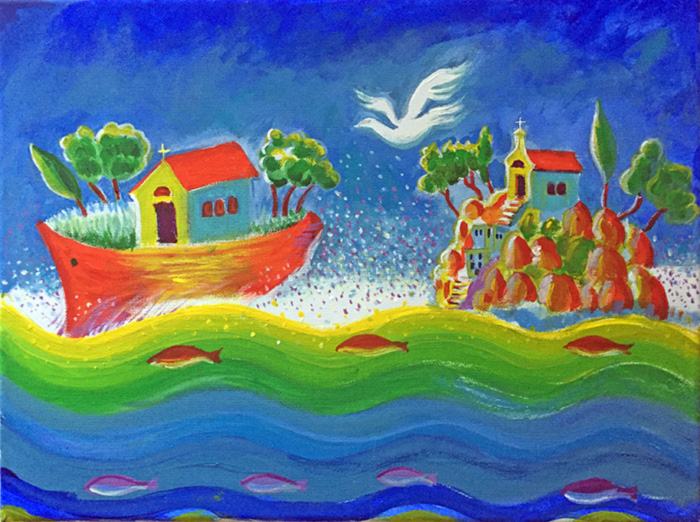
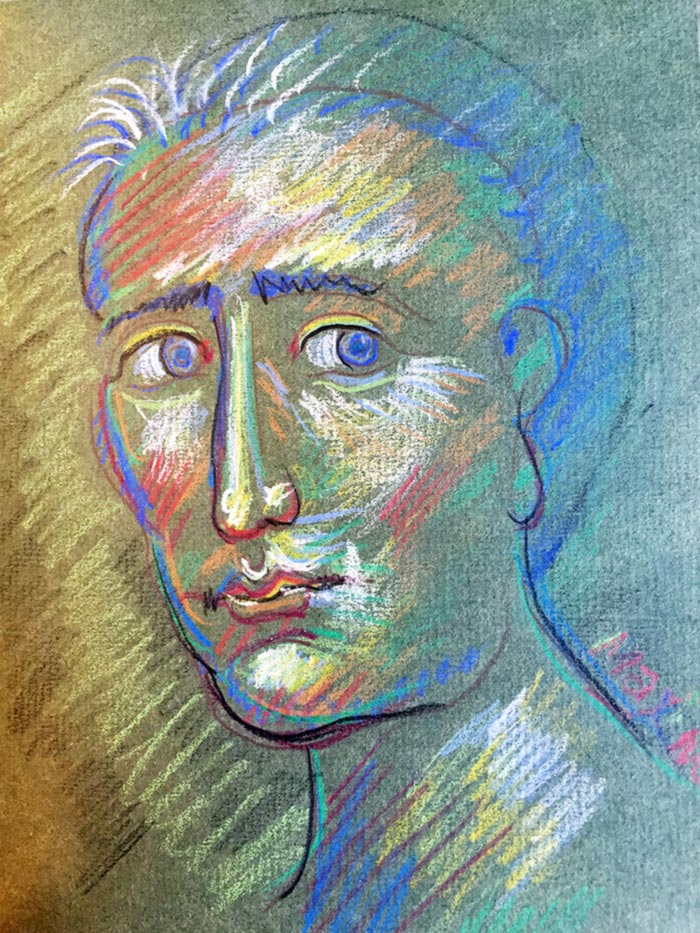
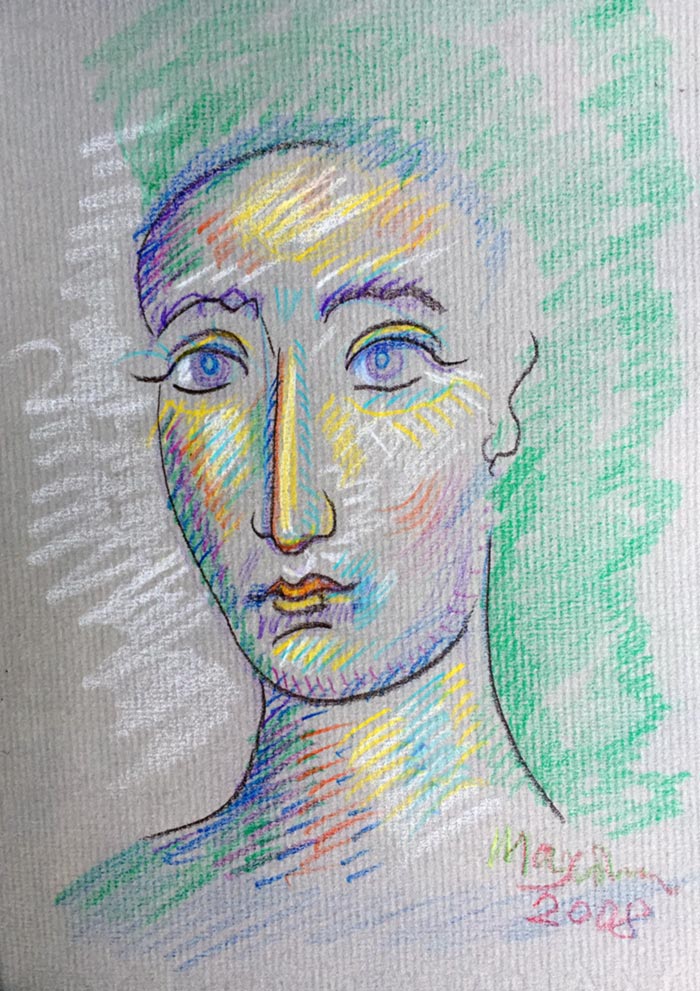
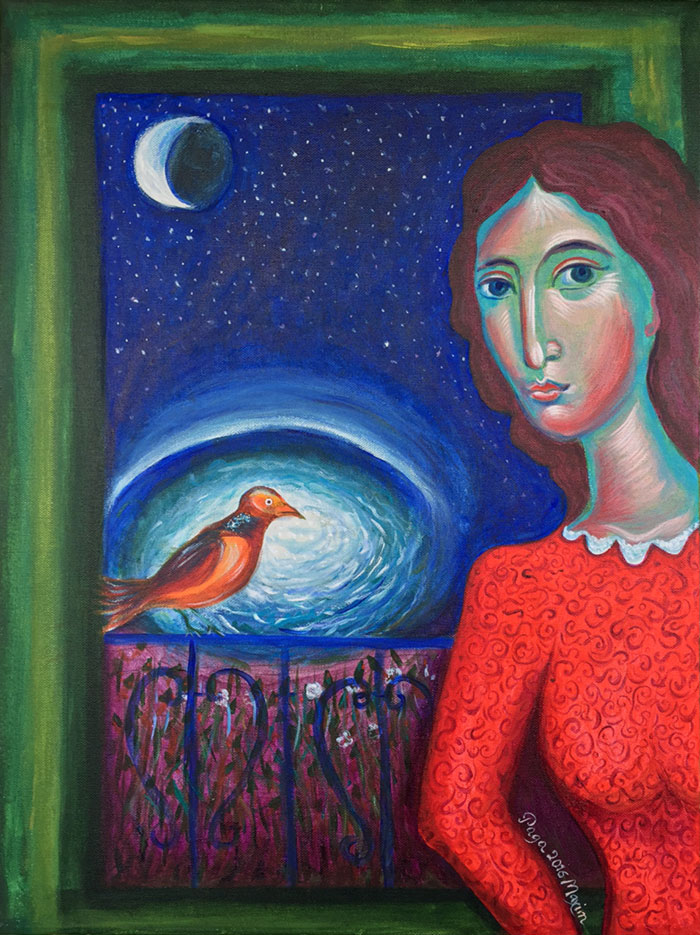
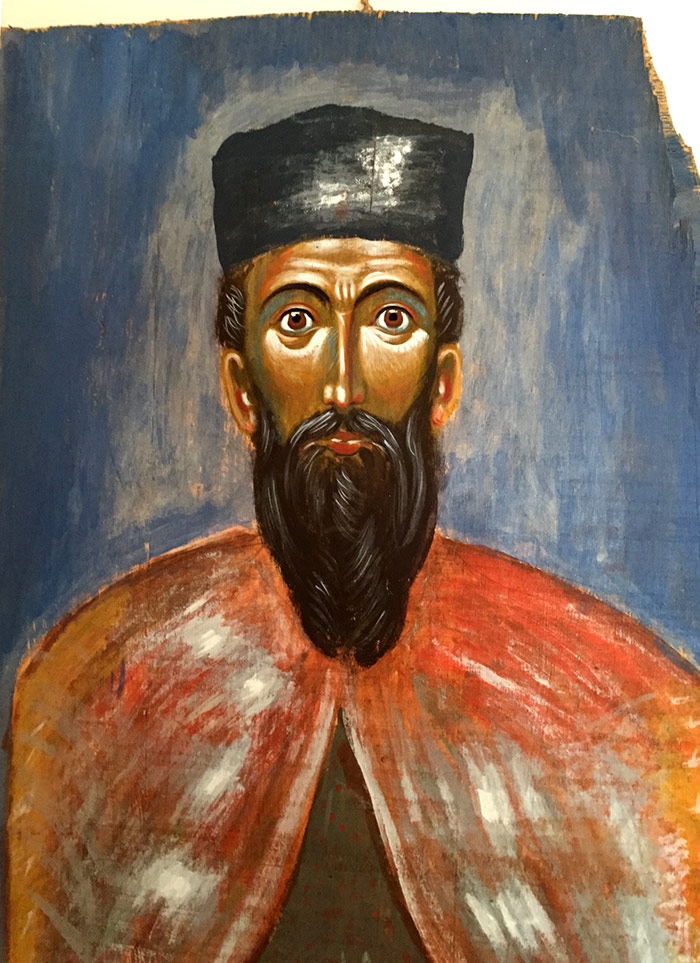
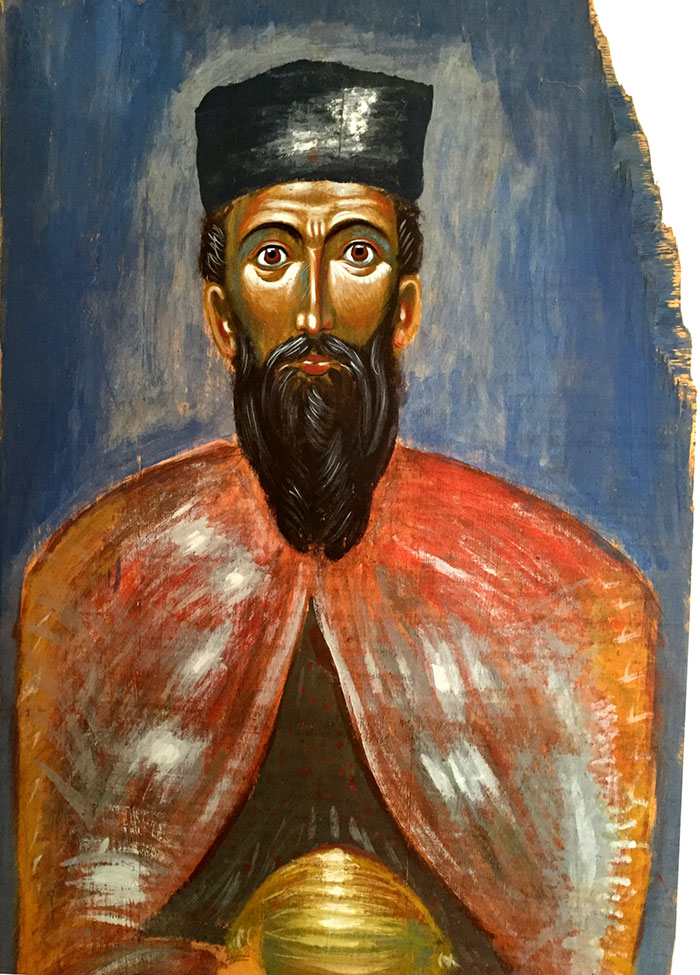
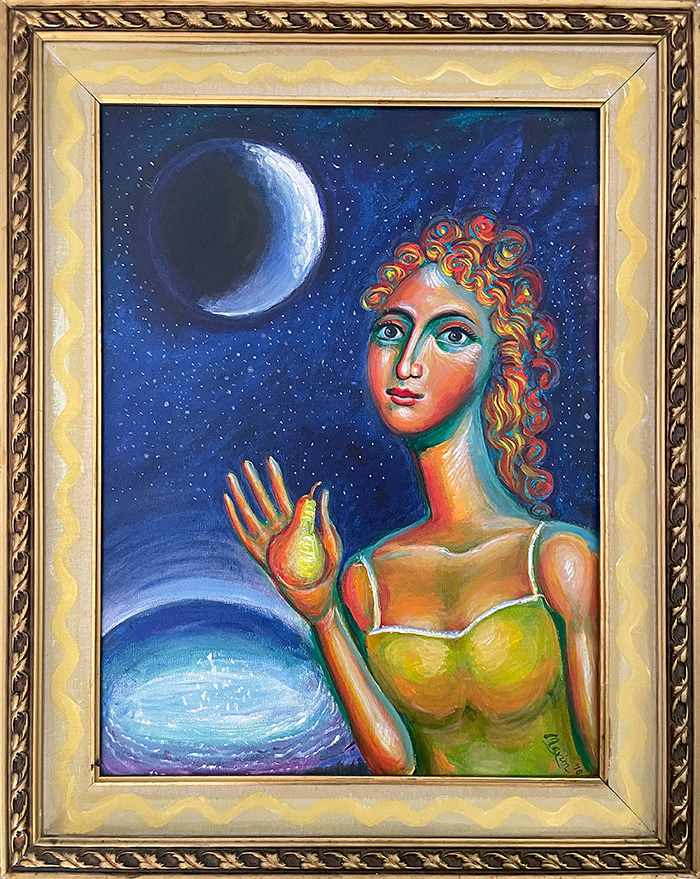
- Details
- Category: Maxim
"Magic in the Moonlight", acrylic on canvas, 2018
Bathed by the light of the moon. When the beauty of the soul is illuminated by the darkness of pain. The heavens narrate the glory of God, and the poetry of His hands announces the firmament.
Bathed by the light of the moon. When the beauty of the soul is illuminated by the darkness of pain. The heavens narrate the glory of God, and the poetry of His hands announces the firmament.
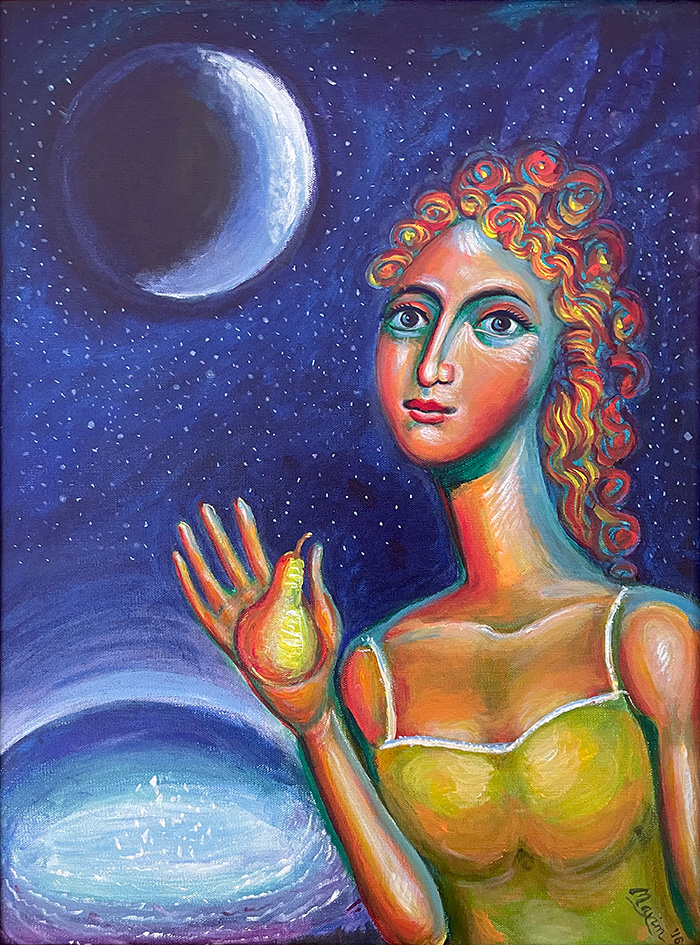
- Details
- Category: Maxim
"Magic in the Moonlight", acrylic on canvas, 2018
Bathed by the light of the moon. When the beauty of the soul is illuminated by the darkness of pain. The heavens narrate the glory of God, and the poetry of His hands announces the firmament.
Bathed by the light of the moon. When the beauty of the soul is illuminated by the darkness of pain. The heavens narrate the glory of God, and the poetry of His hands announces the firmament.
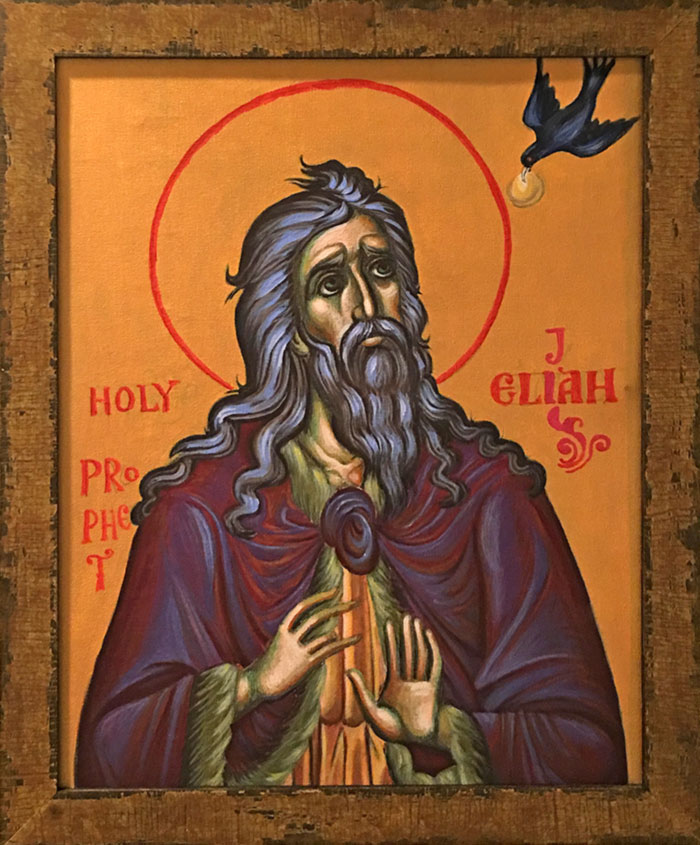
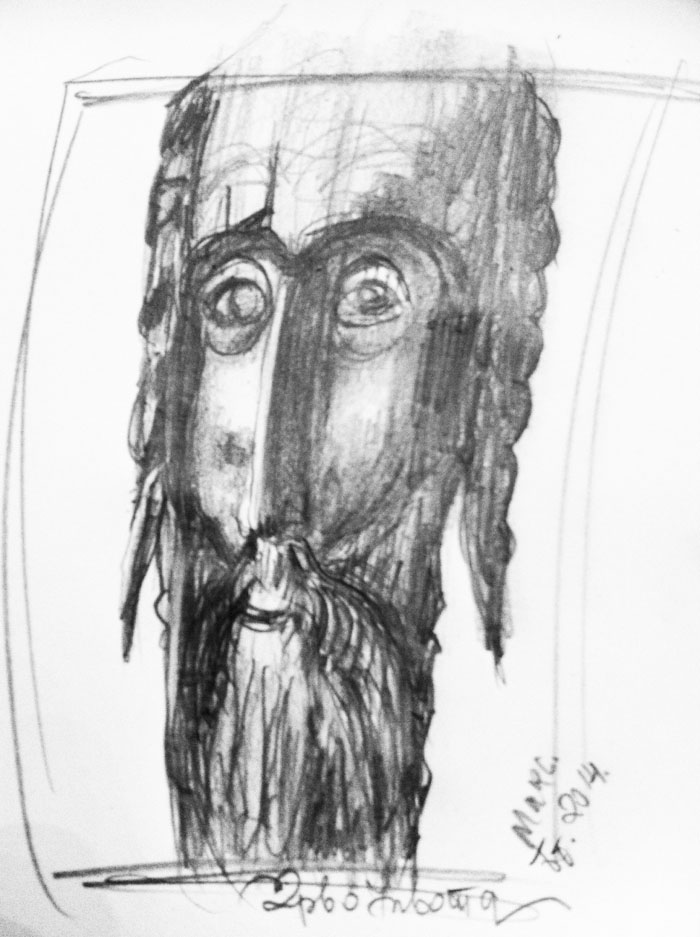
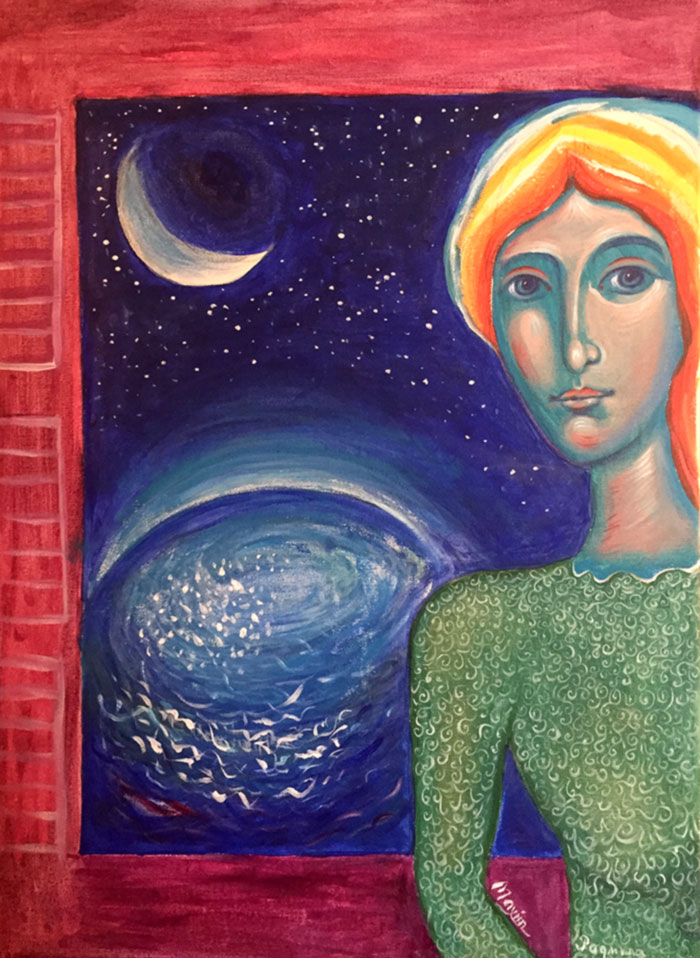
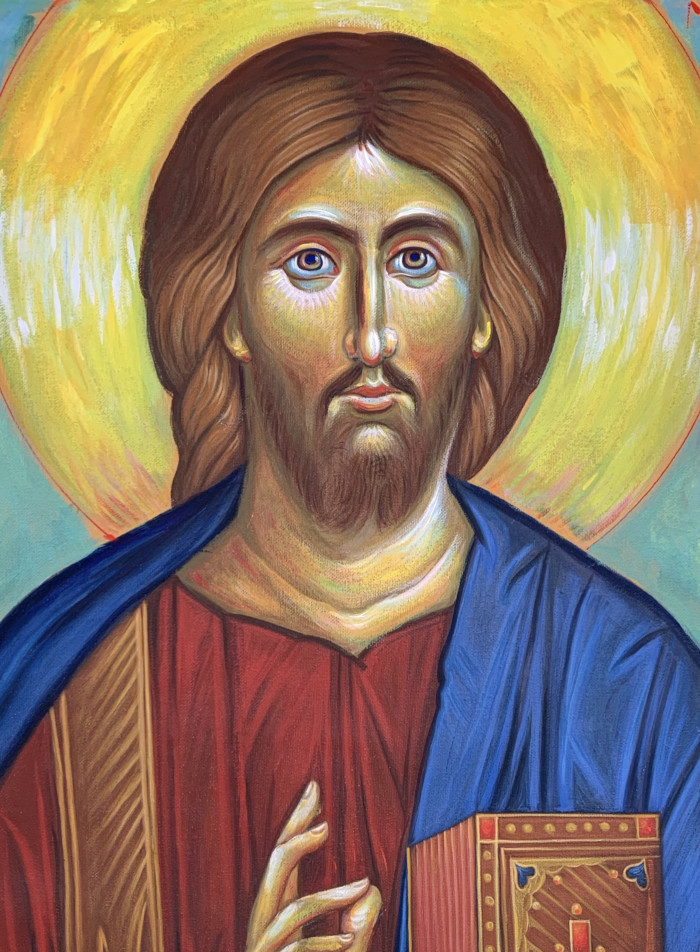
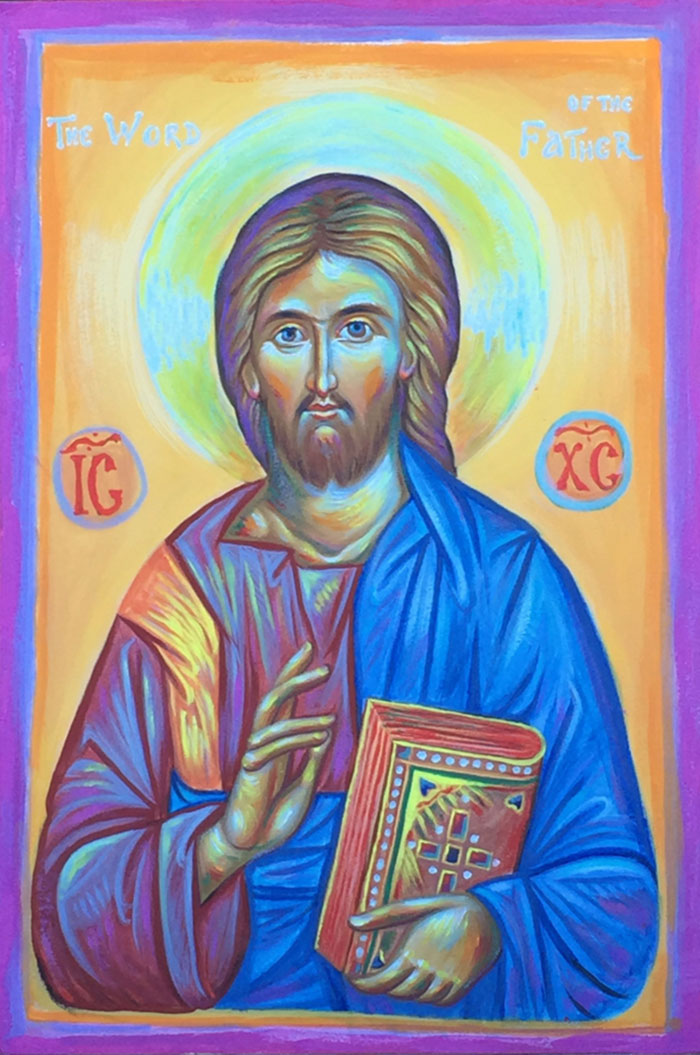
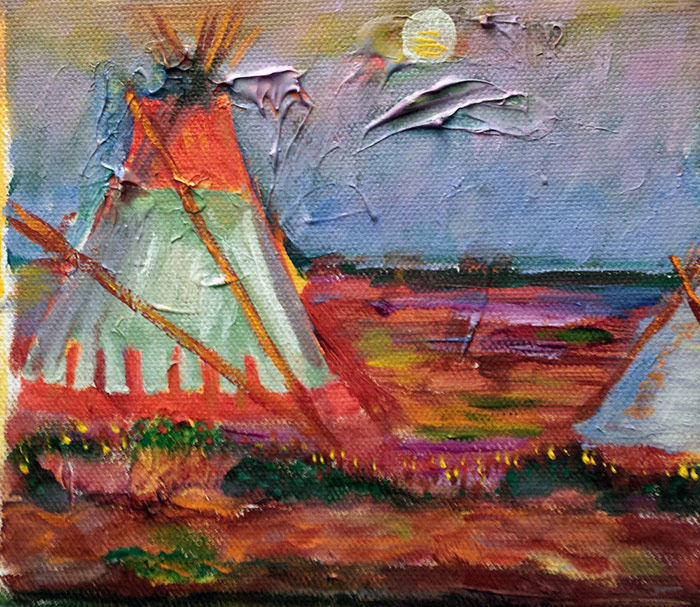
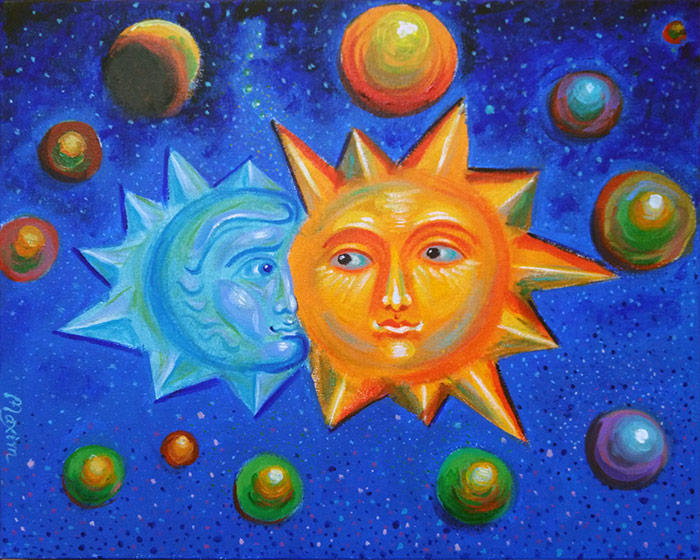
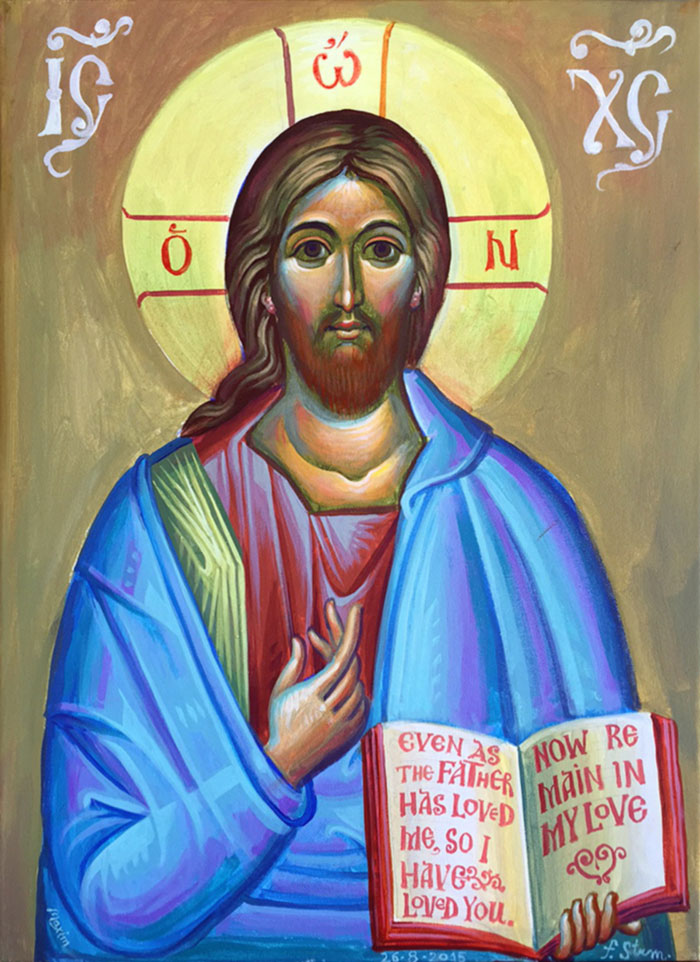
- Details
- Category: Maxim
Jesus Christ the Merciful One, Acrylic on canvas, by Stamatis and Maxim, 2015
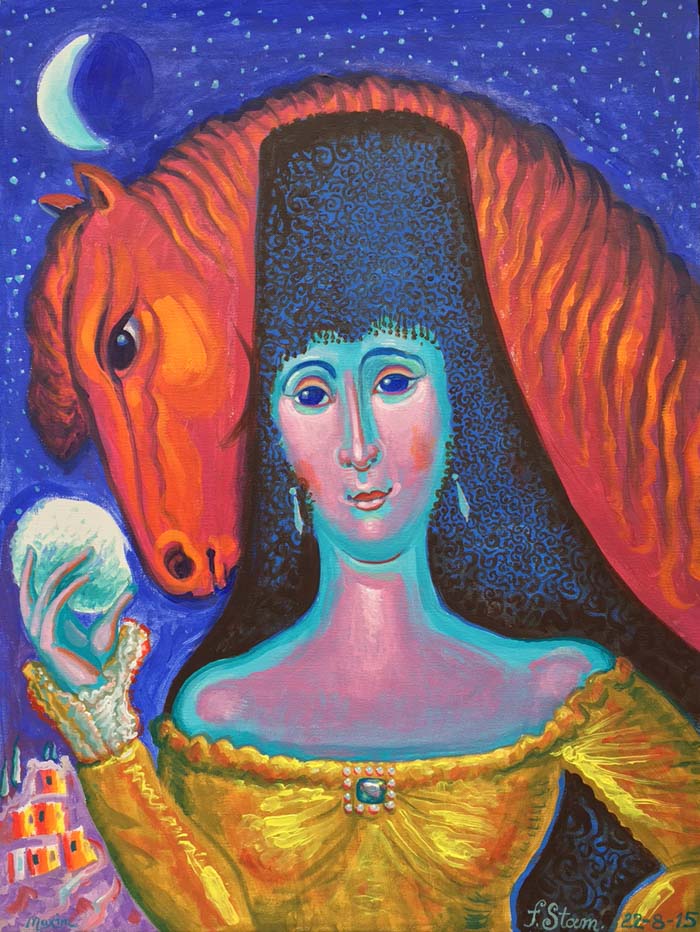
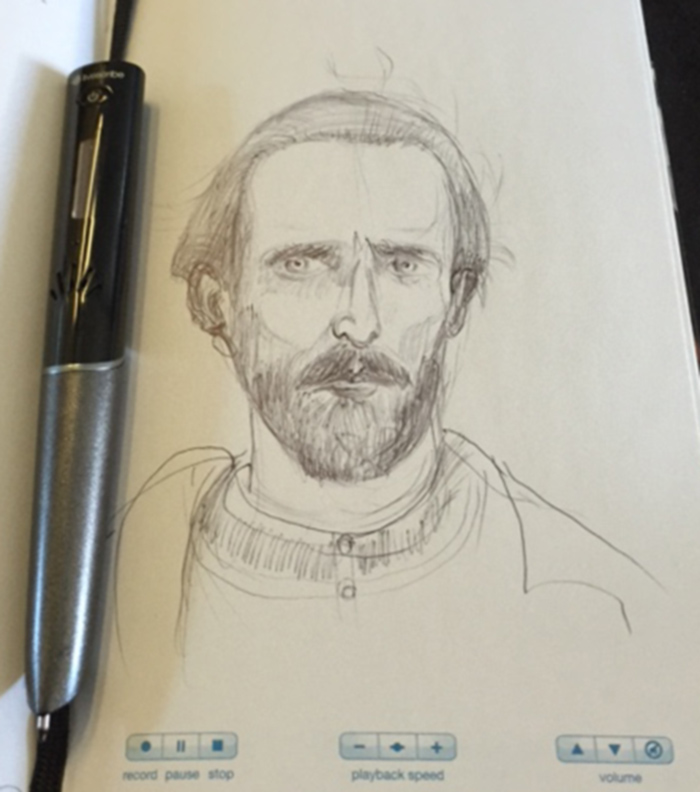
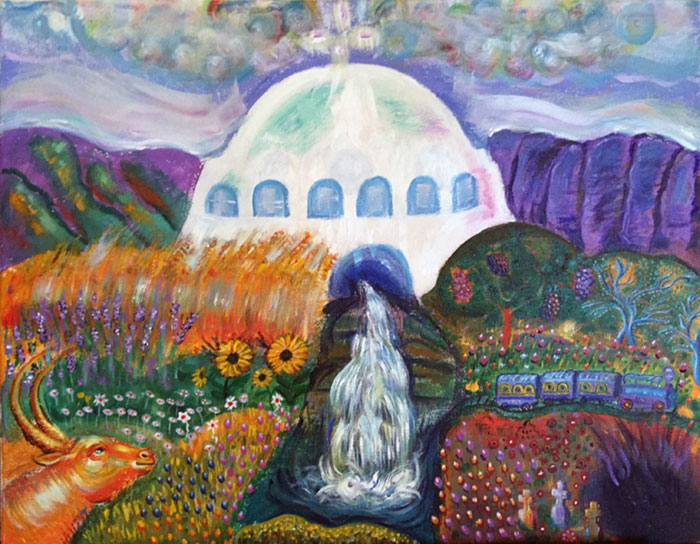
- Details
- Category: Maxim
"Two homelands", acrylic on canvas, 2014.
Depicting the Old Country and the New World. The Old Country is a place where you or your parents were born but do not now live. Never has it been so vital to understand how issues in the Old or New Country impact our lives, business, and... ART! A great number of Serbs who find themselves for longer or shorter periods of time spread out throughout the world – often departing after difficult deliberation – remain connected to the land of their birth or ancestry, living a 'double consciousness'... This painting somehow points to that phenomenon.
Depicting the Old Country and the New World. The Old Country is a place where you or your parents were born but do not now live. Never has it been so vital to understand how issues in the Old or New Country impact our lives, business, and... ART! A great number of Serbs who find themselves for longer or shorter periods of time spread out throughout the world – often departing after difficult deliberation – remain connected to the land of their birth or ancestry, living a 'double consciousness'... This painting somehow points to that phenomenon.
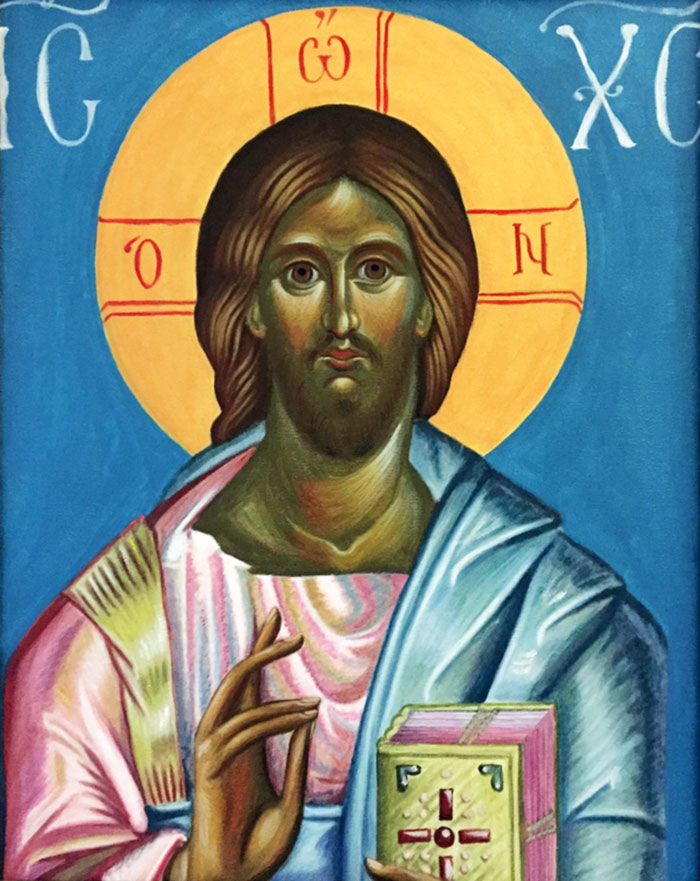
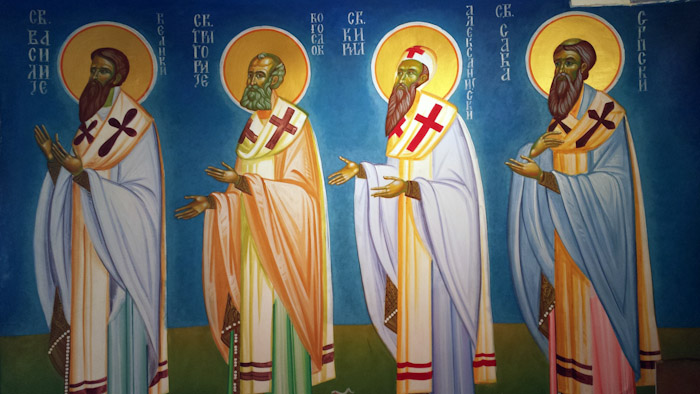
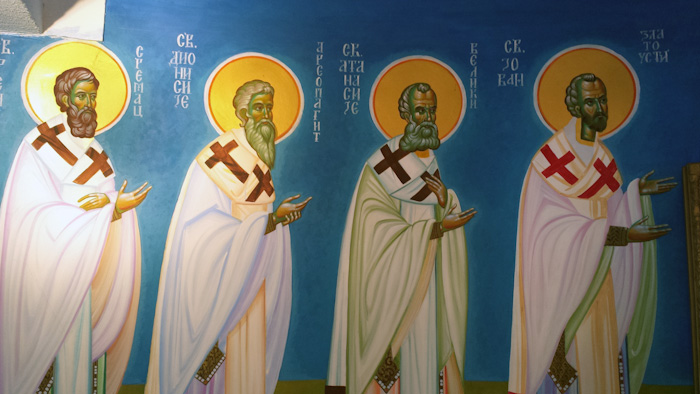
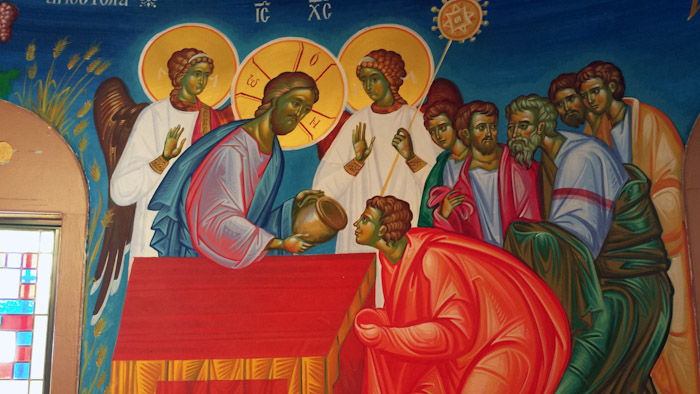
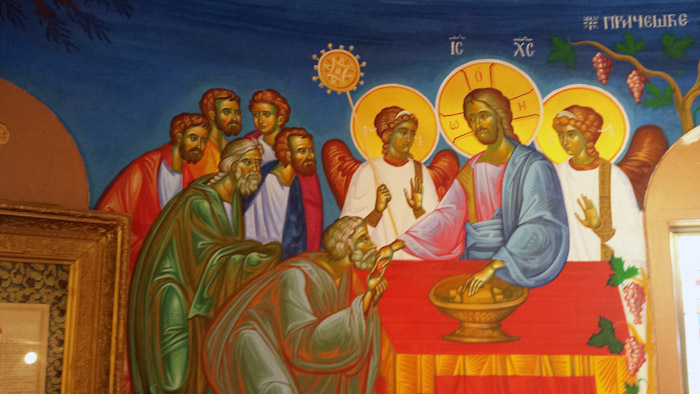
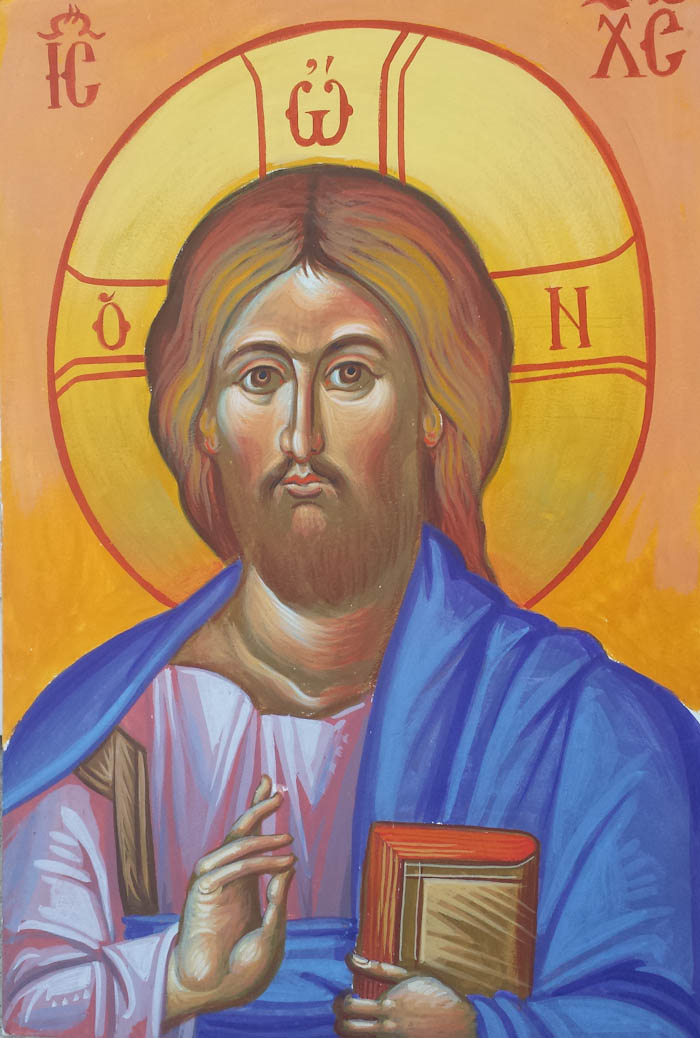
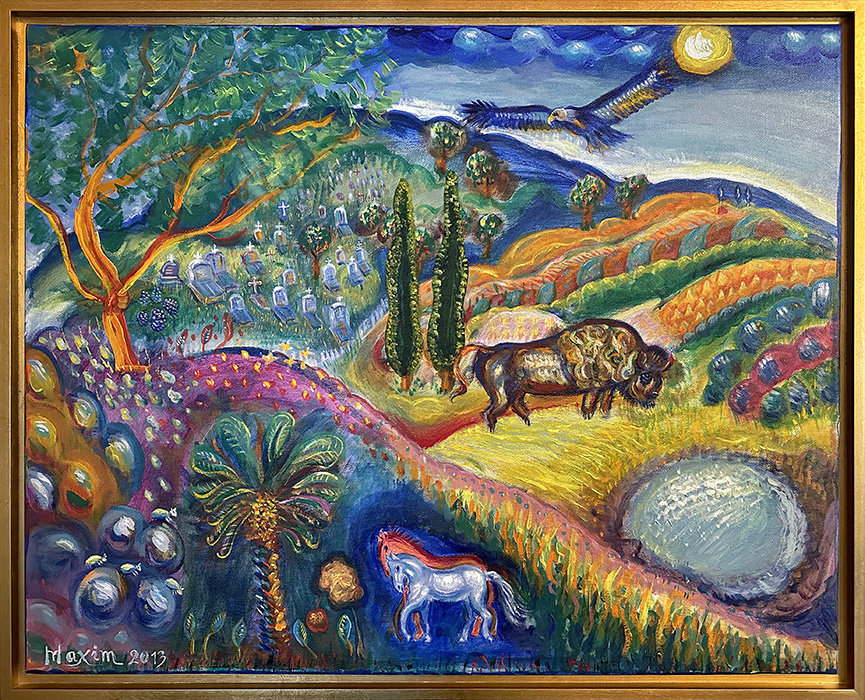
- Details
- Category: Maxim
"Pristine Amador County", by Bishop Maxim
The painter approaches this idyllic landscape with reverence, seeing it as a universal symbol and source of inspiration. The landscapes are both real and imagined. The site is orchestrated as a terrain where bison, lake, horses, trees, etc. form a grand rural space in which topography, soils, climate, water, and indigenous vegetation serve the life in Amador County. The author takes his cues from nature, seemingly random patterns occurring in nature without human intervention. To this “informal,” “romantic,” or "picturesque" approach he adds the cemetery suggesting a subtle, human accident.
The painter approaches this idyllic landscape with reverence, seeing it as a universal symbol and source of inspiration. The landscapes are both real and imagined. The site is orchestrated as a terrain where bison, lake, horses, trees, etc. form a grand rural space in which topography, soils, climate, water, and indigenous vegetation serve the life in Amador County. The author takes his cues from nature, seemingly random patterns occurring in nature without human intervention. To this “informal,” “romantic,” or "picturesque" approach he adds the cemetery suggesting a subtle, human accident.