
- Details
- Category: Maxim
- Hits: 204
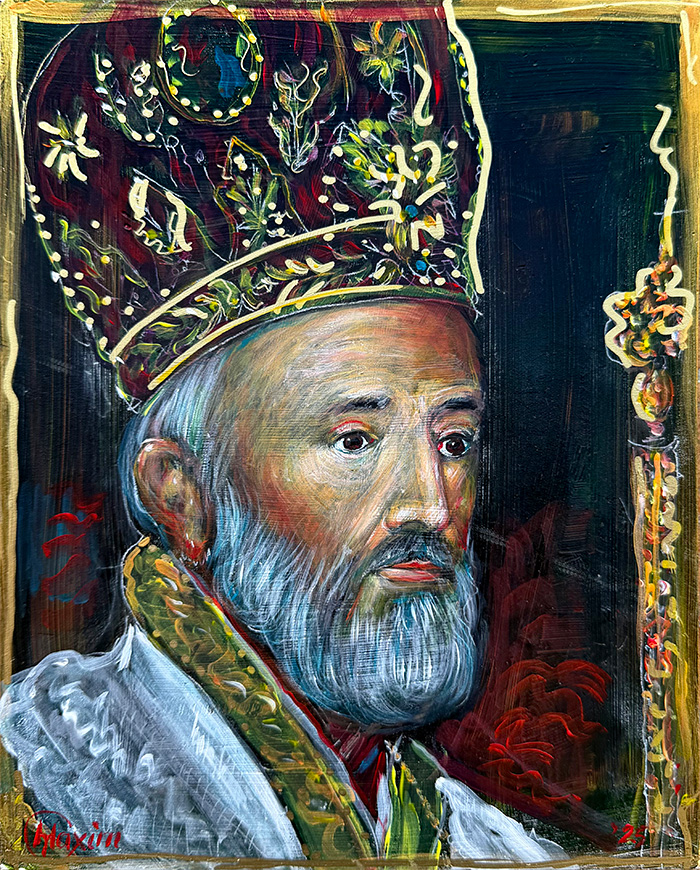
"The Weight of Communion", acrylic on gesso board, Bishop Maxim, 2025
This portrait presents John Zizioulas, Metropolitan of Pergamon, not as a monument of authority but as a man carrying time, thought, and ecclesial responsibility upon his brow. The gaze is slightly averted, inward and attentive, as if listening to a question not yet spoken. The crown—rendered less as regalia than as a living field of signs—hovers between what has been received and what is still awaited. The dark ground holds him in silence, allowing the face to emerge as a place of encounter rather than display. It is a portrait of presence, restraint, and luminous gravity.
Observations on Technique and Approach
What strikes first is the deliberate tension between structure and gesture. The face is built patiently, with layered, translucent strokes that allow flesh to appear as something breathed into being rather than carved. The beard and skin tones are not blended into smoothness but kept vibratory, suggesting a life shaped by prayer, study, and time.
The crown, by contrast, is treated almost iconographically yet with a contemporary freedom: linear accents, dotted lights, and calligraphic movements animate it from within. It feels less painted than inscribed, as if theology itself were etched into the surface. This creates a quiet but powerful dialogue between the stability of the hierarch’s office and the restless, searching intelligence of the theologian.
The background is intentionally restrained—dark, absorbent, nearly nocturnal—so that light is not imposed from outside but seems to rise from the figure itself. The thin gold edging recalls icon tradition without enclosing it fully, allowing the portrait to breathe between icon and modern painting, between liturgical memory and personal encounter.
Overall, the technique resists virtuosity for its own sake. It favors truth over polish, rhythm over finish, and presence over representation. The result is a portrait that does not merely depict Zizioulas, but thinks with him—a painted meditation on personhood, communion, and the quiet burden of shepherding thought for the Church.